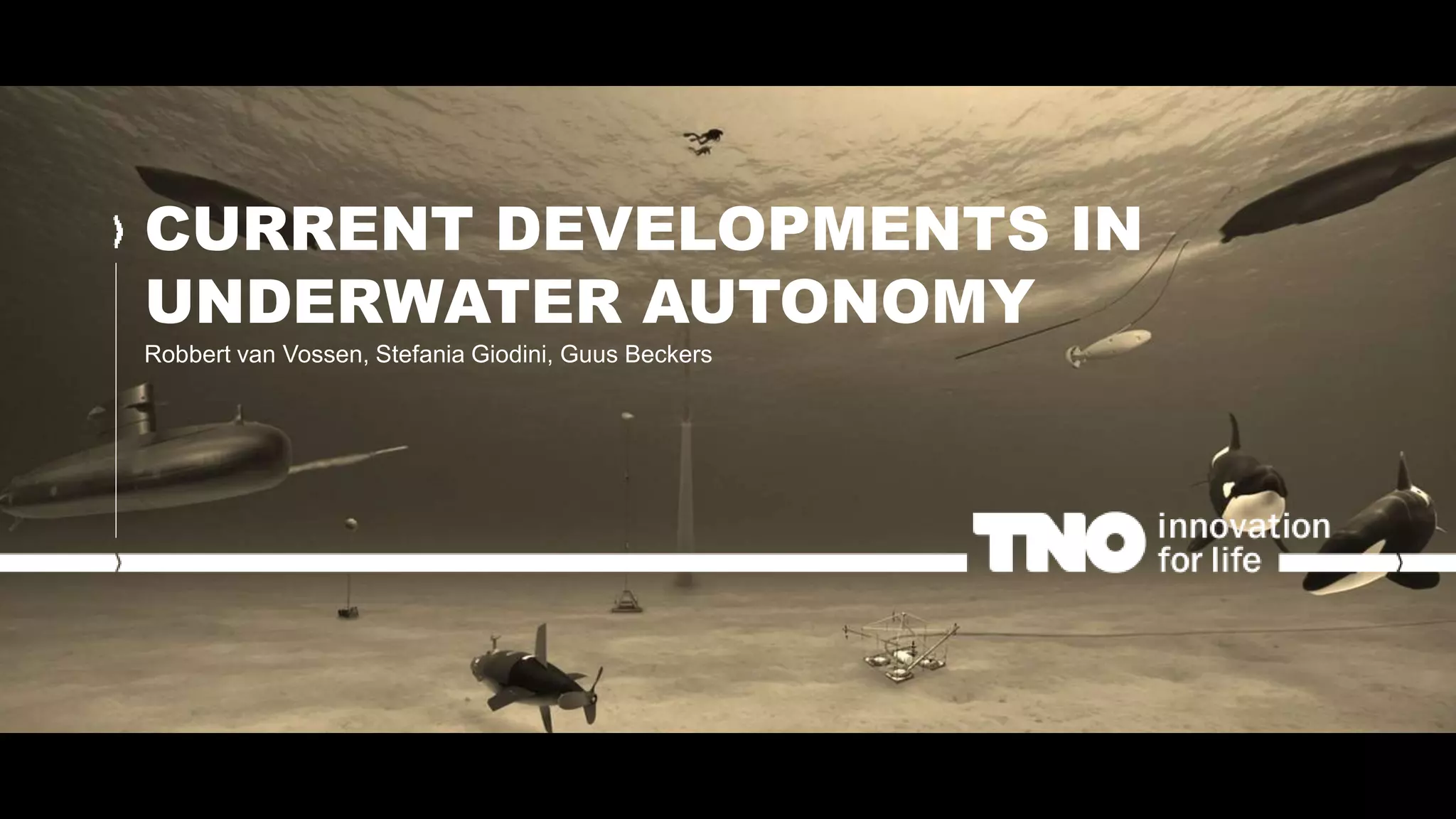
CURRENT DEVELOPMENTS IN
UNDERWATER AUTONOMY
Robbert van Vossen, Stefania Giodini, Guus Beckers
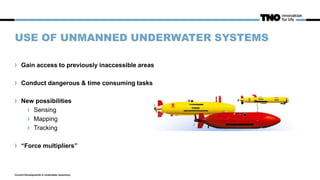
USE OF UNMANNED UNDERWATER SYSTEMS
Gain access to previously inaccessible areas
Conduct dangerous & time consuming tasks
New possibilities
Sensing
Mapping
Tracking
“Force multipliers”
Current Developments in Underwater Autonomy
CHALLENGES IN THE UNDERWATER DOMAIN
Navigation and Localisation – No GPS
Communications:
Tethered  Untethered communications (wireless)
Communication-limited environment:
Limited in bandwidth, range, availability, reliability, and latency
Persistency:
Long duration operations,
Larger areas,
Larger stand-off distance
Dynamic environment and limited prior information
Current Developments in Underwater Autonomy
CHALLENGES IN THE UNDERWATER DOMAIN
Navigation and Localisation – No GPS
Communications:
Tethered  Untethered communications (wireless)
Communication-limited environment:
Limited in bandwidth, range, availability, reliability, and latency
Persistency:
Long duration operations,
Larger areas,
Larger stand-off distance
Dynamic environment and limited prior information
Current Developments in Underwater Autonomy
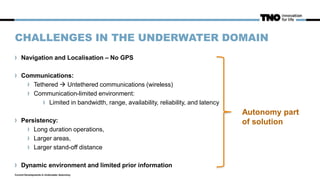
Autonomy part
of solution
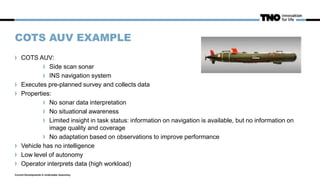
COTS AUV EXAMPLE
COTS AUV:
Side scan sonar
INS navigation system
Executes pre-planned survey and collects data
Properties:
No sonar data interpretation
No situational awareness
Limited insight in task status: information on navigation is available, but no information on
image quality and coverage
No adaptation based on observations to improve performance
Vehicle has no intelligence
Low level of autonomy
Operator interprets data (high workload)
Current Developments in Underwater Autonomy
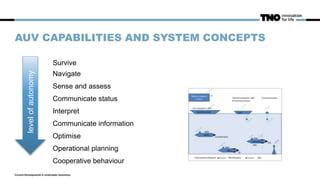
AUV CAPABILITIES AND SYSTEM CONCEPTS
Current Developments in Underwater Autonomy
Survive
Navigate
Sense and assess
Communicate status
Interpret
Communicate information
Optimise
Operational planning
Cooperative behaviour
levelofautonomy
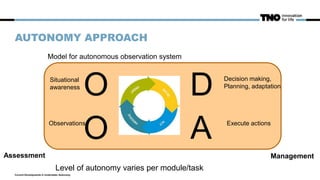
AUTONOMY APPROACH
Current Developments in Underwater Autonomy
Assessment Management
Model for autonomous observation system
O
O D
AObservations
Situational
awareness
Decision making,
Planning, adaptation
Execute actions
Level of autonomy varies per module/task
Current Developments in Underwater Autonomy
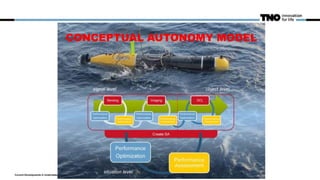
CONCEPTUAL AUTONOMY MODEL
PRESENTATION SCOPE
Current Developments in Underwater Autonomy
Mine-hunting use case
Autonomy
Underwater communications
Networked enabled collaboration
Results from concept development and experimentation studies
Objective: Implement & evaluate with state-of-the-art
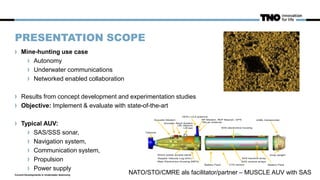
Typical AUV:
SAS/SSS sonar,
Navigation system,
Communication system,
Propulsion
Power supply
Tailcone
Drop-weight
USBL transponder
Battery Pack
SAS electronics housing
SAS transmit array
SAS receive arrays
WiLan antenna
GPS L1/L2 antenna
Main Electronics Housing (MEH)
Doppler Velocity Log (DVL)
RF Modem, RDF Beacon, GPSAcoustic Modem
Acoustic Abort System
LBL-beacon
Lift eye
Shore power access panel
Battery PackCTD sensor
NATO/STO/CMRE als facilitator/partner – MUSCLE AUV with SAS
AUV CAPABILITY TREE FOR MINE HUNTING
Current Developments in Underwater Autonomy
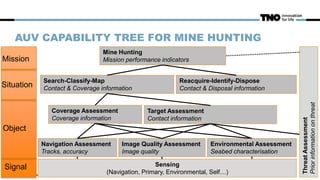
Mine Hunting
Mission performance indicators
Search-Classify-Map
Contact & Coverage information
Coverage Assessment
Coverage information
Target Assessment
Contact information
Navigation Assessment
Tracks, accuracy
Image Quality Assessment
Image quality
Environmental Assessment
Seabed characterisation
Sensing
(Navigation, Primary, Environmental, Self…)
ThreatAssessment
Priorinformationonthreat
Signal
Object
Situation
Mission
Reacquire-Identify-Dispose
Contact & Disposal information
NAVIGATION ASSESSMENT
POSITION ACCURACY
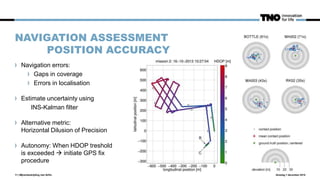
Navigation errors:
Gaps in coverage
Errors in localisation
Estimate uncertainty using
INS-Kalman filter
Alternative metric:
Horizontal Dilusion of Precision
Autonomy: When HDOP treshold
is exceeded  initiate GPS fix
procedure
dinsdag 1 december 201511 | Mijnenbestrijding met AUVs
SENSING
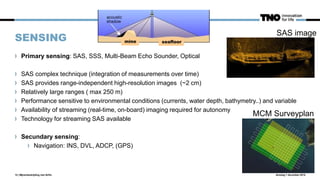
Primary sensing: SAS, SSS, Multi-Beam Echo Sounder, Optical
SAS complex technique (integration of measurements over time)
SAS provides range-independent high-resolution images (~2 cm)
Relatively large ranges ( max 250 m)
Performance sensitive to environmental conditions (currents, water depth, bathymetry..) and variable
Availability of streaming (real-time, on-board) imaging required for autonomy
Technology for streaming SAS available
Secundary sensing:
Navigation: INS, DVL, ADCP, (GPS)
dinsdag 1 december 201512 | Mijnenbestrijding met AUVs
SAS image
MCM Surveyplan
mine seafloor
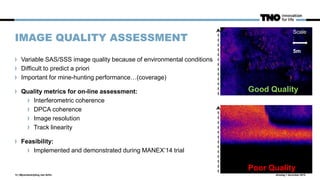
IMAGE QUALITY ASSESSMENT
dinsdag 1 december 201513 | Mijnenbestrijding met AUVs
Variable SAS/SSS image quality because of environmental conditions
Difficult to predict a priori
Important for mine-hunting performance…(coverage)
Quality metrics for on-line assessment:
Interferometric coherence
DPCA coherence
Image resolution
Track linearity
Feasibility:
Implemented and demonstrated during MANEX’14 trial
Scale:
5m
Good Quality
Poor Quality
Scale
:
5m
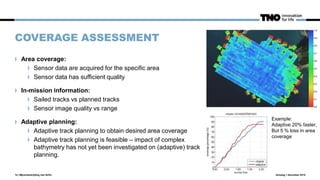
COVERAGE ASSESSMENT
Area coverage:
Sensor data are acquired for the specific area
Sensor data has sufficient quality
In-mission information:
Sailed tracks vs planned tracks
Sensor image quality vs range
Adaptive planning:
Adaptive track planning to obtain desired area coverage
Adaptive track planning is feasible – impact of complex
bathymetry has not yet been investigated on (adaptive) track
planning.
dinsdag 1 december 201514 | Mijnenbestrijding met AUVs
Example:
Adaptive 20% faster,
But 5 % loss in area
coverage
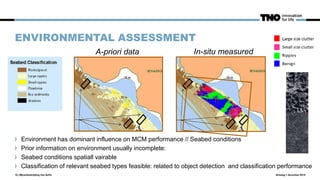
ENVIRONMENTAL ASSESSMENT
Environment has dominant influence on MCM performance // Seabed conditions
Prior information on environment usually incomplete:
Seabed conditions spatiall vairable
Classification of relevant seabed types feasible: related to object detection and classification performance
15 | Mijnenbestrijding met AUVs dinsdag 1 december 2015
A-priori data In-situ measured
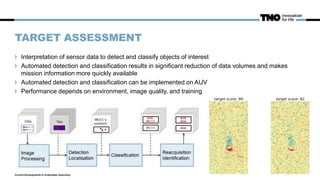
TARGET ASSESSMENT
Interpretation of sensor data to detect and classify objects of interest
Automated detection and classification results in significant reduction of data volumes and makes
mission information more quickly available
Automated detection and classification can be implemented on AUV
Performance depends on environment, image quality, and training
Current Developments in Underwater Autonomy
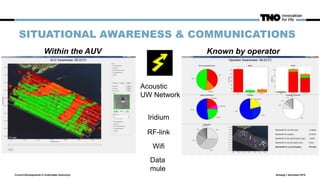
SITUATIONAL AWARENESS & COMMUNICATIONS
dinsdag 1 december 2015
Within the AUV Known by operator
Acoustic
UW Network
RF-link
Data
mule
Wifi
Iridium
Current Developments in Underwater Autonomy
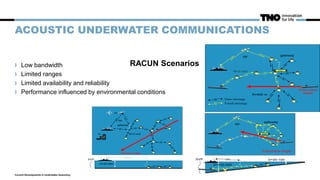
ACOUSTIC UNDERWATER COMMUNICATIONS
Low bandwidth
Limited ranges
Limited availability and reliability
Performance influenced by environmental conditions
Current Developments in Underwater Autonomy
SVP
D=20-500
RF
gateway
R=3 nmi
Surface target
or
or
RF
gateway
R=3 nmi
Subsurface
target
R=500 m
SVP
D=100-500
D=20-100
RF
gateway
Subsurface target
Data message
Fused message
RACUN Scenarios
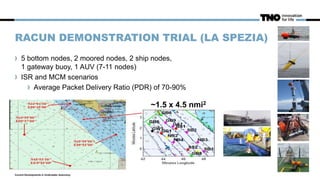
RACUN DEMONSTRATION TRIAL (LA SPEZIA)
5 bottom nodes, 2 moored nodes, 2 ship nodes,
1 gateway buoy, 1 AUV (7-11 nodes)
ISR and MCM scenarios
Average Packet Delivery Ratio (PDR) of 70-90%
Current Developments in Underwater Autonomy
~1.5 x 4.5 nmi2
Current Developments in Underwater Autonomy
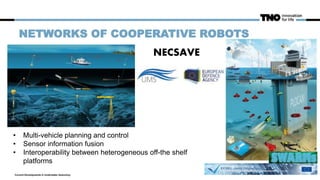
NETWORKS OF COOPERATIVE ROBOTS
• Multi-vehicle planning and control
• Sensor information fusion
• Interoperability between heterogeneous off-the shelf
platforms
NECSAVE
SUMMARY & CONCLUSIONS
Autonomy important in communication-limited environments:
Especially for long-duration operations
Priorities for autonomy:
Survivability
Navigation & Localisation accuracy
Sensor management: Make sure that useful data are collected – achieve desired coverage
Autonomous interpretation of observations:
Enables single-vehicle autonomy by providing performance information
Enables communication of information at low data rates
Enables collaboration
Mission adaptation
UW communications important enabling technology of operations with AUVs
Current Developments in Underwater Autonomy
THANK YOU FOR YOUR
ATTENTION
Current Developments in Underwater Autonomy
robbert.vanvossen@tno.nl

Current developments in underwater autonomy

  • 1.
    CURRENT DEVELOPMENTS IN UNDERWATERAUTONOMY Robbert van Vossen, Stefania Giodini, Guus Beckers
  • 2.
    USE OF UNMANNEDUNDERWATER SYSTEMS Gain access to previously inaccessible areas Conduct dangerous & time consuming tasks New possibilities Sensing Mapping Tracking “Force multipliers” Current Developments in Underwater Autonomy
  • 3.
    CHALLENGES IN THEUNDERWATER DOMAIN Navigation and Localisation – No GPS Communications: Tethered  Untethered communications (wireless) Communication-limited environment: Limited in bandwidth, range, availability, reliability, and latency Persistency: Long duration operations, Larger areas, Larger stand-off distance Dynamic environment and limited prior information Current Developments in Underwater Autonomy
  • 4.
    CHALLENGES IN THEUNDERWATER DOMAIN Navigation and Localisation – No GPS Communications: Tethered  Untethered communications (wireless) Communication-limited environment: Limited in bandwidth, range, availability, reliability, and latency Persistency: Long duration operations, Larger areas, Larger stand-off distance Dynamic environment and limited prior information Current Developments in Underwater Autonomy Autonomy part of solution
  • 5.
    COTS AUV EXAMPLE COTSAUV: Side scan sonar INS navigation system Executes pre-planned survey and collects data Properties: No sonar data interpretation No situational awareness Limited insight in task status: information on navigation is available, but no information on image quality and coverage No adaptation based on observations to improve performance Vehicle has no intelligence Low level of autonomy Operator interprets data (high workload) Current Developments in Underwater Autonomy
  • 6.
    AUV CAPABILITIES ANDSYSTEM CONCEPTS Current Developments in Underwater Autonomy Survive Navigate Sense and assess Communicate status Interpret Communicate information Optimise Operational planning Cooperative behaviour levelofautonomy
  • 7.
    AUTONOMY APPROACH Current Developmentsin Underwater Autonomy Assessment Management Model for autonomous observation system O O D AObservations Situational awareness Decision making, Planning, adaptation Execute actions Level of autonomy varies per module/task
  • 8.
    Current Developments inUnderwater Autonomy CONCEPTUAL AUTONOMY MODEL
  • 9.
    PRESENTATION SCOPE Current Developmentsin Underwater Autonomy Mine-hunting use case Autonomy Underwater communications Networked enabled collaboration Results from concept development and experimentation studies Objective: Implement & evaluate with state-of-the-art Typical AUV: SAS/SSS sonar, Navigation system, Communication system, Propulsion Power supply Tailcone Drop-weight USBL transponder Battery Pack SAS electronics housing SAS transmit array SAS receive arrays WiLan antenna GPS L1/L2 antenna Main Electronics Housing (MEH) Doppler Velocity Log (DVL) RF Modem, RDF Beacon, GPSAcoustic Modem Acoustic Abort System LBL-beacon Lift eye Shore power access panel Battery PackCTD sensor NATO/STO/CMRE als facilitator/partner – MUSCLE AUV with SAS
  • 10.
    AUV CAPABILITY TREEFOR MINE HUNTING Current Developments in Underwater Autonomy Mine Hunting Mission performance indicators Search-Classify-Map Contact & Coverage information Coverage Assessment Coverage information Target Assessment Contact information Navigation Assessment Tracks, accuracy Image Quality Assessment Image quality Environmental Assessment Seabed characterisation Sensing (Navigation, Primary, Environmental, Self…) ThreatAssessment Priorinformationonthreat Signal Object Situation Mission Reacquire-Identify-Dispose Contact & Disposal information
  • 11.
    NAVIGATION ASSESSMENT POSITION ACCURACY Navigationerrors: Gaps in coverage Errors in localisation Estimate uncertainty using INS-Kalman filter Alternative metric: Horizontal Dilusion of Precision Autonomy: When HDOP treshold is exceeded  initiate GPS fix procedure dinsdag 1 december 201511 | Mijnenbestrijding met AUVs
  • 12.
    SENSING Primary sensing: SAS,SSS, Multi-Beam Echo Sounder, Optical SAS complex technique (integration of measurements over time) SAS provides range-independent high-resolution images (~2 cm) Relatively large ranges ( max 250 m) Performance sensitive to environmental conditions (currents, water depth, bathymetry..) and variable Availability of streaming (real-time, on-board) imaging required for autonomy Technology for streaming SAS available Secundary sensing: Navigation: INS, DVL, ADCP, (GPS) dinsdag 1 december 201512 | Mijnenbestrijding met AUVs SAS image MCM Surveyplan mine seafloor
  • 13.
    IMAGE QUALITY ASSESSMENT dinsdag1 december 201513 | Mijnenbestrijding met AUVs Variable SAS/SSS image quality because of environmental conditions Difficult to predict a priori Important for mine-hunting performance…(coverage) Quality metrics for on-line assessment: Interferometric coherence DPCA coherence Image resolution Track linearity Feasibility: Implemented and demonstrated during MANEX’14 trial Scale: 5m Good Quality Poor Quality Scale : 5m
  • 14.
    COVERAGE ASSESSMENT Area coverage: Sensordata are acquired for the specific area Sensor data has sufficient quality In-mission information: Sailed tracks vs planned tracks Sensor image quality vs range Adaptive planning: Adaptive track planning to obtain desired area coverage Adaptive track planning is feasible – impact of complex bathymetry has not yet been investigated on (adaptive) track planning. dinsdag 1 december 201514 | Mijnenbestrijding met AUVs Example: Adaptive 20% faster, But 5 % loss in area coverage
  • 15.
    ENVIRONMENTAL ASSESSMENT Environment hasdominant influence on MCM performance // Seabed conditions Prior information on environment usually incomplete: Seabed conditions spatiall vairable Classification of relevant seabed types feasible: related to object detection and classification performance 15 | Mijnenbestrijding met AUVs dinsdag 1 december 2015 A-priori data In-situ measured
  • 16.
    TARGET ASSESSMENT Interpretation ofsensor data to detect and classify objects of interest Automated detection and classification results in significant reduction of data volumes and makes mission information more quickly available Automated detection and classification can be implemented on AUV Performance depends on environment, image quality, and training Current Developments in Underwater Autonomy
  • 17.
    SITUATIONAL AWARENESS &COMMUNICATIONS dinsdag 1 december 2015 Within the AUV Known by operator Acoustic UW Network RF-link Data mule Wifi Iridium Current Developments in Underwater Autonomy
  • 18.
    ACOUSTIC UNDERWATER COMMUNICATIONS Lowbandwidth Limited ranges Limited availability and reliability Performance influenced by environmental conditions Current Developments in Underwater Autonomy SVP D=20-500 RF gateway R=3 nmi Surface target or or RF gateway R=3 nmi Subsurface target R=500 m SVP D=100-500 D=20-100 RF gateway Subsurface target Data message Fused message RACUN Scenarios
  • 19.
    RACUN DEMONSTRATION TRIAL(LA SPEZIA) 5 bottom nodes, 2 moored nodes, 2 ship nodes, 1 gateway buoy, 1 AUV (7-11 nodes) ISR and MCM scenarios Average Packet Delivery Ratio (PDR) of 70-90% Current Developments in Underwater Autonomy ~1.5 x 4.5 nmi2
  • 20.
    Current Developments inUnderwater Autonomy NETWORKS OF COOPERATIVE ROBOTS • Multi-vehicle planning and control • Sensor information fusion • Interoperability between heterogeneous off-the shelf platforms NECSAVE
  • 21.
    SUMMARY & CONCLUSIONS Autonomyimportant in communication-limited environments: Especially for long-duration operations Priorities for autonomy: Survivability Navigation & Localisation accuracy Sensor management: Make sure that useful data are collected – achieve desired coverage Autonomous interpretation of observations: Enables single-vehicle autonomy by providing performance information Enables communication of information at low data rates Enables collaboration Mission adaptation UW communications important enabling technology of operations with AUVs Current Developments in Underwater Autonomy
  • 22.
    THANK YOU FORYOUR ATTENTION Current Developments in Underwater Autonomy robbert.vanvossen@tno.nl

Editor's Notes

  • #3  Trends: longer operations; longer endurance; communication-limited environment; persistency Civilian / Military TNO’s role: underwater autonomy – primarily defence applications – mine hunting
  • #4  Trends: longer operations; longer endurance; communication-limited environment; persistency Civilian / Military TNO’s role: underwater autonomy – primarily defence applications – mine hunting
  • #5  Trends: longer operations; longer endurance; communication-limited environment; persistency Civilian / Military TNO’s role: underwater autonomy – primarily defence applications – mine hunting
  • #8 Scope: Autonomy – Observation Systems (Information Abstraction + OODA): Application: Mine hunting met onbemande systemen  voorbeeld: REMUS 100  AUV systeemconcepten  Capability Tree TBD
  • #10 CMRE MUSCLE AUV: CD&E
  • #12 Om goed te navigeren en contactposities te kunnen bepalen (zodat we ze ook nog kunnen terugvinden) HDOP indicator op basis INS output 2x HDOP goede indicator van de nauwkeurigheid
  • #16 Coverage (bijv. om te voorkomen dat er schaduwzones ontstaan; interpretatie: om ervoor te zorgen dat je afhankelijk van de complexiteit van interpretatie je voldoende data binnenhaalt Classifier moet getrained worden
  • #18 Movie?