Drivers and uncertainties in past
and future sea level changes
Dewi Le Bars,
Physical Oceanographer at KNMI
HSB 1/04/2016
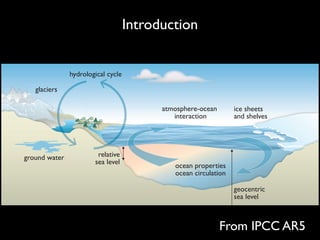
Introduction
ater and ice mass exchange between the land and the oceans leads
a change in GMSL.A signal of added mass to the ocean propagates
pidly around the globe such that all regions experience a sea level
ange within days of the mass being added (Lorbacher et al., 2012).
addition, an influx of freshwater changes ocean temperature and
linity and thus changes ocean currents and local sea level (Stammer,
08;Yin et al.,2009),with signals taking decades to propagate around
gure 13.1 | Climate-sensitive processes and components that can influence global and regional sea level and are considered in this chapter. Changes in any one of the com
nents or processes shown will result in a sea level change. The term ‘ocean properties’ refers to ocean temperature, salinity and density, which influence and are dependent o
ean circulation. Both relative and geocentric sea level vary with position. Note that the geocenter is not shown.
the ground or on its surface in lakes and reservoirs, or cause changes
land surface characteristics that influence runoff or evapotranspiratio
rates, will perturb the hydrological cycle and cause sea level chang
(Sahagian, 2000; Wada et al., 2010). Such processes include wat
impoundment (dams, reservoirs), irrigation schemes, and groundwat
depletion (Section 13.4.5).
From IPCC AR5
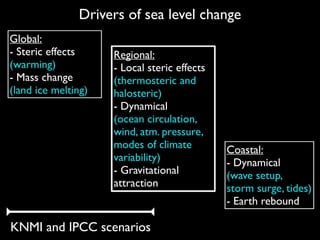
Drivers of sea level change
Global:
- Steric effects
(warming)
- Mass change
(land ice melting)
Regional:
- Local steric effects
(thermosteric and
halosteric)
- Dynamical
(ocean circulation,
wind, atm. pressure,
modes of climate
variability)
- Gravitational
attraction
Coastal:
- Dynamical
(wave setup,
storm surge, tides)
- Earth rebound
KNMI and IPCC scenarios
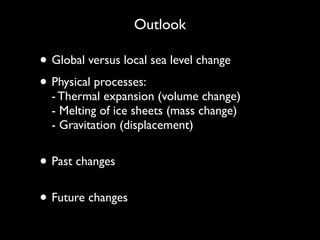
Outlook
• Global versus local sea level change
• Physical processes: 

- Thermal expansion (volume change)

- Melting of ice sheets (mass change)

- Gravitation (displacement)

• Past changes

• Future changes

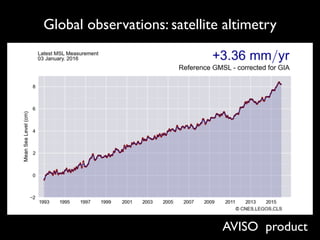
Global observations: satellite altimetry
AVISO product
than the global mean value, with much of the west coast of the Americas experiencing a fall in sea surface height
over the same period. (continued on next page)
Pago PagoManilaAntofagasta
San Francisco
Charlottetown Stockholm
Antofagasta
Manila
Pago Pago
−14
−12
−10
−8
−6
−4
−2
0
2
4
6
8
10
12
14
Sealevelchange(mmyr-1
)
500
250
0
250
500
Sealevel(mm)
1960 1980 2000
Year
San Francisco
1960 1980 2000
Year
Charlottetown
1960 1980 2000
Year
Stockholm
-500
-250
0
250
500
Sealevel(mm)
1960 1980 2000
Year
1960 1980 2000
Year
1960 1980 2000
Year
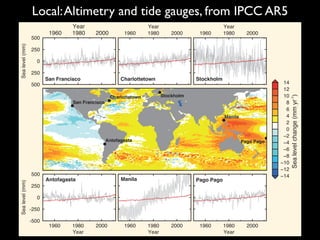
Local:Altimetry and tide gauges, from IPCC AR5
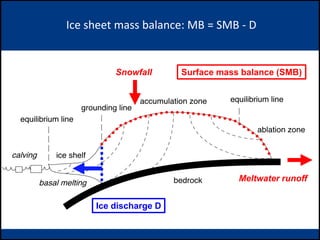
Ice sheet mass balance: MB = SMB - D
Ice discharge D
Snowfall
Meltwater runoff
Surface mass balance (SMB)
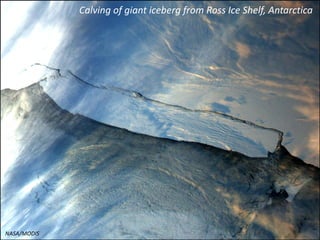
Calving of giant iceberg from Ross Ice Shelf, Antarctica
NASA/MODIS
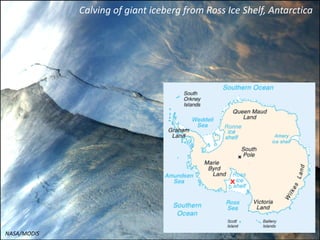
Calving of giant iceberg from Ross Ice Shelf, Antarctica
NASA/MODIS
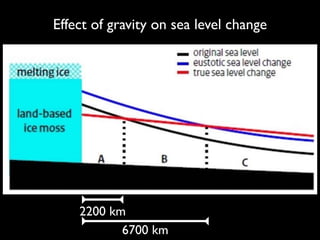
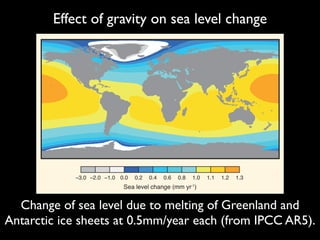
Effect of gravity on sea level change
2200 km
6700 km
Effect of gravity on sea level change
ntly, those located near active subduction zones, where one tec-
ntofagasta (FAQ 13.1, Figure 1) this appears to result in steady
tion
land
mple,
n at
bsid-
Land
sses,
ons,
arge
ciers
ause
bath
gion-
sses,
FAQ13.1, Figure 2 | Model output showing relative sea level change due to
melting of the Greenland ice sheet and the West Antarctic ice sheet at rates of
0.5 mm yr–1 each (giving a global mean value for sea level rise of 1 mm yr–1).
The modelled sea level changes are less than the global mean value in areas
−3.0 −2.0 −1.0 0.0 0.2 0.4 0.6 0.8 1.0 1.1 1.2 1.3
Sea level change (mm yr-1
)
Change of sea level due to melting of Greenland and
Antarctic ice sheets at 0.5mm/year each (from IPCC AR5).
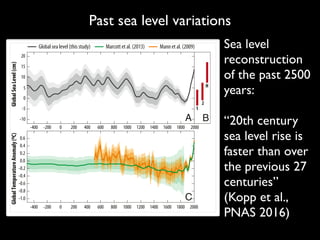
Past sea level variations
the first window to encompass the beginning of the Common Era
and the last window to cover the last 2 centuries before the de-
velopment of a tide-gauge network outside of northern Europe.
timescales of variability in globa
are the same. Results from the
sented in Supporting Information
servatively taken as minima acro
at specific sites are shown in Fi
Results and Discussion
Common Era Reconstruction. Pre-
variability was very likely (proba
and ±11 cm in amplitude (Fig. 1
from 0 CE to 700 CE (P ≥ 0.98)
was nearly stable from 700 CE
CE and 1400 CE (P ≥ 0.98) at a
GSL likely rose from 1400 CE
0.4 mm/y and fell from 1600
0.3 ± 0.3 mm/y.
Historic GSL rise began in
likely (P ≥ 0.93) that GSL has
since 1860 CE. The average rat
from 1860 CE to 1900 CE and
century. It is extremely likely (P
rise was faster than during any
−800 CE.
The spatial coverage of the
tide-gauge dataset is incomplet
cient to reduce the posterior va
rate by >10% relative to the pr
much of the North Atlantic and
the Mediterranean, the South
Australasia (Fig. 2A). High-reso
C
Marcott et al. (2013)Global sea level (this study) Mann et al. (2009)
B
1
2
H
A
GlobalTemperatureAnomaly(oC)GlobalSeaLevel(cm)l(cm)
2000-400 -200 0 200 400 600 800 1000 1200 1400 1600 1800
-10
-5
0
5
10
15
20
-400 -200 0 200 400 600 800 1000 1200 1400 1600 1800 2000
-1.0
-0.8
-0.6
-0.4
-0.2
0.0
0.2
0.4
0.6
10
15
20
Sea level
reconstruction
of the past 2500
years:

“20th century
sea level rise is
faster than over
the previous 27
centuries”
(Kopp et al.,
PNAS 2016)
Past sea level variationsTable 13.1 | Global mean sea level budget (mm yr–1
) over different time intervals from observations and from model-bas
sphere–Ocean General Circulation Model (AOGCM) historical integrations end in 2005; projections for RCP4.5 are used
glacier contributions are computed from the CMIP5 results, using the model of Marzeion et al. (2012a) for glaciers.The land
only, not including climate-related fluctuations.
Source 1901–1990
Observed contributions to global mean sea level (GMSL) rise
Thermal expansion –
Glaciers except in Greenland and Antarcticaa
0.54 [0.47 to 0.61] 0
Glaciers in Greenlanda
0.15 [0.10 to 0.19] 0
Greenland ice sheet –
Antarctic ice sheet –
Land water storage –0.11 [–0.16 to –0.06] 0
Total of contributions –
Observed GMSL rise 1.5 [1.3 to 1.7]
Modelled contributions to GMSL rise
Thermal expansion 0.37 [0.06 to 0.67] 0
Glaciers except in Greenland and Antarctica 0.63 [0.37 to 0.89] 0
Glaciers in Greenland 0.07 [–0.02 to 0.16] 0
Total including land water storage 1.0 [0.5 to 1.4]
Residualc
0.5 [0.1 to 1.0]
different time intervals from observations and from model-based contributions. Uncertainties are 5 to 95%.The Atmo-
ical integrations end in 2005; projections for RCP4.5 are used for 2006–2010. The modelled thermal expansion and
using the model of Marzeion et al. (2012a) for glaciers.The land water contribution is due to anthropogenic intervention
1901–1990 1971–2010 1993–2010
rise
– 0.8 [0.5 to 1.1] 1.1 [0.8 to 1.4]
0.54 [0.47 to 0.61] 0.62 [0.25 to 0.99] 0.76 [0.39 to 1.13]
0.15 [0.10 to 0.19] 0.06 [0.03 to 0.09] 0.10 [0.07 to 0.13]b
– – 0.33 [0.25 to 0.41]
– – 0.27 [0.16 to 0.38]
–0.11 [–0.16 to –0.06] 0.12 [0.03 to 0.22] 0.38 [0.26 to 0.49]
– – 2.8 [2.3 to 3.4]
1.5 [1.3 to 1.7] 2.0 [1.7 to 2.3] 3.2 [2.8 to 3.6]
0.37 [0.06 to 0.67] 0.96 [0.51 to 1.41] 1.49 [0.97 to 2.02]
0.63 [0.37 to 0.89] 0.62 [0.41 to 0.84] 0.78 [0.43 to 1.13]
0.07 [–0.02 to 0.16] 0.10 [0.05 to 0.15] 0.14 [0.06 to 0.23]
1.0 [0.5 to 1.4] 1.8 [1.3 to 2.3] 2.8 [2.1 to 3.5]
0.5 [0.1 to 1.0] 0.2 [–0.4 to 0.8] 0.4 [–0.4 to 1.2]
Last two decades: first closure of the budget (IPCC,AR5)
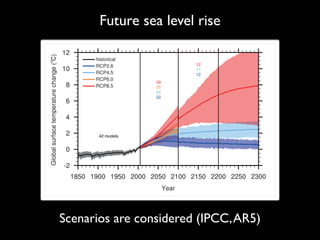
Future sea level rise
enic forcing
ugh the 21st
ges in natu-
om climate
arios in con-
cted global
erived from
ose estimat-
erstood but
model mean
from CMIP5
o within 0.2
e
re and
RCPs are summarized in Table 12.2. The relationship between cumu-
lative anthropogenic carbon emissions and global temperature is
assessed in Section 12.5 and only concentration-driven models are
42 models
39
25
42
32
12
17
12
Figure 12.5 | Time series of global annual mean surface air temperature anomalies
(relative to 1986–2005) from CMIP5 concentration-driven experiments. Projections are
shown for each RCP for the multi-model mean (solid lines) and the 5 to 95% range
(±1.64 standard deviation) across the distribution of individual models (shading). Dis-
Scenarios are considered (IPCC,AR5)
Future sea level rise
–2013) is about 3.7 mm yr–1
, slightly above the observational
of 3.2 [2.8 to 3.6] mm yr–1
for 1993–2010, because the modelled
butions for recent years, although consistent with observations
93–2010 (Section 13.3), are all in the upper part of the observa-
A1B RCP2.6 RCP4.5 RCP6.0 RCP8.5
0.0
0.2
0.4
0.6
0.8
1.0
1.2
Globalmeansealevelrise(m)
2081-2100 relative to 1986-2005Sum
Thermal expansion
Glaciers
Greenland ice sheet (including dynamics)
Antarctic ice sheet (including dynamics)
Land water storage
Greenland ice-sheet rapid dynamics
Antarctic ice-sheet rapid dynamics
13.10 | Projections from process-based models with likely ranges and median values for global mean sea level rise and its contributions in 2081–2100 relative t
r the four RCP scenarios and scenario SRES A1B used in the AR4.The contributions from ice sheets include the contributions from ice-sheet rapid dynamical chang
due to increasing extraction of groundwater.
(From IPCC,AR5)
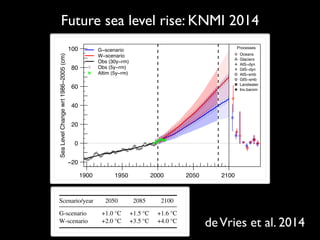
Future sea level rise: KNMI 2014
response to global warming is generall
circulation changes, such as the respo
overturning circulation and the ocean
complexity to the problem, related
resulting from temperature and salinity
1.2.2. Glaciers and small ice caps.
changes in surface mass balance (SMB
Table 1. Steering values of global-mean temperature change (with
respect to 1986–2005 average) that are used in the KNMI’14 sea-
level change scenarios.
Scenario/year 2050 2085 2100
G-scenario +1.0 °C +1.5 °C +1.6 °C
W-scenario +2.0 °C +3.5 °C +4.0 °C
Environ. Res. Lett. 9 (2014) 115007
also shown as
Figure 3. Scenarios for sea-level rise along the North Sea coast. The
vertical axis denotes 30 year running mean sea-level change in cm,
relative to 1986–2005. For years before 2000 and beyond 2085, the
mean was taken over an increasingly smaller window and is drawn
in a different shading. Estimates of natural variability at 5 year time-
scale (see text for details) is included in the range and shown as
Figure 4. Contri
low G-scenario
Environ. Res. Lett. 9 (2014) 115007
deVries et al. 2014
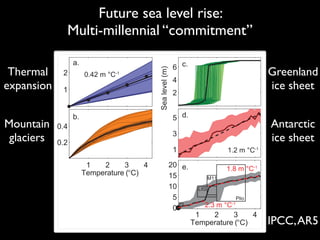
Future sea level rise:
Multi-millennial “commitment”
0.42 m °C-1 0.42 m °C-1
quantitatively consistent with previous estimates on a millennial time
scale (Huybrechts et al., 2011; Goelzer et al., 2012).The sea level contri-
bution of the Greenland ice sheet after 2000 years of integration at 560
ppm was plotted against the average Greenland temperature divided
by the standard polar amplification of 1.5 between global mean and
Greenland mean temperature increase (Gregory and Huybrechts, 2006,
black dot in Figure 13.14h). Taken together, these results imply that a
sea level rise of 1 to 3 m °C–1 is expected if the warming is sustained for
several millennia (low confidence) (Figure 13.14e, 13.14j).
13
Figure 13.14 | (Left column) Multi-millennial sea level commitment per degree Celsius of warming as obtained from phy
°
1.2 m °C-1
1.8 m °C-1
2.3 m °C-1 2.3 m
1.2
1190
13
Figure 13.14 | (Left column) Multi-millennial sea level commitment per degree Celsius of warming as obtained from physical model simulations of (a) ocean warming, (b)
mountain glaciers and (c) the Greenland and (d) the Antarctic ice sheets. (e) The corresponding total sea level commitment, compared to paleo estimates from past warm periods
(PI = pre-industrial, LIG = last interglacial period, M11 = Marine Isotope Stage 11, Plio = Mid-Pliocene). Temperatures are relative to pre-industrial. Dashed lines provide linear
approximations in (d) and (e) with constant slopes of 1.2, 1.8 and 2.3 m °C–1. Shading as well as the vertical line represents the uncertainty range as detailed in the text. (Right
column) 2000-year-sea level commitment.The difference in total sea level commitment (j) compared to the fully equilibrated situation (e) arises from the Greenland ice sheet which
equilibrates on tens of thousands of years.After 2000 years one finds a nonlinear dependence on the temperature increase (h) consistent with coupled climate–ice sheet simulations
by Huybrechts et al. (2011) (black dot).The total sea level commitment after 2000 years is quasi-linear with a slope of 2.3 m °C–1.
°°
1.2 m °C-1
1.8 m °C-1
2.3 m °C-1 2.3 m °C-1
1.2 m °C-1
Thermal
expansion
Mountain
glaciers
Greenland
ice sheet
Antarctic
ice sheet
IPCC,AR5
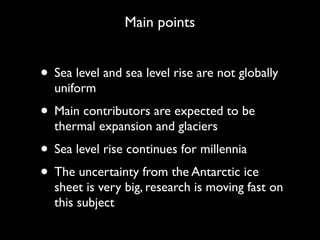
• Sea level and sea level rise are not globally
uniform
• Main contributors are expected to be
thermal expansion and glaciers
• Sea level rise continues for millennia
• The uncertainty from the Antarctic ice
sheet is very big, research is moving fast on
this subject
Main points
Questions?
References:
Church, J.A., P.U. Clark, A. Cazenave, J.M. Gregory, S. Jevrejeva, A. Levermann, M.A.
Merrifield, G.A. Milne, R.S. Nerem, P.D. Nunn, A.J. Payne, W.T. Pfeffer, D. Stammer and
A.S. Unnikrishnan, 2013: Sea Level Change. In: Climate Change 2013: The Physical Science
Basis. Contribution of Working Group I to the Fifth Assessment Report of the
Intergovernmental Panel on Climate Change [Stocker, T.F., D. Qin, G.-K. Plattner, M.
Tignor, S.K. Allen, J. Boschung, A. Nauels, Y. Xia, V. Bex and P.M. Midgley (eds.)].
Cambridge University Press, Cambridge, United Kingdom and New York, NY, USA
Kopp, R. E., Kemp, A. C., Bittermann, K., Horton, B. P., Donnelly, J. P., Gehrels, W. R., …
Rahmstorf, S. (2016). Temperature-driven global sea-level variability in the Common Era, 1–
8. http://doi.org/10.1073/pnas.1517056113
Vries, H. De, Katsman, C., & Drijfhout, S. (2014). Constructing scenarios of regional sea
level change using global temperature pathways. Environmental Research Letters, 9(11),
115007. http://doi.org/10.1088/1748-9326/9/11/115007

Drivers and uncertainties in past and future sea level changes

  • 1.
    Drivers and uncertaintiesin past and future sea level changes Dewi Le Bars, Physical Oceanographer at KNMI HSB 1/04/2016
  • 3.
    Introduction ater and icemass exchange between the land and the oceans leads a change in GMSL.A signal of added mass to the ocean propagates pidly around the globe such that all regions experience a sea level ange within days of the mass being added (Lorbacher et al., 2012). addition, an influx of freshwater changes ocean temperature and linity and thus changes ocean currents and local sea level (Stammer, 08;Yin et al.,2009),with signals taking decades to propagate around gure 13.1 | Climate-sensitive processes and components that can influence global and regional sea level and are considered in this chapter. Changes in any one of the com nents or processes shown will result in a sea level change. The term ‘ocean properties’ refers to ocean temperature, salinity and density, which influence and are dependent o ean circulation. Both relative and geocentric sea level vary with position. Note that the geocenter is not shown. the ground or on its surface in lakes and reservoirs, or cause changes land surface characteristics that influence runoff or evapotranspiratio rates, will perturb the hydrological cycle and cause sea level chang (Sahagian, 2000; Wada et al., 2010). Such processes include wat impoundment (dams, reservoirs), irrigation schemes, and groundwat depletion (Section 13.4.5). From IPCC AR5
  • 4.
    Drivers of sealevel change Global: - Steric effects (warming) - Mass change (land ice melting) Regional: - Local steric effects (thermosteric and halosteric) - Dynamical (ocean circulation, wind, atm. pressure, modes of climate variability) - Gravitational attraction Coastal: - Dynamical (wave setup, storm surge, tides) - Earth rebound KNMI and IPCC scenarios
  • 5.
    Outlook • Global versuslocal sea level change • Physical processes: 
 - Thermal expansion (volume change)
 - Melting of ice sheets (mass change)
 - Gravitation (displacement)
 • Past changes
 • Future changes

  • 6.
    Global observations: satellitealtimetry AVISO product
  • 7.
    than the globalmean value, with much of the west coast of the Americas experiencing a fall in sea surface height over the same period. (continued on next page) Pago PagoManilaAntofagasta San Francisco Charlottetown Stockholm Antofagasta Manila Pago Pago −14 −12 −10 −8 −6 −4 −2 0 2 4 6 8 10 12 14 Sealevelchange(mmyr-1 ) 500 250 0 250 500 Sealevel(mm) 1960 1980 2000 Year San Francisco 1960 1980 2000 Year Charlottetown 1960 1980 2000 Year Stockholm -500 -250 0 250 500 Sealevel(mm) 1960 1980 2000 Year 1960 1980 2000 Year 1960 1980 2000 Year Local:Altimetry and tide gauges, from IPCC AR5
  • 8.
    Ice sheet massbalance: MB = SMB - D Ice discharge D Snowfall Meltwater runoff Surface mass balance (SMB)
  • 9.
    Calving of gianticeberg from Ross Ice Shelf, Antarctica NASA/MODIS
  • 10.
    Calving of gianticeberg from Ross Ice Shelf, Antarctica NASA/MODIS
  • 11.
    Effect of gravityon sea level change 2200 km 6700 km
  • 12.
    Effect of gravityon sea level change ntly, those located near active subduction zones, where one tec- ntofagasta (FAQ 13.1, Figure 1) this appears to result in steady tion land mple, n at bsid- Land sses, ons, arge ciers ause bath gion- sses, FAQ13.1, Figure 2 | Model output showing relative sea level change due to melting of the Greenland ice sheet and the West Antarctic ice sheet at rates of 0.5 mm yr–1 each (giving a global mean value for sea level rise of 1 mm yr–1). The modelled sea level changes are less than the global mean value in areas −3.0 −2.0 −1.0 0.0 0.2 0.4 0.6 0.8 1.0 1.1 1.2 1.3 Sea level change (mm yr-1 ) Change of sea level due to melting of Greenland and Antarctic ice sheets at 0.5mm/year each (from IPCC AR5).
  • 13.
    Past sea levelvariations the first window to encompass the beginning of the Common Era and the last window to cover the last 2 centuries before the de- velopment of a tide-gauge network outside of northern Europe. timescales of variability in globa are the same. Results from the sented in Supporting Information servatively taken as minima acro at specific sites are shown in Fi Results and Discussion Common Era Reconstruction. Pre- variability was very likely (proba and ±11 cm in amplitude (Fig. 1 from 0 CE to 700 CE (P ≥ 0.98) was nearly stable from 700 CE CE and 1400 CE (P ≥ 0.98) at a GSL likely rose from 1400 CE 0.4 mm/y and fell from 1600 0.3 ± 0.3 mm/y. Historic GSL rise began in likely (P ≥ 0.93) that GSL has since 1860 CE. The average rat from 1860 CE to 1900 CE and century. It is extremely likely (P rise was faster than during any −800 CE. The spatial coverage of the tide-gauge dataset is incomplet cient to reduce the posterior va rate by >10% relative to the pr much of the North Atlantic and the Mediterranean, the South Australasia (Fig. 2A). High-reso C Marcott et al. (2013)Global sea level (this study) Mann et al. (2009) B 1 2 H A GlobalTemperatureAnomaly(oC)GlobalSeaLevel(cm)l(cm) 2000-400 -200 0 200 400 600 800 1000 1200 1400 1600 1800 -10 -5 0 5 10 15 20 -400 -200 0 200 400 600 800 1000 1200 1400 1600 1800 2000 -1.0 -0.8 -0.6 -0.4 -0.2 0.0 0.2 0.4 0.6 10 15 20 Sea level reconstruction of the past 2500 years:
 “20th century sea level rise is faster than over the previous 27 centuries” (Kopp et al., PNAS 2016)
  • 14.
    Past sea levelvariationsTable 13.1 | Global mean sea level budget (mm yr–1 ) over different time intervals from observations and from model-bas sphere–Ocean General Circulation Model (AOGCM) historical integrations end in 2005; projections for RCP4.5 are used glacier contributions are computed from the CMIP5 results, using the model of Marzeion et al. (2012a) for glaciers.The land only, not including climate-related fluctuations. Source 1901–1990 Observed contributions to global mean sea level (GMSL) rise Thermal expansion – Glaciers except in Greenland and Antarcticaa 0.54 [0.47 to 0.61] 0 Glaciers in Greenlanda 0.15 [0.10 to 0.19] 0 Greenland ice sheet – Antarctic ice sheet – Land water storage –0.11 [–0.16 to –0.06] 0 Total of contributions – Observed GMSL rise 1.5 [1.3 to 1.7] Modelled contributions to GMSL rise Thermal expansion 0.37 [0.06 to 0.67] 0 Glaciers except in Greenland and Antarctica 0.63 [0.37 to 0.89] 0 Glaciers in Greenland 0.07 [–0.02 to 0.16] 0 Total including land water storage 1.0 [0.5 to 1.4] Residualc 0.5 [0.1 to 1.0] different time intervals from observations and from model-based contributions. Uncertainties are 5 to 95%.The Atmo- ical integrations end in 2005; projections for RCP4.5 are used for 2006–2010. The modelled thermal expansion and using the model of Marzeion et al. (2012a) for glaciers.The land water contribution is due to anthropogenic intervention 1901–1990 1971–2010 1993–2010 rise – 0.8 [0.5 to 1.1] 1.1 [0.8 to 1.4] 0.54 [0.47 to 0.61] 0.62 [0.25 to 0.99] 0.76 [0.39 to 1.13] 0.15 [0.10 to 0.19] 0.06 [0.03 to 0.09] 0.10 [0.07 to 0.13]b – – 0.33 [0.25 to 0.41] – – 0.27 [0.16 to 0.38] –0.11 [–0.16 to –0.06] 0.12 [0.03 to 0.22] 0.38 [0.26 to 0.49] – – 2.8 [2.3 to 3.4] 1.5 [1.3 to 1.7] 2.0 [1.7 to 2.3] 3.2 [2.8 to 3.6] 0.37 [0.06 to 0.67] 0.96 [0.51 to 1.41] 1.49 [0.97 to 2.02] 0.63 [0.37 to 0.89] 0.62 [0.41 to 0.84] 0.78 [0.43 to 1.13] 0.07 [–0.02 to 0.16] 0.10 [0.05 to 0.15] 0.14 [0.06 to 0.23] 1.0 [0.5 to 1.4] 1.8 [1.3 to 2.3] 2.8 [2.1 to 3.5] 0.5 [0.1 to 1.0] 0.2 [–0.4 to 0.8] 0.4 [–0.4 to 1.2] Last two decades: first closure of the budget (IPCC,AR5)
  • 15.
    Future sea levelrise enic forcing ugh the 21st ges in natu- om climate arios in con- cted global erived from ose estimat- erstood but model mean from CMIP5 o within 0.2 e re and RCPs are summarized in Table 12.2. The relationship between cumu- lative anthropogenic carbon emissions and global temperature is assessed in Section 12.5 and only concentration-driven models are 42 models 39 25 42 32 12 17 12 Figure 12.5 | Time series of global annual mean surface air temperature anomalies (relative to 1986–2005) from CMIP5 concentration-driven experiments. Projections are shown for each RCP for the multi-model mean (solid lines) and the 5 to 95% range (±1.64 standard deviation) across the distribution of individual models (shading). Dis- Scenarios are considered (IPCC,AR5)
  • 16.
    Future sea levelrise –2013) is about 3.7 mm yr–1 , slightly above the observational of 3.2 [2.8 to 3.6] mm yr–1 for 1993–2010, because the modelled butions for recent years, although consistent with observations 93–2010 (Section 13.3), are all in the upper part of the observa- A1B RCP2.6 RCP4.5 RCP6.0 RCP8.5 0.0 0.2 0.4 0.6 0.8 1.0 1.2 Globalmeansealevelrise(m) 2081-2100 relative to 1986-2005Sum Thermal expansion Glaciers Greenland ice sheet (including dynamics) Antarctic ice sheet (including dynamics) Land water storage Greenland ice-sheet rapid dynamics Antarctic ice-sheet rapid dynamics 13.10 | Projections from process-based models with likely ranges and median values for global mean sea level rise and its contributions in 2081–2100 relative t r the four RCP scenarios and scenario SRES A1B used in the AR4.The contributions from ice sheets include the contributions from ice-sheet rapid dynamical chang due to increasing extraction of groundwater. (From IPCC,AR5)
  • 17.
    Future sea levelrise: KNMI 2014 response to global warming is generall circulation changes, such as the respo overturning circulation and the ocean complexity to the problem, related resulting from temperature and salinity 1.2.2. Glaciers and small ice caps. changes in surface mass balance (SMB Table 1. Steering values of global-mean temperature change (with respect to 1986–2005 average) that are used in the KNMI’14 sea- level change scenarios. Scenario/year 2050 2085 2100 G-scenario +1.0 °C +1.5 °C +1.6 °C W-scenario +2.0 °C +3.5 °C +4.0 °C Environ. Res. Lett. 9 (2014) 115007 also shown as Figure 3. Scenarios for sea-level rise along the North Sea coast. The vertical axis denotes 30 year running mean sea-level change in cm, relative to 1986–2005. For years before 2000 and beyond 2085, the mean was taken over an increasingly smaller window and is drawn in a different shading. Estimates of natural variability at 5 year time- scale (see text for details) is included in the range and shown as Figure 4. Contri low G-scenario Environ. Res. Lett. 9 (2014) 115007 deVries et al. 2014
  • 18.
    Future sea levelrise: Multi-millennial “commitment” 0.42 m °C-1 0.42 m °C-1 quantitatively consistent with previous estimates on a millennial time scale (Huybrechts et al., 2011; Goelzer et al., 2012).The sea level contri- bution of the Greenland ice sheet after 2000 years of integration at 560 ppm was plotted against the average Greenland temperature divided by the standard polar amplification of 1.5 between global mean and Greenland mean temperature increase (Gregory and Huybrechts, 2006, black dot in Figure 13.14h). Taken together, these results imply that a sea level rise of 1 to 3 m °C–1 is expected if the warming is sustained for several millennia (low confidence) (Figure 13.14e, 13.14j). 13 Figure 13.14 | (Left column) Multi-millennial sea level commitment per degree Celsius of warming as obtained from phy ° 1.2 m °C-1 1.8 m °C-1 2.3 m °C-1 2.3 m 1.2 1190 13 Figure 13.14 | (Left column) Multi-millennial sea level commitment per degree Celsius of warming as obtained from physical model simulations of (a) ocean warming, (b) mountain glaciers and (c) the Greenland and (d) the Antarctic ice sheets. (e) The corresponding total sea level commitment, compared to paleo estimates from past warm periods (PI = pre-industrial, LIG = last interglacial period, M11 = Marine Isotope Stage 11, Plio = Mid-Pliocene). Temperatures are relative to pre-industrial. Dashed lines provide linear approximations in (d) and (e) with constant slopes of 1.2, 1.8 and 2.3 m °C–1. Shading as well as the vertical line represents the uncertainty range as detailed in the text. (Right column) 2000-year-sea level commitment.The difference in total sea level commitment (j) compared to the fully equilibrated situation (e) arises from the Greenland ice sheet which equilibrates on tens of thousands of years.After 2000 years one finds a nonlinear dependence on the temperature increase (h) consistent with coupled climate–ice sheet simulations by Huybrechts et al. (2011) (black dot).The total sea level commitment after 2000 years is quasi-linear with a slope of 2.3 m °C–1. °° 1.2 m °C-1 1.8 m °C-1 2.3 m °C-1 2.3 m °C-1 1.2 m °C-1 Thermal expansion Mountain glaciers Greenland ice sheet Antarctic ice sheet IPCC,AR5
  • 19.
    • Sea leveland sea level rise are not globally uniform • Main contributors are expected to be thermal expansion and glaciers • Sea level rise continues for millennia • The uncertainty from the Antarctic ice sheet is very big, research is moving fast on this subject Main points
  • 20.
    Questions? References: Church, J.A., P.U.Clark, A. Cazenave, J.M. Gregory, S. Jevrejeva, A. Levermann, M.A. Merrifield, G.A. Milne, R.S. Nerem, P.D. Nunn, A.J. Payne, W.T. Pfeffer, D. Stammer and A.S. Unnikrishnan, 2013: Sea Level Change. In: Climate Change 2013: The Physical Science Basis. Contribution of Working Group I to the Fifth Assessment Report of the Intergovernmental Panel on Climate Change [Stocker, T.F., D. Qin, G.-K. Plattner, M. Tignor, S.K. Allen, J. Boschung, A. Nauels, Y. Xia, V. Bex and P.M. Midgley (eds.)]. Cambridge University Press, Cambridge, United Kingdom and New York, NY, USA Kopp, R. E., Kemp, A. C., Bittermann, K., Horton, B. P., Donnelly, J. P., Gehrels, W. R., … Rahmstorf, S. (2016). Temperature-driven global sea-level variability in the Common Era, 1– 8. http://doi.org/10.1073/pnas.1517056113 Vries, H. De, Katsman, C., & Drijfhout, S. (2014). Constructing scenarios of regional sea level change using global temperature pathways. Environmental Research Letters, 9(11), 115007. http://doi.org/10.1088/1748-9326/9/11/115007