Towards Autonomous Driving on road:
the E-GNSS contribution
From basic concepts to "local integrity"
Speakers:
Ing. Gianluca Marucco
Mr. Matteo Vannucchi
Moderator:
Ing. Gabriella Povero
Table of Content
3
Introduction
GNSS Principles
European GNSS
Integrity
Table of Content
4
Introduction
GNSS Principles
European GNSS
Integrity
Autonomous Driving
Technologies relevant in driver assistance systems and autonomous vehicles:
• vehicle electronics
• vehicle dynamics
• command/control
• HMI
• perception
• computer vision
• data-fusion
• communication
• eco-driving
• … and NAVIGATION!
5
2009 by
Kozuch
By ESA/RAL Space/ESO -
http://www.eso.org/public/images/ann12048a/,
CC BY 3.0,
https://commons.wikimedia.org/w/index.php?cu
rid=19979586
Autonomous Driving
Role of GNSS:
• routing can be decided using digital maps.
• navigation by determining
vehicle location and speed
• lane and attitude determination
• short-range situation awareness system (awareness of other vehicles in
the road and collision avoidance) in combination
with positional information sharing among cars
6
Table of Content
7
Introduction
GNSS Principles : introduction
European GNSS
Integrity
Global Navigation Satellite Systems
8
GNSS enable users
(on Earth surface or flying)
to determine their position
with respect to a
Reference Frame
x
y
z
Trilateration
9
The receiver is able to measure
the TOA (Time Of Arrival) and
consequentially the distances
Transmitters are in known positions
The receiver is in an unknown position
10
The Basic Tool: the Clock
The Time Of Arrival is measured by the receiver
The time of departure is known (set by transmitter)
The travel time is their difference
The distance is the travel time multiplied by the
speed of light.
Transmitters and receivers
MUST be equipped with clocks.
11
The Basic Tool: the Clock
Time difference between TX and RX is the basis.
TX and RX clocks must be synchronized
Synchronization error of 1μs corresponds
to an error distance of approx. 300 m
Very onerous
requirement!!
12
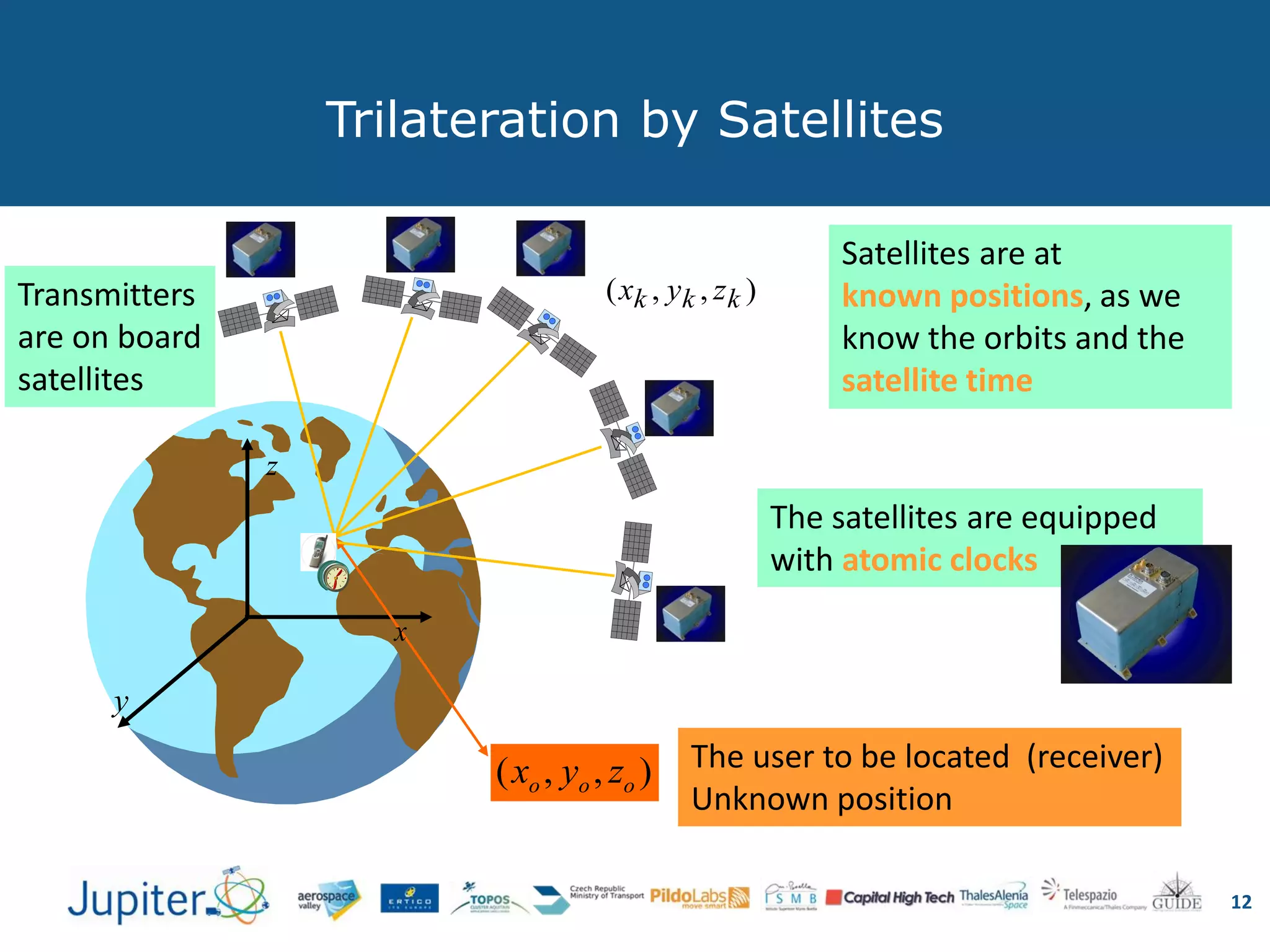
Trilateration by Satellites
),,( ooo zyx
x
y
z
),,( kkk zyx
The user to be located (receiver)
Unknown position
The satellites are equipped
with atomic clocks
Satellites are at
known positions, as we
know the orbits and the
satellite time
Transmitters
are on board
satellites
13
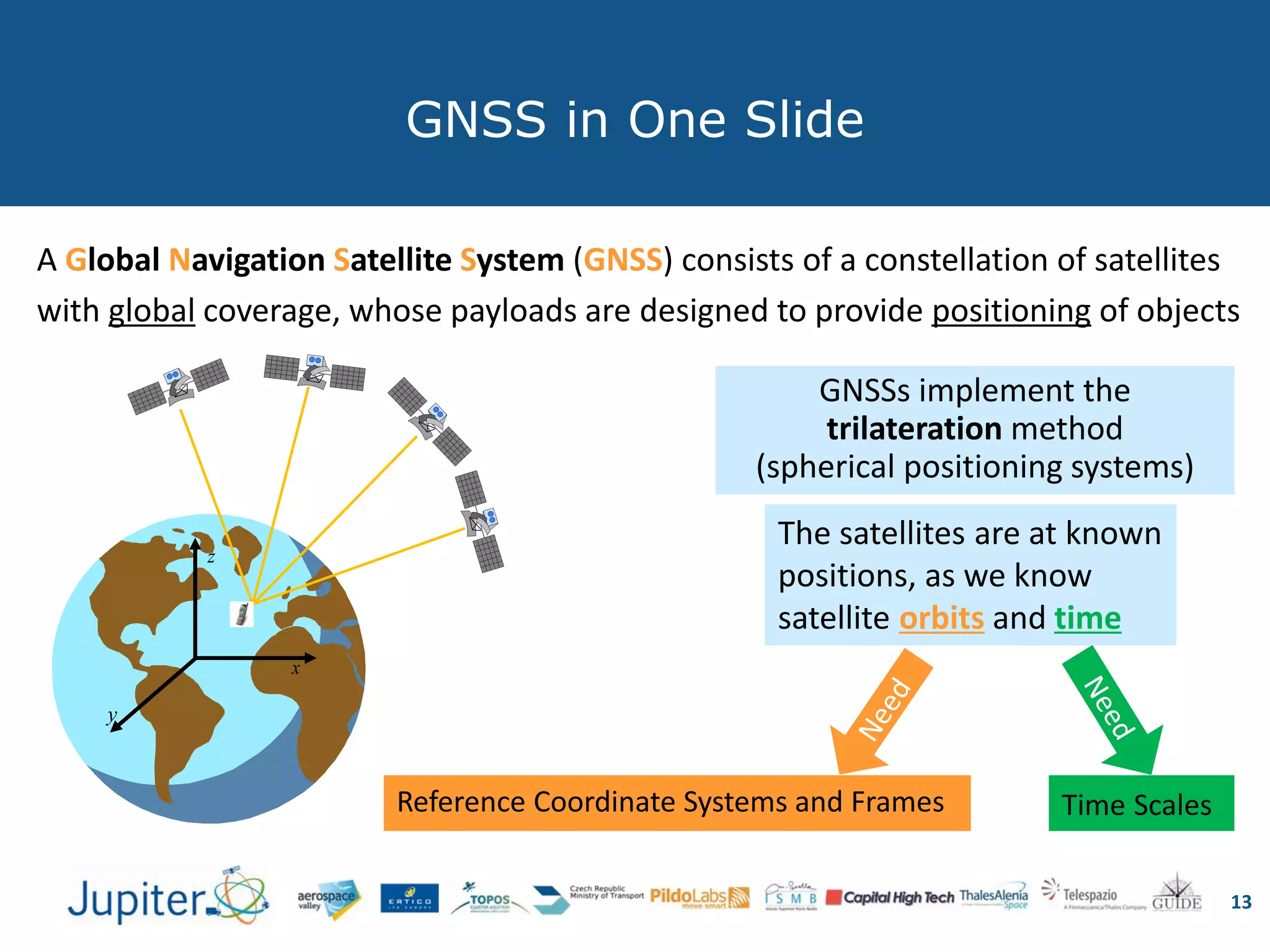
GNSS in One Slide
A Global Navigation Satellite System (GNSS) consists of a constellation of satellites
with global coverage, whose payloads are designed to provide positioning of objects
x
y
z
GNSSs implement the
trilateration method
(spherical positioning systems)
The satellites are at known
positions, as we know
satellite orbits and time
Reference Coordinate Systems and Frames Time Scales
14
3D Positioning
EARTH
Three distance measurements appear
to be enough for positioning in a
three dimensional space
15
How Many Satellites?
Why?
To sidestep the
synchronisation requirement
),,( ooo zyx
x
y
z
),,( kkk zyx
4 Satellites
16
Ranges and Pseudoranges
),,( ooo zyx
x
y
z
),,( kkk zyx
TOA measurements at the
receiver are affected by the
same clock bias )( cb
)( cb )( rb
Receivers are equipped with inexpensive
quartz oscillators.
The range bias becomes
the fourth unknown to be
estimated
)( rb
Because of the bias
pseudoranges are measured
instead of ranges
)( rb
The Navigation Equation
17
• In order to estimate its position a receiver must
have at least four satellites in view
• The satellites must be in Line-of-Sight
• If a larger number of satellites is in view a
better estimation is possible. In the past the
combination of four satellites giving the best
performance was chosen
• Modern receivers use several channels in order
to perform the position estimation
REMARKS
x
y
z
Table of Content
18
Introduction
GNSS Principles: receivers
European GNSS
Integrity
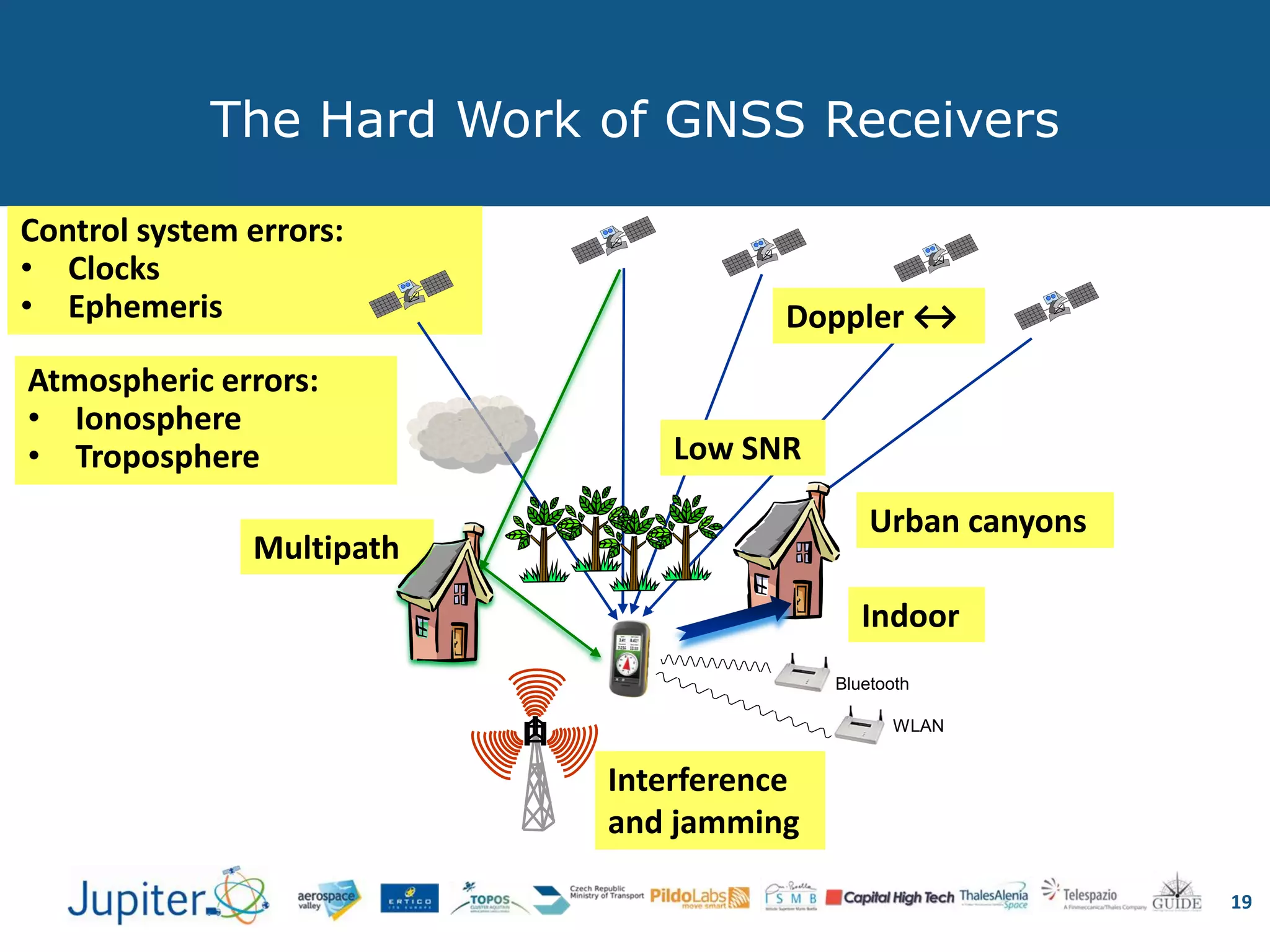
19
Control system errors:
• Clocks
• Ephemeris
The Hard Work of GNSS Receivers
Multipath
Interference
and jamming
Indoor
Bluetooth
WLAN
Urban canyons
Atmospheric errors:
• Ionosphere
• Troposphere
Doppler ↔
Low SNR
20
SE-NAV simulation: Multipaths in a station
21
The Receiver Chain
Let us consider the SIS of a single SV (space vehicle)
SIS (Signal in Space)
Antenna RF
Front-end
ADC
GNSS
Digital
receiver
)(tyIF
)(tyRF
Pseudorange
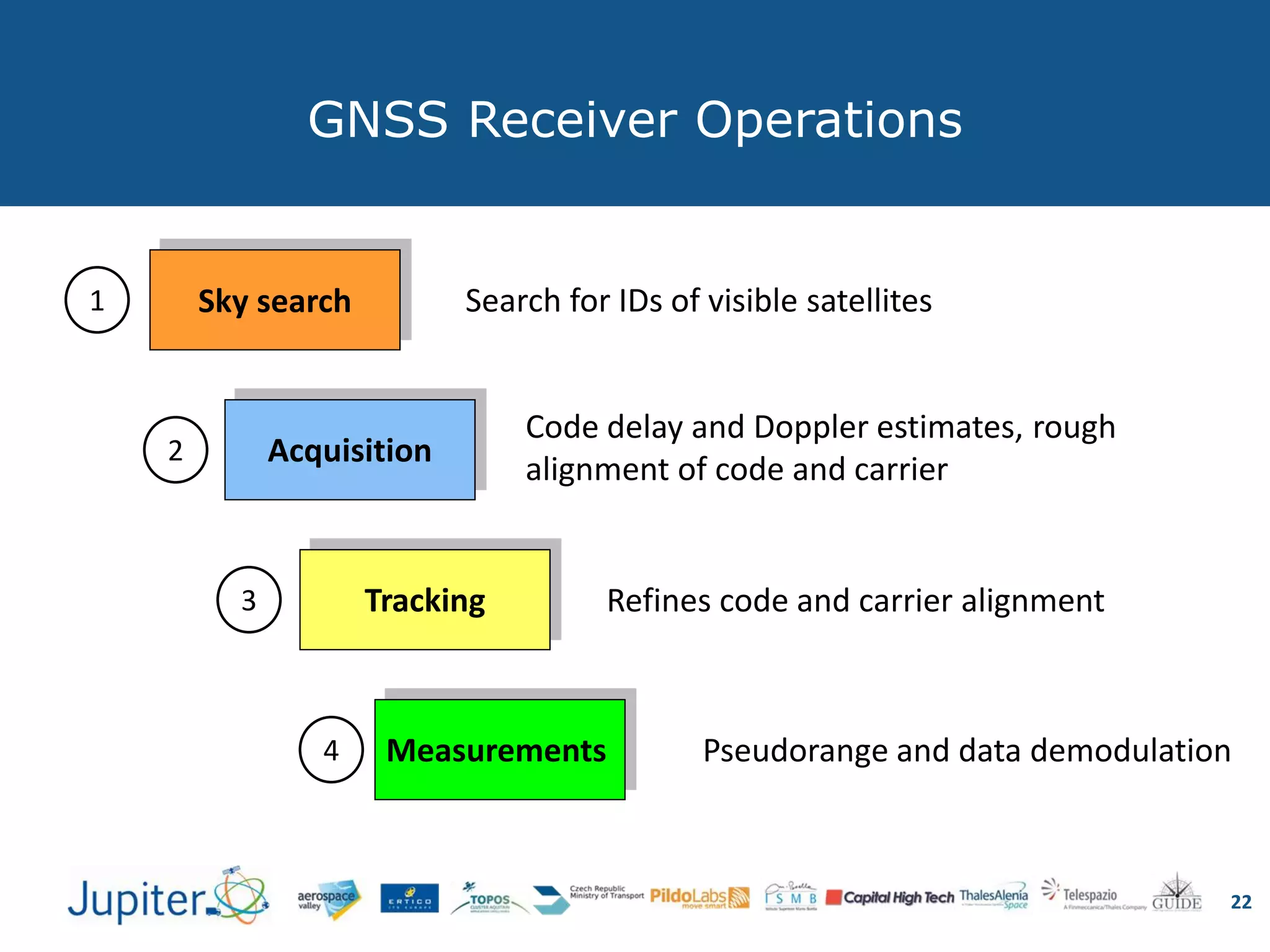
GNSS Receiver Operations
22
Acquisition
Sky search
Tracking
Measurements
Refines code and carrier alignment
Search for IDs of visible satellites
Code delay and Doppler estimates, rough
alignment of code and carrier
Pseudorange and data demodulation
1
2
3
4
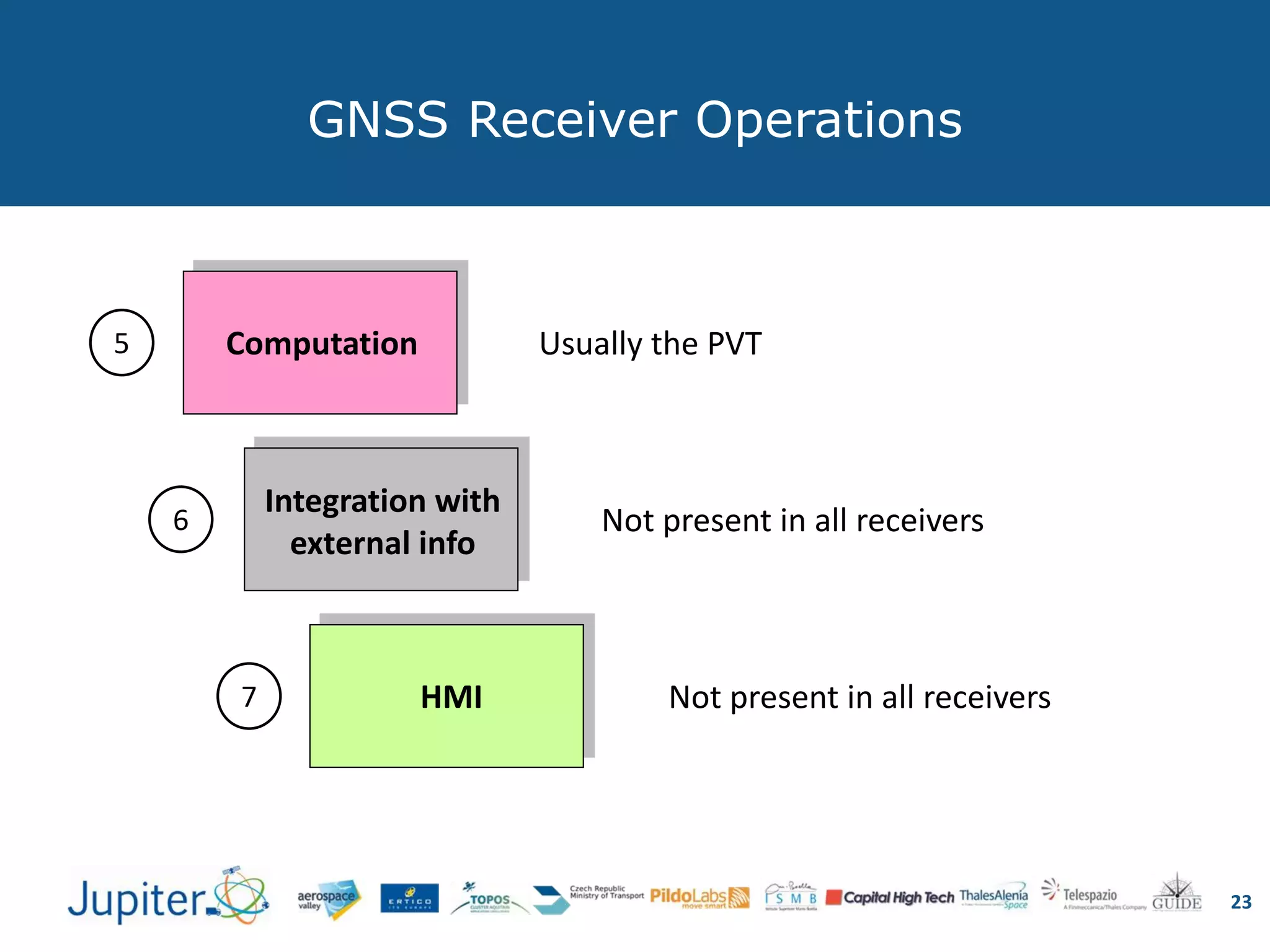
Computation Usually the PVT
Integration with
external info
Not present in all receivers
HMI Not present in all receivers
5
6
7
GNSS Receiver Operations
23
Receiver Performance
24
Receivers Classes
Receivers Specifications
Description Device Price [€]
Handheld receivers for hikers and sailors. Small
size with latitude-longitude displays and maps. 100 - 600
Integrated GPS in mobile phones. Low cost and
single frequency. 50-600
Maritime navigators. Fixed mount, large
screens with electronics chart 100-3000
In-car navigation systems. Detailed street
maps and turn-by-turn directions. These
systems can be also handheld (e.g. PDA)
100-2000
Receivers Classes
25
Price differences are due to reason independent from the embedded GNSS chip
Description Approx. Price [€]
Aviation receivers. FAA in US and EASA
in Europe certified, panel mounted with
maps.
INTEGRITY REQUIRED !
>3000
Survey and mapping professional
receivers. Multi-frequency and
differential GPS, centimeter accuracy
1500 – 30000
Receivers Classes
26
Price differences are due to reason independent from the embedded GNSS chip
Description Approx. Price [€]
Plug-in modules.
Integrated receivers and antenna.
Employed in tracking systems
30 – 700
OEM boards.
Employed for integration in other
complex systems.
100 – 5000
Chip sets.
Employed for integration, but all the
circuitry is needed
1 – 30
GNSS Modules
27
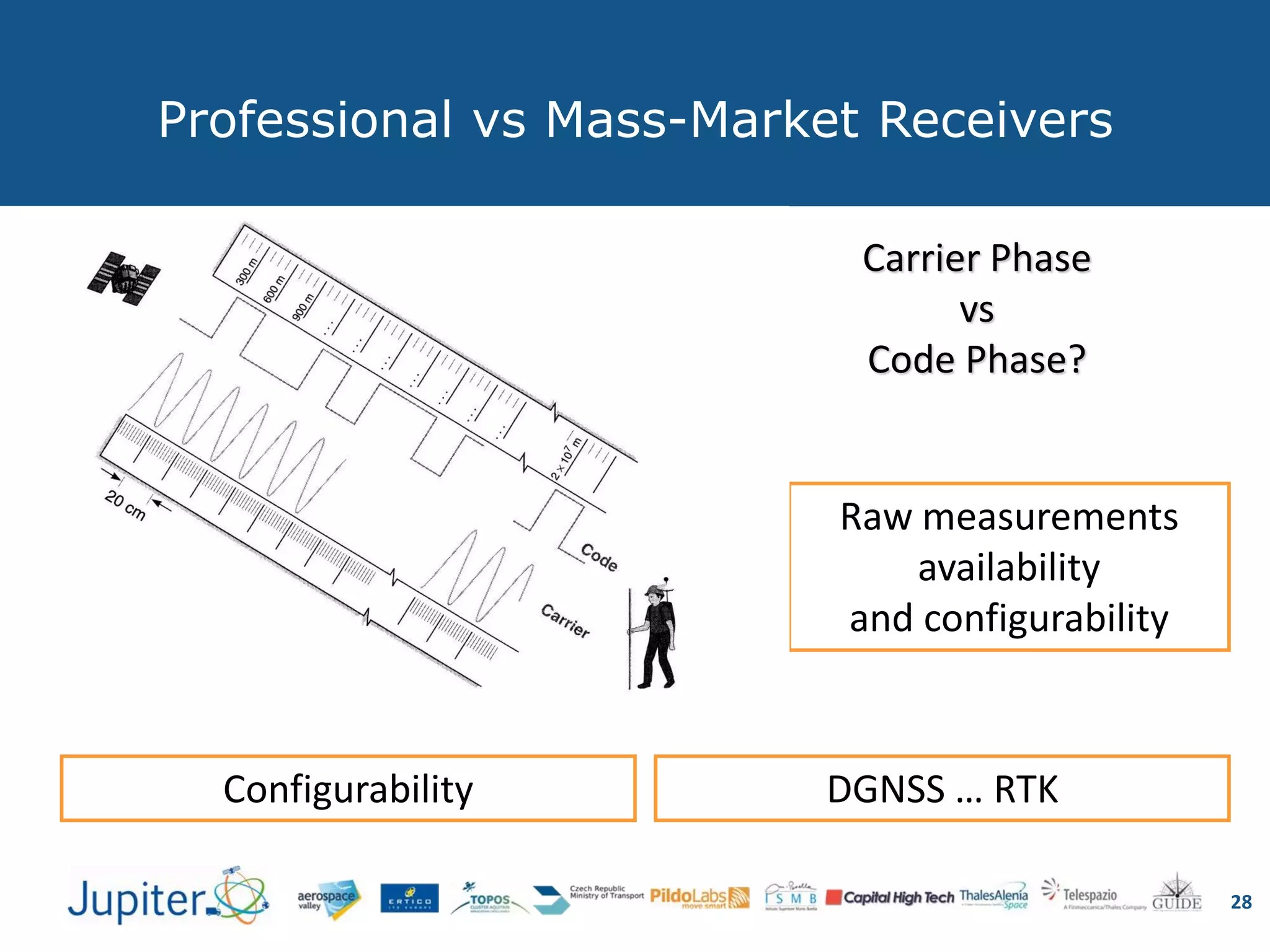
Professional vs Mass-Market Receivers
28
Raw measurements
availability
and configurability
Carrier Phase
vs
Code Phase?
Configurability DGNSS … RTK
Receivers Classification: Market Segment
29
Category Receiver Characteristics
Consumer
Single frequency, cost driven, high volume, moderate performance,
also multi constellation
Light
Professional
Single frequency, multi constellation, cost driven, low volume, good
performance, integration with external devices, professional features
Professional
Multi frequency, multi constellation, cost/requirements driven, low
volume, high performance, advanced processing algorithms
Safety of Life
Double/ Multi frequency, multi constellation, requirements driven,
low volume, high performance, high reliability, integrity, certification
P R S
Double frequency, low volume, high performance, high reliability,
requirements driven, integrity, advanced processing algorithms
GNSS RX Features
30
• Constellation exploited
• Military or civil receiver
• PVT update rate
• Indoor operations or high
multipath environment
• Interference mitigation
• Dynamic conditions (static or high
dynamic)
• DGPS or WAAS/EGNOS capability
(RTK input/ output)
• Storage of log data
• Shock and vibration tolerance
• Cartographic support
• INS integration or dead-reckoning
systems
• Integration with COM systems
• Portability
• Usability
• Power consumption
• Cost
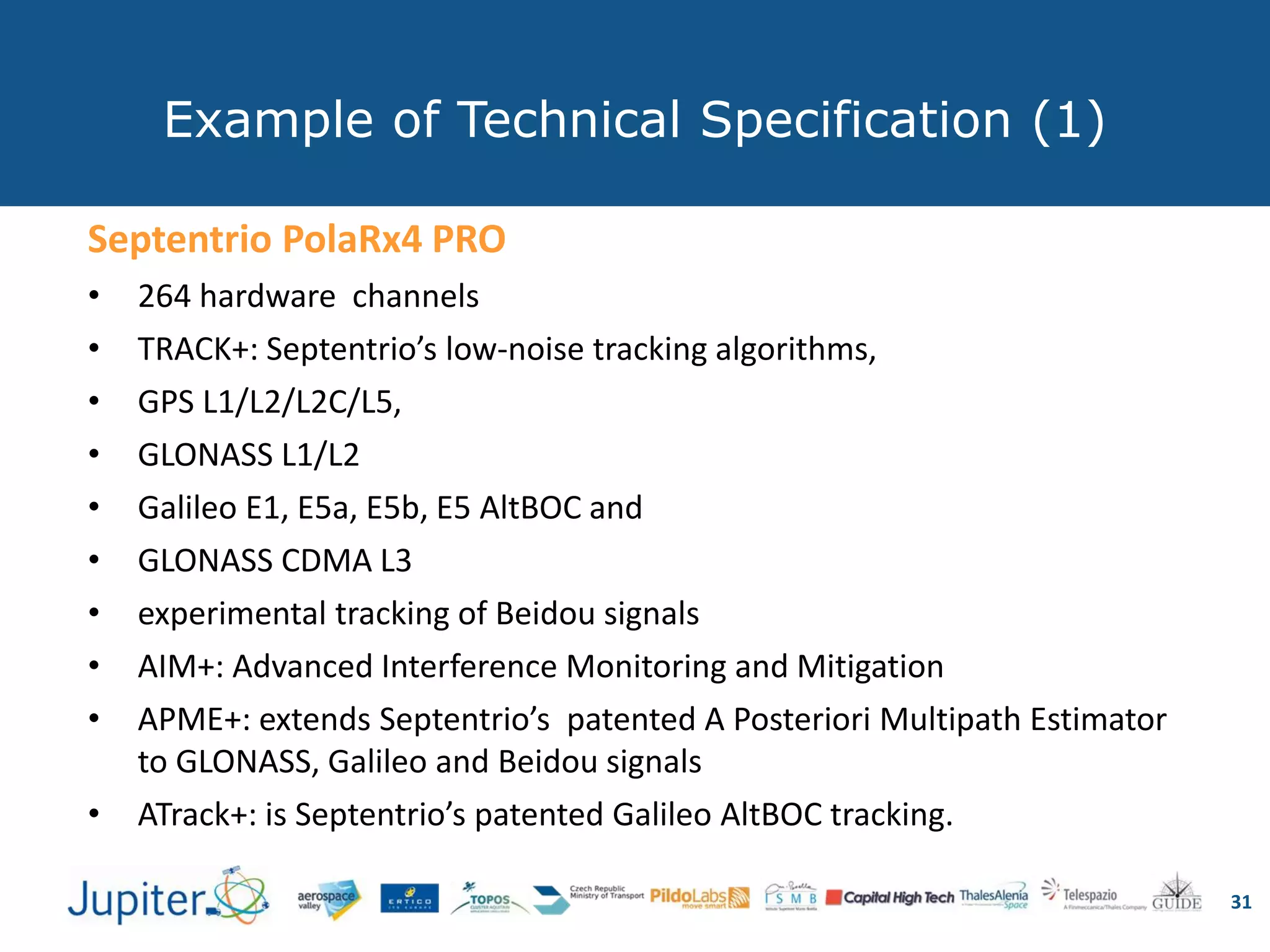
Example of Technical Specification (1)
31
Septentrio PolaRx4 PRO
• 264 hardware channels
• TRACK+: Septentrio’s low-noise tracking algorithms,
• GPS L1/L2/L2C/L5,
• GLONASS L1/L2
• Galileo E1, E5a, E5b, E5 AltBOC and
• GLONASS CDMA L3
• experimental tracking of Beidou signals
• AIM+: Advanced Interference Monitoring and Mitigation
• APME+: extends Septentrio’s patented A Posteriori Multipath Estimator
to GLONASS, Galileo and Beidou signals
• ATrack+: is Septentrio’s patented Galileo AltBOC tracking.
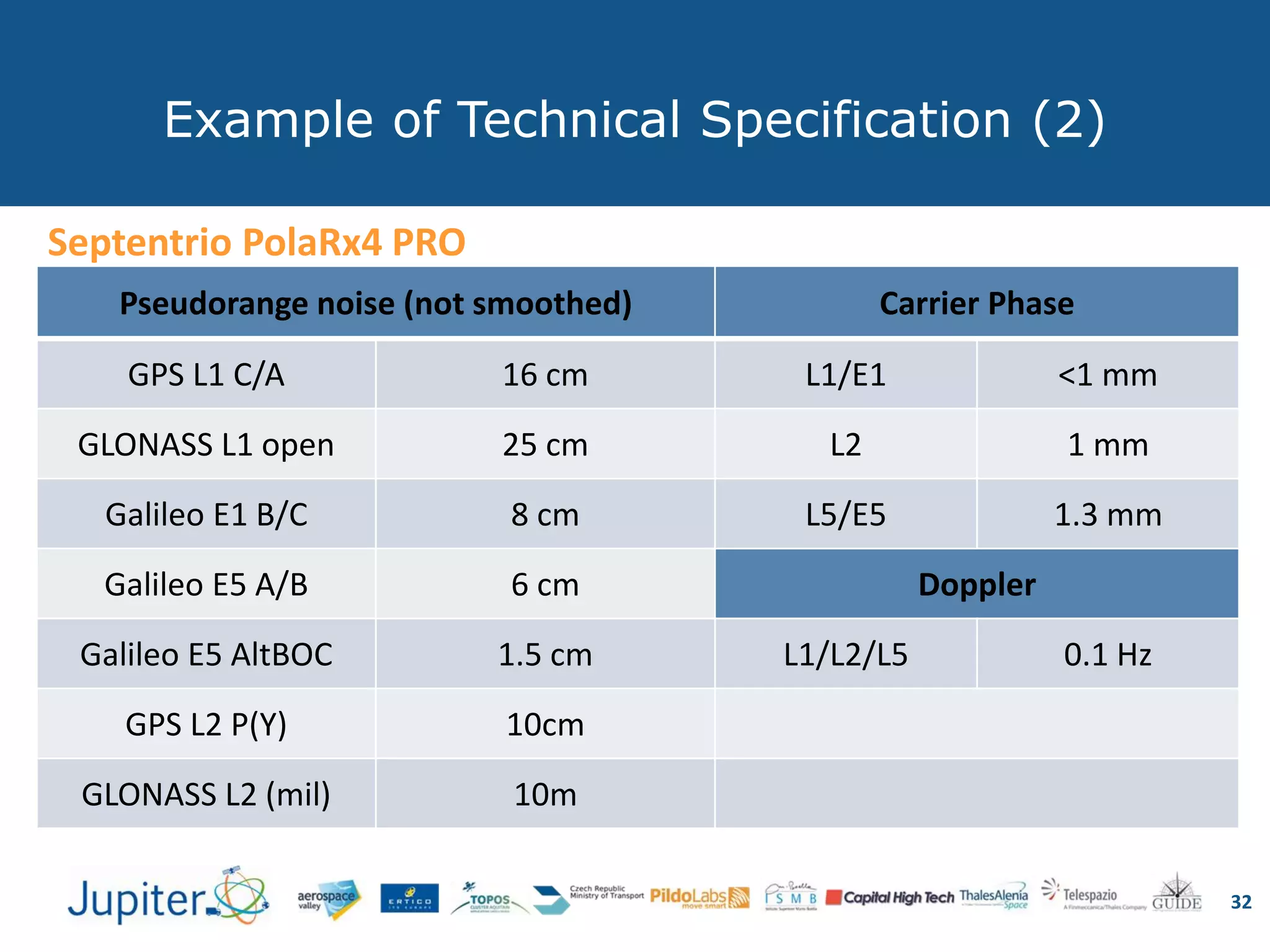
Example of Technical Specification (2)
32
Septentrio PolaRx4 PRO
Pseudorange noise (not smoothed) Carrier Phase
GPS L1 C/A 16 cm L1/E1 <1 mm
GLONASS L1 open 25 cm L2 1 mm
Galileo E1 B/C 8 cm L5/E5 1.3 mm
Galileo E5 A/B 6 cm Doppler
Galileo E5 AltBOC 1.5 cm L1/L2/L5 0.1 Hz
GPS L2 P(Y) 10cm
GLONASS L2 (mil) 10m
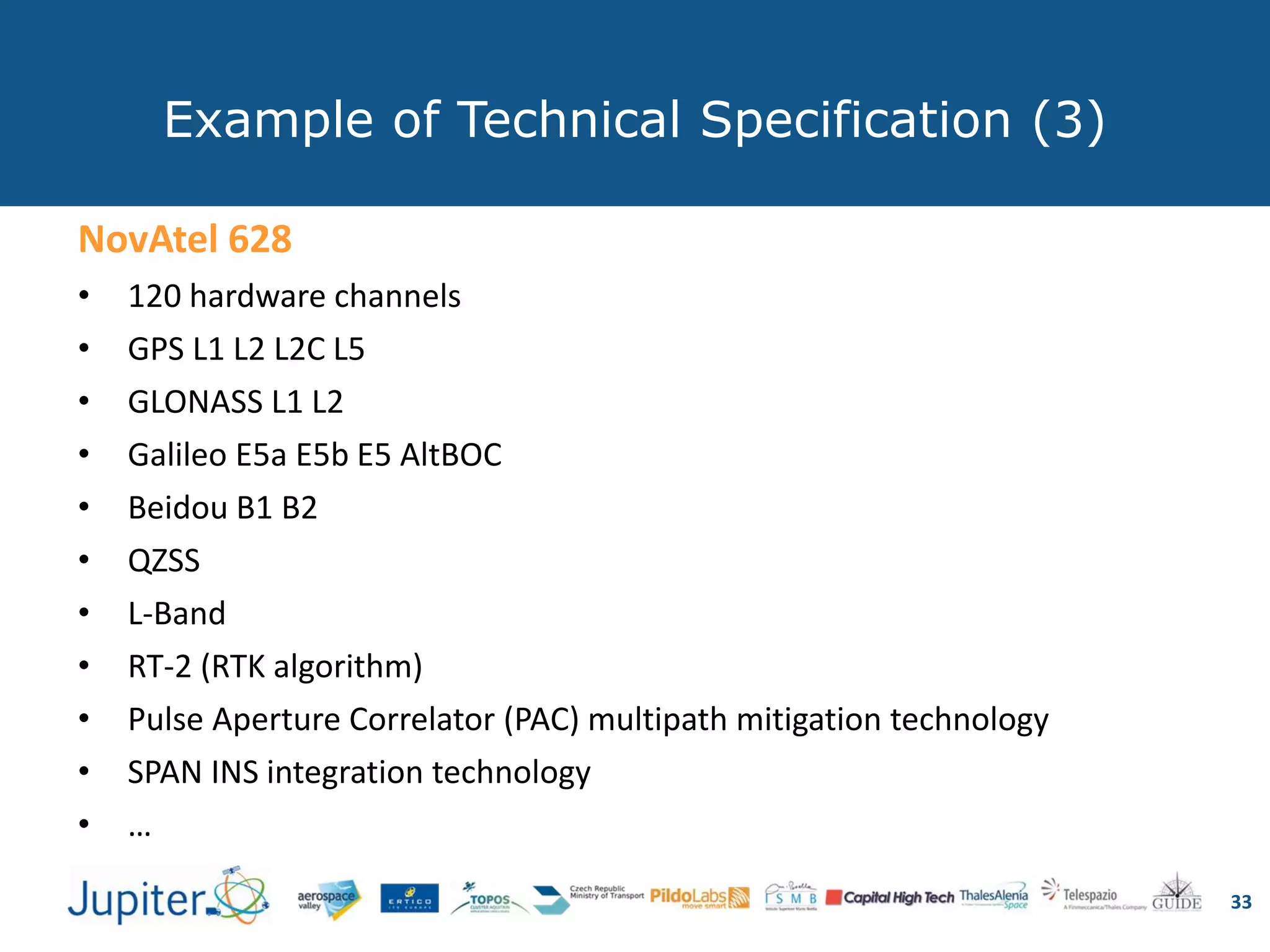
Example of Technical Specification (3)
33
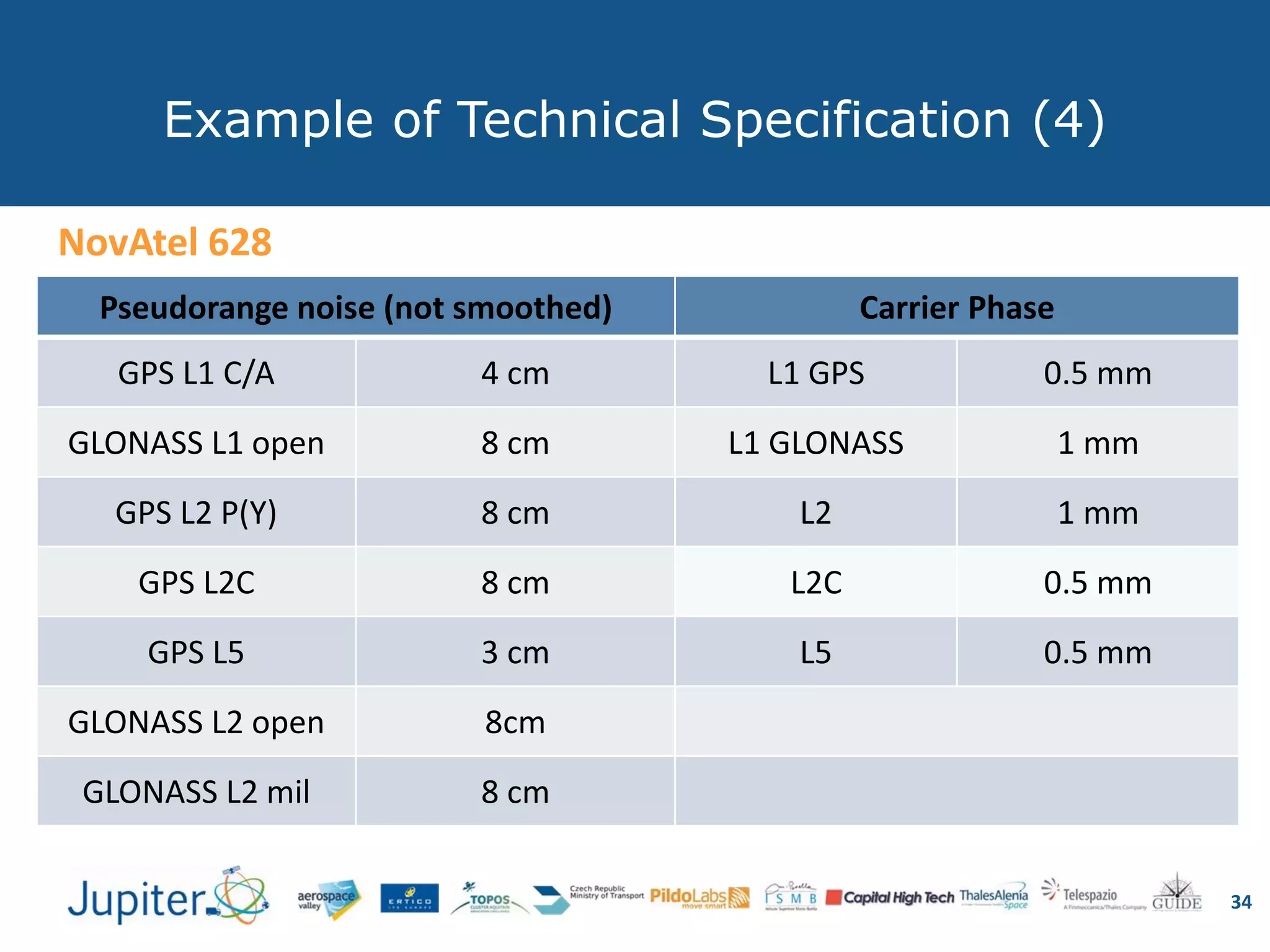
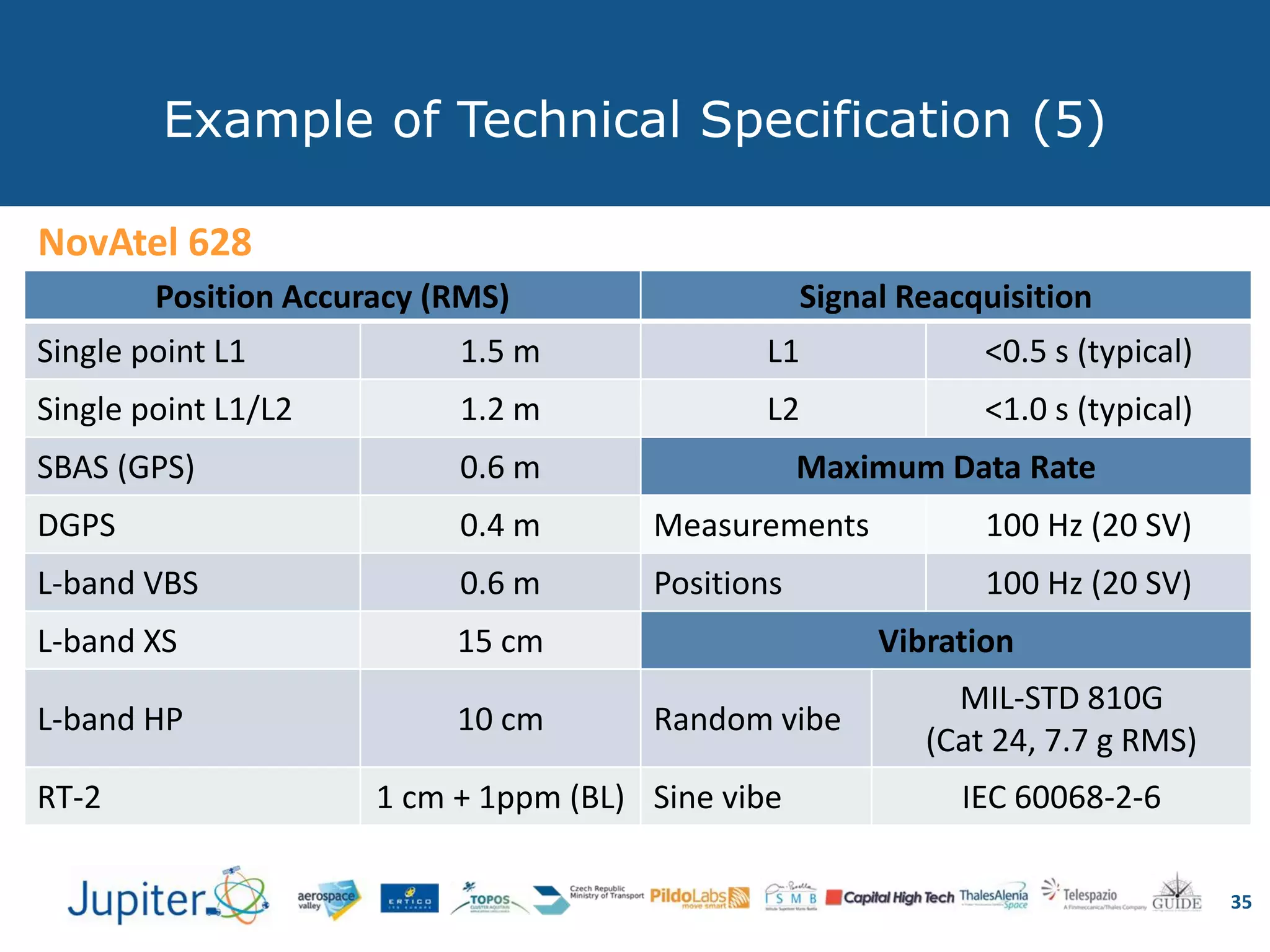
NovAtel 628
• 120 hardware channels
• GPS L1 L2 L2C L5
• GLONASS L1 L2
• Galileo E5a E5b E5 AltBOC
• Beidou B1 B2
• QZSS
• L-Band
• RT-2 (RTK algorithm)
• Pulse Aperture Correlator (PAC) multipath mitigation technology
• SPAN INS integration technology
• …
Example of Technical Specification (4)
34
NovAtel 628
Pseudorange noise (not smoothed) Carrier Phase
GPS L1 C/A 4 cm L1 GPS 0.5 mm
GLONASS L1 open 8 cm L1 GLONASS 1 mm
GPS L2 P(Y) 8 cm L2 1 mm
GPS L2C 8 cm L2C 0.5 mm
GPS L5 3 cm L5 0.5 mm
GLONASS L2 open 8cm
GLONASS L2 mil 8 cm
Example of Technical Specification (5)
35
NovAtel 628
Position Accuracy (RMS) Signal Reacquisition
Single point L1 1.5 m L1 <0.5 s (typical)
Single point L1/L2 1.2 m L2 <1.0 s (typical)
SBAS (GPS) 0.6 m Maximum Data Rate
DGPS 0.4 m Measurements 100 Hz (20 SV)
L-band VBS 0.6 m Positions 100 Hz (20 SV)
L-band XS 15 cm Vibration
L-band HP 10 cm Random vibe
MIL-STD 810G
(Cat 24, 7.7 g RMS)
RT-2 1 cm + 1ppm (BL) Sine vibe IEC 60068-2-6
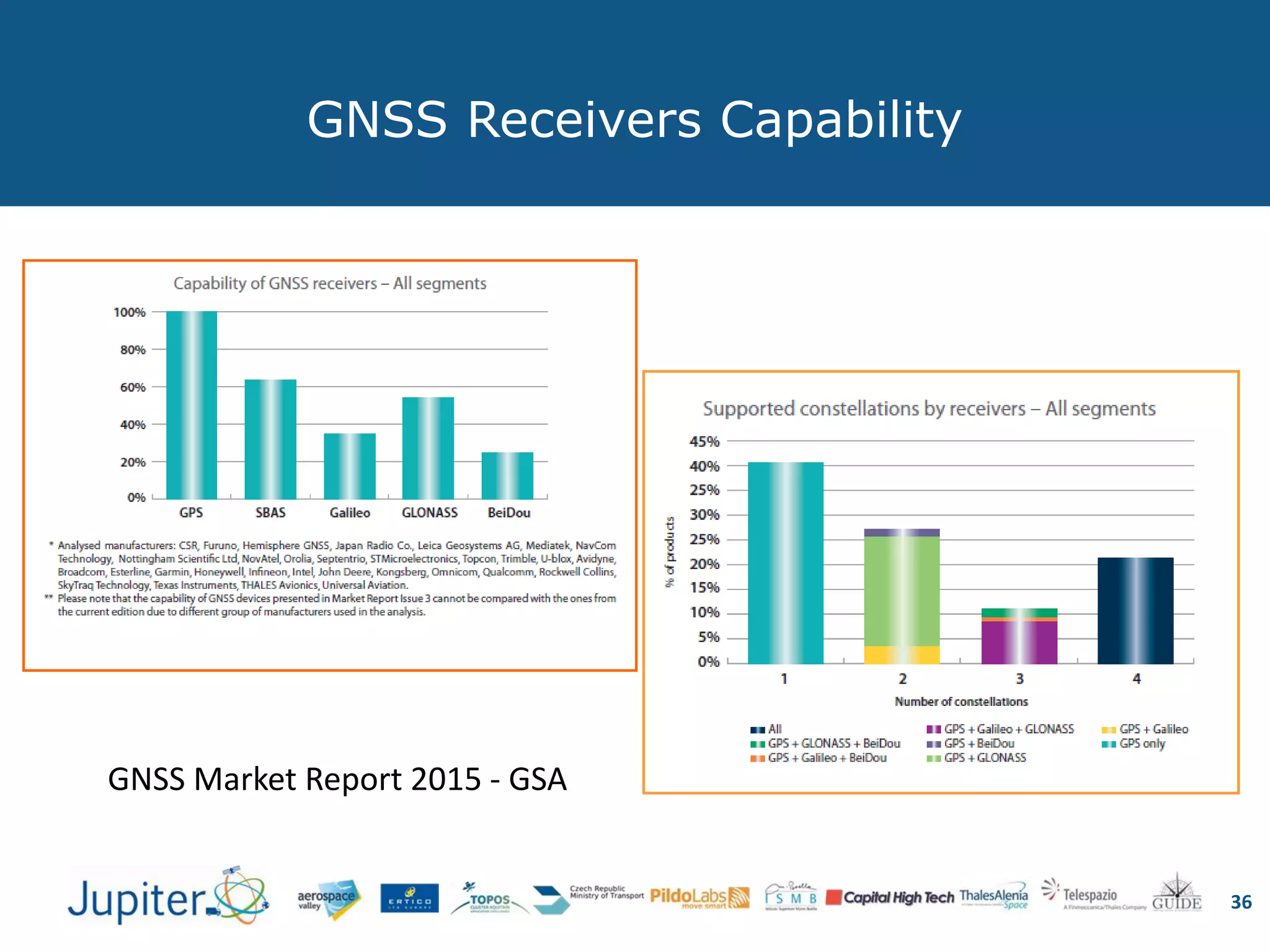
GNSS Receivers Capability
36
GNSS Market Report 2015 - GSA
37
-2.5 -2 -1.5 -1 -0.5 0 0.5 1 1.5 2
-2.5
-2
-1.5
-1
-0.5
0
0.5
1
1.5
2
East Error(m)
NorthError(m)
The position error w.r.t the mean position of GPS & GALILEO
GPS
GALILEO
Galileo Real Early Performance (2014)
• Galileo is benchmarked to GPS in terms of precision in the estimation of the position
• In mid 2014 only 3 Galileo satellites
were transmitting a valid navigation
message
• The position computation was
performed using L1 data from:
o 5 GPS satellites
o 3 Galileo + 2 GPS satellites
• Chosen GPS and Galileo satellites
were those in view during the same
time period and which elevation
and azimuth angles were similar in
pairs. The aim of this scenario is to
have common ionospheric and
troposheric effects for both the systems
Table of Content
38
Introduction
GNSS Principles
European GNSS: EGNOS - EDAS
Integrity
Augmentation: Purposes
39
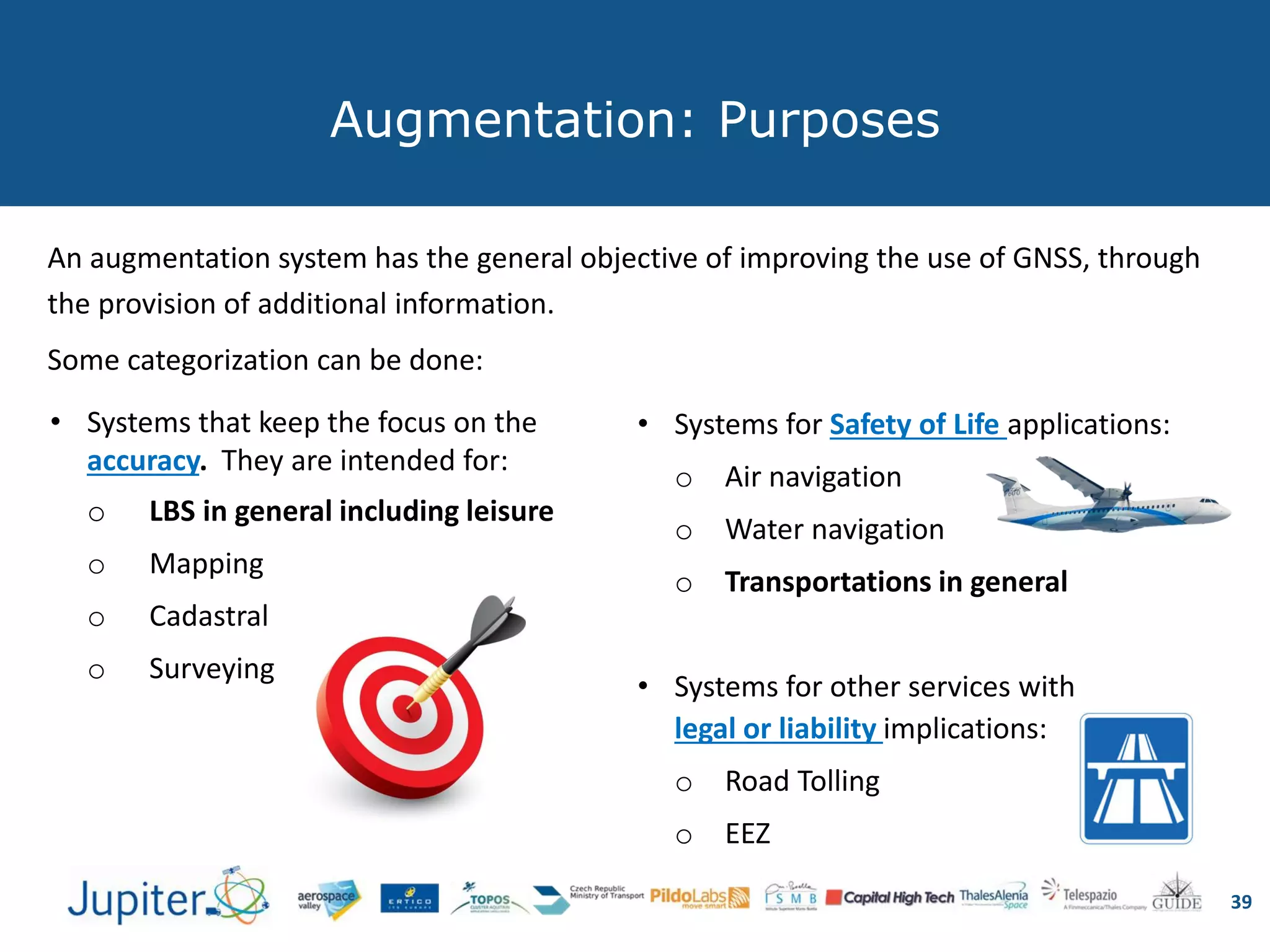
An augmentation system has the general objective of improving the use of GNSS, through
the provision of additional information.
Some categorization can be done:
• Systems that keep the focus on the
accuracy. They are intended for:
o LBS in general including leisure
o Mapping
o Cadastral
o Surveying
• Systems for Safety of Life applications:
o Air navigation
o Water navigation
o Transportations in general
• Systems for other services with
legal or liability implications:
o Road Tolling
o EEZ
EGNOS
40
• EGNOS is the EUROPEAN AUGMENTATION system
• Its purpose is to enable aircrafts to
use GPS for all phases of flight, from
en route down to precision approaches
to any airport within its coverage area.
• EGNOS was promoted by European
Tripartite Group formed by Eurocontol,
the European Community and the European Space Agency.
• Its main features are the provision of:
o Wide Area Differential corrections
o Integrity information
Currently it improves
the use of GPS
41
EGNOS Services
EGNOS provides three services:
• Safety of Life
– http://egnos-user-support.essp-
sas.eu/new_egnos_ops/sites/default/files/library/official_docs/egnos_sol_sdd
_in_force.pdf
• Open Service
– http://egnos-user-support.essp-
sas.eu/new_egnos_ops/sites/default/files/library/official_docs/egnos_os_sdd_
v2_2.pdf
• EDAS (EGNOS Data Access Service)
– http://egnos-user-support.essp-
sas.eu/new_egnos_ops/sites/default/files/library/official_docs/egnos_edas_sd
d_v2_1.pdf
EGNOS Reception Problems
42
Brand Model EGNOS in use Tracking SV 120 Tracking SV 126
µblox LEA 6-T 40.3% 20.1% 30.8%
NovAtel FlexG2-V2 35.5% 12.7% 16.1%
GPS without correction
GPS corrected by EGNOS
EGNOS Data Access Service (EDAS)
• EGNOS is now providing a terrestrial commercial data service: EDAS
o EDAS offers ground-based access to EGNOS data.
o EDAS is the single point of access for the data collected and generated by the
EGNOS infrastructure.
• The main types of data provided by EDAS are:
o GPS, GLONASS and EGNOS GEO data collected
by the entire EGNOS stations network
o EGNOS augmentation messages
identical to those broadcast via
Geostationary Satellites
o Antenna phase centre coordinates
for each EGNOS reference station.
43
EDAS Main Purposes
EDAS allows registered users to plug into EGNOS to receive the internal data
collected, generated and delivered by EGNOS.
EDAS therefore provides an opportunity:
• to deliver EGNOS data to users who cannot always view the EGNOS satellites
(such as in urban canyons)
• to support a variety of other services, applications and research
programmes.
EDAS services are intended to be delivered and maintained over the long term.
44
EDAS Applications
• Redistribution of EGNOS augmentation messages:
– They can be exploited in urban canyons for user communities with their own
equipment standards
• A-GNSS (Assisted GNSS) for Location Based Services: this application can
be used by many user communities, such as:
– Mobile network operators to provide positioning assistance service to their
customers
– Third parties in order to offer Location Based Services in urban areas.
– Emergency services using the position information of mobile phones.
– Network operators in order to use input data to support current or future
A-GNSS services.
45
EDAS Applications
• Professional GNSS Services: for users within surveying, oil and gas
exploration, mapping, construction, tracking and more.
• Development and validation of added value applications.
• Supporting geodetic and mapping research.
• Application of DGNSS and RTK positioning techniques in areas close to
EGNOS stations in order to enhance precision
• EGNOS messages through SISNeT for mobile receivers with Internet
access, irrespective of the GEO visibility conditions in order to improve
accuracy with respect to GPS.
• Research initiatives linked to the analysis of the atmosphere behaviour.
• Offline and real-time processing for GNSS performance analysis.
46
EDAS Architecture
47
EDAS Services
The EDAS services are classified in:
• Main Data Stream Services deliver raw data via:
– Service Level 0 (SL0): it is needed to either transmit data in raw format, or transmit them in a
format that allows a complete reconstruction after decoding.
– Service Level 2 (SL2): it is used to transmit data in RTCM 3.1 standard.
• Data Filtering service allows EDAS users to access a subset of the SL0 or SL2
data to reduce bandwidth consumption
• FTP service enables EDAS users to get EDAS/EGNOS historical data in different
formats and data rates
• SISNeT service provides access to the EGNOS GEO satellites messages over the
Internet through the SISNeT protocol (defined by ESA in 2002)
• Ntrip service provides data from the EGNOS network through the Ntrip
protocol which represent the standard for differential correction distribution
48
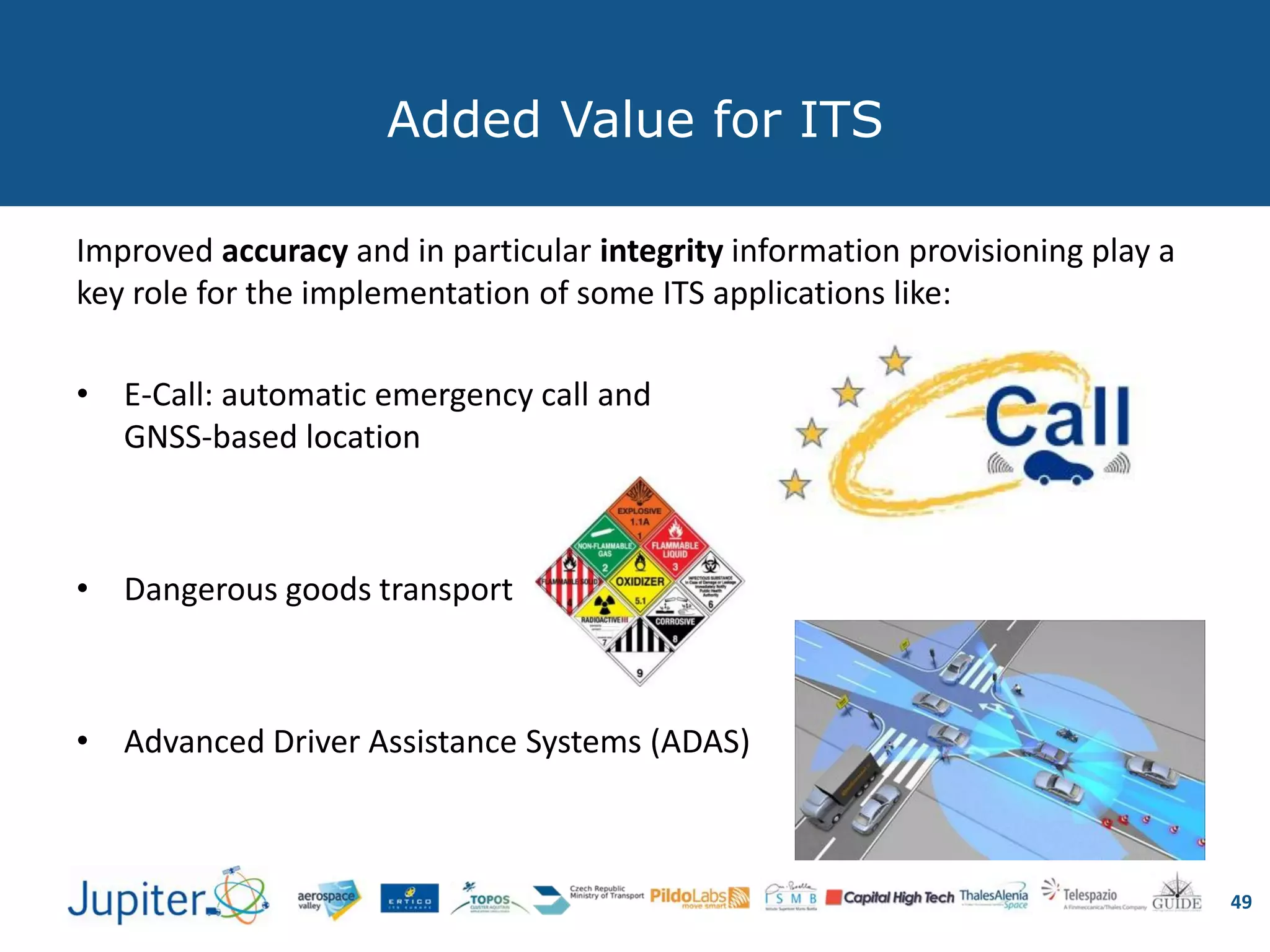
Added Value for ITS
Improved accuracy and in particular integrity information provisioning play a
key role for the implementation of some ITS applications like:
• E-Call: automatic emergency call and
GNSS-based location
• Dangerous goods transport
• Advanced Driver Assistance Systems (ADAS)
49
Table of Content
50
Introduction
GNSS Principles
European GNSS: Galileo
Integrity
Galileo
51
• Initiative of the European Union (EU) and
the European Space Agency (ESA),
in collaboration with European Industries
• Galileo is a civil system under civil control
• Galileo offers more and new services
• Galileo is independent from GPS
• Galileo is compatible and interoperable with GPS
Galileo Adds-on
52
• Improved by new modulation schemesPrecision
• Improved by specific orbit design *Availability
• Improved by specific orbit design *Coverage
• Improved by Authentication service (CS◊)Reliability
• Improved by High Accuracy service (CS◊)Accuracy
* advantage also by multi constellation ◊ Commercial Service
Galileo System Testbed v1
Validation of critical algorithms
GIOVE A/B
2 test satellites
In-Orbit Validation
4 fully operational satellites
and ground segment
Initial Operational Capability
Early services for OS, SAR,
PRS
2003
2005/2008
2013
2015/2016
Full Operational Capability
Full services, 30 satellites
2020
Galileo Implementation Plan
53
Definition of GNSS Signal Authentication
Authentication is the certification that a received signal is not counterfeit,
that it originates from a GNSS satellite and not from a spoofer
Source:
Wesson K., Rothlisberger M., Humphreys T.,
“Practical Cryptographic Civil GPS Signal Authentication,”
Navigation, Journal of The Institute of Navigation, Vol. 59, No. 3, Fall 2012, pp. 177-193.
The presence of a cryptographically secure portion in the received GNSS
signal is required: it is sometimes referred as:
security code
or
digital signature
54
Why Authentication?
• Demand of high quality Location-Based Services, able to provide high accuracy
and reliable position and time information
• GNSS is used for liability-critical applications and commercially-sensitive
Location Based Services: information about the user’s position or velocity is
the basis for legal decisions or economic transactions
– E.g. Road User Charging, Pay-As-You-Drive insurances, mobile payments, etc.
• Surveillance and safety-critical systems rely on GNSS (e.g. dangerous goods
transportation and law enforcement)
• There is a risk of intentional alteration of the GNSS signals by means of
jamming, meaconing or spoofing attacks, made for frauds, illicit exploitation
or offence purposes by hackers and terrorists
• Countermeasures can be possibly based on cryptographically secure signals
Non-cryptographic defences are also possible
55
Spoofing Attack Detection with
Authenticated Signal
56
57
Galileo Services
Open Service (OS)
Freely accessible service for
positioning, navigation and timing
Public Regulated Service (PRS)
Encrypted service designed for greater
robustness and higher availability
Search and Rescue Service (SAR)
Assists locating people in distress and
confirms that help is on the way
Commercial Service (CS)
Delivers authentication and high accuracy
services for commercial applications
Integrity Monitoring Service
Provides vital integrity information
for life-critical applications
The former "Safety-of-Life" service is being re-profiled:
Authentication Provisioning
• The main services foreseen to be part of the CS are high accuracy and
authentication
• Authentication scheme foreseen for CS can be based on both Spreading
Code Encryption (SCE) and Navigation Message Authentication (NMA)
• Relying on these schemes the provision of two levels of authentication
would be possible:
– a data-based authentication service in the E1 I/NAV open signals for mass market users
– a data-based plus spreading-code based authentication service through the CS signals
58
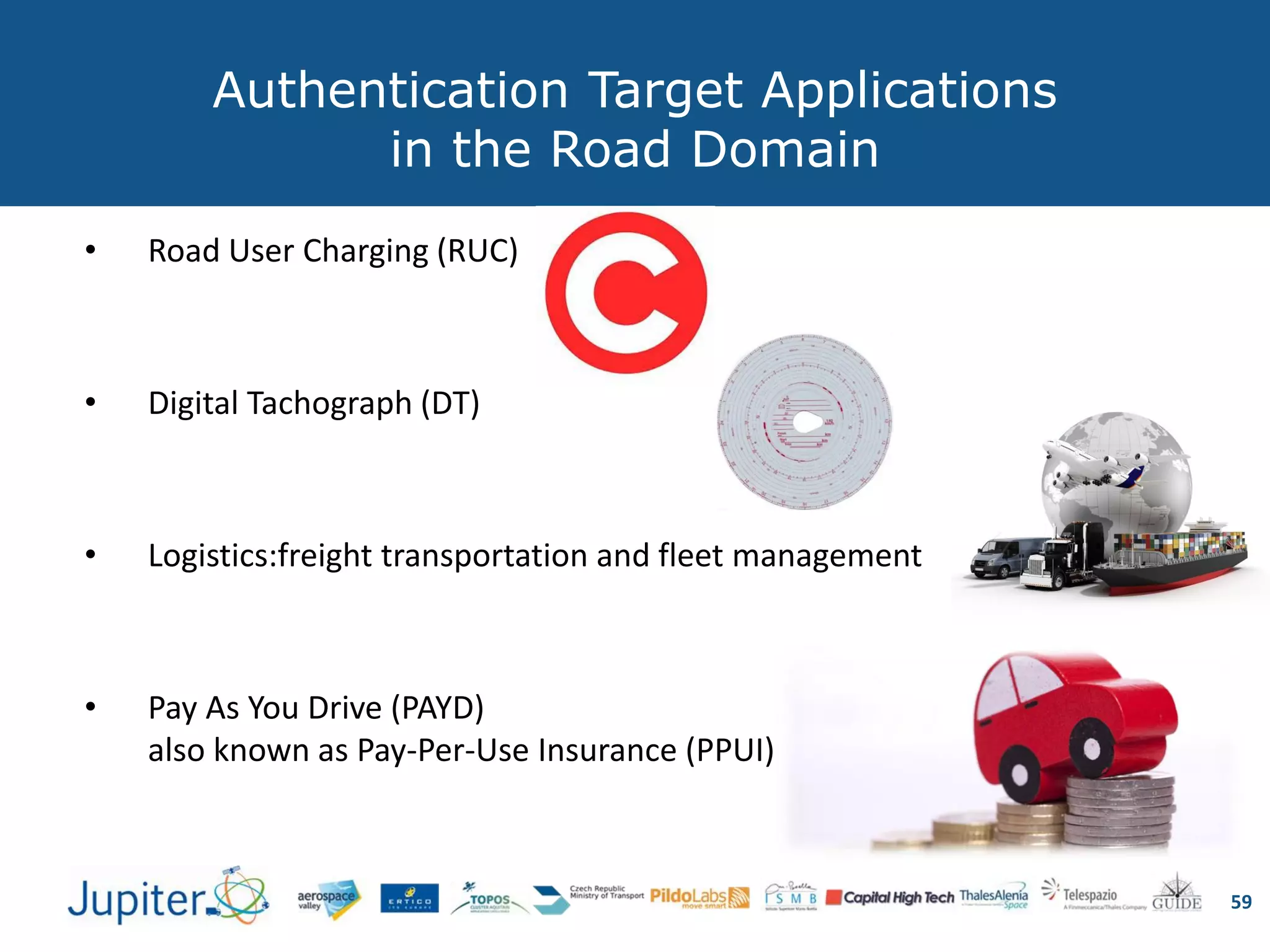
Authentication Target Applications
in the Road Domain
• Road User Charging (RUC)
• Digital Tachograph (DT)
• Logistics:freight transportation and fleet management
• Pay As You Drive (PAYD)
also known as Pay-Per-Use Insurance (PPUI)
59
Summary
Integrity + Authentication = Reliability
• The term reliability is used to refer to integrity and authentication together,
it means the availability of a trusted Position Velocity and Time (PVT) that can
be exploited in liability-critical (as Road User Charging) and safety-critical
applications (as Advanced Driver Assistance Systems)
• Now, it is worth to recall some specification about the level of maturity of the
two features above:
– Authentication protects against false signal that can be generated intentionally: an
authentication service once implemented offers a guarantee that still depends on
the level of the attack
– Integrity has been validated for some applications (typically aviation) and
research in other application fields is still undergoing in particular to take into
account local effects (i.e. error sources) that can’t be easily modelled being
related to local electromagnetic propagation effects (mainly multipath)
62
Table of Content
63
Introduction
GNSS Principles
European GNSS
Integrity
Integrity: Definitions
• Formal:
ability of the system to provide timely warnings to
users when it may not be used to navigate
• Informal:
“I know I’m getting this accuracy, the system is not
lying to me…”
by dr. Brad Parkinson (GPS father)
64
Outline
65
• Need for GNSS integrity in road applications
• The novel “Local Integrity” approach
– Reference system architecture for the Local Integrity
– Cooperative estimation of the local GNSS degradations
• Experimental proof-of-concept
– Urban tests
• Prototype demonstrator of Local Integrity
Classic (Aviation-Born) Integrity Approach
• Principally defined in the aviation context
– For strictly Safety-of-Life applications
– Integrity information (Protection Levels)
provided by augmentation systems (SBAS or LAAS)
• Growing interest in other transportation fields
– Maritime, rail, and vehicular transportation fields
– Need for “reliable” (integer and possibly certified)
positioning information, especially in case of safety-critical or liability-
critical applications
• Applicability of “classic” integrity concepts is far from being straightforward
in case of non-aviation operations
– Deep reconsideration needed, especially in urban contexts
66
Does the Classic Integrity framework
fit for the road domain?
67
It is possible to adopt the classic integrity mechanisms, for road applications?
1) Integrity and continuity risks too conservative
– At least for non-Safety-of-Life applications
2) Integrity and continuity risks assigned per phase of flight
– No matching with on-the-road behaviours
3) Aeronautical GNSS signal propagation models inconsistent
– They assume open-sky satellite visibility
– They assume diffuse ground multipath only, line-of-sight only propagation
– They often assume the availability of local differential corrections
No, it is not
Effect of the receiver and of the «local»
environment nearby the receiver
Outline
68
• Need for GNSS integrity in road applications
• The novel “Local Integrity” approach
– Reference system architecture for the Local
Integrity
– Cooperative estimation of the local GNSS
degradations
• Experimental proof-of-concept
– Urban tests
• Prototype demonstrator of Local Integrity

The Novel “Local Integrity” Approach
69
• Methodology to quantify in average the effects of the local environment
nearby the receiver
– Specifically designed for a road domain
– Intended to overcome the difficulty in modelling the local environment
• Proposed and developed in the framework of the EU FP7 GLOVE project
The Novel “Local Integrity” Approach
70
– Cars used as sensors for signal quality assessment using mass-market
receivers
– GNSS observations taken on board of the cars are shared by means of
VANET communications
– Collaborative monitoring of GNSS signals in urban scenarios
• Spatial/temporal characterization of local signal degradations
• Computation of “Local Protection Levels” ellipses
– On the basis of an “ensemble monitoring” of the quality of the received
signal in a given area and time
– Defined on Along-Track (AT) and Cross-Track (CT) directions
AT
CT
• Basic elements (“ingredients”):
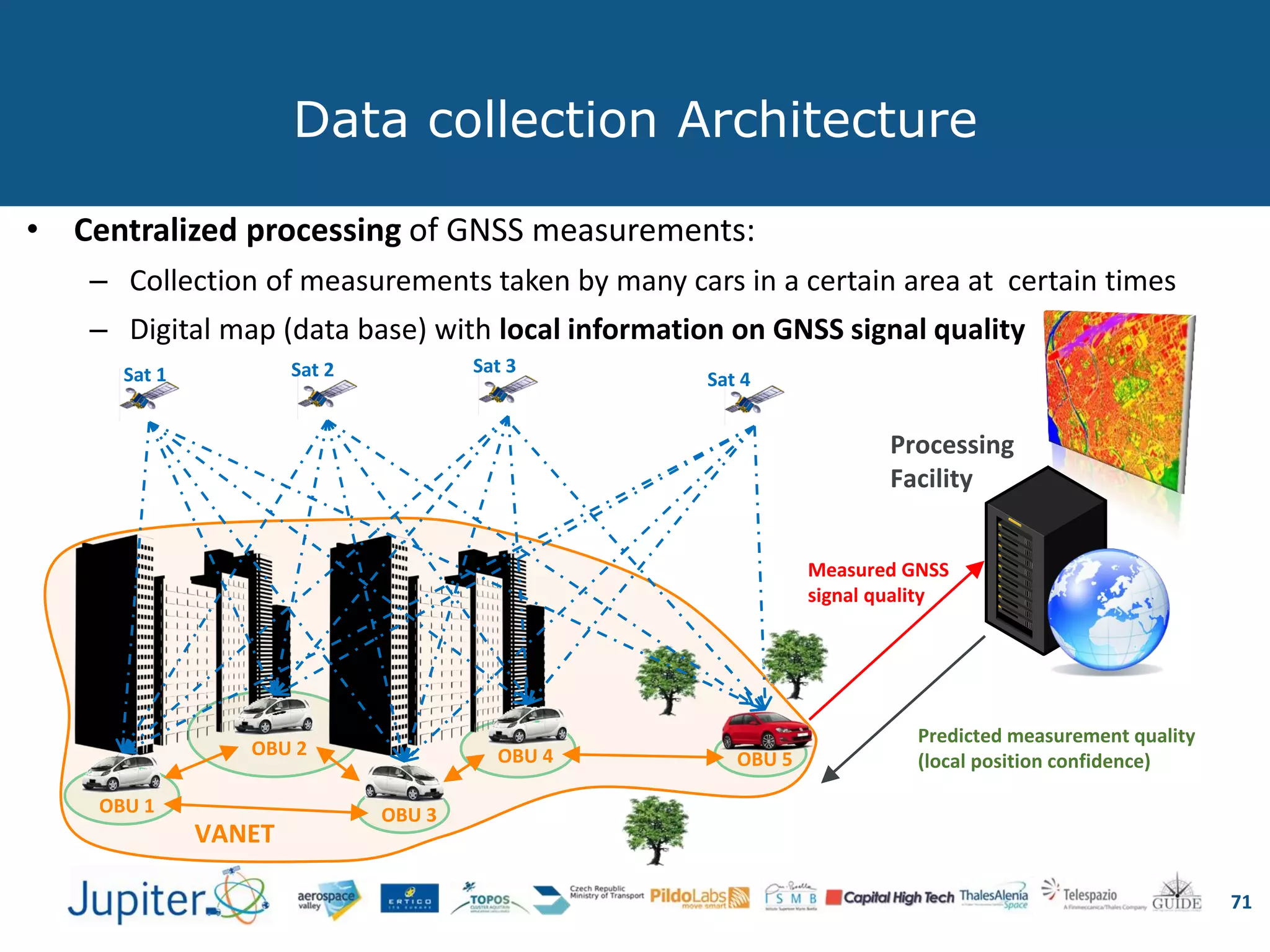
Data collection Architecture
71
• Centralized processing of GNSS measurements:
– Collection of measurements taken by many cars in a certain area at certain times
– Digital map (data base) with local information on GNSS signal quality
Processing
Facility
Measured GNSS
signal quality
Predicted measurement quality
(local position confidence)
Sat 1 Sat 2 Sat 3
Sat 4
OBU 2 OBU 4
OBU 1 OBU 3
OBU 5
VANET
Definition of “Local Protection Levels”
72
• How does the signal quality information coming from the central processing
facility affect the protection level computation?
• Classic definition of Protection Level:
 
1
UEREPL · · T
k trace

 
  
H H
Multiplicative factor related to
the integrity risk requirements
Factor related
to the satellite
geometry
(Dilution of
Precision)
User Equivalent Range Error
New error model, taking into account
local GNSS signal degradations
UERE,eff
New definition of «Local» Protection Level
• New “Effective User Equivalent Range Error”
– Obtained as an ensemble estimation, computed for each satellite
in view, in each position of a grid in a map, at each hour of the day
Measuring the Local GNSS quality
73
• Local measurements: Pseudorange Residuals
– Difference between the measured pseudoranges and the estimated ones, on the
basis of the satellite and receiver positions
– Observable quantity, typically used for assessing pseudorange measurement
quality in RAIM techniques
– In $GPGRS NMEA sentence
• Effective UERE estimation
– Ensemble average of the sample
covariance of the residuals
 
1
T T
LS 

x H H H y
LS w Hxy
2
UERE,
ˆ
4
T
eff
sat
E
N

 
 
 
 
 
 
 


ww
Outline
74
• Need for GNSS integrity in road applications
• The novel “Local Integrity” approach
– Reference system architecture for the Local
Integrity
– Cooperative estimation of the local GNSS
degradations
• Experimental proof-of-concept
– Urban tests
• Prototype demonstrator of Local Integrity


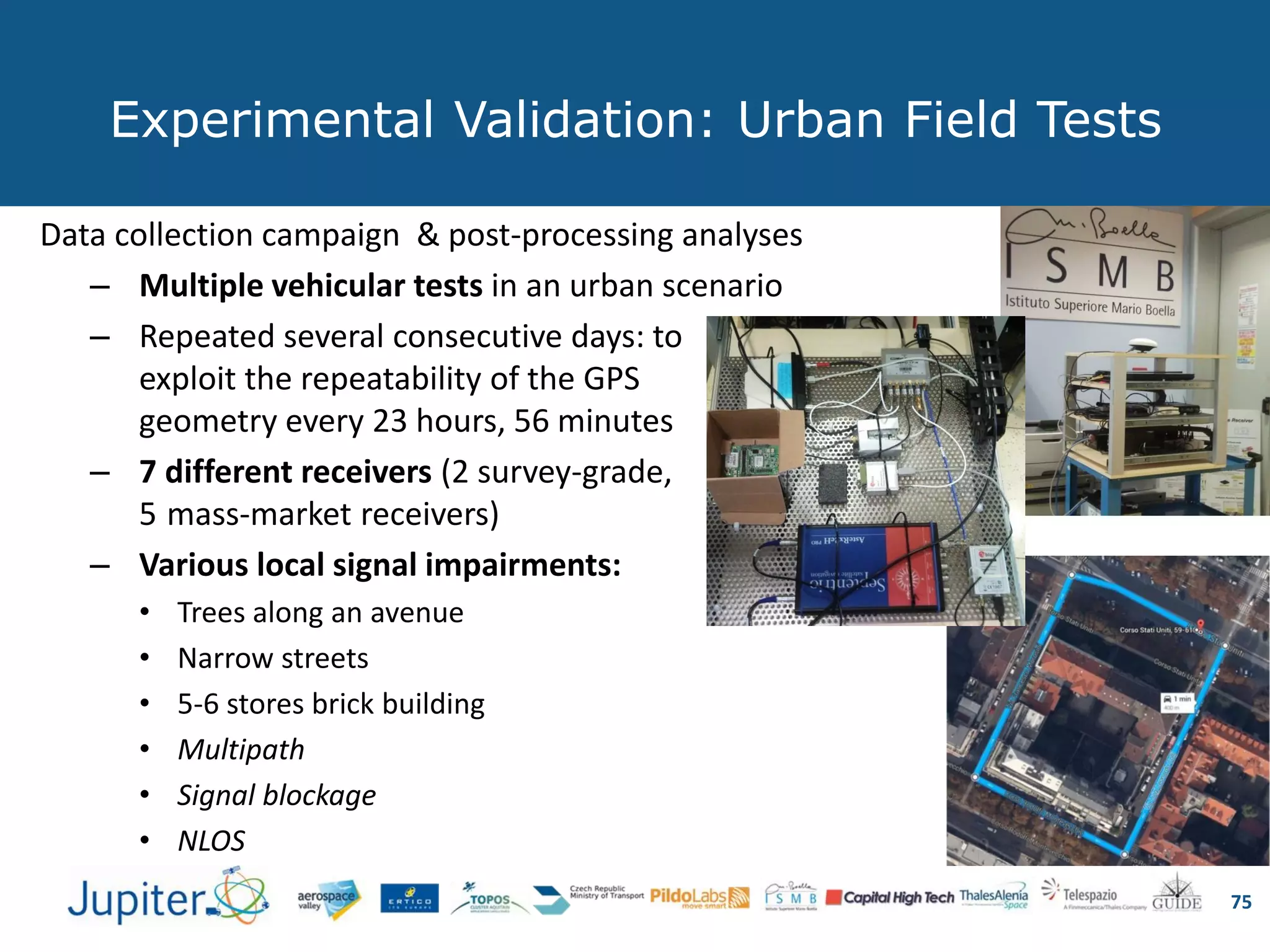
Experimental Validation: Urban Field Tests
75
Data collection campaign & post-processing analyses
– Multiple vehicular tests in an urban scenario
– Repeated several consecutive days: to
exploit the repeatability of the GPS
geometry every 23 hours, 56 minutes
– 7 different receivers (2 survey-grade,
5 mass-market receivers)
– Various local signal impairments:
• Trees along an avenue
• Narrow streets
• 5-6 stores brick building
• Multipath
• Signal blockage
• NLOS
Range residuals are repeatable
76
• Repeatable degradations of range residual measurements
– Along the same path
– Along several days
– Due to the periodicity of the GNSS satellite geometry
11:42:00 11:43:00 11:44:00 11:45:00 11:46:00 11:47:00 11:48:00 11:49:00 11:50:00 11:51:00 11:52:00 11:53:00 11:54:00
-50
-40
-30
-20
-10
0
10
UTC time
Rangeresiduals[m]
Range residuals for SVs used in navigation vs UTC time
PRN 05
PRN 07
PRN 08
PRN 10
PRN 15
PRN 21
PRN 24
PRN 28
PRN 09
PRN 26
30
210
60
240
90270
120
300
150
330
180
0
15
30
45
60
75
90
5
8
9
15
26
28
7
10
Skyplot (satellites used in PVT) at UTC time 11:42:00
Two consecutive passes
in the same position
(1 minute delay)
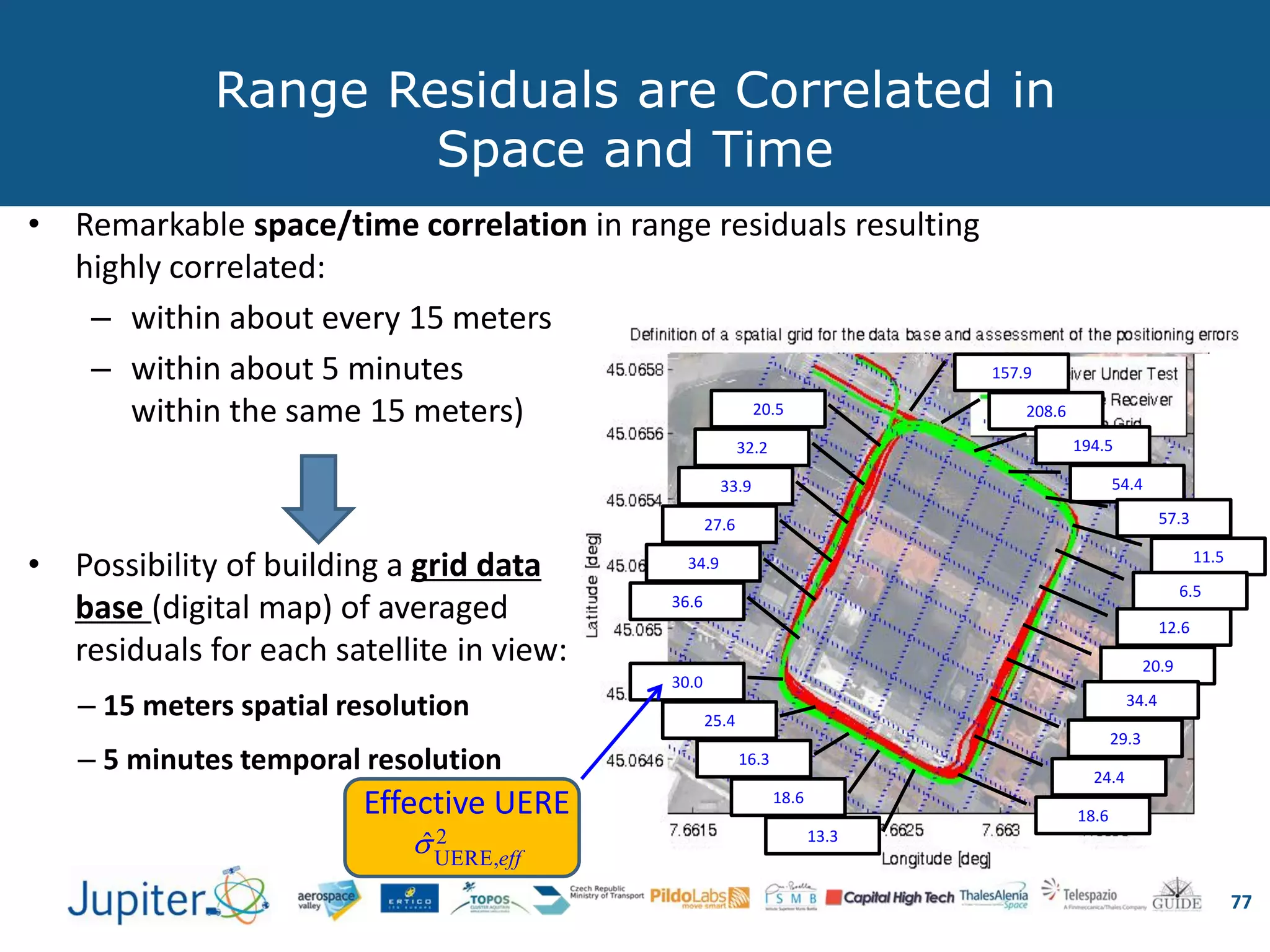
Range Residuals are Correlated in
Space and Time
77
• Remarkable space/time correlation in range residuals resulting
highly correlated:
– within about every 15 meters
– within about 5 minutes
within the same 15 meters)
• Possibility of building a grid data
base (digital map) of averaged
residuals for each satellite in view:
– 15 meters spatial resolution
– 5 minutes temporal resolution
157.9
208.6
194.5
54.4
57.3
11.5
6.5
12.6
20.9
34.4
29.3
24.4
18.6
30.0
25.4
16.3
18.6
13.3
20.5
32.2
33.9
27.6
34.9
36.6
Effective UERE
2
UERE,
ˆ eff

Outline
78
• Need for GNSS integrity in road applications
• The novel “Local Integrity” approach
– Reference system architecture for the Local
Integrity
– Cooperative estimation of the local GNSS
degradations
• Experimental proof-of-concept
– Urban tests
• Prototype demonstrator of Local Integrity



Proof-of-concept Demonstrator of
Local Integrity
79
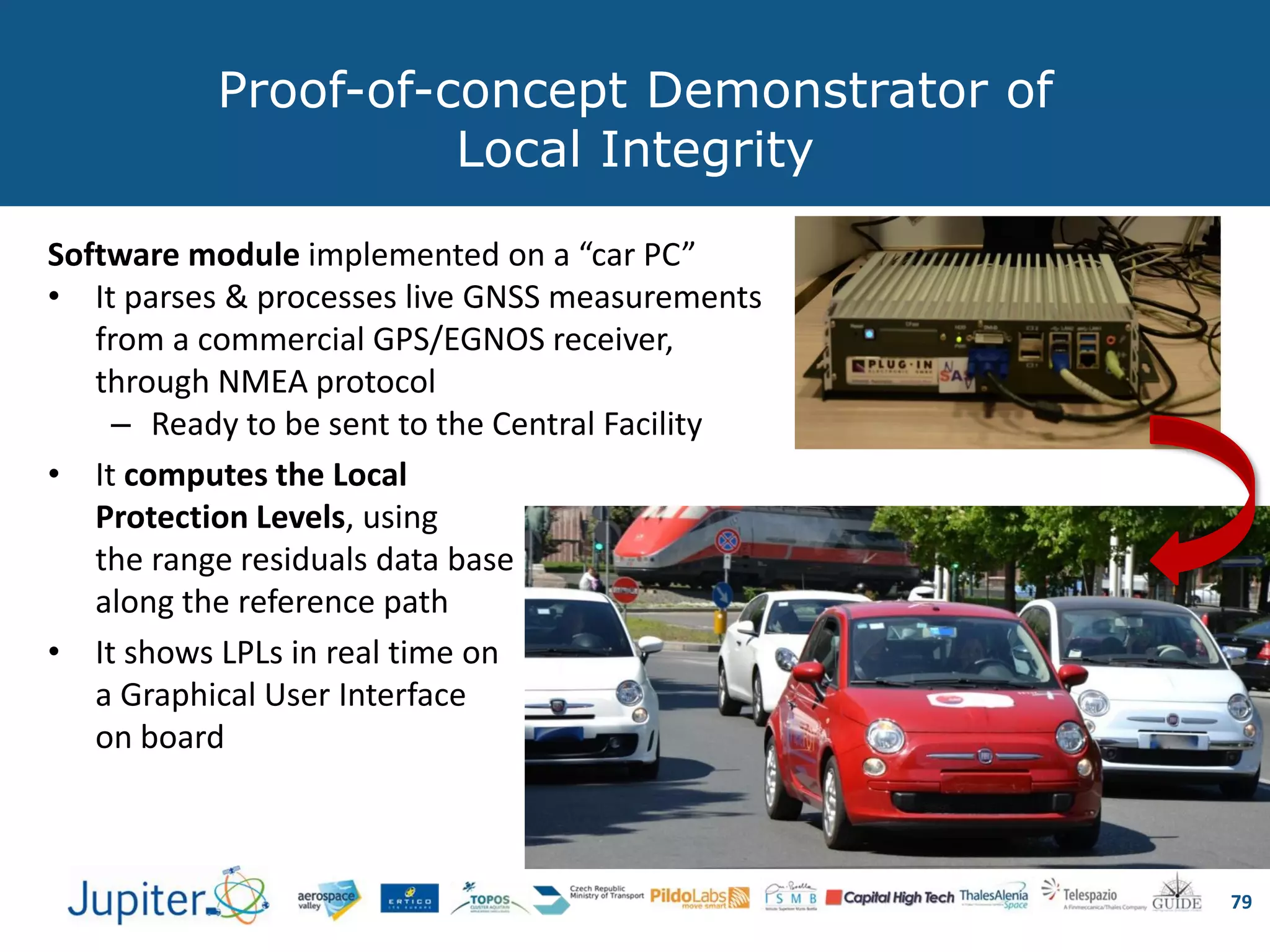
Software module implemented on a “car PC”
• It parses & processes live GNSS measurements
from a commercial GPS/EGNOS receiver,
through NMEA protocol
– Ready to be sent to the Central Facility
• It computes the Local
Protection Levels, using
the range residuals data base
along the reference path
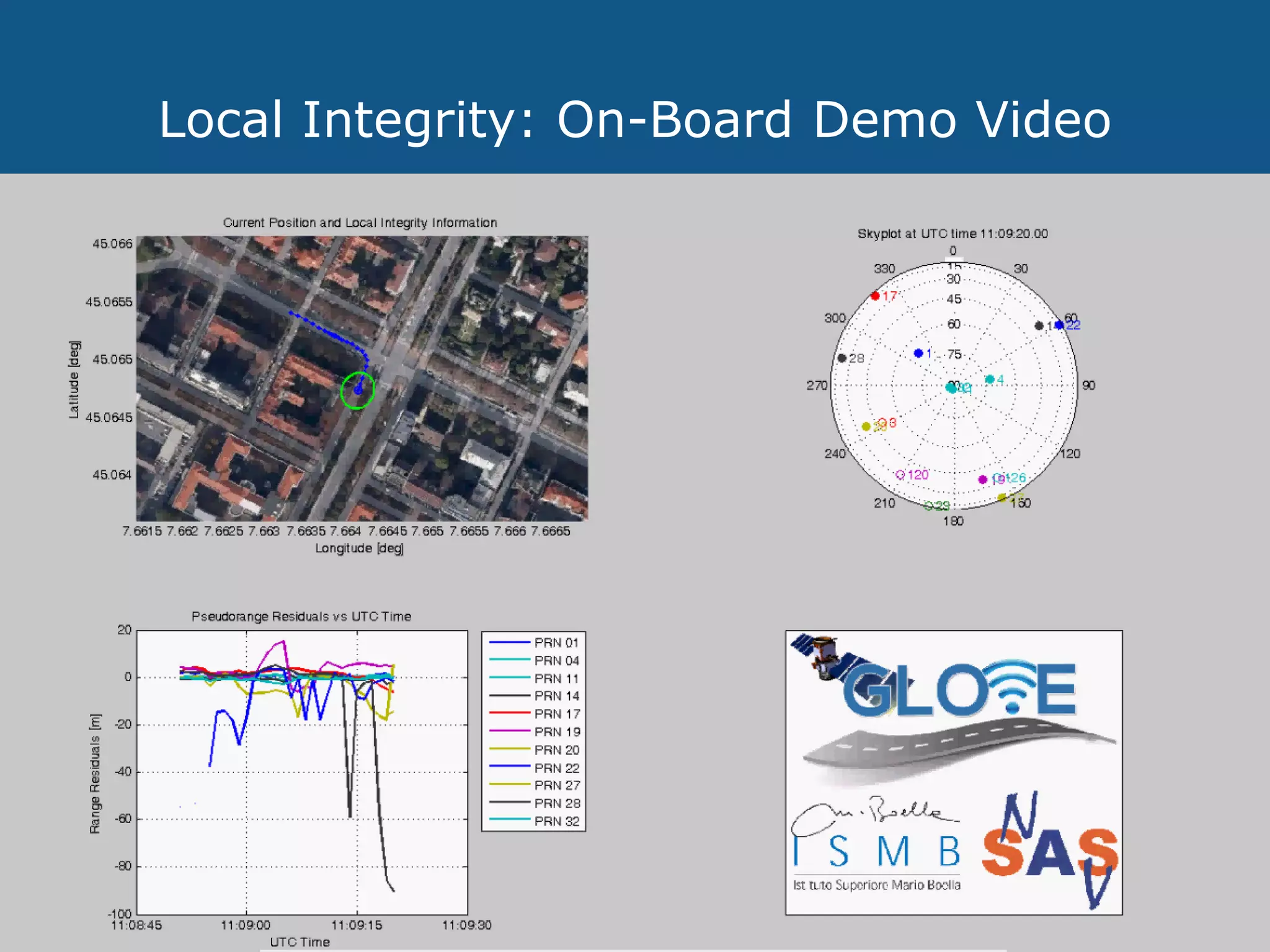
• It shows LPLs in real time on
a Graphical User Interface
on board
Local Integrity: On-Board Demo Video
80
Local protection level: analysis of the results
81
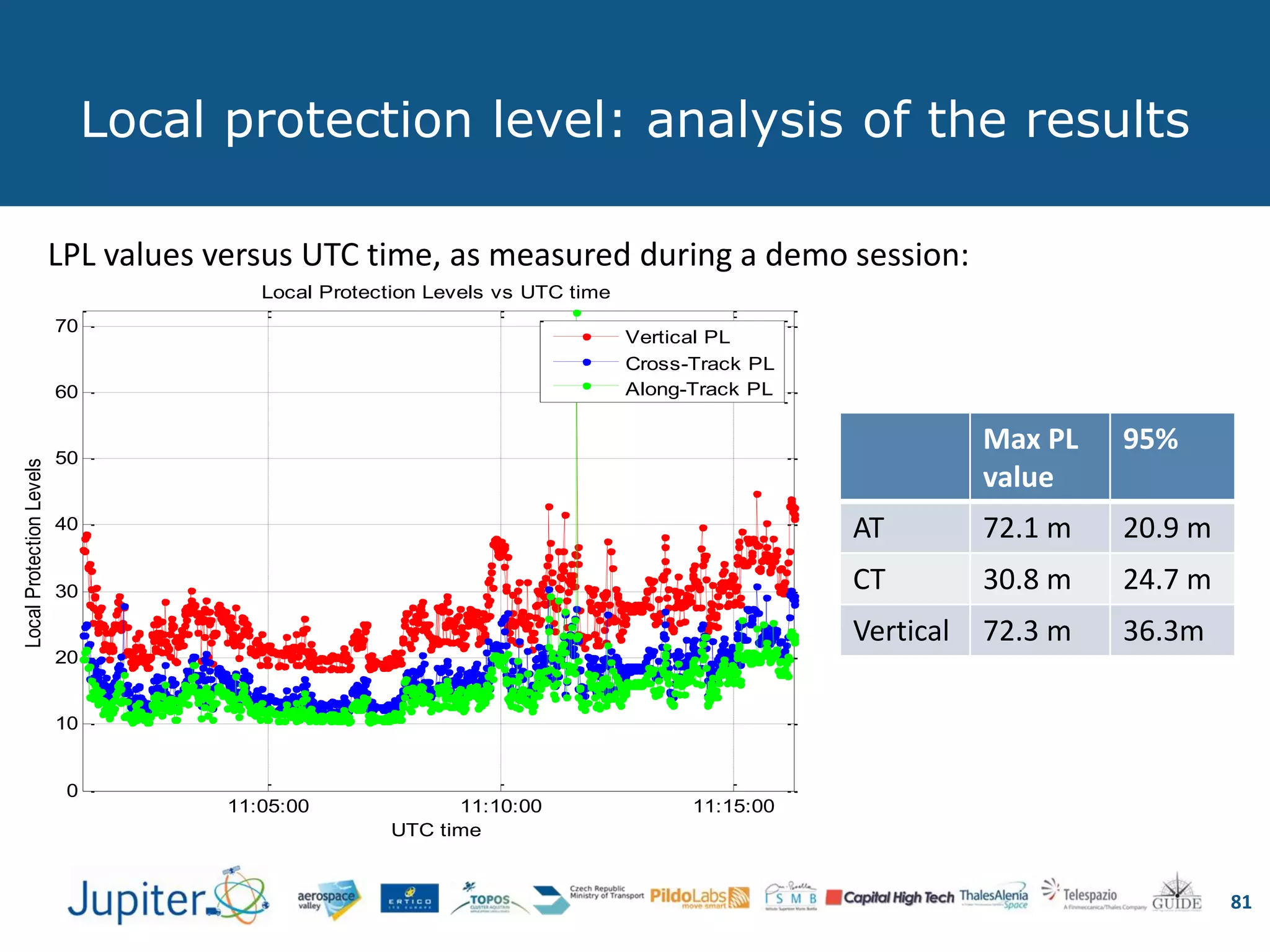
LPL values versus UTC time, as measured during a demo session:
11:05:00 11:10:00 11:15:00
0
10
20
30
40
50
60
70
UTC time
LocalProtectionLevels
Local Protection Levels vs UTC time
Vertical PL
Cross-Track PL
Along-Track PL
Max PL
value
95%
AT 72.1 m 20.9 m
CT 30.8 m 24.7 m
Vertical 72.3 m 36.3m
Final remarks and future developments
82
Promising concept for the domain of the connected vehicles, but deeper
investigations are needed:
• Refinements of the statistical characterization of the different error sources
– Including detection of non-nominal errors
• Proper calibration of data-base building procedure to different scenarios
– Space and time resolution
• Extensive validation campaign of the data base
• Proper definition of the data communication protocols
– VANET
– Non-VANET (3G, LTE, …)
• Regulatory and standardization aspects
83
Contacts
Gabriella Povero – Gianluca Marucco – Matteo Vannucchi
Navigation Technologies
surname@ismb.it
www.navsas.eu
www.ismb.it

Towards Autonomous Driving on road: the E-GNSS contribution

  • 1.
    Towards Autonomous Drivingon road: the E-GNSS contribution From basic concepts to "local integrity"
  • 2.
    Speakers: Ing. Gianluca Marucco Mr.Matteo Vannucchi Moderator: Ing. Gabriella Povero
  • 3.
    Table of Content 3 Introduction GNSSPrinciples European GNSS Integrity
  • 4.
    Table of Content 4 Introduction GNSSPrinciples European GNSS Integrity
  • 5.
    Autonomous Driving Technologies relevantin driver assistance systems and autonomous vehicles: • vehicle electronics • vehicle dynamics • command/control • HMI • perception • computer vision • data-fusion • communication • eco-driving • … and NAVIGATION! 5 2009 by Kozuch By ESA/RAL Space/ESO - http://www.eso.org/public/images/ann12048a/, CC BY 3.0, https://commons.wikimedia.org/w/index.php?cu rid=19979586
  • 6.
    Autonomous Driving Role ofGNSS: • routing can be decided using digital maps. • navigation by determining vehicle location and speed • lane and attitude determination • short-range situation awareness system (awareness of other vehicles in the road and collision avoidance) in combination with positional information sharing among cars 6
  • 7.
    Table of Content 7 Introduction GNSSPrinciples : introduction European GNSS Integrity
  • 8.
    Global Navigation SatelliteSystems 8 GNSS enable users (on Earth surface or flying) to determine their position with respect to a Reference Frame x y z
  • 9.
    Trilateration 9 The receiver isable to measure the TOA (Time Of Arrival) and consequentially the distances Transmitters are in known positions The receiver is in an unknown position
  • 10.
    10 The Basic Tool:the Clock The Time Of Arrival is measured by the receiver The time of departure is known (set by transmitter) The travel time is their difference The distance is the travel time multiplied by the speed of light. Transmitters and receivers MUST be equipped with clocks.
  • 11.
    11 The Basic Tool:the Clock Time difference between TX and RX is the basis. TX and RX clocks must be synchronized Synchronization error of 1μs corresponds to an error distance of approx. 300 m Very onerous requirement!!
  • 12.
    12 Trilateration by Satellites ),,(ooo zyx x y z ),,( kkk zyx The user to be located (receiver) Unknown position The satellites are equipped with atomic clocks Satellites are at known positions, as we know the orbits and the satellite time Transmitters are on board satellites
  • 13.
    13 GNSS in OneSlide A Global Navigation Satellite System (GNSS) consists of a constellation of satellites with global coverage, whose payloads are designed to provide positioning of objects x y z GNSSs implement the trilateration method (spherical positioning systems) The satellites are at known positions, as we know satellite orbits and time Reference Coordinate Systems and Frames Time Scales
  • 14.
    14 3D Positioning EARTH Three distancemeasurements appear to be enough for positioning in a three dimensional space
  • 15.
    15 How Many Satellites? Why? Tosidestep the synchronisation requirement ),,( ooo zyx x y z ),,( kkk zyx 4 Satellites
  • 16.
    16 Ranges and Pseudoranges ),,(ooo zyx x y z ),,( kkk zyx TOA measurements at the receiver are affected by the same clock bias )( cb )( cb )( rb Receivers are equipped with inexpensive quartz oscillators. The range bias becomes the fourth unknown to be estimated )( rb Because of the bias pseudoranges are measured instead of ranges )( rb
  • 17.
    The Navigation Equation 17 •In order to estimate its position a receiver must have at least four satellites in view • The satellites must be in Line-of-Sight • If a larger number of satellites is in view a better estimation is possible. In the past the combination of four satellites giving the best performance was chosen • Modern receivers use several channels in order to perform the position estimation REMARKS x y z
  • 18.
    Table of Content 18 Introduction GNSSPrinciples: receivers European GNSS Integrity
  • 19.
    19 Control system errors: •Clocks • Ephemeris The Hard Work of GNSS Receivers Multipath Interference and jamming Indoor Bluetooth WLAN Urban canyons Atmospheric errors: • Ionosphere • Troposphere Doppler ↔ Low SNR
  • 20.
  • 21.
    21 The Receiver Chain Letus consider the SIS of a single SV (space vehicle) SIS (Signal in Space) Antenna RF Front-end ADC GNSS Digital receiver )(tyIF )(tyRF Pseudorange
  • 22.
    GNSS Receiver Operations 22 Acquisition Skysearch Tracking Measurements Refines code and carrier alignment Search for IDs of visible satellites Code delay and Doppler estimates, rough alignment of code and carrier Pseudorange and data demodulation 1 2 3 4
  • 23.
    Computation Usually thePVT Integration with external info Not present in all receivers HMI Not present in all receivers 5 6 7 GNSS Receiver Operations 23
  • 24.
  • 25.
    Description Device Price[€] Handheld receivers for hikers and sailors. Small size with latitude-longitude displays and maps. 100 - 600 Integrated GPS in mobile phones. Low cost and single frequency. 50-600 Maritime navigators. Fixed mount, large screens with electronics chart 100-3000 In-car navigation systems. Detailed street maps and turn-by-turn directions. These systems can be also handheld (e.g. PDA) 100-2000 Receivers Classes 25 Price differences are due to reason independent from the embedded GNSS chip
  • 26.
    Description Approx. Price[€] Aviation receivers. FAA in US and EASA in Europe certified, panel mounted with maps. INTEGRITY REQUIRED ! >3000 Survey and mapping professional receivers. Multi-frequency and differential GPS, centimeter accuracy 1500 – 30000 Receivers Classes 26 Price differences are due to reason independent from the embedded GNSS chip
  • 27.
    Description Approx. Price[€] Plug-in modules. Integrated receivers and antenna. Employed in tracking systems 30 – 700 OEM boards. Employed for integration in other complex systems. 100 – 5000 Chip sets. Employed for integration, but all the circuitry is needed 1 – 30 GNSS Modules 27
  • 28.
    Professional vs Mass-MarketReceivers 28 Raw measurements availability and configurability Carrier Phase vs Code Phase? Configurability DGNSS … RTK
  • 29.
    Receivers Classification: MarketSegment 29 Category Receiver Characteristics Consumer Single frequency, cost driven, high volume, moderate performance, also multi constellation Light Professional Single frequency, multi constellation, cost driven, low volume, good performance, integration with external devices, professional features Professional Multi frequency, multi constellation, cost/requirements driven, low volume, high performance, advanced processing algorithms Safety of Life Double/ Multi frequency, multi constellation, requirements driven, low volume, high performance, high reliability, integrity, certification P R S Double frequency, low volume, high performance, high reliability, requirements driven, integrity, advanced processing algorithms
  • 30.
    GNSS RX Features 30 •Constellation exploited • Military or civil receiver • PVT update rate • Indoor operations or high multipath environment • Interference mitigation • Dynamic conditions (static or high dynamic) • DGPS or WAAS/EGNOS capability (RTK input/ output) • Storage of log data • Shock and vibration tolerance • Cartographic support • INS integration or dead-reckoning systems • Integration with COM systems • Portability • Usability • Power consumption • Cost
  • 31.
    Example of TechnicalSpecification (1) 31 Septentrio PolaRx4 PRO • 264 hardware channels • TRACK+: Septentrio’s low-noise tracking algorithms, • GPS L1/L2/L2C/L5, • GLONASS L1/L2 • Galileo E1, E5a, E5b, E5 AltBOC and • GLONASS CDMA L3 • experimental tracking of Beidou signals • AIM+: Advanced Interference Monitoring and Mitigation • APME+: extends Septentrio’s patented A Posteriori Multipath Estimator to GLONASS, Galileo and Beidou signals • ATrack+: is Septentrio’s patented Galileo AltBOC tracking.
  • 32.
    Example of TechnicalSpecification (2) 32 Septentrio PolaRx4 PRO Pseudorange noise (not smoothed) Carrier Phase GPS L1 C/A 16 cm L1/E1 <1 mm GLONASS L1 open 25 cm L2 1 mm Galileo E1 B/C 8 cm L5/E5 1.3 mm Galileo E5 A/B 6 cm Doppler Galileo E5 AltBOC 1.5 cm L1/L2/L5 0.1 Hz GPS L2 P(Y) 10cm GLONASS L2 (mil) 10m
  • 33.
    Example of TechnicalSpecification (3) 33 NovAtel 628 • 120 hardware channels • GPS L1 L2 L2C L5 • GLONASS L1 L2 • Galileo E5a E5b E5 AltBOC • Beidou B1 B2 • QZSS • L-Band • RT-2 (RTK algorithm) • Pulse Aperture Correlator (PAC) multipath mitigation technology • SPAN INS integration technology • …
  • 34.
    Example of TechnicalSpecification (4) 34 NovAtel 628 Pseudorange noise (not smoothed) Carrier Phase GPS L1 C/A 4 cm L1 GPS 0.5 mm GLONASS L1 open 8 cm L1 GLONASS 1 mm GPS L2 P(Y) 8 cm L2 1 mm GPS L2C 8 cm L2C 0.5 mm GPS L5 3 cm L5 0.5 mm GLONASS L2 open 8cm GLONASS L2 mil 8 cm
  • 35.
    Example of TechnicalSpecification (5) 35 NovAtel 628 Position Accuracy (RMS) Signal Reacquisition Single point L1 1.5 m L1 <0.5 s (typical) Single point L1/L2 1.2 m L2 <1.0 s (typical) SBAS (GPS) 0.6 m Maximum Data Rate DGPS 0.4 m Measurements 100 Hz (20 SV) L-band VBS 0.6 m Positions 100 Hz (20 SV) L-band XS 15 cm Vibration L-band HP 10 cm Random vibe MIL-STD 810G (Cat 24, 7.7 g RMS) RT-2 1 cm + 1ppm (BL) Sine vibe IEC 60068-2-6
  • 36.
    GNSS Receivers Capability 36 GNSSMarket Report 2015 - GSA
  • 37.
    37 -2.5 -2 -1.5-1 -0.5 0 0.5 1 1.5 2 -2.5 -2 -1.5 -1 -0.5 0 0.5 1 1.5 2 East Error(m) NorthError(m) The position error w.r.t the mean position of GPS & GALILEO GPS GALILEO Galileo Real Early Performance (2014) • Galileo is benchmarked to GPS in terms of precision in the estimation of the position • In mid 2014 only 3 Galileo satellites were transmitting a valid navigation message • The position computation was performed using L1 data from: o 5 GPS satellites o 3 Galileo + 2 GPS satellites • Chosen GPS and Galileo satellites were those in view during the same time period and which elevation and azimuth angles were similar in pairs. The aim of this scenario is to have common ionospheric and troposheric effects for both the systems
  • 38.
    Table of Content 38 Introduction GNSSPrinciples European GNSS: EGNOS - EDAS Integrity
  • 39.
    Augmentation: Purposes 39 An augmentationsystem has the general objective of improving the use of GNSS, through the provision of additional information. Some categorization can be done: • Systems that keep the focus on the accuracy. They are intended for: o LBS in general including leisure o Mapping o Cadastral o Surveying • Systems for Safety of Life applications: o Air navigation o Water navigation o Transportations in general • Systems for other services with legal or liability implications: o Road Tolling o EEZ
  • 40.
    EGNOS 40 • EGNOS isthe EUROPEAN AUGMENTATION system • Its purpose is to enable aircrafts to use GPS for all phases of flight, from en route down to precision approaches to any airport within its coverage area. • EGNOS was promoted by European Tripartite Group formed by Eurocontol, the European Community and the European Space Agency. • Its main features are the provision of: o Wide Area Differential corrections o Integrity information Currently it improves the use of GPS
  • 41.
    41 EGNOS Services EGNOS providesthree services: • Safety of Life – http://egnos-user-support.essp- sas.eu/new_egnos_ops/sites/default/files/library/official_docs/egnos_sol_sdd _in_force.pdf • Open Service – http://egnos-user-support.essp- sas.eu/new_egnos_ops/sites/default/files/library/official_docs/egnos_os_sdd_ v2_2.pdf • EDAS (EGNOS Data Access Service) – http://egnos-user-support.essp- sas.eu/new_egnos_ops/sites/default/files/library/official_docs/egnos_edas_sd d_v2_1.pdf
  • 42.
    EGNOS Reception Problems 42 BrandModel EGNOS in use Tracking SV 120 Tracking SV 126 µblox LEA 6-T 40.3% 20.1% 30.8% NovAtel FlexG2-V2 35.5% 12.7% 16.1% GPS without correction GPS corrected by EGNOS
  • 43.
    EGNOS Data AccessService (EDAS) • EGNOS is now providing a terrestrial commercial data service: EDAS o EDAS offers ground-based access to EGNOS data. o EDAS is the single point of access for the data collected and generated by the EGNOS infrastructure. • The main types of data provided by EDAS are: o GPS, GLONASS and EGNOS GEO data collected by the entire EGNOS stations network o EGNOS augmentation messages identical to those broadcast via Geostationary Satellites o Antenna phase centre coordinates for each EGNOS reference station. 43
  • 44.
    EDAS Main Purposes EDASallows registered users to plug into EGNOS to receive the internal data collected, generated and delivered by EGNOS. EDAS therefore provides an opportunity: • to deliver EGNOS data to users who cannot always view the EGNOS satellites (such as in urban canyons) • to support a variety of other services, applications and research programmes. EDAS services are intended to be delivered and maintained over the long term. 44
  • 45.
    EDAS Applications • Redistributionof EGNOS augmentation messages: – They can be exploited in urban canyons for user communities with their own equipment standards • A-GNSS (Assisted GNSS) for Location Based Services: this application can be used by many user communities, such as: – Mobile network operators to provide positioning assistance service to their customers – Third parties in order to offer Location Based Services in urban areas. – Emergency services using the position information of mobile phones. – Network operators in order to use input data to support current or future A-GNSS services. 45
  • 46.
    EDAS Applications • ProfessionalGNSS Services: for users within surveying, oil and gas exploration, mapping, construction, tracking and more. • Development and validation of added value applications. • Supporting geodetic and mapping research. • Application of DGNSS and RTK positioning techniques in areas close to EGNOS stations in order to enhance precision • EGNOS messages through SISNeT for mobile receivers with Internet access, irrespective of the GEO visibility conditions in order to improve accuracy with respect to GPS. • Research initiatives linked to the analysis of the atmosphere behaviour. • Offline and real-time processing for GNSS performance analysis. 46
  • 47.
  • 48.
    EDAS Services The EDASservices are classified in: • Main Data Stream Services deliver raw data via: – Service Level 0 (SL0): it is needed to either transmit data in raw format, or transmit them in a format that allows a complete reconstruction after decoding. – Service Level 2 (SL2): it is used to transmit data in RTCM 3.1 standard. • Data Filtering service allows EDAS users to access a subset of the SL0 or SL2 data to reduce bandwidth consumption • FTP service enables EDAS users to get EDAS/EGNOS historical data in different formats and data rates • SISNeT service provides access to the EGNOS GEO satellites messages over the Internet through the SISNeT protocol (defined by ESA in 2002) • Ntrip service provides data from the EGNOS network through the Ntrip protocol which represent the standard for differential correction distribution 48
  • 49.
    Added Value forITS Improved accuracy and in particular integrity information provisioning play a key role for the implementation of some ITS applications like: • E-Call: automatic emergency call and GNSS-based location • Dangerous goods transport • Advanced Driver Assistance Systems (ADAS) 49
  • 50.
    Table of Content 50 Introduction GNSSPrinciples European GNSS: Galileo Integrity
  • 51.
    Galileo 51 • Initiative ofthe European Union (EU) and the European Space Agency (ESA), in collaboration with European Industries • Galileo is a civil system under civil control • Galileo offers more and new services • Galileo is independent from GPS • Galileo is compatible and interoperable with GPS
  • 52.
    Galileo Adds-on 52 • Improvedby new modulation schemesPrecision • Improved by specific orbit design *Availability • Improved by specific orbit design *Coverage • Improved by Authentication service (CS◊)Reliability • Improved by High Accuracy service (CS◊)Accuracy * advantage also by multi constellation ◊ Commercial Service
  • 53.
    Galileo System Testbedv1 Validation of critical algorithms GIOVE A/B 2 test satellites In-Orbit Validation 4 fully operational satellites and ground segment Initial Operational Capability Early services for OS, SAR, PRS 2003 2005/2008 2013 2015/2016 Full Operational Capability Full services, 30 satellites 2020 Galileo Implementation Plan 53
  • 54.
    Definition of GNSSSignal Authentication Authentication is the certification that a received signal is not counterfeit, that it originates from a GNSS satellite and not from a spoofer Source: Wesson K., Rothlisberger M., Humphreys T., “Practical Cryptographic Civil GPS Signal Authentication,” Navigation, Journal of The Institute of Navigation, Vol. 59, No. 3, Fall 2012, pp. 177-193. The presence of a cryptographically secure portion in the received GNSS signal is required: it is sometimes referred as: security code or digital signature 54
  • 55.
    Why Authentication? • Demandof high quality Location-Based Services, able to provide high accuracy and reliable position and time information • GNSS is used for liability-critical applications and commercially-sensitive Location Based Services: information about the user’s position or velocity is the basis for legal decisions or economic transactions – E.g. Road User Charging, Pay-As-You-Drive insurances, mobile payments, etc. • Surveillance and safety-critical systems rely on GNSS (e.g. dangerous goods transportation and law enforcement) • There is a risk of intentional alteration of the GNSS signals by means of jamming, meaconing or spoofing attacks, made for frauds, illicit exploitation or offence purposes by hackers and terrorists • Countermeasures can be possibly based on cryptographically secure signals Non-cryptographic defences are also possible 55
  • 56.
    Spoofing Attack Detectionwith Authenticated Signal 56
  • 57.
    57 Galileo Services Open Service(OS) Freely accessible service for positioning, navigation and timing Public Regulated Service (PRS) Encrypted service designed for greater robustness and higher availability Search and Rescue Service (SAR) Assists locating people in distress and confirms that help is on the way Commercial Service (CS) Delivers authentication and high accuracy services for commercial applications Integrity Monitoring Service Provides vital integrity information for life-critical applications The former "Safety-of-Life" service is being re-profiled:
  • 58.
    Authentication Provisioning • Themain services foreseen to be part of the CS are high accuracy and authentication • Authentication scheme foreseen for CS can be based on both Spreading Code Encryption (SCE) and Navigation Message Authentication (NMA) • Relying on these schemes the provision of two levels of authentication would be possible: – a data-based authentication service in the E1 I/NAV open signals for mass market users – a data-based plus spreading-code based authentication service through the CS signals 58
  • 59.
    Authentication Target Applications inthe Road Domain • Road User Charging (RUC) • Digital Tachograph (DT) • Logistics:freight transportation and fleet management • Pay As You Drive (PAYD) also known as Pay-Per-Use Insurance (PPUI) 59
  • 60.
    Summary Integrity + Authentication= Reliability • The term reliability is used to refer to integrity and authentication together, it means the availability of a trusted Position Velocity and Time (PVT) that can be exploited in liability-critical (as Road User Charging) and safety-critical applications (as Advanced Driver Assistance Systems) • Now, it is worth to recall some specification about the level of maturity of the two features above: – Authentication protects against false signal that can be generated intentionally: an authentication service once implemented offers a guarantee that still depends on the level of the attack – Integrity has been validated for some applications (typically aviation) and research in other application fields is still undergoing in particular to take into account local effects (i.e. error sources) that can’t be easily modelled being related to local electromagnetic propagation effects (mainly multipath) 62
  • 61.
    Table of Content 63 Introduction GNSSPrinciples European GNSS Integrity
  • 62.
    Integrity: Definitions • Formal: abilityof the system to provide timely warnings to users when it may not be used to navigate • Informal: “I know I’m getting this accuracy, the system is not lying to me…” by dr. Brad Parkinson (GPS father) 64
  • 63.
    Outline 65 • Need forGNSS integrity in road applications • The novel “Local Integrity” approach – Reference system architecture for the Local Integrity – Cooperative estimation of the local GNSS degradations • Experimental proof-of-concept – Urban tests • Prototype demonstrator of Local Integrity
  • 64.
    Classic (Aviation-Born) IntegrityApproach • Principally defined in the aviation context – For strictly Safety-of-Life applications – Integrity information (Protection Levels) provided by augmentation systems (SBAS or LAAS) • Growing interest in other transportation fields – Maritime, rail, and vehicular transportation fields – Need for “reliable” (integer and possibly certified) positioning information, especially in case of safety-critical or liability- critical applications • Applicability of “classic” integrity concepts is far from being straightforward in case of non-aviation operations – Deep reconsideration needed, especially in urban contexts 66
  • 65.
    Does the ClassicIntegrity framework fit for the road domain? 67 It is possible to adopt the classic integrity mechanisms, for road applications? 1) Integrity and continuity risks too conservative – At least for non-Safety-of-Life applications 2) Integrity and continuity risks assigned per phase of flight – No matching with on-the-road behaviours 3) Aeronautical GNSS signal propagation models inconsistent – They assume open-sky satellite visibility – They assume diffuse ground multipath only, line-of-sight only propagation – They often assume the availability of local differential corrections No, it is not Effect of the receiver and of the «local» environment nearby the receiver
  • 66.
    Outline 68 • Need forGNSS integrity in road applications • The novel “Local Integrity” approach – Reference system architecture for the Local Integrity – Cooperative estimation of the local GNSS degradations • Experimental proof-of-concept – Urban tests • Prototype demonstrator of Local Integrity 
  • 67.
    The Novel “LocalIntegrity” Approach 69 • Methodology to quantify in average the effects of the local environment nearby the receiver – Specifically designed for a road domain – Intended to overcome the difficulty in modelling the local environment • Proposed and developed in the framework of the EU FP7 GLOVE project
  • 68.
    The Novel “LocalIntegrity” Approach 70 – Cars used as sensors for signal quality assessment using mass-market receivers – GNSS observations taken on board of the cars are shared by means of VANET communications – Collaborative monitoring of GNSS signals in urban scenarios • Spatial/temporal characterization of local signal degradations • Computation of “Local Protection Levels” ellipses – On the basis of an “ensemble monitoring” of the quality of the received signal in a given area and time – Defined on Along-Track (AT) and Cross-Track (CT) directions AT CT • Basic elements (“ingredients”):
  • 69.
    Data collection Architecture 71 •Centralized processing of GNSS measurements: – Collection of measurements taken by many cars in a certain area at certain times – Digital map (data base) with local information on GNSS signal quality Processing Facility Measured GNSS signal quality Predicted measurement quality (local position confidence) Sat 1 Sat 2 Sat 3 Sat 4 OBU 2 OBU 4 OBU 1 OBU 3 OBU 5 VANET
  • 70.
    Definition of “LocalProtection Levels” 72 • How does the signal quality information coming from the central processing facility affect the protection level computation? • Classic definition of Protection Level:   1 UEREPL · · T k trace       H H Multiplicative factor related to the integrity risk requirements Factor related to the satellite geometry (Dilution of Precision) User Equivalent Range Error New error model, taking into account local GNSS signal degradations UERE,eff New definition of «Local» Protection Level • New “Effective User Equivalent Range Error” – Obtained as an ensemble estimation, computed for each satellite in view, in each position of a grid in a map, at each hour of the day
  • 71.
    Measuring the LocalGNSS quality 73 • Local measurements: Pseudorange Residuals – Difference between the measured pseudoranges and the estimated ones, on the basis of the satellite and receiver positions – Observable quantity, typically used for assessing pseudorange measurement quality in RAIM techniques – In $GPGRS NMEA sentence • Effective UERE estimation – Ensemble average of the sample covariance of the residuals   1 T T LS   x H H H y LS w Hxy 2 UERE, ˆ 4 T eff sat E N                  ww
  • 72.
    Outline 74 • Need forGNSS integrity in road applications • The novel “Local Integrity” approach – Reference system architecture for the Local Integrity – Cooperative estimation of the local GNSS degradations • Experimental proof-of-concept – Urban tests • Prototype demonstrator of Local Integrity  
  • 73.
    Experimental Validation: UrbanField Tests 75 Data collection campaign & post-processing analyses – Multiple vehicular tests in an urban scenario – Repeated several consecutive days: to exploit the repeatability of the GPS geometry every 23 hours, 56 minutes – 7 different receivers (2 survey-grade, 5 mass-market receivers) – Various local signal impairments: • Trees along an avenue • Narrow streets • 5-6 stores brick building • Multipath • Signal blockage • NLOS
  • 74.
    Range residuals arerepeatable 76 • Repeatable degradations of range residual measurements – Along the same path – Along several days – Due to the periodicity of the GNSS satellite geometry 11:42:00 11:43:00 11:44:00 11:45:00 11:46:00 11:47:00 11:48:00 11:49:00 11:50:00 11:51:00 11:52:00 11:53:00 11:54:00 -50 -40 -30 -20 -10 0 10 UTC time Rangeresiduals[m] Range residuals for SVs used in navigation vs UTC time PRN 05 PRN 07 PRN 08 PRN 10 PRN 15 PRN 21 PRN 24 PRN 28 PRN 09 PRN 26 30 210 60 240 90270 120 300 150 330 180 0 15 30 45 60 75 90 5 8 9 15 26 28 7 10 Skyplot (satellites used in PVT) at UTC time 11:42:00 Two consecutive passes in the same position (1 minute delay)
  • 75.
    Range Residuals areCorrelated in Space and Time 77 • Remarkable space/time correlation in range residuals resulting highly correlated: – within about every 15 meters – within about 5 minutes within the same 15 meters) • Possibility of building a grid data base (digital map) of averaged residuals for each satellite in view: – 15 meters spatial resolution – 5 minutes temporal resolution 157.9 208.6 194.5 54.4 57.3 11.5 6.5 12.6 20.9 34.4 29.3 24.4 18.6 30.0 25.4 16.3 18.6 13.3 20.5 32.2 33.9 27.6 34.9 36.6 Effective UERE 2 UERE, ˆ eff 
  • 76.
    Outline 78 • Need forGNSS integrity in road applications • The novel “Local Integrity” approach – Reference system architecture for the Local Integrity – Cooperative estimation of the local GNSS degradations • Experimental proof-of-concept – Urban tests • Prototype demonstrator of Local Integrity   
  • 77.
    Proof-of-concept Demonstrator of LocalIntegrity 79 Software module implemented on a “car PC” • It parses & processes live GNSS measurements from a commercial GPS/EGNOS receiver, through NMEA protocol – Ready to be sent to the Central Facility • It computes the Local Protection Levels, using the range residuals data base along the reference path • It shows LPLs in real time on a Graphical User Interface on board
  • 78.
  • 79.
    Local protection level:analysis of the results 81 LPL values versus UTC time, as measured during a demo session: 11:05:00 11:10:00 11:15:00 0 10 20 30 40 50 60 70 UTC time LocalProtectionLevels Local Protection Levels vs UTC time Vertical PL Cross-Track PL Along-Track PL Max PL value 95% AT 72.1 m 20.9 m CT 30.8 m 24.7 m Vertical 72.3 m 36.3m
  • 80.
    Final remarks andfuture developments 82 Promising concept for the domain of the connected vehicles, but deeper investigations are needed: • Refinements of the statistical characterization of the different error sources – Including detection of non-nominal errors • Proper calibration of data-base building procedure to different scenarios – Space and time resolution • Extensive validation campaign of the data base • Proper definition of the data communication protocols – VANET – Non-VANET (3G, LTE, …) • Regulatory and standardization aspects
  • 81.
    83 Contacts Gabriella Povero –Gianluca Marucco – Matteo Vannucchi Navigation Technologies surname@ismb.it www.navsas.eu www.ismb.it