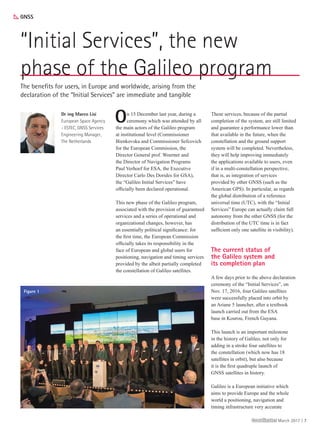
On 15 December last year, during a
ceremony which was attended by all
the main actors of the Galileo program
at institutional level (Commissioner
Bienkovska and Commissioner Sefcovich
for the European Commission, the
Director General prof. Woerner and
the Director of Navigation Programs
Paul Verhoef for ESA, the Executive
Director Carlo Des Dorides for GSA),
the “Galileo Initial Services” have
officially been declared operational.
This new phase of the Galileo program,
associated with the provision of guaranteed
services and a series of operational and
organizational changes, however, has
an essentially political significance: for
the first time, the European Commission
officially takes its responsibility in the
face of European and global users for
positioning, navigation and timing services
provided by the albeit partially completed
the constellation of Galileo satellites.
These services, because of the partial
completion of the system, are still limited
and guarantee a performance lower than
that available in the future, when the
constellation and the ground support
system will be completed. Nevertheless,
they will help improving immediately
the applications available to users, even
if in a multi-constellation perspective,
that is, as integration of services
provided by other GNSS (such as the
American GPS). In particular, as regards
the global distribution of a reference
universal time (UTC), with the “Initial
Services” Europe can actually claim full
autonomy from the other GNSS (for the
distribution of the UTC time is in fact
sufficient only one satellite in visibility).
The current status of
the Galileo system and
its completion plan
A few days prior to the above declaration
ceremony of the “Initial Services”, on
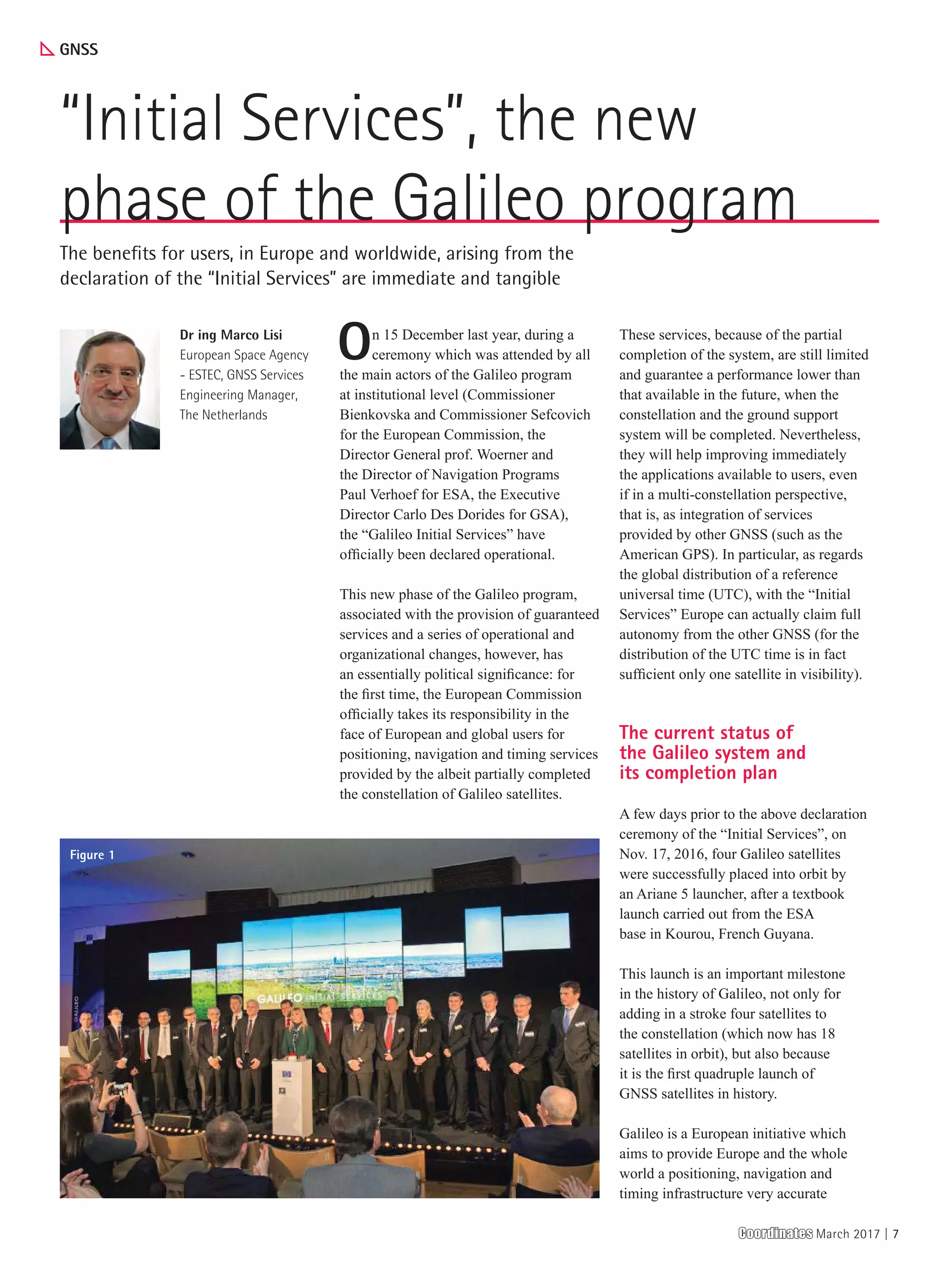
Nov. 17, 2016, four Galileo satellites
were successfully placed into orbit by
an Ariane 5 launcher, after a textbook
launch carried out from the ESA
base in Kourou, French Guyana.
This launch is an important milestone
in the history of Galileo, not only for
adding in a stroke four satellites to
the constellation (which now has 18
satellites in orbit), but also because
it is the first quadruple launch of
GNSS satellites in history.
Galileo is a European initiative which
aims to provide Europe and the whole
world a positioning, navigation and
timing infrastructure very accurate
“Initial Services”, the new
phase of the Galileo program
The benefits for users, in Europe and worldwide, arising from the
declaration of the “Initial Services” are immediate and tangible
Dr ing Marco Lisi
European Space Agency
- ESTEC, GNSS Services
Engineering Manager,
The Netherlands
x GNSS
Figure 1
CoordinatesCoordinates March 2017 | 7
SD64_CMPL_March 2017_Final.indd 7SD64_CMPL_March 2017_Final.indd 7 10/03/17 9:22 pm10/03/17 9:22 pm
and independent. Albeit completely
autonomous, Galileo will however be
interoperable with other existing GNSS,
in particular with the American GPS.
The implementation of the Galileo
system has been developed in two
phases: an initial “In-Orbit Validation”
(IOV) phase”) and a subsequent
“Full Operational Capability” (FOC)
phase, still under completion.
At the end of FOC, in its final
configuration, the Galileo system
will include 30 satellites in orbit (24
plus 6 in active redundancy) and a
complex ground network, with control
centers and stations scattered over
the whole surface of the globe.
The Galileo system is designed to provide
a range of services, each associated
with different radio signals being
broadcasted (“Signals in Space”, SiS):
• The “Open Service” (OS) and the
“Public Regulated Service” (PRS),
which are similar, respectively, to
the “Standard Positioning Service”
and the “Precise positioning
Service” of the GPS system;
• The “Commercial Service”, one of
the innovations introduced by Galileo,
which will provide very accurate
and, most important, authenticated
positioning and timing, specifically
for commercial applications;
• The “Search & Rescue” (SAR)
service”, part of the wider international
Cospas-Sarsat organization, which will
provide emergency services to users in
case of distress and extreme danger.
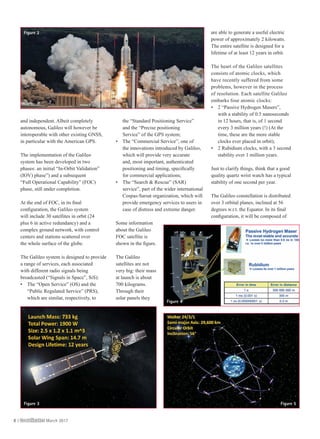
Some information
about the Galileo
FOC satellite is
shown in the figure.
The Galileo
satellites are not
very big: their mass
at launch is about
700 kilograms.
Through their
solar panels they
are able to generate a useful electric
power of approximately 2 kilowatts.
The entire satellite is designed for a
lifetime of at least 12 years in orbit.
The heart of the Galileo satellites
consists of atomic clocks, which
have recently suffered from some
problems, however in the process
of resolution. Each satellite Galileo
embarks four atomic clocks:
• 2 “Passive Hydrogen Masers”,
with a stability of 0.5 nanoseconds
in 12 hours, that is, of 1 second
every 3 million years (!) (At the
time, these are the more stable
clocks ever placed in orbit);
• 2 Rubidium clocks, with a 3 second
stability over 1 million years.
Just to clarify things, think that a good
quality quartz wrist watch has a typical
stability of one second per year.
The Galileo constellation is distributed
over 3 orbital planes, inclined at 56
degrees w.r.t. the Equator. In its final
configuration, it will be composed of
Figure 2
Figure 3
Figure 4
Figure 5
8 | CoordinatesCoordinates March 2017
SD64_CMPL_March 2017_Final.indd 8SD64_CMPL_March 2017_Final.indd 8 10/03/17 9:22 pm10/03/17 9:22 pm
24 satellites, 8 for each of the three
orbital planes, plus 6 satellites in active
(or, as we say, “hot”) redundancy (2
satellites for each orbit plane). The
satellites orbit around the Earth at an
altitude of about 23,000 kilometers.
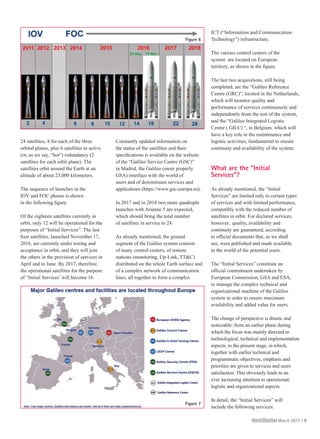
The sequence of launches in the
IOV and FOC phases is shown
in the following figure.
Of the eighteen satellites currently in
orbit, only 12 will be operational for the
purposes of “Initial Services”. The last
four satellites, launched November 17,
2016, are currently under testing and
acceptance in orbit, and they will join
the others in the provision of services in
April and in June. By 2017, therefore,
the operational satellites for the purpose
of “Initial Services’ will become 16.
Constantly updated information on
the status of the satellites and their
specifications is available on the website
of the “Galileo Service Centre (GSC)”
in Madrid, the Galileo (more properly
GSA) interface with the world of
users and of downstream services and
applications (https://www.gsc-europa.eu).
In 2017 and in 2018 two more quadruple
launches with Arianne 5 are expected,
which should bring the total number
of satellites in service to 24.
As already mentioned, the ground
segment of the Galileo system consists
of many control centers, of remote
stations (monitoring, Up-Link, TT&C)
distributed on the whole Earth surface and
of a complex network of communication
lines, all together to form a complex
ICT (“Information and Communication
Technology”) infrastructure.
The various control centers of the
system are located on European
territory, as shown in the figure.
The last two acquisitions, still being
completed, are the “Galileo Reference
Centre (GRC)”, located in the Netherlands,
which will monitor quality and
performance of services continuously and
independently from the rest of the system,
and the “Galileo Integrated Logistic
Centre ( GILC) “, in Belgium, which will
have a key role in the maintenance and
logistic activities, fundamental to ensure
continuity and availability of the system.
What are the “Initial
Services”?
As already mentioned, the “Initial
Services” are limited only to certain types
of services and with limited performance,
compatibly with the reduced number of
satellites in orbit. For declared services,
however, quality, availability and
continuity are guaranteed, according
to official documents that, as we shall
see, were published and made available
to the world of the potential users.
The “Initial Services” constitute an
official commitment undertaken by
European Commission, GSA and ESA,
to manage the complex technical and
organizational machine of the Galileo
system in order to ensure maximum
availability and added value for users.
The change of perspective is drastic and
noticeable: from an earlier phase during
which the focus was mainly directed to
technological, technical and implementation
aspects, to the present stage, in which,
together with earlier technical and
programmatic objectives, emphasis and
priorities are given to services and users
satisfaction. This obviously leads to an
ever increasing attention to operational,
logistic and organizational aspects.
In detail, the “Initial Services” will
include the following services:
Figure 6
Figure 7
CoordinatesCoordinates March 2017 | 9
SD64_CMPL_March 2017_Final.indd 9SD64_CMPL_March 2017_Final.indd 9 10/03/17 9:22 pm10/03/17 9:22 pm
• Open Service
▪ Open to all and interoperable
with other GNSS;
▪ Global availability.
• Public Regulated Service
▪ Access authorized and
controlled by the government
authorities of the Member EU
▪ Global availability.
• Search and Rescue
▪ Open to all;
▪ Global, under the control
of the Cospas-Sarsat
international organization;
▪ Locate signals sent in case of
emergency and communicate
the distress call to the Search
& Rescue centers.
Performance and conditions of the
services offered are described in a
series of official and public documents
issued by the European Commission.
In summary:
- ~ 0.8 meters average ranging
accuracy”, at 95% availability;
- ~ 3 / ~ 8 meters average localization
accuracy, horizontal and vertical,
respectively, at 95% of availability
and when PDOP <6;
- ~ 9.5 nanoseconds of accuracy
in the dissemination of the UTC
time, at 95% availability;
- ~ 7 nanosecond
error in
the offset
distribution
of Galileo-GPS time, at
95% of availability;
- probability of localization
of a SAR distress message
within 10 minutes from its
sending higher than 98%.
It is evident that the “Initial
Services” are just the first, albeit
very promising step towards the
provision of more comprehensive
better performing services.
The “Initial Services” from
the user’s point of view
The benefits for users, in Europe and
worldwide, arising from the declaration of the
“Initial Services” are immediate and tangible.
They result largely from an increased
confidence of downstream applications and
services providers wrt Galileo and especially
of manufacturers of integrated circuits
(the so-called “chip-set manufacturers”)
and of devices (such as smartphones).
Figure 8 Figure 10
Figure 11
Figure 12
Figure 9
10 | CoordinatesCoordinates March 2017
SD64_CMPL_March 2017_Final.indd 10SD64_CMPL_March 2017_Final.indd 10 10/03/17 9:22 pm10/03/17 9:22 pm
Moreover, the “Initial Services”
open the way to a series of important
regulated services at European level.
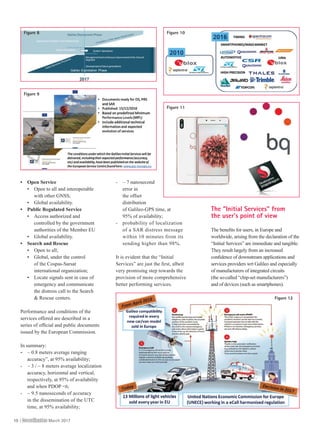
In terms of adoption of the Galileo
standard among the GNSS receiver
manufacturers, we passed from 3
manufacturers adopting Galileo in
2010 to 17 in 2016, representing more
than the 95% of the global market.
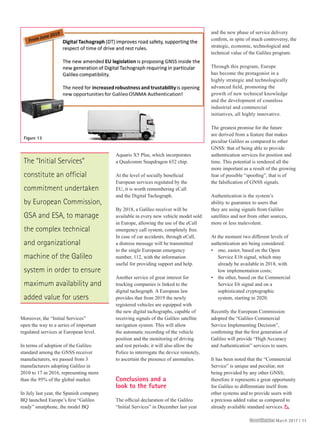
In July last year, the Spanish company
BQ launched Europe’s first “Galileo
ready” smatphone, the model BQ
Aquaris X5 Plus, which incorporates
a Qualcomm Snapdragon 652 chip.
At the level of socially beneficial
European services regulated by the
EU, it is worth remembering eCall
and the Digital Tachograph.
By 2018, a Galileo receiver will be
available in every new vehicle model sold
in Europe, allowing the use of the eCall
emergency call system, completely free.
In case of car accidents, through eCall,
a distress message will be transmitted
to the single European emergency
number, 112, with the information
useful for providing support and help.
Another service of great interest for
trucking companies is linked to the
digital tachograph. A European law
provides that from 2019 the newly
registered vehicles are equipped with
the new digital tachographs, capable of
receiving signals of the Galileo satellite
navigation system. This will allow
the automatic recording of the vehicle
position and the monitoring of driving
and rest periods; it will also allow the
Police to interrogate the device remotely,
to ascertain the presence of anomalies.
Conclusions and a
look to the future
The official declaration of the Galileo
“Initial Services” in December last year
and the new phase of service delivery
confirm, in spite of much controversy, the
strategic, economic, technological and
technical value of the Galileo program.
Through this program, Europe
has become the protagonist in a
highly strategic and technologically
advanced field, promoting the
growth of new technical knowledge
and the development of countless
industrial and commercial
initiatives, all highly innovative.
The greatest promise for the future
are derived from a feature that makes
peculiar Galileo as compared to other
GNSS: that of being able to provide
authentication services for position and
time. This potential is rendered all the
more important as a result of the growing
fear of possible “spoofing”, that is of
the falsification of GNSS signals.
Authentication is the system’s
ability to guarantee to users that
they are using signals from Galileo
satellites and not from other sources,
more or less malevolent.
At the moment two different levels of
authentication are being considered:
• one, easier, based on the Open
Service E1b signal, which may
already be available in 2018, with
low implementation costs;
• the other, based on the Commercial
Service E6 signal and on a
sophisticated cryptographic
system, starting in 2020.
Recently the European Commission
adopted the “Galileo Commercial
Service Implementing Decision”,
confirming that the first generation of
Galileo will provide “High Accuracy
and Authentication” services to users.
It has been noted that the “Commercial
Service” is unique and peculiar, not
being provided by any other GNSS;
therefore it represents a great opportunity
for Galileo to differentiate itself from
other systems and to provide users with
a precious added value as compared to
already available standard services. x
Figure 13
The “Initial Services”
constitute an official
commitment undertaken
by European Commission,
GSA and ESA, to manage
the complex technical
and organizational
machine of the Galileo
system in order to ensure
maximum availability and
added value for users
CoordinatesCoordinates March 2017 | 11
SD64_CMPL_March 2017_Final.indd 11SD64_CMPL_March 2017_Final.indd 11 10/03/17 9:22 pm10/03/17 9:22 pm

"Initial Services", the new phase of the Galileo program

  • 1.
    On 15 Decemberlast year, during a ceremony which was attended by all the main actors of the Galileo program at institutional level (Commissioner Bienkovska and Commissioner Sefcovich for the European Commission, the Director General prof. Woerner and the Director of Navigation Programs Paul Verhoef for ESA, the Executive Director Carlo Des Dorides for GSA), the “Galileo Initial Services” have officially been declared operational. This new phase of the Galileo program, associated with the provision of guaranteed services and a series of operational and organizational changes, however, has an essentially political significance: for the first time, the European Commission officially takes its responsibility in the face of European and global users for positioning, navigation and timing services provided by the albeit partially completed the constellation of Galileo satellites. These services, because of the partial completion of the system, are still limited and guarantee a performance lower than that available in the future, when the constellation and the ground support system will be completed. Nevertheless, they will help improving immediately the applications available to users, even if in a multi-constellation perspective, that is, as integration of services provided by other GNSS (such as the American GPS). In particular, as regards the global distribution of a reference universal time (UTC), with the “Initial Services” Europe can actually claim full autonomy from the other GNSS (for the distribution of the UTC time is in fact sufficient only one satellite in visibility). The current status of the Galileo system and its completion plan A few days prior to the above declaration ceremony of the “Initial Services”, on Nov. 17, 2016, four Galileo satellites were successfully placed into orbit by an Ariane 5 launcher, after a textbook launch carried out from the ESA base in Kourou, French Guyana. This launch is an important milestone in the history of Galileo, not only for adding in a stroke four satellites to the constellation (which now has 18 satellites in orbit), but also because it is the first quadruple launch of GNSS satellites in history. Galileo is a European initiative which aims to provide Europe and the whole world a positioning, navigation and timing infrastructure very accurate “Initial Services”, the new phase of the Galileo program The benefits for users, in Europe and worldwide, arising from the declaration of the “Initial Services” are immediate and tangible Dr ing Marco Lisi European Space Agency - ESTEC, GNSS Services Engineering Manager, The Netherlands x GNSS Figure 1 CoordinatesCoordinates March 2017 | 7 SD64_CMPL_March 2017_Final.indd 7SD64_CMPL_March 2017_Final.indd 7 10/03/17 9:22 pm10/03/17 9:22 pm
  • 2.
    and independent. Albeitcompletely autonomous, Galileo will however be interoperable with other existing GNSS, in particular with the American GPS. The implementation of the Galileo system has been developed in two phases: an initial “In-Orbit Validation” (IOV) phase”) and a subsequent “Full Operational Capability” (FOC) phase, still under completion. At the end of FOC, in its final configuration, the Galileo system will include 30 satellites in orbit (24 plus 6 in active redundancy) and a complex ground network, with control centers and stations scattered over the whole surface of the globe. The Galileo system is designed to provide a range of services, each associated with different radio signals being broadcasted (“Signals in Space”, SiS): • The “Open Service” (OS) and the “Public Regulated Service” (PRS), which are similar, respectively, to the “Standard Positioning Service” and the “Precise positioning Service” of the GPS system; • The “Commercial Service”, one of the innovations introduced by Galileo, which will provide very accurate and, most important, authenticated positioning and timing, specifically for commercial applications; • The “Search & Rescue” (SAR) service”, part of the wider international Cospas-Sarsat organization, which will provide emergency services to users in case of distress and extreme danger. Some information about the Galileo FOC satellite is shown in the figure. The Galileo satellites are not very big: their mass at launch is about 700 kilograms. Through their solar panels they are able to generate a useful electric power of approximately 2 kilowatts. The entire satellite is designed for a lifetime of at least 12 years in orbit. The heart of the Galileo satellites consists of atomic clocks, which have recently suffered from some problems, however in the process of resolution. Each satellite Galileo embarks four atomic clocks: • 2 “Passive Hydrogen Masers”, with a stability of 0.5 nanoseconds in 12 hours, that is, of 1 second every 3 million years (!) (At the time, these are the more stable clocks ever placed in orbit); • 2 Rubidium clocks, with a 3 second stability over 1 million years. Just to clarify things, think that a good quality quartz wrist watch has a typical stability of one second per year. The Galileo constellation is distributed over 3 orbital planes, inclined at 56 degrees w.r.t. the Equator. In its final configuration, it will be composed of Figure 2 Figure 3 Figure 4 Figure 5 8 | CoordinatesCoordinates March 2017 SD64_CMPL_March 2017_Final.indd 8SD64_CMPL_March 2017_Final.indd 8 10/03/17 9:22 pm10/03/17 9:22 pm
  • 3.
    24 satellites, 8for each of the three orbital planes, plus 6 satellites in active (or, as we say, “hot”) redundancy (2 satellites for each orbit plane). The satellites orbit around the Earth at an altitude of about 23,000 kilometers. The sequence of launches in the IOV and FOC phases is shown in the following figure. Of the eighteen satellites currently in orbit, only 12 will be operational for the purposes of “Initial Services”. The last four satellites, launched November 17, 2016, are currently under testing and acceptance in orbit, and they will join the others in the provision of services in April and in June. By 2017, therefore, the operational satellites for the purpose of “Initial Services’ will become 16. Constantly updated information on the status of the satellites and their specifications is available on the website of the “Galileo Service Centre (GSC)” in Madrid, the Galileo (more properly GSA) interface with the world of users and of downstream services and applications (https://www.gsc-europa.eu). In 2017 and in 2018 two more quadruple launches with Arianne 5 are expected, which should bring the total number of satellites in service to 24. As already mentioned, the ground segment of the Galileo system consists of many control centers, of remote stations (monitoring, Up-Link, TT&C) distributed on the whole Earth surface and of a complex network of communication lines, all together to form a complex ICT (“Information and Communication Technology”) infrastructure. The various control centers of the system are located on European territory, as shown in the figure. The last two acquisitions, still being completed, are the “Galileo Reference Centre (GRC)”, located in the Netherlands, which will monitor quality and performance of services continuously and independently from the rest of the system, and the “Galileo Integrated Logistic Centre ( GILC) “, in Belgium, which will have a key role in the maintenance and logistic activities, fundamental to ensure continuity and availability of the system. What are the “Initial Services”? As already mentioned, the “Initial Services” are limited only to certain types of services and with limited performance, compatibly with the reduced number of satellites in orbit. For declared services, however, quality, availability and continuity are guaranteed, according to official documents that, as we shall see, were published and made available to the world of the potential users. The “Initial Services” constitute an official commitment undertaken by European Commission, GSA and ESA, to manage the complex technical and organizational machine of the Galileo system in order to ensure maximum availability and added value for users. The change of perspective is drastic and noticeable: from an earlier phase during which the focus was mainly directed to technological, technical and implementation aspects, to the present stage, in which, together with earlier technical and programmatic objectives, emphasis and priorities are given to services and users satisfaction. This obviously leads to an ever increasing attention to operational, logistic and organizational aspects. In detail, the “Initial Services” will include the following services: Figure 6 Figure 7 CoordinatesCoordinates March 2017 | 9 SD64_CMPL_March 2017_Final.indd 9SD64_CMPL_March 2017_Final.indd 9 10/03/17 9:22 pm10/03/17 9:22 pm
  • 4.
    • Open Service ▪Open to all and interoperable with other GNSS; ▪ Global availability. • Public Regulated Service ▪ Access authorized and controlled by the government authorities of the Member EU ▪ Global availability. • Search and Rescue ▪ Open to all; ▪ Global, under the control of the Cospas-Sarsat international organization; ▪ Locate signals sent in case of emergency and communicate the distress call to the Search & Rescue centers. Performance and conditions of the services offered are described in a series of official and public documents issued by the European Commission. In summary: - ~ 0.8 meters average ranging accuracy”, at 95% availability; - ~ 3 / ~ 8 meters average localization accuracy, horizontal and vertical, respectively, at 95% of availability and when PDOP <6; - ~ 9.5 nanoseconds of accuracy in the dissemination of the UTC time, at 95% availability; - ~ 7 nanosecond error in the offset distribution of Galileo-GPS time, at 95% of availability; - probability of localization of a SAR distress message within 10 minutes from its sending higher than 98%. It is evident that the “Initial Services” are just the first, albeit very promising step towards the provision of more comprehensive better performing services. The “Initial Services” from the user’s point of view The benefits for users, in Europe and worldwide, arising from the declaration of the “Initial Services” are immediate and tangible. They result largely from an increased confidence of downstream applications and services providers wrt Galileo and especially of manufacturers of integrated circuits (the so-called “chip-set manufacturers”) and of devices (such as smartphones). Figure 8 Figure 10 Figure 11 Figure 12 Figure 9 10 | CoordinatesCoordinates March 2017 SD64_CMPL_March 2017_Final.indd 10SD64_CMPL_March 2017_Final.indd 10 10/03/17 9:22 pm10/03/17 9:22 pm
  • 5.
    Moreover, the “InitialServices” open the way to a series of important regulated services at European level. In terms of adoption of the Galileo standard among the GNSS receiver manufacturers, we passed from 3 manufacturers adopting Galileo in 2010 to 17 in 2016, representing more than the 95% of the global market. In July last year, the Spanish company BQ launched Europe’s first “Galileo ready” smatphone, the model BQ Aquaris X5 Plus, which incorporates a Qualcomm Snapdragon 652 chip. At the level of socially beneficial European services regulated by the EU, it is worth remembering eCall and the Digital Tachograph. By 2018, a Galileo receiver will be available in every new vehicle model sold in Europe, allowing the use of the eCall emergency call system, completely free. In case of car accidents, through eCall, a distress message will be transmitted to the single European emergency number, 112, with the information useful for providing support and help. Another service of great interest for trucking companies is linked to the digital tachograph. A European law provides that from 2019 the newly registered vehicles are equipped with the new digital tachographs, capable of receiving signals of the Galileo satellite navigation system. This will allow the automatic recording of the vehicle position and the monitoring of driving and rest periods; it will also allow the Police to interrogate the device remotely, to ascertain the presence of anomalies. Conclusions and a look to the future The official declaration of the Galileo “Initial Services” in December last year and the new phase of service delivery confirm, in spite of much controversy, the strategic, economic, technological and technical value of the Galileo program. Through this program, Europe has become the protagonist in a highly strategic and technologically advanced field, promoting the growth of new technical knowledge and the development of countless industrial and commercial initiatives, all highly innovative. The greatest promise for the future are derived from a feature that makes peculiar Galileo as compared to other GNSS: that of being able to provide authentication services for position and time. This potential is rendered all the more important as a result of the growing fear of possible “spoofing”, that is of the falsification of GNSS signals. Authentication is the system’s ability to guarantee to users that they are using signals from Galileo satellites and not from other sources, more or less malevolent. At the moment two different levels of authentication are being considered: • one, easier, based on the Open Service E1b signal, which may already be available in 2018, with low implementation costs; • the other, based on the Commercial Service E6 signal and on a sophisticated cryptographic system, starting in 2020. Recently the European Commission adopted the “Galileo Commercial Service Implementing Decision”, confirming that the first generation of Galileo will provide “High Accuracy and Authentication” services to users. It has been noted that the “Commercial Service” is unique and peculiar, not being provided by any other GNSS; therefore it represents a great opportunity for Galileo to differentiate itself from other systems and to provide users with a precious added value as compared to already available standard services. x Figure 13 The “Initial Services” constitute an official commitment undertaken by European Commission, GSA and ESA, to manage the complex technical and organizational machine of the Galileo system in order to ensure maximum availability and added value for users CoordinatesCoordinates March 2017 | 11 SD64_CMPL_March 2017_Final.indd 11SD64_CMPL_March 2017_Final.indd 11 10/03/17 9:22 pm10/03/17 9:22 pm