RECEPTOR TYPES
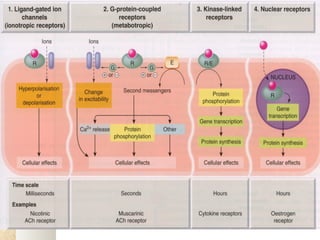
 CHANNEL LINKED (IONOTROPIC)
 G PROTEIN LINKED (METABOTROPIC)
 ENZYME LINKED
 INTRACELLULAR RECEPTOR
(RECEPTORS REGULATING GENE TRANSCRIPTION
/NUCLEAR RECEPTORS)
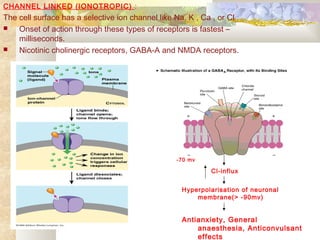
CHANNEL LINKED (IONOTROPIC) :
The cell surface has a selective ion channel like Na, K , Ca , or Cl .
 Onset of action through these types of receptors is fastest –
milliseconds.
 Nicotinic cholinergic receptors, GABA-A and NMDA receptors.
Cl-influx
Hyperpolarisation of neuronal
membrane(> -90mv)
-70 mv
Antianxiety, General
anaesthesia, Anticonvulsant
effects
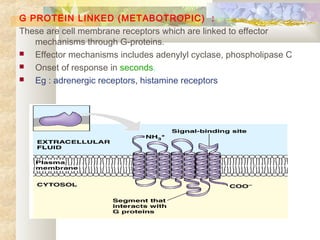
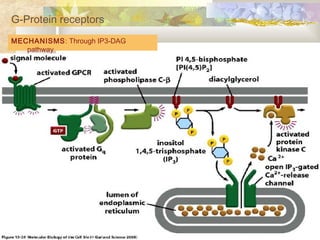
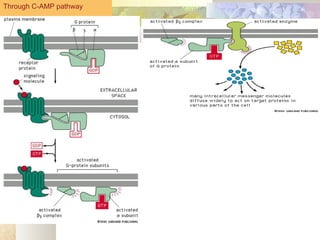
G PROTEIN LINKED (METABOTROPIC) :
These are cell membrane receptors which are linked to effector
mechanisms through G-proteins.
 Effector mechanisms includes adenylyl cyclase, phospholipase C
 Onset of response in seconds.
 Eg : adrenergic receptors, histamine receptors
MECHANISMS: Through IP3-DAG
pathway
G-Protein receptors
Through C-AMP pathway
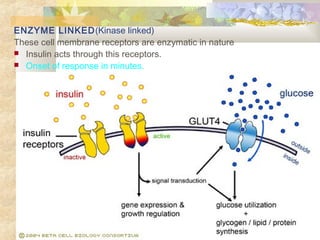
ENZYME LINKED(Kinase linked)
These cell membrane receptors are enzymatic in nature
 Insulin acts through this receptors.
 Onset of response in minutes.
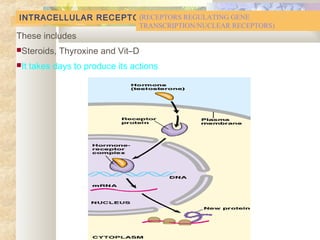
INTRACELLULAR RECEPTOR
These includes
Steroids, Thyroxine and Vit–D
It takes days to produce its actions
(RECEPTORS REGULATING GENE
TRANSCRIPTION/NUCLEAR RECEPTORS)
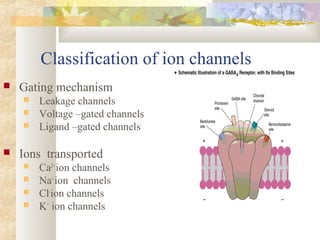
Classification of ion channels
 Gating mechanism
 Leakage channels
 Voltage –gated channels
 Ligand –gated channels
 Ions transported
 Ca2+
ion channels
 Na+
ion channels
 Cl-
ion channels
 K+
ion channels
 Inhibitory function.
 Nicotinic cholinergic
 GABA-A
 Glycine
 Excitatory function
 NMDA
 kainate
G-PROTEIN COUPLED RECEPTORS:-
1. Adrenergic receptors
2. Cholinergic receptors
3. Seretonergic receptors
4. Dopaminergic receptors
5. Histaminergic receptors
6. GABA/BZ-receptors
7. Excitatory amino acid receptors
8. Opioid receptors
9. Purinergic receptors
1)ADRENERGIC RECEPTORS
I α & β-ADRENERGIC RECEPTORS
 α -ADRENERGIC RECEPTORS
a) α -1RECEPTORS
b) α -2 RECEPTORS
2 β RECEPTORS
a) β -1RECEPTORS
b) β -2 RECEPTORS
c) β -3 RECEPTORS
2)CHOLINERGIC RECEPTORS
 THERE ARE 2 TYPES OF RECEPTORS
 MUSCARINIC RECEPTORS
a)M-1
b)M-2
c)M-3
 NICOTINIC RECEPTORS
a)NM
b)NN
c)NN1
d)NN2
3) SERETONERGIC (5-HT) RECEPTORS
1) 5-HT-1
2)5 HT-2
3)5 HT-3
4)5 HT-4
4) DOPAMINERGIC RECEPTORS
 THERE ARE 2 CLASSES
1)D1-Receptors
2)D2-Receptors
5) HISTAMINERGIC RECEPTORS
 There are 2 types
1)H1-Receptors
2)H2- Receptors
6) GABA RECEPTORS
 Three different types of GABA-Receptors
are:-
1)GABAA
2)GABAB
3)GABAC
7)EXCITATORY AMINO ACID
RECETORS :-
 These are of 4 types:-
1)NMDA
2)AMPA
3)Kainate
4)Metabotropic
8) OPIOID RECEPTORS
 There are 3 types in this are:-
1)µ-Opioid Receptors
2)κ-Opioid Receptors
3)δ-Opioid Receptors
9)PURINERGIC RECEPTORS
 There are 2 types in this are:-
1)p1(adenosin receptors)
2)p2(adenosin triphoshate/ATP receptors)

Receptors and its classificationvpp

  • 1.
    RECEPTOR TYPES  CHANNELLINKED (IONOTROPIC)  G PROTEIN LINKED (METABOTROPIC)  ENZYME LINKED  INTRACELLULAR RECEPTOR (RECEPTORS REGULATING GENE TRANSCRIPTION /NUCLEAR RECEPTORS)
  • 3.
    CHANNEL LINKED (IONOTROPIC): The cell surface has a selective ion channel like Na, K , Ca , or Cl .  Onset of action through these types of receptors is fastest – milliseconds.  Nicotinic cholinergic receptors, GABA-A and NMDA receptors. Cl-influx Hyperpolarisation of neuronal membrane(> -90mv) -70 mv Antianxiety, General anaesthesia, Anticonvulsant effects
  • 4.
    G PROTEIN LINKED(METABOTROPIC) : These are cell membrane receptors which are linked to effector mechanisms through G-proteins.  Effector mechanisms includes adenylyl cyclase, phospholipase C  Onset of response in seconds.  Eg : adrenergic receptors, histamine receptors
  • 5.
  • 6.
  • 7.
    ENZYME LINKED(Kinase linked) Thesecell membrane receptors are enzymatic in nature  Insulin acts through this receptors.  Onset of response in minutes.
  • 8.
    INTRACELLULAR RECEPTOR These includes Steroids,Thyroxine and Vit–D It takes days to produce its actions (RECEPTORS REGULATING GENE TRANSCRIPTION/NUCLEAR RECEPTORS)
  • 9.
    Classification of ionchannels  Gating mechanism  Leakage channels  Voltage –gated channels  Ligand –gated channels  Ions transported  Ca2+ ion channels  Na+ ion channels  Cl- ion channels  K+ ion channels
  • 10.
     Inhibitory function. Nicotinic cholinergic  GABA-A  Glycine  Excitatory function  NMDA  kainate
  • 11.
    G-PROTEIN COUPLED RECEPTORS:- 1.Adrenergic receptors 2. Cholinergic receptors 3. Seretonergic receptors 4. Dopaminergic receptors 5. Histaminergic receptors 6. GABA/BZ-receptors 7. Excitatory amino acid receptors 8. Opioid receptors 9. Purinergic receptors
  • 12.
    1)ADRENERGIC RECEPTORS I α& β-ADRENERGIC RECEPTORS  α -ADRENERGIC RECEPTORS a) α -1RECEPTORS b) α -2 RECEPTORS 2 β RECEPTORS a) β -1RECEPTORS b) β -2 RECEPTORS c) β -3 RECEPTORS
  • 13.
    2)CHOLINERGIC RECEPTORS  THEREARE 2 TYPES OF RECEPTORS  MUSCARINIC RECEPTORS a)M-1 b)M-2 c)M-3  NICOTINIC RECEPTORS a)NM b)NN c)NN1 d)NN2
  • 14.
    3) SERETONERGIC (5-HT)RECEPTORS 1) 5-HT-1 2)5 HT-2 3)5 HT-3 4)5 HT-4
  • 15.
    4) DOPAMINERGIC RECEPTORS THERE ARE 2 CLASSES 1)D1-Receptors 2)D2-Receptors
  • 16.
    5) HISTAMINERGIC RECEPTORS There are 2 types 1)H1-Receptors 2)H2- Receptors
  • 17.
    6) GABA RECEPTORS Three different types of GABA-Receptors are:- 1)GABAA 2)GABAB 3)GABAC
  • 18.
    7)EXCITATORY AMINO ACID RECETORS:-  These are of 4 types:- 1)NMDA 2)AMPA 3)Kainate 4)Metabotropic
  • 19.
    8) OPIOID RECEPTORS There are 3 types in this are:- 1)µ-Opioid Receptors 2)κ-Opioid Receptors 3)δ-Opioid Receptors
  • 20.
    9)PURINERGIC RECEPTORS  Thereare 2 types in this are:- 1)p1(adenosin receptors) 2)p2(adenosin triphoshate/ATP receptors)