RECEPTORS
Dr. BK Shoraisham
JR
Dept of Pharmacology
RECEPTORS
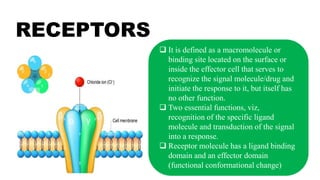
 It is defined as a macromolecule or
binding site located on the surface or
inside the effector cell that serves to
recognize the signal molecule/drug and
initiate the response to it, but itself has
no other function.
 Two essential functions, viz,
recognition of the specific ligand
molecule and transduction of the signal
into a response.
 Receptor molecule has a ligand binding
domain and an effector domain
(functional conformational change)
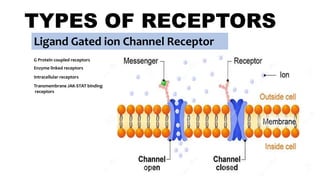
TYPES OF RECEPTORS
 Ligand Gated ion Channel Receptor
 Enzyme linked receptors
 G Protein coupled receptors
 Intracellular receptors
 Transmembrane JAK-STAT binding
receptors
TYPES OF RECEPTORS
Ligand Gated ion Channel Receptor
G Protein coupled receptors
Enzyme linked receptors
Intracellular receptors
Transmembrane JAK-STAT binding
receptors
TYPES OF RECEPTORS
Ligand Gated ion Channel Receptor
G Protein coupled receptors
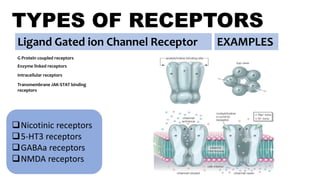
Nicotinic receptors
5-HT3 receptors
GABAa receptors
NMDA receptors
Enzyme linked receptors
Intracellular receptors
EXAMPLES
Transmembrane JAK-STAT binding
receptors
TYPES OF RECEPTORS
Ligand Gated ion Channel Receptor
G Protein coupled receptors
Enzyme linked receptors
Intracellular receptors
Nicotinic receptors
5-HT3 receptors
GABAa receptors
NMDA receptors
EXAMPLES
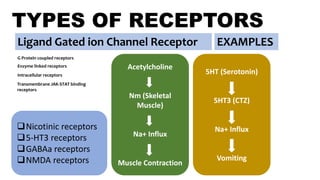
5HT (Serotonin)
5HT3 (CTZ)
Na+ Influx
Vomiting
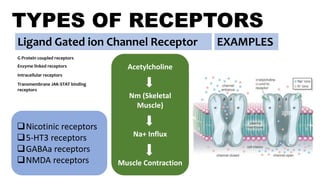
Acetylcholine
Nm (Skeletal
Muscle)
Na+ Influx
Muscle Contraction
Transmembrane JAK-STAT binding
receptors
TYPES OF RECEPTORS
Ligand Gated ion Channel Receptor
G Protein coupled receptors
Enzyme linked receptors
Intracellular receptors
Nicotinic receptors
5-HT3 receptors
GABAa receptors
NMDA receptors
EXAMPLES
5HT (Serotonin)
5HT3 (CTZ)
Na+ Influx
Vomiting
Acetylcholine
Nm (Skeletal
Muscle)
Na+ Influx
Muscle Contraction
Transmembrane JAK-STAT binding
receptors
TYPES OF RECEPTORS
Ligand Gated ion Channel Receptor Examples
G Protein coupled receptors
Kinase linked receptors
Intracellular receptors
Examples of GPCRs
Muscarinic receptors [M1-M5]
Adrenergic receptors [α and β]
Histamine receptors [H1-H3]
Dopamine receptors [D1-D5]
Opioid receptors [μ κ б]
5-HT receptors 5-HT[1-7] except 5-
HT3
GABAb receptors
*GPCR superfamily-largest and
most diverse group of proteins
*seven-transmembrane,
serpentine, G protein–linked
receptors
Transmembrane JAK-STAT binding
receptors
Gs : Adenylyl cyclase , Ca2+
channel
Gi : Adenylyl cyclase, K+
channel opening
Go : Ca2+ channel
inhibition
Gq : Phospholipase C
TYPES OF RECEPTORS
Ligand Gated ion Channel Receptor Examples
G Protein coupled receptors
Kinase linked receptors
Intracellular receptors
Examples of GPCRs
Muscarinic receptors [M1-M5]
Adrenergic receptors [α and β]
Histamine receptors [H1-H3]
Dopamine receptors [D1-D5]
Opioid receptors [μ κ б]
5-HT receptors 5-HT[1-7] except 5- HT3
GABAb receptors
Transmembrane JAK-STAT binding
receptors
Gs : Adenylyl cyclase , Ca2+
channel
Gi : Adenylyl cyclase, K+
channel opening
Go : Ca2+ channel
inhibition
Gq : Phospholipase C
TYPES OF RECEPTORS
Ligand Gated ion Channel Receptor Examples
G Protein coupled receptors
Kinase linked receptors
Intracellular receptors
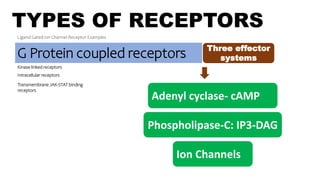
Adenyl cyclase- cAMP
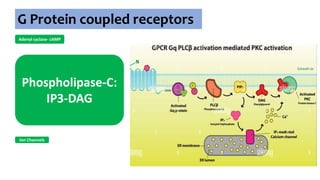
Phospholipase-C: IP3-DAG
Ion Channels
Three effector
systems
Transmembrane JAK-STAT binding
receptors
G Protein coupled receptors
Adenyl
cyclase-
cAMP
Ion Channels
Phospholipase-C: IP3-DAG
G Protein coupled receptors
Effects of cAMP on Organs
Ion Channels
Phospholipase-
C: IP3-DAG
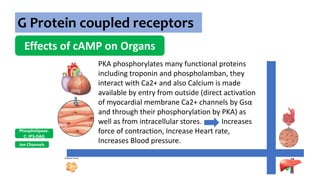
PKA phosphorylates many functional proteins
including troponin and phospholamban, they
interact with Ca2+ and also Calcium is made
available by entry from outside (direct activation
of myocardial membrane Ca2+ channels by Gsα
and through their phosphorylation by PKA) as
well as from intracellular stores. Increases
force of contraction, Increase Heart rate,
Increases Blood pressure.
G Protein coupled receptors
Effects of cAMP on Organs
Ion Channels
Phospholipase-
C: IP3-DAG
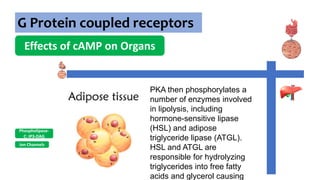
PKA then phosphorylates a
number of enzymes involved
in lipolysis, including
hormone-sensitive lipase
(HSL) and adipose
triglyceride lipase (ATGL).
HSL and ATGL are
responsible for hydrolyzing
triglycerides into free fatty
acids and glycerol causing
G Protein coupled receptors
Effects of cAMP on Organs
Ion Channels
Phospholipase-
C: IP3-DAG
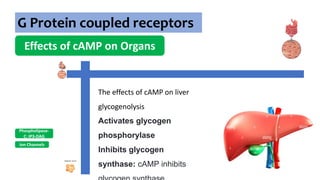
The effects of cAMP on liver
glycogenolysis
Activates glycogen
phosphorylase
Inhibits glycogen
synthase: cAMP inhibits
G Protein coupled receptors
Effects of cAMP on Organs
Ion Channels
Phospholipase-
C: IP3-DAG
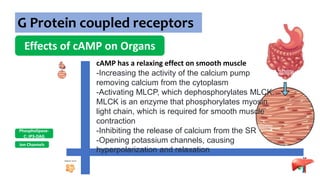
cAMP has a relaxing effect on smooth muscle
-Increasing the activity of the calcium pump
removing calcium from the cytoplasm
-Activating MLCP, which dephosphorylates MLCK.
MLCK is an enzyme that phosphorylates myosin
light chain, which is required for smooth muscle
contraction
-Inhibiting the release of calcium from the SR
-Opening potassium channels, causing
hyperpolarization and relaxation
Adenyl cyclase- cAMP
Phospholipase-C:
IP3-DAG
Ion Channels
G Protein coupled receptors
Adenyl cyclase- cAMP
Phospholipase-C:
IP3-DAG Effects
on Organs
Ion Channels
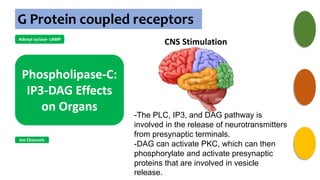
-The PLC, IP3, and DAG pathway is
involved in the release of neurotransmitters
from presynaptic terminals.
-DAG can activate PKC, which can then
phosphorylate and activate presynaptic
proteins that are involved in vesicle
release.
CNS Stimulation
G Protein coupled receptors
Adenyl cyclase- cAMP
Phospholipase-C:
IP3-DAG Effects
on Organs
Ion Channels
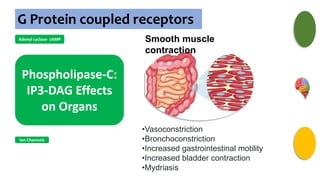
Smooth muscle
contraction
•Vasoconstriction
•Bronchoconstriction
•Increased gastrointestinal motility
•Increased bladder contraction
•Mydriasis
G Protein coupled receptors
Adenyl cyclase- cAMP
Phospholipase-C:
IP3-DAG Effects
on Organs
Ion Channels
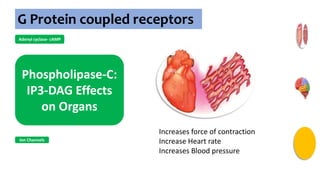
Increases force of contraction
Increase Heart rate
Increases Blood pressure
G Protein coupled receptors
Adenyl cyclase- cAMP
Phospholipase-C:
IP3-DAG Effects
on Organs
Ion Channels
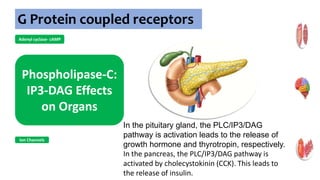
In the pituitary gland, the PLC/IP3/DAG
pathway is activation leads to the release of
growth hormone and thyrotropin, respectively.
In the pancreas, the PLC/IP3/DAG pathway is
activated by cholecystokinin (CCK). This leads to
the release of insulin.
G Protein coupled receptors
Adenyl cyclase- cAMP
Phospholipase-C-
inositol phosphate
Ion Channels
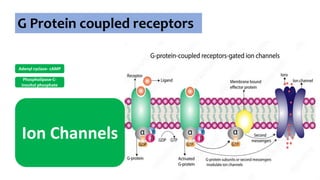
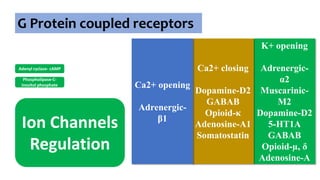
G Protein coupled receptors
Adenyl cyclase- cAMP
Phospholipase-C-
inositol phosphate
Ion Channels
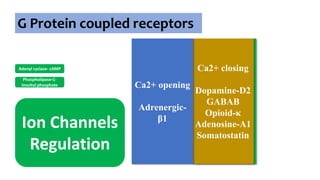
Regulation
K+ opening
Adrenergic-
α2
Muscarinic-
M2
Dopamine-D2
5-HT1A
GABAB
Opioid-µ, δ
Adenosine-A
Ca2+ closing
Dopamine-D2
GABAB
Opioid-κ
Adenosine-A1
Somatostatin
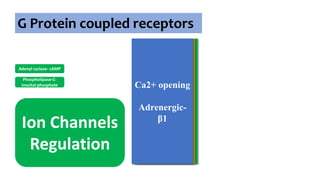
Ca2+ opening
Adrenergic-
β1
G Protein coupled receptors
Adenyl cyclase- cAMP
Phospholipase-C-
inositol phosphate
Ion Channels
Regulation
K+ opening
Adrenergic-
α2
Muscarinic-
M2
Dopamine-D2
5-HT1A
GABAB
Opioid-µ, δ
Adenosine-A
Ca2+ closing
Dopamine-D2
GABAB
Opioid-κ
Adenosine-A1
Somatostatin
Ca2+ opening
Adrenergic-
β1
G Protein coupled receptors
Adenyl cyclase- cAMP
Phospholipase-C-
inositol phosphate
Ion Channels
Regulation
K+ opening
Adrenergic-
α2
Muscarinic-
M2
Dopamine-D2
5-HT1A
GABAB
Opioid-µ, δ
Adenosine-A
Ca2+ closing
Dopamine-D2
GABAB
Opioid-κ
Adenosine-A1
Somatostatin
Ca2+ opening
Adrenergic-
β1
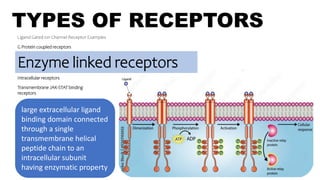
TYPES OF RECEPTORS
Ligand Gated ion Channel Receptor Examples
G Protein coupled receptors
Enzyme linked receptors
Intracellular receptors
large extracellular ligand
binding domain connected
through a single
transmembrane helical
peptide chain to an
intracellular subunit
having enzymatic property
Transmembrane JAK-STAT binding
receptors
TYPES OF RECEPTORS
Ligand Gated ion Channel Receptor Examples
G Protein coupled receptors
Enzyme linked receptors
Intracellular receptors
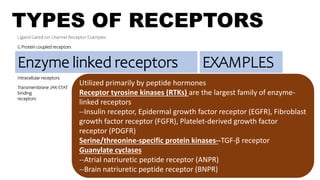
Utilized primarily by peptide hormones
Receptor tyrosine kinases (RTKs) are the largest family of enzyme-
linked receptors
--Insulin receptor, Epidermal growth factor receptor (EGFR), Fibroblast
growth factor receptor (FGFR), Platelet-derived growth factor
receptor (PDGFR)
Serine/threonine-specific protein kinases--TGF-β receptor
Guanylate cyclases
--Atrial natriuretic peptide receptor (ANPR)
--Brain natriuretic peptide receptor (BNPR)
EXAMPLES
Transmembrane JAK-STAT
binding
receptors
TYPES OF RECEPTORS
Ligand Gated ion Channel Receptor Examples
G Protein coupled receptors
Kinase linked receptors
Intracellular receptors
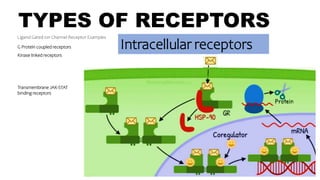
All steroidal hormones (glucocorticoids,
mineralocorticoids, androgens,
estrogens, progesterone)
Thyroxine
vit D and vit A Receptors
Transmembrane JAK-STAT binding
receptors
TYPES OF RECEPTORS
Ligand Gated ion Channel Receptor Examples
G Protein coupled receptors
Kinase linked receptors
Intracellular receptors
Transmembrane JAK-STAT
binding receptors
TYPES OF RECEPTORS
Ligand Gated ion Channel Receptor Examples
G Protein coupled receptors
Kinase linked receptors
Intracellular receptors
Transmembrane JAK-STAT
binding receptors
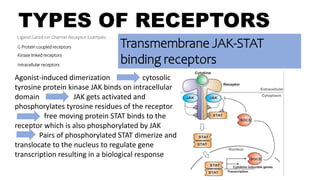
Agonist-induced dimerization cytosolic
tyrosine protein kinase JAK binds on intracellular
domain JAK gets activated and
phosphorylates tyrosine residues of the receptor
------------free moving protein STAT binds to the
receptor which is also phosphorylated by JAK -----
----------Pairs of phosphorylated STAT dimerize and
translocate to the nucleus to regulate gene
transcription resulting in a biological response
TYPES OF RECEPTORS
Ligand Gated ion Channel Receptor Examples
G Protein coupled receptors
Kinase linked receptors
Intracellular receptors
Transmembrane JAK-STAT
binding receptors
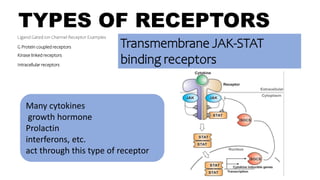
Many cytokines
growth hormone
Prolactin
interferons, etc.
act through this type of receptor

Receptors: Understanding Types and Functions

  • 1.
  • 2.
    RECEPTORS  It isdefined as a macromolecule or binding site located on the surface or inside the effector cell that serves to recognize the signal molecule/drug and initiate the response to it, but itself has no other function.  Two essential functions, viz, recognition of the specific ligand molecule and transduction of the signal into a response.  Receptor molecule has a ligand binding domain and an effector domain (functional conformational change)
  • 3.
    TYPES OF RECEPTORS Ligand Gated ion Channel Receptor  Enzyme linked receptors  G Protein coupled receptors  Intracellular receptors  Transmembrane JAK-STAT binding receptors
  • 4.
    TYPES OF RECEPTORS LigandGated ion Channel Receptor G Protein coupled receptors Enzyme linked receptors Intracellular receptors Transmembrane JAK-STAT binding receptors
  • 5.
    TYPES OF RECEPTORS LigandGated ion Channel Receptor G Protein coupled receptors Nicotinic receptors 5-HT3 receptors GABAa receptors NMDA receptors Enzyme linked receptors Intracellular receptors EXAMPLES Transmembrane JAK-STAT binding receptors
  • 6.
    TYPES OF RECEPTORS LigandGated ion Channel Receptor G Protein coupled receptors Enzyme linked receptors Intracellular receptors Nicotinic receptors 5-HT3 receptors GABAa receptors NMDA receptors EXAMPLES 5HT (Serotonin) 5HT3 (CTZ) Na+ Influx Vomiting Acetylcholine Nm (Skeletal Muscle) Na+ Influx Muscle Contraction Transmembrane JAK-STAT binding receptors
  • 7.
    TYPES OF RECEPTORS LigandGated ion Channel Receptor G Protein coupled receptors Enzyme linked receptors Intracellular receptors Nicotinic receptors 5-HT3 receptors GABAa receptors NMDA receptors EXAMPLES 5HT (Serotonin) 5HT3 (CTZ) Na+ Influx Vomiting Acetylcholine Nm (Skeletal Muscle) Na+ Influx Muscle Contraction Transmembrane JAK-STAT binding receptors
  • 8.
    TYPES OF RECEPTORS LigandGated ion Channel Receptor Examples G Protein coupled receptors Kinase linked receptors Intracellular receptors Examples of GPCRs Muscarinic receptors [M1-M5] Adrenergic receptors [α and β] Histamine receptors [H1-H3] Dopamine receptors [D1-D5] Opioid receptors [μ κ б] 5-HT receptors 5-HT[1-7] except 5- HT3 GABAb receptors *GPCR superfamily-largest and most diverse group of proteins *seven-transmembrane, serpentine, G protein–linked receptors Transmembrane JAK-STAT binding receptors Gs : Adenylyl cyclase , Ca2+ channel Gi : Adenylyl cyclase, K+ channel opening Go : Ca2+ channel inhibition Gq : Phospholipase C
  • 9.
    TYPES OF RECEPTORS LigandGated ion Channel Receptor Examples G Protein coupled receptors Kinase linked receptors Intracellular receptors Examples of GPCRs Muscarinic receptors [M1-M5] Adrenergic receptors [α and β] Histamine receptors [H1-H3] Dopamine receptors [D1-D5] Opioid receptors [μ κ б] 5-HT receptors 5-HT[1-7] except 5- HT3 GABAb receptors Transmembrane JAK-STAT binding receptors Gs : Adenylyl cyclase , Ca2+ channel Gi : Adenylyl cyclase, K+ channel opening Go : Ca2+ channel inhibition Gq : Phospholipase C
  • 10.
    TYPES OF RECEPTORS LigandGated ion Channel Receptor Examples G Protein coupled receptors Kinase linked receptors Intracellular receptors Adenyl cyclase- cAMP Phospholipase-C: IP3-DAG Ion Channels Three effector systems Transmembrane JAK-STAT binding receptors
  • 11.
    G Protein coupledreceptors Adenyl cyclase- cAMP Ion Channels Phospholipase-C: IP3-DAG
  • 12.
    G Protein coupledreceptors Effects of cAMP on Organs Ion Channels Phospholipase- C: IP3-DAG PKA phosphorylates many functional proteins including troponin and phospholamban, they interact with Ca2+ and also Calcium is made available by entry from outside (direct activation of myocardial membrane Ca2+ channels by Gsα and through their phosphorylation by PKA) as well as from intracellular stores. Increases force of contraction, Increase Heart rate, Increases Blood pressure.
  • 13.
    G Protein coupledreceptors Effects of cAMP on Organs Ion Channels Phospholipase- C: IP3-DAG PKA then phosphorylates a number of enzymes involved in lipolysis, including hormone-sensitive lipase (HSL) and adipose triglyceride lipase (ATGL). HSL and ATGL are responsible for hydrolyzing triglycerides into free fatty acids and glycerol causing
  • 14.
    G Protein coupledreceptors Effects of cAMP on Organs Ion Channels Phospholipase- C: IP3-DAG The effects of cAMP on liver glycogenolysis Activates glycogen phosphorylase Inhibits glycogen synthase: cAMP inhibits
  • 15.
    G Protein coupledreceptors Effects of cAMP on Organs Ion Channels Phospholipase- C: IP3-DAG cAMP has a relaxing effect on smooth muscle -Increasing the activity of the calcium pump removing calcium from the cytoplasm -Activating MLCP, which dephosphorylates MLCK. MLCK is an enzyme that phosphorylates myosin light chain, which is required for smooth muscle contraction -Inhibiting the release of calcium from the SR -Opening potassium channels, causing hyperpolarization and relaxation
  • 16.
    Adenyl cyclase- cAMP Phospholipase-C: IP3-DAG IonChannels G Protein coupled receptors
  • 17.
    G Protein coupledreceptors Adenyl cyclase- cAMP Phospholipase-C: IP3-DAG Effects on Organs Ion Channels -The PLC, IP3, and DAG pathway is involved in the release of neurotransmitters from presynaptic terminals. -DAG can activate PKC, which can then phosphorylate and activate presynaptic proteins that are involved in vesicle release. CNS Stimulation
  • 18.
    G Protein coupledreceptors Adenyl cyclase- cAMP Phospholipase-C: IP3-DAG Effects on Organs Ion Channels Smooth muscle contraction •Vasoconstriction •Bronchoconstriction •Increased gastrointestinal motility •Increased bladder contraction •Mydriasis
  • 19.
    G Protein coupledreceptors Adenyl cyclase- cAMP Phospholipase-C: IP3-DAG Effects on Organs Ion Channels Increases force of contraction Increase Heart rate Increases Blood pressure
  • 20.
    G Protein coupledreceptors Adenyl cyclase- cAMP Phospholipase-C: IP3-DAG Effects on Organs Ion Channels In the pituitary gland, the PLC/IP3/DAG pathway is activation leads to the release of growth hormone and thyrotropin, respectively. In the pancreas, the PLC/IP3/DAG pathway is activated by cholecystokinin (CCK). This leads to the release of insulin.
  • 21.
    G Protein coupledreceptors Adenyl cyclase- cAMP Phospholipase-C- inositol phosphate Ion Channels
  • 22.
    G Protein coupledreceptors Adenyl cyclase- cAMP Phospholipase-C- inositol phosphate Ion Channels Regulation K+ opening Adrenergic- α2 Muscarinic- M2 Dopamine-D2 5-HT1A GABAB Opioid-µ, δ Adenosine-A Ca2+ closing Dopamine-D2 GABAB Opioid-κ Adenosine-A1 Somatostatin Ca2+ opening Adrenergic- β1
  • 23.
    G Protein coupledreceptors Adenyl cyclase- cAMP Phospholipase-C- inositol phosphate Ion Channels Regulation K+ opening Adrenergic- α2 Muscarinic- M2 Dopamine-D2 5-HT1A GABAB Opioid-µ, δ Adenosine-A Ca2+ closing Dopamine-D2 GABAB Opioid-κ Adenosine-A1 Somatostatin Ca2+ opening Adrenergic- β1
  • 24.
    G Protein coupledreceptors Adenyl cyclase- cAMP Phospholipase-C- inositol phosphate Ion Channels Regulation K+ opening Adrenergic- α2 Muscarinic- M2 Dopamine-D2 5-HT1A GABAB Opioid-µ, δ Adenosine-A Ca2+ closing Dopamine-D2 GABAB Opioid-κ Adenosine-A1 Somatostatin Ca2+ opening Adrenergic- β1
  • 25.
    TYPES OF RECEPTORS LigandGated ion Channel Receptor Examples G Protein coupled receptors Enzyme linked receptors Intracellular receptors large extracellular ligand binding domain connected through a single transmembrane helical peptide chain to an intracellular subunit having enzymatic property Transmembrane JAK-STAT binding receptors
  • 26.
    TYPES OF RECEPTORS LigandGated ion Channel Receptor Examples G Protein coupled receptors Enzyme linked receptors Intracellular receptors Utilized primarily by peptide hormones Receptor tyrosine kinases (RTKs) are the largest family of enzyme- linked receptors --Insulin receptor, Epidermal growth factor receptor (EGFR), Fibroblast growth factor receptor (FGFR), Platelet-derived growth factor receptor (PDGFR) Serine/threonine-specific protein kinases--TGF-β receptor Guanylate cyclases --Atrial natriuretic peptide receptor (ANPR) --Brain natriuretic peptide receptor (BNPR) EXAMPLES Transmembrane JAK-STAT binding receptors
  • 27.
    TYPES OF RECEPTORS LigandGated ion Channel Receptor Examples G Protein coupled receptors Kinase linked receptors Intracellular receptors All steroidal hormones (glucocorticoids, mineralocorticoids, androgens, estrogens, progesterone) Thyroxine vit D and vit A Receptors Transmembrane JAK-STAT binding receptors
  • 28.
    TYPES OF RECEPTORS LigandGated ion Channel Receptor Examples G Protein coupled receptors Kinase linked receptors Intracellular receptors Transmembrane JAK-STAT binding receptors
  • 29.
    TYPES OF RECEPTORS LigandGated ion Channel Receptor Examples G Protein coupled receptors Kinase linked receptors Intracellular receptors Transmembrane JAK-STAT binding receptors Agonist-induced dimerization cytosolic tyrosine protein kinase JAK binds on intracellular domain JAK gets activated and phosphorylates tyrosine residues of the receptor ------------free moving protein STAT binds to the receptor which is also phosphorylated by JAK ----- ----------Pairs of phosphorylated STAT dimerize and translocate to the nucleus to regulate gene transcription resulting in a biological response
  • 30.
    TYPES OF RECEPTORS LigandGated ion Channel Receptor Examples G Protein coupled receptors Kinase linked receptors Intracellular receptors Transmembrane JAK-STAT binding receptors Many cytokines growth hormone Prolactin interferons, etc. act through this type of receptor

Editor's Notes

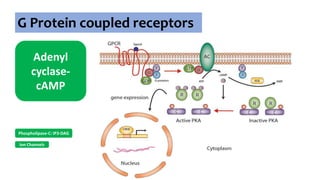
  • #12 he cyclic AMP-dependent signaling pathway. G protein-coupled receptors (GPCRs) undergo conformational changes in response to various extracellular stimuli. Gsα subunit (G-proteins) exchanges GDP for GTP that activates adenylyl cyclase (AC), converting ATP to cAMP. Elevated cAMP levels, regulated by PDEs (also responsible for degradation of cGMP to GMP), then activate protein kinase A (PKA). PKA consists of a tetramer of two homo- or heterodimers regulatory subunits (R) and two catalytic subunits (C) responsible for the phosphorylation of several enzymes and transcription factors downstream [e.g., cAMP-response element-binding protein (CREB)]. The end product is gene expression to mediate cell growth and differentiation. Abbreviations: α, β, γ, Gs-protein subunits; AC, adenyl cyclase; C, catalytic subunit of protein kinase A; cAMP, cyclic AMP; CREB, cyclic AMP response element-binding protein, a transcription factor; GPCR, G-protein-coupled receptor; PDE, phosphodiesterase; PKA, protein kinase A; R, the regulatory subunits of protein kinase. Courtesy of Stratakis Lab, NICHD, NIH
  • #13 he cyclic AMP-dependent signaling pathway. G protein-coupled receptors (GPCRs) undergo conformational changes in response to various extracellular stimuli. Gsα subunit (G-proteins) exchanges GDP for GTP that activates adenylyl cyclase (AC), converting ATP to cAMP. Elevated cAMP levels, regulated by PDEs (also responsible for degradation of cGMP to GMP), then activate protein kinase A (PKA). PKA consists of a tetramer of two homo- or heterodimers regulatory subunits (R) and two catalytic subunits (C) responsible for the phosphorylation of several enzymes and transcription factors downstream [e.g., cAMP-response element-binding protein (CREB)]. The end product is gene expression to mediate cell growth and differentiation. Abbreviations: α, β, γ, Gs-protein subunits; AC, adenyl cyclase; C, catalytic subunit of protein kinase A; cAMP, cyclic AMP; CREB, cyclic AMP response element-binding protein, a transcription factor; GPCR, G-protein-coupled receptor; PDE, phosphodiesterase; PKA, protein kinase A; R, the regulatory subunits of protein kinase. Courtesy of Stratakis Lab, NICHD, NIH
  • #14 he cyclic AMP-dependent signaling pathway. G protein-coupled receptors (GPCRs) undergo conformational changes in response to various extracellular stimuli. Gsα subunit (G-proteins) exchanges GDP for GTP that activates adenylyl cyclase (AC), converting ATP to cAMP. Elevated cAMP levels, regulated by PDEs (also responsible for degradation of cGMP to GMP), then activate protein kinase A (PKA). PKA consists of a tetramer of two homo- or heterodimers regulatory subunits (R) and two catalytic subunits (C) responsible for the phosphorylation of several enzymes and transcription factors downstream [e.g., cAMP-response element-binding protein (CREB)]. The end product is gene expression to mediate cell growth and differentiation. Abbreviations: α, β, γ, Gs-protein subunits; AC, adenyl cyclase; C, catalytic subunit of protein kinase A; cAMP, cyclic AMP; CREB, cyclic AMP response element-binding protein, a transcription factor; GPCR, G-protein-coupled receptor; PDE, phosphodiesterase; PKA, protein kinase A; R, the regulatory subunits of protein kinase. Courtesy of Stratakis Lab, NICHD, NIH
  • #15 he cyclic AMP-dependent signaling pathway. G protein-coupled receptors (GPCRs) undergo conformational changes in response to various extracellular stimuli. Gsα subunit (G-proteins) exchanges GDP for GTP that activates adenylyl cyclase (AC), converting ATP to cAMP. Elevated cAMP levels, regulated by PDEs (also responsible for degradation of cGMP to GMP), then activate protein kinase A (PKA). PKA consists of a tetramer of two homo- or heterodimers regulatory subunits (R) and two catalytic subunits (C) responsible for the phosphorylation of several enzymes and transcription factors downstream [e.g., cAMP-response element-binding protein (CREB)]. The end product is gene expression to mediate cell growth and differentiation. Abbreviations: α, β, γ, Gs-protein subunits; AC, adenyl cyclase; C, catalytic subunit of protein kinase A; cAMP, cyclic AMP; CREB, cyclic AMP response element-binding protein, a transcription factor; GPCR, G-protein-coupled receptor; PDE, phosphodiesterase; PKA, protein kinase A; R, the regulatory subunits of protein kinase. Courtesy of Stratakis Lab, NICHD, NIH
  • #16 he cyclic AMP-dependent signaling pathway. G protein-coupled receptors (GPCRs) undergo conformational changes in response to various extracellular stimuli. Gsα subunit (G-proteins) exchanges GDP for GTP that activates adenylyl cyclase (AC), converting ATP to cAMP. Elevated cAMP levels, regulated by PDEs (also responsible for degradation of cGMP to GMP), then activate protein kinase A (PKA). PKA consists of a tetramer of two homo- or heterodimers regulatory subunits (R) and two catalytic subunits (C) responsible for the phosphorylation of several enzymes and transcription factors downstream [e.g., cAMP-response element-binding protein (CREB)]. The end product is gene expression to mediate cell growth and differentiation. Abbreviations: α, β, γ, Gs-protein subunits; AC, adenyl cyclase; C, catalytic subunit of protein kinase A; cAMP, cyclic AMP; CREB, cyclic AMP response element-binding protein, a transcription factor; GPCR, G-protein-coupled receptor; PDE, phosphodiesterase; PKA, protein kinase A; R, the regulatory subunits of protein kinase. Courtesy of Stratakis Lab, NICHD, NIH
  • #17 he cyclic AMP-dependent signaling pathway. G protein-coupled receptors (GPCRs) undergo conformational changes in response to various extracellular stimuli. Gsα subunit (G-proteins) exchanges GDP for GTP that activates adenylyl cyclase (AC), converting ATP to cAMP. Elevated cAMP levels, regulated by PDEs (also responsible for degradation of cGMP to GMP), then activate protein kinase A (PKA). PKA consists of a tetramer of two homo- or heterodimers regulatory subunits (R) and two catalytic subunits (C) responsible for the phosphorylation of several enzymes and transcription factors downstream [e.g., cAMP-response element-binding protein (CREB)]. The end product is gene expression to mediate cell growth and differentiation. Abbreviations: α, β, γ, Gs-protein subunits; AC, adenyl cyclase; C, catalytic subunit of protein kinase A; cAMP, cyclic AMP; CREB, cyclic AMP response element-binding protein, a transcription factor; GPCR, G-protein-coupled receptor; PDE, phosphodiesterase; PKA, protein kinase A; R, the regulatory subunits of protein kinase. Courtesy of Stratakis Lab, NICHD, NIH
  • #18 he cyclic AMP-dependent signaling pathway. G protein-coupled receptors (GPCRs) undergo conformational changes in response to various extracellular stimuli. Gsα subunit (G-proteins) exchanges GDP for GTP that activates adenylyl cyclase (AC), converting ATP to cAMP. Elevated cAMP levels, regulated by PDEs (also responsible for degradation of cGMP to GMP), then activate protein kinase A (PKA). PKA consists of a tetramer of two homo- or heterodimers regulatory subunits (R) and two catalytic subunits (C) responsible for the phosphorylation of several enzymes and transcription factors downstream [e.g., cAMP-response element-binding protein (CREB)]. The end product is gene expression to mediate cell growth and differentiation. Abbreviations: α, β, γ, Gs-protein subunits; AC, adenyl cyclase; C, catalytic subunit of protein kinase A; cAMP, cyclic AMP; CREB, cyclic AMP response element-binding protein, a transcription factor; GPCR, G-protein-coupled receptor; PDE, phosphodiesterase; PKA, protein kinase A; R, the regulatory subunits of protein kinase. Courtesy of Stratakis Lab, NICHD, NIH
  • #19 he cyclic AMP-dependent signaling pathway. G protein-coupled receptors (GPCRs) undergo conformational changes in response to various extracellular stimuli. Gsα subunit (G-proteins) exchanges GDP for GTP that activates adenylyl cyclase (AC), converting ATP to cAMP. Elevated cAMP levels, regulated by PDEs (also responsible for degradation of cGMP to GMP), then activate protein kinase A (PKA). PKA consists of a tetramer of two homo- or heterodimers regulatory subunits (R) and two catalytic subunits (C) responsible for the phosphorylation of several enzymes and transcription factors downstream [e.g., cAMP-response element-binding protein (CREB)]. The end product is gene expression to mediate cell growth and differentiation. Abbreviations: α, β, γ, Gs-protein subunits; AC, adenyl cyclase; C, catalytic subunit of protein kinase A; cAMP, cyclic AMP; CREB, cyclic AMP response element-binding protein, a transcription factor; GPCR, G-protein-coupled receptor; PDE, phosphodiesterase; PKA, protein kinase A; R, the regulatory subunits of protein kinase. Courtesy of Stratakis Lab, NICHD, NIH
  • #20 he cyclic AMP-dependent signaling pathway. G protein-coupled receptors (GPCRs) undergo conformational changes in response to various extracellular stimuli. Gsα subunit (G-proteins) exchanges GDP for GTP that activates adenylyl cyclase (AC), converting ATP to cAMP. Elevated cAMP levels, regulated by PDEs (also responsible for degradation of cGMP to GMP), then activate protein kinase A (PKA). PKA consists of a tetramer of two homo- or heterodimers regulatory subunits (R) and two catalytic subunits (C) responsible for the phosphorylation of several enzymes and transcription factors downstream [e.g., cAMP-response element-binding protein (CREB)]. The end product is gene expression to mediate cell growth and differentiation. Abbreviations: α, β, γ, Gs-protein subunits; AC, adenyl cyclase; C, catalytic subunit of protein kinase A; cAMP, cyclic AMP; CREB, cyclic AMP response element-binding protein, a transcription factor; GPCR, G-protein-coupled receptor; PDE, phosphodiesterase; PKA, protein kinase A; R, the regulatory subunits of protein kinase. Courtesy of Stratakis Lab, NICHD, NIH
  • #21 he cyclic AMP-dependent signaling pathway. G protein-coupled receptors (GPCRs) undergo conformational changes in response to various extracellular stimuli. Gsα subunit (G-proteins) exchanges GDP for GTP that activates adenylyl cyclase (AC), converting ATP to cAMP. Elevated cAMP levels, regulated by PDEs (also responsible for degradation of cGMP to GMP), then activate protein kinase A (PKA). PKA consists of a tetramer of two homo- or heterodimers regulatory subunits (R) and two catalytic subunits (C) responsible for the phosphorylation of several enzymes and transcription factors downstream [e.g., cAMP-response element-binding protein (CREB)]. The end product is gene expression to mediate cell growth and differentiation. Abbreviations: α, β, γ, Gs-protein subunits; AC, adenyl cyclase; C, catalytic subunit of protein kinase A; cAMP, cyclic AMP; CREB, cyclic AMP response element-binding protein, a transcription factor; GPCR, G-protein-coupled receptor; PDE, phosphodiesterase; PKA, protein kinase A; R, the regulatory subunits of protein kinase. Courtesy of Stratakis Lab, NICHD, NIH
  • #22 he cyclic AMP-dependent signaling pathway. G protein-coupled receptors (GPCRs) undergo conformational changes in response to various extracellular stimuli. Gsα subunit (G-proteins) exchanges GDP for GTP that activates adenylyl cyclase (AC), converting ATP to cAMP. Elevated cAMP levels, regulated by PDEs (also responsible for degradation of cGMP to GMP), then activate protein kinase A (PKA). PKA consists of a tetramer of two homo- or heterodimers regulatory subunits (R) and two catalytic subunits (C) responsible for the phosphorylation of several enzymes and transcription factors downstream [e.g., cAMP-response element-binding protein (CREB)]. The end product is gene expression to mediate cell growth and differentiation. Abbreviations: α, β, γ, Gs-protein subunits; AC, adenyl cyclase; C, catalytic subunit of protein kinase A; cAMP, cyclic AMP; CREB, cyclic AMP response element-binding protein, a transcription factor; GPCR, G-protein-coupled receptor; PDE, phosphodiesterase; PKA, protein kinase A; R, the regulatory subunits of protein kinase. Courtesy of Stratakis Lab, NICHD, NIH
  • #23 he cyclic AMP-dependent signaling pathway. G protein-coupled receptors (GPCRs) undergo conformational changes in response to various extracellular stimuli. Gsα subunit (G-proteins) exchanges GDP for GTP that activates adenylyl cyclase (AC), converting ATP to cAMP. Elevated cAMP levels, regulated by PDEs (also responsible for degradation of cGMP to GMP), then activate protein kinase A (PKA). PKA consists of a tetramer of two homo- or heterodimers regulatory subunits (R) and two catalytic subunits (C) responsible for the phosphorylation of several enzymes and transcription factors downstream [e.g., cAMP-response element-binding protein (CREB)]. The end product is gene expression to mediate cell growth and differentiation. Abbreviations: α, β, γ, Gs-protein subunits; AC, adenyl cyclase; C, catalytic subunit of protein kinase A; cAMP, cyclic AMP; CREB, cyclic AMP response element-binding protein, a transcription factor; GPCR, G-protein-coupled receptor; PDE, phosphodiesterase; PKA, protein kinase A; R, the regulatory subunits of protein kinase. Courtesy of Stratakis Lab, NICHD, NIH
  • #24 he cyclic AMP-dependent signaling pathway. G protein-coupled receptors (GPCRs) undergo conformational changes in response to various extracellular stimuli. Gsα subunit (G-proteins) exchanges GDP for GTP that activates adenylyl cyclase (AC), converting ATP to cAMP. Elevated cAMP levels, regulated by PDEs (also responsible for degradation of cGMP to GMP), then activate protein kinase A (PKA). PKA consists of a tetramer of two homo- or heterodimers regulatory subunits (R) and two catalytic subunits (C) responsible for the phosphorylation of several enzymes and transcription factors downstream [e.g., cAMP-response element-binding protein (CREB)]. The end product is gene expression to mediate cell growth and differentiation. Abbreviations: α, β, γ, Gs-protein subunits; AC, adenyl cyclase; C, catalytic subunit of protein kinase A; cAMP, cyclic AMP; CREB, cyclic AMP response element-binding protein, a transcription factor; GPCR, G-protein-coupled receptor; PDE, phosphodiesterase; PKA, protein kinase A; R, the regulatory subunits of protein kinase. Courtesy of Stratakis Lab, NICHD, NIH
  • #25 he cyclic AMP-dependent signaling pathway. G protein-coupled receptors (GPCRs) undergo conformational changes in response to various extracellular stimuli. Gsα subunit (G-proteins) exchanges GDP for GTP that activates adenylyl cyclase (AC), converting ATP to cAMP. Elevated cAMP levels, regulated by PDEs (also responsible for degradation of cGMP to GMP), then activate protein kinase A (PKA). PKA consists of a tetramer of two homo- or heterodimers regulatory subunits (R) and two catalytic subunits (C) responsible for the phosphorylation of several enzymes and transcription factors downstream [e.g., cAMP-response element-binding protein (CREB)]. The end product is gene expression to mediate cell growth and differentiation. Abbreviations: α, β, γ, Gs-protein subunits; AC, adenyl cyclase; C, catalytic subunit of protein kinase A; cAMP, cyclic AMP; CREB, cyclic AMP response element-binding protein, a transcription factor; GPCR, G-protein-coupled receptor; PDE, phosphodiesterase; PKA, protein kinase A; R, the regulatory subunits of protein kinase. Courtesy of Stratakis Lab, NICHD, NIH