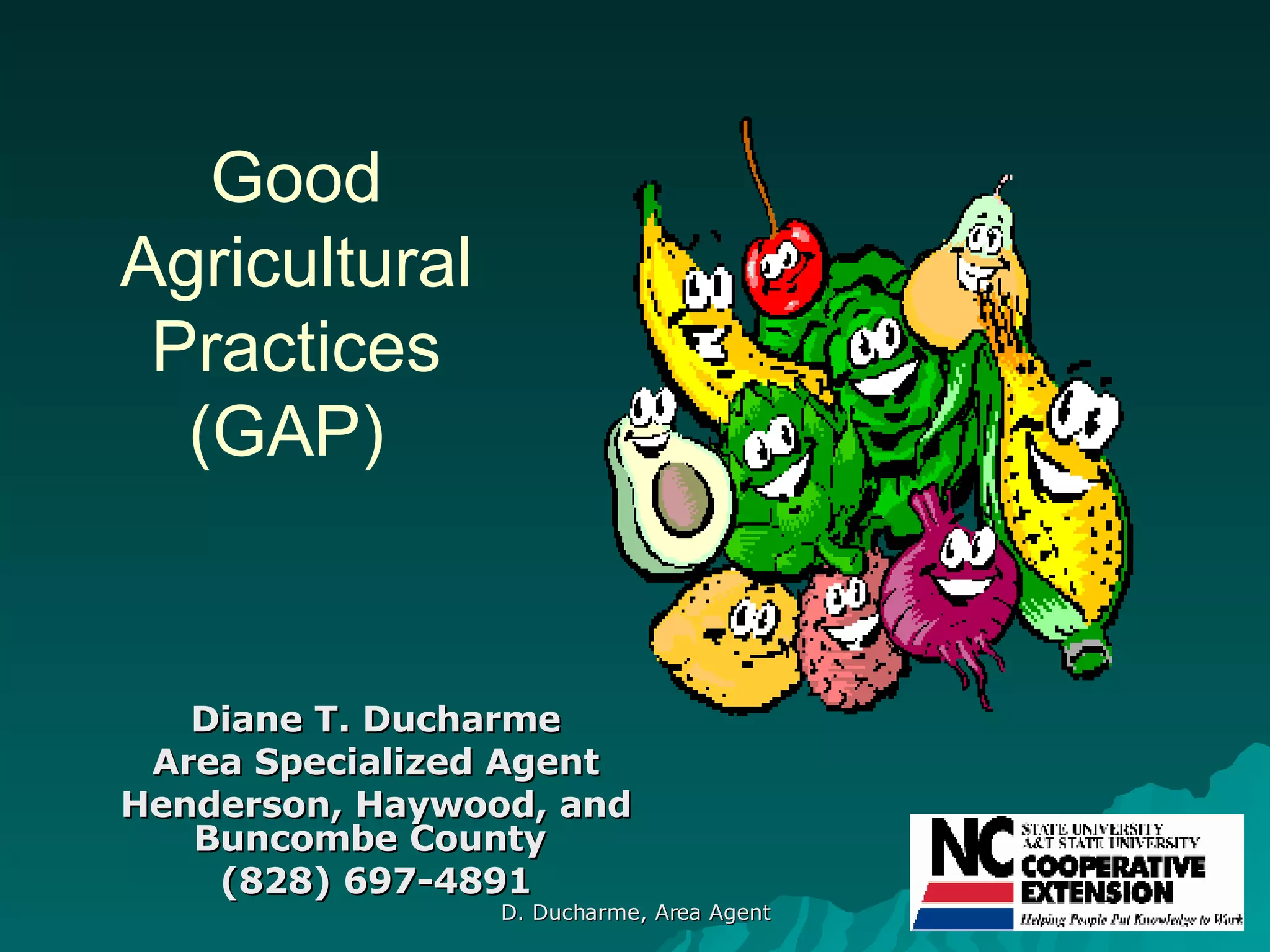
Good Agricultural Practices (GAP)  Diane T. Ducharme Area Specialized Agent Henderson, Haywood, and Buncombe County  (828) 697-4891
Good Agricultural Practices Definitions  = GAP = GHP – Good Handling Practices = GMP – Good Manufacturing Practices A tool for addressing food safety (human pathogens) on the farm a Voluntary program (Now- 10/07) Seven (7) practices highlighted to be taken throughout an operation
What does HACCP got to do with it? HACCP stands for Hazard Analysis Critical Control Point a system in which points in a process are identified and controls are put in place to ensure that food safety hazards are eliminated  Regulated for the Processed Food Industry not Fresh Produce!
HACCP and GAP GAPs are based on the foundation of the HACCP steps On the next slide you will see the similarities between the two
Processed  vs  Fresh  HACCP – Hazard Analysis Critical Control Points Processed foods   7 basis principles Required (Regulated)  GAP - Good Agricultural Practices Fresh produce 7 basis principles Voluntary   Business to business
Starting at the Beginning… GAPs foundation is with the “Guide to Minimize Microbial Food Safety Hazards for Fresh Fruits and Vegetables” Created in 1998 by the FDA, USDA and CDC guidance document ("the guide") addresses microbial food safety hazards and good agricultural and management practices common to the growing, harvesting, washing, sorting, packing, and transporting of most fruits and vegetables
http://www.foodsafety.gov/~dms/prodguid.html#preface October, 1998
How this works The “Guide” gives us steps or areas of concern for possible contamination These steps will give the grower guidance in looking at their individual farms for possible areas where this food safety risk can be decreased or eliminated.
The “Skinny” on the GAP steps Prevent Microbial contamination Start program of GAPs Human/animal feces Water Animal manure (proximity and 120 days)  Worker hygiene/sanitation Follow all applicable laws (pesticides, etc) Traceback/recordkeeping/ documentation
Preventing  microbial contamination  of fresh produce is favored over relying  on corrective action once contamination occurs.   GOOD AGRICULTURAL  PRACTICE #1
GOOD AGRICULTURAL  PRACTICE #2   To minimize microbial food safety hazards in fresh produce, growers, packers or shippers should  use good agricultural  or management practices in those areas over which they have control.
GOOD AGRICULTURAL    PRACTICE #3 Fresh produce can become microbiologically contaminated at any point along the farm-to-table food chain.  The major source of microbial contamination with fresh produce is  associated with   human  or animal feces.  (proximity)
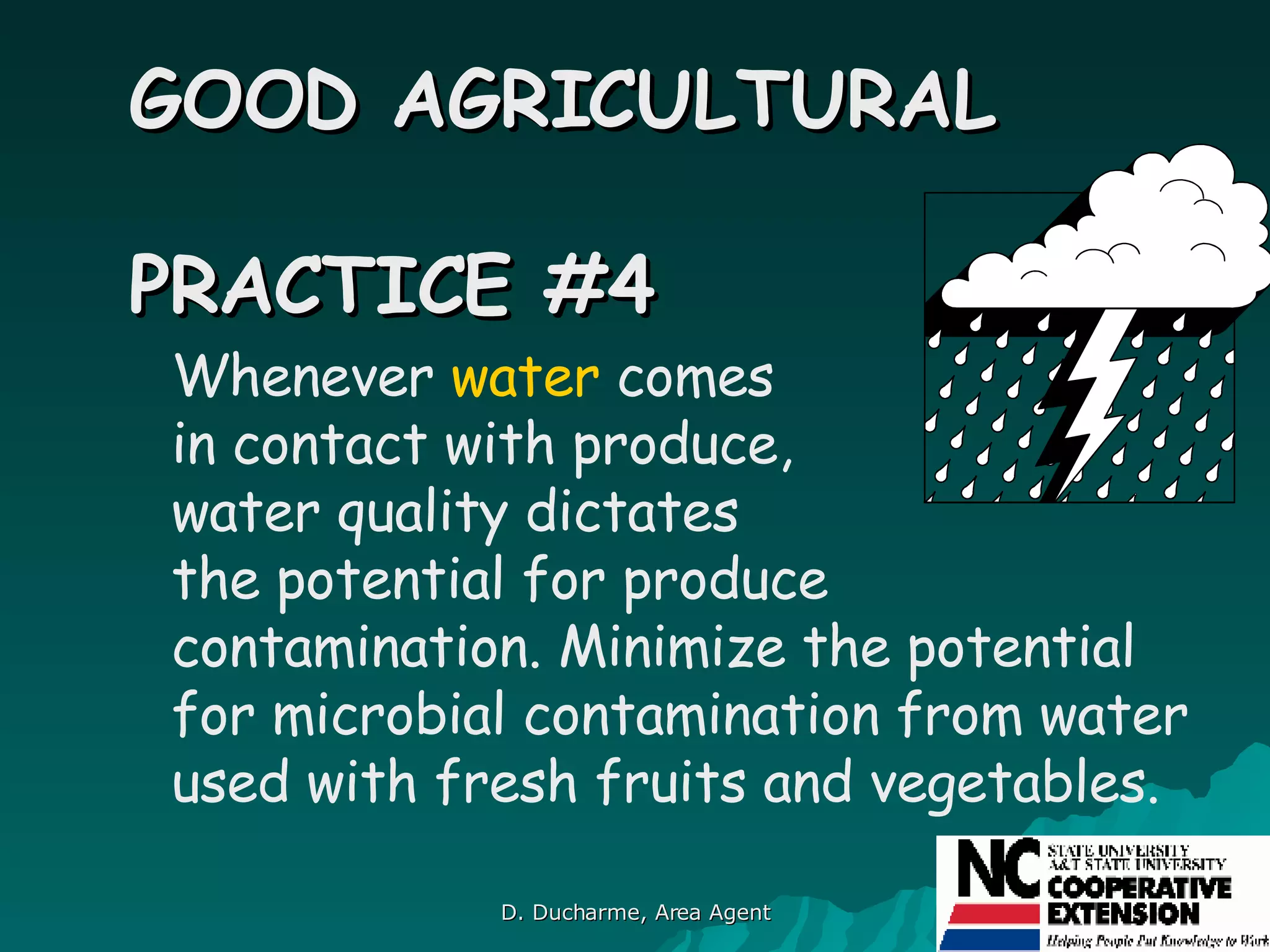
Whenever  water  comes  in contact with produce,  water quality dictates  the potential for produce contamination. Minimize the potential for microbial contamination from water used with fresh fruits and vegetables.   GOOD AGRICULTURAL  PRACTICE #4
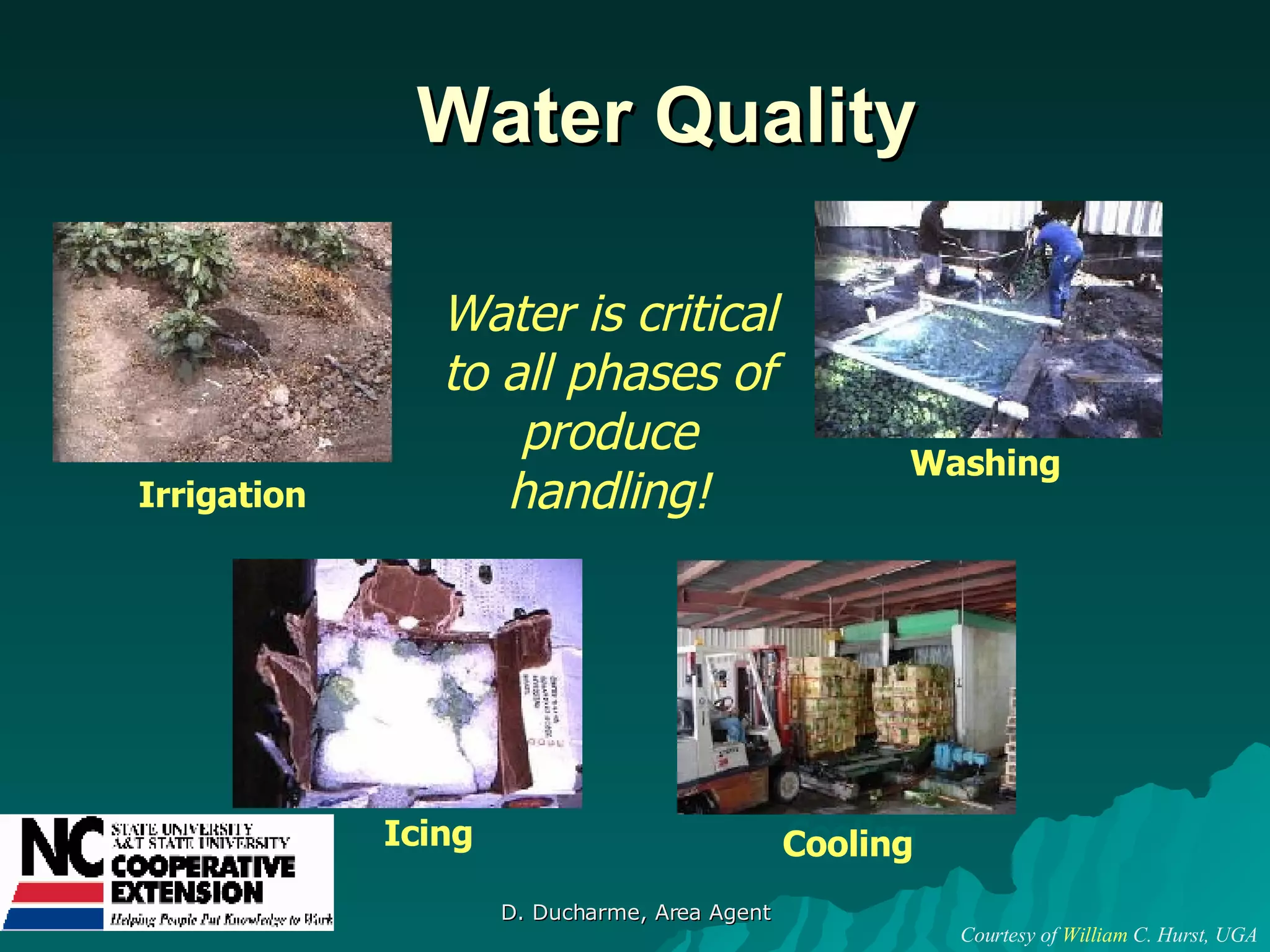
Water Quality Irrigation Washing Cooling Icing Water is critical to all phases of produce handling! Cooling Courtesy of  William  C. Hurst, UGA
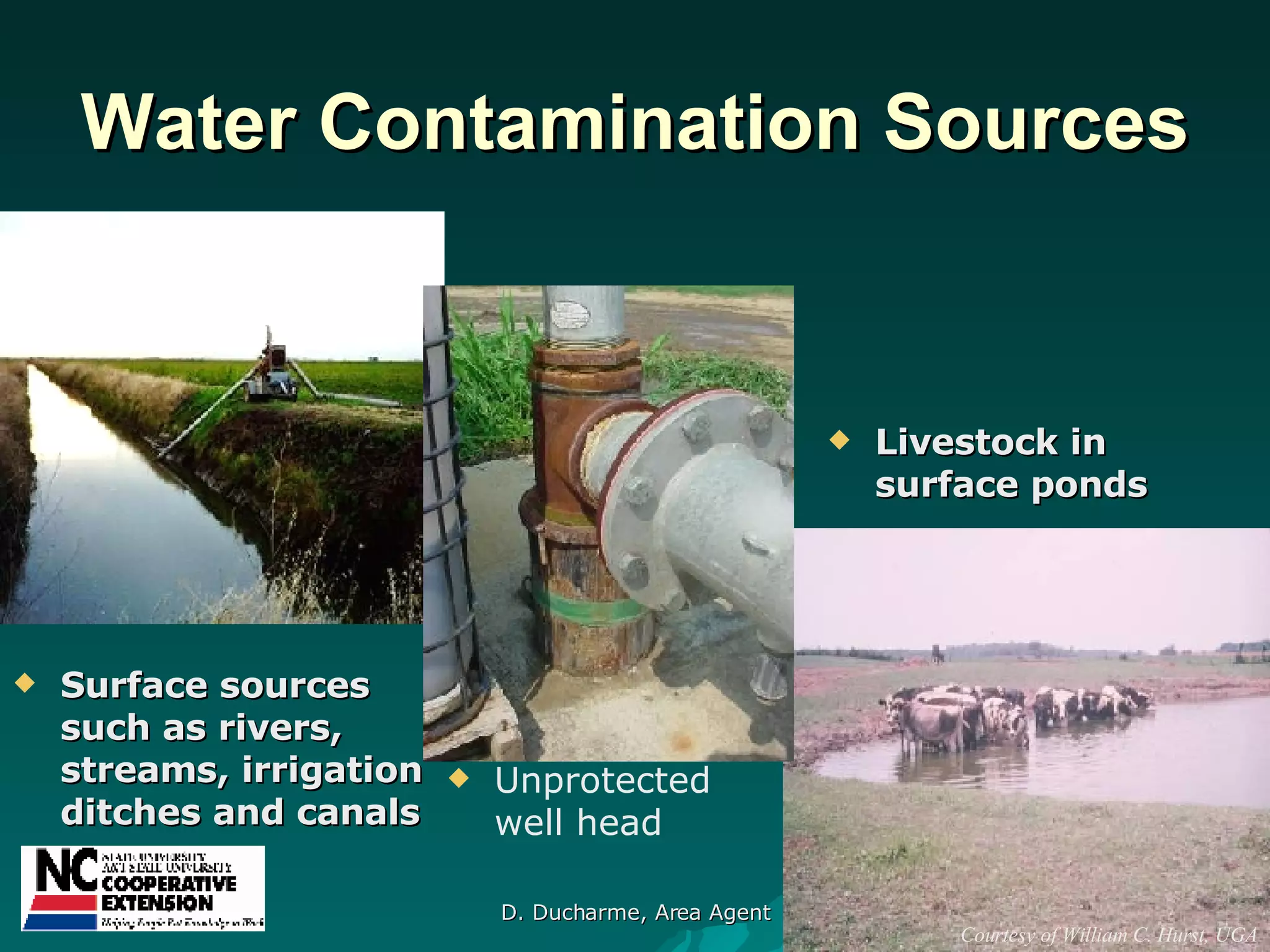
Water Contamination Sources Livestock in surface ponds Surface sources such as rivers, streams, irrigation ditches and canals Unprotected well head Courtesy of William C. Hurst, UGA
Practices using  animal manure or municipal biosolid wastes  should be managed closely to minimize the potential for microbial contamination for fresh produce. (120 days)   GOOD AGRICULTURAL PRACTICE #5
Worker hygiene and sanitation practices during production, harvesting, sorting,packing and transport  play a critical role in minimizing the potential for microbial contamination of fresh produce.   GOOD AGRICULTURAL PRACTICE #6
Field Worker Hygiene Courtesy of Trevor Suslow Courtesy of Cornell GAPs Program Are gloves worn? Are facilities accessible? Are toilets well stocked? Courtesy of William C. Hurst, UGA
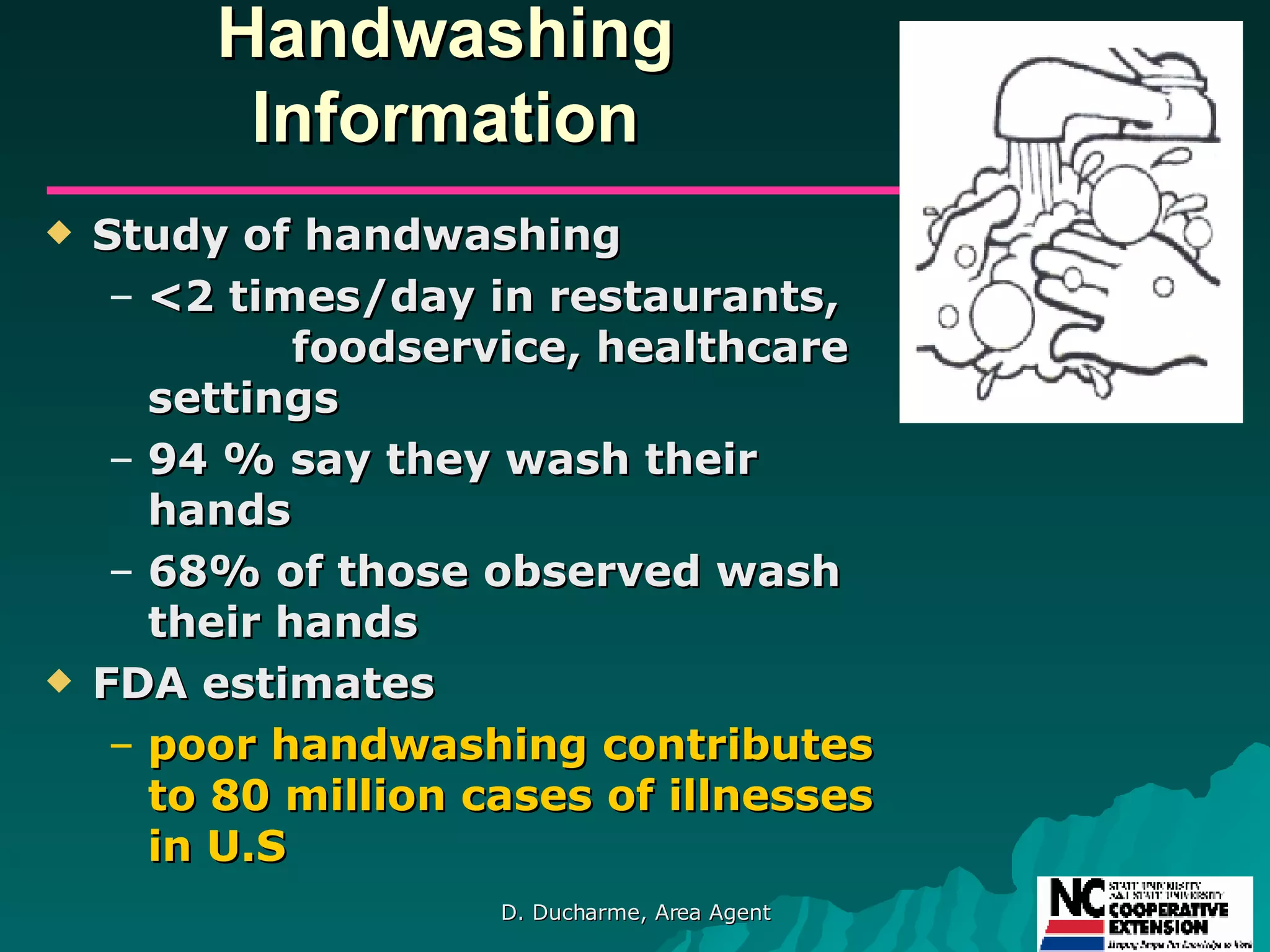
Handwashing Information Study of handwashing  <2 times/day in restaurants,  foodservice, healthcare settings 94 % say they wash their hands  68% of those observed wash their hands  FDA estimates  poor handwashing contributes to 80 million cases of illnesses in U.S
Hazard Identification in the Fresh Produce Industry At 21 of 24 farms surveyed, worker health and hygiene were the major hazards to produce safety. Inadequate hand washing was the most frequent  hazard noted. Inadequate hygiene training ranked #2, followed by unsanitary worker facilities. J. Guzewich, Food Protection Mtg. 2003 Courtesy of William C. Hurst, UGA
Black light and Glowgerm is used to show incidence of bacteria
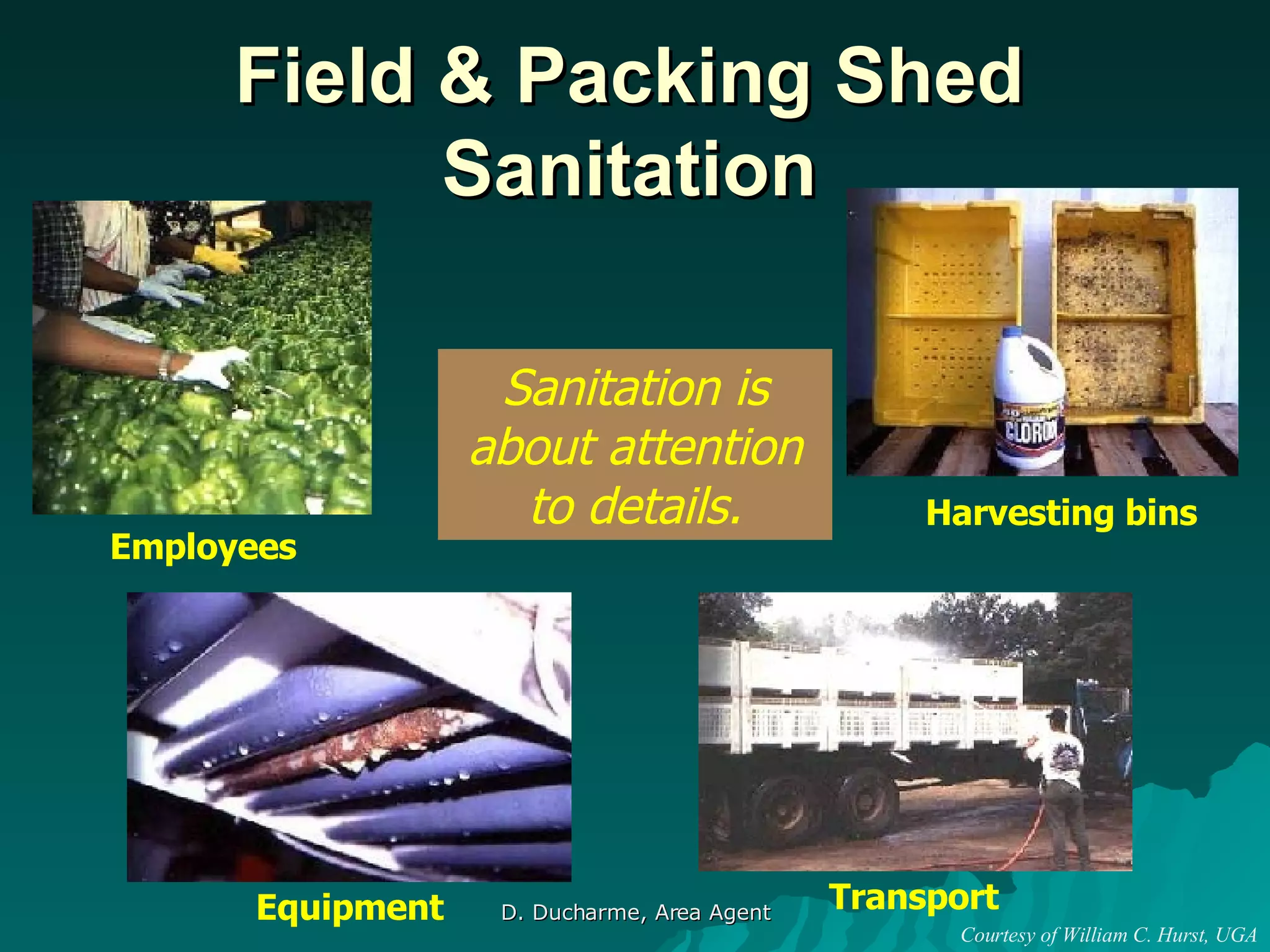
Field & Packing Shed Sanitation Sanitation is about attention to details. Employees Equipment Harvesting bins Transport Courtesy of William C. Hurst, UGA
Keep Grading Equipment Clean
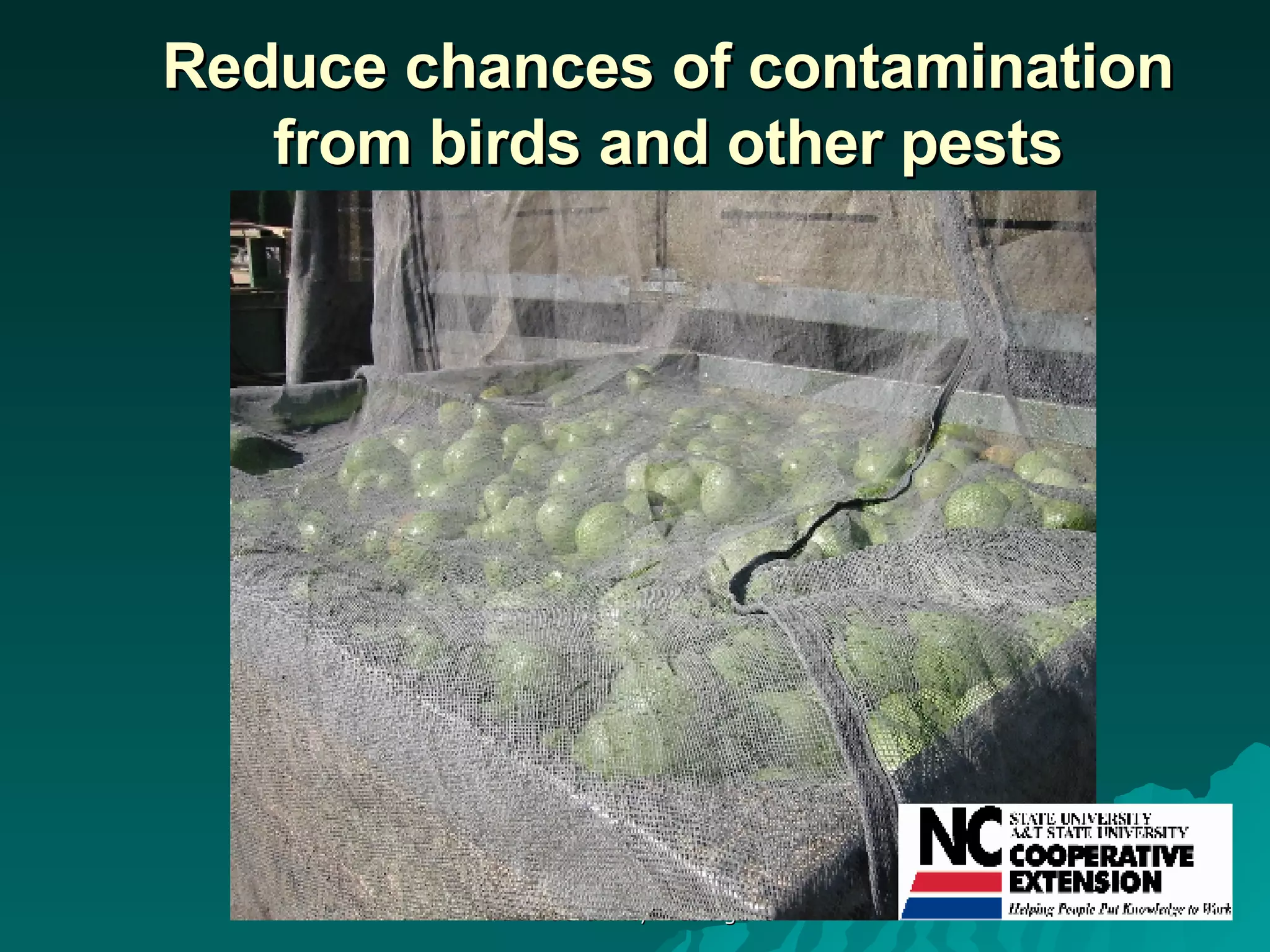
Reduce chances of contamination from birds and other pests
Follow all applicable local, state, and Federal laws and regulations , or corresponding or similar laws, regulations, or standards  for operators outside  the U.S. for agricultural  practices.   GOOD AGRICULTURAL PRACTICE #7
Really about Documentation Maintaining adequate records can mean the difference staying in business or being sold and/or shut down. Records allows for tracking problems and corrective action effectiveness. Provide worker training for all workers including Hispanic workers Document worker training Post appropriate signage for workers and the general public
Workers document training
Signs posted and check list posted for restroom facilities
What Can Growers & Packers Do? Learn about the risks Who is the enemy? Develop a food safety plan  Document activities Prevention is the key! Courtesy of William C. Hurst, UGA
In Summary GAPs is a voluntary program, industry moving this forward Food Safety is the Issue Make it simple, but write definitive statements of how and when and how documents Remember, don’t write anything in your SOPs that you don’t intend on doing and documenting!
Resources National Gap Resources http://www.gaps.cornell.edu/educationalmaterials.htm NCSU Food Safety Gaps www.extensionfoodsafety.com USDA Audit Matrix  http://www.ams.usda.gov/fv/fpbgapghp.htm Third-Party Auditor NCDA PRIMUS Others
Keep Our Produce Safe Any Questions?

Good Agricultural Practices (D. Ducharme)

  • 1.
    Good Agricultural Practices(GAP) Diane T. Ducharme Area Specialized Agent Henderson, Haywood, and Buncombe County (828) 697-4891
  • 2.
    Good Agricultural PracticesDefinitions = GAP = GHP – Good Handling Practices = GMP – Good Manufacturing Practices A tool for addressing food safety (human pathogens) on the farm a Voluntary program (Now- 10/07) Seven (7) practices highlighted to be taken throughout an operation
  • 3.
    What does HACCPgot to do with it? HACCP stands for Hazard Analysis Critical Control Point a system in which points in a process are identified and controls are put in place to ensure that food safety hazards are eliminated Regulated for the Processed Food Industry not Fresh Produce!
  • 4.
    HACCP and GAPGAPs are based on the foundation of the HACCP steps On the next slide you will see the similarities between the two
  • 5.
    Processed vs Fresh HACCP – Hazard Analysis Critical Control Points Processed foods 7 basis principles Required (Regulated) GAP - Good Agricultural Practices Fresh produce 7 basis principles Voluntary Business to business
  • 6.
    Starting at theBeginning… GAPs foundation is with the “Guide to Minimize Microbial Food Safety Hazards for Fresh Fruits and Vegetables” Created in 1998 by the FDA, USDA and CDC guidance document (&quot;the guide&quot;) addresses microbial food safety hazards and good agricultural and management practices common to the growing, harvesting, washing, sorting, packing, and transporting of most fruits and vegetables
  • 7.
  • 8.
    How this worksThe “Guide” gives us steps or areas of concern for possible contamination These steps will give the grower guidance in looking at their individual farms for possible areas where this food safety risk can be decreased or eliminated.
  • 9.
    The “Skinny” onthe GAP steps Prevent Microbial contamination Start program of GAPs Human/animal feces Water Animal manure (proximity and 120 days) Worker hygiene/sanitation Follow all applicable laws (pesticides, etc) Traceback/recordkeeping/ documentation
  • 10.
    Preventing microbialcontamination of fresh produce is favored over relying on corrective action once contamination occurs.   GOOD AGRICULTURAL PRACTICE #1
  • 11.
    GOOD AGRICULTURAL PRACTICE #2   To minimize microbial food safety hazards in fresh produce, growers, packers or shippers should use good agricultural or management practices in those areas over which they have control.
  • 12.
    GOOD AGRICULTURAL PRACTICE #3 Fresh produce can become microbiologically contaminated at any point along the farm-to-table food chain. The major source of microbial contamination with fresh produce is associated with human or animal feces. (proximity)
  • 13.
    Whenever water comes in contact with produce, water quality dictates the potential for produce contamination. Minimize the potential for microbial contamination from water used with fresh fruits and vegetables. GOOD AGRICULTURAL PRACTICE #4
  • 14.
    Water Quality IrrigationWashing Cooling Icing Water is critical to all phases of produce handling! Cooling Courtesy of William C. Hurst, UGA
  • 15.
    Water Contamination SourcesLivestock in surface ponds Surface sources such as rivers, streams, irrigation ditches and canals Unprotected well head Courtesy of William C. Hurst, UGA
  • 16.
    Practices using animal manure or municipal biosolid wastes should be managed closely to minimize the potential for microbial contamination for fresh produce. (120 days) GOOD AGRICULTURAL PRACTICE #5
  • 17.
    Worker hygiene andsanitation practices during production, harvesting, sorting,packing and transport play a critical role in minimizing the potential for microbial contamination of fresh produce. GOOD AGRICULTURAL PRACTICE #6
  • 18.
    Field Worker HygieneCourtesy of Trevor Suslow Courtesy of Cornell GAPs Program Are gloves worn? Are facilities accessible? Are toilets well stocked? Courtesy of William C. Hurst, UGA
  • 19.
    Handwashing Information Studyof handwashing <2 times/day in restaurants, foodservice, healthcare settings 94 % say they wash their hands 68% of those observed wash their hands FDA estimates poor handwashing contributes to 80 million cases of illnesses in U.S
  • 20.
    Hazard Identification inthe Fresh Produce Industry At 21 of 24 farms surveyed, worker health and hygiene were the major hazards to produce safety. Inadequate hand washing was the most frequent hazard noted. Inadequate hygiene training ranked #2, followed by unsanitary worker facilities. J. Guzewich, Food Protection Mtg. 2003 Courtesy of William C. Hurst, UGA
  • 21.
    Black light andGlowgerm is used to show incidence of bacteria
  • 22.
    Field & PackingShed Sanitation Sanitation is about attention to details. Employees Equipment Harvesting bins Transport Courtesy of William C. Hurst, UGA
  • 23.
  • 24.
    Reduce chances ofcontamination from birds and other pests
  • 25.
    Follow all applicablelocal, state, and Federal laws and regulations , or corresponding or similar laws, regulations, or standards for operators outside the U.S. for agricultural practices. GOOD AGRICULTURAL PRACTICE #7
  • 26.
    Really about DocumentationMaintaining adequate records can mean the difference staying in business or being sold and/or shut down. Records allows for tracking problems and corrective action effectiveness. Provide worker training for all workers including Hispanic workers Document worker training Post appropriate signage for workers and the general public
  • 27.
  • 28.
    Signs posted andcheck list posted for restroom facilities
  • 29.
    What Can Growers& Packers Do? Learn about the risks Who is the enemy? Develop a food safety plan Document activities Prevention is the key! Courtesy of William C. Hurst, UGA
  • 30.
    In Summary GAPsis a voluntary program, industry moving this forward Food Safety is the Issue Make it simple, but write definitive statements of how and when and how documents Remember, don’t write anything in your SOPs that you don’t intend on doing and documenting!
  • 31.
    Resources National GapResources http://www.gaps.cornell.edu/educationalmaterials.htm NCSU Food Safety Gaps www.extensionfoodsafety.com USDA Audit Matrix http://www.ams.usda.gov/fv/fpbgapghp.htm Third-Party Auditor NCDA PRIMUS Others
  • 32.
    Keep Our ProduceSafe Any Questions?