LINE
CLEARENC
E
By:
PHANI VENKATA SAI RAM
QA OFFICER
GULF GLASS
MANUFACTURING COMPANY
KUWAIT
WHY?
This procedure have
been established to
prevent mix-ups of
Empty container,
component, labels,
documents and mistakes
while preparing or
processing a product
during the time of job
change.
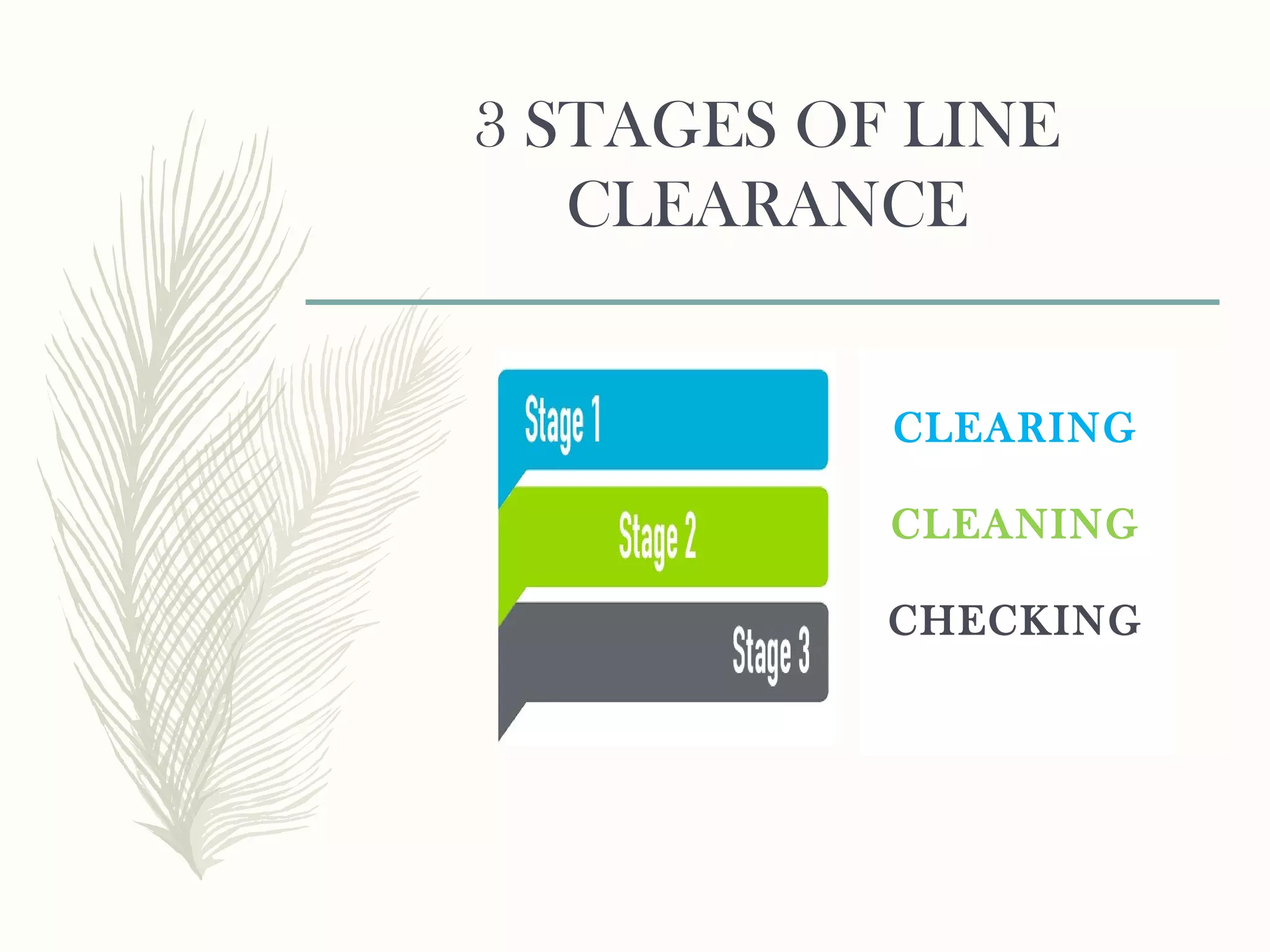
3 STAGES OF LINE
CLEARANCE
CLEARING
CLEANING
CHECKING
To Do:
- Remove all the previous job related items
from area/line like bottles, tools, mold
components, machine parts, plugs, left over
solution/material, product, labels , printed
cartons, batch coding, packed products,
documents.
Responsibility:
-Q. Inspectors / D. supervisors to make sure all
the previous jobs related products, documents,
etc., are placed in their location. & all waste is
disposed properly.
-Supervisors to cross check whether it is
followed properly and report the same to Team
leader’s/Department heads/Managers.
To Do:
-Clean area/line up to the maximum possible
extent
-Cleaning to be done only after CLEARING
Responsibility:
-Q. Inspectors / D. Supervisors responsibility
for cleaning.
-Supervisors & Team leaders responsibility to
make sure sufficient arrangement like
manpower and resources are arranged to clean
the line
To Do:
-Check & Fill the Line clearance form.
-Checking to be carried out only after clearing
and cleaning of previous products.
-1 person from each department (D&P and
Q.A) has to cross check the area / line. The
same should be recorded in the Line clearance
form.
-Area / line clearance failure should be
recorded in the same line clearance form
after stopping/closing the line, and informed
to immediate Team leaders.
Responsibility:
-Line/Area Supervisor ensure the clearing and
cleaning.
Line clearance, Line cleaning and Line checking
(Decoration & Packing area)
Line: Shift: Date:
Job name: Last bottle of previous
job at Low rater time:
First bottle of
new job at Low rater time:
Decoration operator (A): QA Inspector (B):
S.no Check list A
YES/NO
B
YES/NO
1 Check whether decoration machine job setup card is available for the new job.
2 Check if low rater grippers are clean and free from foreign particles.
3 Check if whether there is any direct metal contact to bottles from low rater to
decoration lehr entrance.
4 Check if decoration machine area is free dust and previous bottles.
5 Check if in feed and out feed conveyors of decoration machine are dust and oil
free.
6 Check if counters are set properly to Zero and adjusted as per bottle height.
7 Check if decoration lehr set point temperature is kept as per the validated setup.
8 Check if the art work of the new job is attached near the visual screen.
9 Check if whether the art work of the previous job is removed for the display board
near the visual screen.
10 Check if whether all the documents of the previous job are replaced with the new
one.
11 Check if whether Label/Tag is attached to the incomplete pallets of the previous
job and/are cleared for sending to the Quarantine area.
12 Check if Inspection table, single liners and complete area of line is free from
previous bottles and foreign particles.
13 Check if the visual screen is cleaned and free form the dust.
14 Check if whether there is any jerking of single liners and any bottle falling
problem for the previous job is cleared.
15 Check if the depallatiser is free from dust and any direct metal contact to the
bottles.
16 Check if bottom light is in working condition.
17 Check if pallet packing specification is place in the packing area.
18 Check if the packing area is clean & free from the previous bottles and foreign
particles.
Prepared by Reviewed by Approved by
D&P Operator D&P Supervisor D&P Team leader/D&P HOD.
QA Inspector QA Supervisor QC Team Leader/QA Manager.
Area/line clearance
failure:-
Critical line clearance failure
must be subjected to issue a
Corrective action request
(CAR) against the
Person/Department and to be
investigated to identify the root
cause.
Control of rejection:-
- Rejected item should be kept in
separate pallet with identification
tag.
- Online rejected items should be
kept in pallets with status label or
send directly to re-processing/re-
cycling area.
- Line clearance to be carried
out prior to
commencement of same
product different batch
(same job artwork/Label
change) or different
product (Job change).
- If the line is not used
immediately after cleaning and
clearing it must be
rechecked immediately
NOTE:
Live line clearance & Test for Effectiveness.
- Live line clearance has been successfully used as a
useful training tool for new operators or for the
introduction of new equipment. It involves the placing
of ‘dummy’ articles with in the area / line after the
checking is completed.
- Operators are then asked to find the dummies.
If all of the dummies are not found then this may
indicate the need for further operator training or
modification to the procedures or checklist.
- The dummies should be placed in areas where
clearing or checking are known to be a problem.
- The dummies used should not be capable of being
confused for the genuine article. Defaced genuine
articles should not be used as dummies.
- Dummies used should not be capable of being
packaged or further processed. An example of an
acceptable dummy is a colored plastic, magnetic etc.,
- Also, with frequency based on
reasonable level of confidence or
at least twice in a year all Q.A in
process personnel will be
evaluated for line clearance
activity effectiveness.
- Q.A and Concerned
Departments personnel shall be
given training for line clearance
activity and evaluated for the
effectiveness.
Training frequency &
Responsibility
REFERENCE:-
ISO 15378: 2006
WWW.FDA.GOV.COM
Line clearence by Phani venkata sai ram

Line clearence by Phani venkata sai ram

  • 1.
    LINE CLEARENC E By: PHANI VENKATA SAIRAM QA OFFICER GULF GLASS MANUFACTURING COMPANY KUWAIT
  • 2.
  • 3.
    This procedure have beenestablished to prevent mix-ups of Empty container, component, labels, documents and mistakes while preparing or processing a product during the time of job change.
  • 4.
    3 STAGES OFLINE CLEARANCE CLEARING CLEANING CHECKING
  • 6.
    To Do: - Removeall the previous job related items from area/line like bottles, tools, mold components, machine parts, plugs, left over solution/material, product, labels , printed cartons, batch coding, packed products, documents. Responsibility: -Q. Inspectors / D. supervisors to make sure all the previous jobs related products, documents, etc., are placed in their location. & all waste is disposed properly. -Supervisors to cross check whether it is followed properly and report the same to Team leader’s/Department heads/Managers.
  • 8.
    To Do: -Clean area/lineup to the maximum possible extent -Cleaning to be done only after CLEARING Responsibility: -Q. Inspectors / D. Supervisors responsibility for cleaning. -Supervisors & Team leaders responsibility to make sure sufficient arrangement like manpower and resources are arranged to clean the line
  • 10.
    To Do: -Check &Fill the Line clearance form. -Checking to be carried out only after clearing and cleaning of previous products. -1 person from each department (D&P and Q.A) has to cross check the area / line. The same should be recorded in the Line clearance form. -Area / line clearance failure should be recorded in the same line clearance form after stopping/closing the line, and informed to immediate Team leaders. Responsibility: -Line/Area Supervisor ensure the clearing and cleaning.
  • 11.
    Line clearance, Linecleaning and Line checking (Decoration & Packing area) Line: Shift: Date: Job name: Last bottle of previous job at Low rater time: First bottle of new job at Low rater time: Decoration operator (A): QA Inspector (B): S.no Check list A YES/NO B YES/NO 1 Check whether decoration machine job setup card is available for the new job. 2 Check if low rater grippers are clean and free from foreign particles. 3 Check if whether there is any direct metal contact to bottles from low rater to decoration lehr entrance. 4 Check if decoration machine area is free dust and previous bottles. 5 Check if in feed and out feed conveyors of decoration machine are dust and oil free. 6 Check if counters are set properly to Zero and adjusted as per bottle height. 7 Check if decoration lehr set point temperature is kept as per the validated setup. 8 Check if the art work of the new job is attached near the visual screen. 9 Check if whether the art work of the previous job is removed for the display board near the visual screen. 10 Check if whether all the documents of the previous job are replaced with the new one. 11 Check if whether Label/Tag is attached to the incomplete pallets of the previous job and/are cleared for sending to the Quarantine area. 12 Check if Inspection table, single liners and complete area of line is free from previous bottles and foreign particles. 13 Check if the visual screen is cleaned and free form the dust. 14 Check if whether there is any jerking of single liners and any bottle falling problem for the previous job is cleared. 15 Check if the depallatiser is free from dust and any direct metal contact to the bottles. 16 Check if bottom light is in working condition. 17 Check if pallet packing specification is place in the packing area. 18 Check if the packing area is clean & free from the previous bottles and foreign particles. Prepared by Reviewed by Approved by D&P Operator D&P Supervisor D&P Team leader/D&P HOD. QA Inspector QA Supervisor QC Team Leader/QA Manager.
  • 12.
    Area/line clearance failure:- Critical lineclearance failure must be subjected to issue a Corrective action request (CAR) against the Person/Department and to be investigated to identify the root cause.
  • 14.
    Control of rejection:- -Rejected item should be kept in separate pallet with identification tag. - Online rejected items should be kept in pallets with status label or send directly to re-processing/re- cycling area.
  • 15.
    - Line clearanceto be carried out prior to commencement of same product different batch (same job artwork/Label change) or different product (Job change). - If the line is not used immediately after cleaning and clearing it must be rechecked immediately NOTE:
  • 16.
    Live line clearance& Test for Effectiveness.
  • 17.
    - Live lineclearance has been successfully used as a useful training tool for new operators or for the introduction of new equipment. It involves the placing of ‘dummy’ articles with in the area / line after the checking is completed. - Operators are then asked to find the dummies. If all of the dummies are not found then this may indicate the need for further operator training or modification to the procedures or checklist. - The dummies should be placed in areas where clearing or checking are known to be a problem. - The dummies used should not be capable of being confused for the genuine article. Defaced genuine articles should not be used as dummies. - Dummies used should not be capable of being packaged or further processed. An example of an acceptable dummy is a colored plastic, magnetic etc.,
  • 18.
    - Also, withfrequency based on reasonable level of confidence or at least twice in a year all Q.A in process personnel will be evaluated for line clearance activity effectiveness. - Q.A and Concerned Departments personnel shall be given training for line clearance activity and evaluated for the effectiveness. Training frequency & Responsibility REFERENCE:- ISO 15378: 2006 WWW.FDA.GOV.COM