ADOLESCENCE
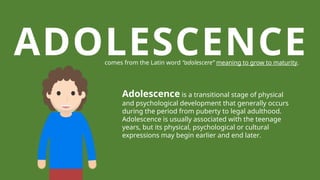
comes from the Latin word “adolescere” meaning to grow to maturity.
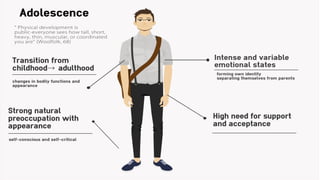
Adolescence is a transitional stage of physical
and psychological development that generally occurs
during the period from puberty to legal adulthood.
Adolescence is usually associated with the teenage
years, but its physical, psychological or cultural
expressions may begin earlier and end later.
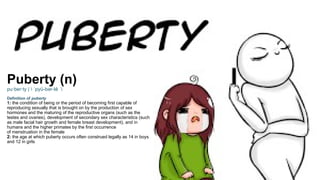
Puberty (n)
pu·​
ber·​
ty |  pyü-bər-tē 
ˈ
Definition of puberty
1: the condition of being or the period of becoming first capable of
reproducing sexually that is brought on by the production of sex
hormones and the maturing of the reproductive organs (such as the
testes and ovaries), development of secondary sex characteristics (such
as male facial hair growth and female breast development), and in
humans and the higher primates by the first occurrence
of menstruation in the female
2: the age at which puberty occurs often construed legally as 14 in boys
and 12 in girls
 Physical changes- such as rapid
growth spurts, the development of breasts
in
girls and an increase in penis size in boys.
 Psychological changes- that often
cause
teenagers to become moody, self-
conscious,
and aggressive.
 Behavioral changes- that can cause
some teenagers to experiment with new
and
potentially risky activities for example
smoking,
Puberty can result in the following changes:
Physical development refers to the advancements
and refinements of motor skills, or, in other words,
children’s abilities to use and control their bodies.
Physical development is one of the many domains of
infant and toddler development. It relates to the
growth and skill development of the body, including
the brain, muscles, and senses.
External changes are clearly seen and noticed from
outside. For example, Increase in height and weight of
the body, growth of sexual organs, appearance of
moustache and bread in a male child, etc.
Internal changes the changes that appear in the
internal systems of the body such as changes and
development of digestive system, circulatory system,
respiratory system, glandular system, etc.
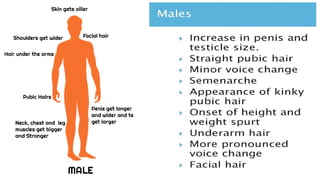
Physical Development in men
OTHER CHANGES
Male musculature and body shape
 By the end of puberty, adult men
have heavier bones and nearly
twice as much as skeletal muscle.
 This muscle develops mainly during
the later stages of puberty and
muscle growth can continue even
after a male is biologically adult.
Body odor and acne - Rising levels.
of androgens can change the
fatty acid composition of
perspiration, resulting in a more
adult body odor. As ingirls,
another androgen effect is
increased secretion of oil
(sebum) from the skin and the
resultant variable amounts of
acne. Acne cannot be prevented
or diminished easily, but it
typically fully diminishes at the
end of puberty
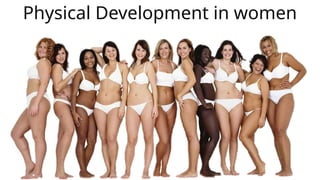
Physical Development in women
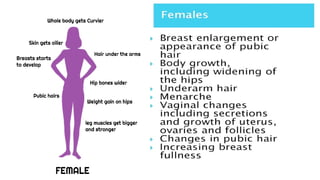
CHANGES IN FEMALES
 Vagina, uterus, ovaries
 Menstruation and fertility
 Body shape, fat distribution and body
composition
 Body odor and acne
How do these changes affect teens?
 Teens frequently sleep longer
 Teens may be more clumsy because of growth spurt.
 Teenage girls may become overly sensitive about their
weight.
 Teens may be concerned because they are not
physically developing at the same rate as their peers.
 Teens may feel awkward about the demonstrating
affection of the opposite sex parent.
 Teens may ask more direct questions about sex.
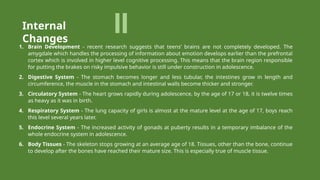
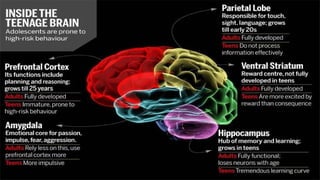
1. Brain Development - recent research suggests that teens’ brains are not completely developed. The
amygdale which handles the processing of information about emotion develops earlier than the prefrontal
cortex which is involved in higher level cognitive processing. This means that the brain region responsible
for putting the brakes on risky impulsive behavior is still under construction in adolescence.
2. Digestive System - The stomach becomes longer and less tubular, the intestines grow in length and
circumference, the muscle in the stomach and intestinal walls become thicker and stronger.
3. Circulatory System - The heart grows rapidly during adolescence, by the age of 17 or 18, it is twelve times
as heavy as it was in birth.
4. Respiratory System - The lung capacity of girls is almost at the mature level at the age of 17, boys reach
this level several years later.
5. Endocrine System - The increased activity of gonads at puberty results in a temporary imbalance of the
whole endocrine system in adolescence.
6. Body Tissues - The skeleton stops growing at an average age of 18. Tissues, other than the bone, continue
to develop after the bones have reached their mature size. This is especially true of muscle tissue.
Internal
Changes
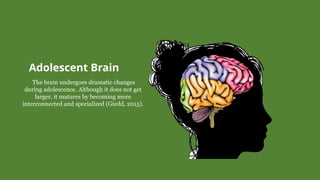
Adolescent Brain
The brain undergoes dramatic changes
during adolescence. Although it does not get
larger, it matures by becoming more
interconnected and specialized (Giedd, 2015).
PHYSICAL AND MENTAL HEALTH
 For most part, the adolescent years are relatively healthy.
Health problems often are associated with poverty or a
risk taking lifestyle. Adolescents are less likely than
younger children to get regular medical care.
 Many adolescents especially girls, do not engage in
regular, vigorous physical activity.
 Many adolescents do not get enough sleep.
 Concern with body image often leads to obsessive dieting.
 Three common eating disorders in adolescence are
obesity, anorexia nervosa and bulimia nervosa. All can
have serious long term effects
o Anorexia Nervosa – eating disorder characterized by
self-starvation.
o Bulimia Nervosa – eating disorder in which a person
regularly eats huge quantities of food and then
purges the body by laxatives, induced vomiting,
fasting or excessive exercise.
o Obesity – extreme overweight in relation to age, sex,
height and body type.
PHYSICAL AND MENTAL HEALTH
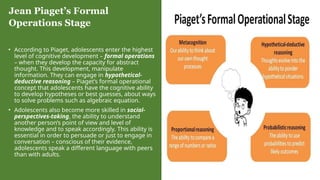
• According to Piaget, adolescents enter the highest
level of cognitive development – formal operations
– when they develop the capacity for abstract
thought. This development, manipulate
information. They can engage in hypothetical-
deductive reasoning – Piaget’s formal operational
concept that adolescents have the cognitive ability
to develop hypotheses or best guesses, about ways
to solve problems such as algebraic equation.
• Adolescents also become more skilled in social-
perspectives-taking, the ability to understand
another person’s point of view and level of
knowledge and to speak accordingly. This ability is
essential in order to persuade or just to engage in
conversation – conscious of their evidence,
adolescents speak a different language with peers
than with adults.
Jean Piaget’s Formal
Operations Stage
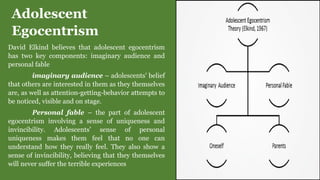
Adolescent
Egocentrism
David Elkind believes that adolescent egocentrism
has two key components: imaginary audience and
personal fable
imaginary audience – adolescents’ belief
that others are interested in them as they themselves
are, as well as attention-getting-behavior attempts to
be noticed, visible and on stage.
Personal fable – the part of adolescent
egocentrism involving a sense of uniqueness and
invincibility. Adolescents’ sense of personal
uniqueness makes them feel that no one can
understand how they really feel. They also show a
sense of invincibility, believing that they themselves
will never suffer the terrible experiences
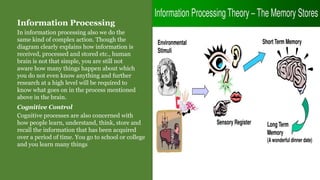
Information Processing
In information processing also we do the
same kind of complex action. Though the
diagram clearly explains how information is
received, processed and stored etc., human
brain is not that simple, you are still not
aware how many things happen about which
you do not even know anything and further
research at a high level will be required to
know what goes on in the process mentioned
above in the brain.
Cognitive Control
Cognitive processes are also concerned with
how people learn, understand, think, store and
recall the information that has been acquired
over a period of time. You go to school or college
and you learn many things
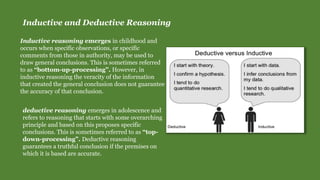
Inductive and Deductive Reasoning
Inductive reasoning emerges in childhood and
occurs when specific observations, or specific
comments from those in authority, may be used to
draw general conclusions. This is sometimes referred
to as “bottom-up-processing”. However, in
inductive reasoning the veracity of the information
that created the general conclusion does not guarantee
the accuracy of that conclusion.
deductive reasoning emerges in adolescence and
refers to reasoning that starts with some overarching
principle and based on this proposes specific
conclusions. This is sometimes referred to as “top-
down-processing”. Deductive reasoning
guarantees a truthful conclusion if the premises on
which it is based are accurate.
Intuitive versus Analytic Thinking
Level III: Post Conventional Reasoning – the
highest level in Kohlberg’s theory of moral
development. People now recognize conflicts
between moral standards and make their own
judgments on the basis of principles of right,
fairness, and justice.
Stage 5: Morality of contract of individual
rights and of democratically accepted law.
People think in rational terms, valuing
the will of the majority and welfare of society.
They generally see these values as best supported
by adherence to the law.
Stage 6: Morality of universal ethical
principles.
People do what they as individuals think
is right, regardless of legal restrictions or the
opinions of others. They act in accordance with
internalized standards, knowing that they would
condemn themselves if they did not.
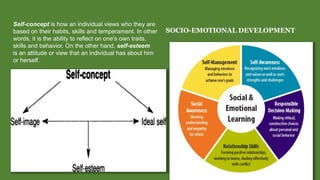
SOCIO-EMOTIONAL DEVELOPMENT
Self-concept is how an individual views who they are
based on their habits, skills and temperament. In other
words, it is the ability to reflect on one's own traits,
skills and behavior. On the other hand, self-esteem
is an attitude or view that an individual has about him
or herself.
Identity
Identity is a self portrait composed of many pieces, Identity is the qualities, beliefs, personality, looks and/or
expressions that make a person or group. One can regard the awareness and the categorizing of identity as
positive or as destructive.
 The career and work path the person wants to follow (vocation,
career identity).
 Whether the person is conservative, liberal, or middle-of-the road
(political identity).
 Whether the person is single, married, divorced and so on
(relationship identity)
 The extent to which the person is motivated to achieve and is
intellectual. (achievement, intellectual identity)
 Whether the person is heterosexual, homosexual or bisexual (sexual
identity).
 Which part of the world or country a person is from and how
intensely the person identifies with his or her cultural heritage.
(cultural/ethnic identity)
 The kind of things a person like to do, which can include sports,
music, hobbies and so on (interest)
 The individuals personality characteristics such as being introverted
or extraverted, anxious or calm, friendly or hostile and soon.
(personality)
 The individuals body image (physical identity)
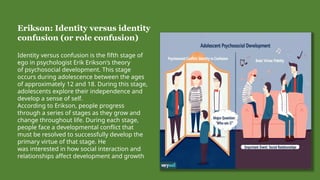
Erikson: Identity versus identity
confusion (or role confusion)
Identity versus confusion is the fifth stage of
ego in psychologist Erik Erikson's theory
of psychosocial development. This stage
occurs during adolescence between the ages
of approximately 12 and 18. During this stage,
adolescents explore their independence and
develop a sense of self.
According to Erikson, people progress
through a series of stages as they grow and
change throughout life. During each stage,
people face a developmental conflict that
must be resolved to successfully develop the
primary virtue of that stage. He
was interested in how social interaction and
relationships affect development and growth
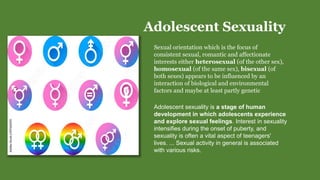
Adolescent Sexuality
Sexual orientation which is the focus of
consistent sexual, romantic and affectionate
interests either heterosexual (of the other sex),
homosexual (of the same sex), bisexual (of
both sexes) appears to be influenced by an
interaction of biological and environmental
factors and maybe at least partly genetic
Adolescent sexuality is a stage of human
development in which adolescents experience
and explore sexual feelings. Interest in sexuality
intensifies during the onset of puberty, and
sexuality is often a vital aspect of teenagers'
lives. ... Sexual activity in general is associated
with various risks.
EMOTIONAL DEVELOPMENT
Young adolescents can be on top of the world one
moment and down in the dumps the next. In many
instances, the intensity of their emotions seems
out of proportion to the events that elicit them. It
is important for adults to recognize that
moodiness is a normal aspect of early adolescence;
and most adolescents make it through this moody
times to become competent adults.
Relationship with Family, Peers and
Adult Society
A teen's focus often shifts to social interactions and friendships. This
includes same-sex friends, same-sex groups of friends, and boy/girl
groups of friends. Sexual maturity triggers interest in dating and sexual
relationships.
Changes in relationship with self
During the teens, a new understanding of oneself occurs. This may include
changes in these self-concepts:
•Independence. This means making decisions for oneself and acting on
one's own thought processes and judgment. Teens start to learn to work out
problems on their own. With more reasoning and intuitive abilities, teens start
to face new responsibilities and to enjoy their own thoughts and actions.
•Identity . This is defined as a sense of self or one's personality. One of the key tasks of adolescence is to reach a sense of a
personal identity and a secure sense of self. A teen gets comfortable with and accepts a more mature physical body. They also
learn to use their own judgment and make decisions on their own.
•Self-esteem. This is the feeling one has about oneself. Self-esteem is determined by answering the question "How much do I
like myself?" With the start of adolescence, a decrease in self-esteem is somewhat common. This is due to the many body
changes, new thoughts, and new ways of thinking about things.
Changes in peer relationships
Teens spend more time with friends. They report feeling more understood and
accepted by their friends. Less and less time is spent with parents and other
family members. Close friendships tend to develop between teens with similar
interests, social class, and ethnic backgrounds. While childhood friendships
tend to be based on common activities, teen friendships expand to include
similarities in attitudes, values, and shared activities.
Changes in family relationships
One of the developmental tasks of adolescence is to separate from one's family as one
emerges into an independent young adult. A part of this process is coming to terms with
specific feelings about one's family. During adolescence, teens start to realize that their
parents and significant authority figures don’t know everything or have solutions to all
types of struggles. Some teenage rebellion against parents is common and normal. With
the start of puberty, girls tend to have more disagreements with their mothers. Boys,
especially those who mature early, also tend to have more disagreements with their
mothers than with their fathers.
Changes in male-female relationships
The shift to male-female and sexual relationships is influenced by sexual interest and by social and
cultural influences and expectations. Social and cultural expectations and behaviors in male-female or
sexual relationships are learned from observations and practice. During adolescence, developmental
tasks include struggles to gain control over sexual and aggressive urges. And by discovering potential
or actual love relationships. Sexual behaviors during adolescence may include impulsive behavior, a
wide range of experimental interactions of mutual exploring, and eventually intercourse.
Antisocial Behavior and Juvenile Delinquency
Antisocial behavior is a broad construct that
encompasses not only delinquency and crime, but also
disruptive behavior of children, such as aggression, below
the age of criminal responsibility.
A juvenile delinquent is an adolescent who breaks the
law of engages in behavior that is considered illegal.
Adolescent becomes a juvenile delinquent only after being
judged guilty of a crime by a court of law. Heredity, identity
problems, community influences and family experiences
have been proposed as causes of juvenile delinquency.
Chronic delinquency is associated with multiple
interaction of risk factor, including ineffective parenting,
school failure, peer influences, neighborhood influences
and low socioeconomic status.
Social changes
social change as changes in human interactions
and relationships that transform cultural and
social institutions. These changes occur over time
and often have profound and long-term
consequences for society. Well known examples of
such change have resulted from social movements
in civil rights, women's rights, and LBGTQ rights,
to name just a few. Relationships have changed,
institutions have changed, and cultural norms
have changed as a result of these social change
movements.
Emotional Changes
Teens show strong feelings and intense emotions at
different times. Moods might seem unpredictable.
These emotional ups and downs can lead to increased
conflict. Your child’s brain is still learning how to
control and express emotions in a grown-up way
Changes in relationships Teens want
to spend less time with family and more time
with friends.
some conflict between parents and children during the teenage
years is normal as teens seek more independence. It actually
shows that your child is maturing. Conflict tends to peak in early
adolescence. If you feel like you’re arguing with your child all the
time, it might help to know that this isn’t likely to affect your long
term relationship with your child
sees things differently from you: this isn’t because your child
wants to upset you. It’s because your child is beginning to
think more abstractly and to question different points of
view. At the same time, some teens find it hard to
understand the effects of their behavior and comments on
other people. These skills will develop with time.

Module-14-Adolescent.pptxhhhhhhhhhhhhhhh

  • 2.
    ADOLESCENCE comes from theLatin word “adolescere” meaning to grow to maturity. Adolescence is a transitional stage of physical and psychological development that generally occurs during the period from puberty to legal adulthood. Adolescence is usually associated with the teenage years, but its physical, psychological or cultural expressions may begin earlier and end later.
  • 5.
    Puberty (n) pu·​ ber·​ ty | pyü-bər-tē ˈ Definition of puberty 1: the condition of being or the period of becoming first capable of reproducing sexually that is brought on by the production of sex hormones and the maturing of the reproductive organs (such as the testes and ovaries), development of secondary sex characteristics (such as male facial hair growth and female breast development), and in humans and the higher primates by the first occurrence of menstruation in the female 2: the age at which puberty occurs often construed legally as 14 in boys and 12 in girls
  • 6.
     Physical changes-such as rapid growth spurts, the development of breasts in girls and an increase in penis size in boys.  Psychological changes- that often cause teenagers to become moody, self- conscious, and aggressive.  Behavioral changes- that can cause some teenagers to experiment with new and potentially risky activities for example smoking, Puberty can result in the following changes:
  • 7.
    Physical development refersto the advancements and refinements of motor skills, or, in other words, children’s abilities to use and control their bodies. Physical development is one of the many domains of infant and toddler development. It relates to the growth and skill development of the body, including the brain, muscles, and senses. External changes are clearly seen and noticed from outside. For example, Increase in height and weight of the body, growth of sexual organs, appearance of moustache and bread in a male child, etc. Internal changes the changes that appear in the internal systems of the body such as changes and development of digestive system, circulatory system, respiratory system, glandular system, etc.
  • 8.
  • 10.
    OTHER CHANGES Male musculatureand body shape  By the end of puberty, adult men have heavier bones and nearly twice as much as skeletal muscle.  This muscle develops mainly during the later stages of puberty and muscle growth can continue even after a male is biologically adult.
  • 11.
    Body odor andacne - Rising levels. of androgens can change the fatty acid composition of perspiration, resulting in a more adult body odor. As ingirls, another androgen effect is increased secretion of oil (sebum) from the skin and the resultant variable amounts of acne. Acne cannot be prevented or diminished easily, but it typically fully diminishes at the end of puberty
  • 12.
  • 14.
    CHANGES IN FEMALES Vagina, uterus, ovaries  Menstruation and fertility  Body shape, fat distribution and body composition  Body odor and acne How do these changes affect teens?  Teens frequently sleep longer  Teens may be more clumsy because of growth spurt.  Teenage girls may become overly sensitive about their weight.  Teens may be concerned because they are not physically developing at the same rate as their peers.  Teens may feel awkward about the demonstrating affection of the opposite sex parent.  Teens may ask more direct questions about sex.
  • 15.
    1. Brain Development- recent research suggests that teens’ brains are not completely developed. The amygdale which handles the processing of information about emotion develops earlier than the prefrontal cortex which is involved in higher level cognitive processing. This means that the brain region responsible for putting the brakes on risky impulsive behavior is still under construction in adolescence. 2. Digestive System - The stomach becomes longer and less tubular, the intestines grow in length and circumference, the muscle in the stomach and intestinal walls become thicker and stronger. 3. Circulatory System - The heart grows rapidly during adolescence, by the age of 17 or 18, it is twelve times as heavy as it was in birth. 4. Respiratory System - The lung capacity of girls is almost at the mature level at the age of 17, boys reach this level several years later. 5. Endocrine System - The increased activity of gonads at puberty results in a temporary imbalance of the whole endocrine system in adolescence. 6. Body Tissues - The skeleton stops growing at an average age of 18. Tissues, other than the bone, continue to develop after the bones have reached their mature size. This is especially true of muscle tissue. Internal Changes
  • 16.
    Adolescent Brain The brainundergoes dramatic changes during adolescence. Although it does not get larger, it matures by becoming more interconnected and specialized (Giedd, 2015).
  • 18.
  • 19.
     For mostpart, the adolescent years are relatively healthy. Health problems often are associated with poverty or a risk taking lifestyle. Adolescents are less likely than younger children to get regular medical care.  Many adolescents especially girls, do not engage in regular, vigorous physical activity.  Many adolescents do not get enough sleep.  Concern with body image often leads to obsessive dieting.  Three common eating disorders in adolescence are obesity, anorexia nervosa and bulimia nervosa. All can have serious long term effects o Anorexia Nervosa – eating disorder characterized by self-starvation. o Bulimia Nervosa – eating disorder in which a person regularly eats huge quantities of food and then purges the body by laxatives, induced vomiting, fasting or excessive exercise. o Obesity – extreme overweight in relation to age, sex, height and body type. PHYSICAL AND MENTAL HEALTH
  • 20.
    • According toPiaget, adolescents enter the highest level of cognitive development – formal operations – when they develop the capacity for abstract thought. This development, manipulate information. They can engage in hypothetical- deductive reasoning – Piaget’s formal operational concept that adolescents have the cognitive ability to develop hypotheses or best guesses, about ways to solve problems such as algebraic equation. • Adolescents also become more skilled in social- perspectives-taking, the ability to understand another person’s point of view and level of knowledge and to speak accordingly. This ability is essential in order to persuade or just to engage in conversation – conscious of their evidence, adolescents speak a different language with peers than with adults. Jean Piaget’s Formal Operations Stage
  • 21.
    Adolescent Egocentrism David Elkind believesthat adolescent egocentrism has two key components: imaginary audience and personal fable imaginary audience – adolescents’ belief that others are interested in them as they themselves are, as well as attention-getting-behavior attempts to be noticed, visible and on stage. Personal fable – the part of adolescent egocentrism involving a sense of uniqueness and invincibility. Adolescents’ sense of personal uniqueness makes them feel that no one can understand how they really feel. They also show a sense of invincibility, believing that they themselves will never suffer the terrible experiences
  • 22.
    Information Processing In informationprocessing also we do the same kind of complex action. Though the diagram clearly explains how information is received, processed and stored etc., human brain is not that simple, you are still not aware how many things happen about which you do not even know anything and further research at a high level will be required to know what goes on in the process mentioned above in the brain. Cognitive Control Cognitive processes are also concerned with how people learn, understand, think, store and recall the information that has been acquired over a period of time. You go to school or college and you learn many things

  • 23.
    Inductive and DeductiveReasoning Inductive reasoning emerges in childhood and occurs when specific observations, or specific comments from those in authority, may be used to draw general conclusions. This is sometimes referred to as “bottom-up-processing”. However, in inductive reasoning the veracity of the information that created the general conclusion does not guarantee the accuracy of that conclusion. deductive reasoning emerges in adolescence and refers to reasoning that starts with some overarching principle and based on this proposes specific conclusions. This is sometimes referred to as “top- down-processing”. Deductive reasoning guarantees a truthful conclusion if the premises on which it is based are accurate.
  • 24.
  • 25.
    Level III: PostConventional Reasoning – the highest level in Kohlberg’s theory of moral development. People now recognize conflicts between moral standards and make their own judgments on the basis of principles of right, fairness, and justice. Stage 5: Morality of contract of individual rights and of democratically accepted law. People think in rational terms, valuing the will of the majority and welfare of society. They generally see these values as best supported by adherence to the law. Stage 6: Morality of universal ethical principles. People do what they as individuals think is right, regardless of legal restrictions or the opinions of others. They act in accordance with internalized standards, knowing that they would condemn themselves if they did not.
  • 26.
    SOCIO-EMOTIONAL DEVELOPMENT Self-concept ishow an individual views who they are based on their habits, skills and temperament. In other words, it is the ability to reflect on one's own traits, skills and behavior. On the other hand, self-esteem is an attitude or view that an individual has about him or herself.
  • 27.
    Identity Identity is aself portrait composed of many pieces, Identity is the qualities, beliefs, personality, looks and/or expressions that make a person or group. One can regard the awareness and the categorizing of identity as positive or as destructive.  The career and work path the person wants to follow (vocation, career identity).  Whether the person is conservative, liberal, or middle-of-the road (political identity).  Whether the person is single, married, divorced and so on (relationship identity)  The extent to which the person is motivated to achieve and is intellectual. (achievement, intellectual identity)  Whether the person is heterosexual, homosexual or bisexual (sexual identity).  Which part of the world or country a person is from and how intensely the person identifies with his or her cultural heritage. (cultural/ethnic identity)  The kind of things a person like to do, which can include sports, music, hobbies and so on (interest)  The individuals personality characteristics such as being introverted or extraverted, anxious or calm, friendly or hostile and soon. (personality)  The individuals body image (physical identity)
  • 28.
    Erikson: Identity versusidentity confusion (or role confusion) Identity versus confusion is the fifth stage of ego in psychologist Erik Erikson's theory of psychosocial development. This stage occurs during adolescence between the ages of approximately 12 and 18. During this stage, adolescents explore their independence and develop a sense of self. According to Erikson, people progress through a series of stages as they grow and change throughout life. During each stage, people face a developmental conflict that must be resolved to successfully develop the primary virtue of that stage. He was interested in how social interaction and relationships affect development and growth
  • 29.
    Adolescent Sexuality Sexual orientationwhich is the focus of consistent sexual, romantic and affectionate interests either heterosexual (of the other sex), homosexual (of the same sex), bisexual (of both sexes) appears to be influenced by an interaction of biological and environmental factors and maybe at least partly genetic Adolescent sexuality is a stage of human development in which adolescents experience and explore sexual feelings. Interest in sexuality intensifies during the onset of puberty, and sexuality is often a vital aspect of teenagers' lives. ... Sexual activity in general is associated with various risks.
  • 30.
    EMOTIONAL DEVELOPMENT Young adolescentscan be on top of the world one moment and down in the dumps the next. In many instances, the intensity of their emotions seems out of proportion to the events that elicit them. It is important for adults to recognize that moodiness is a normal aspect of early adolescence; and most adolescents make it through this moody times to become competent adults.
  • 32.
    Relationship with Family,Peers and Adult Society A teen's focus often shifts to social interactions and friendships. This includes same-sex friends, same-sex groups of friends, and boy/girl groups of friends. Sexual maturity triggers interest in dating and sexual relationships. Changes in relationship with self During the teens, a new understanding of oneself occurs. This may include changes in these self-concepts: •Independence. This means making decisions for oneself and acting on one's own thought processes and judgment. Teens start to learn to work out problems on their own. With more reasoning and intuitive abilities, teens start to face new responsibilities and to enjoy their own thoughts and actions. •Identity . This is defined as a sense of self or one's personality. One of the key tasks of adolescence is to reach a sense of a personal identity and a secure sense of self. A teen gets comfortable with and accepts a more mature physical body. They also learn to use their own judgment and make decisions on their own. •Self-esteem. This is the feeling one has about oneself. Self-esteem is determined by answering the question "How much do I like myself?" With the start of adolescence, a decrease in self-esteem is somewhat common. This is due to the many body changes, new thoughts, and new ways of thinking about things.
  • 33.
    Changes in peerrelationships Teens spend more time with friends. They report feeling more understood and accepted by their friends. Less and less time is spent with parents and other family members. Close friendships tend to develop between teens with similar interests, social class, and ethnic backgrounds. While childhood friendships tend to be based on common activities, teen friendships expand to include similarities in attitudes, values, and shared activities. Changes in family relationships One of the developmental tasks of adolescence is to separate from one's family as one emerges into an independent young adult. A part of this process is coming to terms with specific feelings about one's family. During adolescence, teens start to realize that their parents and significant authority figures don’t know everything or have solutions to all types of struggles. Some teenage rebellion against parents is common and normal. With the start of puberty, girls tend to have more disagreements with their mothers. Boys, especially those who mature early, also tend to have more disagreements with their mothers than with their fathers. Changes in male-female relationships The shift to male-female and sexual relationships is influenced by sexual interest and by social and cultural influences and expectations. Social and cultural expectations and behaviors in male-female or sexual relationships are learned from observations and practice. During adolescence, developmental tasks include struggles to gain control over sexual and aggressive urges. And by discovering potential or actual love relationships. Sexual behaviors during adolescence may include impulsive behavior, a wide range of experimental interactions of mutual exploring, and eventually intercourse.
  • 34.
    Antisocial Behavior andJuvenile Delinquency Antisocial behavior is a broad construct that encompasses not only delinquency and crime, but also disruptive behavior of children, such as aggression, below the age of criminal responsibility. A juvenile delinquent is an adolescent who breaks the law of engages in behavior that is considered illegal. Adolescent becomes a juvenile delinquent only after being judged guilty of a crime by a court of law. Heredity, identity problems, community influences and family experiences have been proposed as causes of juvenile delinquency. Chronic delinquency is associated with multiple interaction of risk factor, including ineffective parenting, school failure, peer influences, neighborhood influences and low socioeconomic status.
  • 35.
    Social changes social changeas changes in human interactions and relationships that transform cultural and social institutions. These changes occur over time and often have profound and long-term consequences for society. Well known examples of such change have resulted from social movements in civil rights, women's rights, and LBGTQ rights, to name just a few. Relationships have changed, institutions have changed, and cultural norms have changed as a result of these social change movements. Emotional Changes Teens show strong feelings and intense emotions at different times. Moods might seem unpredictable. These emotional ups and downs can lead to increased conflict. Your child’s brain is still learning how to control and express emotions in a grown-up way
  • 36.
    Changes in relationshipsTeens want to spend less time with family and more time with friends. some conflict between parents and children during the teenage years is normal as teens seek more independence. It actually shows that your child is maturing. Conflict tends to peak in early adolescence. If you feel like you’re arguing with your child all the time, it might help to know that this isn’t likely to affect your long term relationship with your child sees things differently from you: this isn’t because your child wants to upset you. It’s because your child is beginning to think more abstractly and to question different points of view. At the same time, some teens find it hard to understand the effects of their behavior and comments on other people. These skills will develop with time.