Lee Chia Chun (KEM100017)
session 2013/2014
Supervised by: Dr. Ong Zhi Chao
28-May 2014 (Wed)
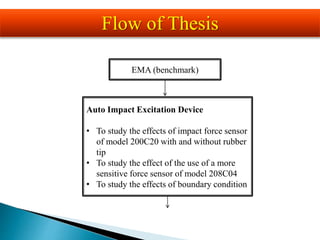
EMA (benchmark)
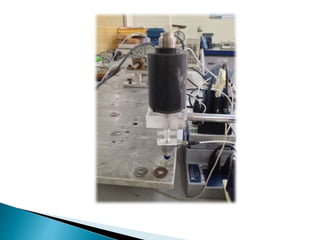
Auto Impact Excitation Device
• To study the effects of impact force sensor
of model 200C20 with and without rubber
tip
• To study the effect of the use of a more
sensitive force sensor of model 208C04
• To study the effects of boundary condition
Flow of Thesis
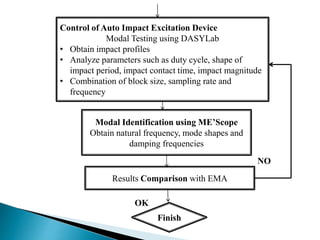
Modal Identification using ME’Scope
Obtain natural frequency, mode shapes and
damping frequencies
Results Comparison with EMA
Finish
OK
NO
Control of Auto Impact Excitation Device
Modal Testing using DASYLab
• Obtain impact profiles
• Analyze parameters such as duty cycle, shape of
impact period, impact contact time, impact magnitude
• Combination of block size, sampling rate and
frequency
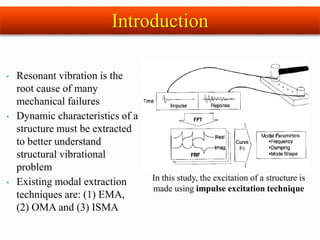
• Resonant vibration is the
root cause of many
mechanical failures
• Dynamic characteristics of a
structure must be extracted
to better understand
structural vibrational
problem
• Existing modal extraction
techniques are: (1) EMA,
(2) OMA and (3) ISMA
In this study, the excitation of a structure is
made using impulse excitation technique
Introduction
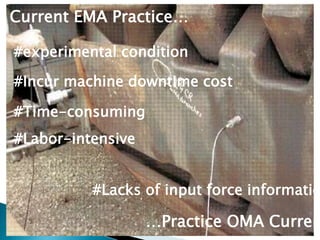
Current EMA Practice…
#experimental condition
#Labor-intensive
#Time-consuming
#Incur machine downtime cost
…Practice OMA Curren
#Lacks of input force informatio
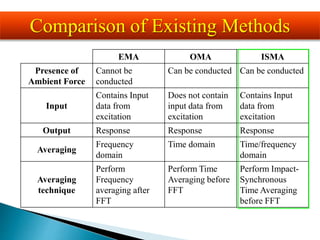
EMA OMA ISMA
Presence of
Ambient Force
Cannot be
conducted
Can be conducted Can be conducted
Input
Contains Input
data from
excitation
Does not contain
input data from
excitation
Contains Input
data from
excitation
Output Response Response Response
Averaging
Frequency
domain
Time domain Time/frequency
domain
Averaging
technique
Perform
Frequency
averaging after
FFT
Perform Time
Averaging before
FFT
Perform Impact-
Synchronous
Time Averaging
before FFT
Comparison of Existing Methods
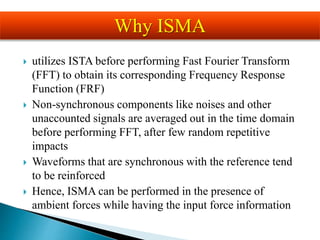
 utilizes ISTA before performing Fast Fourier Transform
(FFT) to obtain its corresponding Frequency Response
Function (FRF)
 Non-synchronous components like noises and other
unaccounted signals are averaged out in the time domain
before performing FFT, after few random repetitive
impacts
 Waveforms that are synchronous with the reference tend
to be reinforced
 Hence, ISMA can be performed in the presence of
ambient forces while having the input force information
Why ISMA
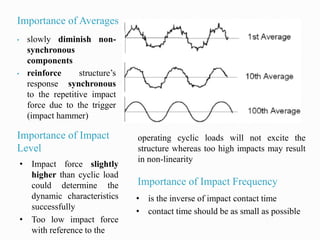
Importance of Averages
• slowly diminish non-
synchronous
components
• reinforce structure’s
response synchronous
to the repetitive impact
force due to the trigger
(impact hammer)
• Impact force slightly
higher than cyclic load
could determine the
dynamic characteristics
successfully
• Too low impact force
with reference to the
operating cyclic loads will not excite the
structure whereas too high impacts may result
in non-linearity
Importance of Impact
Level
Importance of Impact Frequency
• is the inverse of impact contact time
• contact time should be as small as possible
 has difficulty in extracting dynamic characteristics of a
structure which is closer to the operating speed for high speed
machines
 perform badly if the impact frequency in ISMA is synchronous
with the running speed
 performs random impacts using manually operated impact
hammer which is labour-intensive and time-consuming
 Manual procedures result in inconsistency in terms of impact
contact time, impact period and impact level, as well as human
errors e.g. double impact
 This gives rise to the need of automating ISMA
Limitation of ISMA
 To control and synchronize the portable
calibrated auto impact excitation device with
virtual instruments
 To study the impact profiles generated by
the auto impact excitation device which
facilitates ISMA
 To compare and verify the dynamic
characteristics obtained by auto impact
excitation device to that obtained by EMA
during non-rotating condition (benchmark)
Objectives
 Obtain modal parameters under experimental
conditions
 Conducted in complete shutdown mode
 Excitation force applied in the time domain, but the
system responses are auto-correlated with the
measured input (Peter Avitabile, 2001; Peres & Bono,
2011)
 The correlated functions are transformed into
frequency domain to obtain the transfer functions
(FRF)
2.1 Experimental Modal Analysis (EMA)
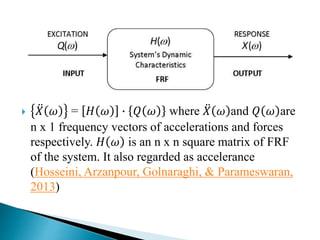
 𝑋 𝜔 = 𝐻 𝜔 ∙ 𝑄 𝜔 where 𝑋 𝜔 and 𝑄 𝜔 are
n x 1 frequency vectors of accelerations and forces
respectively. 𝐻 𝜔 is an n x n square matrix of FRF
of the system. It also regarded as accelerance
(Hosseini, Arzanpour, Golnaraghi, & Parameswaran,
2013)
Alternatively, can be written as,
𝑋𝑖 = 𝑗=1
𝑛
𝐻𝑖𝑗 ∙ 𝑄𝑗
 (Chao, 2013), in page 30, describes above constitutes
a reciprocal theorem for dynamic loads that is
similar to Maxwell’s reciprocal theorem for static
loads
 So, it is OK to rove or fix any of the impact hammer
or the force transducer
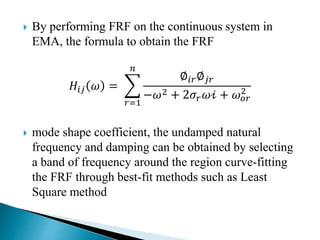
 By performing FRF on the continuous system in
EMA, the formula to obtain the FRF
𝐻𝑖𝑗 𝜔 =
𝑟=1
𝑛
∅𝑖𝑟∅ 𝑗𝑟
−𝜔2 + 2𝜎𝑟 𝜔𝒾 + 𝜔 𝑜𝑟
2
 mode shape coefficient, the undamped natural
frequency and damping can be obtained by selecting
a band of frequency around the region curve-fitting
the FRF through best-fit methods such as Least
Square method
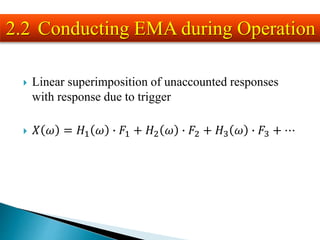
 Linear superimposition of unaccounted responses
with response due to trigger
 𝑋 𝜔 = 𝐻1 𝜔 ∙ 𝐹1 + 𝐻2 𝜔 ∙ 𝐹2 + 𝐻3 𝜔 ∙ 𝐹3 + ⋯
2.2 Conducting EMA during Operation
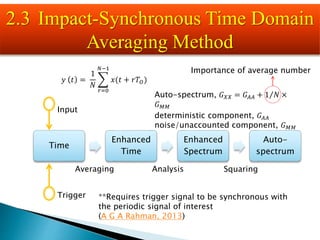
Time
Enhanced
Time
Enhanced
Spectrum
Auto-
spectrum
Input
Trigger
Averaging Analysis Squaring
**Requires trigger signal to be synchronous with
the periodic signal of interest
(A G A Rahman, 2013)
Auto-spectrum, 𝐺 𝑋𝑋 = 𝐺 𝐴𝐴 + 1 𝑁 ×
𝐺 𝑀𝑀
deterministic component, 𝐺 𝐴𝐴
noise/unaccounted component, 𝐺 𝑀𝑀
Importance of average number
𝑦 𝑡 =
1
𝑁
𝑟=0
𝑁−1
𝑥(𝑡 + 𝑟𝑇𝑂)
2.3 Impact-Synchronous Time Domain
Averaging Method
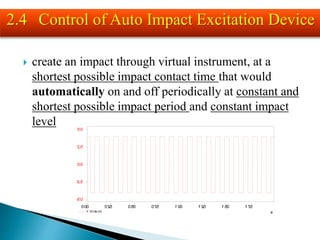
 create an impact through virtual instrument, at a
shortest possible impact contact time that would
automatically on and off periodically at constant and
shortest possible impact period and constant impact
level
s
0 .00 0 .25 0 .50 0 .75 1 .00 1 .25 1 .50 1 .75
Y /tCha rt0
5 .0
2 .5
0 .0
-2 .5
-5 .0
2.4 Control of Auto Impact Excitation Device
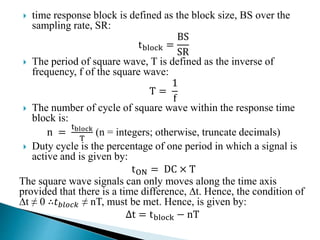
 time response block is defined as the block size, BS over the
sampling rate, SR:
tblock =
BS
SR
 The period of square wave, T is defined as the inverse of
frequency, f of the square wave:
T =
1
f
 The number of cycle of square wave within the response time
block is:
n =
tblock
T
(n = integers; otherwise, truncate decimals)
 Duty cycle is the percentage of one period in which a signal is
active and is given by:
tON = DC × T
The square wave signals can only moves along the time axis
provided that there is a time difference, ∆t. Hence, the condition of
∆t ≠ 0 ∴𝑡 𝑏𝑙𝑜𝑐𝑘 ≠ nT, must be met. Hence, is given by:
∆t = tblock − nT
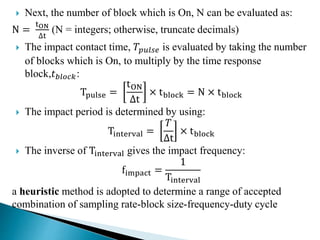
 Next, the number of block which is On, N can be evaluated as:
N =
tON
∆t
(N = integers; otherwise, truncate decimals)
 The impact contact time, 𝑇𝑝𝑢𝑙𝑠𝑒 is evaluated by taking the number
of blocks which is On, to multiply by the time response
block,𝑡 𝑏𝑙𝑜𝑐𝑘:
Tpulse =
tON
∆t
× tblock = N × tblock
 The impact period is determined by using:
Tinterval =
𝑇
∆t
× tblock
 The inverse of Tinterval gives the impact frequency:
fimpact =
1
Tinterval
a heuristic method is adopted to determine a range of accepted
combination of sampling rate-block size-frequency-duty cycle
 quantitative technique to compare the closeness between two
families of mode shapes x(1) and x(2) (Allemang, 2003;
Allemang & Brown, 1998; Peter Avitabile, 2001)
 MAC (𝑥(𝑖)
(1)
, 𝑥(𝑗)
(2)
) =
𝑥(𝑖)
(1)
𝑥(𝑗)
(2)
𝑥(𝑖)
(1)
𝑥(𝑗)
(2)
2
 indicates whether there are enough measurement points for the
modal analysis (Gaetan Kerschen, 2006)
MAC Value Interpretation
= 1.0 Two mode shapes are identical
> 0.9 Two mode shapes are similar
< 0.9 Two mode shapes are different
2.5 Modal Assurance Criteria (MAC)
Goals:
 To acquire impact profiles of the test structure
obtained by using the auto impact excitation to
compare with EMA
 To obtain the dynamic characteristics of the test
structure to compare and validated with EMA
3.1 Methodology
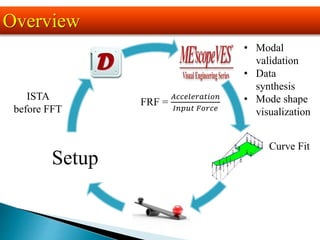
Setup
FRF =
𝐴𝑐𝑐𝑒𝑙𝑒𝑟𝑎𝑡𝑖𝑜𝑛
𝐼𝑛𝑝𝑢𝑡 𝐹𝑜𝑟𝑐𝑒
Curve Fit
ISTA
before FFT
Overview
• Modal
validation
• Data
synthesis
• Mode shape
visualization
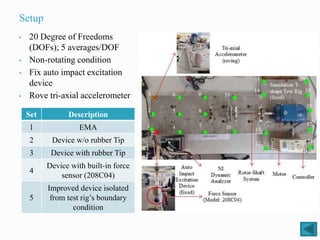
Setup
• 20 Degree of Freedoms
(DOFs); 5 averages/DOF
• Non-rotating condition
• Fix auto impact excitation
device
• Rove tri-axial accelerometer
Set Description
1 EMA
2 Device w/o rubber Tip
3 Device with rubber Tip
4
Device with built-in force
sensor (208C04)
5
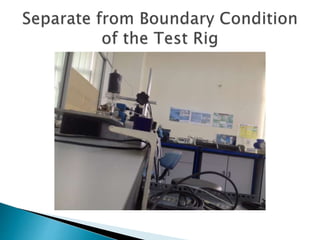
Improved device isolated
from test rig’s boundary
condition
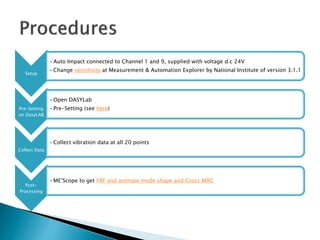
Setup
•Auto Impact connected to Channel 1 and 9, supplied with voltage d.c 24V
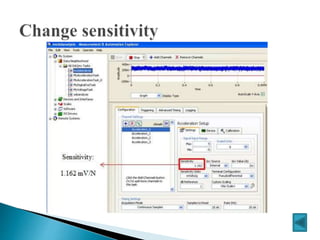
•Change sensitivity at Measurement & Automation Explorer by National Institute of version 3.1.1
Pre-Setting
on DasyLAB
•Open DASYLab
•Pre-Setting (see here)
Collect Data
•Collect vibration data at all 20 points
Post-
Processing
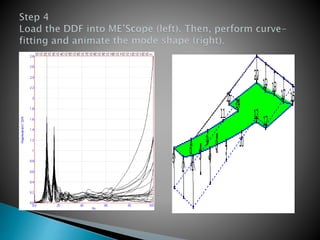
•ME’Scope to get FRF and animate mode shape and Cross MAC
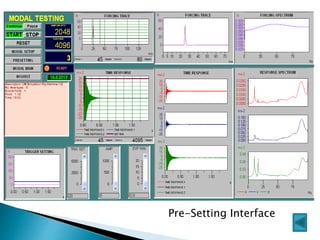
Pre-Setting Interface
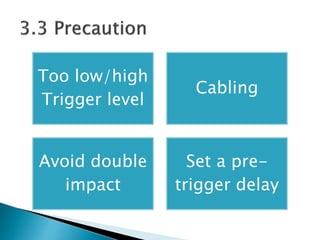
Too low/high
Trigger level
Cabling
Avoid double
impact
Set a pre-
trigger delay
 To control and synchronize the portable
calibrated auto impact excitation device with
virtual instruments
 To study the impact profiles generated by
the auto impact excitation device which
facilitates ISMA
 To compare and verify the dynamic
characteristics obtained by auto impact
excitation device to that obtained by EMA
during non-rotating condition (benchmark)
Objectives
m s
0 .0 2 .5 5 .0 7 .5 10 .0 12 .5 15 .0 17 .5 20 .0
Y /tChart0
5 .0
2 .5
0 .0
-2 .5
-5 .0
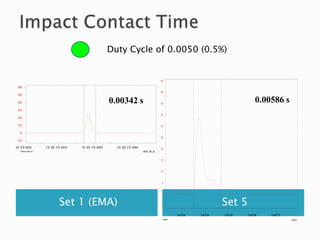
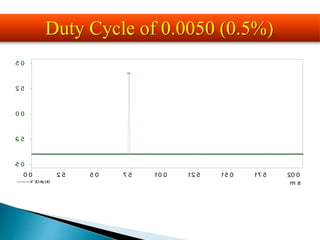
Duty Cycle of 0.0050 (0.5%)
h :m in :s
12 :39 :30 12 :39 :40 12 :39 :50 12 :40 :00 12 :40 :10 12 :40 :20
50
45
40
35
30
25
20
15
10
5
0
-5
R eco rde r0
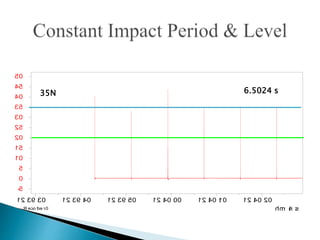
6.5024 s35N
Set 1 (EMA) Set 5
h :m in :s
13 :23 :10 .520 13 :23 :10 .530 13 :23 :10 .540 13 :23 :10 .550
60
50
40
30
20
10
0
-10
R eco rde r0
h:m in:s
12:40:07.250 12:40:07.255 12:40:07.260 12:40:07.265 12:40:07.270
50
45
40
35
30
25
20
15
10
5
0
-5
Recorder0
0.00342 s 0.00586 s
Duty Cycle of 0.0050 (0.5%)
 Data acquisition time = 2.0 s
 Auto impact sampling Rate: 10,000 – 100,000
 Auto impact block Size: < 2,048
 Experimentally found that 2 – 10 s
 Sampling rate < 50,000 blocks/s yields a stable impact level
 number of block ON should be above 2 to get a stable impact
level
 Display delay &/or bog down of DASYLab program due to:
speed, memory & limited video capability of the
computer
complexity of the worksheet
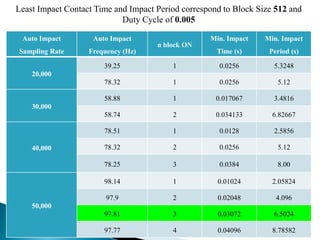
 Taking duty cycle = 0.0050, a heuristic method is adopted
Auto Impact
Sampling Rate
Auto Impact
Frequency (Hz)
n block ON
Min. Impact
Time (s)
Min. Impact
Period (s)
20,000
39.25 1 0.0256 5.3248
78.32 1 0.0256 5.12
30,000
58.88 1 0.017067 3.4816
58.74 2 0.034133 6.82667
40,000
78.51 1 0.0128 2.5856
78.32 2 0.0256 5.12
78.25 3 0.0384 8.00
50,000
98.14 1 0.01024 2.05824
97.9 2 0.02048 4.096
97.81 3 0.03072 6.5024
97.77 4 0.04096 8.78582
Least Impact Contact Time and Impact Period correspond to Block Size 512 and
Duty Cycle of 0.005
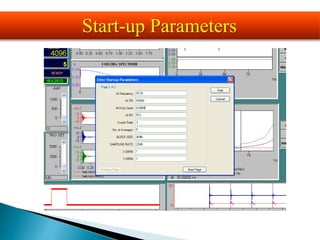
Start-up Parameters
 To control and synchronize the portable
calibrated auto impact excitation device with
virtual instruments
 To study the impact profiles generated by
the auto impact excitation device which
facilitates ISMA
 To compare and verify the dynamic
characteristics obtained by auto impact
excitation device to that obtained by EMA
during non-rotating condition (benchmark)
Objectives
Qualitative comparison:
• Overlaid Frequency Response Function (FRF) Spectral
• Mode Shape
Quantitative comparison:
• Difference in Natural Frequencies
• Modal Assurance Criteria (MAC)
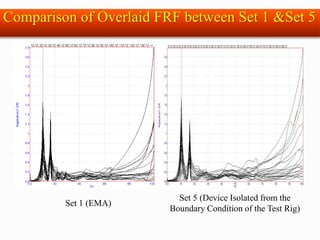
Comparison between Set 1 & Set 5
Set 1 (EMA)
Set 5 (Device Isolated from the
Boundary Condition of the Test Rig)
Comparison of Overlaid FRF between Set 1 &Set 5
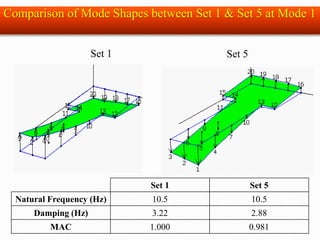
Set 1 Set 5
Set 1 Set 5
Natural Frequency (Hz) 10.5 10.5
Damping (Hz) 3.22 2.88
MAC 1.000 0.981
Comparison of Mode Shapes between Set 1 & Set 5 at Mode 1
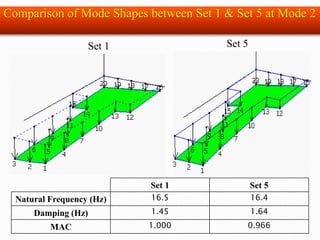
Set 1 Set 5
Set 1 Set 5
Natural Frequency (Hz) 16.5 16.4
Damping (Hz) 1.45 1.64
MAC 1.000 0.966
Comparison of Mode Shapes between Set 1 & Set 5 at Mode 2
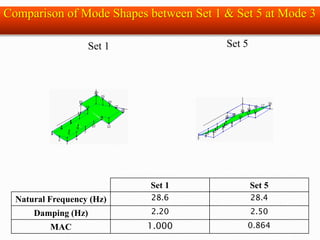
Set 1 Set 5
Set 1 Set 5
Natural Frequency (Hz) 28.6 28.4
Damping (Hz) 2.20 2.50
MAC 1.000 0.864
Comparison of Mode Shapes between Set 1 & Set 5 at Mode 3
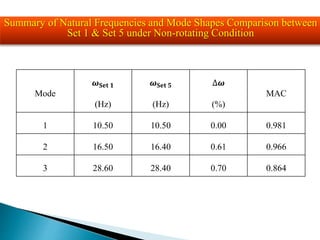
Mode
𝝎 𝐒𝐞𝐭 𝟏
(Hz)
𝝎 𝐒𝐞𝐭 𝟓
(Hz)
∆𝝎
(%)
MAC
1 10.50 10.50 0.00 0.981
2 16.50 16.40 0.61 0.966
3 28.60 28.40 0.70 0.864
Summary of Natural Frequencies and Mode Shapes Comparison between
Set 1 & Set 5 under Non-rotating Condition
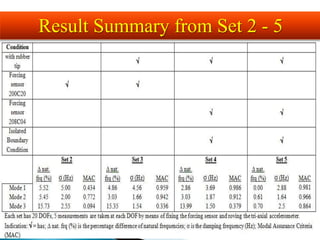
Result Summary from Set 2 - 5
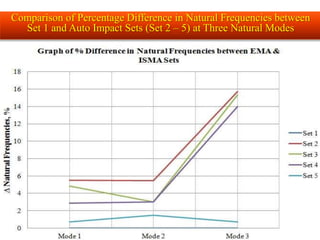
Comparison of Percentage Difference in Natural Frequencies between
Set 1 and Auto Impact Sets (Set 2 – 5) at Three Natural Modes
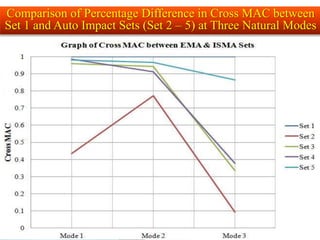
Comparison of Percentage Difference in Cross MAC between
Set 1 and Auto Impact Sets (Set 2 – 5) at Three Natural Modes
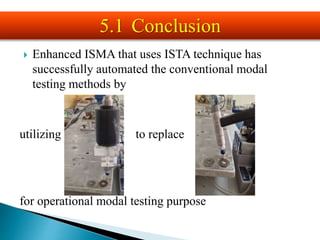
 Enhanced ISMA that uses ISTA technique has
successfully automated the conventional modal
testing methods by
utilizing to replace
for operational modal testing purpose
5.1 Conclusion
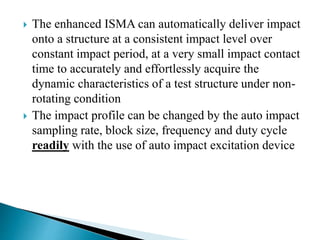
 The enhanced ISMA can automatically deliver impact
onto a structure at a consistent impact level over
constant impact period, at a very small impact contact
time to accurately and effortlessly acquire the
dynamic characteristics of a test structure under non-
rotating condition
 The impact profile can be changed by the auto impact
sampling rate, block size, frequency and duty cycle
readily with the use of auto impact excitation device
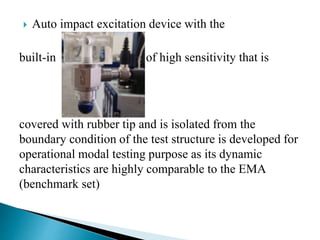
 Auto impact excitation device with the
built-in of high sensitivity that is
covered with rubber tip and is isolated from the
boundary condition of the test structure is developed for
operational modal testing purpose as its dynamic
characteristics are highly comparable to the EMA
(benchmark set)
 Perform the enhanced ISMA technique on a rotating
structure for verification purpose
 Create a programming algorithm in the virtual
instrument (DASYLab) to immediately stop the data
acquisition process after the running components and
noises are successfully filtered out
 Devise a practical way to isolate the auto impact
excitation device from the boundary condition of a
test structure
5.2 Recommendation
Questions?
Comparison between Different Values of Duty
Cycle
m s
0 .0 2 .5 5 .0 7 .5 10 .0 12 .5 15 .0 17 .5 20 .0 22 .5 25 .0 27 .5 30 .0 32 .5 35 .0 37 .5 40 .0
Y /tChart0
5 .0
2 .5
0 .0
-2 .5
-5 .0
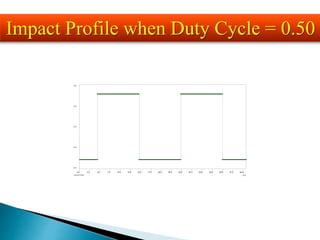
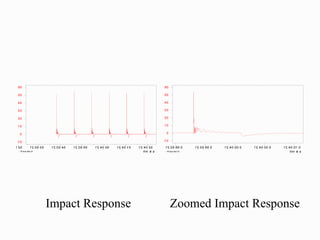
Impact Profile when Duty Cycle = 0.50
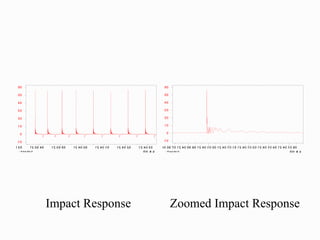
Impact Response Zoomed Impact Response
h :m in :s
12 :39 :35 12 :39 :45 12 :39 :55 12 :40 :05 12 :40 :15 12 :40 :25 12 :40 :35
60
50
40
30
20
10
0
-10
R eco rde r0 h :m in :s
12 :40 :09 .70 12 :40 :09 .85 12 :40 :10 .00 12 :40 :10 .15 12 :40 :10 .30 12 :40 :10 .45 12 :40 :10 .60
60
50
40
30
20
10
0
-10
R eco rde r0
m s
0 .0 2 .5 5 .0 7 .5 10 .0 15 .0 20 .0 25 .0 30 .0 35 .0 40 .0
Y /tChart0
5 .0
2 .5
0 .0
-2 .5
-5 .0
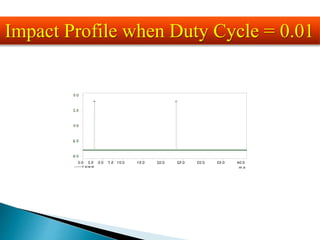
Impact Profile when Duty Cycle = 0.01
Impact Response Zoomed Impact Response
h :m in :s
12 :39 :25 12 :39 :35 12 :39 :45 12 :39 :55 12 :40 :05 12 :40 :15 12 :40 :25
60
50
40
30
20
10
0
-10
R eco rde r0 h :m in :s
12 :39 :59 .0 12 :39 :59 .5 12 :40 :00 .0 12 :40 :00 .5 12 :40 :01 .0
60
50
40
30
20
10
0
-10
R eco rde r0
Comparison between Set 1 & Set 2
h :m in :s
1 :46 :45 11 :46 :50 11 :46 :55 11 :47 :00 11 :47 :05 11 :47 :10 11 :47 :15 11 :47 :20 11 :47 :25 11 :47 :30 11 :47 :35 11 :47 :40 11 :47 :45
100
75
50
25
0
-25
Recorder0
h :m in :s
11 :46 :59 .85 11 :46 :59 .90 11 :46 :59 .95 11 :47 :00 .00 11 :47 :00 .05 11 :47 :00 .10 11 :47 :00 .15 11 :47 :00 .20 11 :47 :00 .25
100
75
50
25
0
-25
Reco rde r0
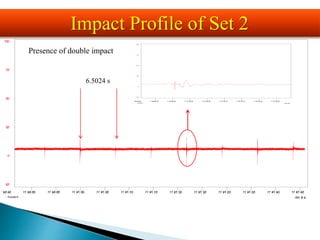
6.5024 s
Impact Profile of Set 2
Presence of double impact
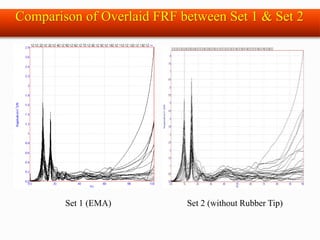
Set 1 (EMA) Set 2 (without Rubber Tip)
Comparison of Overlaid FRF between Set 1 & Set 2
Set 1 Set 2
Set 1 Set 2
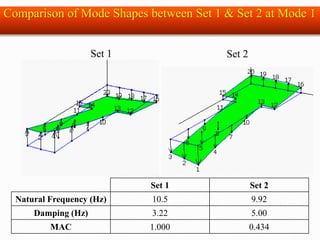
Natural Frequency (Hz) 10.5 9.92
Damping (Hz) 3.22 5.00
MAC 1.000 0.434
Comparison of Mode Shapes between Set 1 & Set 2 at Mode 1
Set 1 Set 2
Set 1 Set 2
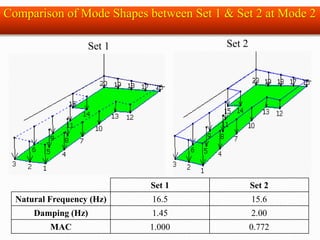
Natural Frequency (Hz) 16.5 15.6
Damping (Hz) 1.45 2.00
MAC 1.000 0.772
Comparison of Mode Shapes between Set 1 & Set 2 at Mode 2
Set 1 Set 2
Set 1 Set 2
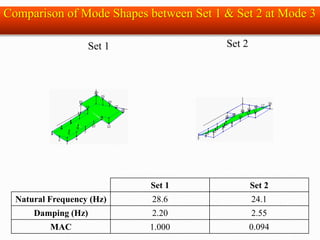
Natural Frequency (Hz) 28.6 24.1
Damping (Hz) 2.20 2.55
MAC 1.000 0.094
Comparison of Mode Shapes between Set 1 & Set 2 at Mode 3
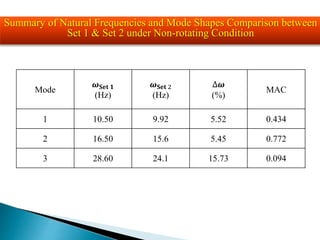
Mode
𝝎 𝐒𝐞𝐭 𝟏
(Hz)
𝝎 𝐒𝐞𝐭 2
(Hz)
∆𝝎
(%)
MAC
1 10.50 9.92 5.52 0.434
2 16.50 15.6 5.45 0.772
3 28.60 24.1 15.73 0.094
Summary of Natural Frequencies and Mode Shapes Comparison between
Set 1 & Set 2 under Non-rotating Condition
Comparison between Set 1 & Set 3
Impact Profile of Set 3
h :m in :s
12 :05 :10 12 :05 :15 12 :05 :20 12 :05 :25 12 :05 :30 12 :05 :35 12 :05 :40
100
75
50
25
0
-25
s
30 .00 30 .25 30 .50 30 .75 31 .00 31 .25 31 .50 31 .75
Y /tChart0
30
25
20
15
10
5
0
-5
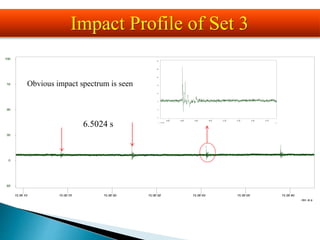
6.5024 s
Obvious impact spectrum is seen
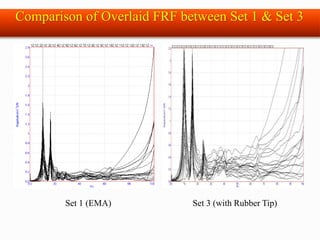
Set 1 (EMA) Set 3 (with Rubber Tip)
Comparison of Overlaid FRF between Set 1 & Set 3
Set 1 Set 3
Set 1 Set 3
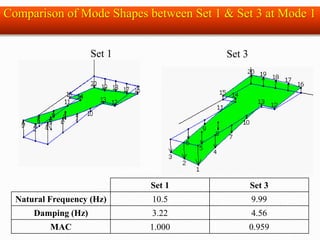
Natural Frequency (Hz) 10.5 9.99
Damping (Hz) 3.22 4.56
MAC 1.000 0.959
Comparison of Mode Shapes between Set 1 & Set 3 at Mode 1
Set 1 Set 3
Set 1 Set 3
Natural Frequency (Hz) 16.5 16.0
Damping (Hz) 1.45 1.66
MAC 1.000 0.942
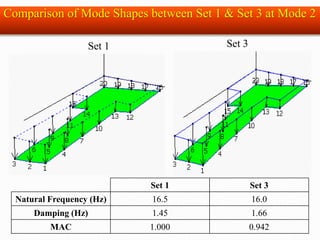
Comparison of Mode Shapes between Set 1 & Set 3 at Mode 2
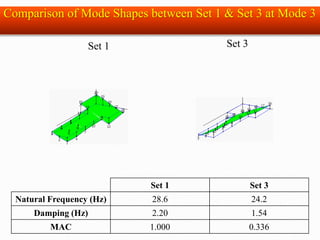
Set 1 Set 3
Set 1 Set 3
Natural Frequency (Hz) 28.6 24.2
Damping (Hz) 2.20 1.54
MAC 1.000 0.336
Comparison of Mode Shapes between Set 1 & Set 3 at Mode 3
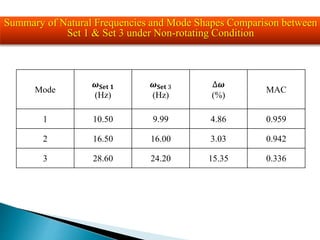
Mode
𝝎 𝐒𝐞𝐭 𝟏
(Hz)
𝝎 𝐒𝐞𝐭 3
(Hz)
∆𝝎
(%)
MAC
1 10.50 9.99 4.86 0.959
2 16.50 16.00 3.03 0.942
3 28.60 24.20 15.35 0.336
Summary of Natural Frequencies and Mode Shapes Comparison between
Set 1 & Set 3 under Non-rotating Condition
Comparison between Set 1 & Set 4
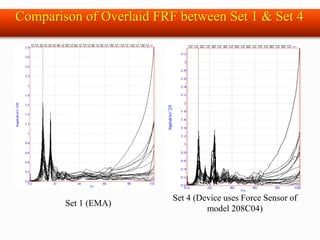
Set 1 (EMA)
Set 4 (Device uses Force Sensor of
model 208C04)
Comparison of Overlaid FRF between Set 1 & Set 4
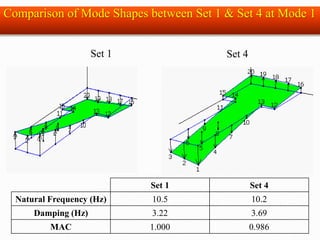
Set 1 Set 4
Set 1 Set 4
Natural Frequency (Hz) 10.5 10.2
Damping (Hz) 3.22 3.69
MAC 1.000 0.986
Comparison of Mode Shapes between Set 1 & Set 4 at Mode 1
Set 1 Set 4
Set 1 Set 4
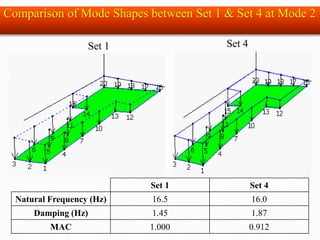
Natural Frequency (Hz) 16.5 16.0
Damping (Hz) 1.45 1.87
MAC 1.000 0.912
Comparison of Mode Shapes between Set 1 & Set 4 at Mode 2
Set 1 Set 4
Set 1 Set 4
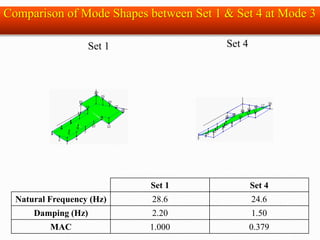
Natural Frequency (Hz) 28.6 24.6
Damping (Hz) 2.20 1.50
MAC 1.000 0.379
Comparison of Mode Shapes between Set 1 & Set 4 at Mode 3
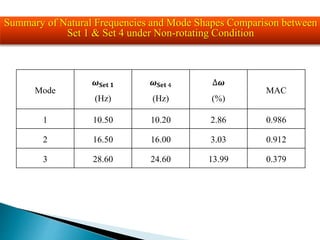
Mode
𝝎 𝐒𝐞𝐭 𝟏
(Hz)
𝝎 𝐒𝐞𝐭 4
(Hz)
∆𝝎
(%)
MAC
1 10.50 10.20 2.86 0.986
2 16.50 16.00 3.03 0.912
3 28.60 24.60 13.99 0.379
Summary of Natural Frequencies and Mode Shapes Comparison between
Set 1 & Set 4 under Non-rotating Condition
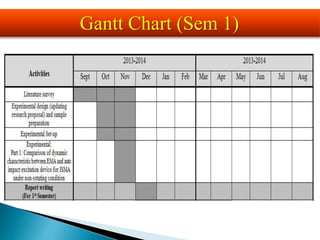
Gantt Chart (Sem 1)
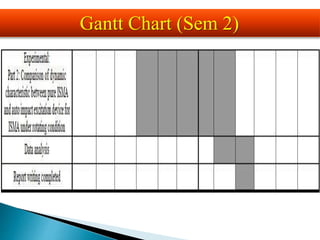
Gantt Chart (Sem 2)

FYP_Thesis Presentation

  • 1.
    Lee Chia Chun(KEM100017) session 2013/2014 Supervised by: Dr. Ong Zhi Chao 28-May 2014 (Wed)
  • 2.
    EMA (benchmark) Auto ImpactExcitation Device • To study the effects of impact force sensor of model 200C20 with and without rubber tip • To study the effect of the use of a more sensitive force sensor of model 208C04 • To study the effects of boundary condition Flow of Thesis
  • 3.
    Modal Identification usingME’Scope Obtain natural frequency, mode shapes and damping frequencies Results Comparison with EMA Finish OK NO Control of Auto Impact Excitation Device Modal Testing using DASYLab • Obtain impact profiles • Analyze parameters such as duty cycle, shape of impact period, impact contact time, impact magnitude • Combination of block size, sampling rate and frequency
  • 5.
    • Resonant vibrationis the root cause of many mechanical failures • Dynamic characteristics of a structure must be extracted to better understand structural vibrational problem • Existing modal extraction techniques are: (1) EMA, (2) OMA and (3) ISMA In this study, the excitation of a structure is made using impulse excitation technique Introduction
  • 6.
    Current EMA Practice… #experimentalcondition #Labor-intensive #Time-consuming #Incur machine downtime cost …Practice OMA Curren #Lacks of input force informatio
  • 7.
    EMA OMA ISMA Presenceof Ambient Force Cannot be conducted Can be conducted Can be conducted Input Contains Input data from excitation Does not contain input data from excitation Contains Input data from excitation Output Response Response Response Averaging Frequency domain Time domain Time/frequency domain Averaging technique Perform Frequency averaging after FFT Perform Time Averaging before FFT Perform Impact- Synchronous Time Averaging before FFT Comparison of Existing Methods
  • 8.
     utilizes ISTAbefore performing Fast Fourier Transform (FFT) to obtain its corresponding Frequency Response Function (FRF)  Non-synchronous components like noises and other unaccounted signals are averaged out in the time domain before performing FFT, after few random repetitive impacts  Waveforms that are synchronous with the reference tend to be reinforced  Hence, ISMA can be performed in the presence of ambient forces while having the input force information Why ISMA
  • 9.
    Importance of Averages •slowly diminish non- synchronous components • reinforce structure’s response synchronous to the repetitive impact force due to the trigger (impact hammer) • Impact force slightly higher than cyclic load could determine the dynamic characteristics successfully • Too low impact force with reference to the operating cyclic loads will not excite the structure whereas too high impacts may result in non-linearity Importance of Impact Level Importance of Impact Frequency • is the inverse of impact contact time • contact time should be as small as possible
  • 10.
     has difficultyin extracting dynamic characteristics of a structure which is closer to the operating speed for high speed machines  perform badly if the impact frequency in ISMA is synchronous with the running speed  performs random impacts using manually operated impact hammer which is labour-intensive and time-consuming  Manual procedures result in inconsistency in terms of impact contact time, impact period and impact level, as well as human errors e.g. double impact  This gives rise to the need of automating ISMA Limitation of ISMA
  • 12.
     To controland synchronize the portable calibrated auto impact excitation device with virtual instruments  To study the impact profiles generated by the auto impact excitation device which facilitates ISMA  To compare and verify the dynamic characteristics obtained by auto impact excitation device to that obtained by EMA during non-rotating condition (benchmark) Objectives
  • 14.
     Obtain modalparameters under experimental conditions  Conducted in complete shutdown mode  Excitation force applied in the time domain, but the system responses are auto-correlated with the measured input (Peter Avitabile, 2001; Peres & Bono, 2011)  The correlated functions are transformed into frequency domain to obtain the transfer functions (FRF) 2.1 Experimental Modal Analysis (EMA)
  • 15.
     𝑋 𝜔= 𝐻 𝜔 ∙ 𝑄 𝜔 where 𝑋 𝜔 and 𝑄 𝜔 are n x 1 frequency vectors of accelerations and forces respectively. 𝐻 𝜔 is an n x n square matrix of FRF of the system. It also regarded as accelerance (Hosseini, Arzanpour, Golnaraghi, & Parameswaran, 2013)
  • 16.
    Alternatively, can bewritten as, 𝑋𝑖 = 𝑗=1 𝑛 𝐻𝑖𝑗 ∙ 𝑄𝑗  (Chao, 2013), in page 30, describes above constitutes a reciprocal theorem for dynamic loads that is similar to Maxwell’s reciprocal theorem for static loads  So, it is OK to rove or fix any of the impact hammer or the force transducer
  • 17.
     By performingFRF on the continuous system in EMA, the formula to obtain the FRF 𝐻𝑖𝑗 𝜔 = 𝑟=1 𝑛 ∅𝑖𝑟∅ 𝑗𝑟 −𝜔2 + 2𝜎𝑟 𝜔𝒾 + 𝜔 𝑜𝑟 2  mode shape coefficient, the undamped natural frequency and damping can be obtained by selecting a band of frequency around the region curve-fitting the FRF through best-fit methods such as Least Square method
  • 18.
     Linear superimpositionof unaccounted responses with response due to trigger  𝑋 𝜔 = 𝐻1 𝜔 ∙ 𝐹1 + 𝐻2 𝜔 ∙ 𝐹2 + 𝐻3 𝜔 ∙ 𝐹3 + ⋯ 2.2 Conducting EMA during Operation
  • 19.
    Time Enhanced Time Enhanced Spectrum Auto- spectrum Input Trigger Averaging Analysis Squaring **Requirestrigger signal to be synchronous with the periodic signal of interest (A G A Rahman, 2013) Auto-spectrum, 𝐺 𝑋𝑋 = 𝐺 𝐴𝐴 + 1 𝑁 × 𝐺 𝑀𝑀 deterministic component, 𝐺 𝐴𝐴 noise/unaccounted component, 𝐺 𝑀𝑀 Importance of average number 𝑦 𝑡 = 1 𝑁 𝑟=0 𝑁−1 𝑥(𝑡 + 𝑟𝑇𝑂) 2.3 Impact-Synchronous Time Domain Averaging Method
  • 20.
     create animpact through virtual instrument, at a shortest possible impact contact time that would automatically on and off periodically at constant and shortest possible impact period and constant impact level s 0 .00 0 .25 0 .50 0 .75 1 .00 1 .25 1 .50 1 .75 Y /tCha rt0 5 .0 2 .5 0 .0 -2 .5 -5 .0 2.4 Control of Auto Impact Excitation Device
  • 21.
     time responseblock is defined as the block size, BS over the sampling rate, SR: tblock = BS SR  The period of square wave, T is defined as the inverse of frequency, f of the square wave: T = 1 f  The number of cycle of square wave within the response time block is: n = tblock T (n = integers; otherwise, truncate decimals)  Duty cycle is the percentage of one period in which a signal is active and is given by: tON = DC × T The square wave signals can only moves along the time axis provided that there is a time difference, ∆t. Hence, the condition of ∆t ≠ 0 ∴𝑡 𝑏𝑙𝑜𝑐𝑘 ≠ nT, must be met. Hence, is given by: ∆t = tblock − nT
  • 22.
     Next, thenumber of block which is On, N can be evaluated as: N = tON ∆t (N = integers; otherwise, truncate decimals)  The impact contact time, 𝑇𝑝𝑢𝑙𝑠𝑒 is evaluated by taking the number of blocks which is On, to multiply by the time response block,𝑡 𝑏𝑙𝑜𝑐𝑘: Tpulse = tON ∆t × tblock = N × tblock  The impact period is determined by using: Tinterval = 𝑇 ∆t × tblock  The inverse of Tinterval gives the impact frequency: fimpact = 1 Tinterval a heuristic method is adopted to determine a range of accepted combination of sampling rate-block size-frequency-duty cycle
  • 23.
     quantitative techniqueto compare the closeness between two families of mode shapes x(1) and x(2) (Allemang, 2003; Allemang & Brown, 1998; Peter Avitabile, 2001)  MAC (𝑥(𝑖) (1) , 𝑥(𝑗) (2) ) = 𝑥(𝑖) (1) 𝑥(𝑗) (2) 𝑥(𝑖) (1) 𝑥(𝑗) (2) 2  indicates whether there are enough measurement points for the modal analysis (Gaetan Kerschen, 2006) MAC Value Interpretation = 1.0 Two mode shapes are identical > 0.9 Two mode shapes are similar < 0.9 Two mode shapes are different 2.5 Modal Assurance Criteria (MAC)
  • 25.
    Goals:  To acquireimpact profiles of the test structure obtained by using the auto impact excitation to compare with EMA  To obtain the dynamic characteristics of the test structure to compare and validated with EMA 3.1 Methodology
  • 26.
    Setup FRF = 𝐴𝑐𝑐𝑒𝑙𝑒𝑟𝑎𝑡𝑖𝑜𝑛 𝐼𝑛𝑝𝑢𝑡 𝐹𝑜𝑟𝑐𝑒 CurveFit ISTA before FFT Overview • Modal validation • Data synthesis • Mode shape visualization
  • 27.
    Setup • 20 Degreeof Freedoms (DOFs); 5 averages/DOF • Non-rotating condition • Fix auto impact excitation device • Rove tri-axial accelerometer Set Description 1 EMA 2 Device w/o rubber Tip 3 Device with rubber Tip 4 Device with built-in force sensor (208C04) 5 Improved device isolated from test rig’s boundary condition
  • 28.
    Setup •Auto Impact connectedto Channel 1 and 9, supplied with voltage d.c 24V •Change sensitivity at Measurement & Automation Explorer by National Institute of version 3.1.1 Pre-Setting on DasyLAB •Open DASYLab •Pre-Setting (see here) Collect Data •Collect vibration data at all 20 points Post- Processing •ME’Scope to get FRF and animate mode shape and Cross MAC
  • 30.
  • 33.
    Too low/high Trigger level Cabling Avoiddouble impact Set a pre- trigger delay
  • 36.
     To controland synchronize the portable calibrated auto impact excitation device with virtual instruments  To study the impact profiles generated by the auto impact excitation device which facilitates ISMA  To compare and verify the dynamic characteristics obtained by auto impact excitation device to that obtained by EMA during non-rotating condition (benchmark) Objectives
  • 37.
    m s 0 .02 .5 5 .0 7 .5 10 .0 12 .5 15 .0 17 .5 20 .0 Y /tChart0 5 .0 2 .5 0 .0 -2 .5 -5 .0 Duty Cycle of 0.0050 (0.5%)
  • 38.
    h :m in:s 12 :39 :30 12 :39 :40 12 :39 :50 12 :40 :00 12 :40 :10 12 :40 :20 50 45 40 35 30 25 20 15 10 5 0 -5 R eco rde r0 6.5024 s35N
  • 39.
    Set 1 (EMA)Set 5 h :m in :s 13 :23 :10 .520 13 :23 :10 .530 13 :23 :10 .540 13 :23 :10 .550 60 50 40 30 20 10 0 -10 R eco rde r0 h:m in:s 12:40:07.250 12:40:07.255 12:40:07.260 12:40:07.265 12:40:07.270 50 45 40 35 30 25 20 15 10 5 0 -5 Recorder0 0.00342 s 0.00586 s Duty Cycle of 0.0050 (0.5%)
  • 40.
     Data acquisitiontime = 2.0 s  Auto impact sampling Rate: 10,000 – 100,000  Auto impact block Size: < 2,048  Experimentally found that 2 – 10 s  Sampling rate < 50,000 blocks/s yields a stable impact level  number of block ON should be above 2 to get a stable impact level  Display delay &/or bog down of DASYLab program due to: speed, memory & limited video capability of the computer complexity of the worksheet  Taking duty cycle = 0.0050, a heuristic method is adopted
  • 41.
    Auto Impact Sampling Rate AutoImpact Frequency (Hz) n block ON Min. Impact Time (s) Min. Impact Period (s) 20,000 39.25 1 0.0256 5.3248 78.32 1 0.0256 5.12 30,000 58.88 1 0.017067 3.4816 58.74 2 0.034133 6.82667 40,000 78.51 1 0.0128 2.5856 78.32 2 0.0256 5.12 78.25 3 0.0384 8.00 50,000 98.14 1 0.01024 2.05824 97.9 2 0.02048 4.096 97.81 3 0.03072 6.5024 97.77 4 0.04096 8.78582 Least Impact Contact Time and Impact Period correspond to Block Size 512 and Duty Cycle of 0.005
  • 42.
  • 44.
     To controland synchronize the portable calibrated auto impact excitation device with virtual instruments  To study the impact profiles generated by the auto impact excitation device which facilitates ISMA  To compare and verify the dynamic characteristics obtained by auto impact excitation device to that obtained by EMA during non-rotating condition (benchmark) Objectives
  • 45.
    Qualitative comparison: • OverlaidFrequency Response Function (FRF) Spectral • Mode Shape Quantitative comparison: • Difference in Natural Frequencies • Modal Assurance Criteria (MAC)
  • 46.
  • 47.
    Set 1 (EMA) Set5 (Device Isolated from the Boundary Condition of the Test Rig) Comparison of Overlaid FRF between Set 1 &Set 5
  • 48.
    Set 1 Set5 Set 1 Set 5 Natural Frequency (Hz) 10.5 10.5 Damping (Hz) 3.22 2.88 MAC 1.000 0.981 Comparison of Mode Shapes between Set 1 & Set 5 at Mode 1
  • 49.
    Set 1 Set5 Set 1 Set 5 Natural Frequency (Hz) 16.5 16.4 Damping (Hz) 1.45 1.64 MAC 1.000 0.966 Comparison of Mode Shapes between Set 1 & Set 5 at Mode 2
  • 50.
    Set 1 Set5 Set 1 Set 5 Natural Frequency (Hz) 28.6 28.4 Damping (Hz) 2.20 2.50 MAC 1.000 0.864 Comparison of Mode Shapes between Set 1 & Set 5 at Mode 3
  • 51.
    Mode 𝝎 𝐒𝐞𝐭 𝟏 (Hz) 𝝎𝐒𝐞𝐭 𝟓 (Hz) ∆𝝎 (%) MAC 1 10.50 10.50 0.00 0.981 2 16.50 16.40 0.61 0.966 3 28.60 28.40 0.70 0.864 Summary of Natural Frequencies and Mode Shapes Comparison between Set 1 & Set 5 under Non-rotating Condition
  • 52.
  • 53.
    Comparison of PercentageDifference in Natural Frequencies between Set 1 and Auto Impact Sets (Set 2 – 5) at Three Natural Modes
  • 54.
    Comparison of PercentageDifference in Cross MAC between Set 1 and Auto Impact Sets (Set 2 – 5) at Three Natural Modes
  • 56.
     Enhanced ISMAthat uses ISTA technique has successfully automated the conventional modal testing methods by utilizing to replace for operational modal testing purpose 5.1 Conclusion
  • 57.
     The enhancedISMA can automatically deliver impact onto a structure at a consistent impact level over constant impact period, at a very small impact contact time to accurately and effortlessly acquire the dynamic characteristics of a test structure under non- rotating condition  The impact profile can be changed by the auto impact sampling rate, block size, frequency and duty cycle readily with the use of auto impact excitation device
  • 58.
     Auto impactexcitation device with the built-in of high sensitivity that is covered with rubber tip and is isolated from the boundary condition of the test structure is developed for operational modal testing purpose as its dynamic characteristics are highly comparable to the EMA (benchmark set)
  • 59.
     Perform theenhanced ISMA technique on a rotating structure for verification purpose  Create a programming algorithm in the virtual instrument (DASYLab) to immediately stop the data acquisition process after the running components and noises are successfully filtered out  Devise a practical way to isolate the auto impact excitation device from the boundary condition of a test structure 5.2 Recommendation
  • 60.
  • 62.
    Comparison between DifferentValues of Duty Cycle
  • 63.
    m s 0 .02 .5 5 .0 7 .5 10 .0 12 .5 15 .0 17 .5 20 .0 22 .5 25 .0 27 .5 30 .0 32 .5 35 .0 37 .5 40 .0 Y /tChart0 5 .0 2 .5 0 .0 -2 .5 -5 .0 Impact Profile when Duty Cycle = 0.50
  • 64.
    Impact Response ZoomedImpact Response h :m in :s 12 :39 :35 12 :39 :45 12 :39 :55 12 :40 :05 12 :40 :15 12 :40 :25 12 :40 :35 60 50 40 30 20 10 0 -10 R eco rde r0 h :m in :s 12 :40 :09 .70 12 :40 :09 .85 12 :40 :10 .00 12 :40 :10 .15 12 :40 :10 .30 12 :40 :10 .45 12 :40 :10 .60 60 50 40 30 20 10 0 -10 R eco rde r0
  • 65.
    m s 0 .02 .5 5 .0 7 .5 10 .0 15 .0 20 .0 25 .0 30 .0 35 .0 40 .0 Y /tChart0 5 .0 2 .5 0 .0 -2 .5 -5 .0 Impact Profile when Duty Cycle = 0.01
  • 66.
    Impact Response ZoomedImpact Response h :m in :s 12 :39 :25 12 :39 :35 12 :39 :45 12 :39 :55 12 :40 :05 12 :40 :15 12 :40 :25 60 50 40 30 20 10 0 -10 R eco rde r0 h :m in :s 12 :39 :59 .0 12 :39 :59 .5 12 :40 :00 .0 12 :40 :00 .5 12 :40 :01 .0 60 50 40 30 20 10 0 -10 R eco rde r0
  • 67.
  • 68.
    h :m in:s 1 :46 :45 11 :46 :50 11 :46 :55 11 :47 :00 11 :47 :05 11 :47 :10 11 :47 :15 11 :47 :20 11 :47 :25 11 :47 :30 11 :47 :35 11 :47 :40 11 :47 :45 100 75 50 25 0 -25 Recorder0 h :m in :s 11 :46 :59 .85 11 :46 :59 .90 11 :46 :59 .95 11 :47 :00 .00 11 :47 :00 .05 11 :47 :00 .10 11 :47 :00 .15 11 :47 :00 .20 11 :47 :00 .25 100 75 50 25 0 -25 Reco rde r0 6.5024 s Impact Profile of Set 2 Presence of double impact
  • 69.
    Set 1 (EMA)Set 2 (without Rubber Tip) Comparison of Overlaid FRF between Set 1 & Set 2
  • 70.
    Set 1 Set2 Set 1 Set 2 Natural Frequency (Hz) 10.5 9.92 Damping (Hz) 3.22 5.00 MAC 1.000 0.434 Comparison of Mode Shapes between Set 1 & Set 2 at Mode 1
  • 71.
    Set 1 Set2 Set 1 Set 2 Natural Frequency (Hz) 16.5 15.6 Damping (Hz) 1.45 2.00 MAC 1.000 0.772 Comparison of Mode Shapes between Set 1 & Set 2 at Mode 2
  • 72.
    Set 1 Set2 Set 1 Set 2 Natural Frequency (Hz) 28.6 24.1 Damping (Hz) 2.20 2.55 MAC 1.000 0.094 Comparison of Mode Shapes between Set 1 & Set 2 at Mode 3
  • 73.
    Mode 𝝎 𝐒𝐞𝐭 𝟏 (Hz) 𝝎𝐒𝐞𝐭 2 (Hz) ∆𝝎 (%) MAC 1 10.50 9.92 5.52 0.434 2 16.50 15.6 5.45 0.772 3 28.60 24.1 15.73 0.094 Summary of Natural Frequencies and Mode Shapes Comparison between Set 1 & Set 2 under Non-rotating Condition
  • 74.
  • 75.
    Impact Profile ofSet 3 h :m in :s 12 :05 :10 12 :05 :15 12 :05 :20 12 :05 :25 12 :05 :30 12 :05 :35 12 :05 :40 100 75 50 25 0 -25 s 30 .00 30 .25 30 .50 30 .75 31 .00 31 .25 31 .50 31 .75 Y /tChart0 30 25 20 15 10 5 0 -5 6.5024 s Obvious impact spectrum is seen
  • 76.
    Set 1 (EMA)Set 3 (with Rubber Tip) Comparison of Overlaid FRF between Set 1 & Set 3
  • 77.
    Set 1 Set3 Set 1 Set 3 Natural Frequency (Hz) 10.5 9.99 Damping (Hz) 3.22 4.56 MAC 1.000 0.959 Comparison of Mode Shapes between Set 1 & Set 3 at Mode 1
  • 78.
    Set 1 Set3 Set 1 Set 3 Natural Frequency (Hz) 16.5 16.0 Damping (Hz) 1.45 1.66 MAC 1.000 0.942 Comparison of Mode Shapes between Set 1 & Set 3 at Mode 2
  • 79.
    Set 1 Set3 Set 1 Set 3 Natural Frequency (Hz) 28.6 24.2 Damping (Hz) 2.20 1.54 MAC 1.000 0.336 Comparison of Mode Shapes between Set 1 & Set 3 at Mode 3
  • 80.
    Mode 𝝎 𝐒𝐞𝐭 𝟏 (Hz) 𝝎𝐒𝐞𝐭 3 (Hz) ∆𝝎 (%) MAC 1 10.50 9.99 4.86 0.959 2 16.50 16.00 3.03 0.942 3 28.60 24.20 15.35 0.336 Summary of Natural Frequencies and Mode Shapes Comparison between Set 1 & Set 3 under Non-rotating Condition
  • 81.
  • 82.
    Set 1 (EMA) Set4 (Device uses Force Sensor of model 208C04) Comparison of Overlaid FRF between Set 1 & Set 4
  • 83.
    Set 1 Set4 Set 1 Set 4 Natural Frequency (Hz) 10.5 10.2 Damping (Hz) 3.22 3.69 MAC 1.000 0.986 Comparison of Mode Shapes between Set 1 & Set 4 at Mode 1
  • 84.
    Set 1 Set4 Set 1 Set 4 Natural Frequency (Hz) 16.5 16.0 Damping (Hz) 1.45 1.87 MAC 1.000 0.912 Comparison of Mode Shapes between Set 1 & Set 4 at Mode 2
  • 85.
    Set 1 Set4 Set 1 Set 4 Natural Frequency (Hz) 28.6 24.6 Damping (Hz) 2.20 1.50 MAC 1.000 0.379 Comparison of Mode Shapes between Set 1 & Set 4 at Mode 3
  • 86.
    Mode 𝝎 𝐒𝐞𝐭 𝟏 (Hz) 𝝎𝐒𝐞𝐭 4 (Hz) ∆𝝎 (%) MAC 1 10.50 10.20 2.86 0.986 2 16.50 16.00 3.03 0.912 3 28.60 24.60 13.99 0.379 Summary of Natural Frequencies and Mode Shapes Comparison between Set 1 & Set 4 under Non-rotating Condition
  • 87.
  • 88.

Editor's Notes

  • #6 The importance of knowing the dynamic characteristics of a structure covers a wide range of applications, such as these modal parameters could be used in troubleshooting (damage detection), analytical model updating, optimal dynamic design, passive and active vibration control, as well as vibration-based structural health monitoring in aerospace, mechanical and civil engineering. This is because when a damage event occurs, the dynamic characteristics would change, hence allow the engineers to detect the anomalies in terms of its dynamic characteristics.
  • #8 FRF can be expressed various forms, for example as a quotient of output and input, motion and force or response and excitation. In general, there are three types of frequency response functions – receptance, mobility and accelerance (sometimes denoted as inertance)
  • #13 Link to significance and application
  • #28 Explain why 20 points are selected Explain why fix device and rove accelerometer
  • #34 Apply a pre-trigger setting
  • #37 Link to significance and application
  • #41 Such time range gives ample time for the test structure to restore to its static condition after previous knock and also to give time for complete data acquisition process to take place auto impact excitation would have no enough force to swing
  • #45 Link to significance and application
  • #48 Shape of FRFs between both are very identical, including peak amplitude
  • #49 Pitching mode; All points on the plate are shown to be in-phase relative to Set 1. Point 11 is the nodal point.
  • #50 Pitching mode; All points on the plate are shown to be in-phase relative to Set 1. Point 11 is the nodal point.
  • #51 Pitching mode; All points on the plate are shown to be in-phase relative to Set 1. Point 11 is the nodal point.
  • #54 technique has been improved with rubber tip on the built-in impact forcing sensor of higher sensitivity and isolated from the boundary condition of the test structure
  • #60 it may take more knocks or longer test time if the running speed components are synchronous with excitation frequency
  • #65 No sharp
  • #67 No sharp peak
  • #70 Shape of FRFs between both are very identical, including peak amplitude
  • #71 Pitching mode; All points on the plate are shown to be in-phase relative to Set 1. Point 11 is the nodal point.
  • #72 Pitching mode; All points on the plate are shown to be in-phase relative to Set 1. Point 11 is the nodal point.
  • #73 Pitching mode; All points on the plate are shown to be in-phase relative to Set 1. Point 11 is the nodal point.
  • #77 Shape of FRFs between both are very identical, including peak amplitude
  • #78 Pitching mode; All points on the plate are shown to be in-phase relative to Set 1. Point 11 is the nodal point.
  • #79 Pitching mode; All points on the plate are shown to be in-phase relative to Set 1. Point 11 is the nodal point.
  • #80 Pitching mode; All points on the plate are shown to be in-phase relative to Set 1. Point 11 is the nodal point.
  • #83 Shape of FRFs between both are very identical, including peak amplitude
  • #84 Pitching mode; All points on the plate are shown to be in-phase relative to Set 1. Point 11 is the nodal point.
  • #85 Pitching mode; All points on the plate are shown to be in-phase relative to Set 1. Point 11 is the nodal point.
  • #86 Pitching mode; All points on the plate are shown to be in-phase relative to Set 1. Point 11 is the nodal point.