CONTROVERSY
Presented by Group 3.6
KMEM2163
Critical Thinking
WHAT??
• Average increase in the temperature of the
atmosphere.
• Causes:
• Natural phenomenon
– Cycle of climate change
• Man-made pollution
– man-made greenhouse gases, dominantly characterized by
carbon dioxide (CO2) content
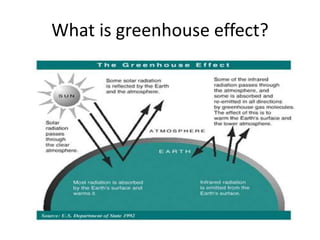
What is greenhouse effect?
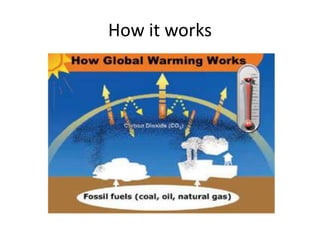
How it works
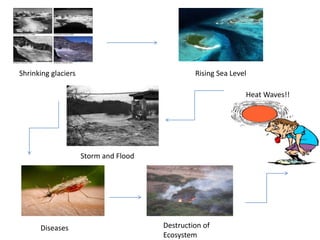
Shrinking glaciers Rising Sea Level
Storm and Flood
Diseases Destruction of
Ecosystem
Heat Waves!!
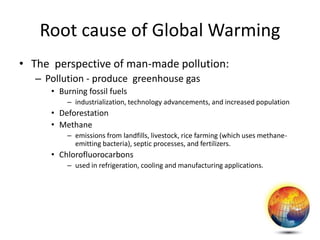
Root cause of Global Warming
• The perspective of man-made pollution:
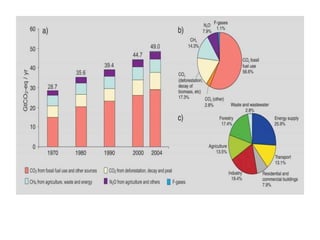
– Pollution - produce greenhouse gas
• Burning fossil fuels
– industrialization, technology advancements, and increased population
• Deforestation
• Methane
– emissions from landfills, livestock, rice farming (which uses methane-
emitting bacteria), septic processes, and fertilizers.
• Chlorofluorocarbons
– used in refrigeration, cooling and manufacturing applications.
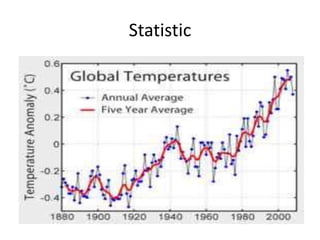
Statistic
Global Warming Controversy
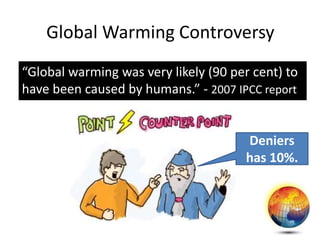
“Global warming was very likely (90 per cent) to
have been caused by humans.” - 2007 IPCC report
Deniers
has 10%.
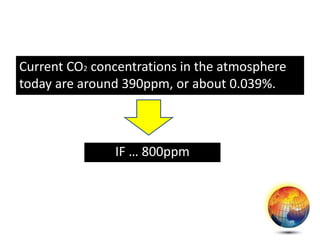
Current CO2 concentrations in the atmosphere
today are around 390ppm, or about 0.039%.
IF … 800ppm
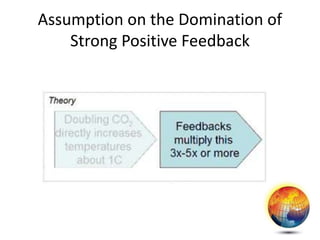
Assumption on the Domination of
Strong Positive Feedback
Constant Ocean Heat Content
• The new ARGO floating temperature stations
have measured little or no increase in ocean
heat content since they were put in service in
2003
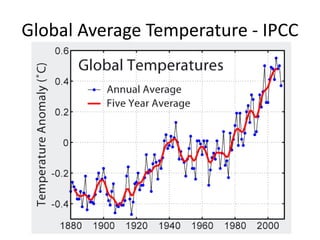
Global Average Temperature - IPCC
Measurement Technology Bias
• Improvements in our ability to accurately
count or measure a phenomenon is mistaken
for a real underlying change in the frequency
of the phenomenon.
• The count of annual tornadoes appears to
have increased over the last fifty years, but
this increase is almost entirely due to Doppler
radar and other technologies identifying
previously unrecognized twisters.
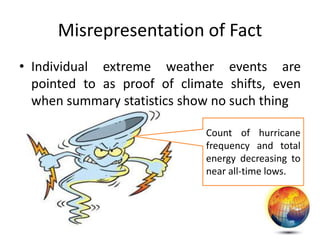
Misrepresentation of Fact
• Individual extreme weather events are
pointed to as proof of climate shifts, even
when summary statistics show no such thing
Count of hurricane
frequency and total
energy decreasing to
near all-time lows.
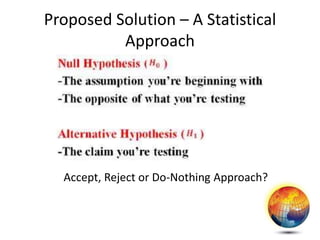
Proposed Solution – A Statistical
Approach
Accept, Reject or Do-Nothing Approach?
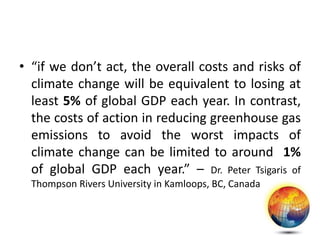
• “if we don’t act, the overall costs and risks of
climate change will be equivalent to losing at
least 5% of global GDP each year. In contrast,
the costs of action in reducing greenhouse gas
emissions to avoid the worst impacts of
climate change can be limited to around 1%
of global GDP each year.” – Dr. Peter Tsigaris of
Thompson Rivers University in Kamloops, BC, Canada

KXEX2163 Critical Thinking_Global Warming Controversy

  • 1.
    CONTROVERSY Presented by Group3.6 KMEM2163 Critical Thinking
  • 2.
    WHAT?? • Average increasein the temperature of the atmosphere. • Causes: • Natural phenomenon – Cycle of climate change • Man-made pollution – man-made greenhouse gases, dominantly characterized by carbon dioxide (CO2) content
  • 3.
  • 4.
  • 5.
    Shrinking glaciers RisingSea Level Storm and Flood Diseases Destruction of Ecosystem Heat Waves!!
  • 6.
    Root cause ofGlobal Warming • The perspective of man-made pollution: – Pollution - produce greenhouse gas • Burning fossil fuels – industrialization, technology advancements, and increased population • Deforestation • Methane – emissions from landfills, livestock, rice farming (which uses methane- emitting bacteria), septic processes, and fertilizers. • Chlorofluorocarbons – used in refrigeration, cooling and manufacturing applications.
  • 7.
  • 9.
    Global Warming Controversy “Globalwarming was very likely (90 per cent) to have been caused by humans.” - 2007 IPCC report Deniers has 10%.
  • 11.
    Current CO2 concentrationsin the atmosphere today are around 390ppm, or about 0.039%. IF … 800ppm
  • 12.
    Assumption on theDomination of Strong Positive Feedback
  • 13.
    Constant Ocean HeatContent • The new ARGO floating temperature stations have measured little or no increase in ocean heat content since they were put in service in 2003
  • 14.
  • 15.
    Measurement Technology Bias •Improvements in our ability to accurately count or measure a phenomenon is mistaken for a real underlying change in the frequency of the phenomenon. • The count of annual tornadoes appears to have increased over the last fifty years, but this increase is almost entirely due to Doppler radar and other technologies identifying previously unrecognized twisters.
  • 16.
    Misrepresentation of Fact •Individual extreme weather events are pointed to as proof of climate shifts, even when summary statistics show no such thing Count of hurricane frequency and total energy decreasing to near all-time lows.
  • 17.
    Proposed Solution –A Statistical Approach Accept, Reject or Do-Nothing Approach?
  • 18.
    • “if wedon’t act, the overall costs and risks of climate change will be equivalent to losing at least 5% of global GDP each year. In contrast, the costs of action in reducing greenhouse gas emissions to avoid the worst impacts of climate change can be limited to around 1% of global GDP each year.” – Dr. Peter Tsigaris of Thompson Rivers University in Kamloops, BC, Canada

Editor's Notes

  • #10 So why do these “deniers” stand athwart of the 97%?  Is it just politics?  Oil money? Perversity? Ignorance?
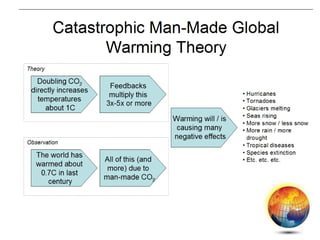
  • #12 Raise by 1 degree celcius. While potentially undesirable, a degree of warming is hardly catastrophic.
  • #13 The IPCC assumed that strong positive feedbacks dominated, and thus arrived at numbers that implied that feedbacks added an additional 2-4 degrees to the 1 degree from CO2 directly.
  • #17 of hurricane frequency and total energy (e.g. total cyclonic energy) have actually been decreasing over the last several years, to near all-time lows.