Baran Shafqat CEP Assignment 1 2015-ME-01
Mechanical Vibration 7th
Semester Page 1 of 17
Vibration Analysis and Modelling of a Cantilever Beam
Student Details
Your Full Name Baran Shafqat
Registration No. 2015-ME-01
Abstract
Vibration analysis and proper vibration control are most of the critical aspects of engineering that
must be taken into account so that the proper modelling of different systems can be made. The
point having the most crucial impact is resonance that occurs when the forcing frequency becomes
equal to the natural frequency of the system. In order to avoid it, vibration analysis of a cantilever
beam has been carried out so that the natural frequencies can be estimated. Different computational
techniques have been employed in this regard like SolidWorks and MATLAB. The results of solid
works are more precise corresponding to the material selection and have minimum percentage
error with the hand calculations. As the results on MATLAB have been carried out by the help of
the experimental data so the percentage error of it with the experimental results is found minimum.
The main objective associated with this project is estimation of natural frequencies and
phenomenon of vibration control.
1. Introduction
To have a broad understanding about the vibrational behavior and vibrational analysis of different
structures and machines is mandatory for an engineer in order to make rapid progress in his field.
The effects of different forcing frequencies must be taken into account. In some cases, the effects
are negligible but the same thing does not happen in most of the cases where if the forcing
frequency matches with the natural frequency of the vibrating object, it may result in crucial
problems as the amplitude at resonance is maximum.
The impact of vibrations on a body can be exemplified as the rotor of the helicopter and the wing
of the aero-plane. Both act as cantilever beam. During maintenance operation of aircraft, proper
vibration tracing is carried out in order to avoid any harmful consequences during the flights. In
the rare cases, where the landing is made on an uneven surface, the wing of the aero-plane may
experience different nature of forcing frequency and if got match with the natural frequency of the
wing, the phenomenon of ground resonance takes place. In such situation, proper isolation is
required and to avoid ground resonance, changing the frequency ratio is made.[1]
At resonance, it becomes very difficult to avoid the vibrations. Thus it is mandatory to understand
the concept and relation between the natural frequency of the vibrating body and forcing
frequency. The vibration control can be made either by using the passive control system or active
control system. If the passive control system is unable to meet the requirements related to the
vibration control, an active control system is introduced with proportional gain and derivative
gain.[2]
In the experiment of cantilever beam, magnet was used as a system providing passive controlling.
If the vibration controlling system was not used the amplitude of vibration got very large and the
whole beam got ruptured in meanwhile. The intensity of this aspect can be realized that the
Baran Shafqat CEP Assignment 1 2015-ME-01
Mechanical Vibration 7th
Semester Page 2 of 17
vibration control is also a most important criteria especially in case of the cars where engine is the
most dominant source of vibration and for the passenger ease and comfort, the vibrational
controlling system is employed in it. [3]
The main objective of this project is to make a clear understanding about the response of a single
degree of freedom system using different computational techniques or modern tools like Lab-
View, SolidWorks and MATLAB. The experiment was carried out on a cantilever beam in order
to study its vibrational behavior. The experimental data was gained by using Lab-View and the
results were then compared with the results of SolidWorks, MATLAB and theoretical calculations
employing the basic relations. [4]The results of SolidWorks and theoretical calculations were
comparable as the material selected in the SolidWorks and the material specifications used in
theoretical calculations are similar but the experimental results and the results of MATLAB were
found quite similar as MATLAB was made to use the experimental data for the further
calculations.
2. Literature Review
While dealing with the response of the system, we need to consider its displacement curves in both
time and frequency domain. The response of the system under any forcing frequency gives
information about the nature of the forcing frequency i.e. either it is periodic or non-periodic. In
order to explain it on the cantilever beam, we need to consider the effect of the mass applies and
also the mass of the beam to understand the nature of the response of the beam. First of all we need
to be clear about few of the most important terminologies that are explained below.
2.1. Free and Forced Vibration
Free vibration:
When an external force is applied on a vibrating body for a very short interval and the body is
allowed to make vibrations under its inertia, is called free vibration. In ideal cases, with the passage
of time, ignoring the damping resistive force imposed by the air and air drag, the amplitude of the
vibration remains constant (undamped oscillation) but in actual practice, the air drag decreases the
amplitude of vibration and eventually the body comes to rest after certain time of oscillation.[5]
The general equation for free vibration is,
𝑚 𝑒𝑞 𝑥̈ + 𝑐 𝑒𝑞 𝑥̇ + 𝑘 𝑒𝑞 𝑥 = 0
Where
𝑚 𝑒𝑞 = 𝐸𝑞𝑢𝑖𝑣𝑎𝑙𝑒𝑛𝑡 𝑚𝑎𝑠𝑠 𝑜𝑓 𝑡ℎ𝑒 𝑣𝑖𝑏𝑟𝑎𝑡𝑖𝑛𝑔 𝑏𝑜𝑑𝑦 (𝑘𝑔)
𝑐 𝑒𝑞 = 𝐸𝑞𝑢𝑖𝑣𝑎𝑙𝑒𝑛𝑡 𝑑𝑎𝑚𝑝𝑖𝑛𝑔 𝑐𝑜𝑛𝑠𝑡𝑎𝑛𝑡 𝑜𝑓 𝑡ℎ𝑒 𝑑𝑎𝑚𝑝𝑒𝑟 (𝑁𝑠𝑚−2
)
𝑘 𝑒𝑞 = 𝐸𝑞𝑢𝑖𝑣𝑎𝑙𝑒𝑛𝑡 𝑠𝑝𝑟𝑖𝑛𝑔 𝑐𝑜𝑛𝑠𝑡𝑎𝑛𝑡 𝑜𝑓 𝑡ℎ𝑒 𝑠𝑝𝑟𝑖𝑛𝑔 (𝑁𝑚−1
)
The response of the system in free vibrations is transient response.
Forced vibration:
When an external force is applied on a body and body is allowed to execute vibrations then after
certain time interval a periodic force is applied on the body and this force is being applied. This
Baran Shafqat CEP Assignment 1 2015-ME-01
Mechanical Vibration 7th
Semester Page 3 of 17
not only increases the amplitude of the vibration but if the frequency of the externally applied force
becomes equal to the natural frequency of oscillation of the body, the phenomenon of resonance
takes place and the body is assumed to have ideal infinite magnitude displacement.[6]
The general equation for free vibration is,
𝑚 𝑒𝑞 𝑥̈ + 𝑐 𝑒𝑞 𝑥̇ + 𝑘 𝑒𝑞 𝑥 = 𝐹(𝑡)
Where
𝐹(𝑡) = 𝐸𝑥𝑡𝑒𝑟𝑛𝑎𝑙𝑙𝑦 𝑎𝑝𝑝𝑙𝑖𝑒𝑑 𝑓𝑜𝑟𝑐𝑒
The response of the system in free vibrations is steady state response.
Natural frequency (𝝎 𝒏):
The frequency with which a body oscillated when no external force or driving force is applied on
the body is called its natural frequency.
𝜔 𝑛 = √
𝑘 𝑒𝑞
𝑚 𝑒𝑞
Natural frequency is most crucial element in the designing procedure i.e. we need to take into
account the natural frequency so that the frequency of externally applied force may not get equal
to the natural frequency and results in resonance. In order to avoid resonance, information related
to natural frequency is very much important. [7]
Frequency ratio (𝒓):
It is the ratio between the frequency of the externally applied force and the natural frequency of
the vibrating body. At resonance, frequency ratio is unity.
𝑟 =
𝜔
𝜔 𝑛
Damping ratio (𝜻):
It is the ratio between the equivalent damping constant of the system and the critical damping
constant of the system. For an undamped system, 𝜁 = 0 [8]
𝜁 =
𝑐 𝑒𝑞
𝑐 𝑐
=
𝑐 𝑒𝑞
2 × 𝑚 𝑒𝑞 × 𝜔 𝑛
=
𝑐 𝑒𝑞
2 × √ 𝑚 𝑒𝑞 × 𝑘 𝑒𝑞
2.2. Magnification Factor
It is the ratio between the steady state amplitude of the vibrating body and the static deflection
experienced by the body under the action of its own weight.[9]
𝑋 =
𝐹𝑜
√(𝑘 𝑒𝑞 − 𝑚 𝑒𝑞 𝜔2)
2
+ (𝑐 𝑒𝑞 𝜔)
2
𝑋 =
𝐹𝑜
𝑘 𝑒𝑞√(1 − 𝑟2)2 + (2𝜁𝑟)2
=
𝛿𝑠𝑡
√(1 − 𝑟2)2 + (2𝜁𝑟)2
𝑀 =
𝑋
𝛿𝑠𝑡
=
1
√(1 − 𝑟2)2 + (2𝜁𝑟)2
Baran Shafqat CEP Assignment 1 2015-ME-01
Mechanical Vibration 7th
Semester Page 4 of 17
At resonance (𝑟 = 1)
𝑀 =
1
2𝜁
For undamped system (𝜁 = 0)
𝑀 =
1
(1 − 𝑟2)
2.3. Euler–Bernoulli Beam Theory
Theory which is used to measure deflection in beam under lateral loads is called Euler–Bernoulli
Beam Theory. It is used to calculate natural frequency of beam in different modes. It also describes
the properties of beam carrying loads.
𝜔 𝑛 = 𝛼2
√
𝐸𝐼
𝜌𝐴𝑙4
3. Methodology
The specifications of the cantilever beam modelled in theory and Solid works has been given
below,
𝑀𝑎𝑡𝑒𝑟𝑖𝑎𝑙: 𝐴𝐼𝑆𝐼 1035 𝑆𝑡𝑒𝑒𝑙 (𝑆𝑆)
𝑀𝑎𝑠𝑠 𝑑𝑒𝑠𝑛𝑖𝑡𝑦 = 𝜌 = 7850 𝑘𝑔𝑚−3
𝐿𝑒𝑛𝑔𝑡ℎ 𝑜𝑓 𝑡ℎ𝑒 𝑏𝑒𝑎𝑚 = 𝑙 = 410 𝑚𝑚
𝑊𝑖𝑑𝑡ℎ 𝑜𝑓 𝑡ℎ𝑒 𝑏𝑒𝑎𝑚 = 𝑏 = 25.4 𝑚𝑚
𝑇ℎ𝑖𝑐𝑘𝑛𝑒𝑠𝑠 𝑜𝑓 𝑡ℎ𝑒 𝑏𝑒𝑎𝑚 = ℎ = 3.2 𝑚𝑚
𝑀𝑎𝑠𝑠 𝑜𝑓 𝑡ℎ𝑒 𝑚𝑎𝑔𝑛𝑒𝑡 = 𝑀 𝑚 = 0.099 𝑘𝑔
𝑉𝑜𝑙𝑢𝑚𝑒 𝑜𝑓 𝑡ℎ𝑒 𝑚𝑎𝑔𝑛𝑒𝑡 = 𝑉𝑚 =
𝑀 𝑚
𝜌
= 12611 𝑚𝑚3
While performing the computational techniques for the vibration analysis of the cantilever beam,
different approaches have been employed.
1. Vibration analysis of the cantilever beam on solid works with mass and without mass.
2. Vibration analysis of cantilever beam on MATLAB mathworks with and without mass.
3. Experimental vibration analysis of the cantilever beam with and without mass.
4. Vibration analysis of cantilever beam with and without mass using theoretical knowledge.
All of the methods that have been mentioned above are discussed in details by using the following
procedure.
4. Results
Results from following tools will be shown below.
Baran Shafqat CEP Assignment 1 2015-ME-01
Mechanical Vibration 7th
Semester Page 5 of 17
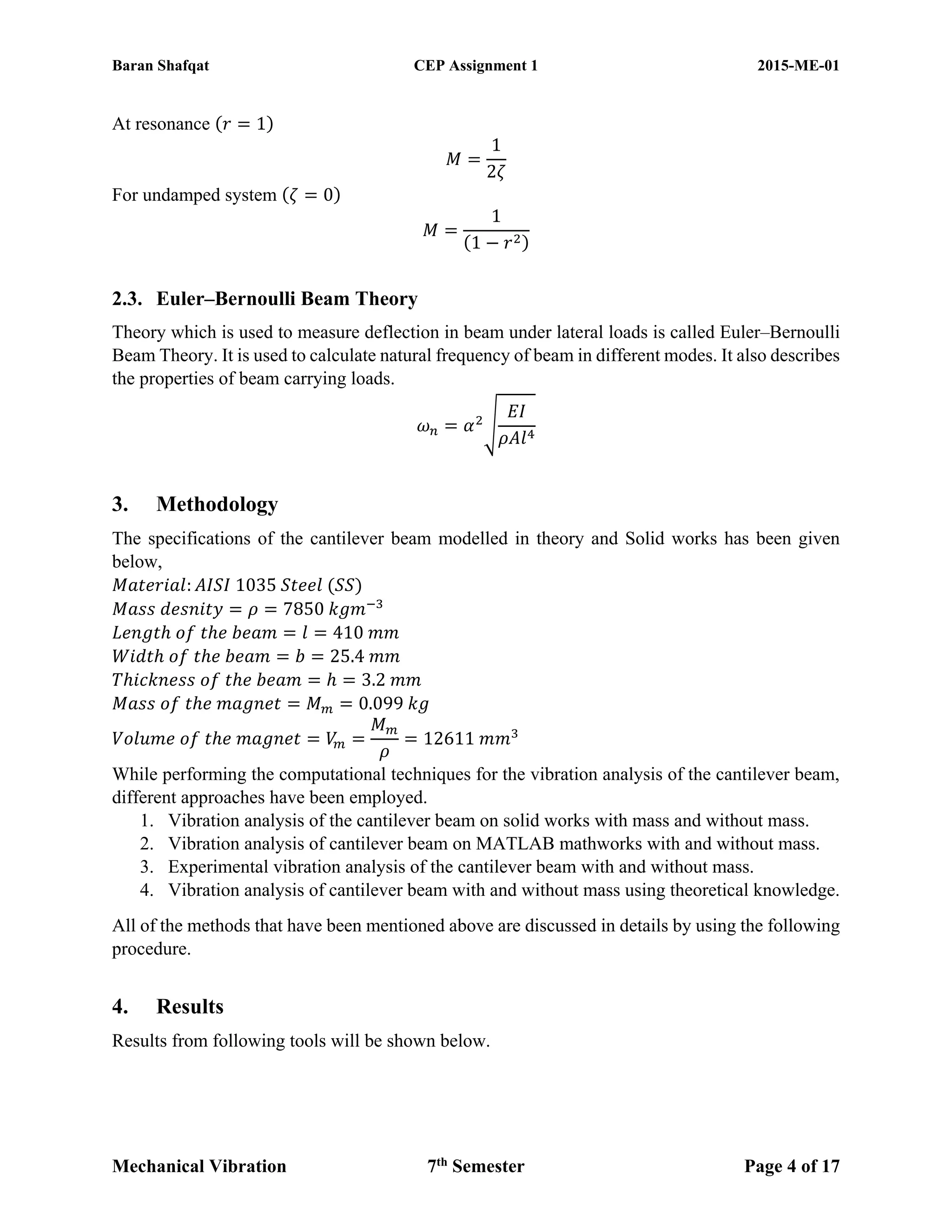
4.1. Vibration analysis of the cantilever beam on SolidWorks
First of all the cantilever beam was modelled in SolidWorks by using the provided dimensions
after this from the simulation mode, frequency simulation was selected and then the material was
selected for the beam and then the fixture was applied on one of its face. Meshing was done and
then the simulation was run without applying any external mass on the beam.[10]
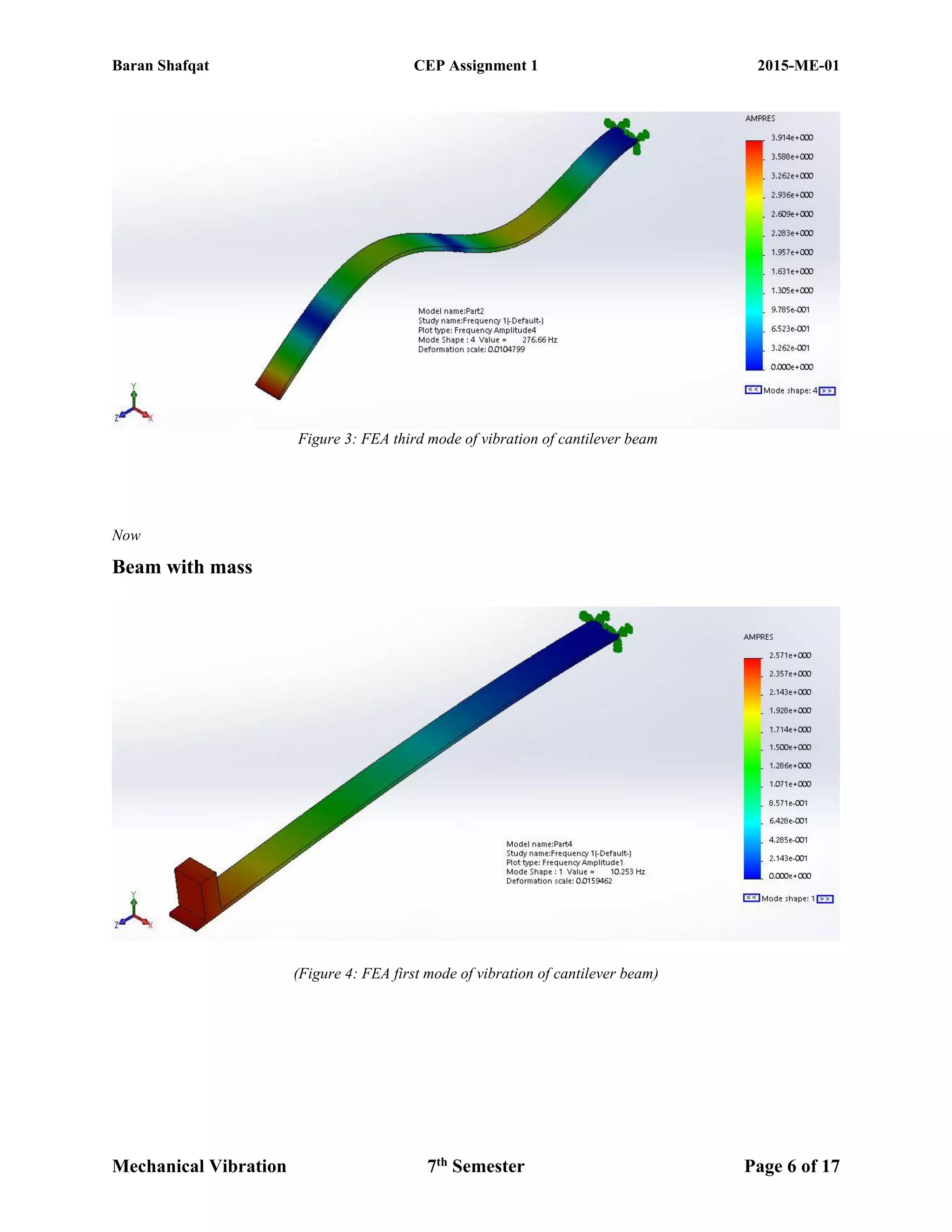
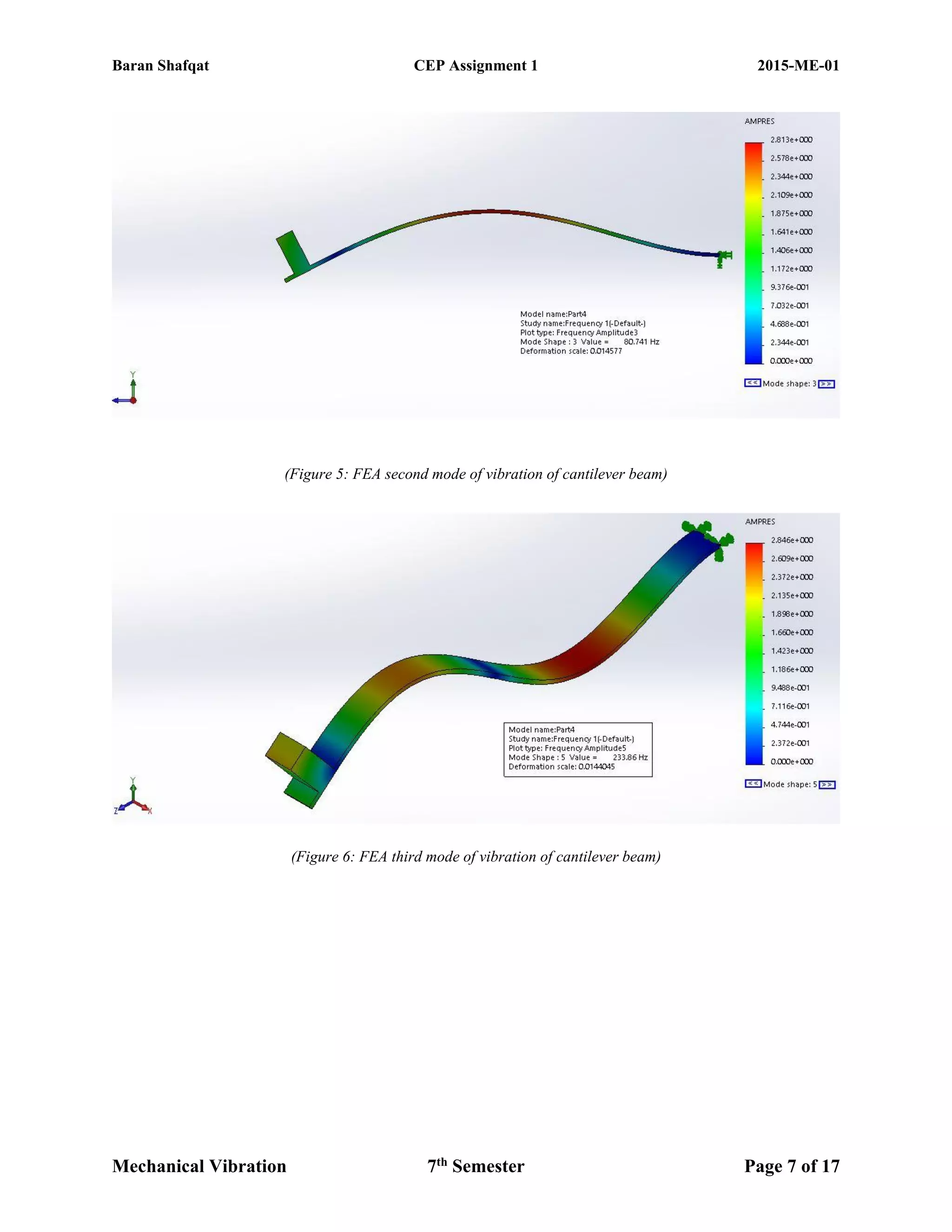
After this the same procedure of modelling was done and then as the mass applied to its one end
is 0.099 kg, so a box with the required assumed dimensions was generated and extruded. After this
the same simulation procedure was performed and the results were obtained.
After this the following results were generated by the solid works,
Beam without mass
(Figure 1: FEA first mode of vibration of cantilever beam)
(Figure 2: FEA second mode of vibration of cantilever beam)
Baran Shafqat CEP Assignment 1 2015-ME-01
Mechanical Vibration 7th
Semester Page 6 of 17
Figure 3: FEA third mode of vibration of cantilever beam
Now
Beam with mass
(Figure 4: FEA first mode of vibration of cantilever beam)
Baran Shafqat CEP Assignment 1 2015-ME-01
Mechanical Vibration 7th
Semester Page 7 of 17
(Figure 5: FEA second mode of vibration of cantilever beam)
(Figure 6: FEA third mode of vibration of cantilever beam)
Baran Shafqat CEP Assignment 1 2015-ME-01
Mechanical Vibration 7th
Semester Page 8 of 17
4.2. Vibration analysis of cantilever beam using Euler Bernoulli theory
By using the theoretical knowledge the natural frequency of the cantilever can be found either by
using the formulas for three different modes of vibrations or by using log decrement method as
given below,
Method of different modes of vibrations
Here we need to take into account both the cases i.e. when the cantilever beam is subjected to a
mass and when it not subjected to a mass.
Beam without mass
𝐷𝑒𝑛𝑠𝑖𝑡𝑦 𝑜𝑓 𝑚𝑎𝑡𝑒𝑟𝑖𝑎𝑙 = 𝜌 = 7850 𝑘𝑔𝑚−3
𝐸𝑙𝑎𝑠𝑡𝑖𝑐 𝑀𝑜𝑑𝑢𝑙𝑢𝑠 𝑜𝑓 𝑡ℎ𝑒 𝑚𝑎𝑡𝑒𝑟𝑖𝑎𝑙 = 𝐸 = 2.0499 × 10¹¹
𝑁𝑚−2
𝑉𝑜𝑙𝑢𝑚𝑒 𝑜𝑓 𝑐𝑎𝑛𝑡𝑖𝑙𝑒𝑣𝑒𝑟 𝑏𝑒𝑎𝑚 = 𝑉 = 𝑙 × 𝑏 × ℎ = 410 × 25.4 × 3.2 = 33324.8 𝑚𝑚3
𝐶𝑟𝑜𝑠𝑠 − 𝑠𝑒𝑐𝑡𝑖𝑜𝑛𝑎𝑙 𝑎𝑟𝑒𝑎 𝑜𝑓 𝑏𝑒𝑎𝑚 = 𝐴 = 𝑏 × ℎ = 0.0254 × 0.0032 = 8.128 × 10⁻⁵
𝑚2
𝑀𝑎𝑠𝑠 𝑜𝑓 𝑡ℎ𝑒 𝑏𝑒𝑎𝑚 = 𝑚 = 𝜌 × 𝑉 = 7850 × 33324.8 × 10−9
= 0.261 𝑘𝑔
𝑚 𝑒𝑞 = 𝑚 = 0.261 𝑘𝑔
𝐼 =
1
12
𝑏ℎ3
=
1
12
× (25.4 × 10−3) × (3.2 × 10−3) = 6.935 × 10⁻¹¹
𝑚4
𝑘 𝑒𝑞 =
3𝐸𝐼
𝑙3
=
3 × (2.0499 × 1011) × (6.935 × 10−11)
(410 × 10−3)3
= 618.7978 𝑁𝑚−1
As,
𝜔 𝑛 = 𝛼2√
𝐸𝐼
𝜌𝐴𝑙4
For first mode of vibration (𝛼 = 1.875),
𝜔 𝑛1
= 1.8752√
(2.0499 × 1011) × (6.935 × 10−11)
7850 × (8.128 × 10−5) × (0.410)4
= 98.7183 𝑟𝑎𝑑𝑠−1
= 15.7115 𝐻𝑧
For second mode of vibration (𝛼 = 4.694),
𝜔 𝑛2
= 4.6942√
(2.0499 × 1011) × (6.935 × 10−11)
7850 × (8.128 × 10−5) × (0.410)4
= 618.7018 𝑟𝑎𝑑𝑠−1
= 98.4694 𝐻𝑧
For third mode of vibration (𝛼 = 7.855),
𝜔 𝑛3
= 7.8552√
(2.0499 × 1011) × (6.935 × 10−11)
7850 × (8.128 × 10−5) × (0.410)4
= 1732.5571 𝑟𝑎𝑑𝑠−1
= 275.7450 𝐻𝑧
Beam with mass
𝑚 𝑒𝑞 = 𝑀 𝑚 +
33
140
𝑚 = 0.099 + 0.23(0.261) = 0.15903 𝑘𝑔
𝜔 𝑛1
= √
𝑘 𝑒𝑞
𝑚 𝑒𝑞
= √
618.7978
0.15903
= 62.3796 𝑟𝑎𝑑𝑠−1
= 9.9280 𝐻𝑧
Baran Shafqat CEP Assignment 1 2015-ME-01
Mechanical Vibration 7th
Semester Page 9 of 17
1.1.1.Method of Log decrement
The log decrement method was used to calculate the damped natural frequency of the cantilever
beam by making time domain plots of the given experimental data of the beam in MATLAB after
importing it in MATLAB.
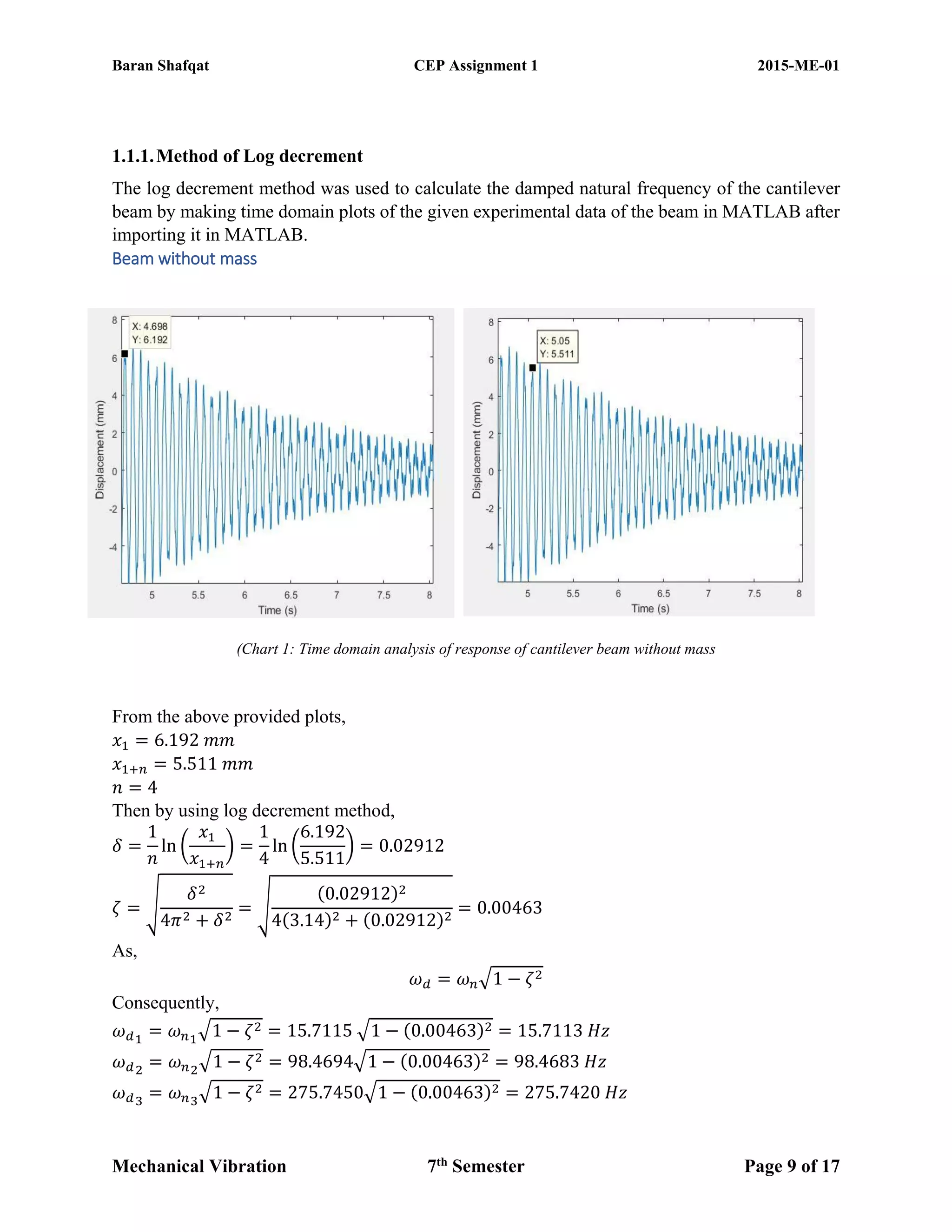
Beam without mass
(Chart 1: Time domain analysis of response of cantilever beam without mass
From the above provided plots,
𝑥1 = 6.192 𝑚𝑚
𝑥1+𝑛 = 5.511 𝑚𝑚
𝑛 = 4
Then by using log decrement method,
𝛿 =
1
𝑛
ln (
𝑥1
𝑥1+𝑛
) =
1
4
ln (
6.192
5.511
) = 0.02912
𝜁 = √
𝛿2
4𝜋2 + 𝛿2
= √
(0.02912)2
4(3.14)2 + (0.02912)2
= 0.00463
As,
𝜔 𝑑 = 𝜔 𝑛√1 − 𝜁2
Consequently,
𝜔 𝑑1
= 𝜔 𝑛1
√1 − 𝜁2 = 15.7115 √1 − (0.00463)2 = 15.7113 𝐻𝑧
𝜔 𝑑2
= 𝜔 𝑛2
√1 − 𝜁2 = 98.4694√1 − (0.00463)2 = 98.4683 𝐻𝑧
𝜔 𝑑3
= 𝜔 𝑛3
√1 − 𝜁2 = 275.7450√1 − (0.00463)2 = 275.7420 𝐻𝑧
Baran Shafqat CEP Assignment 1 2015-ME-01
Mechanical Vibration 7th
Semester Page 10 of 17
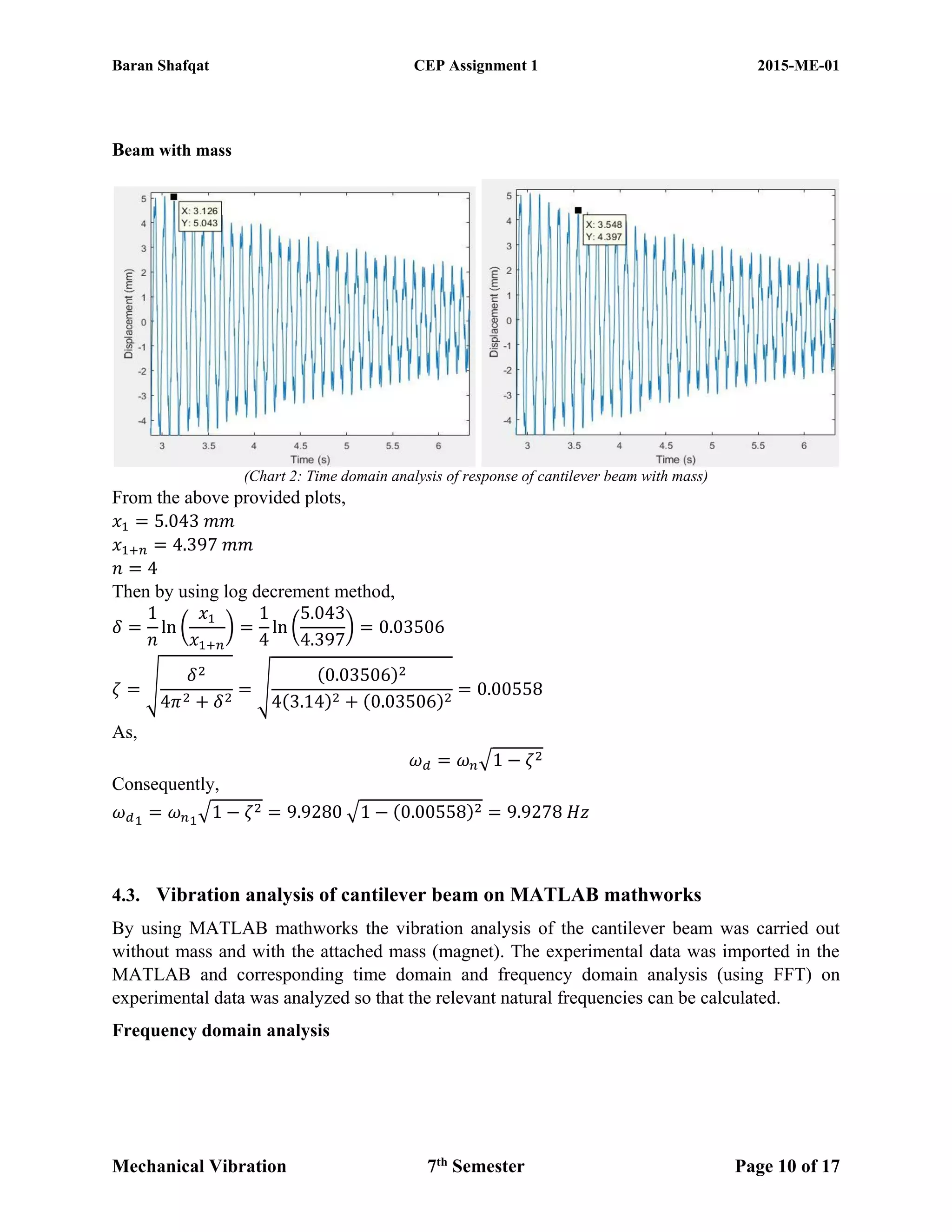
Beam with mass
(Chart 2: Time domain analysis of response of cantilever beam with mass)
From the above provided plots,
𝑥1 = 5.043 𝑚𝑚
𝑥1+𝑛 = 4.397 𝑚𝑚
𝑛 = 4
Then by using log decrement method,
𝛿 =
1
𝑛
ln (
𝑥1
𝑥1+𝑛
) =
1
4
ln (
5.043
4.397
) = 0.03506
𝜁 = √
𝛿2
4𝜋2 + 𝛿2
= √
(0.03506)2
4(3.14)2 + (0.03506)2
= 0.00558
As,
𝜔 𝑑 = 𝜔 𝑛√1 − 𝜁2
Consequently,
𝜔 𝑑1
= 𝜔 𝑛1
√1 − 𝜁2 = 9.9280 √1 − (0.00558)2 = 9.9278 𝐻𝑧
4.3. Vibration analysis of cantilever beam on MATLAB mathworks
By using MATLAB mathworks the vibration analysis of the cantilever beam was carried out
without mass and with the attached mass (magnet). The experimental data was imported in the
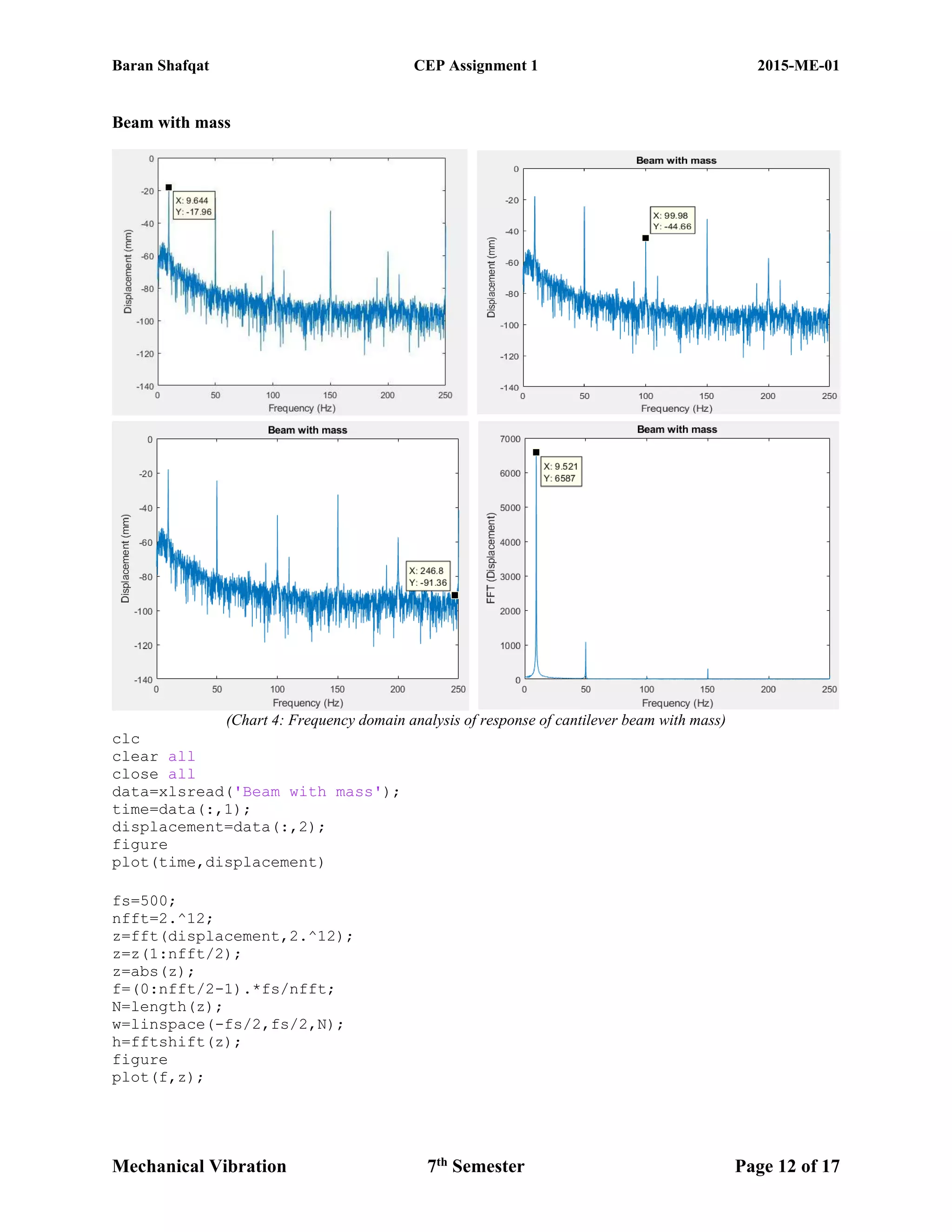
MATLAB and corresponding time domain and frequency domain analysis (using FFT) on
experimental data was analyzed so that the relevant natural frequencies can be calculated.
Frequency domain analysis
Baran Shafqat CEP Assignment 1 2015-ME-01
Mechanical Vibration 7th
Semester Page 11 of 17
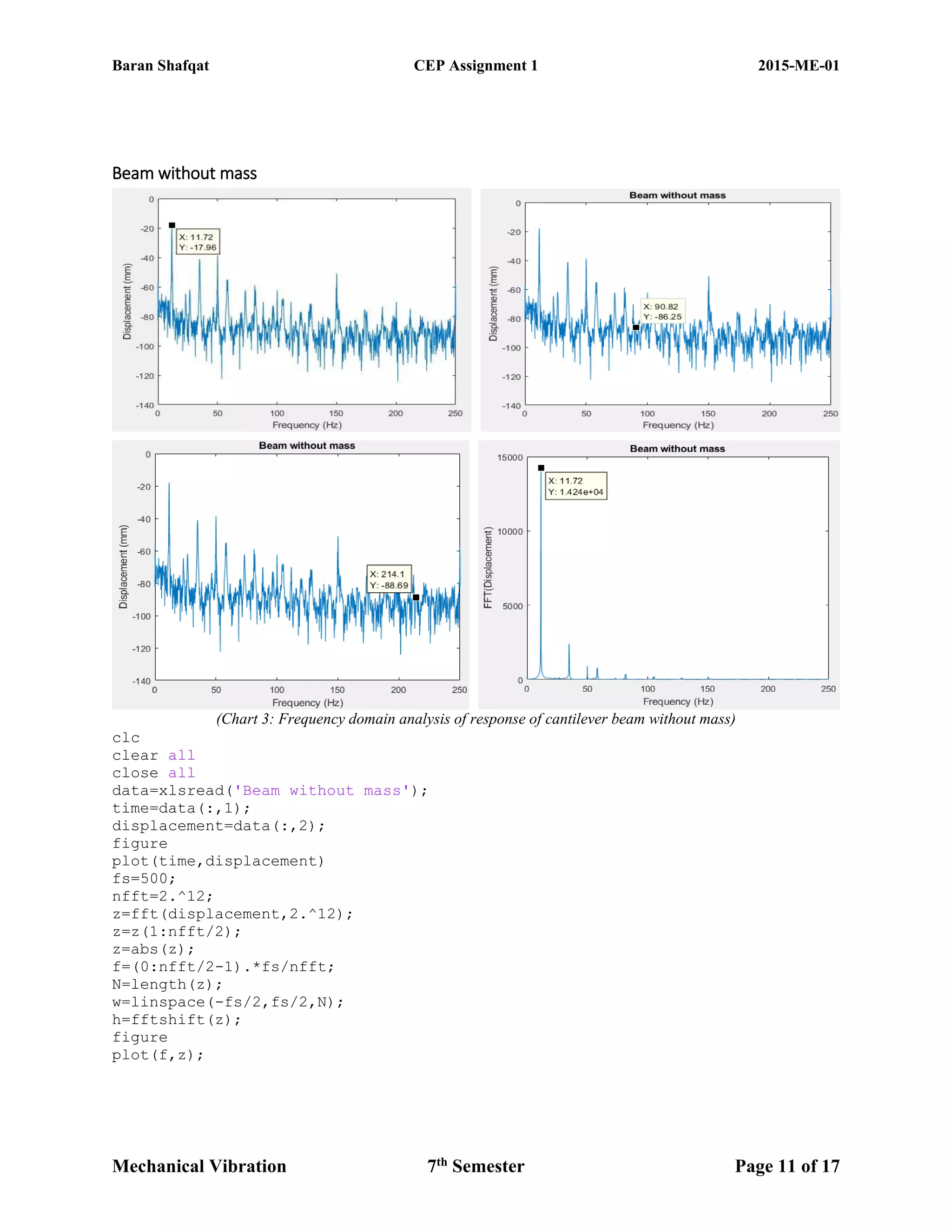
Beam without mass
(Chart 3: Frequency domain analysis of response of cantilever beam without mass)
clc
clear all
close all
data=xlsread('Beam without mass');
time=data(:,1);
displacement=data(:,2);
figure
plot(time,displacement)
fs=500;
nfft=2.^12;
z=fft(displacement,2.^12);
z=z(1:nfft/2);
z=abs(z);
f=(0:nfft/2-1).*fs/nfft;
N=length(z);
w=linspace(-fs/2,fs/2,N);
h=fftshift(z);
figure
plot(f,z);
Baran Shafqat CEP Assignment 1 2015-ME-01
Mechanical Vibration 7th
Semester Page 12 of 17
Beam with mass
(Chart 4: Frequency domain analysis of response of cantilever beam with mass)
clc
clear all
close all
data=xlsread('Beam with mass');
time=data(:,1);
displacement=data(:,2);
figure
plot(time,displacement)
fs=500;
nfft=2.^12;
z=fft(displacement,2.^12);
z=z(1:nfft/2);
z=abs(z);
f=(0:nfft/2-1).*fs/nfft;
N=length(z);
w=linspace(-fs/2,fs/2,N);
h=fftshift(z);
figure
plot(f,z);
Baran Shafqat CEP Assignment 1 2015-ME-01
Mechanical Vibration 7th
Semester Page 13 of 17
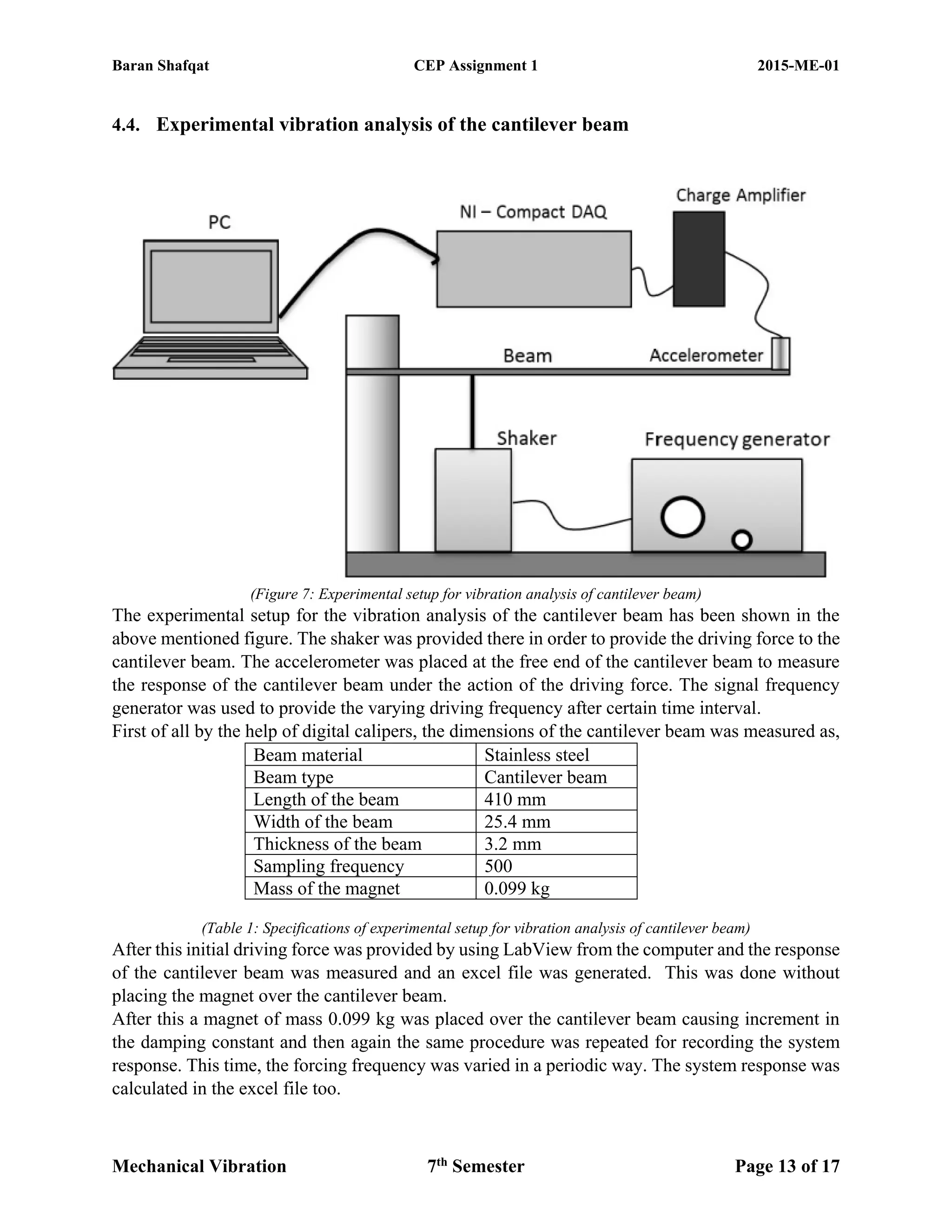
4.4. Experimental vibration analysis of the cantilever beam
(Figure 7: Experimental setup for vibration analysis of cantilever beam)
The experimental setup for the vibration analysis of the cantilever beam has been shown in the
above mentioned figure. The shaker was provided there in order to provide the driving force to the
cantilever beam. The accelerometer was placed at the free end of the cantilever beam to measure
the response of the cantilever beam under the action of the driving force. The signal frequency
generator was used to provide the varying driving frequency after certain time interval.
First of all by the help of digital calipers, the dimensions of the cantilever beam was measured as,
Beam material Stainless steel
Beam type Cantilever beam
Length of the beam 410 mm
Width of the beam 25.4 mm
Thickness of the beam 3.2 mm
Sampling frequency 500
Mass of the magnet 0.099 kg
(Table 1: Specifications of experimental setup for vibration analysis of cantilever beam)
After this initial driving force was provided by using LabView from the computer and the response
of the cantilever beam was measured and an excel file was generated. This was done without
placing the magnet over the cantilever beam.
After this a magnet of mass 0.099 kg was placed over the cantilever beam causing increment in
the damping constant and then again the same procedure was repeated for recording the system
response. This time, the forcing frequency was varied in a periodic way. The system response was
calculated in the excel file too.
Baran Shafqat CEP Assignment 1 2015-ME-01
Mechanical Vibration 7th
Semester Page 14 of 17
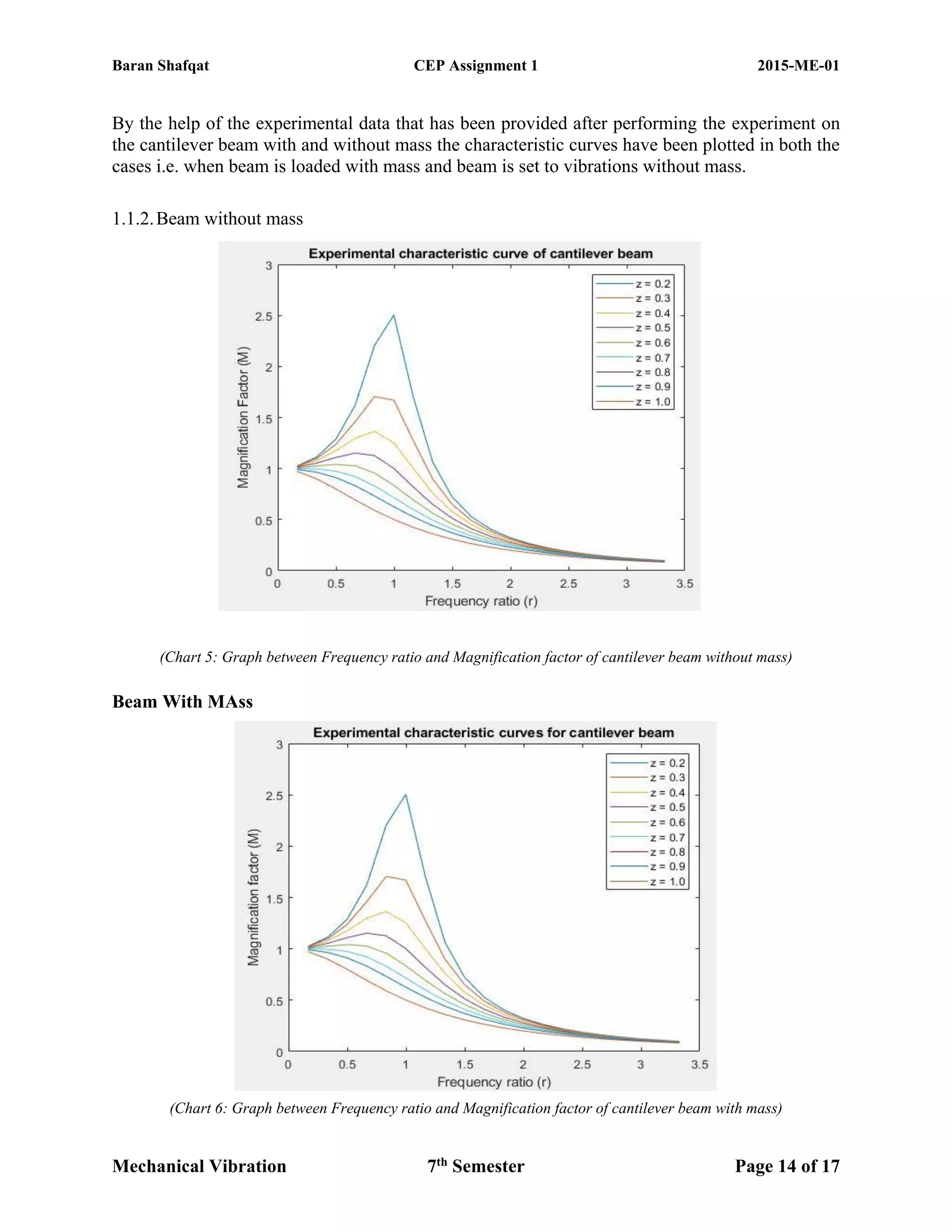
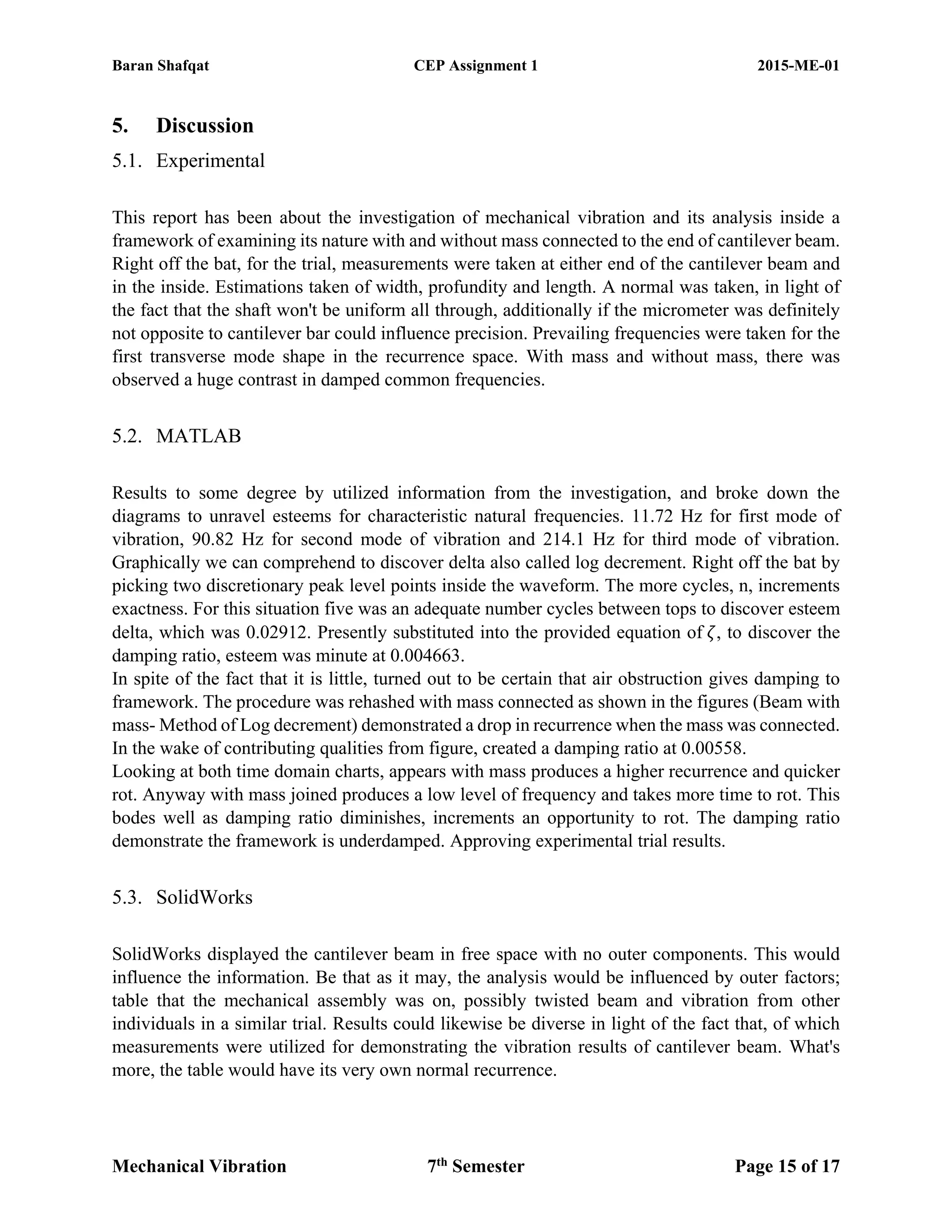
By the help of the experimental data that has been provided after performing the experiment on
the cantilever beam with and without mass the characteristic curves have been plotted in both the
cases i.e. when beam is loaded with mass and beam is set to vibrations without mass.
1.1.2.Beam without mass
(Chart 5: Graph between Frequency ratio and Magnification factor of cantilever beam without mass)
Beam With MAss
(Chart 6: Graph between Frequency ratio and Magnification factor of cantilever beam with mass)
Baran Shafqat CEP Assignment 1 2015-ME-01
Mechanical Vibration 7th
Semester Page 15 of 17
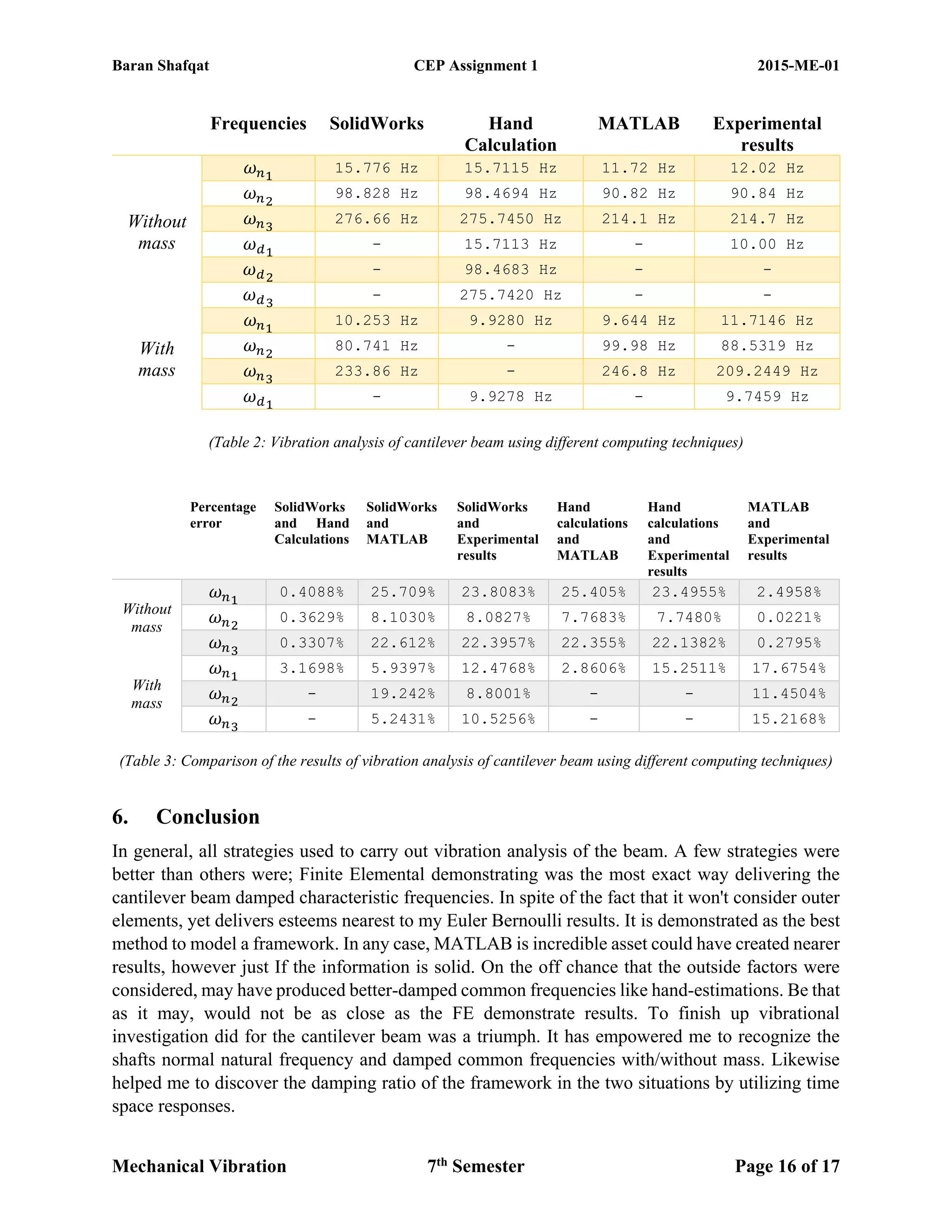
5. Discussion
5.1. Experimental
This report has been about the investigation of mechanical vibration and its analysis inside a
framework of examining its nature with and without mass connected to the end of cantilever beam.
Right off the bat, for the trial, measurements were taken at either end of the cantilever beam and
in the inside. Estimations taken of width, profundity and length. A normal was taken, in light of
the fact that the shaft won't be uniform all through, additionally if the micrometer was definitely
not opposite to cantilever bar could influence precision. Prevailing frequencies were taken for the
first transverse mode shape in the recurrence space. With mass and without mass, there was
observed a huge contrast in damped common frequencies.
5.2. MATLAB
Results to some degree by utilized information from the investigation, and broke down the
diagrams to unravel esteems for characteristic natural frequencies. 11.72 Hz for first mode of
vibration, 90.82 Hz for second mode of vibration and 214.1 Hz for third mode of vibration.
Graphically we can comprehend to discover delta also called log decrement. Right off the bat by
picking two discretionary peak level points inside the waveform. The more cycles, n, increments
exactness. For this situation five was an adequate number cycles between tops to discover esteem
delta, which was 0.02912. Presently substituted into the provided equation of 𝜁, to discover the
damping ratio, esteem was minute at 0.004663.
In spite of the fact that it is little, turned out to be certain that air obstruction gives damping to
framework. The procedure was rehashed with mass connected as shown in the figures (Beam with
mass- Method of Log decrement) demonstrated a drop in recurrence when the mass was connected.
In the wake of contributing qualities from figure, created a damping ratio at 0.00558.
Looking at both time domain charts, appears with mass produces a higher recurrence and quicker
rot. Anyway with mass joined produces a low level of frequency and takes more time to rot. This
bodes well as damping ratio diminishes, increments an opportunity to rot. The damping ratio
demonstrate the framework is underdamped. Approving experimental trial results.
5.3. SolidWorks
SolidWorks displayed the cantilever beam in free space with no outer components. This would
influence the information. Be that as it may, the analysis would be influenced by outer factors;
table that the mechanical assembly was on, possibly twisted beam and vibration from other
individuals in a similar trial. Results could likewise be diverse in light of the fact that, of which
measurements were utilized for demonstrating the vibration results of cantilever beam. What's
more, the table would have its very own normal recurrence.
Baran Shafqat CEP Assignment 1 2015-ME-01
Mechanical Vibration 7th
Semester Page 16 of 17
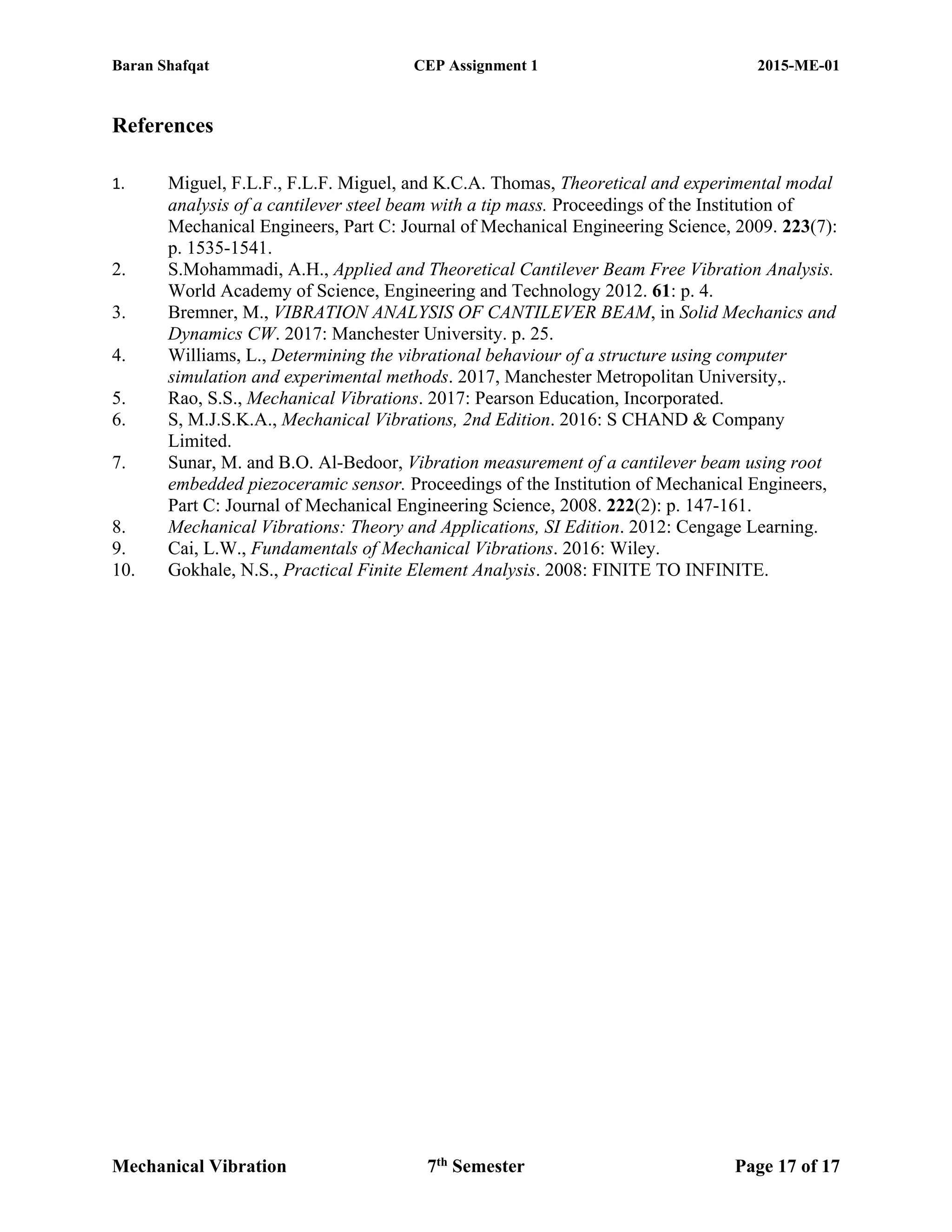
Frequencies SolidWorks Hand
Calculation
MATLAB Experimental
results
Without
mass
𝜔 𝑛1
15.776 Hz 15.7115 Hz 11.72 Hz 12.02 Hz
𝜔 𝑛2
98.828 Hz 98.4694 Hz 90.82 Hz 90.84 Hz
𝜔 𝑛3
276.66 Hz 275.7450 Hz 214.1 Hz 214.7 Hz
𝜔 𝑑1
- 15.7113 Hz - 10.00 Hz
𝜔 𝑑2
- 98.4683 Hz - -
𝜔 𝑑3
- 275.7420 Hz - -
With
mass
𝜔 𝑛1
10.253 Hz 9.9280 Hz 9.644 Hz 11.7146 Hz
𝜔 𝑛2
80.741 Hz - 99.98 Hz 88.5319 Hz
𝜔 𝑛3
233.86 Hz - 246.8 Hz 209.2449 Hz
𝜔 𝑑1
- 9.9278 Hz - 9.7459 Hz
(Table 2: Vibration analysis of cantilever beam using different computing techniques)
Percentage
error
SolidWorks
and Hand
Calculations
SolidWorks
and
MATLAB
SolidWorks
and
Experimental
results
Hand
calculations
and
MATLAB
Hand
calculations
and
Experimental
results
MATLAB
and
Experimental
results
Without
mass
𝜔 𝑛1
0.4088% 25.709% 23.8083% 25.405% 23.4955% 2.4958%
𝜔 𝑛2
0.3629% 8.1030% 8.0827% 7.7683% 7.7480% 0.0221%
𝜔 𝑛3
0.3307% 22.612% 22.3957% 22.355% 22.1382% 0.2795%
With
mass
𝜔 𝑛1
3.1698% 5.9397% 12.4768% 2.8606% 15.2511% 17.6754%
𝜔 𝑛2
- 19.242% 8.8001% - - 11.4504%
𝜔 𝑛3
- 5.2431% 10.5256% - - 15.2168%
(Table 3: Comparison of the results of vibration analysis of cantilever beam using different computing techniques)
6. Conclusion
In general, all strategies used to carry out vibration analysis of the beam. A few strategies were
better than others were; Finite Elemental demonstrating was the most exact way delivering the
cantilever beam damped characteristic frequencies. In spite of the fact that it won't consider outer
elements, yet delivers esteems nearest to my Euler Bernoulli results. It is demonstrated as the best
method to model a framework. In any case, MATLAB is incredible asset could have created nearer
results, however just If the information is solid. On the off chance that the outside factors were
considered, may have produced better-damped common frequencies like hand-estimations. Be that
as it may, would not be as close as the FE demonstrate results. To finish up vibrational
investigation did for the cantilever beam was a triumph. It has empowered me to recognize the
shafts normal natural frequency and damped common frequencies with/without mass. Likewise
helped me to discover the damping ratio of the framework in the two situations by utilizing time
space responses.
Baran Shafqat CEP Assignment 1 2015-ME-01
Mechanical Vibration 7th
Semester Page 17 of 17
References
1. Miguel, F.L.F., F.L.F. Miguel, and K.C.A. Thomas, Theoretical and experimental modal
analysis of a cantilever steel beam with a tip mass. Proceedings of the Institution of
Mechanical Engineers, Part C: Journal of Mechanical Engineering Science, 2009. 223(7):
p. 1535-1541.
2. S.Mohammadi, A.H., Applied and Theoretical Cantilever Beam Free Vibration Analysis.
World Academy of Science, Engineering and Technology 2012. 61: p. 4.
3. Bremner, M., VIBRATION ANALYSIS OF CANTILEVER BEAM, in Solid Mechanics and
Dynamics CW. 2017: Manchester University. p. 25.
4. Williams, L., Determining the vibrational behaviour of a structure using computer
simulation and experimental methods. 2017, Manchester Metropolitan University,.
5. Rao, S.S., Mechanical Vibrations. 2017: Pearson Education, Incorporated.
6. S, M.J.S.K.A., Mechanical Vibrations, 2nd Edition. 2016: S CHAND & Company
Limited.
7. Sunar, M. and B.O. Al-Bedoor, Vibration measurement of a cantilever beam using root
embedded piezoceramic sensor. Proceedings of the Institution of Mechanical Engineers,
Part C: Journal of Mechanical Engineering Science, 2008. 222(2): p. 147-161.
8. Mechanical Vibrations: Theory and Applications, SI Edition. 2012: Cengage Learning.
9. Cai, L.W., Fundamentals of Mechanical Vibrations. 2016: Wiley.
10. Gokhale, N.S., Practical Finite Element Analysis. 2008: FINITE TO INFINITE.

Vibration analysis and modelling of cantilever beam

  • 1.
    Baran Shafqat CEPAssignment 1 2015-ME-01 Mechanical Vibration 7th Semester Page 1 of 17 Vibration Analysis and Modelling of a Cantilever Beam Student Details Your Full Name Baran Shafqat Registration No. 2015-ME-01 Abstract Vibration analysis and proper vibration control are most of the critical aspects of engineering that must be taken into account so that the proper modelling of different systems can be made. The point having the most crucial impact is resonance that occurs when the forcing frequency becomes equal to the natural frequency of the system. In order to avoid it, vibration analysis of a cantilever beam has been carried out so that the natural frequencies can be estimated. Different computational techniques have been employed in this regard like SolidWorks and MATLAB. The results of solid works are more precise corresponding to the material selection and have minimum percentage error with the hand calculations. As the results on MATLAB have been carried out by the help of the experimental data so the percentage error of it with the experimental results is found minimum. The main objective associated with this project is estimation of natural frequencies and phenomenon of vibration control. 1. Introduction To have a broad understanding about the vibrational behavior and vibrational analysis of different structures and machines is mandatory for an engineer in order to make rapid progress in his field. The effects of different forcing frequencies must be taken into account. In some cases, the effects are negligible but the same thing does not happen in most of the cases where if the forcing frequency matches with the natural frequency of the vibrating object, it may result in crucial problems as the amplitude at resonance is maximum. The impact of vibrations on a body can be exemplified as the rotor of the helicopter and the wing of the aero-plane. Both act as cantilever beam. During maintenance operation of aircraft, proper vibration tracing is carried out in order to avoid any harmful consequences during the flights. In the rare cases, where the landing is made on an uneven surface, the wing of the aero-plane may experience different nature of forcing frequency and if got match with the natural frequency of the wing, the phenomenon of ground resonance takes place. In such situation, proper isolation is required and to avoid ground resonance, changing the frequency ratio is made.[1] At resonance, it becomes very difficult to avoid the vibrations. Thus it is mandatory to understand the concept and relation between the natural frequency of the vibrating body and forcing frequency. The vibration control can be made either by using the passive control system or active control system. If the passive control system is unable to meet the requirements related to the vibration control, an active control system is introduced with proportional gain and derivative gain.[2] In the experiment of cantilever beam, magnet was used as a system providing passive controlling. If the vibration controlling system was not used the amplitude of vibration got very large and the whole beam got ruptured in meanwhile. The intensity of this aspect can be realized that the
  • 2.
    Baran Shafqat CEPAssignment 1 2015-ME-01 Mechanical Vibration 7th Semester Page 2 of 17 vibration control is also a most important criteria especially in case of the cars where engine is the most dominant source of vibration and for the passenger ease and comfort, the vibrational controlling system is employed in it. [3] The main objective of this project is to make a clear understanding about the response of a single degree of freedom system using different computational techniques or modern tools like Lab- View, SolidWorks and MATLAB. The experiment was carried out on a cantilever beam in order to study its vibrational behavior. The experimental data was gained by using Lab-View and the results were then compared with the results of SolidWorks, MATLAB and theoretical calculations employing the basic relations. [4]The results of SolidWorks and theoretical calculations were comparable as the material selected in the SolidWorks and the material specifications used in theoretical calculations are similar but the experimental results and the results of MATLAB were found quite similar as MATLAB was made to use the experimental data for the further calculations. 2. Literature Review While dealing with the response of the system, we need to consider its displacement curves in both time and frequency domain. The response of the system under any forcing frequency gives information about the nature of the forcing frequency i.e. either it is periodic or non-periodic. In order to explain it on the cantilever beam, we need to consider the effect of the mass applies and also the mass of the beam to understand the nature of the response of the beam. First of all we need to be clear about few of the most important terminologies that are explained below. 2.1. Free and Forced Vibration Free vibration: When an external force is applied on a vibrating body for a very short interval and the body is allowed to make vibrations under its inertia, is called free vibration. In ideal cases, with the passage of time, ignoring the damping resistive force imposed by the air and air drag, the amplitude of the vibration remains constant (undamped oscillation) but in actual practice, the air drag decreases the amplitude of vibration and eventually the body comes to rest after certain time of oscillation.[5] The general equation for free vibration is, 𝑚 𝑒𝑞 𝑥̈ + 𝑐 𝑒𝑞 𝑥̇ + 𝑘 𝑒𝑞 𝑥 = 0 Where 𝑚 𝑒𝑞 = 𝐸𝑞𝑢𝑖𝑣𝑎𝑙𝑒𝑛𝑡 𝑚𝑎𝑠𝑠 𝑜𝑓 𝑡ℎ𝑒 𝑣𝑖𝑏𝑟𝑎𝑡𝑖𝑛𝑔 𝑏𝑜𝑑𝑦 (𝑘𝑔) 𝑐 𝑒𝑞 = 𝐸𝑞𝑢𝑖𝑣𝑎𝑙𝑒𝑛𝑡 𝑑𝑎𝑚𝑝𝑖𝑛𝑔 𝑐𝑜𝑛𝑠𝑡𝑎𝑛𝑡 𝑜𝑓 𝑡ℎ𝑒 𝑑𝑎𝑚𝑝𝑒𝑟 (𝑁𝑠𝑚−2 ) 𝑘 𝑒𝑞 = 𝐸𝑞𝑢𝑖𝑣𝑎𝑙𝑒𝑛𝑡 𝑠𝑝𝑟𝑖𝑛𝑔 𝑐𝑜𝑛𝑠𝑡𝑎𝑛𝑡 𝑜𝑓 𝑡ℎ𝑒 𝑠𝑝𝑟𝑖𝑛𝑔 (𝑁𝑚−1 ) The response of the system in free vibrations is transient response. Forced vibration: When an external force is applied on a body and body is allowed to execute vibrations then after certain time interval a periodic force is applied on the body and this force is being applied. This
  • 3.
    Baran Shafqat CEPAssignment 1 2015-ME-01 Mechanical Vibration 7th Semester Page 3 of 17 not only increases the amplitude of the vibration but if the frequency of the externally applied force becomes equal to the natural frequency of oscillation of the body, the phenomenon of resonance takes place and the body is assumed to have ideal infinite magnitude displacement.[6] The general equation for free vibration is, 𝑚 𝑒𝑞 𝑥̈ + 𝑐 𝑒𝑞 𝑥̇ + 𝑘 𝑒𝑞 𝑥 = 𝐹(𝑡) Where 𝐹(𝑡) = 𝐸𝑥𝑡𝑒𝑟𝑛𝑎𝑙𝑙𝑦 𝑎𝑝𝑝𝑙𝑖𝑒𝑑 𝑓𝑜𝑟𝑐𝑒 The response of the system in free vibrations is steady state response. Natural frequency (𝝎 𝒏): The frequency with which a body oscillated when no external force or driving force is applied on the body is called its natural frequency. 𝜔 𝑛 = √ 𝑘 𝑒𝑞 𝑚 𝑒𝑞 Natural frequency is most crucial element in the designing procedure i.e. we need to take into account the natural frequency so that the frequency of externally applied force may not get equal to the natural frequency and results in resonance. In order to avoid resonance, information related to natural frequency is very much important. [7] Frequency ratio (𝒓): It is the ratio between the frequency of the externally applied force and the natural frequency of the vibrating body. At resonance, frequency ratio is unity. 𝑟 = 𝜔 𝜔 𝑛 Damping ratio (𝜻): It is the ratio between the equivalent damping constant of the system and the critical damping constant of the system. For an undamped system, 𝜁 = 0 [8] 𝜁 = 𝑐 𝑒𝑞 𝑐 𝑐 = 𝑐 𝑒𝑞 2 × 𝑚 𝑒𝑞 × 𝜔 𝑛 = 𝑐 𝑒𝑞 2 × √ 𝑚 𝑒𝑞 × 𝑘 𝑒𝑞 2.2. Magnification Factor It is the ratio between the steady state amplitude of the vibrating body and the static deflection experienced by the body under the action of its own weight.[9] 𝑋 = 𝐹𝑜 √(𝑘 𝑒𝑞 − 𝑚 𝑒𝑞 𝜔2) 2 + (𝑐 𝑒𝑞 𝜔) 2 𝑋 = 𝐹𝑜 𝑘 𝑒𝑞√(1 − 𝑟2)2 + (2𝜁𝑟)2 = 𝛿𝑠𝑡 √(1 − 𝑟2)2 + (2𝜁𝑟)2 𝑀 = 𝑋 𝛿𝑠𝑡 = 1 √(1 − 𝑟2)2 + (2𝜁𝑟)2
  • 4.
    Baran Shafqat CEPAssignment 1 2015-ME-01 Mechanical Vibration 7th Semester Page 4 of 17 At resonance (𝑟 = 1) 𝑀 = 1 2𝜁 For undamped system (𝜁 = 0) 𝑀 = 1 (1 − 𝑟2) 2.3. Euler–Bernoulli Beam Theory Theory which is used to measure deflection in beam under lateral loads is called Euler–Bernoulli Beam Theory. It is used to calculate natural frequency of beam in different modes. It also describes the properties of beam carrying loads. 𝜔 𝑛 = 𝛼2 √ 𝐸𝐼 𝜌𝐴𝑙4 3. Methodology The specifications of the cantilever beam modelled in theory and Solid works has been given below, 𝑀𝑎𝑡𝑒𝑟𝑖𝑎𝑙: 𝐴𝐼𝑆𝐼 1035 𝑆𝑡𝑒𝑒𝑙 (𝑆𝑆) 𝑀𝑎𝑠𝑠 𝑑𝑒𝑠𝑛𝑖𝑡𝑦 = 𝜌 = 7850 𝑘𝑔𝑚−3 𝐿𝑒𝑛𝑔𝑡ℎ 𝑜𝑓 𝑡ℎ𝑒 𝑏𝑒𝑎𝑚 = 𝑙 = 410 𝑚𝑚 𝑊𝑖𝑑𝑡ℎ 𝑜𝑓 𝑡ℎ𝑒 𝑏𝑒𝑎𝑚 = 𝑏 = 25.4 𝑚𝑚 𝑇ℎ𝑖𝑐𝑘𝑛𝑒𝑠𝑠 𝑜𝑓 𝑡ℎ𝑒 𝑏𝑒𝑎𝑚 = ℎ = 3.2 𝑚𝑚 𝑀𝑎𝑠𝑠 𝑜𝑓 𝑡ℎ𝑒 𝑚𝑎𝑔𝑛𝑒𝑡 = 𝑀 𝑚 = 0.099 𝑘𝑔 𝑉𝑜𝑙𝑢𝑚𝑒 𝑜𝑓 𝑡ℎ𝑒 𝑚𝑎𝑔𝑛𝑒𝑡 = 𝑉𝑚 = 𝑀 𝑚 𝜌 = 12611 𝑚𝑚3 While performing the computational techniques for the vibration analysis of the cantilever beam, different approaches have been employed. 1. Vibration analysis of the cantilever beam on solid works with mass and without mass. 2. Vibration analysis of cantilever beam on MATLAB mathworks with and without mass. 3. Experimental vibration analysis of the cantilever beam with and without mass. 4. Vibration analysis of cantilever beam with and without mass using theoretical knowledge. All of the methods that have been mentioned above are discussed in details by using the following procedure. 4. Results Results from following tools will be shown below.
  • 5.
    Baran Shafqat CEPAssignment 1 2015-ME-01 Mechanical Vibration 7th Semester Page 5 of 17 4.1. Vibration analysis of the cantilever beam on SolidWorks First of all the cantilever beam was modelled in SolidWorks by using the provided dimensions after this from the simulation mode, frequency simulation was selected and then the material was selected for the beam and then the fixture was applied on one of its face. Meshing was done and then the simulation was run without applying any external mass on the beam.[10] After this the same procedure of modelling was done and then as the mass applied to its one end is 0.099 kg, so a box with the required assumed dimensions was generated and extruded. After this the same simulation procedure was performed and the results were obtained. After this the following results were generated by the solid works, Beam without mass (Figure 1: FEA first mode of vibration of cantilever beam) (Figure 2: FEA second mode of vibration of cantilever beam)
  • 6.
    Baran Shafqat CEPAssignment 1 2015-ME-01 Mechanical Vibration 7th Semester Page 6 of 17 Figure 3: FEA third mode of vibration of cantilever beam Now Beam with mass (Figure 4: FEA first mode of vibration of cantilever beam)
  • 7.
    Baran Shafqat CEPAssignment 1 2015-ME-01 Mechanical Vibration 7th Semester Page 7 of 17 (Figure 5: FEA second mode of vibration of cantilever beam) (Figure 6: FEA third mode of vibration of cantilever beam)
  • 8.
    Baran Shafqat CEPAssignment 1 2015-ME-01 Mechanical Vibration 7th Semester Page 8 of 17 4.2. Vibration analysis of cantilever beam using Euler Bernoulli theory By using the theoretical knowledge the natural frequency of the cantilever can be found either by using the formulas for three different modes of vibrations or by using log decrement method as given below, Method of different modes of vibrations Here we need to take into account both the cases i.e. when the cantilever beam is subjected to a mass and when it not subjected to a mass. Beam without mass 𝐷𝑒𝑛𝑠𝑖𝑡𝑦 𝑜𝑓 𝑚𝑎𝑡𝑒𝑟𝑖𝑎𝑙 = 𝜌 = 7850 𝑘𝑔𝑚−3 𝐸𝑙𝑎𝑠𝑡𝑖𝑐 𝑀𝑜𝑑𝑢𝑙𝑢𝑠 𝑜𝑓 𝑡ℎ𝑒 𝑚𝑎𝑡𝑒𝑟𝑖𝑎𝑙 = 𝐸 = 2.0499 × 10¹¹ 𝑁𝑚−2 𝑉𝑜𝑙𝑢𝑚𝑒 𝑜𝑓 𝑐𝑎𝑛𝑡𝑖𝑙𝑒𝑣𝑒𝑟 𝑏𝑒𝑎𝑚 = 𝑉 = 𝑙 × 𝑏 × ℎ = 410 × 25.4 × 3.2 = 33324.8 𝑚𝑚3 𝐶𝑟𝑜𝑠𝑠 − 𝑠𝑒𝑐𝑡𝑖𝑜𝑛𝑎𝑙 𝑎𝑟𝑒𝑎 𝑜𝑓 𝑏𝑒𝑎𝑚 = 𝐴 = 𝑏 × ℎ = 0.0254 × 0.0032 = 8.128 × 10⁻⁵ 𝑚2 𝑀𝑎𝑠𝑠 𝑜𝑓 𝑡ℎ𝑒 𝑏𝑒𝑎𝑚 = 𝑚 = 𝜌 × 𝑉 = 7850 × 33324.8 × 10−9 = 0.261 𝑘𝑔 𝑚 𝑒𝑞 = 𝑚 = 0.261 𝑘𝑔 𝐼 = 1 12 𝑏ℎ3 = 1 12 × (25.4 × 10−3) × (3.2 × 10−3) = 6.935 × 10⁻¹¹ 𝑚4 𝑘 𝑒𝑞 = 3𝐸𝐼 𝑙3 = 3 × (2.0499 × 1011) × (6.935 × 10−11) (410 × 10−3)3 = 618.7978 𝑁𝑚−1 As, 𝜔 𝑛 = 𝛼2√ 𝐸𝐼 𝜌𝐴𝑙4 For first mode of vibration (𝛼 = 1.875), 𝜔 𝑛1 = 1.8752√ (2.0499 × 1011) × (6.935 × 10−11) 7850 × (8.128 × 10−5) × (0.410)4 = 98.7183 𝑟𝑎𝑑𝑠−1 = 15.7115 𝐻𝑧 For second mode of vibration (𝛼 = 4.694), 𝜔 𝑛2 = 4.6942√ (2.0499 × 1011) × (6.935 × 10−11) 7850 × (8.128 × 10−5) × (0.410)4 = 618.7018 𝑟𝑎𝑑𝑠−1 = 98.4694 𝐻𝑧 For third mode of vibration (𝛼 = 7.855), 𝜔 𝑛3 = 7.8552√ (2.0499 × 1011) × (6.935 × 10−11) 7850 × (8.128 × 10−5) × (0.410)4 = 1732.5571 𝑟𝑎𝑑𝑠−1 = 275.7450 𝐻𝑧 Beam with mass 𝑚 𝑒𝑞 = 𝑀 𝑚 + 33 140 𝑚 = 0.099 + 0.23(0.261) = 0.15903 𝑘𝑔 𝜔 𝑛1 = √ 𝑘 𝑒𝑞 𝑚 𝑒𝑞 = √ 618.7978 0.15903 = 62.3796 𝑟𝑎𝑑𝑠−1 = 9.9280 𝐻𝑧
  • 9.
    Baran Shafqat CEPAssignment 1 2015-ME-01 Mechanical Vibration 7th Semester Page 9 of 17 1.1.1.Method of Log decrement The log decrement method was used to calculate the damped natural frequency of the cantilever beam by making time domain plots of the given experimental data of the beam in MATLAB after importing it in MATLAB. Beam without mass (Chart 1: Time domain analysis of response of cantilever beam without mass From the above provided plots, 𝑥1 = 6.192 𝑚𝑚 𝑥1+𝑛 = 5.511 𝑚𝑚 𝑛 = 4 Then by using log decrement method, 𝛿 = 1 𝑛 ln ( 𝑥1 𝑥1+𝑛 ) = 1 4 ln ( 6.192 5.511 ) = 0.02912 𝜁 = √ 𝛿2 4𝜋2 + 𝛿2 = √ (0.02912)2 4(3.14)2 + (0.02912)2 = 0.00463 As, 𝜔 𝑑 = 𝜔 𝑛√1 − 𝜁2 Consequently, 𝜔 𝑑1 = 𝜔 𝑛1 √1 − 𝜁2 = 15.7115 √1 − (0.00463)2 = 15.7113 𝐻𝑧 𝜔 𝑑2 = 𝜔 𝑛2 √1 − 𝜁2 = 98.4694√1 − (0.00463)2 = 98.4683 𝐻𝑧 𝜔 𝑑3 = 𝜔 𝑛3 √1 − 𝜁2 = 275.7450√1 − (0.00463)2 = 275.7420 𝐻𝑧
  • 10.
    Baran Shafqat CEPAssignment 1 2015-ME-01 Mechanical Vibration 7th Semester Page 10 of 17 Beam with mass (Chart 2: Time domain analysis of response of cantilever beam with mass) From the above provided plots, 𝑥1 = 5.043 𝑚𝑚 𝑥1+𝑛 = 4.397 𝑚𝑚 𝑛 = 4 Then by using log decrement method, 𝛿 = 1 𝑛 ln ( 𝑥1 𝑥1+𝑛 ) = 1 4 ln ( 5.043 4.397 ) = 0.03506 𝜁 = √ 𝛿2 4𝜋2 + 𝛿2 = √ (0.03506)2 4(3.14)2 + (0.03506)2 = 0.00558 As, 𝜔 𝑑 = 𝜔 𝑛√1 − 𝜁2 Consequently, 𝜔 𝑑1 = 𝜔 𝑛1 √1 − 𝜁2 = 9.9280 √1 − (0.00558)2 = 9.9278 𝐻𝑧 4.3. Vibration analysis of cantilever beam on MATLAB mathworks By using MATLAB mathworks the vibration analysis of the cantilever beam was carried out without mass and with the attached mass (magnet). The experimental data was imported in the MATLAB and corresponding time domain and frequency domain analysis (using FFT) on experimental data was analyzed so that the relevant natural frequencies can be calculated. Frequency domain analysis
  • 11.
    Baran Shafqat CEPAssignment 1 2015-ME-01 Mechanical Vibration 7th Semester Page 11 of 17 Beam without mass (Chart 3: Frequency domain analysis of response of cantilever beam without mass) clc clear all close all data=xlsread('Beam without mass'); time=data(:,1); displacement=data(:,2); figure plot(time,displacement) fs=500; nfft=2.^12; z=fft(displacement,2.^12); z=z(1:nfft/2); z=abs(z); f=(0:nfft/2-1).*fs/nfft; N=length(z); w=linspace(-fs/2,fs/2,N); h=fftshift(z); figure plot(f,z);
  • 12.
    Baran Shafqat CEPAssignment 1 2015-ME-01 Mechanical Vibration 7th Semester Page 12 of 17 Beam with mass (Chart 4: Frequency domain analysis of response of cantilever beam with mass) clc clear all close all data=xlsread('Beam with mass'); time=data(:,1); displacement=data(:,2); figure plot(time,displacement) fs=500; nfft=2.^12; z=fft(displacement,2.^12); z=z(1:nfft/2); z=abs(z); f=(0:nfft/2-1).*fs/nfft; N=length(z); w=linspace(-fs/2,fs/2,N); h=fftshift(z); figure plot(f,z);
  • 13.
    Baran Shafqat CEPAssignment 1 2015-ME-01 Mechanical Vibration 7th Semester Page 13 of 17 4.4. Experimental vibration analysis of the cantilever beam (Figure 7: Experimental setup for vibration analysis of cantilever beam) The experimental setup for the vibration analysis of the cantilever beam has been shown in the above mentioned figure. The shaker was provided there in order to provide the driving force to the cantilever beam. The accelerometer was placed at the free end of the cantilever beam to measure the response of the cantilever beam under the action of the driving force. The signal frequency generator was used to provide the varying driving frequency after certain time interval. First of all by the help of digital calipers, the dimensions of the cantilever beam was measured as, Beam material Stainless steel Beam type Cantilever beam Length of the beam 410 mm Width of the beam 25.4 mm Thickness of the beam 3.2 mm Sampling frequency 500 Mass of the magnet 0.099 kg (Table 1: Specifications of experimental setup for vibration analysis of cantilever beam) After this initial driving force was provided by using LabView from the computer and the response of the cantilever beam was measured and an excel file was generated. This was done without placing the magnet over the cantilever beam. After this a magnet of mass 0.099 kg was placed over the cantilever beam causing increment in the damping constant and then again the same procedure was repeated for recording the system response. This time, the forcing frequency was varied in a periodic way. The system response was calculated in the excel file too.
  • 14.
    Baran Shafqat CEPAssignment 1 2015-ME-01 Mechanical Vibration 7th Semester Page 14 of 17 By the help of the experimental data that has been provided after performing the experiment on the cantilever beam with and without mass the characteristic curves have been plotted in both the cases i.e. when beam is loaded with mass and beam is set to vibrations without mass. 1.1.2.Beam without mass (Chart 5: Graph between Frequency ratio and Magnification factor of cantilever beam without mass) Beam With MAss (Chart 6: Graph between Frequency ratio and Magnification factor of cantilever beam with mass)
  • 15.
    Baran Shafqat CEPAssignment 1 2015-ME-01 Mechanical Vibration 7th Semester Page 15 of 17 5. Discussion 5.1. Experimental This report has been about the investigation of mechanical vibration and its analysis inside a framework of examining its nature with and without mass connected to the end of cantilever beam. Right off the bat, for the trial, measurements were taken at either end of the cantilever beam and in the inside. Estimations taken of width, profundity and length. A normal was taken, in light of the fact that the shaft won't be uniform all through, additionally if the micrometer was definitely not opposite to cantilever bar could influence precision. Prevailing frequencies were taken for the first transverse mode shape in the recurrence space. With mass and without mass, there was observed a huge contrast in damped common frequencies. 5.2. MATLAB Results to some degree by utilized information from the investigation, and broke down the diagrams to unravel esteems for characteristic natural frequencies. 11.72 Hz for first mode of vibration, 90.82 Hz for second mode of vibration and 214.1 Hz for third mode of vibration. Graphically we can comprehend to discover delta also called log decrement. Right off the bat by picking two discretionary peak level points inside the waveform. The more cycles, n, increments exactness. For this situation five was an adequate number cycles between tops to discover esteem delta, which was 0.02912. Presently substituted into the provided equation of 𝜁, to discover the damping ratio, esteem was minute at 0.004663. In spite of the fact that it is little, turned out to be certain that air obstruction gives damping to framework. The procedure was rehashed with mass connected as shown in the figures (Beam with mass- Method of Log decrement) demonstrated a drop in recurrence when the mass was connected. In the wake of contributing qualities from figure, created a damping ratio at 0.00558. Looking at both time domain charts, appears with mass produces a higher recurrence and quicker rot. Anyway with mass joined produces a low level of frequency and takes more time to rot. This bodes well as damping ratio diminishes, increments an opportunity to rot. The damping ratio demonstrate the framework is underdamped. Approving experimental trial results. 5.3. SolidWorks SolidWorks displayed the cantilever beam in free space with no outer components. This would influence the information. Be that as it may, the analysis would be influenced by outer factors; table that the mechanical assembly was on, possibly twisted beam and vibration from other individuals in a similar trial. Results could likewise be diverse in light of the fact that, of which measurements were utilized for demonstrating the vibration results of cantilever beam. What's more, the table would have its very own normal recurrence.
  • 16.
    Baran Shafqat CEPAssignment 1 2015-ME-01 Mechanical Vibration 7th Semester Page 16 of 17 Frequencies SolidWorks Hand Calculation MATLAB Experimental results Without mass 𝜔 𝑛1 15.776 Hz 15.7115 Hz 11.72 Hz 12.02 Hz 𝜔 𝑛2 98.828 Hz 98.4694 Hz 90.82 Hz 90.84 Hz 𝜔 𝑛3 276.66 Hz 275.7450 Hz 214.1 Hz 214.7 Hz 𝜔 𝑑1 - 15.7113 Hz - 10.00 Hz 𝜔 𝑑2 - 98.4683 Hz - - 𝜔 𝑑3 - 275.7420 Hz - - With mass 𝜔 𝑛1 10.253 Hz 9.9280 Hz 9.644 Hz 11.7146 Hz 𝜔 𝑛2 80.741 Hz - 99.98 Hz 88.5319 Hz 𝜔 𝑛3 233.86 Hz - 246.8 Hz 209.2449 Hz 𝜔 𝑑1 - 9.9278 Hz - 9.7459 Hz (Table 2: Vibration analysis of cantilever beam using different computing techniques) Percentage error SolidWorks and Hand Calculations SolidWorks and MATLAB SolidWorks and Experimental results Hand calculations and MATLAB Hand calculations and Experimental results MATLAB and Experimental results Without mass 𝜔 𝑛1 0.4088% 25.709% 23.8083% 25.405% 23.4955% 2.4958% 𝜔 𝑛2 0.3629% 8.1030% 8.0827% 7.7683% 7.7480% 0.0221% 𝜔 𝑛3 0.3307% 22.612% 22.3957% 22.355% 22.1382% 0.2795% With mass 𝜔 𝑛1 3.1698% 5.9397% 12.4768% 2.8606% 15.2511% 17.6754% 𝜔 𝑛2 - 19.242% 8.8001% - - 11.4504% 𝜔 𝑛3 - 5.2431% 10.5256% - - 15.2168% (Table 3: Comparison of the results of vibration analysis of cantilever beam using different computing techniques) 6. Conclusion In general, all strategies used to carry out vibration analysis of the beam. A few strategies were better than others were; Finite Elemental demonstrating was the most exact way delivering the cantilever beam damped characteristic frequencies. In spite of the fact that it won't consider outer elements, yet delivers esteems nearest to my Euler Bernoulli results. It is demonstrated as the best method to model a framework. In any case, MATLAB is incredible asset could have created nearer results, however just If the information is solid. On the off chance that the outside factors were considered, may have produced better-damped common frequencies like hand-estimations. Be that as it may, would not be as close as the FE demonstrate results. To finish up vibrational investigation did for the cantilever beam was a triumph. It has empowered me to recognize the shafts normal natural frequency and damped common frequencies with/without mass. Likewise helped me to discover the damping ratio of the framework in the two situations by utilizing time space responses.
  • 17.
    Baran Shafqat CEPAssignment 1 2015-ME-01 Mechanical Vibration 7th Semester Page 17 of 17 References 1. Miguel, F.L.F., F.L.F. Miguel, and K.C.A. Thomas, Theoretical and experimental modal analysis of a cantilever steel beam with a tip mass. Proceedings of the Institution of Mechanical Engineers, Part C: Journal of Mechanical Engineering Science, 2009. 223(7): p. 1535-1541. 2. S.Mohammadi, A.H., Applied and Theoretical Cantilever Beam Free Vibration Analysis. World Academy of Science, Engineering and Technology 2012. 61: p. 4. 3. Bremner, M., VIBRATION ANALYSIS OF CANTILEVER BEAM, in Solid Mechanics and Dynamics CW. 2017: Manchester University. p. 25. 4. Williams, L., Determining the vibrational behaviour of a structure using computer simulation and experimental methods. 2017, Manchester Metropolitan University,. 5. Rao, S.S., Mechanical Vibrations. 2017: Pearson Education, Incorporated. 6. S, M.J.S.K.A., Mechanical Vibrations, 2nd Edition. 2016: S CHAND & Company Limited. 7. Sunar, M. and B.O. Al-Bedoor, Vibration measurement of a cantilever beam using root embedded piezoceramic sensor. Proceedings of the Institution of Mechanical Engineers, Part C: Journal of Mechanical Engineering Science, 2008. 222(2): p. 147-161. 8. Mechanical Vibrations: Theory and Applications, SI Edition. 2012: Cengage Learning. 9. Cai, L.W., Fundamentals of Mechanical Vibrations. 2016: Wiley. 10. Gokhale, N.S., Practical Finite Element Analysis. 2008: FINITE TO INFINITE.