Futures and Forwards contract
   Derivatives in a Nutshell


                                      By
                               Shravan Bhumkar
                              (KH08JUNMBA100)

Financial & Cost Accounting                  Batch- XIII (B)
         Prof. Hardic Mehta              Shravan Bhumkar
What is a Derivative ?

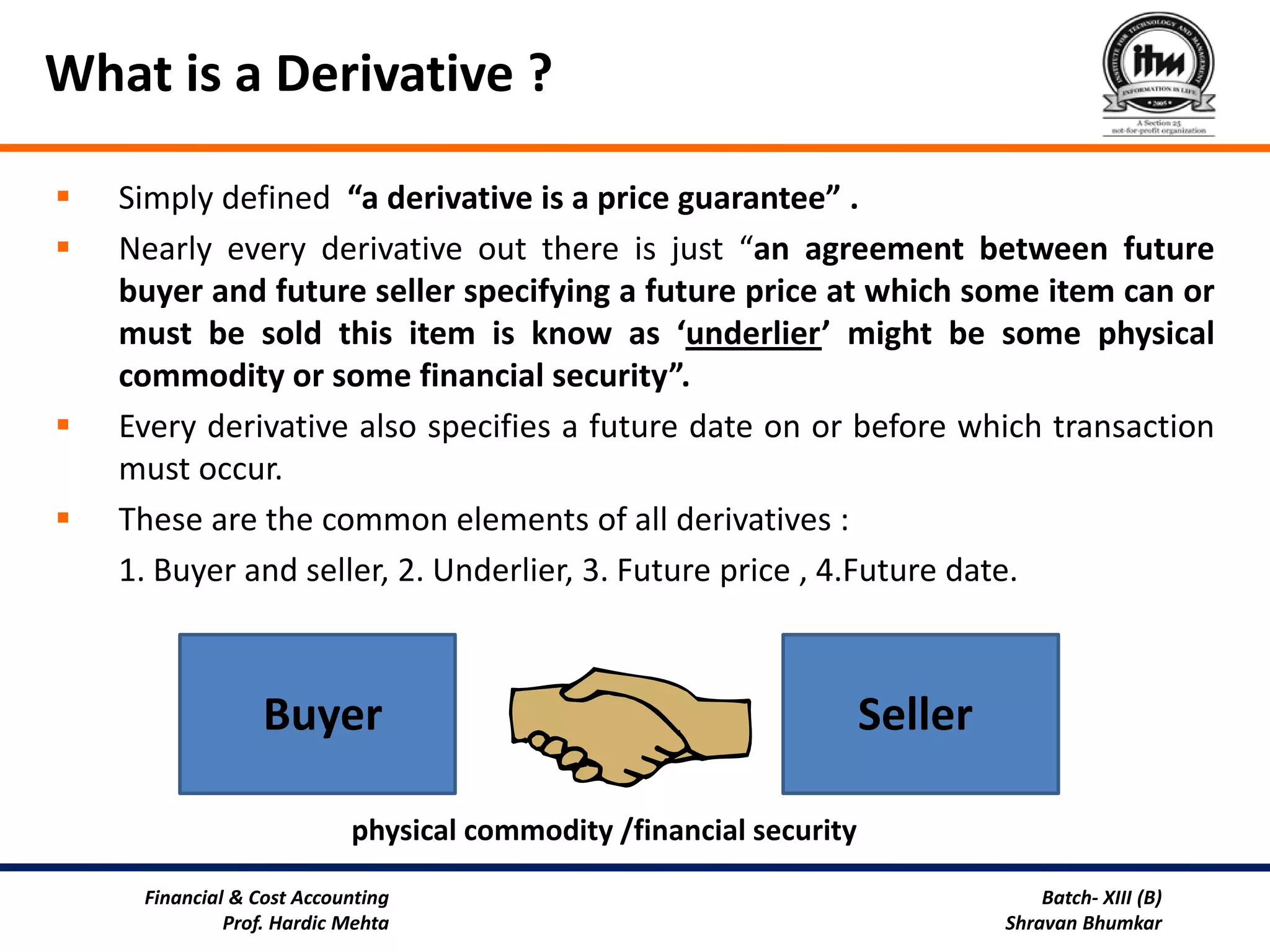
   Simply defined “a derivative is a price guarantee” .
   Nearly every derivative out there is just “an agreement between future
    buyer and future seller specifying a future price at which some item can or
    must be sold this item is know as ‘underlier’ might be some physical
    commodity or some financial security”.
   Every derivative also specifies a future date on or before which transaction
    must occur.
   These are the common elements of all derivatives :
    1. Buyer and seller, 2. Underlier, 3. Future price , 4.Future date.


                  Buyer                                             Seller

                           physical commodity /financial security

     Financial & Cost Accounting                                                 Batch- XIII (B)
              Prof. Hardic Mehta                                             Shravan Bhumkar
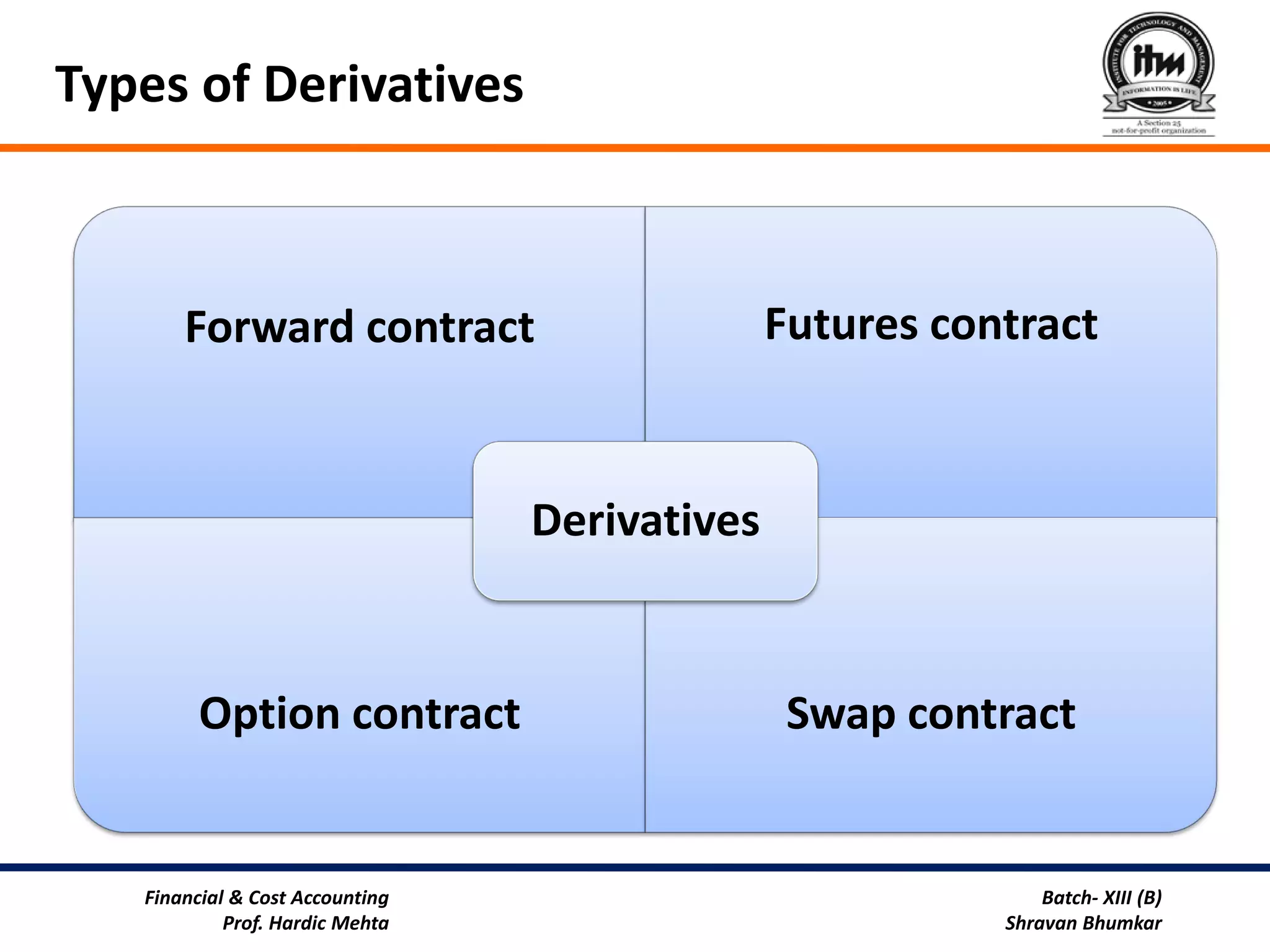
Types of Derivatives


       Forward contract                        Futures contract


                                 Derivatives


        Option contract                         Swap contract


   Financial & Cost Accounting                                Batch- XIII (B)
            Prof. Hardic Mehta                            Shravan Bhumkar
Forward contract

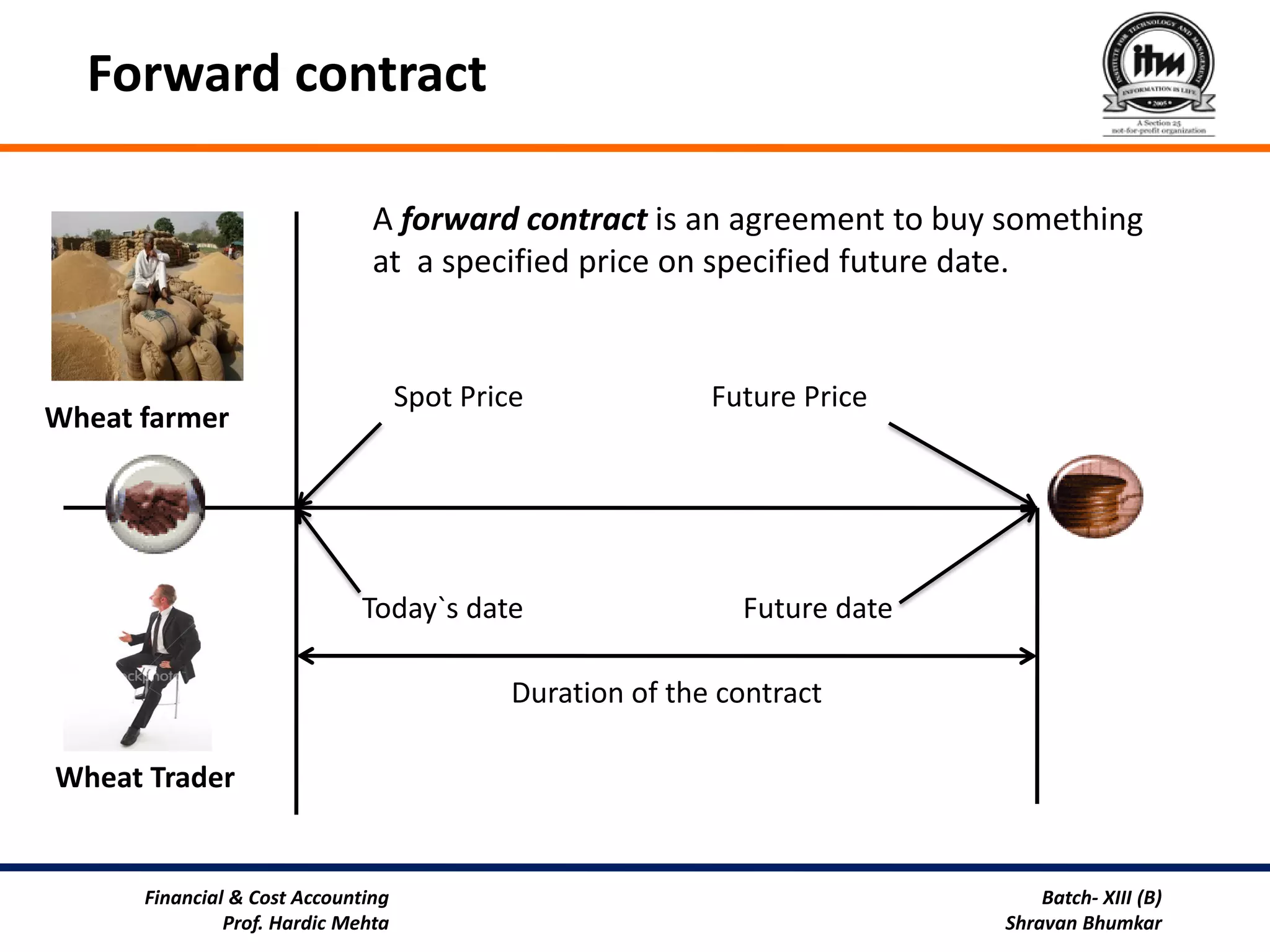
                               A forward contract is an agreement to buy something
                               at a specified price on specified future date.


                                    Spot Price              Future Price
Wheat farmer


                              Today`s date                    Future date

                                             Duration of the contract

Wheat Trader


      Financial & Cost Accounting                                               Batch- XIII (B)
               Prof. Hardic Mehta                                           Shravan Bhumkar
Forwards contract

    Over the counter (OTC) product

    Customized contract terms

    Less liquid

    No margin payment

    Exposed to counter party risk

    Settlement happens at end of contract


     Financial & Cost Accounting                 Batch- XIII (B)
              Prof. Hardic Mehta             Shravan Bhumkar
Futures contract

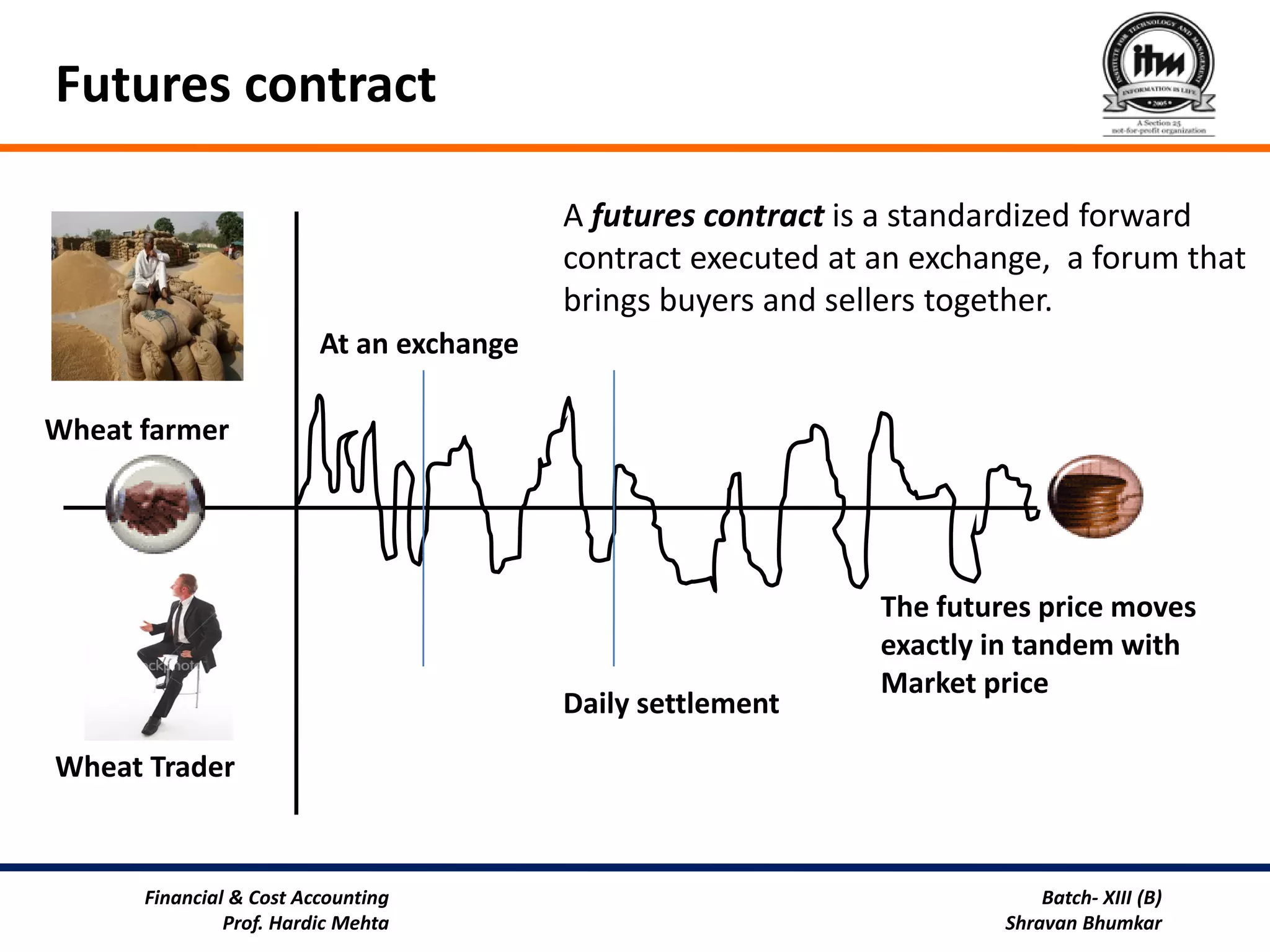
                                          A futures contract is a standardized forward
                                          contract executed at an exchange, a forum that
                                          brings buyers and sellers together.
                         At an exchange

Wheat farmer


                                                               The futures price moves
                                                               exactly in tandem with
                                                               Market price
                                          Daily settlement

Wheat Trader


      Financial & Cost Accounting                                           Batch- XIII (B)
               Prof. Hardic Mehta                                       Shravan Bhumkar
Futures contract

      Trade on an organized exchange

     Standardized contract term

     Daily Settlement, hence more liquid

     Requires margin, counter party risk is minimum

     The interests of buyer and seller are safe guarded to a great extent


     Financial & Cost Accounting                                      Batch- XIII (B)
              Prof. Hardic Mehta                                  Shravan Bhumkar
Common Terminologies

Spot price : The price at which an asset trades in the spot market.

Future price : The price at which the futures contract trades in the futures
market.

Contract cycle: The period over which contract trades.

Expiry date: It is the date specified in the futures contract. This is last day on
which the contract will be traded, at the end of which it will cease to exist.

Contract size: The amount of asset that has to be delivered under one
contract.


     Financial & Cost Accounting                                          Batch- XIII (B)
              Prof. Hardic Mehta                                      Shravan Bhumkar
Common Terminologies

Basis : In the context of financial futures, basis can be defined as futures price
minus the spot price.

Cost of carry : This is the cost of maintaining or “carrying” a forward position
over time.

Initial margin : That the amount must be deposited in the margin account at
the time a futures contract is first entered into is initial margin.

Mark-to-market : In the futures market, at the end of each trading day, the
margin account is adjusted to reflect the investor`s gain or loss depending
upon the futures closing price. This is called mark to market.


     Financial & Cost Accounting                                         Batch- XIII (B)
              Prof. Hardic Mehta                                     Shravan Bhumkar
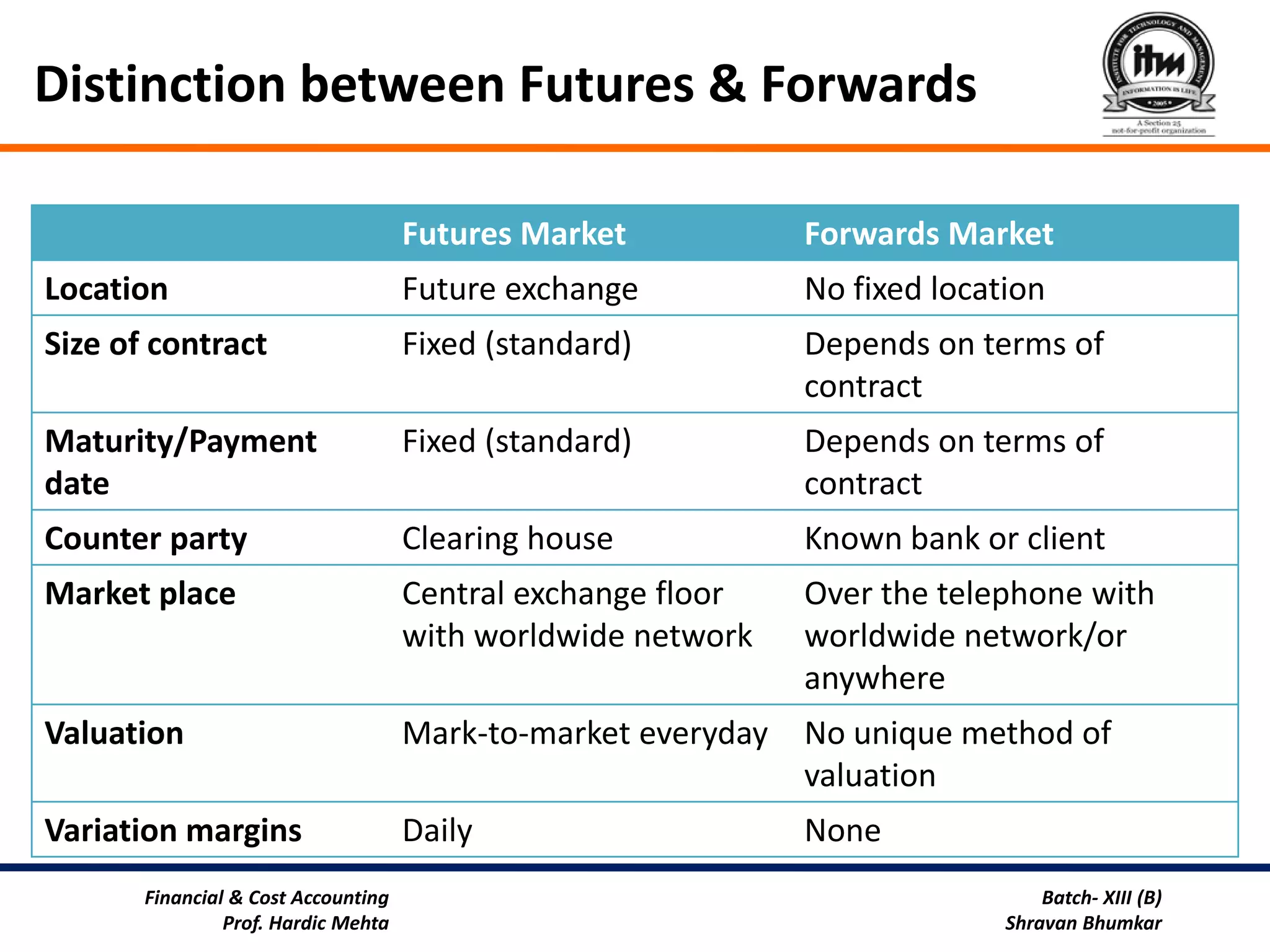
Distinction between Futures & Forwards

                                     Futures Market            Forwards Market
Location                             Future exchange           No fixed location
Size of contract                     Fixed (standard)          Depends on terms of
                                                               contract
Maturity/Payment                     Fixed (standard)          Depends on terms of
date                                                           contract
Counter party                        Clearing house            Known bank or client
Market place                         Central exchange floor    Over the telephone with
                                     with worldwide network    worldwide network/or
                                                               anywhere
Valuation                            Mark-to-market everyday   No unique method of
                                                               valuation
Variation margins                    Daily                     None
       Financial & Cost Accounting                                               Batch- XIII (B)
                Prof. Hardic Mehta                                           Shravan Bhumkar
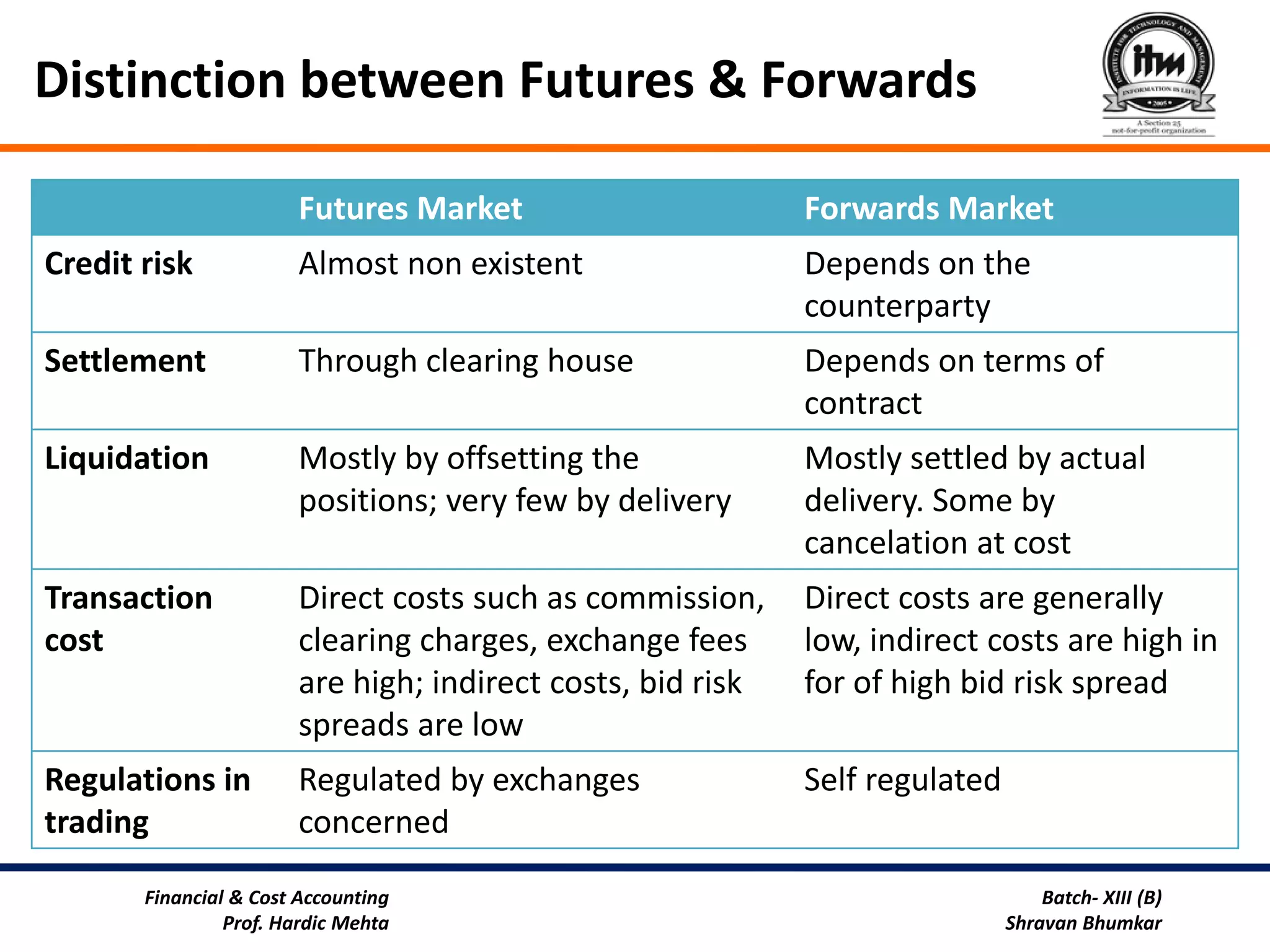
Distinction between Futures & Forwards

                       Futures Market                       Forwards Market
Credit risk            Almost non existent                  Depends on the
                                                            counterparty
Settlement             Through clearing house               Depends on terms of
                                                            contract
Liquidation            Mostly by offsetting the             Mostly settled by actual
                       positions; very few by delivery      delivery. Some by
                                                            cancelation at cost
Transaction            Direct costs such as commission,     Direct costs are generally
cost                   clearing charges, exchange fees      low, indirect costs are high in
                       are high; indirect costs, bid risk   for of high bid risk spread
                       spreads are low
Regulations in         Regulated by exchanges               Self regulated
trading                concerned

       Financial & Cost Accounting                                               Batch- XIII (B)
                Prof. Hardic Mehta                                           Shravan Bhumkar
Commodities

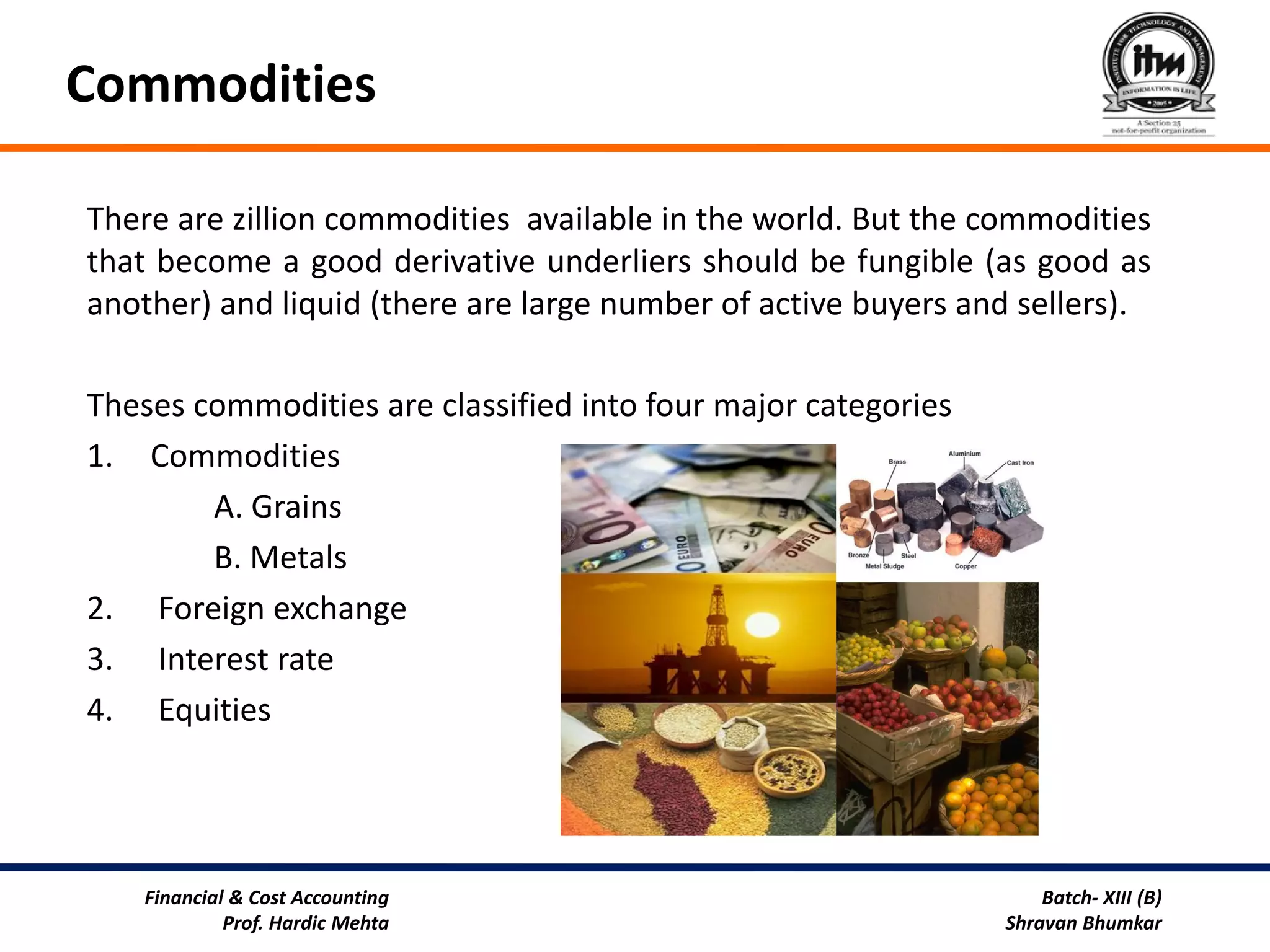
There are zillion commodities available in the world. But the commodities
that become a good derivative underliers should be fungible (as good as
another) and liquid (there are large number of active buyers and sellers).

Theses commodities are classified into four major categories
1. Commodities
        A. Grains
        B. Metals
2. Foreign exchange
3. Interest rate
4. Equities


    Financial & Cost Accounting                                    Batch- XIII (B)
             Prof. Hardic Mehta                                Shravan Bhumkar
How derivatives are used ?

Hedgers use derivatives to manage uncertainty.
(Individuals, Partnership firms, Companies)


Speculators use derivatives to wager on it.
(Individuals, Partnership firms, Companies)


    Financial & Cost Accounting                      Batch- XIII (B)
             Prof. Hardic Mehta                  Shravan Bhumkar
How derivatives are used ?

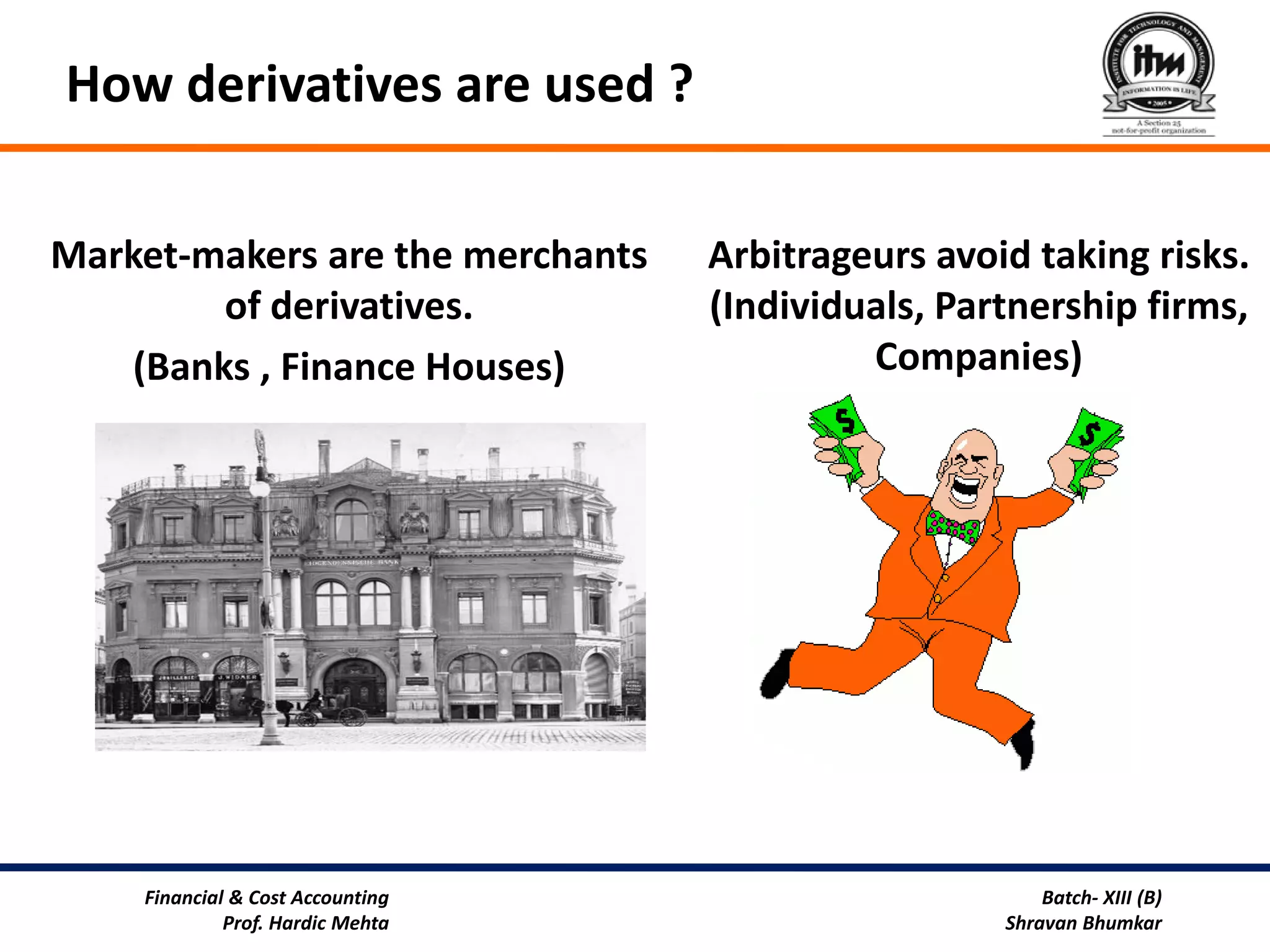
Market-makers are the merchants   Arbitrageurs avoid taking risks.
         of derivatives.          (Individuals, Partnership firms,
    (Banks , Finance Houses)               Companies)


    Financial & Cost Accounting                        Batch- XIII (B)
             Prof. Hardic Mehta                    Shravan Bhumkar
Conclusion


                                 Let the market be
                                 “bullish” or “bearish” if
                                 you know derivatives
                                 you will flourish.


   Financial & Cost Accounting                                   Batch- XIII (B)
            Prof. Hardic Mehta                               Shravan Bhumkar
Thank you.


Financial & Cost Accounting                    Batch- XIII (B)
         Prof. Hardic Mehta                Shravan Bhumkar

Futures & Forwards Contract Derivtives In A Nutshell

  • 1.
    Futures and Forwardscontract Derivatives in a Nutshell By Shravan Bhumkar (KH08JUNMBA100) Financial & Cost Accounting Batch- XIII (B) Prof. Hardic Mehta Shravan Bhumkar
  • 2.
    What is aDerivative ?  Simply defined “a derivative is a price guarantee” .  Nearly every derivative out there is just “an agreement between future buyer and future seller specifying a future price at which some item can or must be sold this item is know as ‘underlier’ might be some physical commodity or some financial security”.  Every derivative also specifies a future date on or before which transaction must occur.  These are the common elements of all derivatives : 1. Buyer and seller, 2. Underlier, 3. Future price , 4.Future date. Buyer Seller physical commodity /financial security Financial & Cost Accounting Batch- XIII (B) Prof. Hardic Mehta Shravan Bhumkar
  • 3.
    Types of Derivatives Forward contract Futures contract Derivatives Option contract Swap contract Financial & Cost Accounting Batch- XIII (B) Prof. Hardic Mehta Shravan Bhumkar
  • 4.
    Forward contract A forward contract is an agreement to buy something at a specified price on specified future date. Spot Price Future Price Wheat farmer Today`s date Future date Duration of the contract Wheat Trader Financial & Cost Accounting Batch- XIII (B) Prof. Hardic Mehta Shravan Bhumkar
  • 5.
    Forwards contract  Over the counter (OTC) product  Customized contract terms  Less liquid  No margin payment  Exposed to counter party risk  Settlement happens at end of contract Financial & Cost Accounting Batch- XIII (B) Prof. Hardic Mehta Shravan Bhumkar
  • 6.
    Futures contract A futures contract is a standardized forward contract executed at an exchange, a forum that brings buyers and sellers together. At an exchange Wheat farmer The futures price moves exactly in tandem with Market price Daily settlement Wheat Trader Financial & Cost Accounting Batch- XIII (B) Prof. Hardic Mehta Shravan Bhumkar
  • 7.
    Futures contract  Trade on an organized exchange  Standardized contract term  Daily Settlement, hence more liquid  Requires margin, counter party risk is minimum  The interests of buyer and seller are safe guarded to a great extent Financial & Cost Accounting Batch- XIII (B) Prof. Hardic Mehta Shravan Bhumkar
  • 8.
    Common Terminologies Spot price: The price at which an asset trades in the spot market. Future price : The price at which the futures contract trades in the futures market. Contract cycle: The period over which contract trades. Expiry date: It is the date specified in the futures contract. This is last day on which the contract will be traded, at the end of which it will cease to exist. Contract size: The amount of asset that has to be delivered under one contract. Financial & Cost Accounting Batch- XIII (B) Prof. Hardic Mehta Shravan Bhumkar
  • 9.
    Common Terminologies Basis :In the context of financial futures, basis can be defined as futures price minus the spot price. Cost of carry : This is the cost of maintaining or “carrying” a forward position over time. Initial margin : That the amount must be deposited in the margin account at the time a futures contract is first entered into is initial margin. Mark-to-market : In the futures market, at the end of each trading day, the margin account is adjusted to reflect the investor`s gain or loss depending upon the futures closing price. This is called mark to market. Financial & Cost Accounting Batch- XIII (B) Prof. Hardic Mehta Shravan Bhumkar
  • 10.
    Distinction between Futures& Forwards Futures Market Forwards Market Location Future exchange No fixed location Size of contract Fixed (standard) Depends on terms of contract Maturity/Payment Fixed (standard) Depends on terms of date contract Counter party Clearing house Known bank or client Market place Central exchange floor Over the telephone with with worldwide network worldwide network/or anywhere Valuation Mark-to-market everyday No unique method of valuation Variation margins Daily None Financial & Cost Accounting Batch- XIII (B) Prof. Hardic Mehta Shravan Bhumkar
  • 11.
    Distinction between Futures& Forwards Futures Market Forwards Market Credit risk Almost non existent Depends on the counterparty Settlement Through clearing house Depends on terms of contract Liquidation Mostly by offsetting the Mostly settled by actual positions; very few by delivery delivery. Some by cancelation at cost Transaction Direct costs such as commission, Direct costs are generally cost clearing charges, exchange fees low, indirect costs are high in are high; indirect costs, bid risk for of high bid risk spread spreads are low Regulations in Regulated by exchanges Self regulated trading concerned Financial & Cost Accounting Batch- XIII (B) Prof. Hardic Mehta Shravan Bhumkar
  • 12.
    Commodities There are zillioncommodities available in the world. But the commodities that become a good derivative underliers should be fungible (as good as another) and liquid (there are large number of active buyers and sellers). Theses commodities are classified into four major categories 1. Commodities A. Grains B. Metals 2. Foreign exchange 3. Interest rate 4. Equities Financial & Cost Accounting Batch- XIII (B) Prof. Hardic Mehta Shravan Bhumkar
  • 13.
    How derivatives areused ? Hedgers use derivatives to manage uncertainty. (Individuals, Partnership firms, Companies) Speculators use derivatives to wager on it. (Individuals, Partnership firms, Companies) Financial & Cost Accounting Batch- XIII (B) Prof. Hardic Mehta Shravan Bhumkar
  • 14.
    How derivatives areused ? Market-makers are the merchants Arbitrageurs avoid taking risks. of derivatives. (Individuals, Partnership firms, (Banks , Finance Houses) Companies) Financial & Cost Accounting Batch- XIII (B) Prof. Hardic Mehta Shravan Bhumkar
  • 15.
    Conclusion Let the market be “bullish” or “bearish” if you know derivatives you will flourish. Financial & Cost Accounting Batch- XIII (B) Prof. Hardic Mehta Shravan Bhumkar
  • 16.
    Thank you. Financial &Cost Accounting Batch- XIII (B) Prof. Hardic Mehta Shravan Bhumkar