Futures and Future Contracts &
Trading mechanism of derivatives on
stock exchanges
What Is A Futures Contract?
 A forward contract is an agreement
between two parties to exchange an asset
for cash at a predetermined future date for a
price that is specified today. A futures
contract is a standardized forward contract.
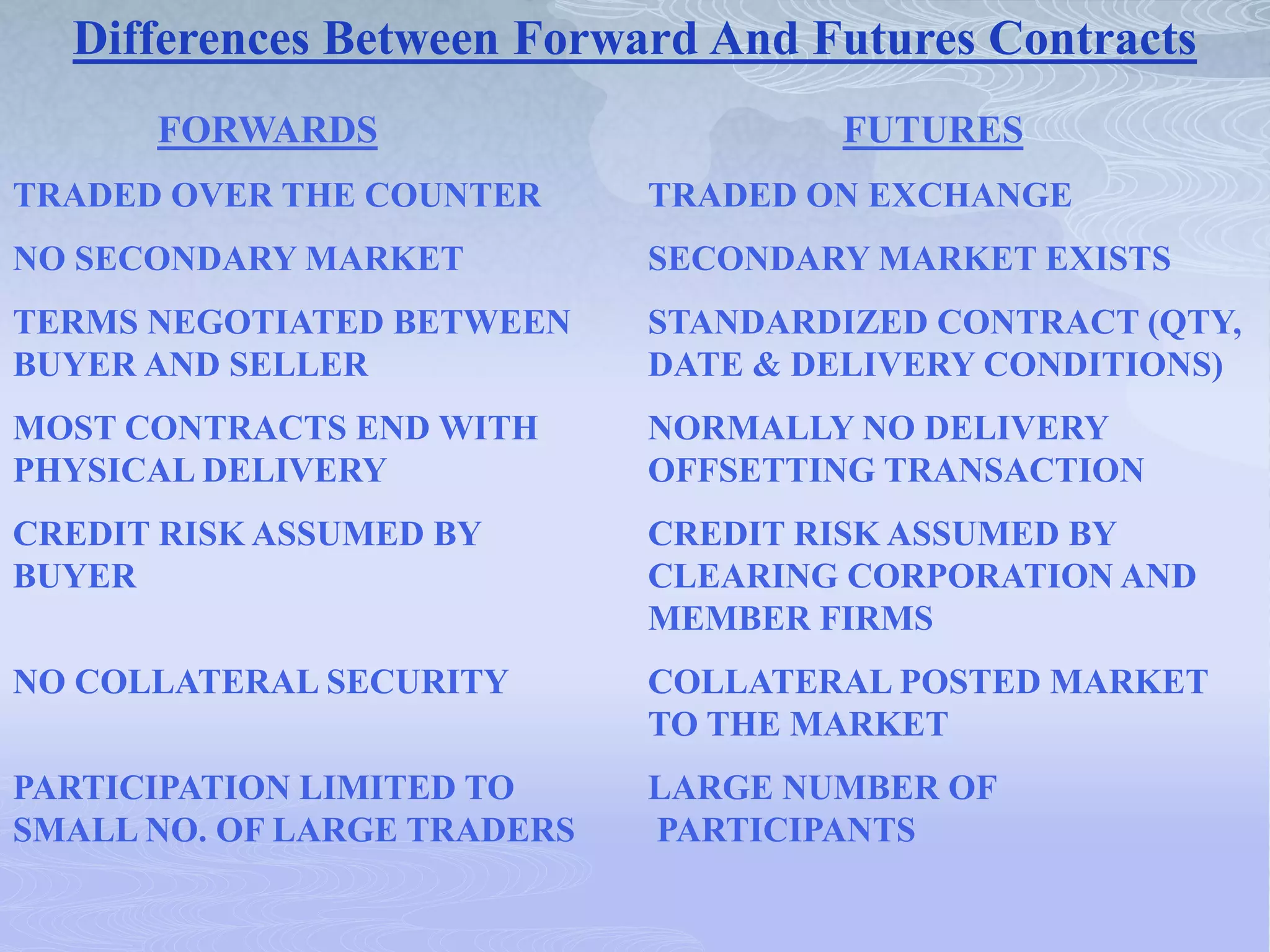
Differences Between Forward And Futures Contracts
FORWARDS FUTURES
TRADED OVER THE COUNTER TRADED ON EXCHANGE
NO SECONDARY MARKET SECONDARY MARKET EXISTS
TERMS NEGOTIATED BETWEEN STANDARDIZED CONTRACT (QTY,
BUYER AND SELLER DATE & DELIVERY CONDITIONS)
MOST CONTRACTS END WITH NORMALLY NO DELIVERY
PHYSICAL DELIVERY OFFSETTING TRANSACTION
CREDIT RISK ASSUMED BY CREDIT RISK ASSUMED BY
BUYER CLEARING CORPORATION AND
MEMBER FIRMS
NO COLLATERAL SECURITY COLLATERAL POSTED MARKET
TO THE MARKET
PARTICIPATION LIMITED TO LARGE NUMBER OF
SMALL NO. OF LARGE TRADERS PARTICIPANTS
Futures Terminology
Spot price:
The price at which an underlying asset trades
in the spot market.
Futures price: The price that is agreed upon
at the time of the contract for the delivery of
an asset at a specific future date.
Futures Terminology
Contract cycle:
It is the period over which a contract trades. The
index futures contracts on the NSE have one-month,
two-month and three-month expiry cycles which
expire on the last Thursday of the month.
Thus a January expiration contract expires on the last
Thursday of January and a February expiration
contract ceases trading on the last Thursday of
February. On the Friday following the last Thursday,
a new contract having a three-month expiry is
introduced for trading.
Futures Terminology
Expiry date:
The date on which the final settlement of
the contract takes place.
Contract size:
The amount of asset that has to be delivered
under one contract. This is also called as the
lot size.
Futures Terminology
Basis:
Basis is defined as the futures price minus
the spot price. There will be a different basis
for each delivery month for each contract. In
a normal market, basis will be positive. This
reflects that futures prices normally exceed
spot prices.
Futures Terminology
Cost of carry:
Measures the storage cost plus the interest
that is paid to finance the asset less the
income earned on the asset.
Initial margin:
The amount that must be deposited in the
margin account at the time a futures
contract is first entered into is known as
initial margin.
Futures Terminology
Marking-to-market:
In the futures market, at the end of each
trading day, the margin account is adjusted
to reflect the investor’s gain or loss
depending upon the futures closing price.
This is called marking-to-market.
Futures Terminology
Maintenance margin:
Investors are required to place margins
with their trading members before they are
allowed to trade. If the balance in the
margin account falls below the maintenance
margin, the investor receives a margin call
and is expected to top up the margin
account to the initial margin level before
trading commences on the next day.
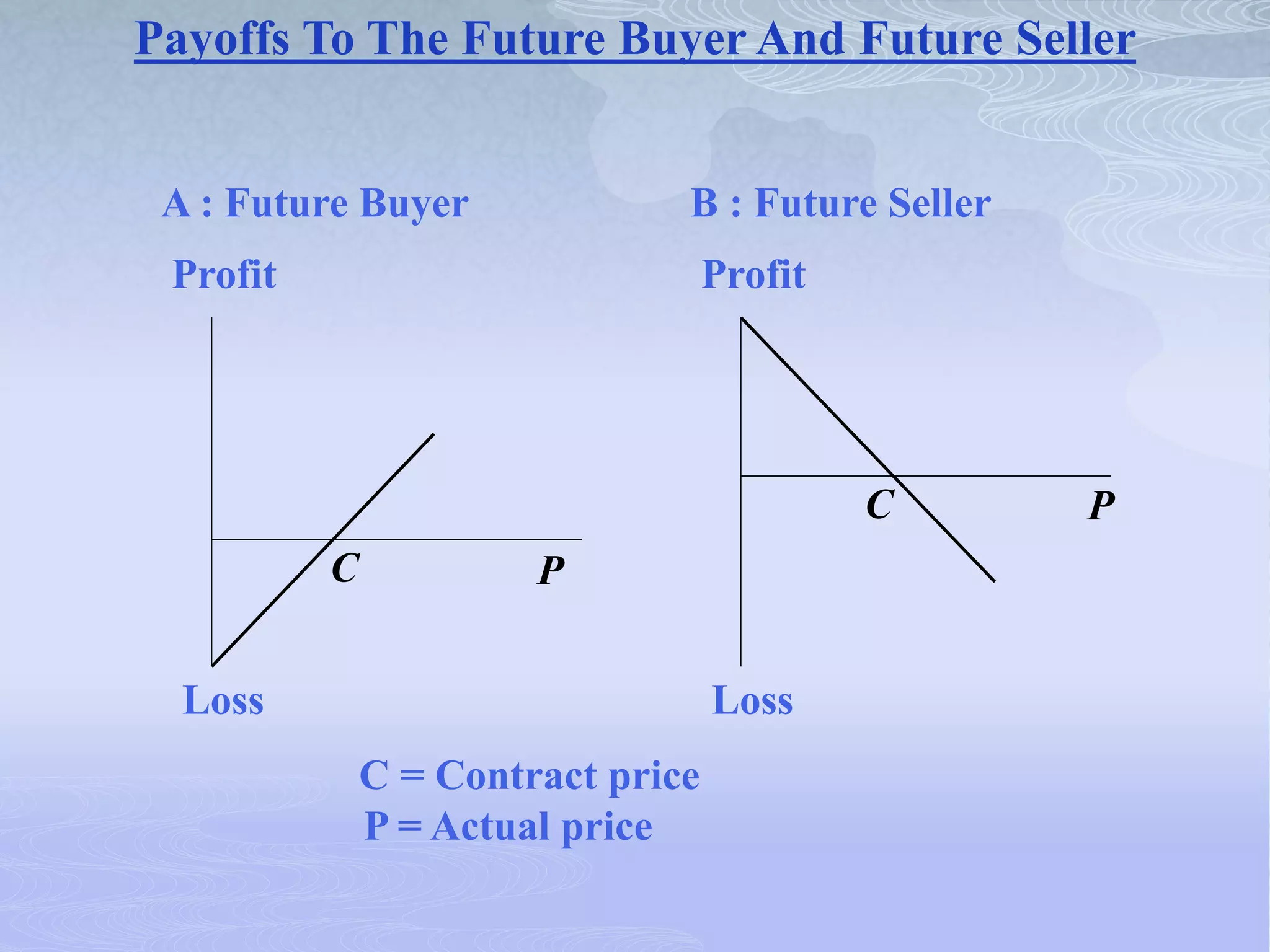
Futures Payoffs
Futures contracts have linear or symmetrical
payoffs. It implies that the losses as well as
profits for the buyer and the seller of a
futures contract are unlimited. These linear
payoffs are fascinating as they can be
combined with options and the underlying
to generate various complex payoffs.
Payoff for buyer of futures: Long
futures
The payoff for a person who buys a futures contract
is similar to the payoff for a person who holds an
asset. He has a potentially unlimited upside as well
as a potentially unlimited downside.
Take the case of a speculator who buys a two-month
Nifty index futures contract when the Nifty stands at
2220. The underlying asset in this case is the Nifty
portfolio. When the index moves up, the long futures
position starts making profits, and when the index
moves down it starts making losses.
Payoff for seller of futures: Short
futures
The payoff for a person who sells a futures contract is
similar to the payoff for a person who shorts an
asset. He has a potentially unlimited upside as well
as a potentially unlimited downside.
Take the case of a speculator who sells a two-month
Nifty index futures contract when the Nifty stands at
2220. The underlying asset in this case is the Nifty
portfolio. When the index moves down, the short
futures position starts making profits, and when the
index moves up, it starts making losses.
Payoffs To The Future Buyer And Future Seller
A : Future Buyer B : Future Seller
Profit Profit
Loss Loss
C
C
P
P
C = Contract price
P = Actual price
Futures and Options Trading
System - NSE
The futures & options trading system of NSE,
called NEAT-F&O trading system, provides a
fully automated screen-based trading for Index
futures & options and Stock futures & options
on a nationwide basis as well as an online
monitoring and surveillance mechanism.
It supports an order driven market and provides
complete transparency of trading operations.
Entities in the trading system
1.Trading members:
Trading members are members of NSE. They can trade
either on their own account or on behalf of their clients
including participants. The exchange assigns a trading
member ID to each trading member.
Each trading member can have more than one user. The
number of users allowed for each trading member is
notified by the exchange from time to time. Each user of a
trading member must be registered with the exchange
and is assigned an unique user ID.
Entities in the trading system
2.Clearing members:
Clearing members are members of NSCCL.
They carry out risk management activities and
confirmation/inquiry of trades through the
trading system.
3.Professional clearing members:
A professional clearing member is a clearing
member who is not a trading member.
Typically, banks and custodians become
professional clearing members and clear and
settle for their trading members.
Entities in the trading system
4.Participants:
A participant is a client of trading members
like financial institutions. These clients may
trade through multiple trading members but
settle through a single clearing member.
Basis of trading
The NEAT F&O system supports an order driven market,
wherein orders match automatically. Order matching is
essentially on the basis of security, its price, time and
quantity.
All quantity fields are in units and price in rupees. The
exchange notifies the regular lot size and tick size for each of
the contracts traded on this segment from time to time.
When any order enters the trading system, it is an active order.
It tries to find a match on the other side of the book. If it
finds a match, a trade is generated. If it does not find a
match, the order becomes passive and goes and sits in the
respective outstanding order book in the system.
Client Broker Relationship in
Derivative Segment
A trading member must ensure compliance particularly with relation to the following while
dealing with clients:
• Filling of ‘Know Your Client’ form
• Execution of Client Broker agreement
• Bring risk factors to the knowledge of client by getting acknowledgement of client on risk
disclosure document
• Timely execution of orders as per the instruction of clients in respective client codes.
• Collection of adequate margins from the client
• Maintaining separate client bank account for the segregation of client money.
• Timely issue of contract notes as per the prescribed format to the client
• Ensuring timely pay-in and pay-out of funds to and from the clients
• Resolving complaint of clients if any at the earliest.
• Avoiding receipt and payment of cash and deal only through account payee cheques
• Sending the periodical statement of accounts to clients
• Not charging excess brokerage
• Maintaining unique client code as per the regulations.
Order types and conditions
The system allows the trading members to
enter orders with various conditions
attached to them as per their requirements.
These conditions are broadly divided into
the following categories:
• Time conditions
• Price conditions
• Other conditions
Time conditions
Day order:
A day order, as the name suggests is an order which
is valid for the day on which it is entered. If the
order is not executed during the day, the system
cancels the order automatically at the end of the day.
Immediate or Cancel (IOC):
An IOC order allows the user to buy or sell a
contract as soon as the order is released into the
system, failing which the order is cancelled from the
system. Partial match is possible for the order, and
the unmatched portion of the order is cancelled
immediately.
Price condition
Stop-loss:
This facility allows the user to release an order into the
system, after the market price of the security reaches or
crosses a threshold price e.g. if for stop-loss buy order,
the trigger is 1027.00, the limit price is 1030.00 and the
market (last traded) price is 1023.00, then this order is
released into the system once the market price reaches
or exceeds 1027.00.
This order is added to the regular lot book with time of
triggering as the time stamp, as a limit order of 1030.00.
For the stop-loss sell order, the trigger price has to be
greater than the limit price.
Other conditions
Market price:
Market orders are orders for which no price is specified at the time the order is entered
(i.e. price is market price). For such orders, the system determines the price.
Trigger price:
Price at which an order gets triggered from the stop-loss book.
Limit price:
Price of the orders after triggering from stop-loss book.
Pro:
Pro means that the orders are entered on the trading member’s own account.
Cli:
Cli means that the trading member enters the orders on behalf of a client.
Futures and Options Market
Instruments
The F&O segment of NSE provides trading
facilities for the following derivative
instruments:
1. Index based futures
2. Index based options
3. Individual stock options
4. Individual stock futures
Contract specifications for index
futures
On NSE’s platform one can trade in Nifty, CNX IT, BANK
Nifty, Mini Nifty etc. futures contracts having one-month,
two-month and three-month expiry cycles. All contracts
expire on the last Thursday of every month.
Thus, a January expiration contract would expire on the
last Thursday of January and a February expiry contract
would cease trading on the last Thursday of February.
On the Friday following the last Thursday, a new contract
having a three-month expiry would be introduced for
trading. Thus, at any point in time, three contracts would
be available for trading with the first contract expiring
on the last Thursday of that month.
Contract specifications for index
futures
The Instrument type refers to “Futures
contract on index” and Contract symbol -
NIFTY denotes a “Futures contract on Nifty
index” and the Expiry date represents the last
date on which the contract will be available for
trading.
Each futures contract has a separate limit order
book. All passive orders are stacked in the
system in terms of price-time priority and
trades take place at the passive order price
Example:
If trading is for a minimum lot size of 50 units
and the index level is around 5000, then the
appropriate value of a single index futures
contract would be Rs.250,000.
The minimum tick size for an index future
contract is 0.05 units. Thus a single move in the
index value would imply a resultant gain or
loss of Rs.2.50 (i.e. 0.05*50 units) on an open
position of 50 units.
Contract specification for index
options
On NSE’s index options market, there are one-month, two-month
and three-month expiry contracts with minimum nine different
strikes available for trading.
Hence, if there are three serial month contracts available and the
scheme of strikes is 6-1-6, then there are minimum 3 x 13 x 2
(call and put options) i.e. 78 options contracts available on an
index.
Option contracts are specified as follows: DATE-EXPIRYMONTH-
YEAR-CALL/PUT-AMERICAN/ EUROPEAN- STRIKE. For example
the European style call option contract on the Nifty index with a
strike price of 5000 expiring on the 26th November 2009 is
specified as ’26NOV2009 5000 CE’.
Contract specification for index
options
Just as in the case of futures contracts, each
option product (for instance, the 26 NOV
2009 5000 CE) has it’s own order book and
it’s own prices.
All index options contracts are cash settled
and expire on the last Thursday of the
month. The minimum tick for an index
options contract is 0.05 paise.
Criteria for Stocks and Index
Eligibility for Trading
Eligibility criteria of stocks
1. The stock is chosen from amongst the top 500
stocks in terms of average daily market
capitalisation and average daily traded value in the
previous six months on a rolling basis.
2.The stock’s median quarter-sigma order size over
the last six months should be not less than Rs. 10
lakhs. For this purpose, a stock’s quarter-sigma
order size should mean the order size (in value
terms) required to cause a change in the stock price
equal to one-quarter of a standard deviation.
Eligibility criteria of stocks
3.The market wide position limit in the stock should
not be less than Rs.300 crores. The market wide
position limit (number of shares) is valued taking the
closing prices of stocks in the underlying cash market
on the date of expiry of contract in the month.
The market wide position limit of open position (in
terms of the number of underlying stock) on futures
and option contracts on a particular underlying stock
shall be 20% of the number of shares held by non-
promoters in the relevant underlying security i.e. free-
float holding.
Eligibility criteria of stocks
4. For an existing F&O stock, the continued
eligibility criteria is that market wide position
limit in the stock shall not be less than Rs. 200
crores and stock’s median quarter-sigma order
size over the last six months shall be not less
than Rs. 5 lakh.
5. Additionallly, the stock’s average monthly
turnover in derivatives segment over last 3
months shall not be less than Rs. 100 crores.
Eligibility criteria of stocks
6. If an existing security fails to meet the
eligibility criteria for three months
consecutively, then no fresh month contract
will be issued on that security.
However, the existing unexpired contracts can be
permitted to trade till expiry and new strikes
can also be introduced in the existing contract
months. Further, once the stock is excluded
from the F&O list, it shall not be considered for
re-inclusion for a period of one year.
Eligibility criteria of indices
The exchange may consider introducing derivative contracts
on an index if the stocks contributing to 80% weightage of
the index are individually eligible for derivative trading.
However, no single ineligible stocks in the index should have a
weightage of more than 5% in the index. The above criteria is
applied every month, if the index fails to meet the eligibility
criteria for three months consecutively, then no fresh month
contract would be issued on that index,
However, the existing unexpired contacts will be permitted to
trade till expiry and new strikes can also be introduced in the
existing contracts.
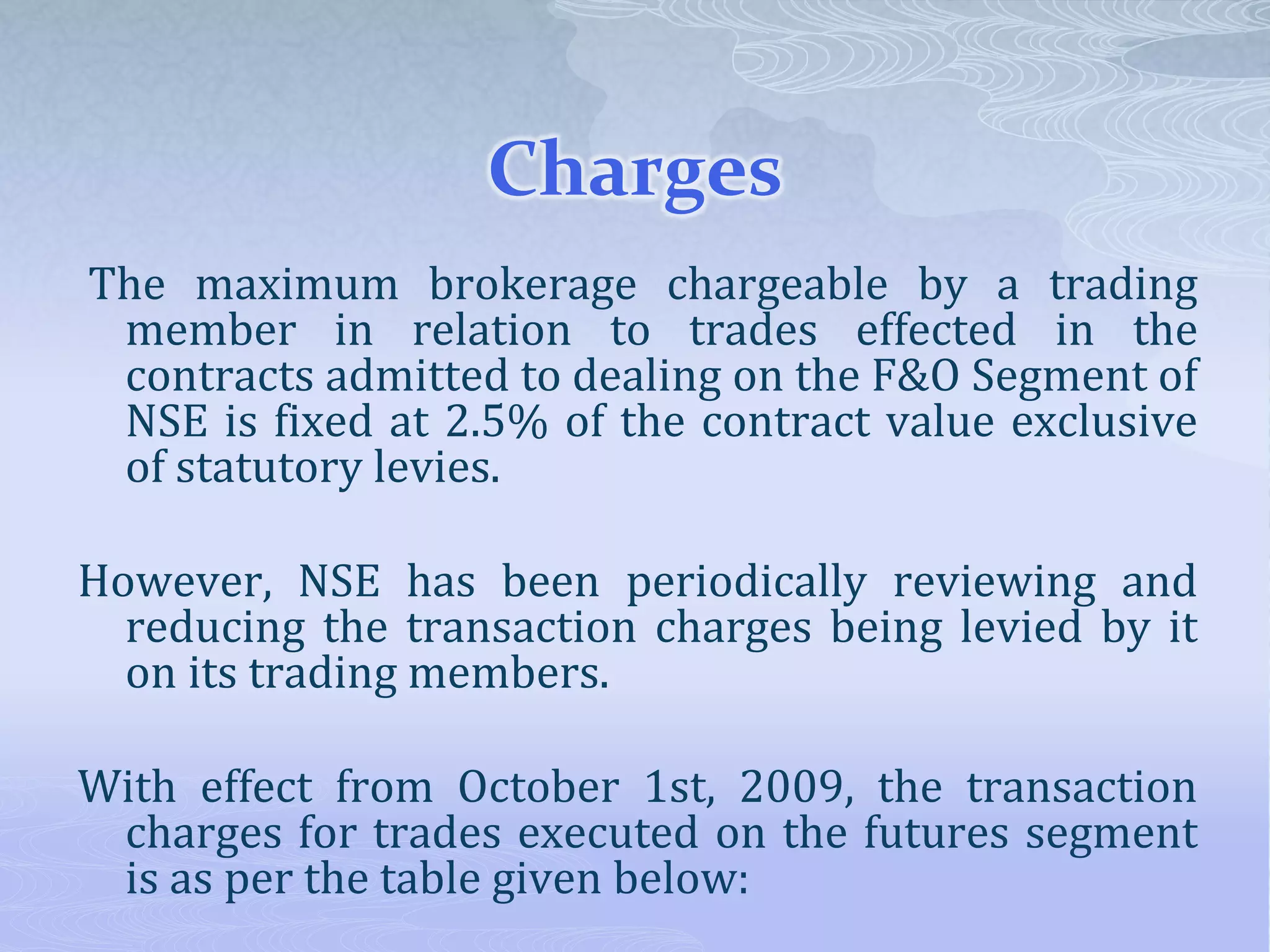
Charges
The maximum brokerage chargeable by a trading
member in relation to trades effected in the
contracts admitted to dealing on the F&O Segment of
NSE is fixed at 2.5% of the contract value exclusive
of statutory levies.
However, NSE has been periodically reviewing and
reducing the transaction charges being levied by it
on its trading members.
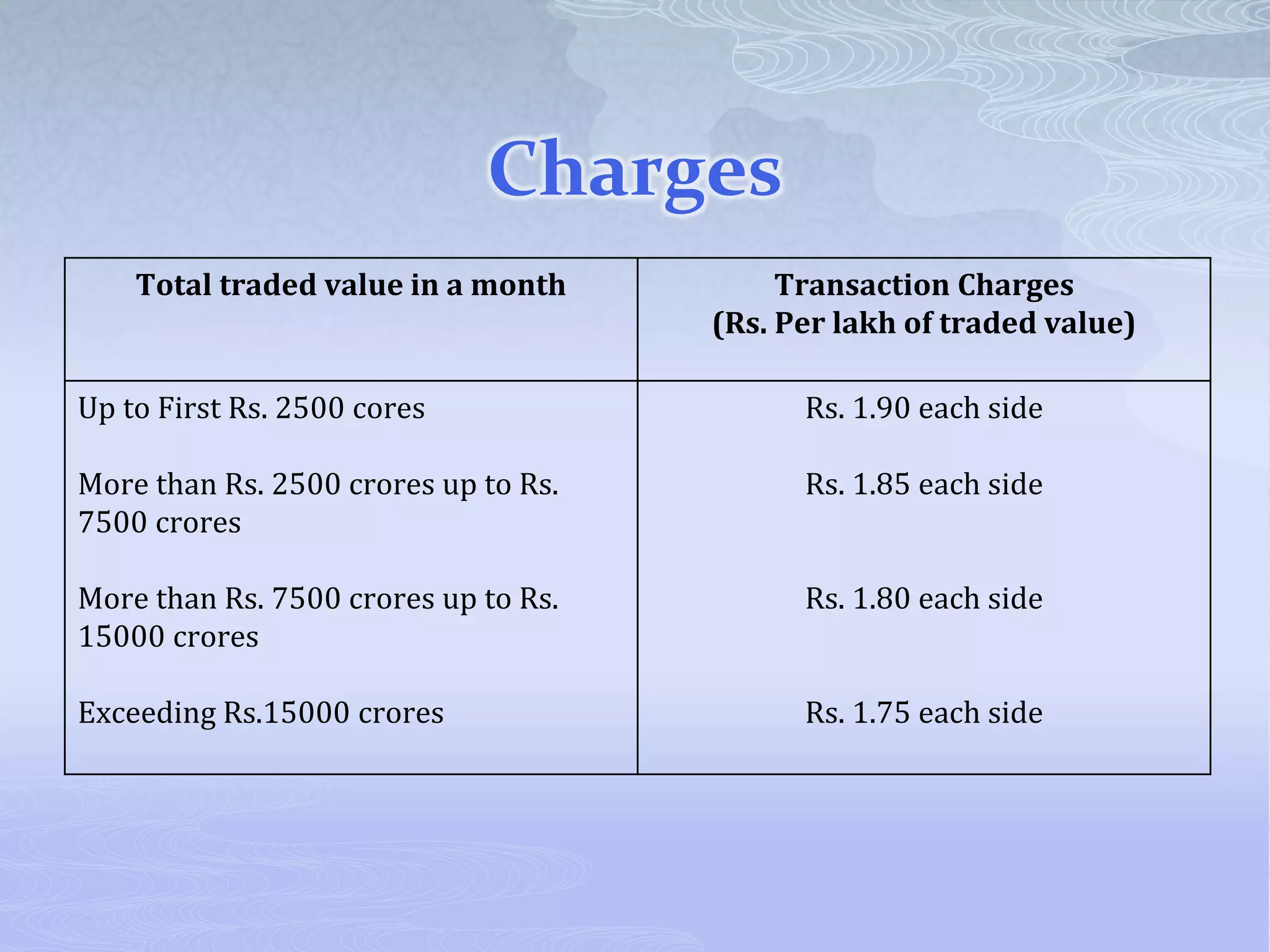
With effect from October 1st, 2009, the transaction
charges for trades executed on the futures segment
is as per the table given below:
Charges
Total traded value in a month Transaction Charges
(Rs. Per lakh of traded value)
Up to First Rs. 2500 cores
More than Rs. 2500 crores up to Rs.
7500 crores
More than Rs. 7500 crores up to Rs.
15000 crores
Exceeding Rs.15000 crores
Rs. 1.90 each side
Rs. 1.85 each side
Rs. 1.80 each side
Rs. 1.75 each side
Charges
For the transactions in the options sub-
segment the transaction charges are levied on
the premium value at the rate of 0.05% (each
side) instead of on the strike price as levied
earlier.
Further to this, trading members have been
advised to charge brokerage from their clients
on the Premium price (traded price) rather
than Strike price.
Mechanics Of Trading
Trading in futures is more complex than trading in stocks.
Inter alia it involves
• Intermediation by a clearing house
• Margins
• Marking - to - market
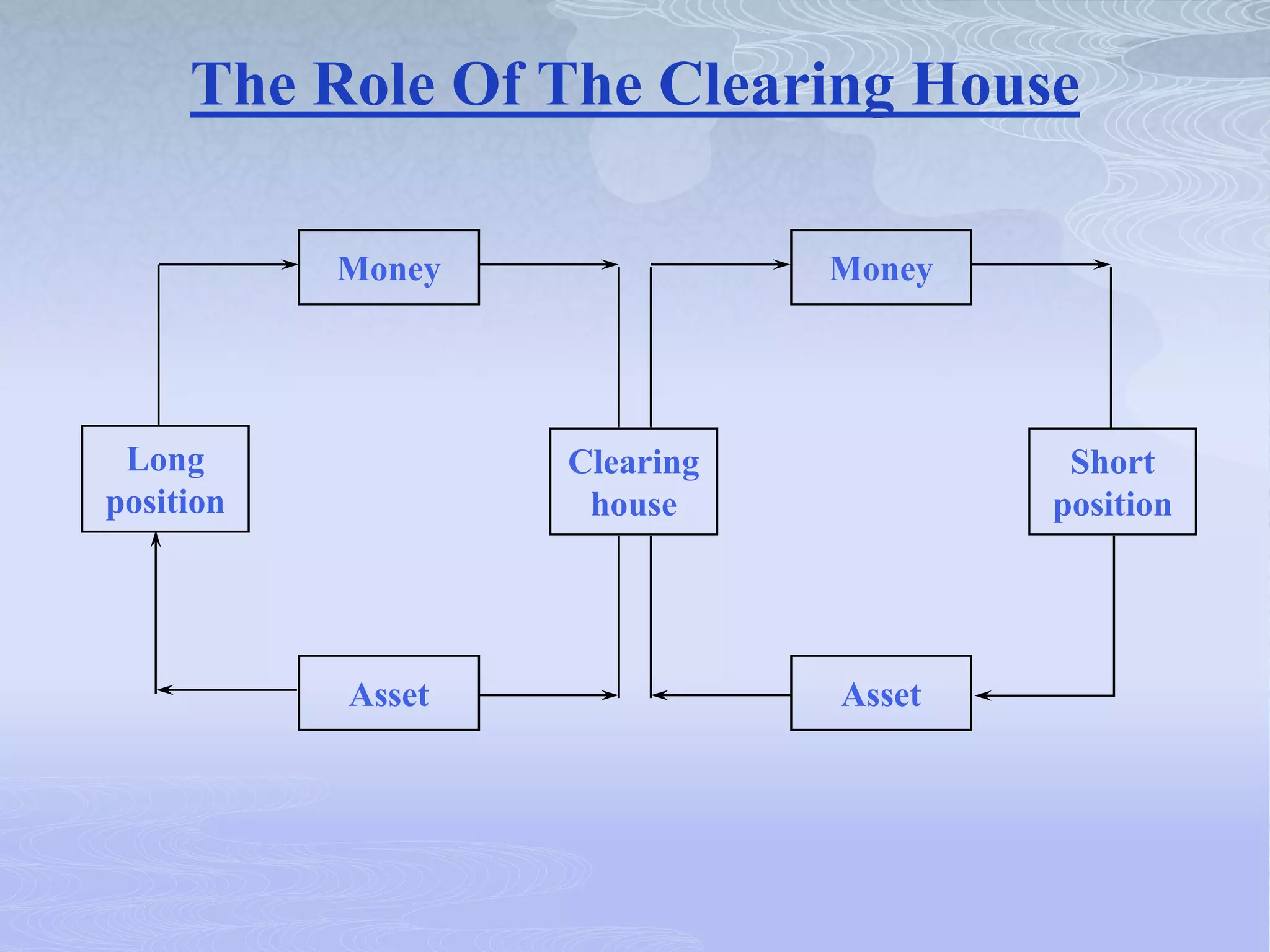
Long
position
Money
Clearing
house
Short
position
Asset
Money
Asset
The Role Of The Clearing House
Margins
• When you execute a futures trade, you have to provide the
initial margin.
• If you incur sustained losses from daily marking-to-
market, and your margin amount falls below a critical level
called the maintenance margin you have to replenish the
margin amount.
Margins By NSE
Initial Margin
NSCCL collects initial margin up-front for all the
open positions of a CM based on the margins
computed by NSCCL-SPAN®.
Premium Margin
In addition to Span Margin, Premium Margin is
charged to members. The premium margin is the
client wise premium amount payable by the buyer of
the option and is levied till the completion of pay-in
towards the premium settlement.
Margins By NSE
Assignment Margin
Assignment Margin is levied on a CM in addition to
SPAN margin and Premium Margin. It is levied on
assigned positions of CMs towards interim and final
exercise settlement obligations for option contracts
on index and individual securities till the pay-in
towards exercise settlement is complete.
Margins By NSE
Exposure Margin
The exposure margins for options and futures contracts on index
are as follows:
 For Index options and Index futures contracts:
3% of the notional value of a futures contract. In case of options
it is charged only on short positions and is 3% of the notional
value of open positions.
 For option contracts and Futures Contract on individual
Securities:
The higher of 5% or 1.5 standard deviation of the notional
value of gross open position in futures on individual securities
and gross short open positions in options on individual
securities in a particular underlying. The standard deviation of
daily logarithmic returns of prices in the underlying stock in
the cash market in the last six months is computed on a rolling
and monthly basis at the end of each month.
Benefits of trading in Futures
and Options
1) Able to transfer the risk to the person who is
willing to accept them
2) Incentive to make profits with minimal amount
of risk capital
3) Lower transaction costs
4) Provides liquidity, enables price discovery in
underlying market
5) Derivatives market are lead economic indicators.
The advantages of trading in
Index Futures
• The contracts are highly liquid
• Index Futures provide higher leverage than any other
stocks
• It requires low initial capital requirement
• It has lower risk than buying and holding stocks
• It is just as easy to trade the short side as the long side
• Only have to study one index instead of 100s of stocks
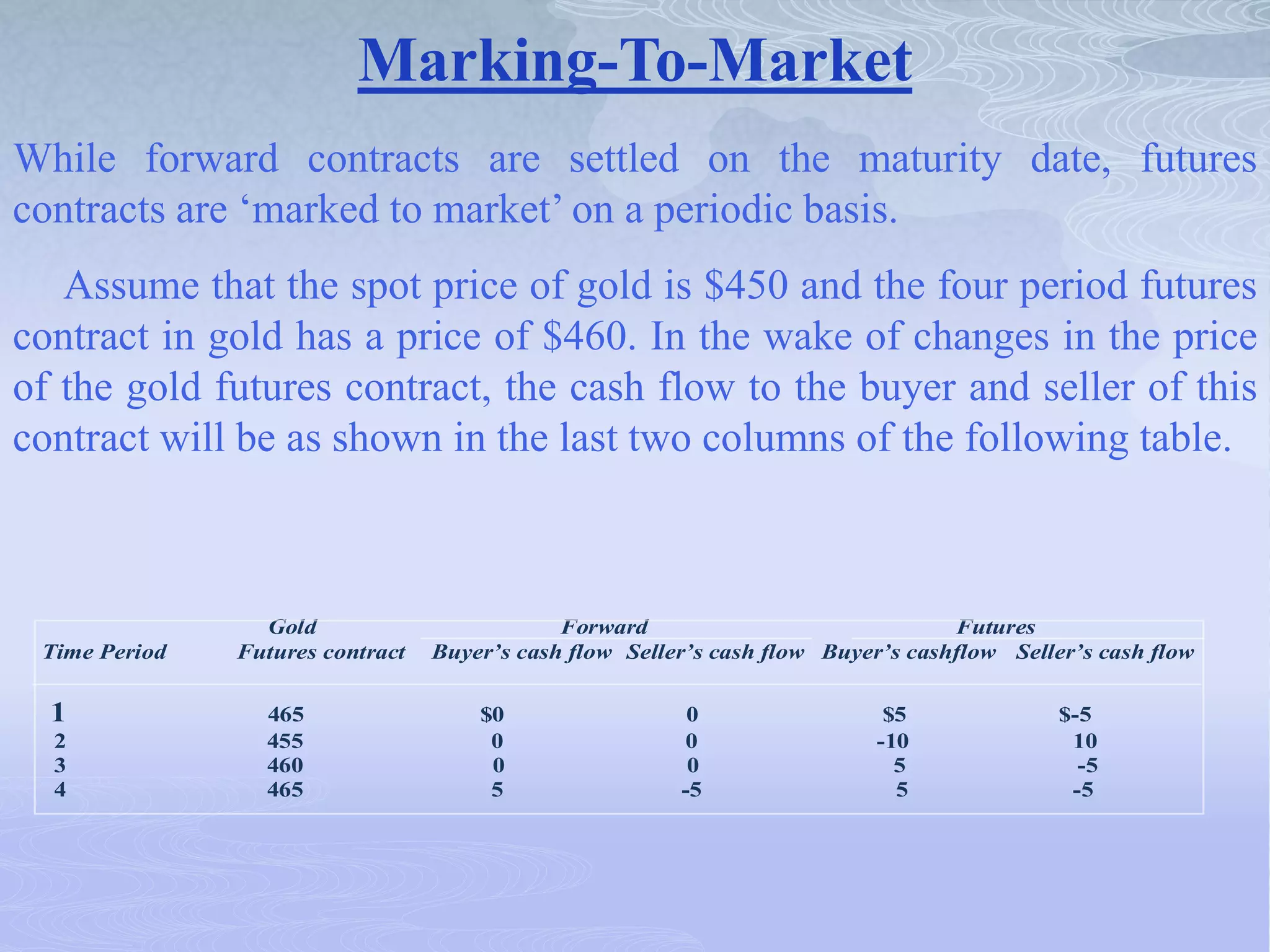
Marking-To-Market
While forward contracts are settled on the maturity date, futures
contracts are ‘marked to market’ on a periodic basis.
Assume that the spot price of gold is $450 and the four period futures
contract in gold has a price of $460. In the wake of changes in the price
of the gold futures contract, the cash flow to the buyer and seller of this
contract will be as shown in the last two columns of the following table.
Gold Forward Futures
Time Period Futures contract Buyer’s cash flow Seller’s cash flow Buyer’s cashflow Seller’s cash flow
1 465 $0 0 $5 $-5
2 455 0 0 -10 10
3 460 0 0 5 -5
4 465 5 -5 5 -5
How are the contracts settled?
All the Futures and Options contracts are settled
in cash on a daily basis and at the expiry or
exercise of the respective contracts as the case
may be.
Clients/Trading Members are not required to
hold any stock of the underlying for dealing in
the Futures / Options market.
Working of Future market
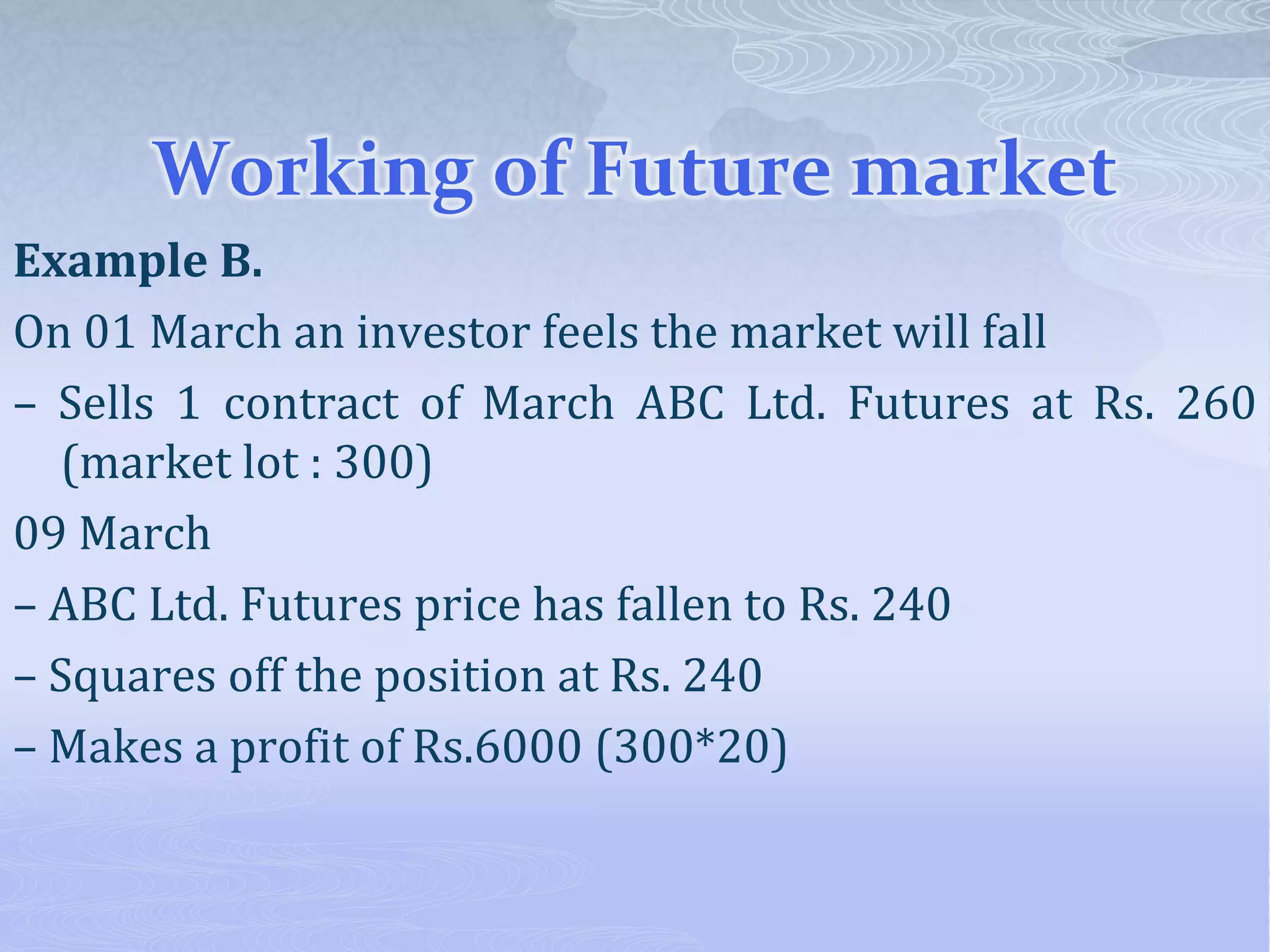
Example A.
On 01 March an investor feels the market will rise
– Buys 1 contract of March ABC Ltd. Futures at Rs. 260 (market lot :
300)
09 March
– ABC Ltd. Futures price has risen to Rs. 280
– Sells off the position at Rs. 280. Makes a profit of Rs.6000
(300*20)
Working of Future market
Example B.
On 01 March an investor feels the market will fall
– Sells 1 contract of March ABC Ltd. Futures at Rs. 260
(market lot : 300)
09 March
– ABC Ltd. Futures price has fallen to Rs. 240
– Squares off the position at Rs. 240
– Makes a profit of Rs.6000 (300*20)
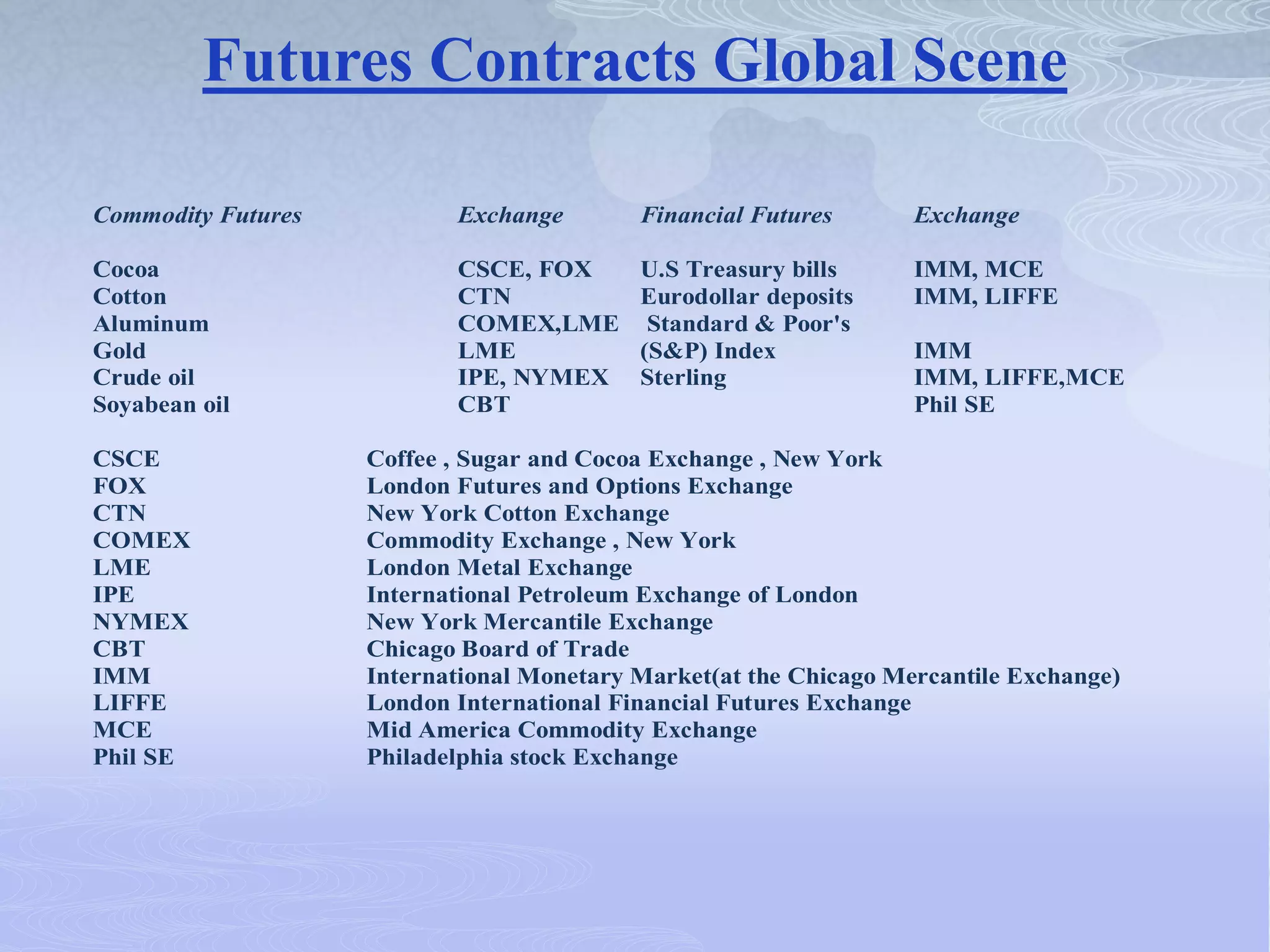
Futures Contracts Global Scene
Commodity Futures Exchange Financial Futures Exchange
Cocoa CSCE, FOX U.S Treasury bills IMM, MCE
Cotton CTN Eurodollar deposits IMM, LIFFE
Aluminum COMEX,LME Standard & Poor's
Gold LME (S&P) Index IMM
Crude oil IPE, NYMEX Sterling IMM, LIFFE,MCE
Soyabean oil CBT Phil SE
CSCE Coffee , Sugar and Cocoa Exchange , New York
FOX London Futures and Options Exchange
CTN New York Cotton Exchange
COMEX Commodity Exchange , New York
LME London Metal Exchange
IPE International Petroleum Exchange of London
NYMEX New York Mercantile Exchange
CBT Chicago Board of Trade
IMM International Monetary Market(at the Chicago Mercantile Exchange)
LIFFE London International Financial Futures Exchange
MCE Mid America Commodity Exchange
Phil SE Philadelphia stock Exchange
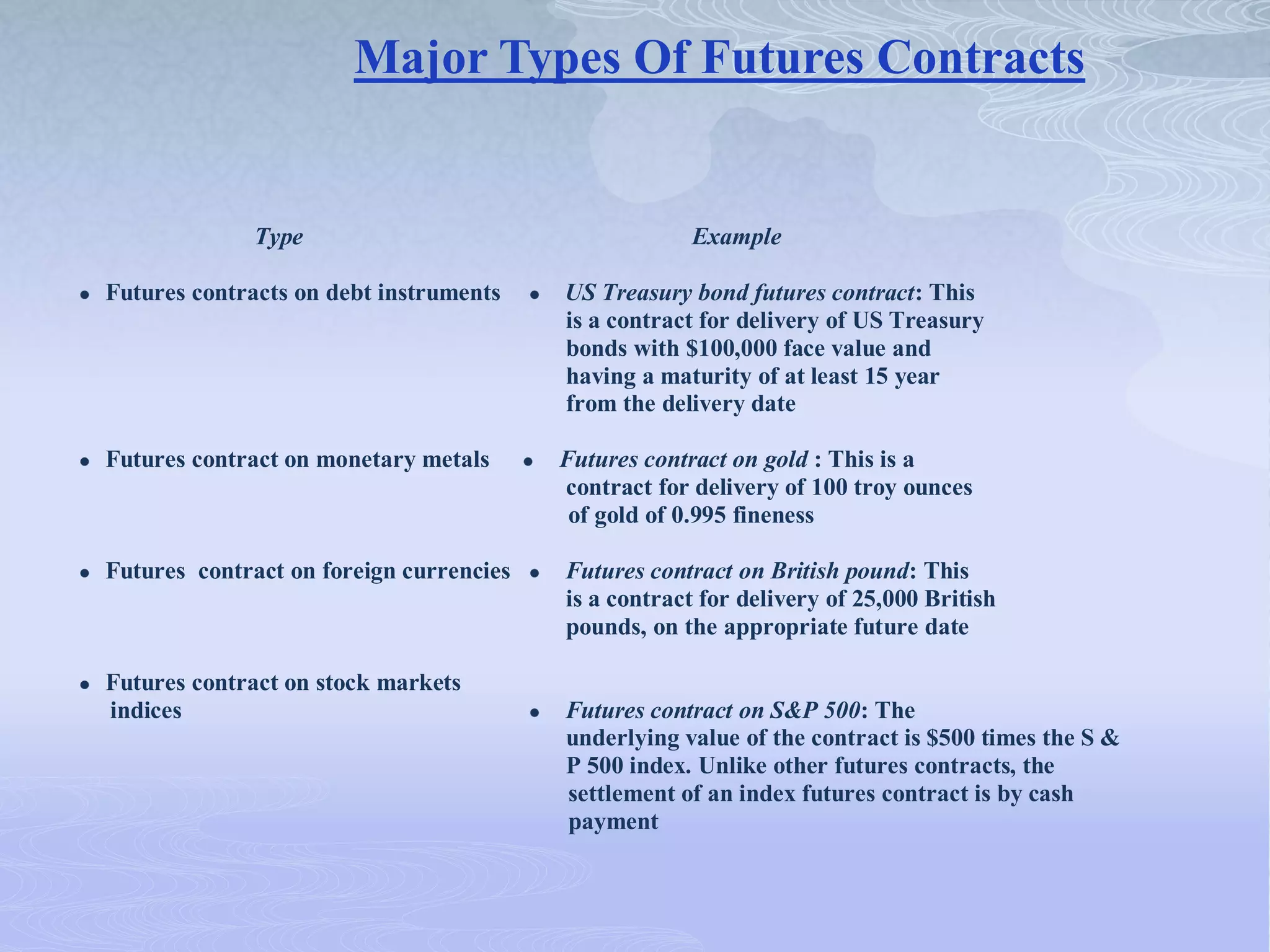
Major Types Of Futures Contracts
Type Example
Futures contracts on debt instruments US Treasury bond futures contract: This
is a contract for delivery of US Treasury
bonds with $100,000 face value and
having a maturity of at least 15 year
from the delivery date
Futures contract on monetary metals Futures contract on gold : This is a
contract for delivery of 100 troy ounces
of gold of 0.995 fineness
Futures contract on foreign currencies Futures contract on British pound: This
is a contract for delivery of 25,000 British
pounds, on the appropriate future date
Futures contract on stock markets
indices Futures contract on S&P 500: The
underlying value of the contract is $500 times the S &
P 500 index. Unlike other futures contracts, the
settlement of an index futures contract is by cash
payment
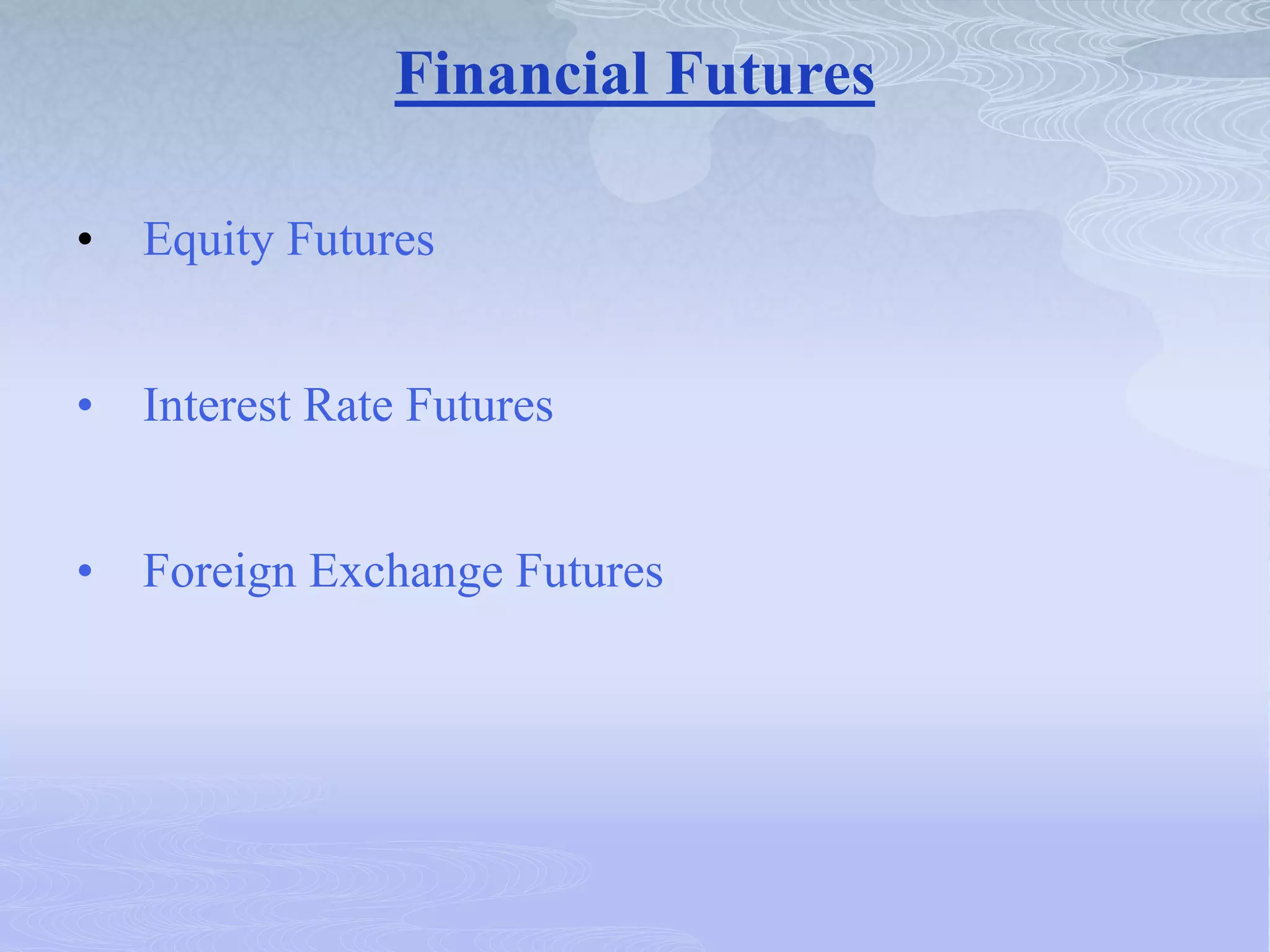
Financial Futures
• Equity Futures
• Interest Rate Futures
• Foreign Exchange Futures
Individual Stock Futures
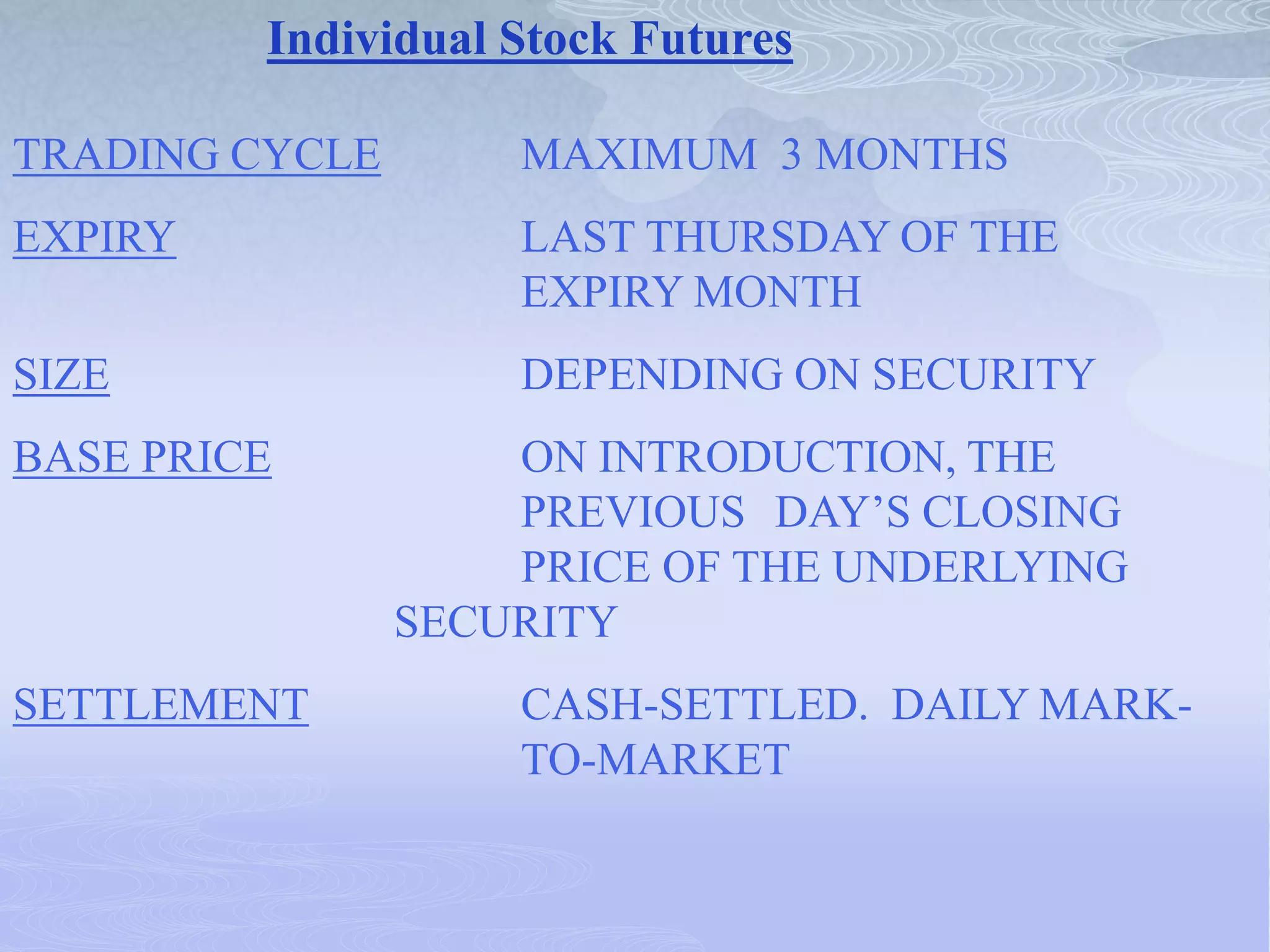
TRADING CYCLE MAXIMUM 3 MONTHS
EXPIRY LAST THURSDAY OF THE
EXPIRY MONTH
SIZE DEPENDING ON SECURITY
BASE PRICE ON INTRODUCTION, THE
PREVIOUS DAY’S CLOSING
PRICE OF THE UNDERLYING
SECURITY
SETTLEMENT CASH-SETTLED. DAILY MARK-
TO-MARKET

Futures and future contracts & trading mechanism of derivatives on stock exchanges

  • 1.
    Futures and FutureContracts & Trading mechanism of derivatives on stock exchanges
  • 2.
    What Is AFutures Contract?  A forward contract is an agreement between two parties to exchange an asset for cash at a predetermined future date for a price that is specified today. A futures contract is a standardized forward contract.
  • 3.
    Differences Between ForwardAnd Futures Contracts FORWARDS FUTURES TRADED OVER THE COUNTER TRADED ON EXCHANGE NO SECONDARY MARKET SECONDARY MARKET EXISTS TERMS NEGOTIATED BETWEEN STANDARDIZED CONTRACT (QTY, BUYER AND SELLER DATE & DELIVERY CONDITIONS) MOST CONTRACTS END WITH NORMALLY NO DELIVERY PHYSICAL DELIVERY OFFSETTING TRANSACTION CREDIT RISK ASSUMED BY CREDIT RISK ASSUMED BY BUYER CLEARING CORPORATION AND MEMBER FIRMS NO COLLATERAL SECURITY COLLATERAL POSTED MARKET TO THE MARKET PARTICIPATION LIMITED TO LARGE NUMBER OF SMALL NO. OF LARGE TRADERS PARTICIPANTS
  • 4.
    Futures Terminology Spot price: Theprice at which an underlying asset trades in the spot market. Futures price: The price that is agreed upon at the time of the contract for the delivery of an asset at a specific future date.
  • 5.
    Futures Terminology Contract cycle: Itis the period over which a contract trades. The index futures contracts on the NSE have one-month, two-month and three-month expiry cycles which expire on the last Thursday of the month. Thus a January expiration contract expires on the last Thursday of January and a February expiration contract ceases trading on the last Thursday of February. On the Friday following the last Thursday, a new contract having a three-month expiry is introduced for trading.
  • 6.
    Futures Terminology Expiry date: Thedate on which the final settlement of the contract takes place. Contract size: The amount of asset that has to be delivered under one contract. This is also called as the lot size.
  • 7.
    Futures Terminology Basis: Basis isdefined as the futures price minus the spot price. There will be a different basis for each delivery month for each contract. In a normal market, basis will be positive. This reflects that futures prices normally exceed spot prices.
  • 8.
    Futures Terminology Cost ofcarry: Measures the storage cost plus the interest that is paid to finance the asset less the income earned on the asset. Initial margin: The amount that must be deposited in the margin account at the time a futures contract is first entered into is known as initial margin.
  • 9.
    Futures Terminology Marking-to-market: In thefutures market, at the end of each trading day, the margin account is adjusted to reflect the investor’s gain or loss depending upon the futures closing price. This is called marking-to-market.
  • 10.
    Futures Terminology Maintenance margin: Investorsare required to place margins with their trading members before they are allowed to trade. If the balance in the margin account falls below the maintenance margin, the investor receives a margin call and is expected to top up the margin account to the initial margin level before trading commences on the next day.
  • 11.
    Futures Payoffs Futures contractshave linear or symmetrical payoffs. It implies that the losses as well as profits for the buyer and the seller of a futures contract are unlimited. These linear payoffs are fascinating as they can be combined with options and the underlying to generate various complex payoffs.
  • 12.
    Payoff for buyerof futures: Long futures The payoff for a person who buys a futures contract is similar to the payoff for a person who holds an asset. He has a potentially unlimited upside as well as a potentially unlimited downside. Take the case of a speculator who buys a two-month Nifty index futures contract when the Nifty stands at 2220. The underlying asset in this case is the Nifty portfolio. When the index moves up, the long futures position starts making profits, and when the index moves down it starts making losses.
  • 13.
    Payoff for sellerof futures: Short futures The payoff for a person who sells a futures contract is similar to the payoff for a person who shorts an asset. He has a potentially unlimited upside as well as a potentially unlimited downside. Take the case of a speculator who sells a two-month Nifty index futures contract when the Nifty stands at 2220. The underlying asset in this case is the Nifty portfolio. When the index moves down, the short futures position starts making profits, and when the index moves up, it starts making losses.
  • 14.
    Payoffs To TheFuture Buyer And Future Seller A : Future Buyer B : Future Seller Profit Profit Loss Loss C C P P C = Contract price P = Actual price
  • 15.
    Futures and OptionsTrading System - NSE The futures & options trading system of NSE, called NEAT-F&O trading system, provides a fully automated screen-based trading for Index futures & options and Stock futures & options on a nationwide basis as well as an online monitoring and surveillance mechanism. It supports an order driven market and provides complete transparency of trading operations.
  • 16.
    Entities in thetrading system 1.Trading members: Trading members are members of NSE. They can trade either on their own account or on behalf of their clients including participants. The exchange assigns a trading member ID to each trading member. Each trading member can have more than one user. The number of users allowed for each trading member is notified by the exchange from time to time. Each user of a trading member must be registered with the exchange and is assigned an unique user ID.
  • 17.
    Entities in thetrading system 2.Clearing members: Clearing members are members of NSCCL. They carry out risk management activities and confirmation/inquiry of trades through the trading system. 3.Professional clearing members: A professional clearing member is a clearing member who is not a trading member. Typically, banks and custodians become professional clearing members and clear and settle for their trading members.
  • 18.
    Entities in thetrading system 4.Participants: A participant is a client of trading members like financial institutions. These clients may trade through multiple trading members but settle through a single clearing member.
  • 19.
    Basis of trading TheNEAT F&O system supports an order driven market, wherein orders match automatically. Order matching is essentially on the basis of security, its price, time and quantity. All quantity fields are in units and price in rupees. The exchange notifies the regular lot size and tick size for each of the contracts traded on this segment from time to time. When any order enters the trading system, it is an active order. It tries to find a match on the other side of the book. If it finds a match, a trade is generated. If it does not find a match, the order becomes passive and goes and sits in the respective outstanding order book in the system.
  • 20.
    Client Broker Relationshipin Derivative Segment A trading member must ensure compliance particularly with relation to the following while dealing with clients: • Filling of ‘Know Your Client’ form • Execution of Client Broker agreement • Bring risk factors to the knowledge of client by getting acknowledgement of client on risk disclosure document • Timely execution of orders as per the instruction of clients in respective client codes. • Collection of adequate margins from the client • Maintaining separate client bank account for the segregation of client money. • Timely issue of contract notes as per the prescribed format to the client • Ensuring timely pay-in and pay-out of funds to and from the clients • Resolving complaint of clients if any at the earliest. • Avoiding receipt and payment of cash and deal only through account payee cheques • Sending the periodical statement of accounts to clients • Not charging excess brokerage • Maintaining unique client code as per the regulations.
  • 21.
    Order types andconditions The system allows the trading members to enter orders with various conditions attached to them as per their requirements. These conditions are broadly divided into the following categories: • Time conditions • Price conditions • Other conditions
  • 22.
    Time conditions Day order: Aday order, as the name suggests is an order which is valid for the day on which it is entered. If the order is not executed during the day, the system cancels the order automatically at the end of the day. Immediate or Cancel (IOC): An IOC order allows the user to buy or sell a contract as soon as the order is released into the system, failing which the order is cancelled from the system. Partial match is possible for the order, and the unmatched portion of the order is cancelled immediately.
  • 23.
    Price condition Stop-loss: This facilityallows the user to release an order into the system, after the market price of the security reaches or crosses a threshold price e.g. if for stop-loss buy order, the trigger is 1027.00, the limit price is 1030.00 and the market (last traded) price is 1023.00, then this order is released into the system once the market price reaches or exceeds 1027.00. This order is added to the regular lot book with time of triggering as the time stamp, as a limit order of 1030.00. For the stop-loss sell order, the trigger price has to be greater than the limit price.
  • 24.
    Other conditions Market price: Marketorders are orders for which no price is specified at the time the order is entered (i.e. price is market price). For such orders, the system determines the price. Trigger price: Price at which an order gets triggered from the stop-loss book. Limit price: Price of the orders after triggering from stop-loss book. Pro: Pro means that the orders are entered on the trading member’s own account. Cli: Cli means that the trading member enters the orders on behalf of a client.
  • 25.
    Futures and OptionsMarket Instruments The F&O segment of NSE provides trading facilities for the following derivative instruments: 1. Index based futures 2. Index based options 3. Individual stock options 4. Individual stock futures
  • 26.
    Contract specifications forindex futures On NSE’s platform one can trade in Nifty, CNX IT, BANK Nifty, Mini Nifty etc. futures contracts having one-month, two-month and three-month expiry cycles. All contracts expire on the last Thursday of every month. Thus, a January expiration contract would expire on the last Thursday of January and a February expiry contract would cease trading on the last Thursday of February. On the Friday following the last Thursday, a new contract having a three-month expiry would be introduced for trading. Thus, at any point in time, three contracts would be available for trading with the first contract expiring on the last Thursday of that month.
  • 27.
    Contract specifications forindex futures The Instrument type refers to “Futures contract on index” and Contract symbol - NIFTY denotes a “Futures contract on Nifty index” and the Expiry date represents the last date on which the contract will be available for trading. Each futures contract has a separate limit order book. All passive orders are stacked in the system in terms of price-time priority and trades take place at the passive order price
  • 28.
    Example: If trading isfor a minimum lot size of 50 units and the index level is around 5000, then the appropriate value of a single index futures contract would be Rs.250,000. The minimum tick size for an index future contract is 0.05 units. Thus a single move in the index value would imply a resultant gain or loss of Rs.2.50 (i.e. 0.05*50 units) on an open position of 50 units.
  • 29.
    Contract specification forindex options On NSE’s index options market, there are one-month, two-month and three-month expiry contracts with minimum nine different strikes available for trading. Hence, if there are three serial month contracts available and the scheme of strikes is 6-1-6, then there are minimum 3 x 13 x 2 (call and put options) i.e. 78 options contracts available on an index. Option contracts are specified as follows: DATE-EXPIRYMONTH- YEAR-CALL/PUT-AMERICAN/ EUROPEAN- STRIKE. For example the European style call option contract on the Nifty index with a strike price of 5000 expiring on the 26th November 2009 is specified as ’26NOV2009 5000 CE’.
  • 30.
    Contract specification forindex options Just as in the case of futures contracts, each option product (for instance, the 26 NOV 2009 5000 CE) has it’s own order book and it’s own prices. All index options contracts are cash settled and expire on the last Thursday of the month. The minimum tick for an index options contract is 0.05 paise.
  • 31.
    Criteria for Stocksand Index Eligibility for Trading Eligibility criteria of stocks 1. The stock is chosen from amongst the top 500 stocks in terms of average daily market capitalisation and average daily traded value in the previous six months on a rolling basis. 2.The stock’s median quarter-sigma order size over the last six months should be not less than Rs. 10 lakhs. For this purpose, a stock’s quarter-sigma order size should mean the order size (in value terms) required to cause a change in the stock price equal to one-quarter of a standard deviation.
  • 32.
    Eligibility criteria ofstocks 3.The market wide position limit in the stock should not be less than Rs.300 crores. The market wide position limit (number of shares) is valued taking the closing prices of stocks in the underlying cash market on the date of expiry of contract in the month. The market wide position limit of open position (in terms of the number of underlying stock) on futures and option contracts on a particular underlying stock shall be 20% of the number of shares held by non- promoters in the relevant underlying security i.e. free- float holding.
  • 33.
    Eligibility criteria ofstocks 4. For an existing F&O stock, the continued eligibility criteria is that market wide position limit in the stock shall not be less than Rs. 200 crores and stock’s median quarter-sigma order size over the last six months shall be not less than Rs. 5 lakh. 5. Additionallly, the stock’s average monthly turnover in derivatives segment over last 3 months shall not be less than Rs. 100 crores.
  • 34.
    Eligibility criteria ofstocks 6. If an existing security fails to meet the eligibility criteria for three months consecutively, then no fresh month contract will be issued on that security. However, the existing unexpired contracts can be permitted to trade till expiry and new strikes can also be introduced in the existing contract months. Further, once the stock is excluded from the F&O list, it shall not be considered for re-inclusion for a period of one year.
  • 35.
    Eligibility criteria ofindices The exchange may consider introducing derivative contracts on an index if the stocks contributing to 80% weightage of the index are individually eligible for derivative trading. However, no single ineligible stocks in the index should have a weightage of more than 5% in the index. The above criteria is applied every month, if the index fails to meet the eligibility criteria for three months consecutively, then no fresh month contract would be issued on that index, However, the existing unexpired contacts will be permitted to trade till expiry and new strikes can also be introduced in the existing contracts.
  • 36.
    Charges The maximum brokeragechargeable by a trading member in relation to trades effected in the contracts admitted to dealing on the F&O Segment of NSE is fixed at 2.5% of the contract value exclusive of statutory levies. However, NSE has been periodically reviewing and reducing the transaction charges being levied by it on its trading members. With effect from October 1st, 2009, the transaction charges for trades executed on the futures segment is as per the table given below:
  • 37.
    Charges Total traded valuein a month Transaction Charges (Rs. Per lakh of traded value) Up to First Rs. 2500 cores More than Rs. 2500 crores up to Rs. 7500 crores More than Rs. 7500 crores up to Rs. 15000 crores Exceeding Rs.15000 crores Rs. 1.90 each side Rs. 1.85 each side Rs. 1.80 each side Rs. 1.75 each side
  • 38.
    Charges For the transactionsin the options sub- segment the transaction charges are levied on the premium value at the rate of 0.05% (each side) instead of on the strike price as levied earlier. Further to this, trading members have been advised to charge brokerage from their clients on the Premium price (traded price) rather than Strike price.
  • 39.
    Mechanics Of Trading Tradingin futures is more complex than trading in stocks. Inter alia it involves • Intermediation by a clearing house • Margins • Marking - to - market
  • 40.
  • 41.
    Margins • When youexecute a futures trade, you have to provide the initial margin. • If you incur sustained losses from daily marking-to- market, and your margin amount falls below a critical level called the maintenance margin you have to replenish the margin amount.
  • 42.
    Margins By NSE InitialMargin NSCCL collects initial margin up-front for all the open positions of a CM based on the margins computed by NSCCL-SPAN®. Premium Margin In addition to Span Margin, Premium Margin is charged to members. The premium margin is the client wise premium amount payable by the buyer of the option and is levied till the completion of pay-in towards the premium settlement.
  • 43.
    Margins By NSE AssignmentMargin Assignment Margin is levied on a CM in addition to SPAN margin and Premium Margin. It is levied on assigned positions of CMs towards interim and final exercise settlement obligations for option contracts on index and individual securities till the pay-in towards exercise settlement is complete.
  • 44.
    Margins By NSE ExposureMargin The exposure margins for options and futures contracts on index are as follows:  For Index options and Index futures contracts: 3% of the notional value of a futures contract. In case of options it is charged only on short positions and is 3% of the notional value of open positions.  For option contracts and Futures Contract on individual Securities: The higher of 5% or 1.5 standard deviation of the notional value of gross open position in futures on individual securities and gross short open positions in options on individual securities in a particular underlying. The standard deviation of daily logarithmic returns of prices in the underlying stock in the cash market in the last six months is computed on a rolling and monthly basis at the end of each month.
  • 45.
    Benefits of tradingin Futures and Options 1) Able to transfer the risk to the person who is willing to accept them 2) Incentive to make profits with minimal amount of risk capital 3) Lower transaction costs 4) Provides liquidity, enables price discovery in underlying market 5) Derivatives market are lead economic indicators.
  • 46.
    The advantages oftrading in Index Futures • The contracts are highly liquid • Index Futures provide higher leverage than any other stocks • It requires low initial capital requirement • It has lower risk than buying and holding stocks • It is just as easy to trade the short side as the long side • Only have to study one index instead of 100s of stocks
  • 47.
    Marking-To-Market While forward contractsare settled on the maturity date, futures contracts are ‘marked to market’ on a periodic basis. Assume that the spot price of gold is $450 and the four period futures contract in gold has a price of $460. In the wake of changes in the price of the gold futures contract, the cash flow to the buyer and seller of this contract will be as shown in the last two columns of the following table. Gold Forward Futures Time Period Futures contract Buyer’s cash flow Seller’s cash flow Buyer’s cashflow Seller’s cash flow 1 465 $0 0 $5 $-5 2 455 0 0 -10 10 3 460 0 0 5 -5 4 465 5 -5 5 -5
  • 48.
    How are thecontracts settled? All the Futures and Options contracts are settled in cash on a daily basis and at the expiry or exercise of the respective contracts as the case may be. Clients/Trading Members are not required to hold any stock of the underlying for dealing in the Futures / Options market.
  • 49.
    Working of Futuremarket Example A. On 01 March an investor feels the market will rise – Buys 1 contract of March ABC Ltd. Futures at Rs. 260 (market lot : 300) 09 March – ABC Ltd. Futures price has risen to Rs. 280 – Sells off the position at Rs. 280. Makes a profit of Rs.6000 (300*20)
  • 50.
    Working of Futuremarket Example B. On 01 March an investor feels the market will fall – Sells 1 contract of March ABC Ltd. Futures at Rs. 260 (market lot : 300) 09 March – ABC Ltd. Futures price has fallen to Rs. 240 – Squares off the position at Rs. 240 – Makes a profit of Rs.6000 (300*20)
  • 51.
    Futures Contracts GlobalScene Commodity Futures Exchange Financial Futures Exchange Cocoa CSCE, FOX U.S Treasury bills IMM, MCE Cotton CTN Eurodollar deposits IMM, LIFFE Aluminum COMEX,LME Standard & Poor's Gold LME (S&P) Index IMM Crude oil IPE, NYMEX Sterling IMM, LIFFE,MCE Soyabean oil CBT Phil SE CSCE Coffee , Sugar and Cocoa Exchange , New York FOX London Futures and Options Exchange CTN New York Cotton Exchange COMEX Commodity Exchange , New York LME London Metal Exchange IPE International Petroleum Exchange of London NYMEX New York Mercantile Exchange CBT Chicago Board of Trade IMM International Monetary Market(at the Chicago Mercantile Exchange) LIFFE London International Financial Futures Exchange MCE Mid America Commodity Exchange Phil SE Philadelphia stock Exchange
  • 52.
    Major Types OfFutures Contracts Type Example Futures contracts on debt instruments US Treasury bond futures contract: This is a contract for delivery of US Treasury bonds with $100,000 face value and having a maturity of at least 15 year from the delivery date Futures contract on monetary metals Futures contract on gold : This is a contract for delivery of 100 troy ounces of gold of 0.995 fineness Futures contract on foreign currencies Futures contract on British pound: This is a contract for delivery of 25,000 British pounds, on the appropriate future date Futures contract on stock markets indices Futures contract on S&P 500: The underlying value of the contract is $500 times the S & P 500 index. Unlike other futures contracts, the settlement of an index futures contract is by cash payment
  • 53.
    Financial Futures • EquityFutures • Interest Rate Futures • Foreign Exchange Futures
  • 54.
    Individual Stock Futures TRADINGCYCLE MAXIMUM 3 MONTHS EXPIRY LAST THURSDAY OF THE EXPIRY MONTH SIZE DEPENDING ON SECURITY BASE PRICE ON INTRODUCTION, THE PREVIOUS DAY’S CLOSING PRICE OF THE UNDERLYING SECURITY SETTLEMENT CASH-SETTLED. DAILY MARK- TO-MARKET