M. Hidalgo
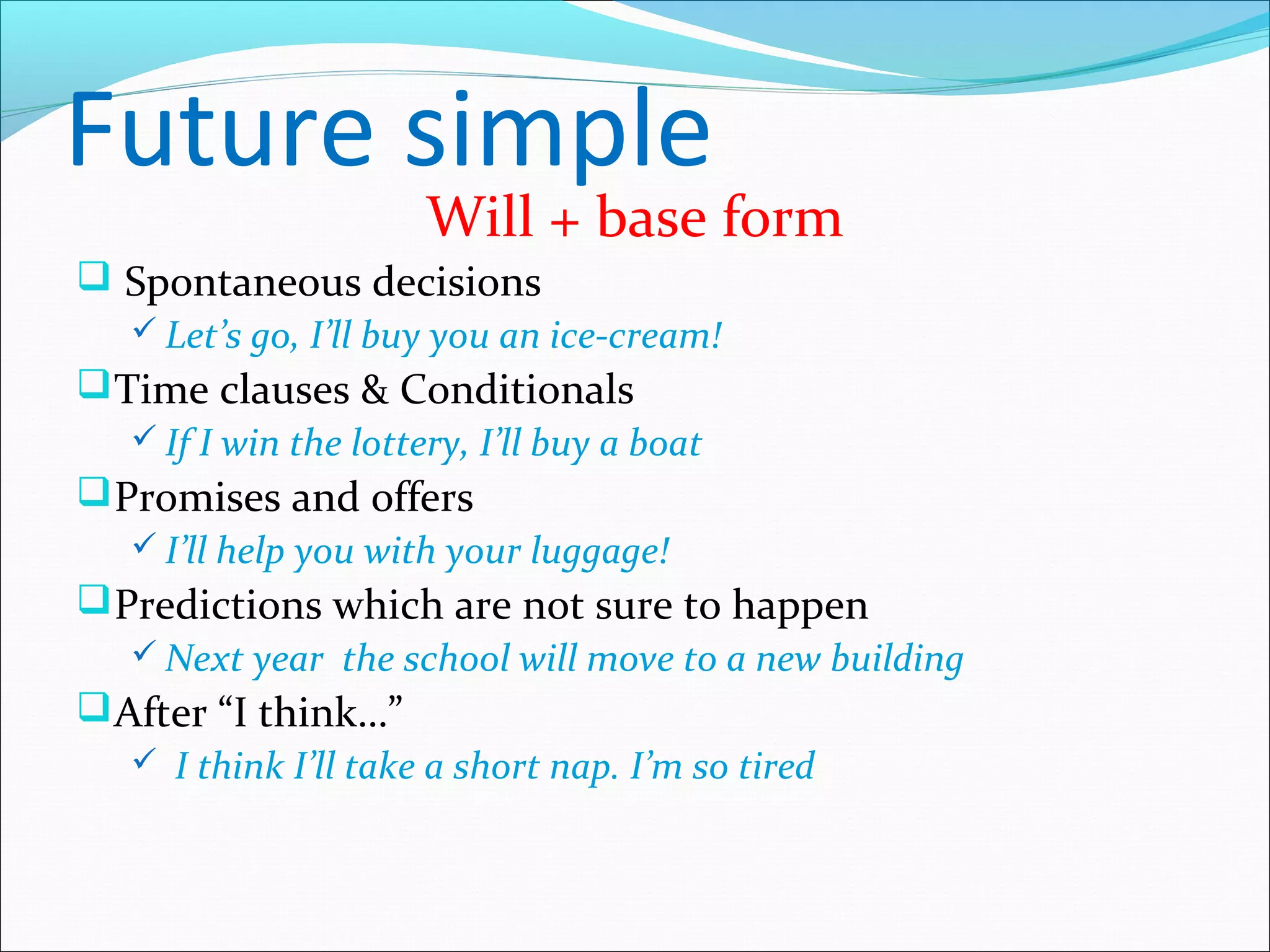
Future simple
                    Will + base form
 Spontaneous decisions
    Let’s go, I’ll buy you an ice-cream!
 Time clauses & Conditionals
    If I win the lottery, I’ll buy a boat
 Promises and offers
    I’ll help you with your luggage!
 Predictions which are not sure to happen
    Next year the school will move to a new building
 After “I think…”
    I think I’ll take a short nap. I’m so tired
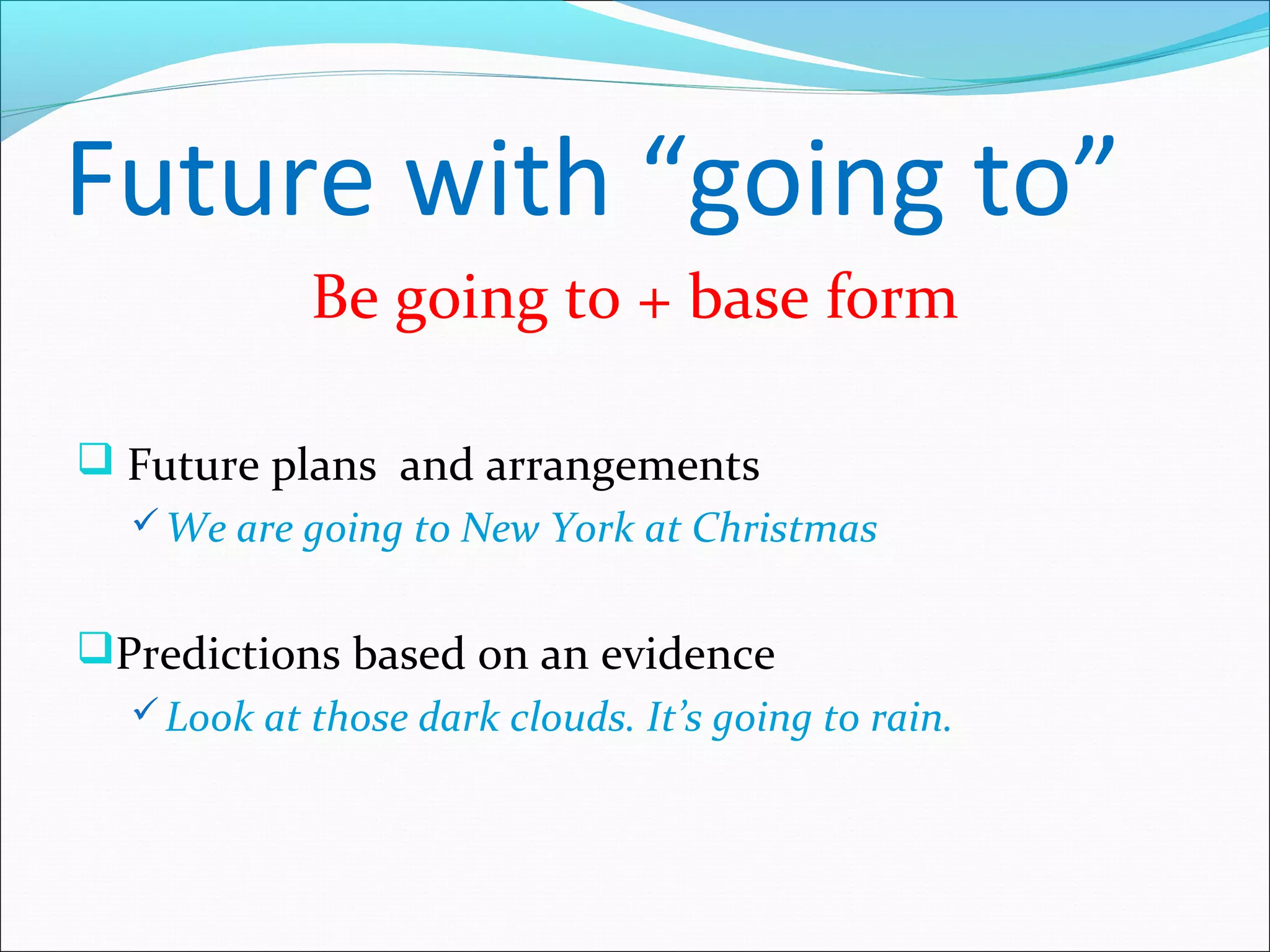
Future with “going to”
            Be going to + base form

 Future plans and arrangements
   We are going to New York at Christmas


Predictions based on an evidence
   Look at those dark clouds. It’s going to rain.
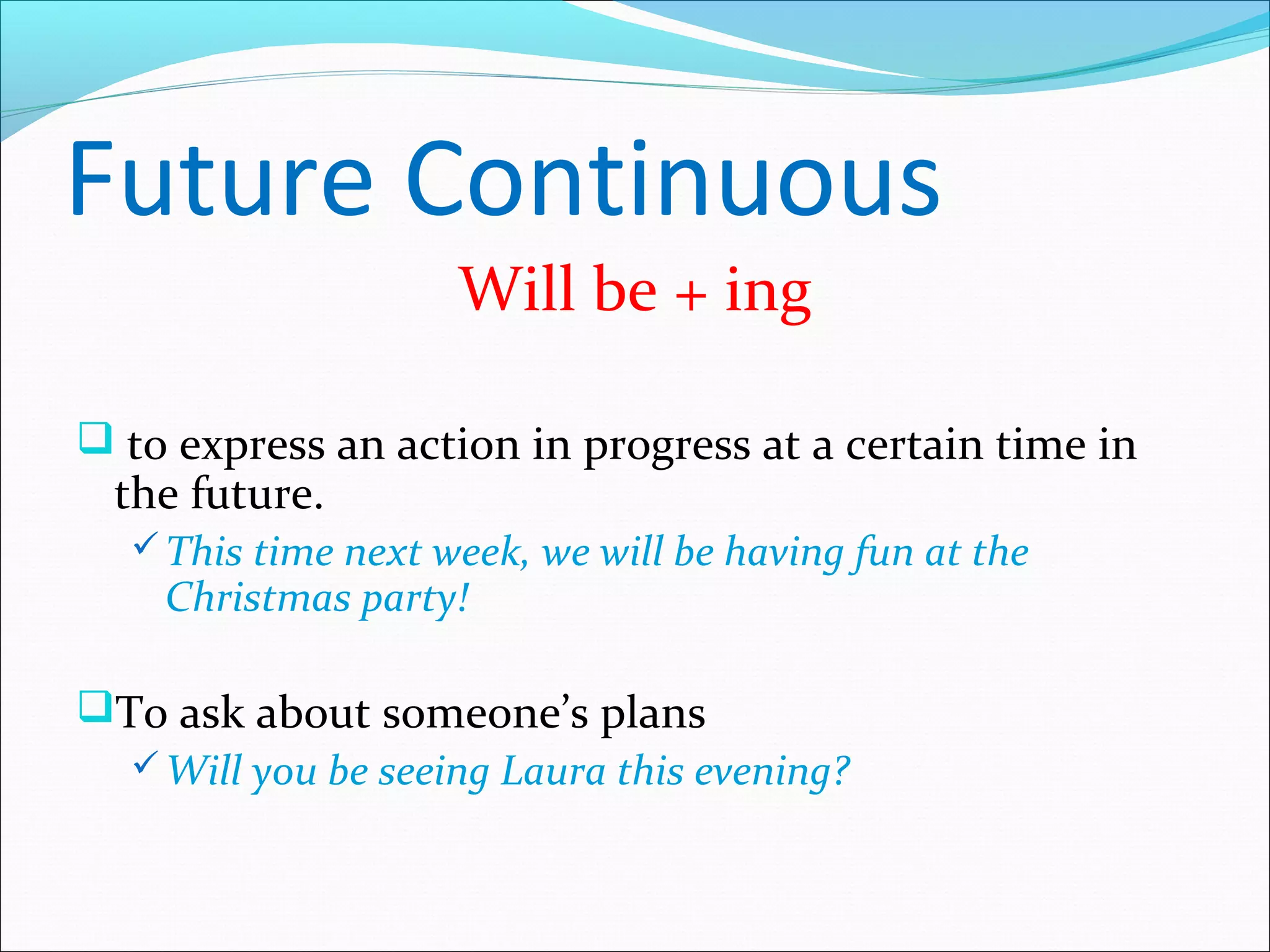
Future Continuous
                    Will be + ing

 to express an action in progress at a certain time in
  the future.
   This time next week, we will be having fun at the
    Christmas party!

To ask about someone’s plans
   Will you be seeing Laura this evening?
Future Perfect
          Will have + past participle

 to express an action that will be complete in the
 future
   In 4 weeks’ time we will have started a new year
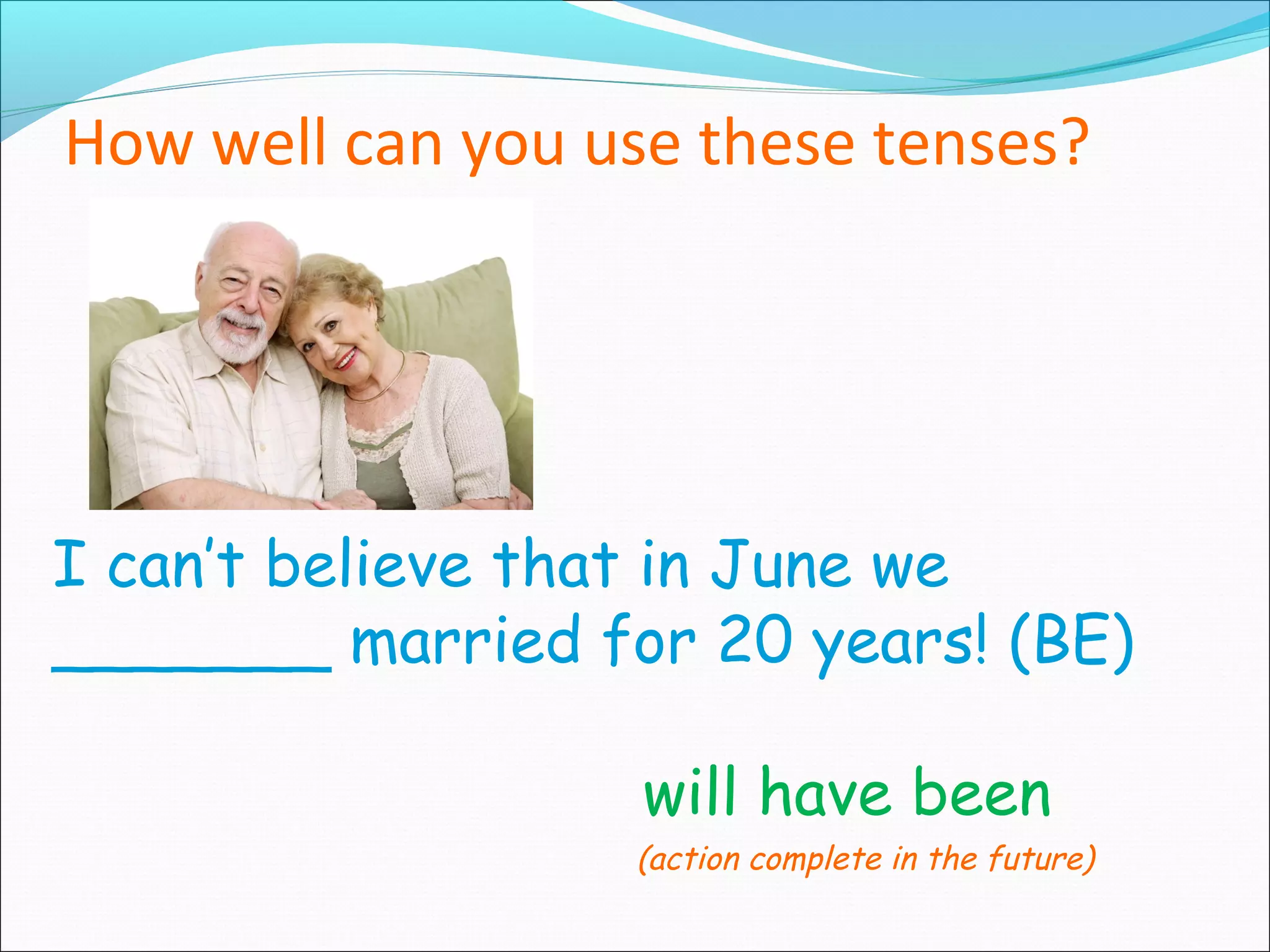
How well can you use these tenses?


I can’t believe that in June we
_______ married for 20 years! (BE)

                   will have been
                  (action complete in the future)
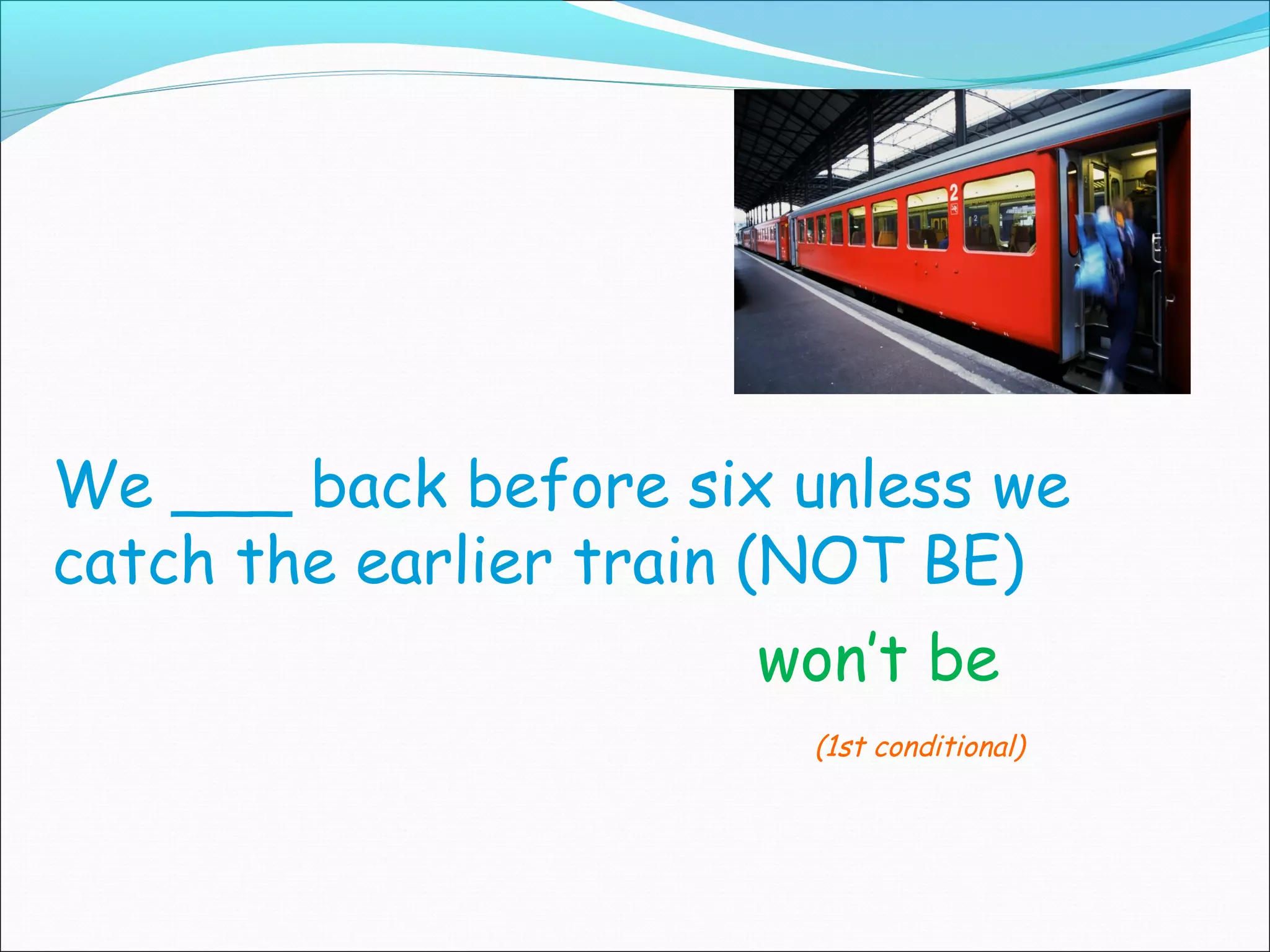
We ___ back before six unless we
catch the earlier train (NOT BE)
                      won’t be
                       (1st conditional)
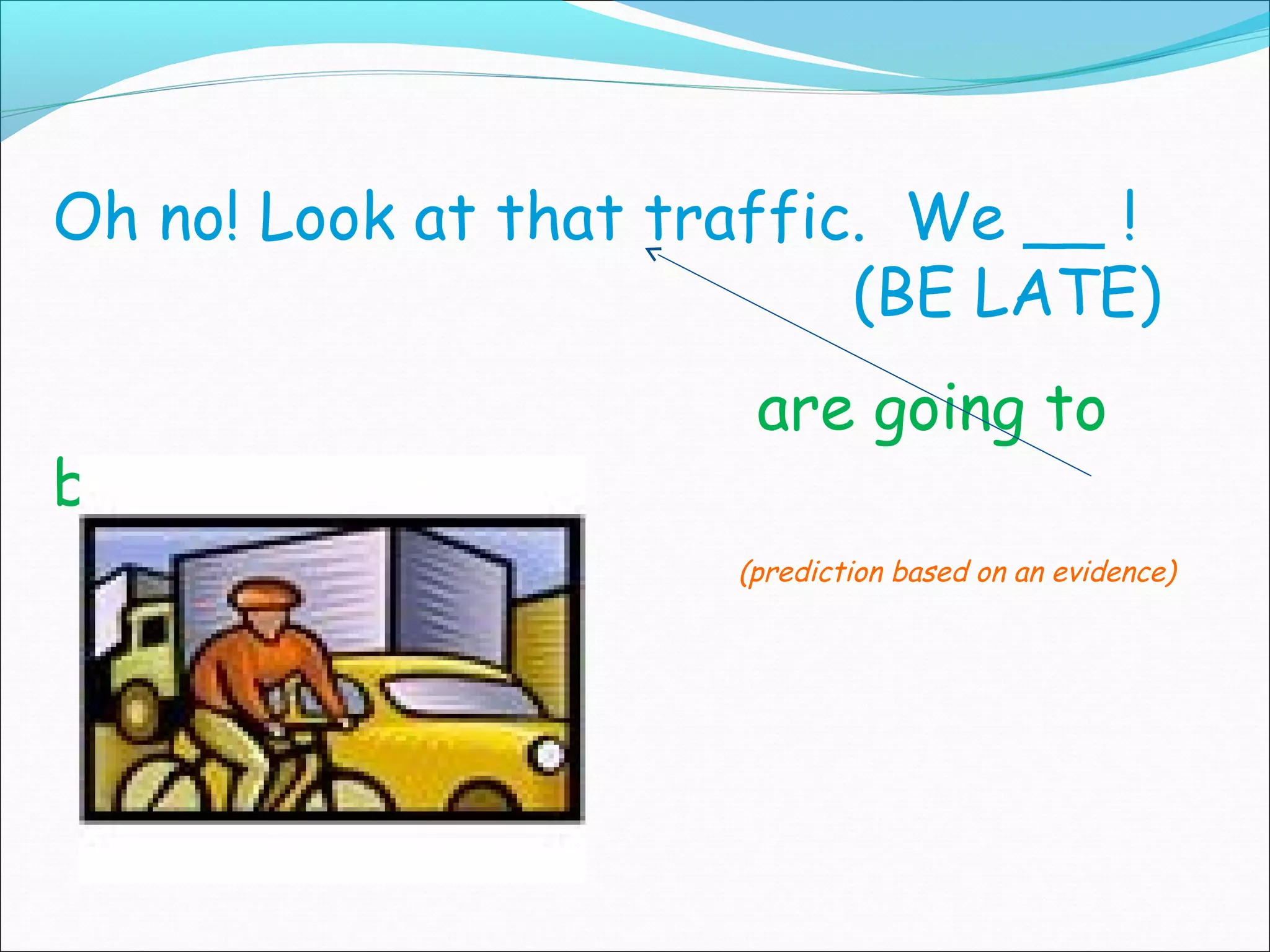
Oh no! Look at that traffic. We __ !
                           (BE LATE)
                       are going to
be
                      (prediction based on an evidence)
What do you think we ____ this time
next year?
(DO)
           will be doing
          (action happening at a
         specific point in the future)


                                         (1st conditional)
I’ll tell you what the plans are as
 soon as I _____ them.
                          (KNOW)

                    know
                    (time clause)
By the end of this course you ___
1,000 words.
                        (LEARN)

          will have learned/learnt
              (action completed in the future)
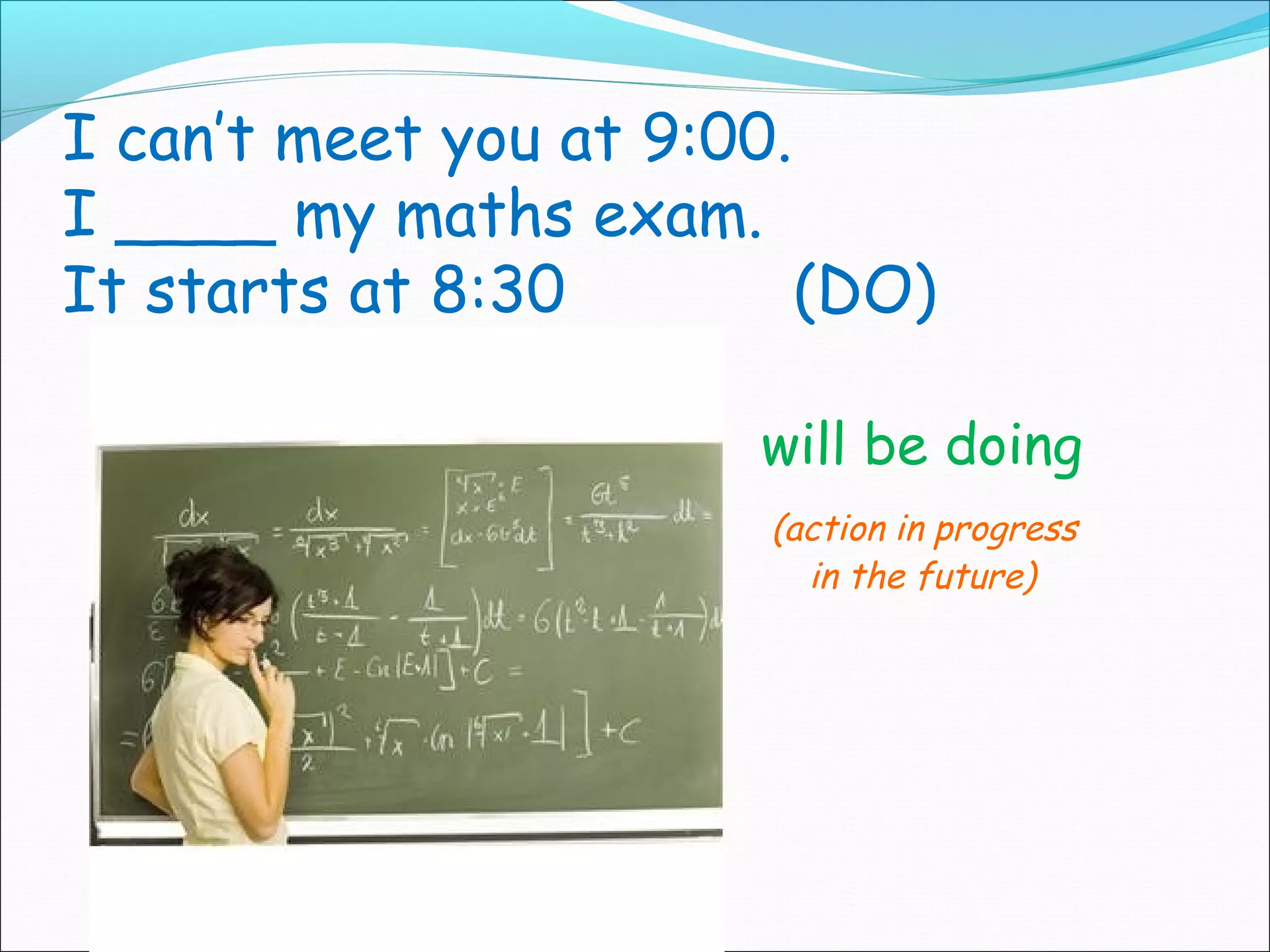
I can’t meet you at 9:00.
I ____ my maths exam.
It starts at 8:30         (DO)

                       will be doing
                        (action in progress
                          in the future)
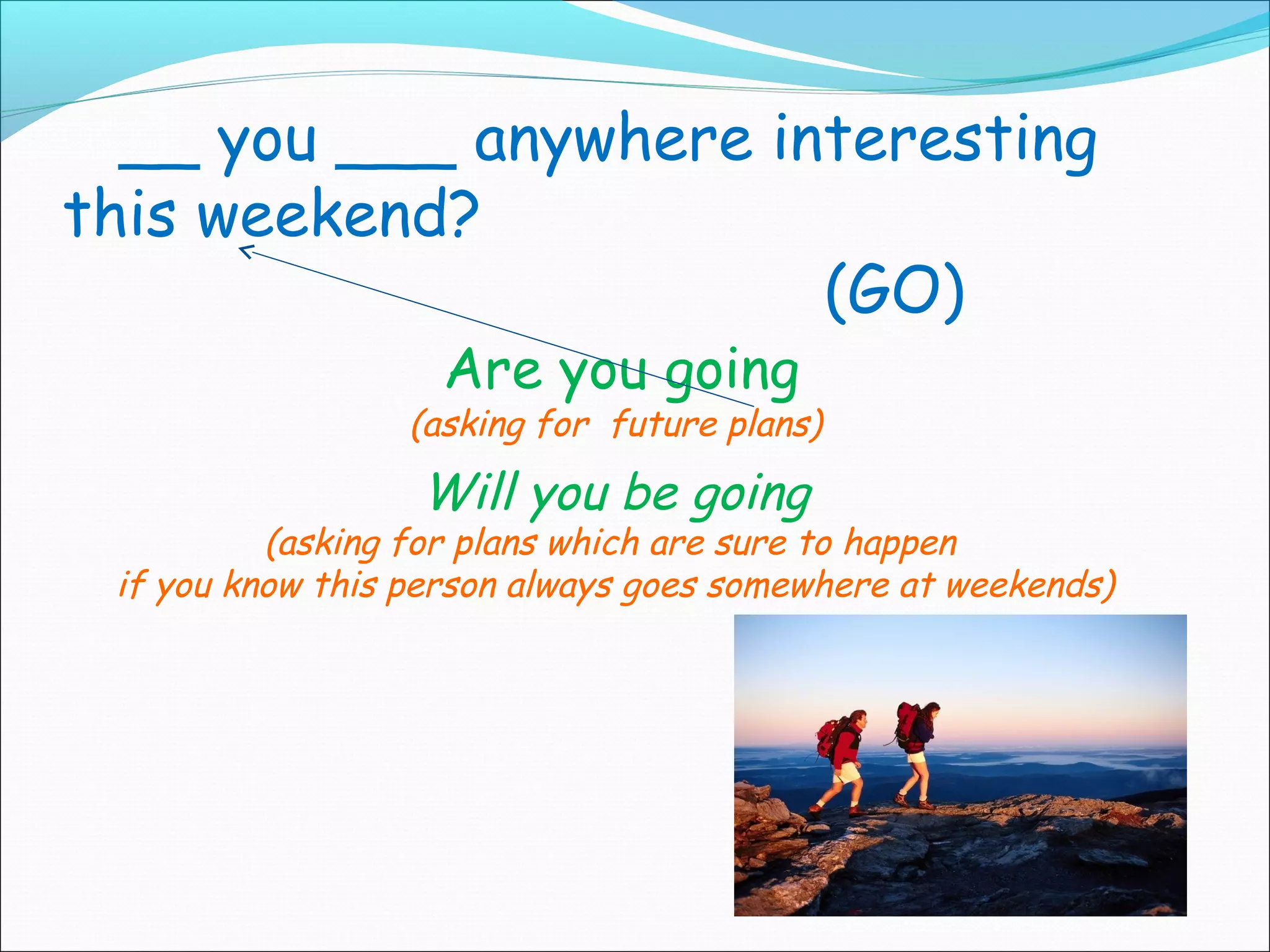
__ you ___ anywhere interesting
this weekend?
                        (GO)
                    Are you going
                  (asking for future plans)

                  Will you be going
          (asking for plans which are sure to happen
 if you know this person always goes somewhere at weekends)
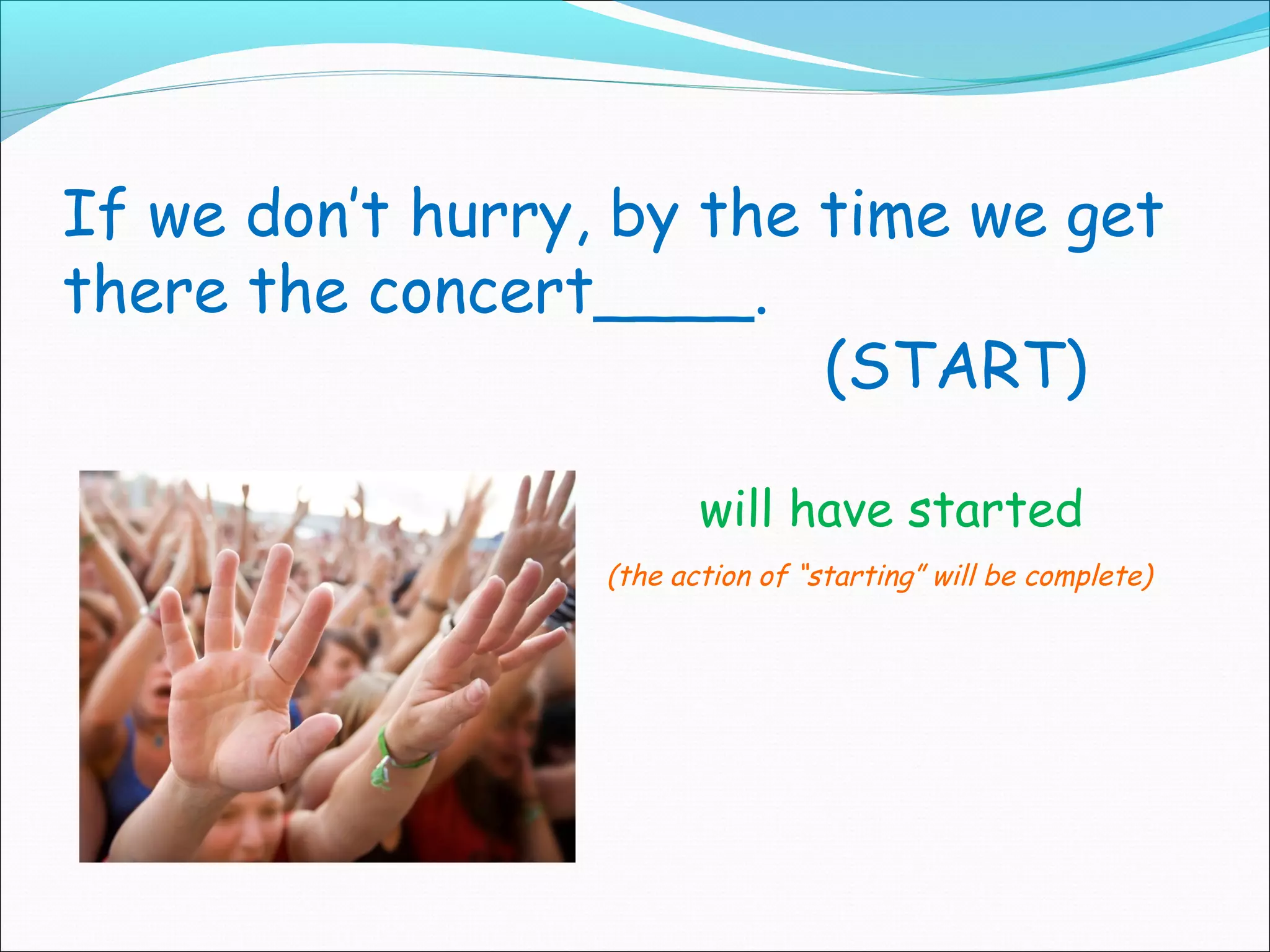
If we don’t hurry, by the time we get
there the concert____.
                          (START)

                         will have started
                  (the action of “starting” will be complete)
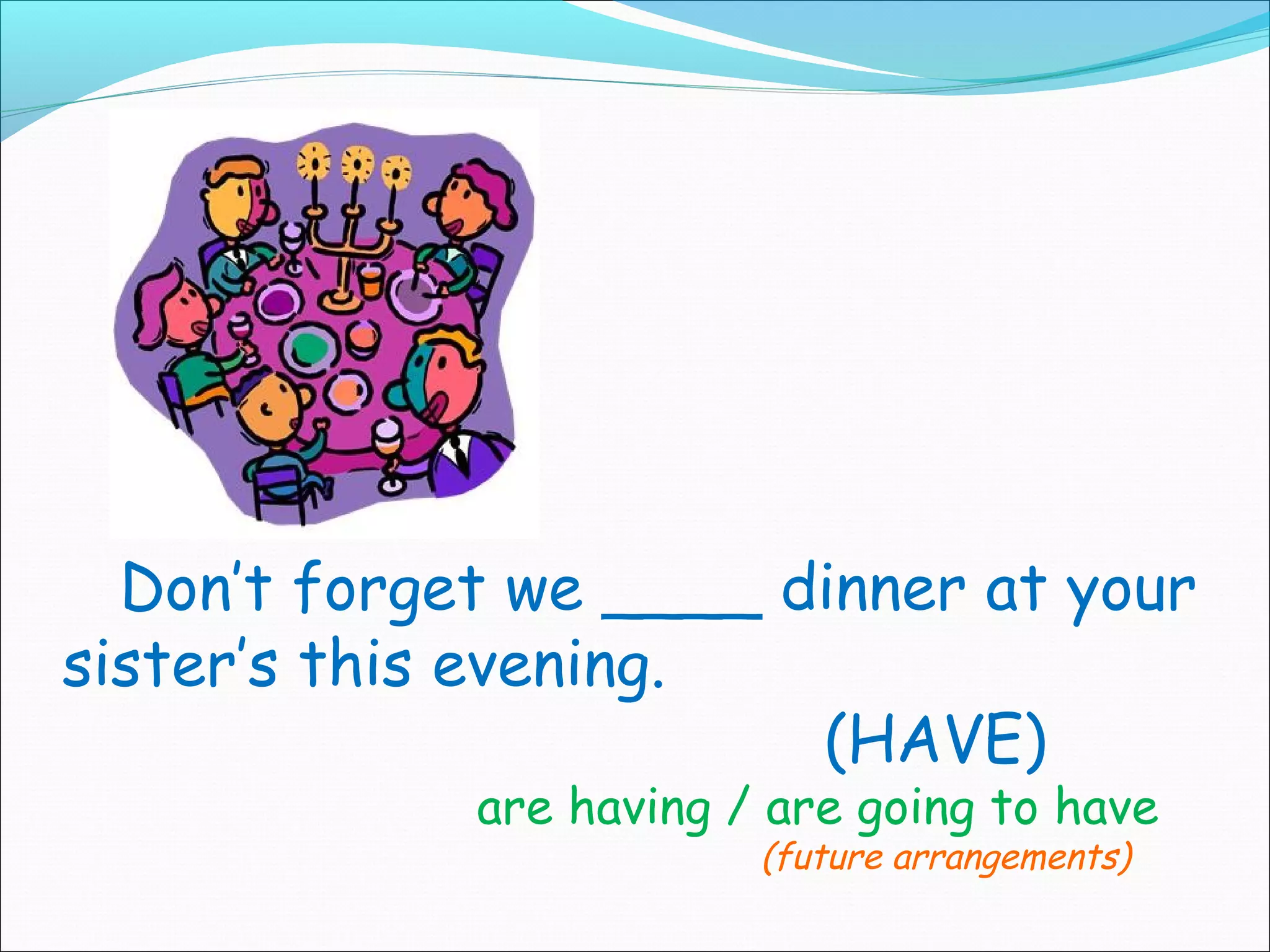
Don’t forget we ____ dinner at your
sister’s this evening.
                        (HAVE)
             are having / are going to have
                         (future arrangements)
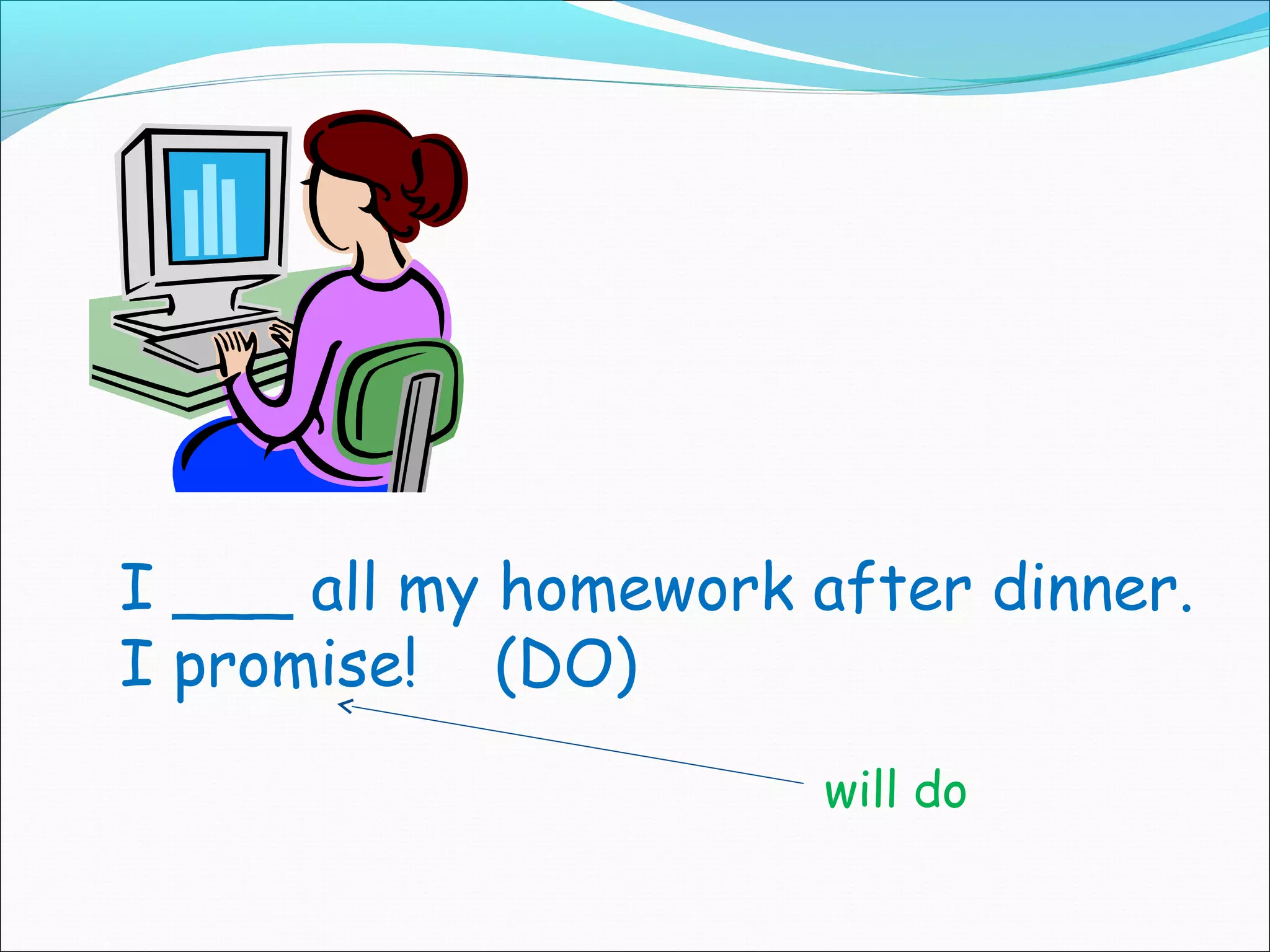
I ___ all my homework after dinner.
I promise! (DO)
                      will do
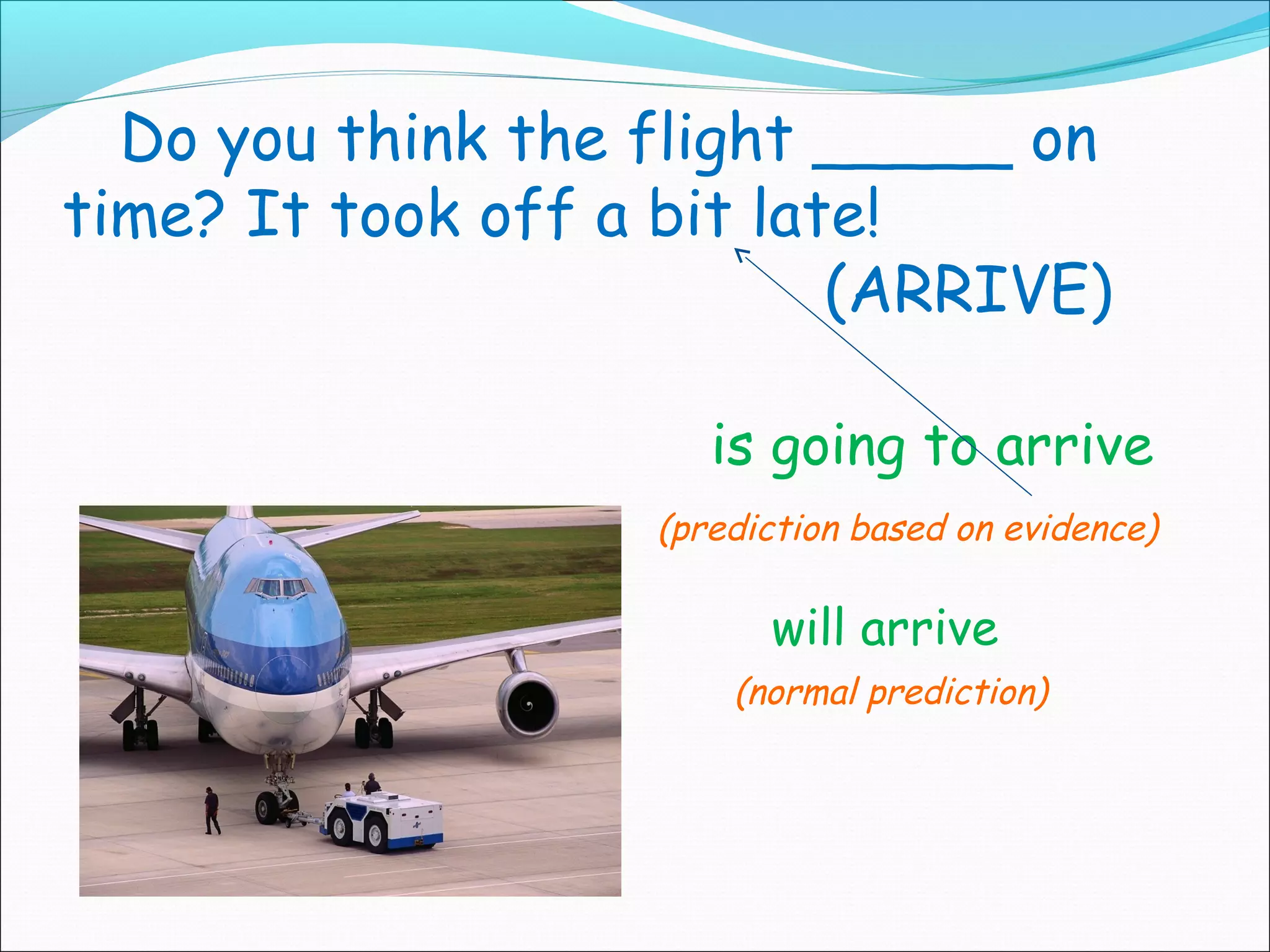
Do you think the flight _____ on
time? It took off a bit late!
                           (ARRIVE)

                      is going to arrive
                   (prediction based on evidence)

                         will arrive
                       (normal prediction)
You are sure to recognise me at the
station. I ____ a pink tie!
                            (WEAR)
    will be wearing
 (notice that we always use the verb “wear” in the continuous form!
  and we are referring to a specific time in the future)
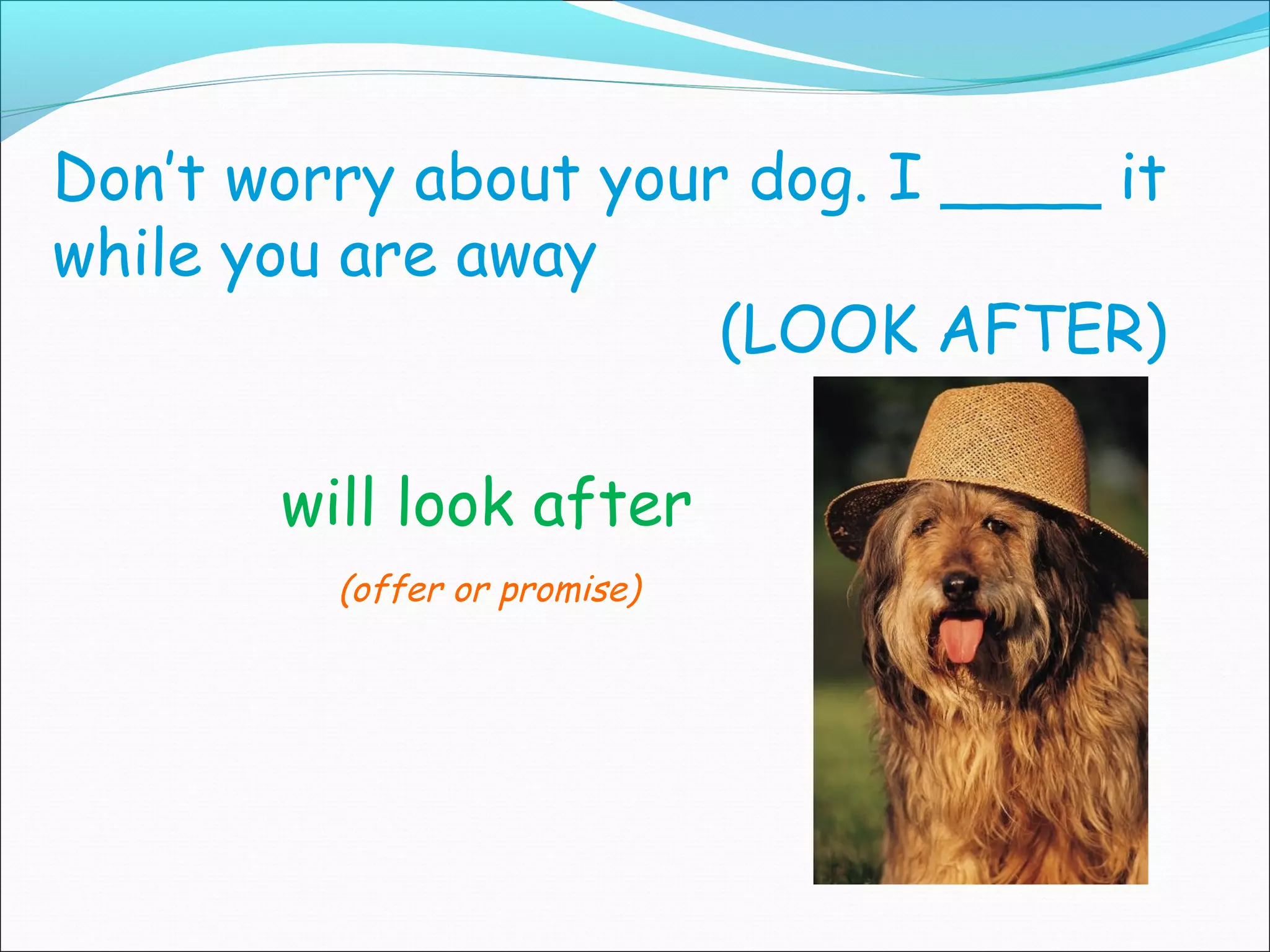
Don’t worry about your dog. I ____ it
while you are away
                      (LOOK AFTER)

       will look after
         (offer or promise)
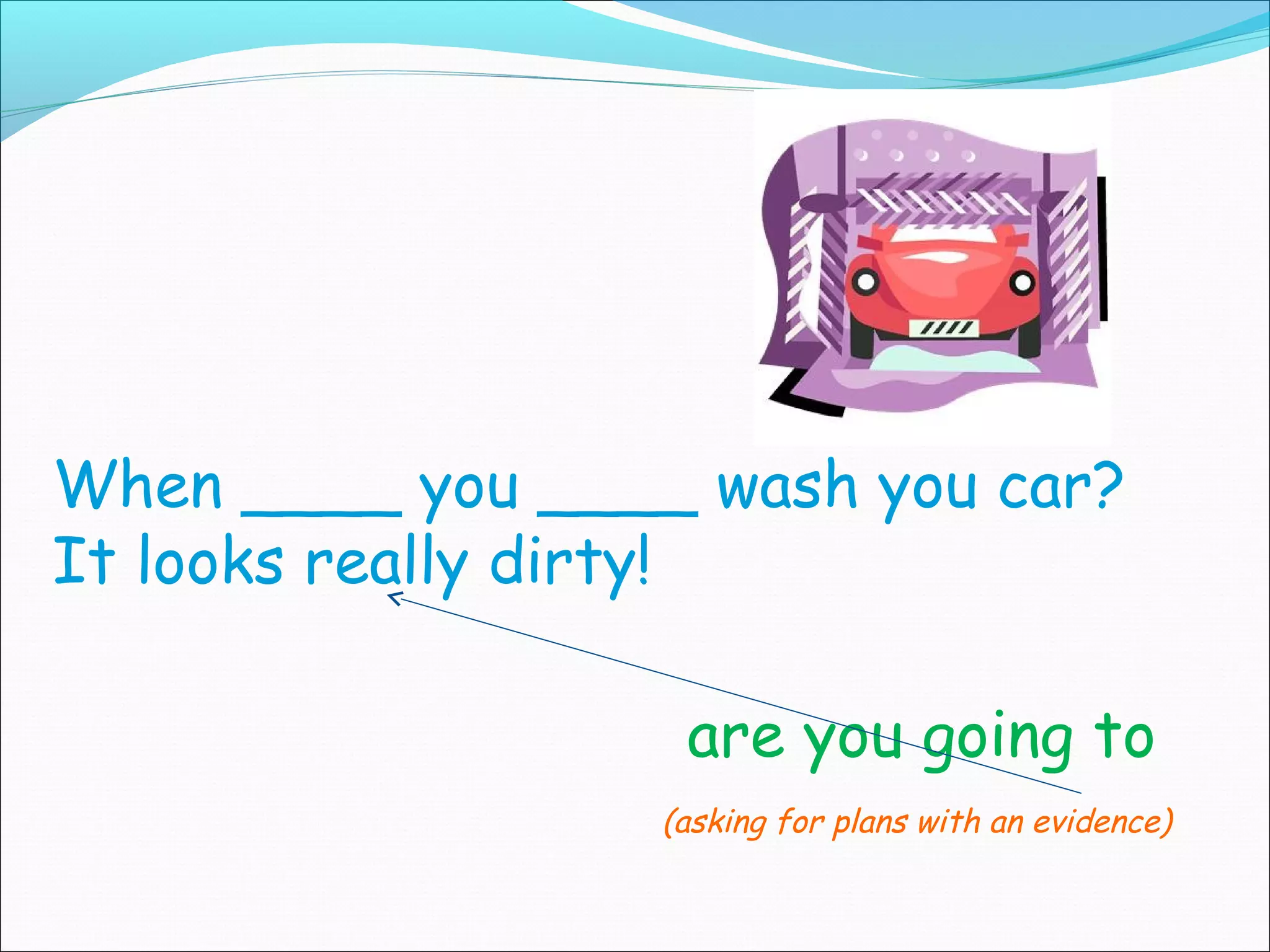
When ____ you ____ wash you car?
It looks really dirty!

                   are you going to
                  (asking for plans with an evidence)
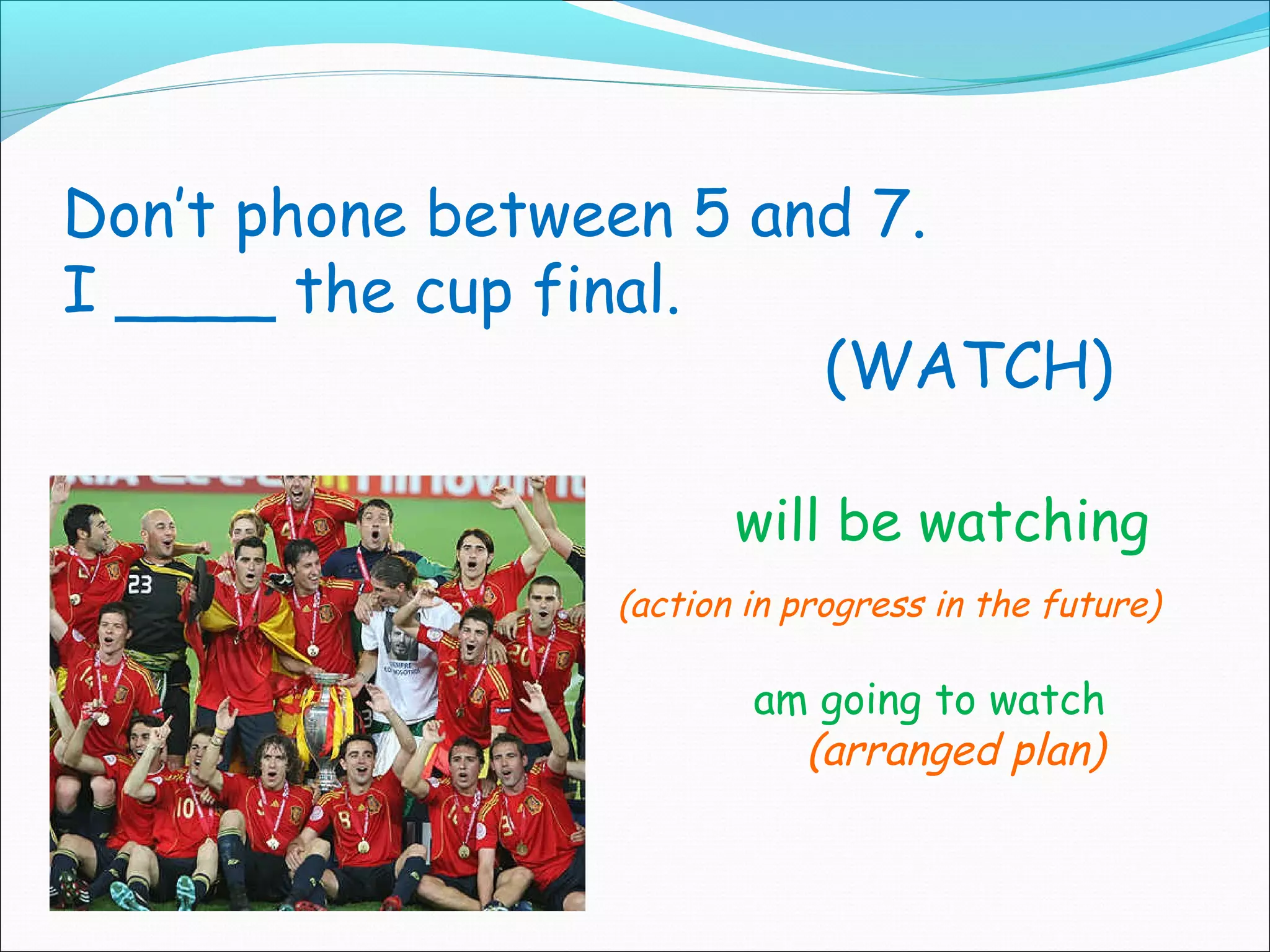
Don’t phone between 5 and 7.
I ____ the cup final.
                        (WATCH)

                       will be watching
                (action in progress in the future)

                        am going to watch
                          (arranged plan)
Be due to + infinitive
Be due to is used to refer to fixed events happening at a
specific time:

The film is due to start at 8 pm.
Half of our employees are due to retire in five years.
Negotiations were due to take place later that week.
Be about to + infinitive
Be about to refers to arranged actions happening in the
immediate future and is often used with just:

Hurry up! The ceremony is about to begin!
"Do you have a minute?" "I'm sorry, I'm just about to
 leave."
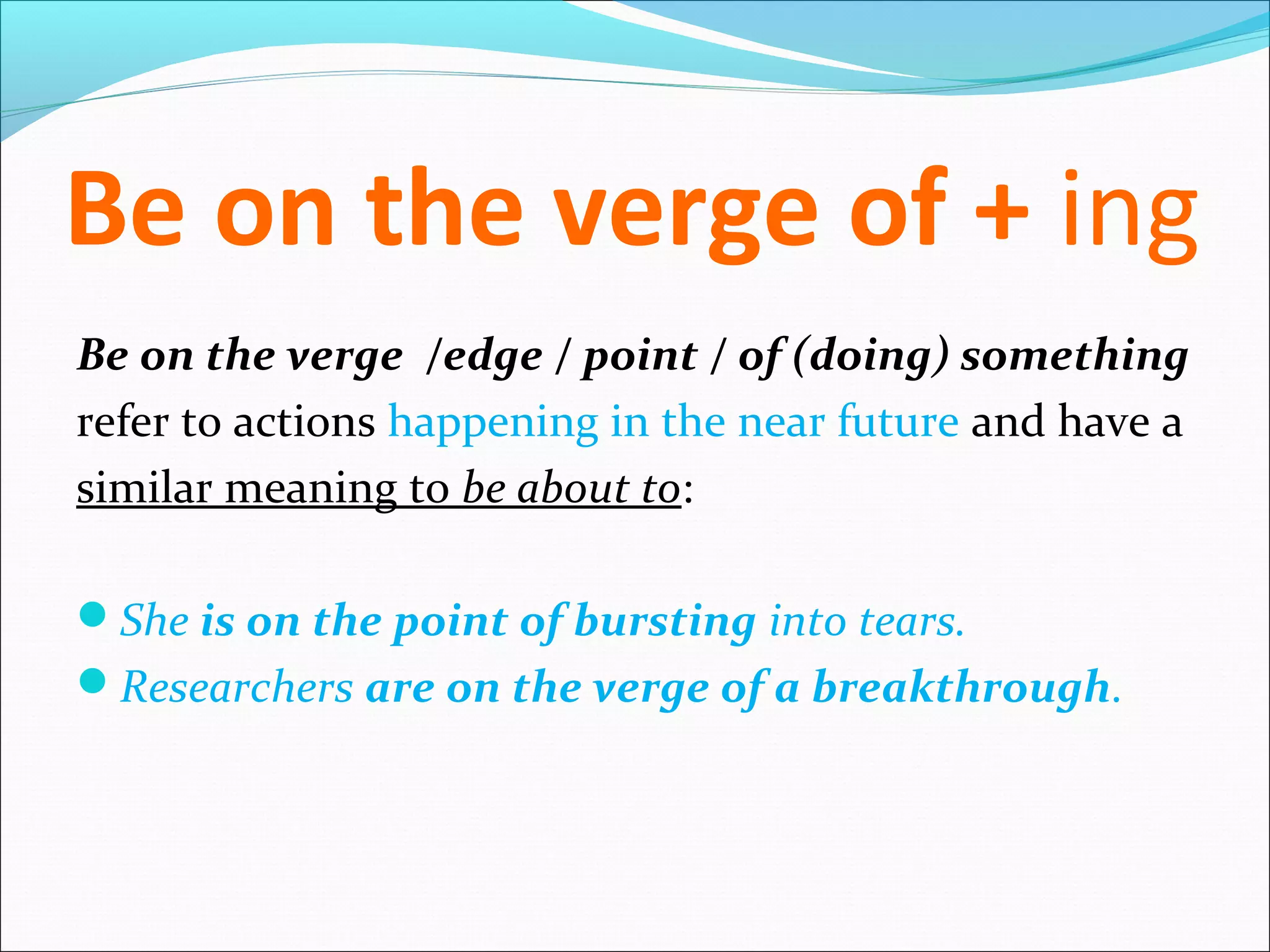
Be on the verge of + ing
Be on the verge /edge / point / of (doing) something
refer to actions happening in the near future and have a
similar meaning to be about to:

She is on the point of bursting into tears.
Researchers are on the verge of a breakthrough.
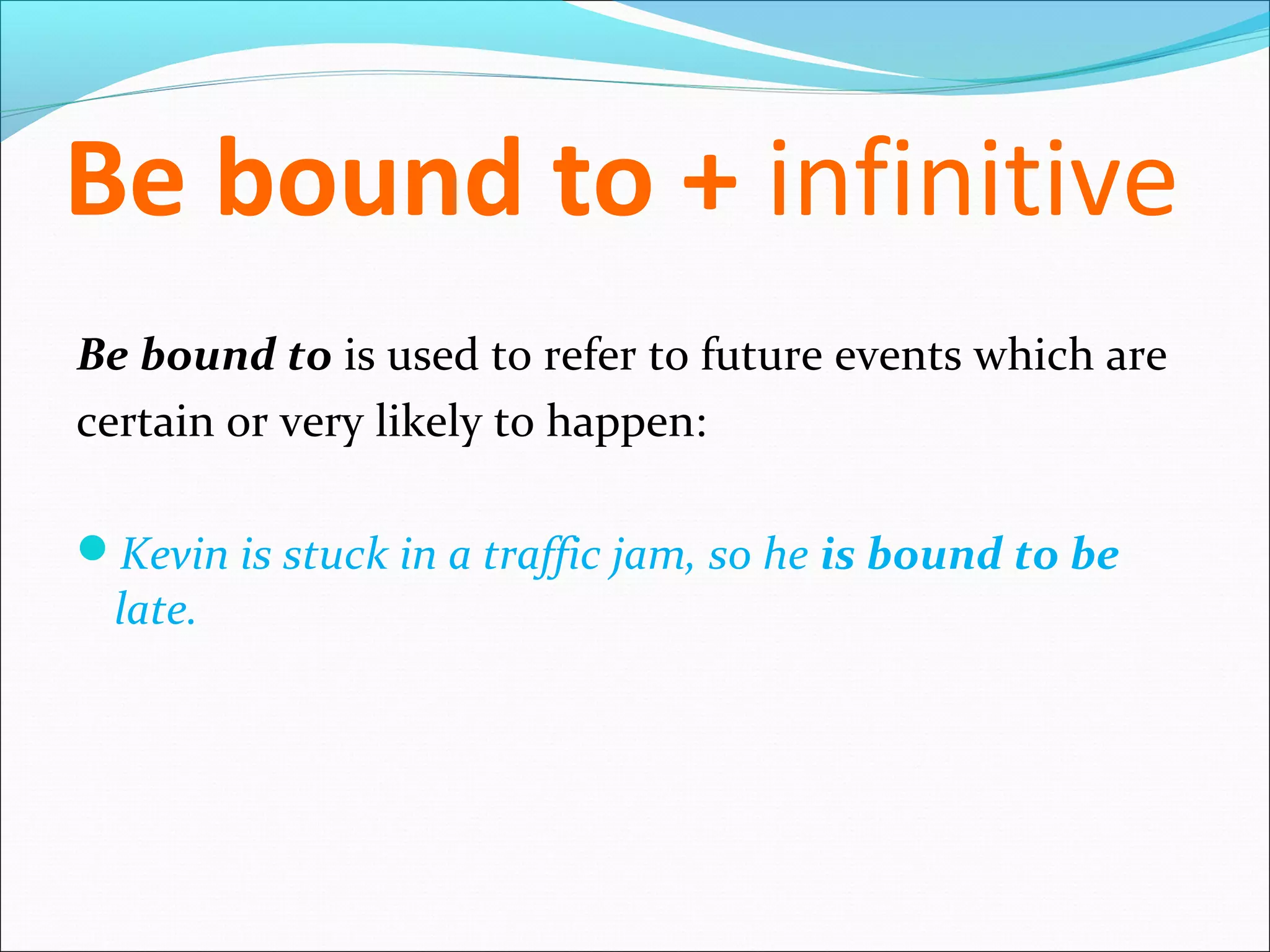
Be bound to + infinitive
Be bound to is used to refer to future events which are
certain or very likely to happen:

Kevin is stuck in a traffic jam, so he is bound to be
 late.
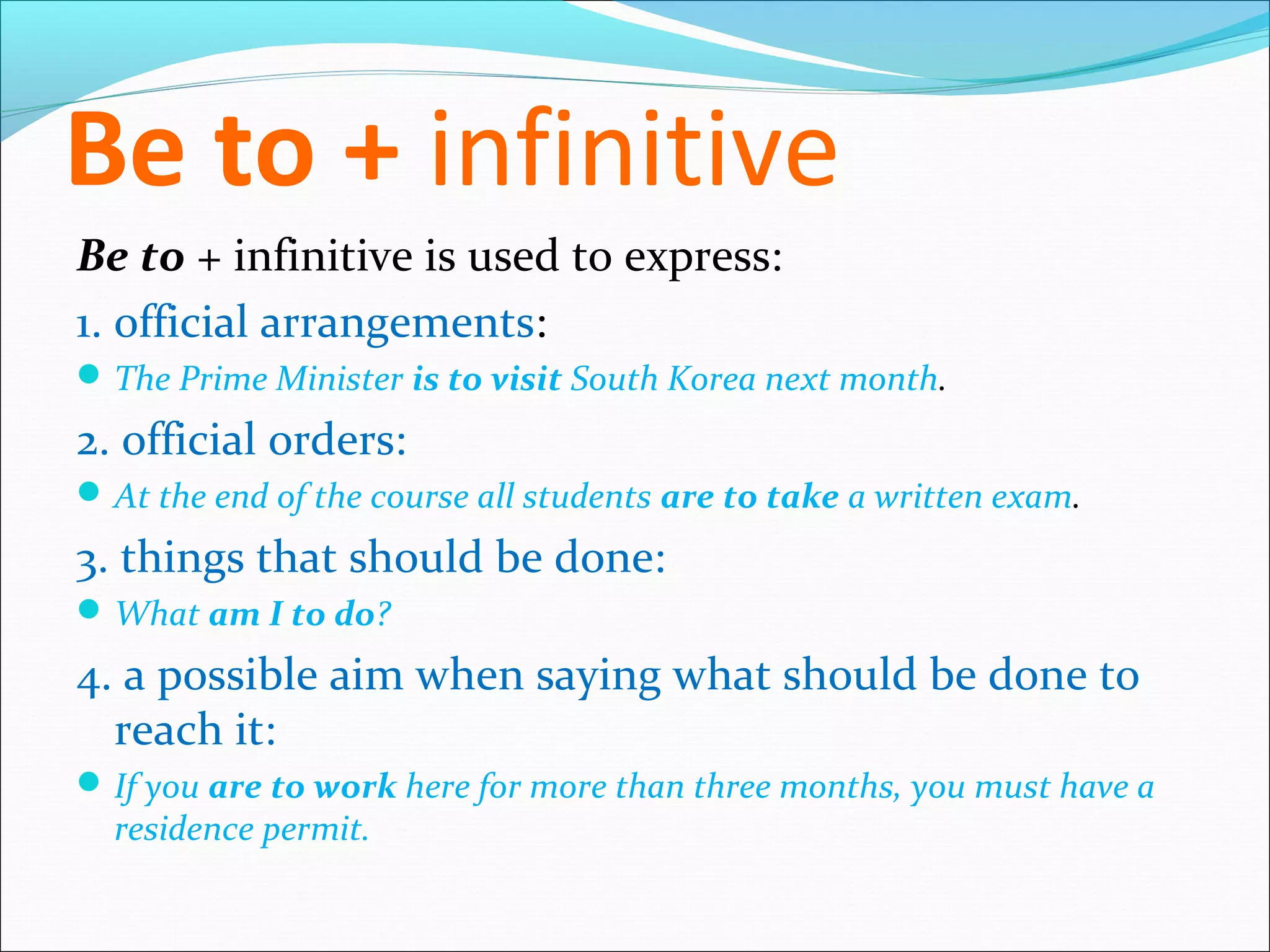
Be to + infinitive
Be to + infinitive is used to express:
1. official arrangements:
 The Prime Minister is to visit South Korea next month.

2. official orders:
 At the end of the course all students are to take a written exam.

3. things that should be done:
 What am I to do?

4. a possible aim when saying what should be done to
  reach it:
 If you are to work here for more than three months, you must have a
  residence permit.
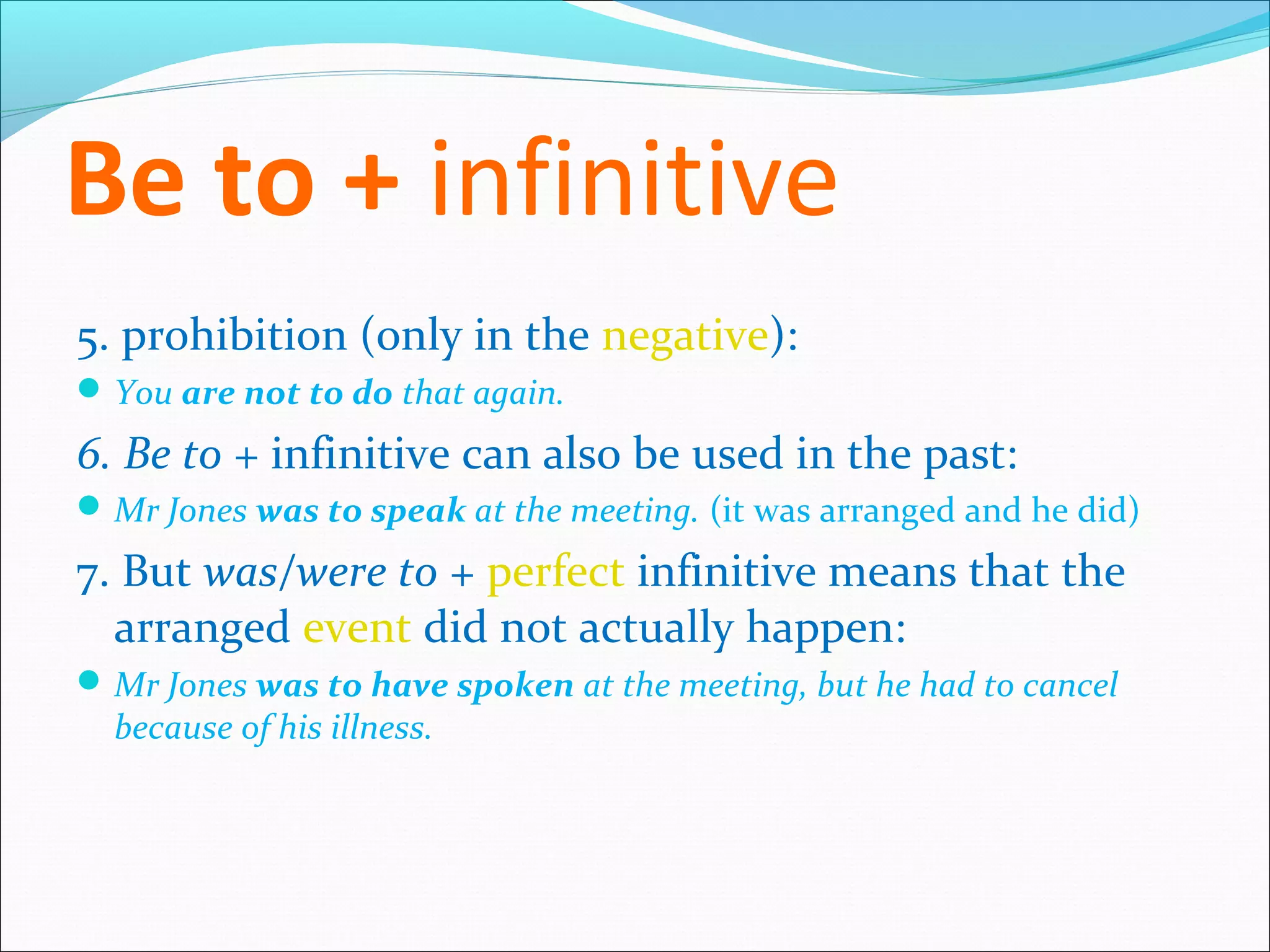
Be to + infinitive
5. prohibition (only in the negative):
 You are not to do that again.

6. Be to + infinitive can also be used in the past:
 Mr Jones was to speak at the meeting. (it was arranged and he did)

7. But was/were to + perfect infinitive means that the
  arranged event did not actually happen:
 Mr Jones was to have spoken at the meeting, but he had to cancel
  because of his illness.
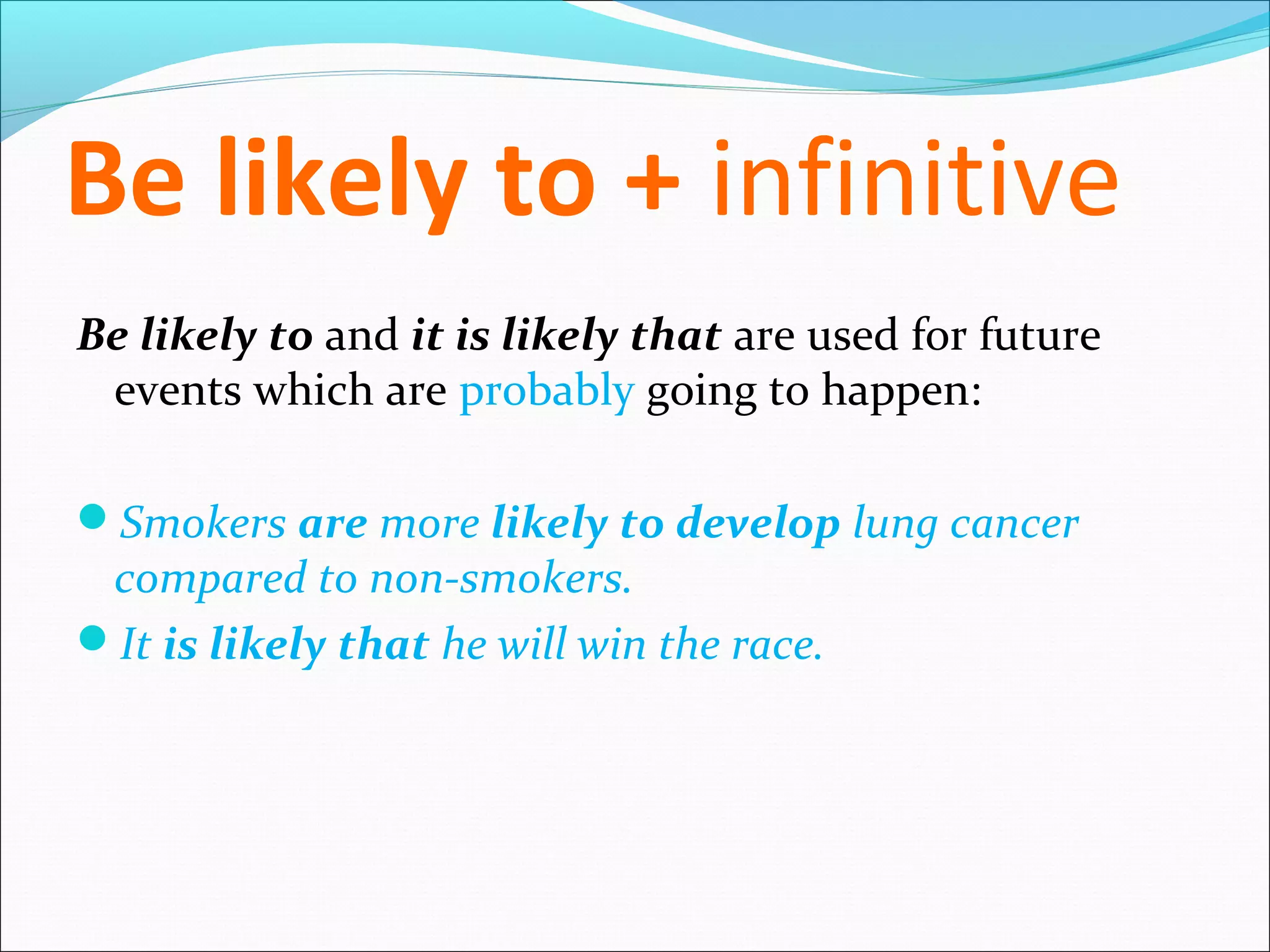
Be likely to + infinitive
Be likely to and it is likely that are used for future
 events which are probably going to happen:

Smokers are more likely to develop lung cancer
 compared to non-smokers.
It is likely that he will win the race.
Great! Well done!

Future tenses revision_intensive

  • 1.
  • 2.
    Future simple Will + base form  Spontaneous decisions  Let’s go, I’ll buy you an ice-cream!  Time clauses & Conditionals  If I win the lottery, I’ll buy a boat  Promises and offers  I’ll help you with your luggage!  Predictions which are not sure to happen  Next year the school will move to a new building  After “I think…”  I think I’ll take a short nap. I’m so tired
  • 3.
    Future with “goingto” Be going to + base form  Future plans and arrangements  We are going to New York at Christmas Predictions based on an evidence  Look at those dark clouds. It’s going to rain.
  • 4.
    Future Continuous Will be + ing  to express an action in progress at a certain time in the future.  This time next week, we will be having fun at the Christmas party! To ask about someone’s plans  Will you be seeing Laura this evening?
  • 5.
    Future Perfect Will have + past participle  to express an action that will be complete in the future  In 4 weeks’ time we will have started a new year
  • 6.
    How well canyou use these tenses? I can’t believe that in June we _______ married for 20 years! (BE) will have been (action complete in the future)
  • 7.
    We ___ backbefore six unless we catch the earlier train (NOT BE) won’t be (1st conditional)
  • 8.
    Oh no! Lookat that traffic. We __ ! (BE LATE) are going to be (prediction based on an evidence)
  • 9.
    What do youthink we ____ this time next year? (DO) will be doing (action happening at a specific point in the future) (1st conditional)
  • 10.
    I’ll tell youwhat the plans are as soon as I _____ them. (KNOW) know (time clause)
  • 11.
    By the endof this course you ___ 1,000 words. (LEARN) will have learned/learnt (action completed in the future)
  • 12.
    I can’t meetyou at 9:00. I ____ my maths exam. It starts at 8:30 (DO) will be doing (action in progress in the future)
  • 13.
    __ you ___anywhere interesting this weekend? (GO) Are you going (asking for future plans) Will you be going (asking for plans which are sure to happen if you know this person always goes somewhere at weekends)
  • 14.
    If we don’thurry, by the time we get there the concert____. (START) will have started (the action of “starting” will be complete)
  • 15.
    Don’t forget we____ dinner at your sister’s this evening. (HAVE) are having / are going to have (future arrangements)
  • 16.
    I ___ allmy homework after dinner. I promise! (DO) will do
  • 17.
    Do you thinkthe flight _____ on time? It took off a bit late! (ARRIVE) is going to arrive (prediction based on evidence) will arrive (normal prediction)
  • 18.
    You are sureto recognise me at the station. I ____ a pink tie! (WEAR) will be wearing (notice that we always use the verb “wear” in the continuous form! and we are referring to a specific time in the future)
  • 19.
    Don’t worry aboutyour dog. I ____ it while you are away (LOOK AFTER) will look after (offer or promise)
  • 20.
    When ____ you____ wash you car? It looks really dirty! are you going to (asking for plans with an evidence)
  • 21.
    Don’t phone between5 and 7. I ____ the cup final. (WATCH) will be watching (action in progress in the future) am going to watch (arranged plan)
  • 23.
    Be due to+ infinitive Be due to is used to refer to fixed events happening at a specific time: The film is due to start at 8 pm. Half of our employees are due to retire in five years. Negotiations were due to take place later that week.
  • 24.
    Be about to+ infinitive Be about to refers to arranged actions happening in the immediate future and is often used with just: Hurry up! The ceremony is about to begin! "Do you have a minute?" "I'm sorry, I'm just about to leave."
  • 25.
    Be on theverge of + ing Be on the verge /edge / point / of (doing) something refer to actions happening in the near future and have a similar meaning to be about to: She is on the point of bursting into tears. Researchers are on the verge of a breakthrough.
  • 26.
    Be bound to+ infinitive Be bound to is used to refer to future events which are certain or very likely to happen: Kevin is stuck in a traffic jam, so he is bound to be late.
  • 27.
    Be to +infinitive Be to + infinitive is used to express: 1. official arrangements:  The Prime Minister is to visit South Korea next month. 2. official orders:  At the end of the course all students are to take a written exam. 3. things that should be done:  What am I to do? 4. a possible aim when saying what should be done to reach it:  If you are to work here for more than three months, you must have a residence permit.
  • 28.
    Be to +infinitive 5. prohibition (only in the negative):  You are not to do that again. 6. Be to + infinitive can also be used in the past:  Mr Jones was to speak at the meeting. (it was arranged and he did) 7. But was/were to + perfect infinitive means that the arranged event did not actually happen:  Mr Jones was to have spoken at the meeting, but he had to cancel because of his illness.
  • 29.
    Be likely to+ infinitive Be likely to and it is likely that are used for future events which are probably going to happen: Smokers are more likely to develop lung cancer compared to non-smokers. It is likely that he will win the race.
  • 30.