Housekeeping   One thing you need to write down— http://21stcenturylearning.wikispaces.com
Learner-centered, lifelong learning has been the cry of knowledge society visionaries for the last decade. Yet learning continues to be delivered with teacher-centric tools in a 8-10 week graded format.  Society is changing. Learners needs are changing.   Schools as we know them, as a model for learning, are being challenged by communities and networks, which are better able to attend to the varied characteristics of the learning process by using multiple approaches, orchestrated within a learning ecology.
Are you Ready for Leading in the 21st Century It isn’t just “coming”… it has arrived! And schools who aren’t redefining themselves, risk becoming irrelevant in preparing students for the future.
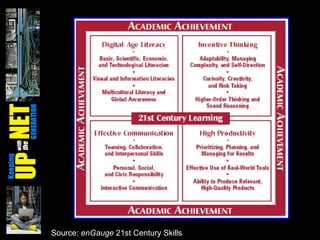
Source:  enGauge  21st Century Skills
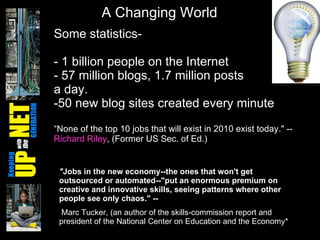
Some statistics- - 1 billion people on the Internet  57 million blogs, 1.7 million posts  a day. 50 new blog sites created every minute “ None of the top 10 jobs that will exist in 2010 exist today." --  Richard Riley , (Former US Sec. of Ed.) A Changing World " Jobs in the new economy--the ones that won't get outsourced or automated--"put an enormous premium on creative and innovative skills, seeing patterns where other people see only chaos." -- Marc Tucker, (an author of the skills-commission report and president of the National Center on Education and the Economy*
It is estimated that  1.5 exabytes of unique new information  will be generated  worldwide this year. That’s estimated to be  more than in the  previous 5,000 years. Knowledge Creation
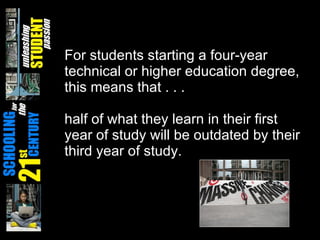
For students starting a four-year technical or higher education degree, this means that . . . half of what they learn in their first year of study will be outdated by their third year of study.
 
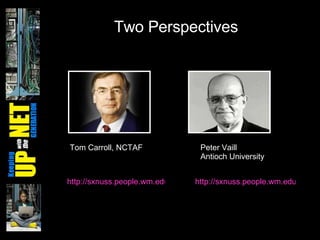
Two Perspectives Tom Carroll, NCTAF Peter Vaill  Antioch University http://sxnuss.people.wm.edu/tom_carroll.swf http://sxnuss.people.wm.edu/peter_vaill.swf
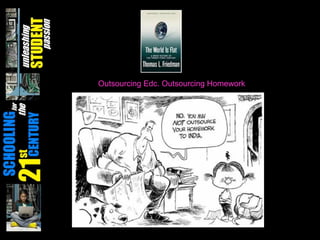
Outsourcing  Edc .   Outsourcing Homework
Creativity Creativity is now as important in education as literacy and we should treat it with the same status. If you're not prepared to be wrong then you will never come up with anything original.   We don't grow into creativity we grow out of it, or rather, we get educated out of it.
"Technological change is not additive, its ecological. A new technology does not change something, it changes everything" [Neil Postman]   Source: Mark Treadwell - http://www.i-learnt.com
 
Time Travel Lewis Perelman, author of  School's Out  (1992). Perelman argues that schools are out of sync with technological change:  . ..the technological gap between the school environment and the "real world" is growing so wide, so fast that the classroom experience is on the way to becoming not merely unproductive but increasingly irrelevant to normal human existence  (p.215).  Seymour Papert (1993) In the wake of the startling growth of science and technology in our recent past, some areas of human activity have undergone megachange. Telecommunications, entertainment and transportation, as well as medicine, are among them. School is a notable example of an area that has not (p.2).
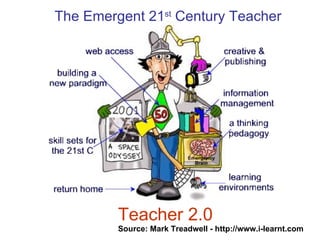
Teacher 2.0 The Emergent 21 st  Century Teacher Teacher 2.0 Source: Mark Treadwell   - http://www.i-learnt.com
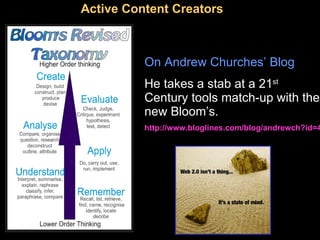
Active Content Creators On Andrew Churches’ Blog   He takes a stab at a 21 st  Century tools match-up with the new Bloom’s. http:// www.bloglines.com/blog/andrewch?id =4
 
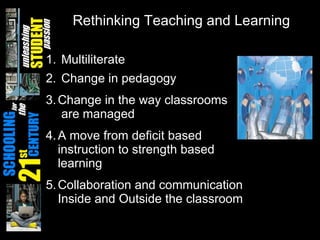
Rethinking Teaching and Learning Multiliterate Change in pedagogy   Change in the way classrooms  are managed A move from deficit based instruction to strength based learning Collaboration and communication Inside and Outside the classroom
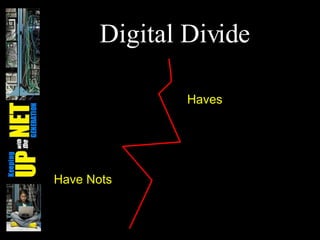
Digital Divide Have Nots Haves
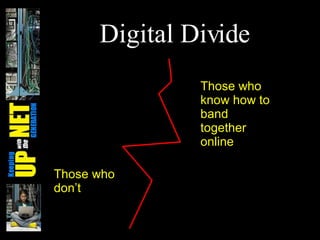
Digital Divide Those who don’t Those who know how to band together online
The truth is that parents of children with technology access at home will ensure that their children have this information advantage. Who will ensure that the children of poverty are given an equal opportunity?

Dimensions Of Change

  • 1.
  • 2.
    Housekeeping One thing you need to write down— http://21stcenturylearning.wikispaces.com
  • 3.
    Learner-centered, lifelong learninghas been the cry of knowledge society visionaries for the last decade. Yet learning continues to be delivered with teacher-centric tools in a 8-10 week graded format. Society is changing. Learners needs are changing. Schools as we know them, as a model for learning, are being challenged by communities and networks, which are better able to attend to the varied characteristics of the learning process by using multiple approaches, orchestrated within a learning ecology.
  • 4.
    Are you Readyfor Leading in the 21st Century It isn’t just “coming”… it has arrived! And schools who aren’t redefining themselves, risk becoming irrelevant in preparing students for the future.
  • 5.
    Source: enGauge 21st Century Skills
  • 6.
    Some statistics- -1 billion people on the Internet 57 million blogs, 1.7 million posts a day. 50 new blog sites created every minute “ None of the top 10 jobs that will exist in 2010 exist today." -- Richard Riley , (Former US Sec. of Ed.) A Changing World " Jobs in the new economy--the ones that won't get outsourced or automated--"put an enormous premium on creative and innovative skills, seeing patterns where other people see only chaos." -- Marc Tucker, (an author of the skills-commission report and president of the National Center on Education and the Economy*
  • 7.
    It is estimatedthat 1.5 exabytes of unique new information will be generated worldwide this year. That’s estimated to be more than in the previous 5,000 years. Knowledge Creation
  • 8.
    For students startinga four-year technical or higher education degree, this means that . . . half of what they learn in their first year of study will be outdated by their third year of study.
  • 9.
  • 10.
    Two Perspectives TomCarroll, NCTAF Peter Vaill Antioch University http://sxnuss.people.wm.edu/tom_carroll.swf http://sxnuss.people.wm.edu/peter_vaill.swf
  • 11.
    Outsourcing Edc. Outsourcing Homework
  • 12.
    Creativity Creativity isnow as important in education as literacy and we should treat it with the same status. If you're not prepared to be wrong then you will never come up with anything original. We don't grow into creativity we grow out of it, or rather, we get educated out of it.
  • 13.
    "Technological change isnot additive, its ecological. A new technology does not change something, it changes everything" [Neil Postman] Source: Mark Treadwell - http://www.i-learnt.com
  • 14.
  • 15.
    Time Travel LewisPerelman, author of School's Out (1992). Perelman argues that schools are out of sync with technological change: . ..the technological gap between the school environment and the "real world" is growing so wide, so fast that the classroom experience is on the way to becoming not merely unproductive but increasingly irrelevant to normal human existence (p.215). Seymour Papert (1993) In the wake of the startling growth of science and technology in our recent past, some areas of human activity have undergone megachange. Telecommunications, entertainment and transportation, as well as medicine, are among them. School is a notable example of an area that has not (p.2).
  • 16.
    Teacher 2.0 TheEmergent 21 st Century Teacher Teacher 2.0 Source: Mark Treadwell - http://www.i-learnt.com
  • 17.
    Active Content CreatorsOn Andrew Churches’ Blog He takes a stab at a 21 st Century tools match-up with the new Bloom’s. http:// www.bloglines.com/blog/andrewch?id =4
  • 18.
  • 19.
    Rethinking Teaching andLearning Multiliterate Change in pedagogy Change in the way classrooms are managed A move from deficit based instruction to strength based learning Collaboration and communication Inside and Outside the classroom
  • 20.
  • 21.
    Digital Divide Thosewho don’t Those who know how to band together online
  • 22.
    The truth isthat parents of children with technology access at home will ensure that their children have this information advantage. Who will ensure that the children of poverty are given an equal opportunity?