By Mr Biswanath prusty
Features of fungi
• Fungi are eukaryotic organisms that include microorganisms such as
yeasts, moulds and mushrooms. These organisms are classified under
kingdom fungi.
• The organisms found in Kingdom fungi contain a cell wall and are
omnipresent. They are classified as heterotrophs among the living
organisms.
• To name a few – the appearance of black spots on bread left outside
for some days, the mushrooms and the yeast cells, which are
commonly used for the production of beer and bread are also fungi.
They are also found in most of the skin infections and other fungal
diseases.
Structure of fungi
The structure of fungi can be explained in the following points:
1.Almost all the fungi have a filamentous structure except the yeast cells.
2.They can be either single-celled or multicellular organism.
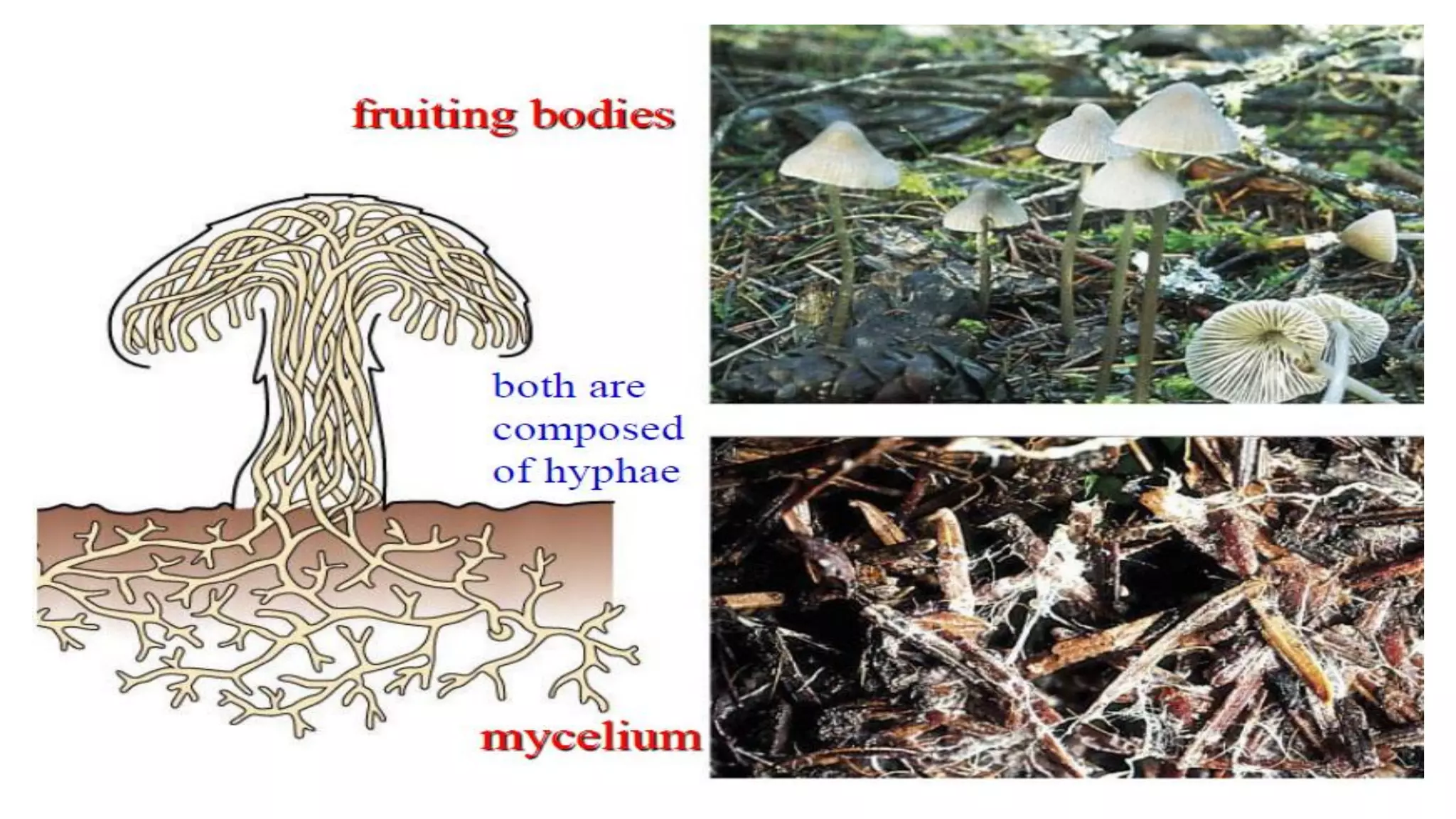
3.Fungi consist of long thread-like structures known as hyphae. These hyphae
together form a mesh-like structure called mycelium.
4.Fungi possess a cell wall which is made up of chitin and polysaccharides.
5.The cell wall comprises protoplast which is differentiated into other cell
parts such as cell membrane, cytoplasm, cell organelles and nuclei.
6.The nucleus is dense, clear, with chromatin threads. The nucleus is
surrounded by a nuclear membrane.
Characteristics of Fungi
Following are the important characteristics of fungi:
1.Fungi are eukaryotic, non-vascular, non-motile and heterotrophic organisms.
2.They may be unicellular or filamentous.
3.They reproduce by means of spores.
4.Fungi exhibit the phenomenon of alternation of generation.
5.Fungi lack chlorophyll and hence cannot perform photosynthesis.
6.Fungi store their food in the form of starch.
7.Biosynthesis of chitin occurs in fungi.
8.The nuclei of the fungi are very small.
9.The fungi have no embryonic stage. They develop from the spores.
10.The mode of reproduction is sexual or asexual.
11.Some fungi are parasitic and can infect the host.
12.Fungi produce a chemical called pheromone which leads to sexual reproduction in
fungi.
13.Examples include mushrooms, moulds, yeast.
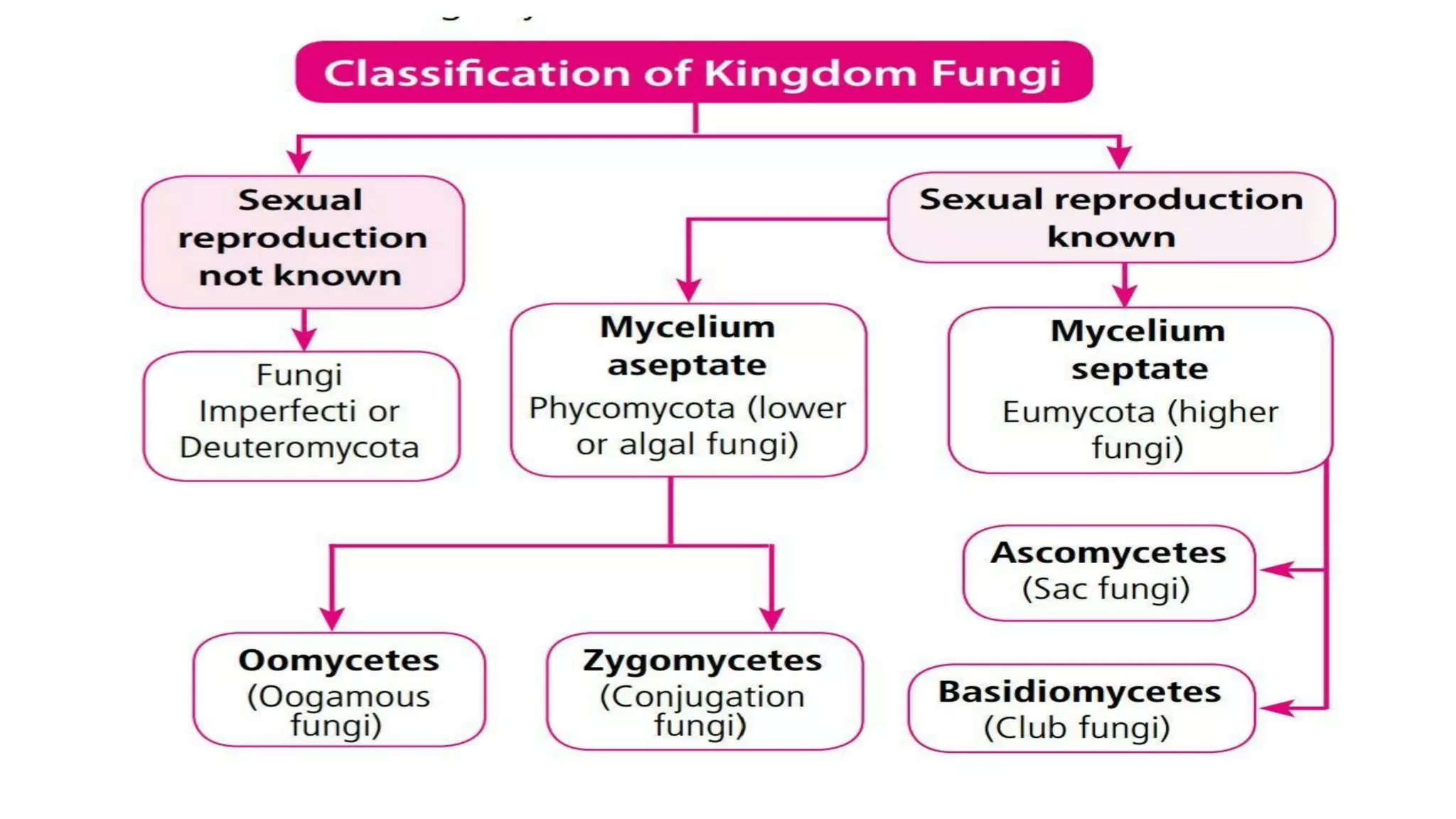
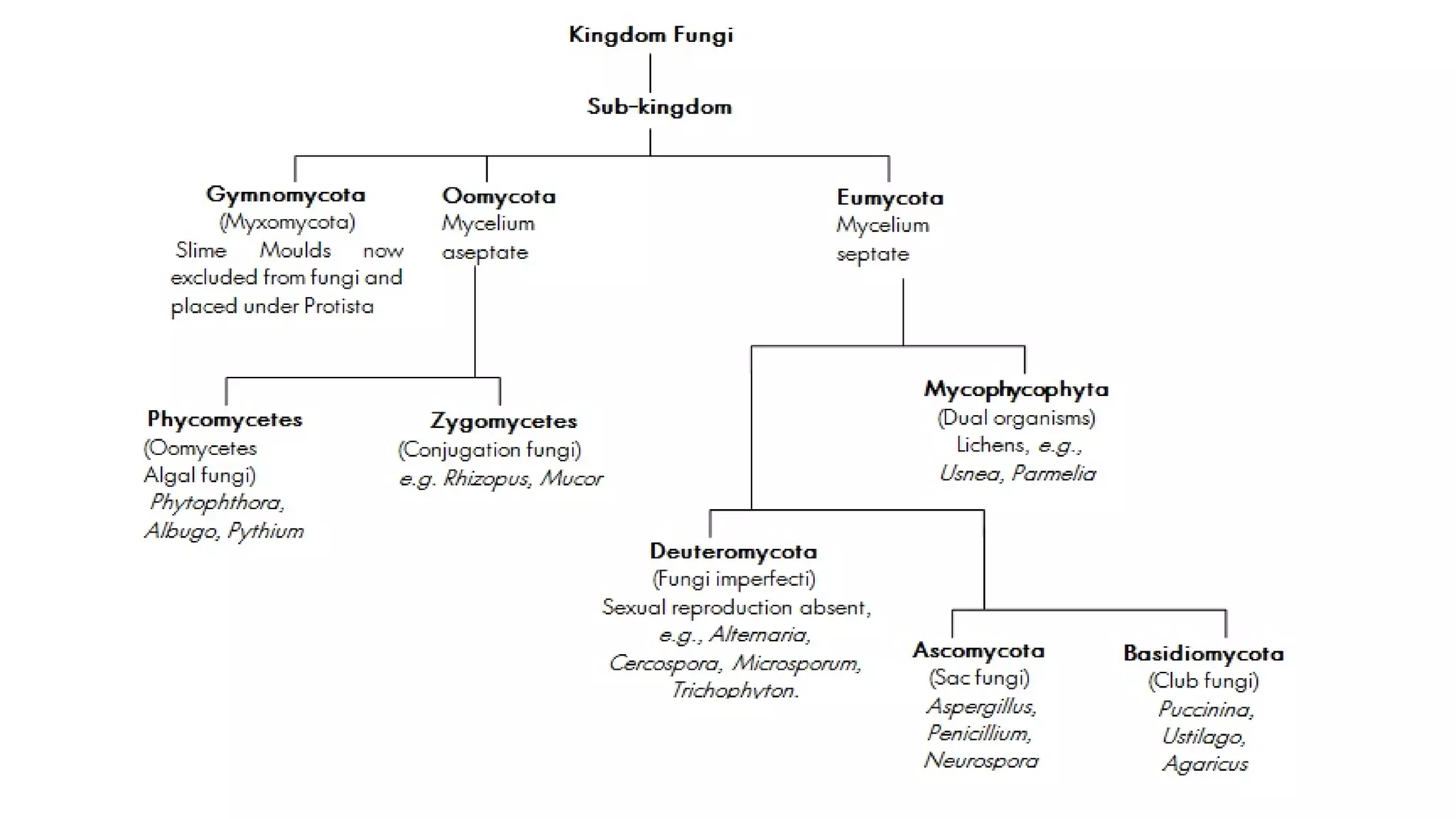
Classification of Fungi
Kingdom Fungi are classified based on different modes. The different classification of
fungi is as follows:
Based on Mode of nutrition
On the basis of nutrition, kingdom fungi can be classified into 3 groups.
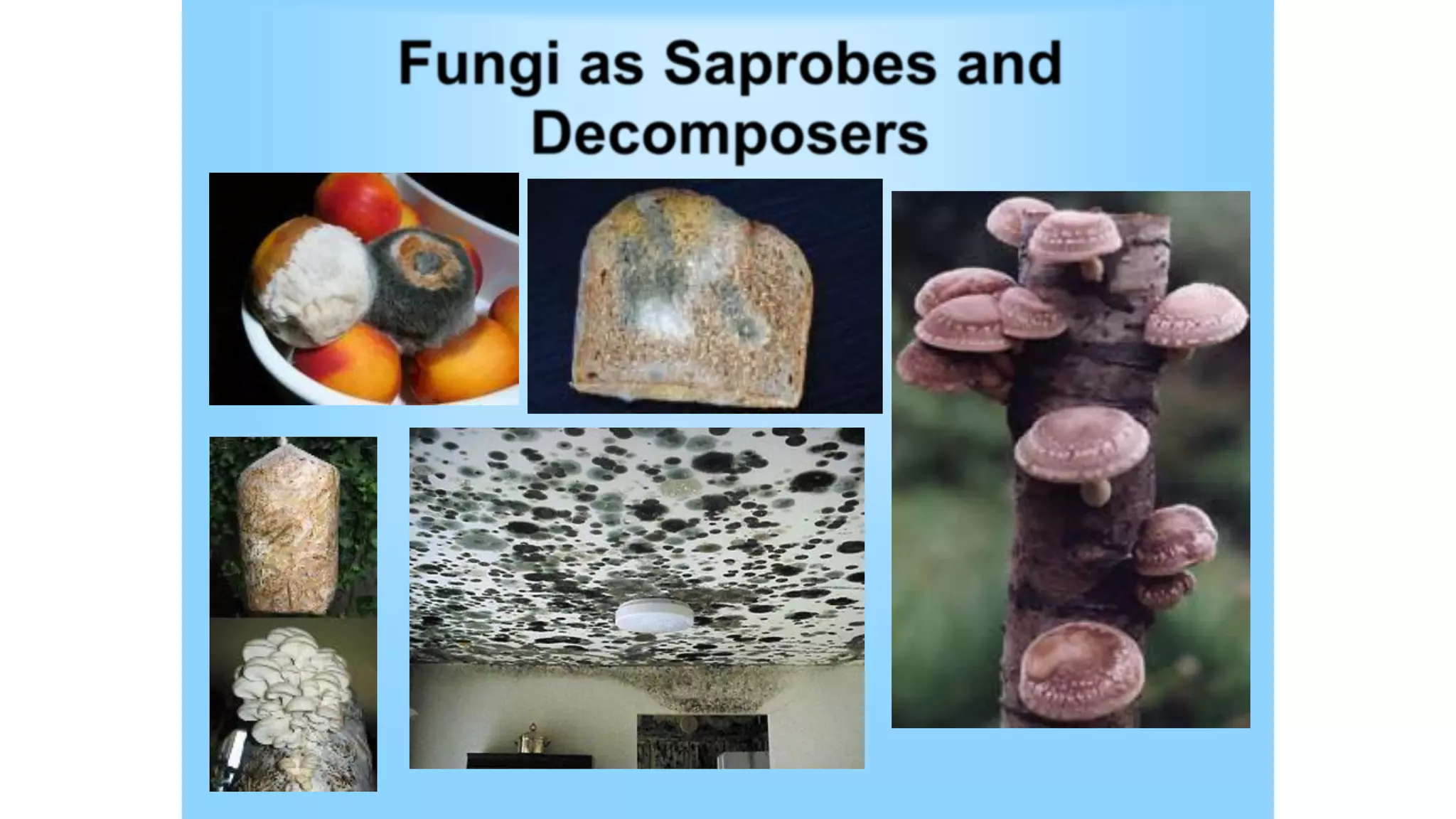
1.Saprophytic – The fungi obtain their nutrition by feeding on dead organic
substances. Examples: Rhizopus, Penicillium and Aspergillus.
2.Parasitic – The fungi obtain their nutrition by living on other living organisms (plants
or animals) and absorb nutrients from their host. Examples: Taphrina and Puccinia.
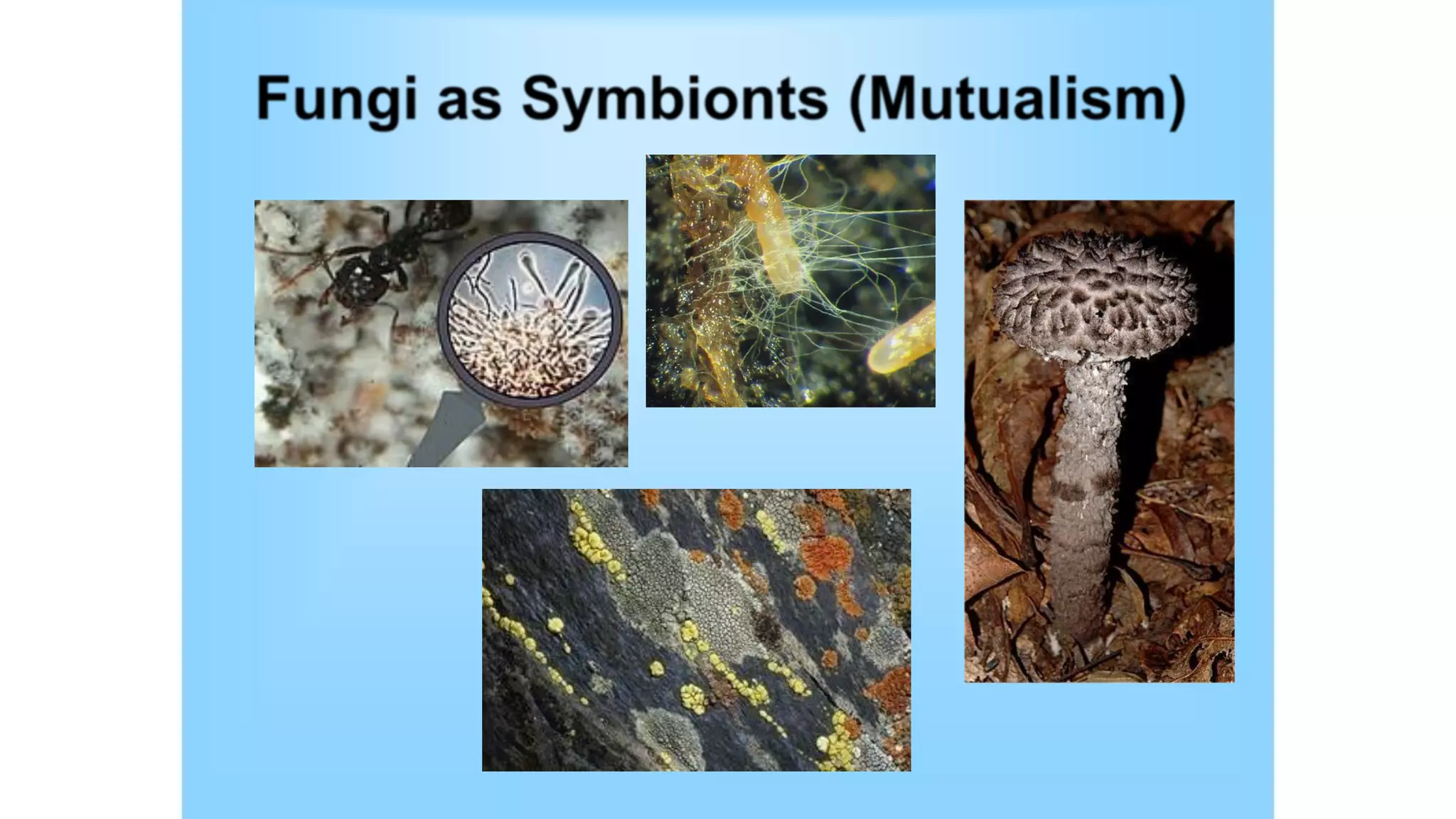
3.Symbiotic – These fungi live by having an interdependent relationship association
with other species in which both are mutually benefited. Examples: Lichens and
mycorrhiza.
Lichens are the symbiotic association between algae and fungi. Here both algae and
fungi are mutually benefited as fungi provide shelter for algae and in reverse algae
synthesis carbohydrates for fungi.
Based on Spore Formation
Kingdom Fungi are classified into the following based on the formation of spores:
1.Zygomycetes – These are formed by the fusion of two different cells. The
sexual spores are known as zygospores while the asexual spores are known as
sporangiospores. The hyphae are without the septa.
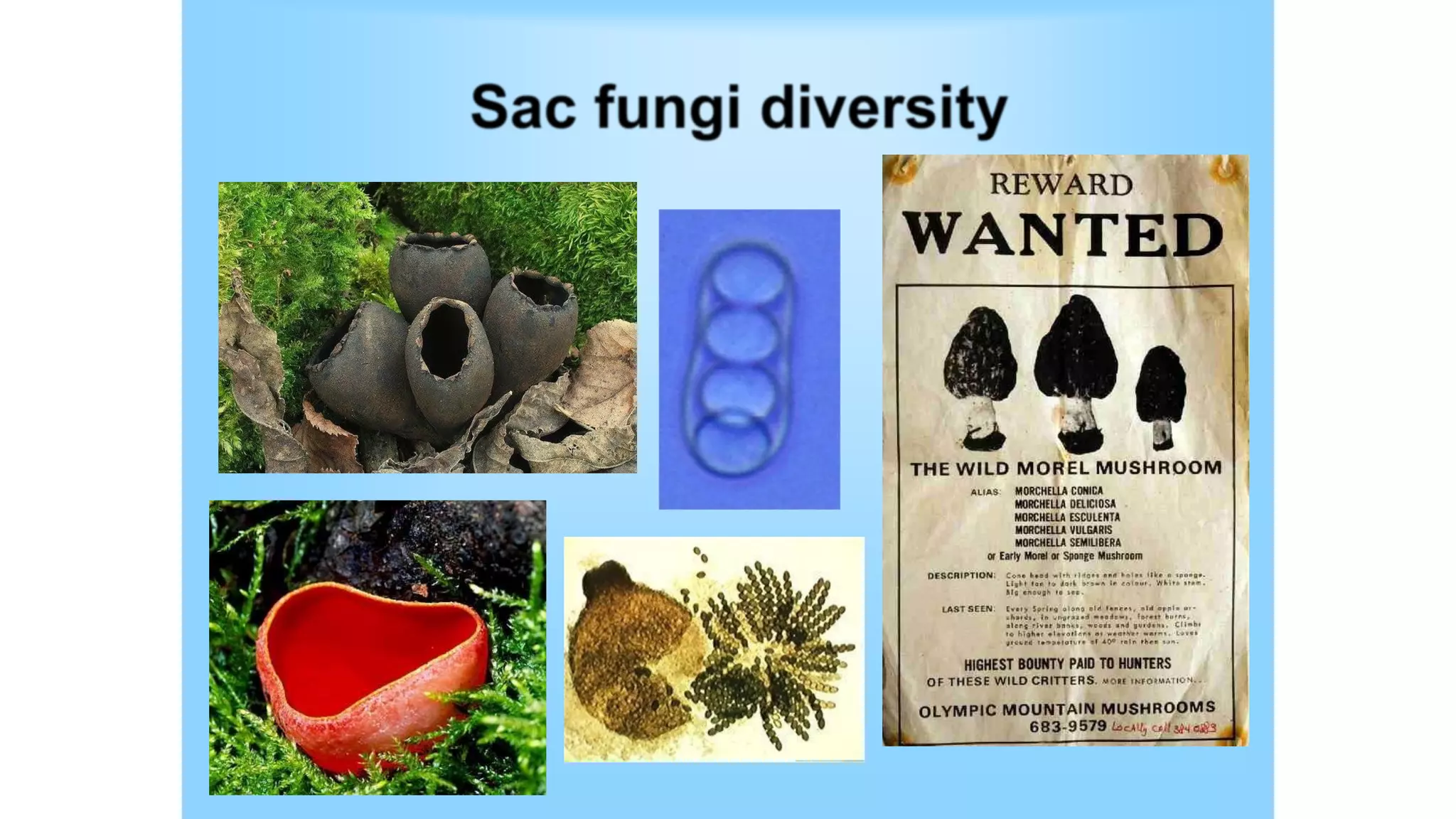
2.Ascomycetes – They are also called as sac fungi. They can be coprophilous,
decomposers, parasitic or saprophytic. The sexual spores are called ascospores.
Asexual reproduction occurs by conidiospores. Example – Saccharomyces
3.Basidiomycetes – Mushrooms are the most commonly found basidiomycetes
and mostly live as parasites. Sexual reproduction occurs by basidiospores.
Asexual reproduction occurs by conidia, budding or fragmentation. Example-
Agaricus
4.Deuteromycetes – They are otherwise called imperfect fungi as they do not
follow the regular reproduction cycle as the other fungi. They do not reproduce
sexually. Asexual reproduction occurs by conidia. Example – Trichoderma.
• “Fungus roots”
• Mutualism between:
* Fungus (nutrient & water uptake for plant)
* Plant (carbohydrate for fungus)
• Several kinds
* Zygomycota – hyphae invade root cells
* Ascomycota & Basidiomycota – hyphae invade root but
don’t penetrate cells
• Extremely important ecological role of fungi
Russula
mushroom
mycorrhizas on
Western
Hemlock root
Fungal hyphae
around root and
between cells
Mycorrhiza cross sections
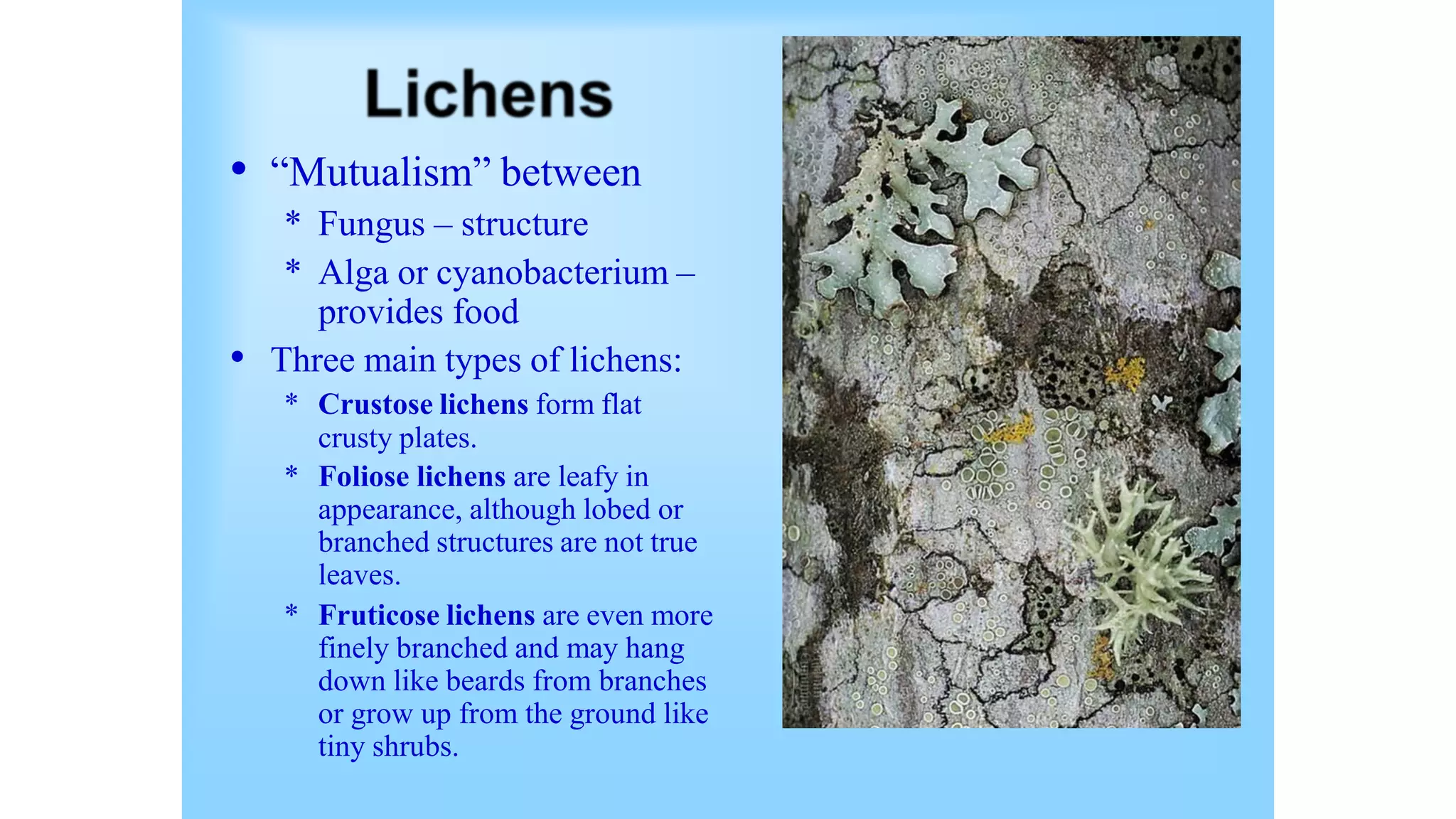
• “Mutualism” between
* Fungus – structure
* Alga or cyanobacterium –
provides food
• Three main types of lichens:
* Crustose lichens form flat
crusty plates.
* Foliose lichens are leafy in
appearance, although lobed or
branched structures are not true
leaves.
* Fruticose lichens are even more
finely branched and may hang
down like beards from branches
or grow up from the ground like
tiny shrubs.
• Spores - asexual (product of
mitosis) or sexual (product of
meiosis) in origin.
• Purpose of Spores
* Allows the fungus to move
to new food source.
* Resistant stage - allows
fungus to survive periods of
adversity.
* Means of introducing new
genetic combinations into a
population
• Spores are reproductive cells
* Sexual (meiotic in origin)
* Asexual (mitotic in origin)
• Formed:
* Directly on hyphae
* Inside sporangia
* Fruiting bodies
Penicillium hyphae
with conidia
Pilobolus sporangia
Amanita fruiting body
germinating
spore
mycelium
• Mycelia have a huge surface area
The Characteristics of Fungi
• Fungus is often hidden from view. It grows
through its food source (substratum),
excretes extracellular digestive enzymes,
and absorbs dissolved food.
• Indeterminate clonal growth.
• Vegetative phase of fungus is generally
sedentary.
The Characteristics of Fungi
• Cell wall present, composed of cellulose and/or chitin.
• Food storage - generally in the form of lipids and glycogen.
• Eukaryotes - true nucleus and other organelles present.
• All fungi require water and oxygen (no obligate anaerobes).
• Fungi grow in almost every habitat imaginable, as long as there
is some type of organic matter present and the environment is
not too extreme.
• Diverse group, number of described species is somewhere
between 69,000 to 100,000 (estimated 1.5 million species total).
motile spores
zygosporangia
asci
• Simple fungi
• Produce motile spores -
zoospores
• Mostly saprobes and
parasites in aquatic habitats
• Could just as well be
Protists Chytridium growing on spores
Chytriomyces growing on pine pollen
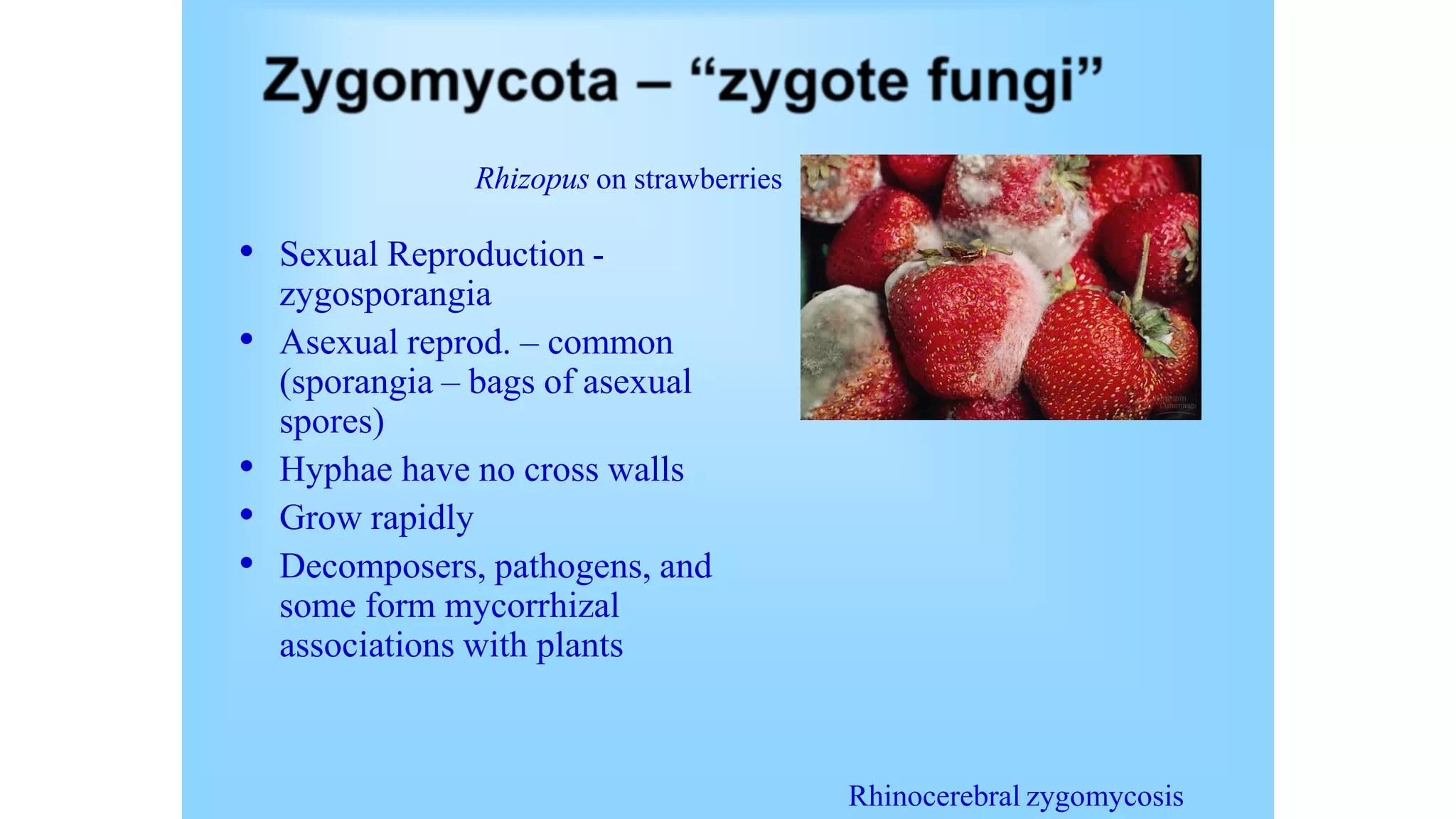
Rhizopus on strawberries
• Sexual Reproduction -
zygosporangia
• Asexual reprod. – common
(sporangia – bags of asexual
spores)
• Hyphae have no cross walls
• Grow rapidly
• Decomposers, pathogens, and
some form mycorrhizal
associations with plants
Rhinocerebral zygomycosis
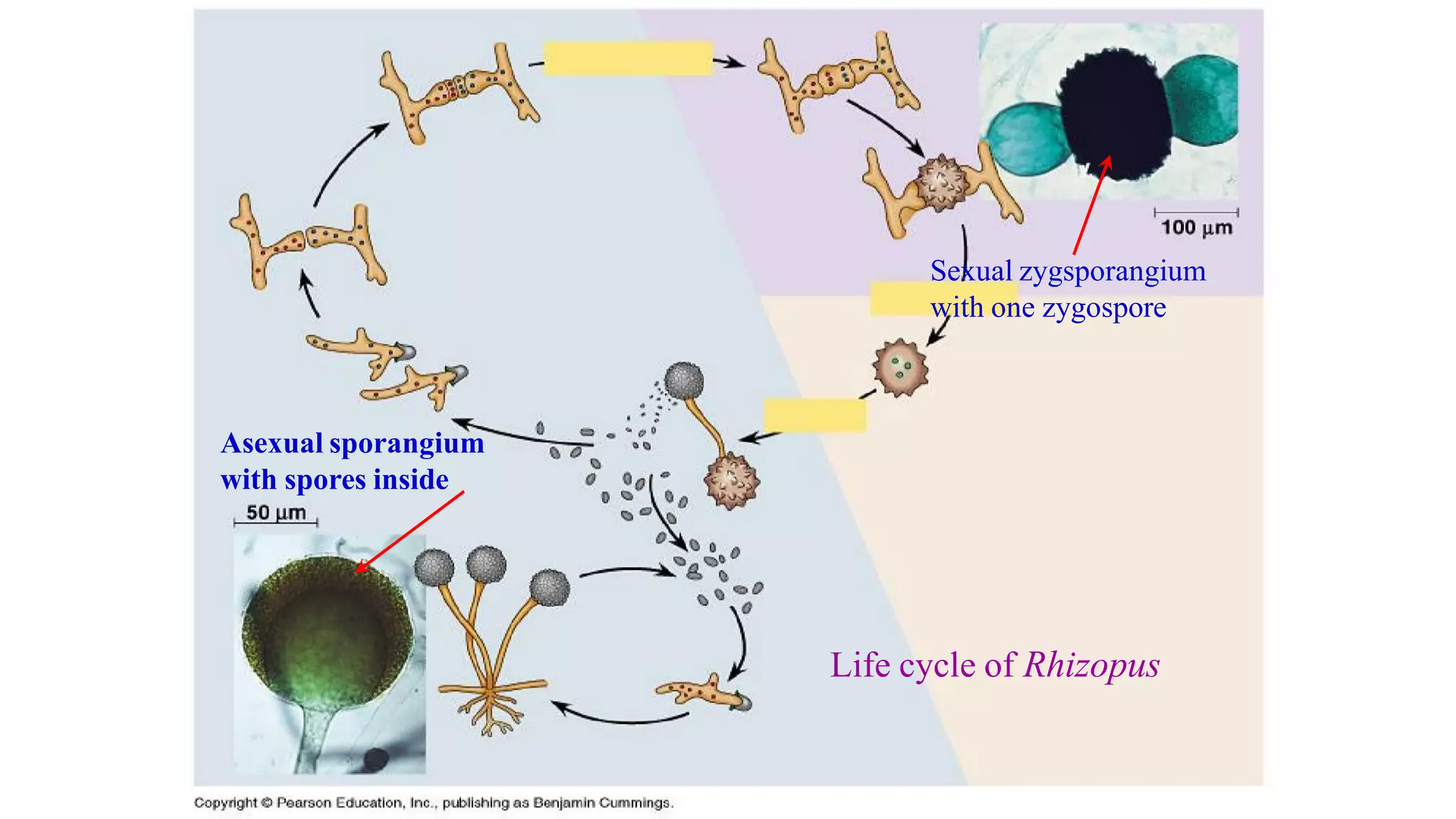
Life cycle of Rhizopus
Asexual sporangium
with spores inside
Sexual zygsporangium
with one zygospore
• Sexual Reproduction – asci
(sing. = ascus)
• Asex. Reprod. – common
• Cup fungi, morels, truffles
• Important plant parasites &
saprobes
• Yeast - Saccharomyces
• Decomposers, pathogens,
and found in most lichens
Acluster of asci with spores inside
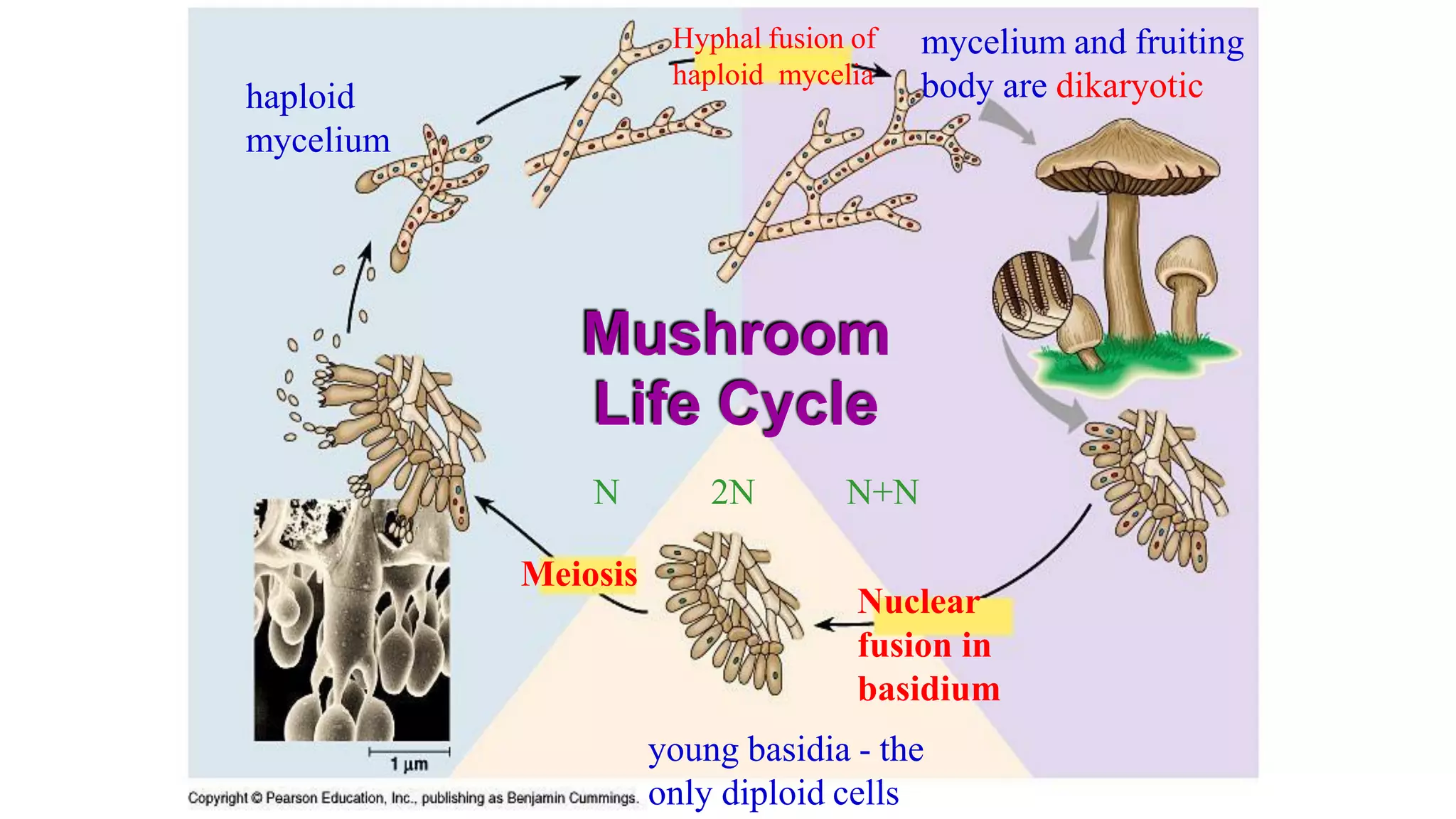
• Sexual Reproduction – basidia
• Asexual reprod – not so
• common
• Long-lived dikaryotic mycelia
• Rusts & smuts –plant parasites
• Mushrooms, polypores, puffballs, boletes, bird’s nest fungi
• Enzymes decompose wood, leaves, and other organic materials
• Decomposers, pathogens, and some form mycorrhizal
associations with plants SEM of basidia and spores
Meiosis
Hyphal fusion of
haploid mycelia
haploid
mycelium
Nuclear
fusion in
basidium
young basidia - the
only diploid cells
mycelium and fruiting
body are dikaryotic
Mushroom
Life Cycle
N 2N N+N
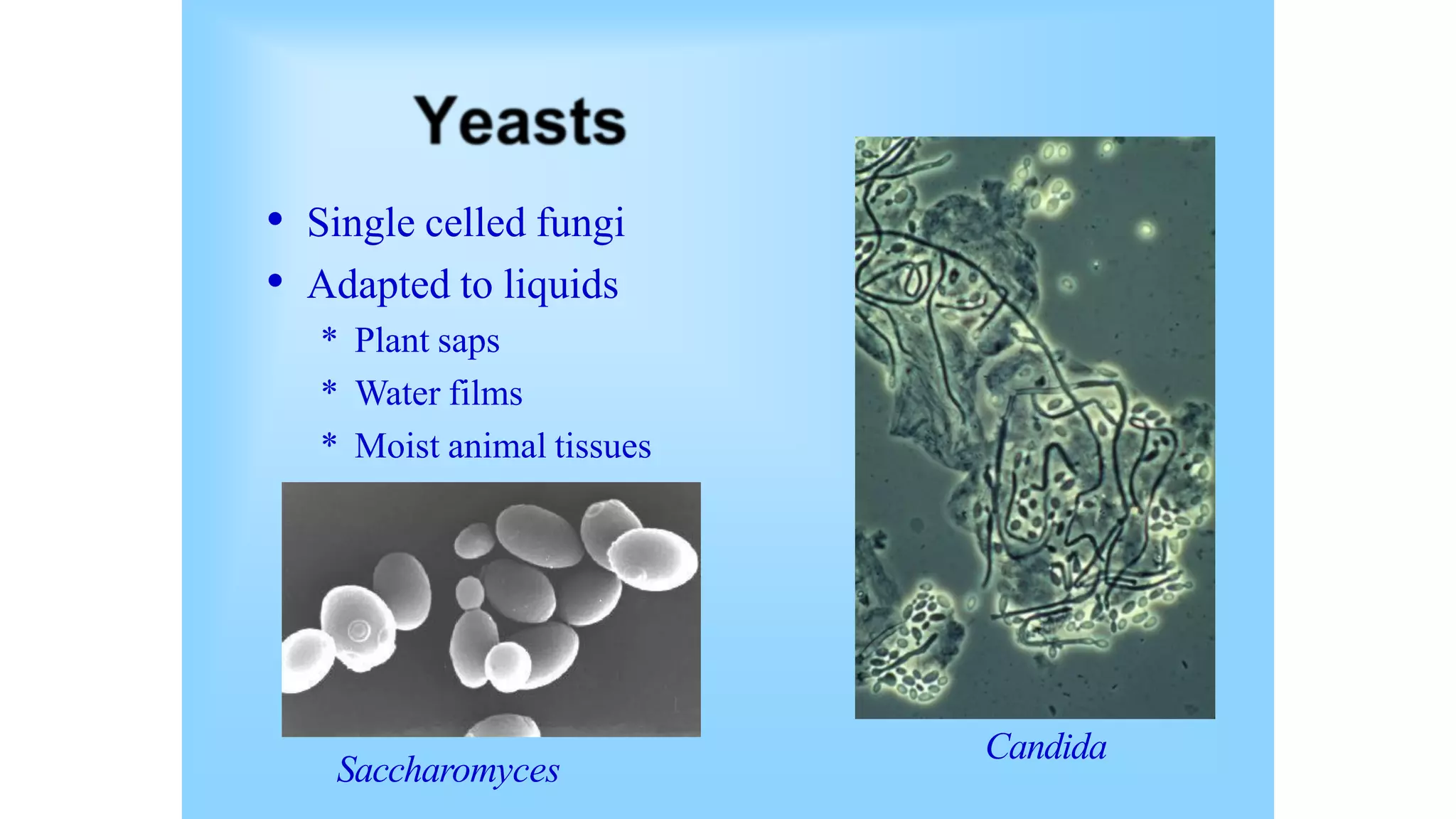
• Single celled fungi
• Adapted to liquids
* Plant saps
* Water films
* Moist animal tissues
Candida
Saccharomyces
• Rapidly growth
• Asexual spores
• Many human importances
* Food spoilage
* Food products
* Antibiotics, etc.
Fig 31.21Antibiotic activity
Noble Rot - Botrytis
• Beneficial Effects of Fungi
* Decomposition - nutrient and carbon recycling.
* Biosynthetic factories. Can be used to produce drugs, antibiotics,
alcohol, acids, food (e.g., fermented products, mushrooms).
* Model organisms for biochemical and genetic studies.
• Harmful Effects of Fungi
* Destruction of food, lumber, paper, and cloth.
* Animal and human diseases, including allergies.
* Toxins produced by poisonous mushrooms and within food (e.g.,
grain, cheese).
* Plant diseases.
Uses of Fungi
• Fungi are one of the most important groups of organisms on the planet as it plays a vital role in
the biosphere and has great economic importance on account of their both benefits and harmful
effects.
• Following are some of the important uses of fungi:
1.Recycling – They play a major role in recycling the dead and decayed matter.
2.Food – Mushrooms species are edible which are cultured and are used as food by humans.
3.Medicines – There are many fungi which are used to produce antibiotics, to control diseases in
humans and animals. Penicillin antibiotic is derived from a common fungi Penicillium.
4.Biocontrol Agents – Fungi are involved in exploiting insects, other small worms and help in
controlling pests. Spores of fungi are used as spray-on crops.
5.Food spoilage – Fungi play a major role in recycling organic material and are also responsible for
major spoilage and economic losses of stored food.
Examples of Fungi
Following are the common examples of fungi:
• Yeast
• Mushrooms
• Moulds
• Truffles

Kingdom of fungi by Bnp

  • 1.
  • 2.
    Features of fungi •Fungi are eukaryotic organisms that include microorganisms such as yeasts, moulds and mushrooms. These organisms are classified under kingdom fungi. • The organisms found in Kingdom fungi contain a cell wall and are omnipresent. They are classified as heterotrophs among the living organisms. • To name a few – the appearance of black spots on bread left outside for some days, the mushrooms and the yeast cells, which are commonly used for the production of beer and bread are also fungi. They are also found in most of the skin infections and other fungal diseases.
  • 3.
    Structure of fungi Thestructure of fungi can be explained in the following points: 1.Almost all the fungi have a filamentous structure except the yeast cells. 2.They can be either single-celled or multicellular organism. 3.Fungi consist of long thread-like structures known as hyphae. These hyphae together form a mesh-like structure called mycelium. 4.Fungi possess a cell wall which is made up of chitin and polysaccharides. 5.The cell wall comprises protoplast which is differentiated into other cell parts such as cell membrane, cytoplasm, cell organelles and nuclei. 6.The nucleus is dense, clear, with chromatin threads. The nucleus is surrounded by a nuclear membrane.
  • 6.
    Characteristics of Fungi Followingare the important characteristics of fungi: 1.Fungi are eukaryotic, non-vascular, non-motile and heterotrophic organisms. 2.They may be unicellular or filamentous. 3.They reproduce by means of spores. 4.Fungi exhibit the phenomenon of alternation of generation. 5.Fungi lack chlorophyll and hence cannot perform photosynthesis. 6.Fungi store their food in the form of starch. 7.Biosynthesis of chitin occurs in fungi. 8.The nuclei of the fungi are very small. 9.The fungi have no embryonic stage. They develop from the spores. 10.The mode of reproduction is sexual or asexual. 11.Some fungi are parasitic and can infect the host. 12.Fungi produce a chemical called pheromone which leads to sexual reproduction in fungi. 13.Examples include mushrooms, moulds, yeast.
  • 7.
    Classification of Fungi KingdomFungi are classified based on different modes. The different classification of fungi is as follows: Based on Mode of nutrition On the basis of nutrition, kingdom fungi can be classified into 3 groups. 1.Saprophytic – The fungi obtain their nutrition by feeding on dead organic substances. Examples: Rhizopus, Penicillium and Aspergillus. 2.Parasitic – The fungi obtain their nutrition by living on other living organisms (plants or animals) and absorb nutrients from their host. Examples: Taphrina and Puccinia. 3.Symbiotic – These fungi live by having an interdependent relationship association with other species in which both are mutually benefited. Examples: Lichens and mycorrhiza. Lichens are the symbiotic association between algae and fungi. Here both algae and fungi are mutually benefited as fungi provide shelter for algae and in reverse algae synthesis carbohydrates for fungi.
  • 8.
    Based on SporeFormation Kingdom Fungi are classified into the following based on the formation of spores: 1.Zygomycetes – These are formed by the fusion of two different cells. The sexual spores are known as zygospores while the asexual spores are known as sporangiospores. The hyphae are without the septa. 2.Ascomycetes – They are also called as sac fungi. They can be coprophilous, decomposers, parasitic or saprophytic. The sexual spores are called ascospores. Asexual reproduction occurs by conidiospores. Example – Saccharomyces 3.Basidiomycetes – Mushrooms are the most commonly found basidiomycetes and mostly live as parasites. Sexual reproduction occurs by basidiospores. Asexual reproduction occurs by conidia, budding or fragmentation. Example- Agaricus 4.Deuteromycetes – They are otherwise called imperfect fungi as they do not follow the regular reproduction cycle as the other fungi. They do not reproduce sexually. Asexual reproduction occurs by conidia. Example – Trichoderma.
  • 16.
    • “Fungus roots” •Mutualism between: * Fungus (nutrient & water uptake for plant) * Plant (carbohydrate for fungus) • Several kinds * Zygomycota – hyphae invade root cells * Ascomycota & Basidiomycota – hyphae invade root but don’t penetrate cells • Extremely important ecological role of fungi
  • 17.
    Russula mushroom mycorrhizas on Western Hemlock root Fungalhyphae around root and between cells Mycorrhiza cross sections
  • 18.
    • “Mutualism” between *Fungus – structure * Alga or cyanobacterium – provides food • Three main types of lichens: * Crustose lichens form flat crusty plates. * Foliose lichens are leafy in appearance, although lobed or branched structures are not true leaves. * Fruticose lichens are even more finely branched and may hang down like beards from branches or grow up from the ground like tiny shrubs.
  • 20.
    • Spores -asexual (product of mitosis) or sexual (product of meiosis) in origin. • Purpose of Spores * Allows the fungus to move to new food source. * Resistant stage - allows fungus to survive periods of adversity. * Means of introducing new genetic combinations into a population
  • 21.
    • Spores arereproductive cells * Sexual (meiotic in origin) * Asexual (mitotic in origin) • Formed: * Directly on hyphae * Inside sporangia * Fruiting bodies Penicillium hyphae with conidia Pilobolus sporangia Amanita fruiting body
  • 22.
  • 23.
    The Characteristics ofFungi • Fungus is often hidden from view. It grows through its food source (substratum), excretes extracellular digestive enzymes, and absorbs dissolved food. • Indeterminate clonal growth. • Vegetative phase of fungus is generally sedentary.
  • 24.
    The Characteristics ofFungi • Cell wall present, composed of cellulose and/or chitin. • Food storage - generally in the form of lipids and glycogen. • Eukaryotes - true nucleus and other organelles present. • All fungi require water and oxygen (no obligate anaerobes). • Fungi grow in almost every habitat imaginable, as long as there is some type of organic matter present and the environment is not too extreme. • Diverse group, number of described species is somewhere between 69,000 to 100,000 (estimated 1.5 million species total).
  • 25.
  • 26.
    • Simple fungi •Produce motile spores - zoospores • Mostly saprobes and parasites in aquatic habitats • Could just as well be Protists Chytridium growing on spores Chytriomyces growing on pine pollen
  • 27.
    Rhizopus on strawberries •Sexual Reproduction - zygosporangia • Asexual reprod. – common (sporangia – bags of asexual spores) • Hyphae have no cross walls • Grow rapidly • Decomposers, pathogens, and some form mycorrhizal associations with plants Rhinocerebral zygomycosis
  • 28.
    Life cycle ofRhizopus Asexual sporangium with spores inside Sexual zygsporangium with one zygospore
  • 29.
    • Sexual Reproduction– asci (sing. = ascus) • Asex. Reprod. – common • Cup fungi, morels, truffles • Important plant parasites & saprobes • Yeast - Saccharomyces • Decomposers, pathogens, and found in most lichens Acluster of asci with spores inside
  • 31.
    • Sexual Reproduction– basidia • Asexual reprod – not so • common • Long-lived dikaryotic mycelia • Rusts & smuts –plant parasites • Mushrooms, polypores, puffballs, boletes, bird’s nest fungi • Enzymes decompose wood, leaves, and other organic materials • Decomposers, pathogens, and some form mycorrhizal associations with plants SEM of basidia and spores
  • 32.
    Meiosis Hyphal fusion of haploidmycelia haploid mycelium Nuclear fusion in basidium young basidia - the only diploid cells mycelium and fruiting body are dikaryotic Mushroom Life Cycle N 2N N+N
  • 34.
    • Single celledfungi • Adapted to liquids * Plant saps * Water films * Moist animal tissues Candida Saccharomyces
  • 35.
    • Rapidly growth •Asexual spores • Many human importances * Food spoilage * Food products * Antibiotics, etc. Fig 31.21Antibiotic activity Noble Rot - Botrytis
  • 36.
    • Beneficial Effectsof Fungi * Decomposition - nutrient and carbon recycling. * Biosynthetic factories. Can be used to produce drugs, antibiotics, alcohol, acids, food (e.g., fermented products, mushrooms). * Model organisms for biochemical and genetic studies. • Harmful Effects of Fungi * Destruction of food, lumber, paper, and cloth. * Animal and human diseases, including allergies. * Toxins produced by poisonous mushrooms and within food (e.g., grain, cheese). * Plant diseases.
  • 37.
    Uses of Fungi •Fungi are one of the most important groups of organisms on the planet as it plays a vital role in the biosphere and has great economic importance on account of their both benefits and harmful effects. • Following are some of the important uses of fungi: 1.Recycling – They play a major role in recycling the dead and decayed matter. 2.Food – Mushrooms species are edible which are cultured and are used as food by humans. 3.Medicines – There are many fungi which are used to produce antibiotics, to control diseases in humans and animals. Penicillin antibiotic is derived from a common fungi Penicillium. 4.Biocontrol Agents – Fungi are involved in exploiting insects, other small worms and help in controlling pests. Spores of fungi are used as spray-on crops. 5.Food spoilage – Fungi play a major role in recycling organic material and are also responsible for major spoilage and economic losses of stored food. Examples of Fungi Following are the common examples of fungi: • Yeast • Mushrooms • Moulds • Truffles