Lecture# 03
Hafiz Zahid Nabi
Dr. Ghulam Moeen uddin
1
Introduction
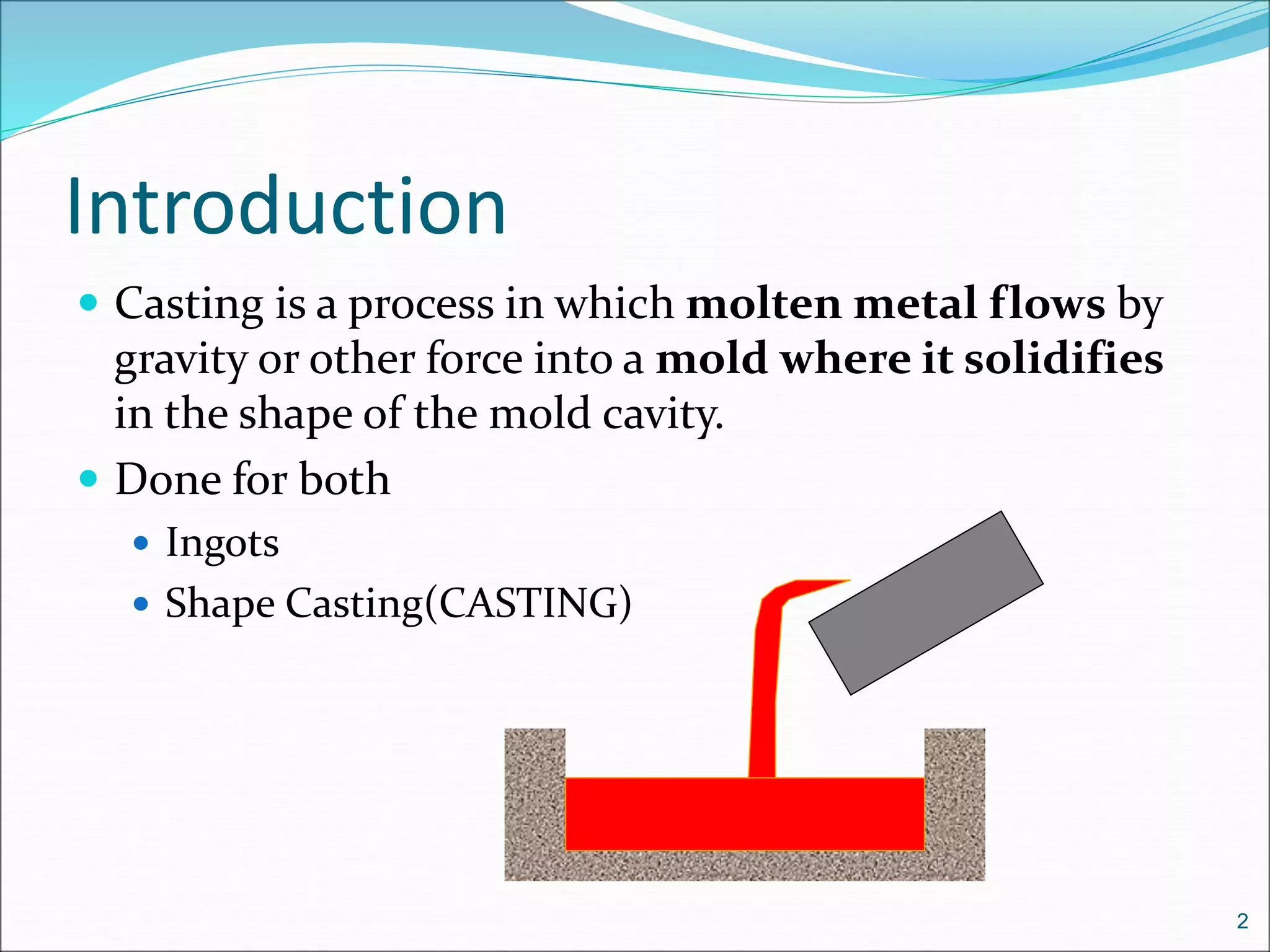
 Casting is a process in which molten metal flows by
gravity or other force into a mold where it solidifies
in the shape of the mold cavity.
 Done for both
 Ingots
 Shape Casting(CASTING)
2
 Casting can be used to create complex part geometries,
including both external and internal shapes.
 Poor dimensional control, porosity, hardness
 Net Shape products (no finishing),
 Near Net Shape (finishing)
 Can be for Very large parts upto 100 tons
 On any metal that can be heated to the liquid state.
 Some casting methods are quite suited to mass
production.
3
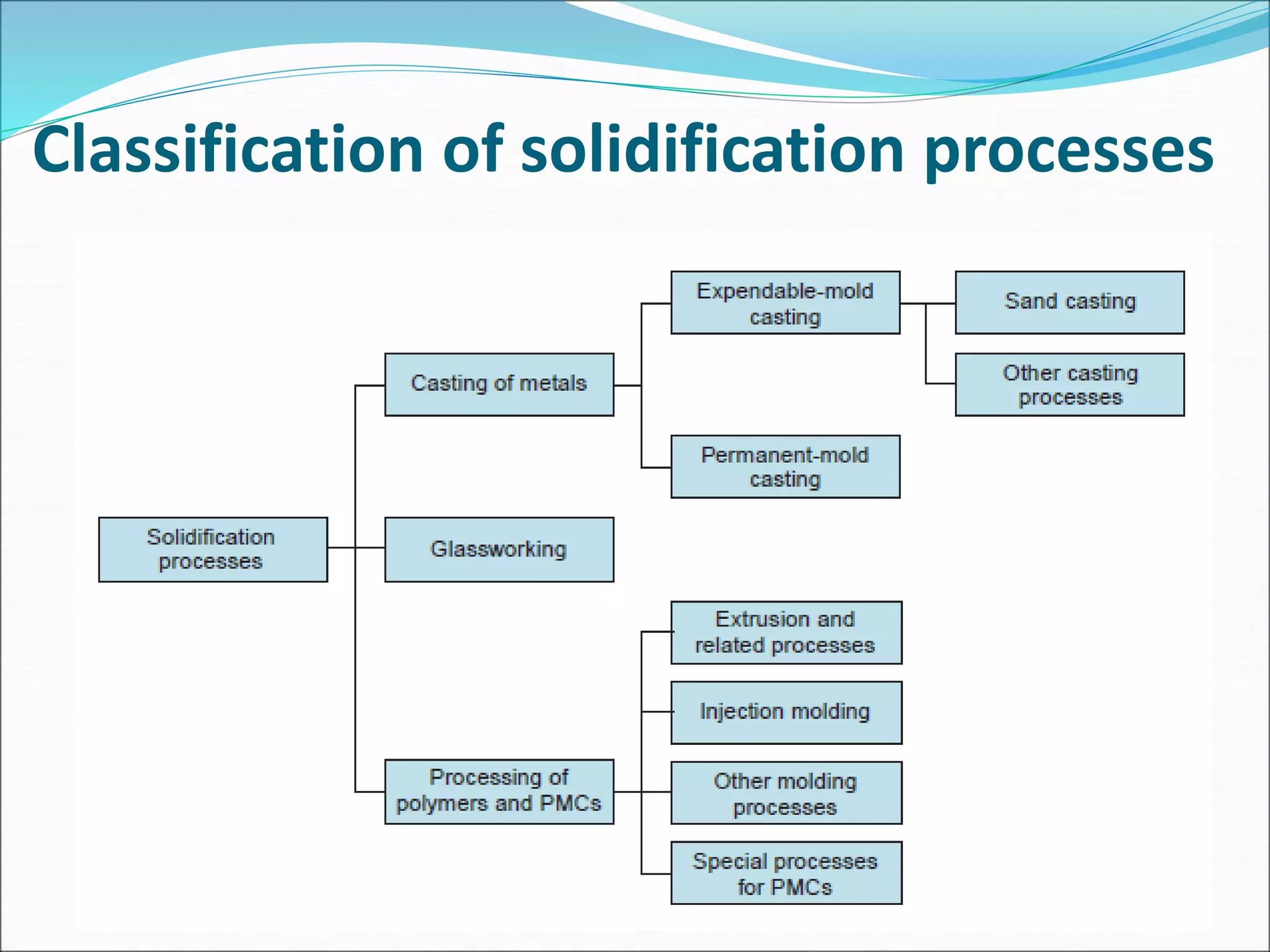
Classification of solidification processes
History of casting
Casting of metals can be traced back 4000 B.C.
Gold was first metal to be discovered and used by the
early civilization.
Copper that gave rise to the need for casting. Shapes
much more complicated made by casting than by
hammering.
Alloys Copper, Tin and aluminum based
 in 1340 - cast iron
 in 1826 - malleable iron
 in 1948 - nodular cast iron
5
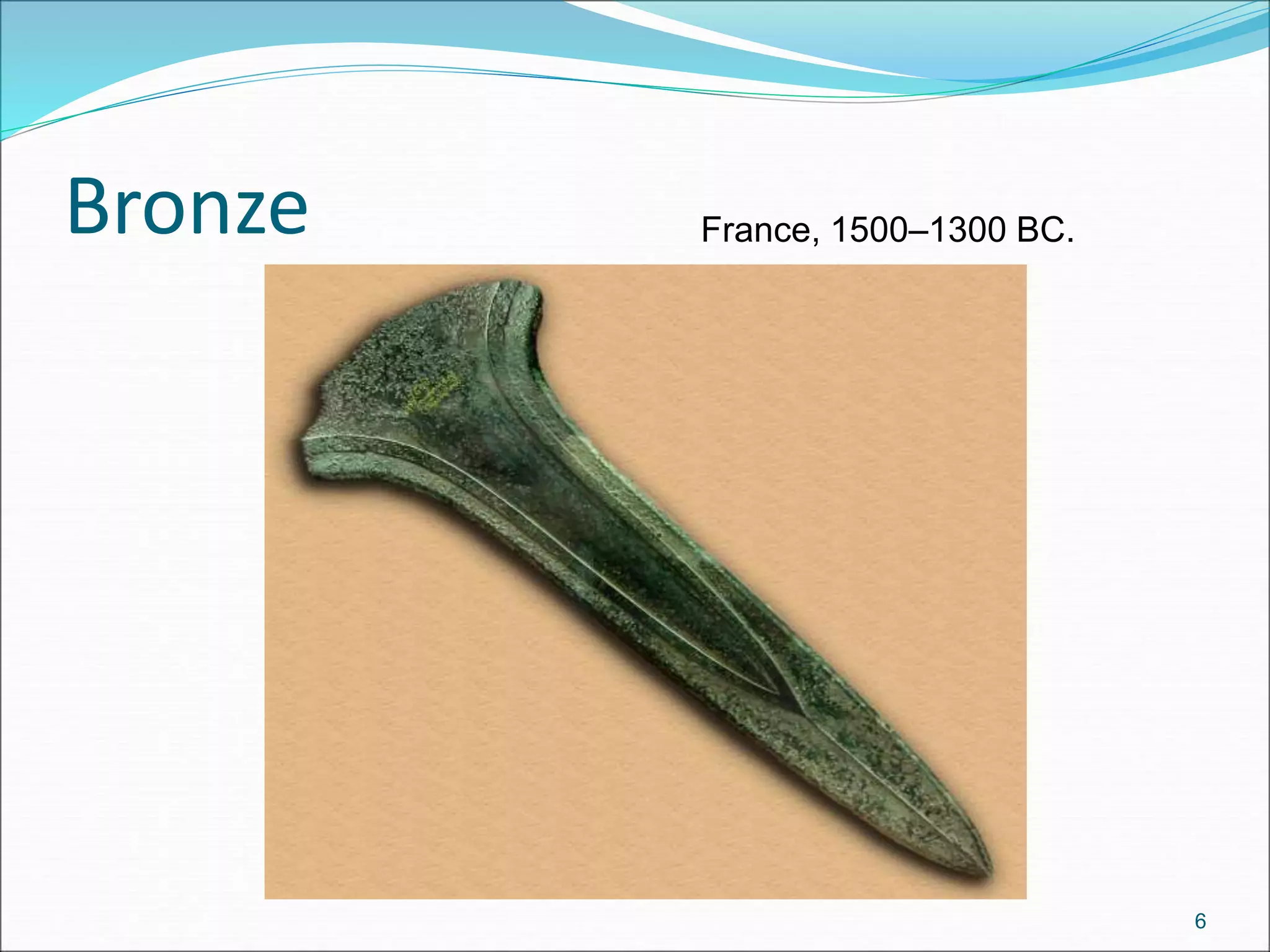
Bronze France, 1500–1300 BC.
6
Bronze
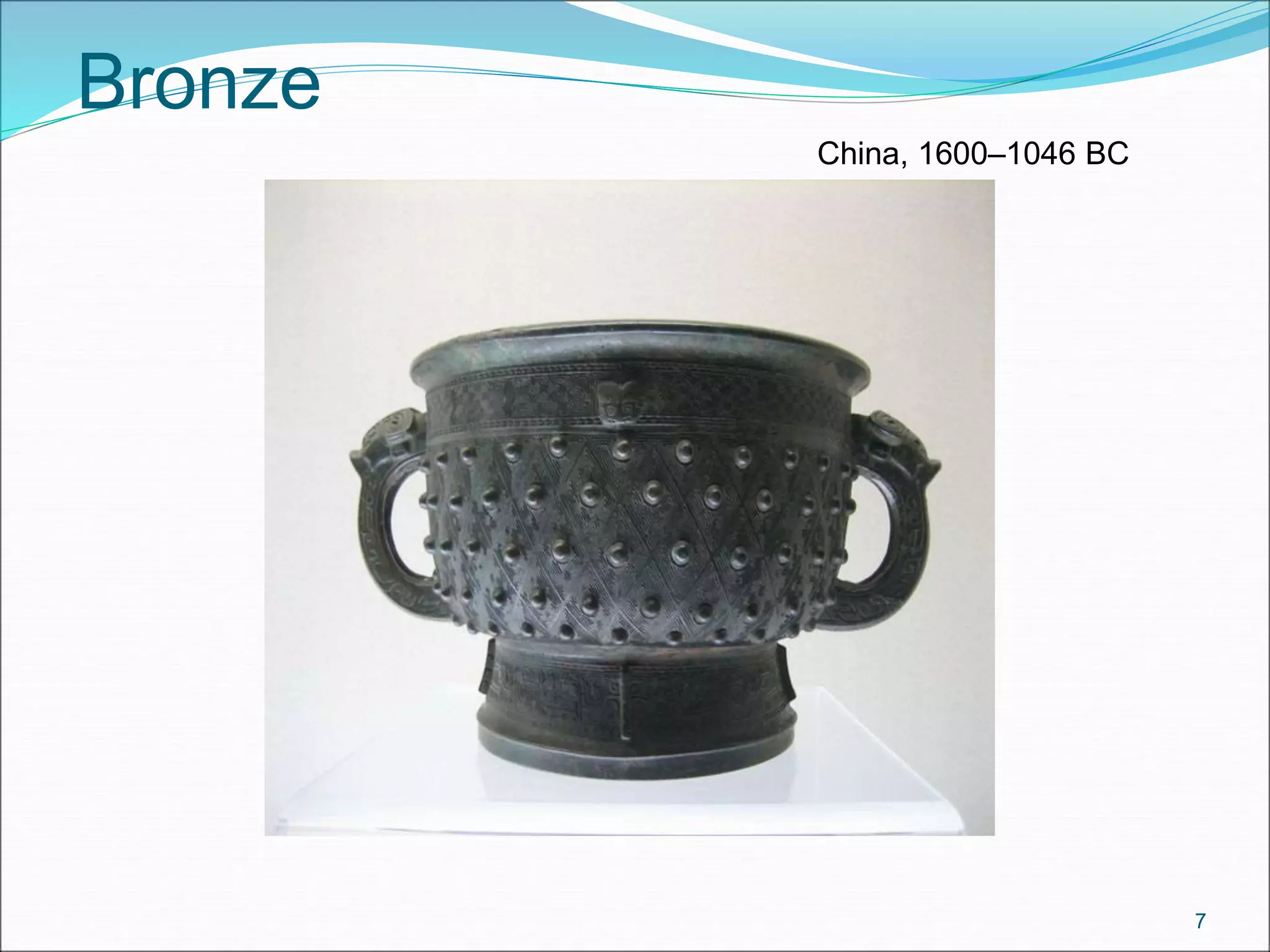
China, 1600–1046 BC
7
Bronze
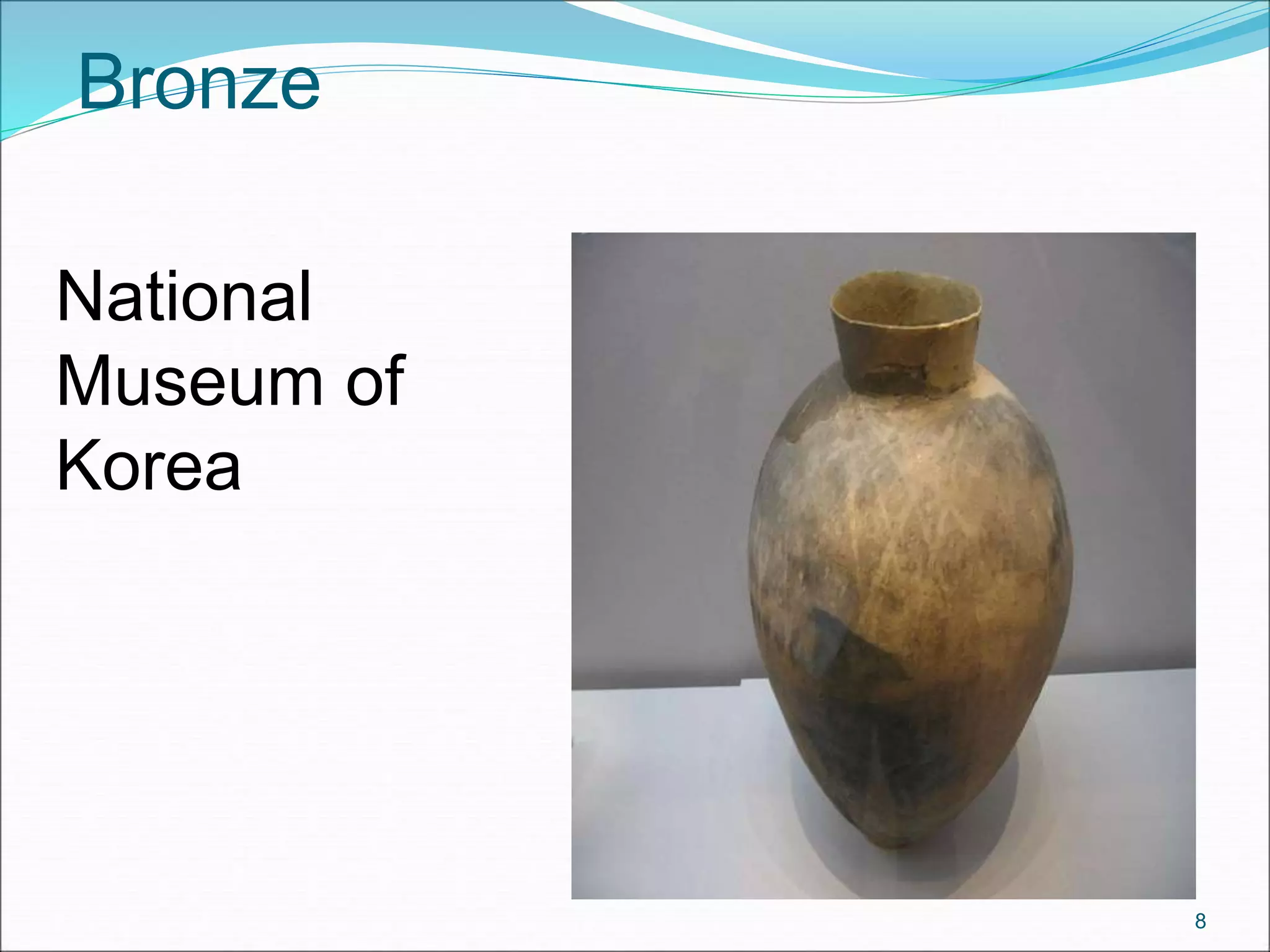
National
Museum of
Korea
8
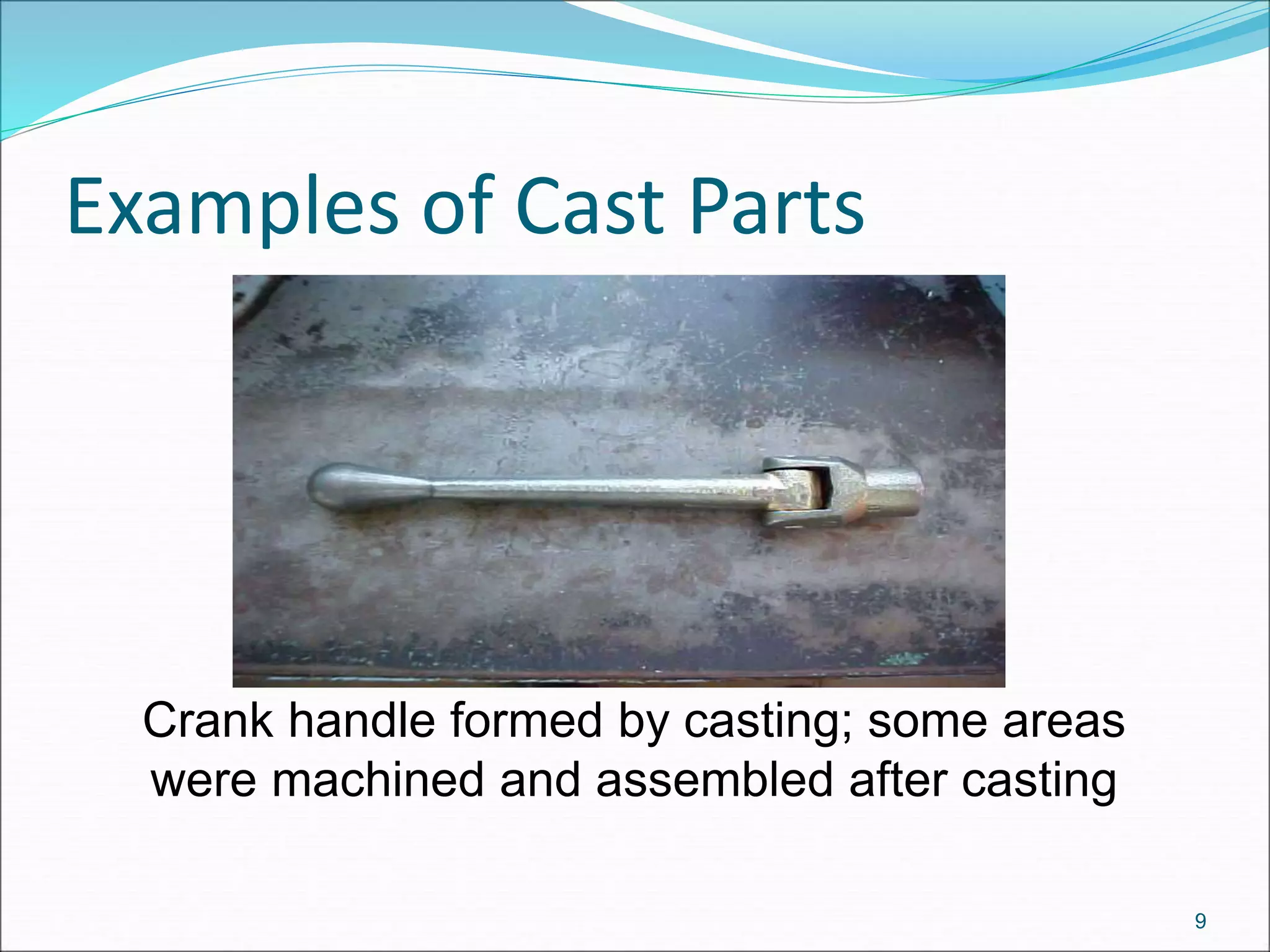
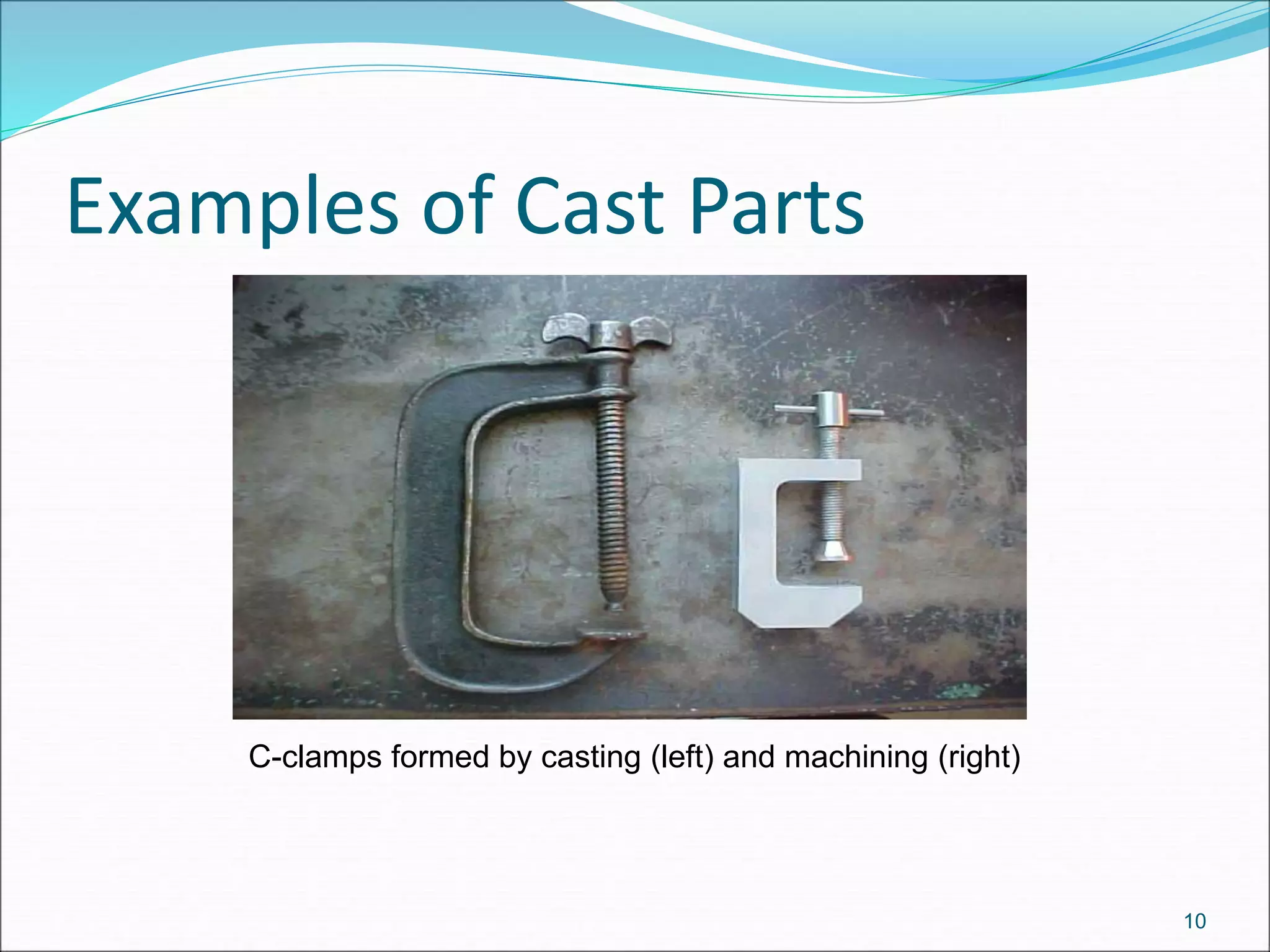
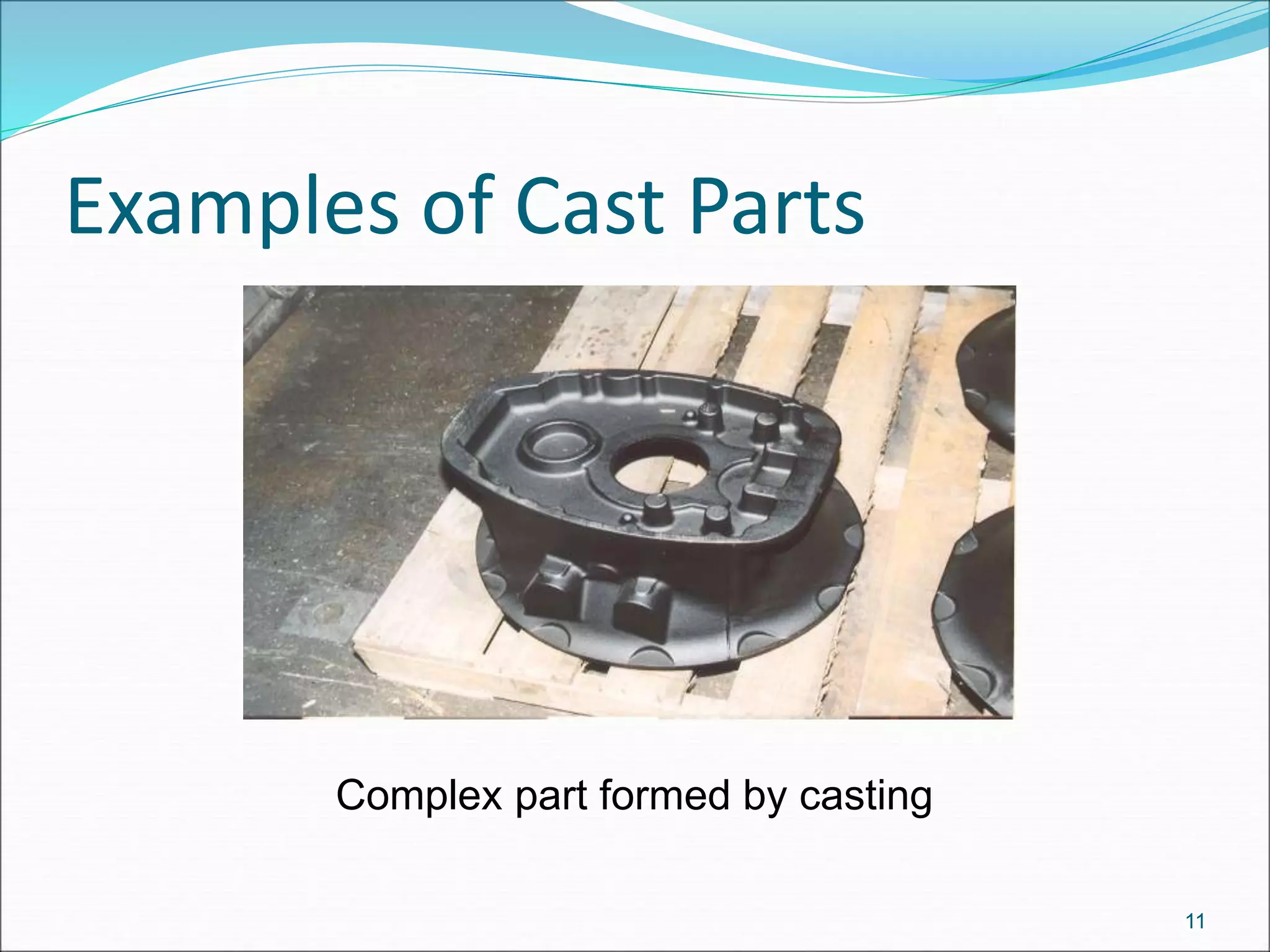
Examples of Cast Parts
Crank handle formed by casting; some areas
were machined and assembled after casting
9
Examples of Cast Parts
C-clamps formed by casting (left) and machining (right)
10
Examples of Cast Parts
Complex part formed by casting
11
Overview of Casting Technology
 Casting is usually performed in a foundry
 Foundry is a factory equipped for making molds,
melting and handling molten metal, performing the
casting process, and cleaning the finished casting
 Workers are called Foundry men
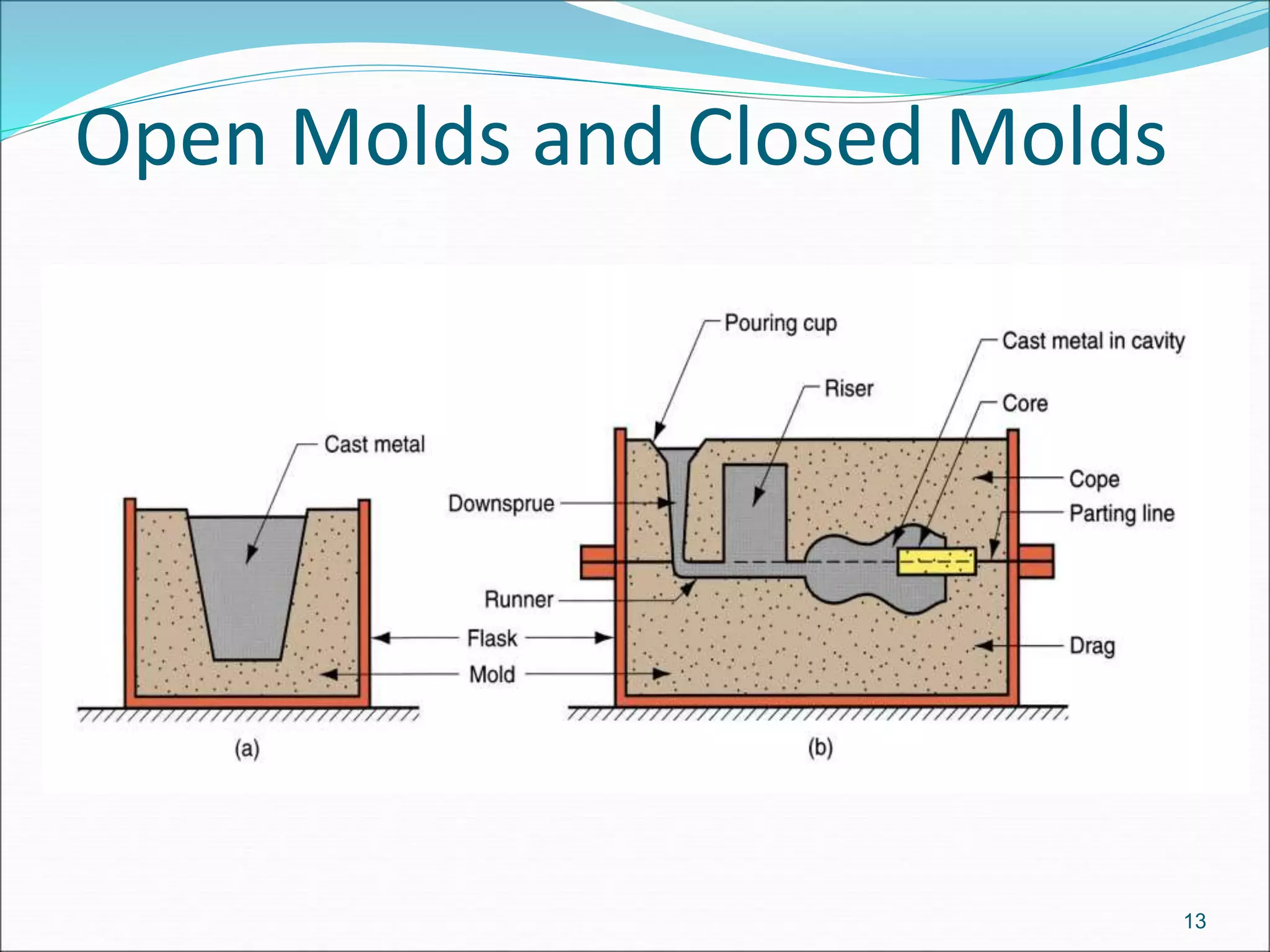
 Mold contains a cavity whose geometry determines
part shape
 PATTERN is a dummy part to build cavity in sand
castings
 Cavity must be slightly oversized to allow for
shrinkage of metal
 Types of Casting processes based on type of Molds 12
Open Molds and Closed Molds
13
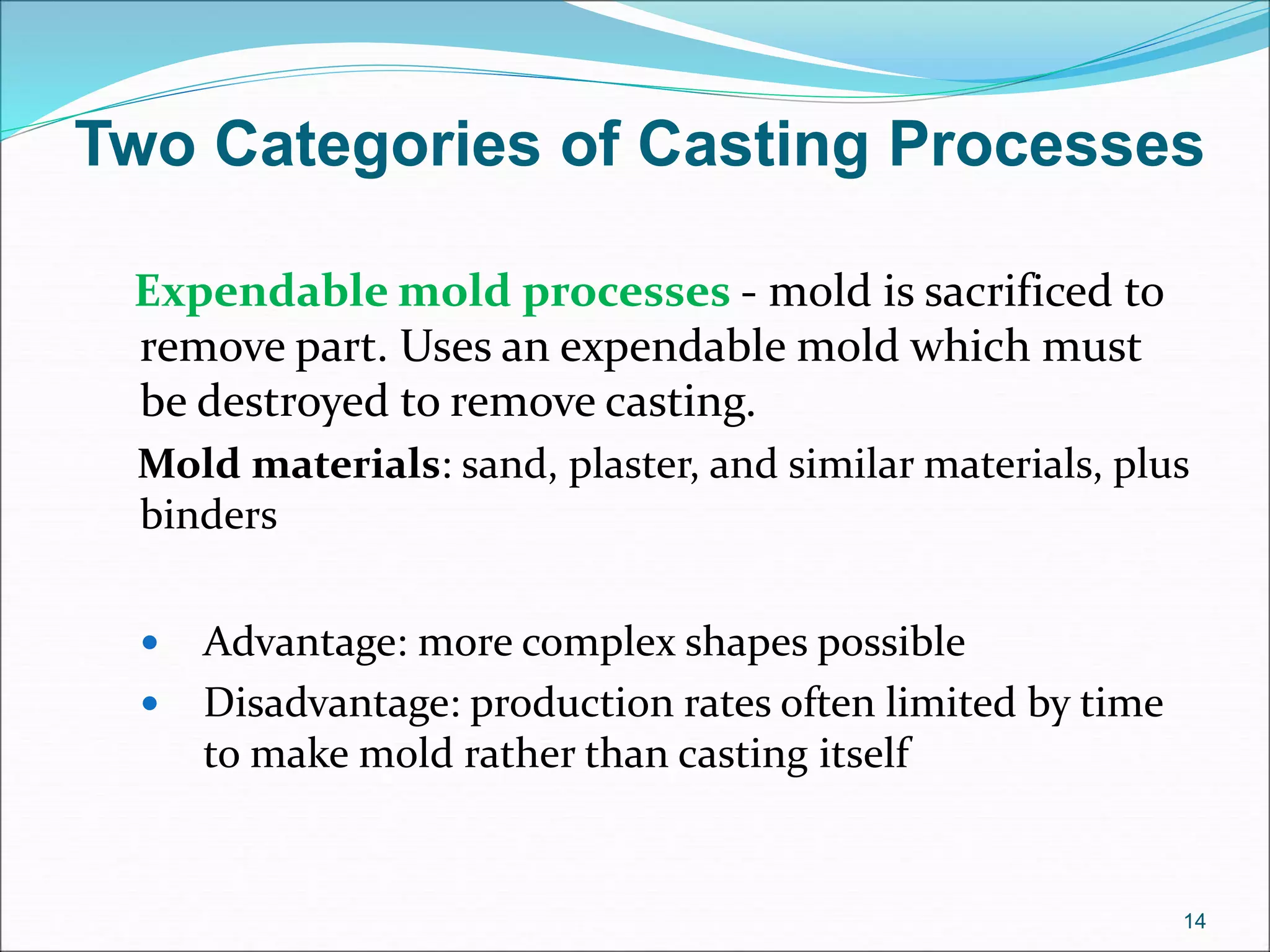
Two Categories of Casting Processes
Expendable mold processes - mold is sacrificed to
remove part. Uses an expendable mold which must
be destroyed to remove casting.
Mold materials: sand, plaster, and similar materials, plus
binders
 Advantage: more complex shapes possible
 Disadvantage: production rates often limited by time
to make mold rather than casting itself
14
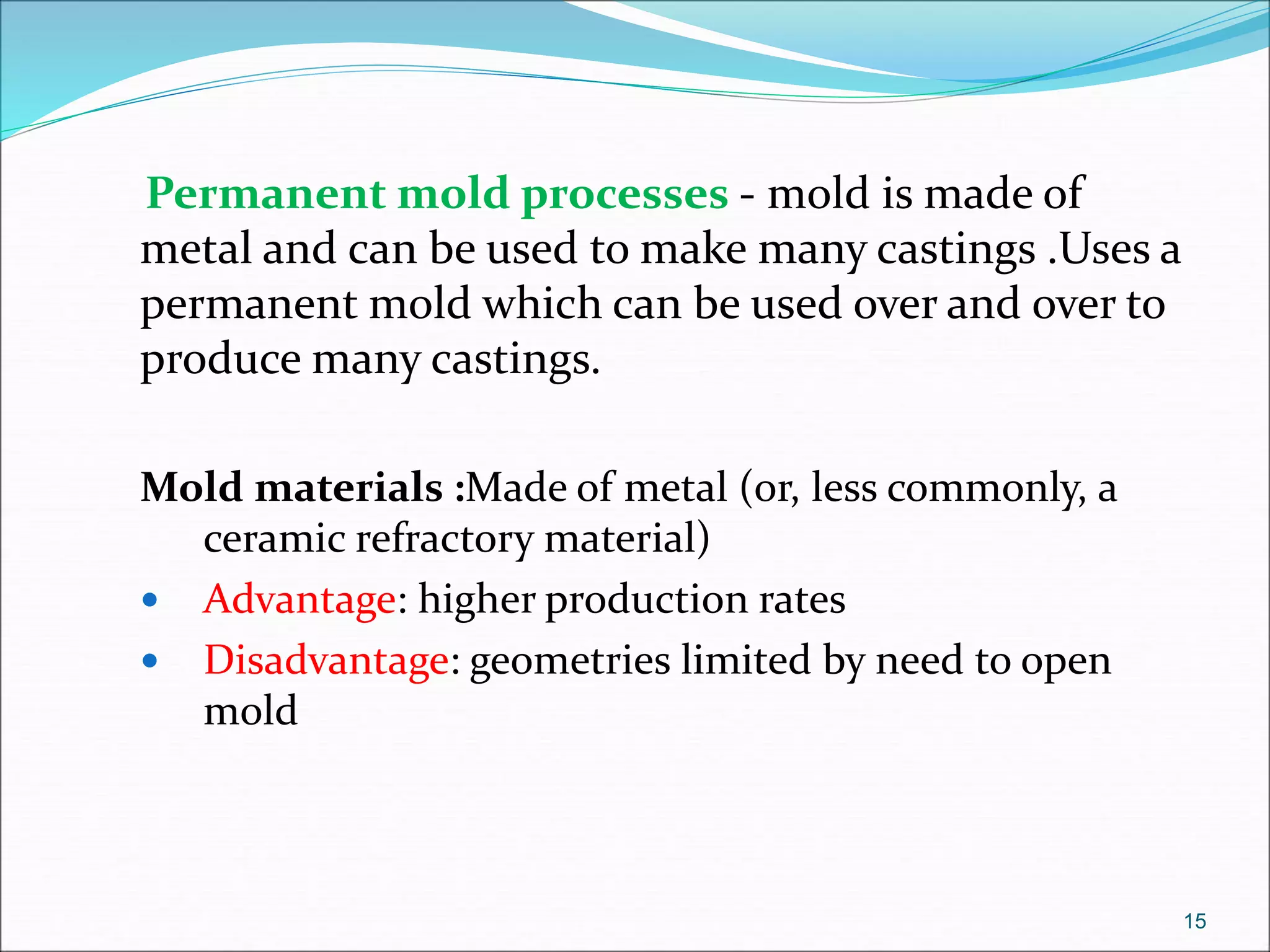
Permanent mold processes - mold is made of
metal and can be used to make many castings .Uses a
permanent mold which can be used over and over to
produce many castings.
Mold materials :Made of metal (or, less commonly, a
ceramic refractory material)
 Advantage: higher production rates
 Disadvantage: geometries limited by need to open
mold
15
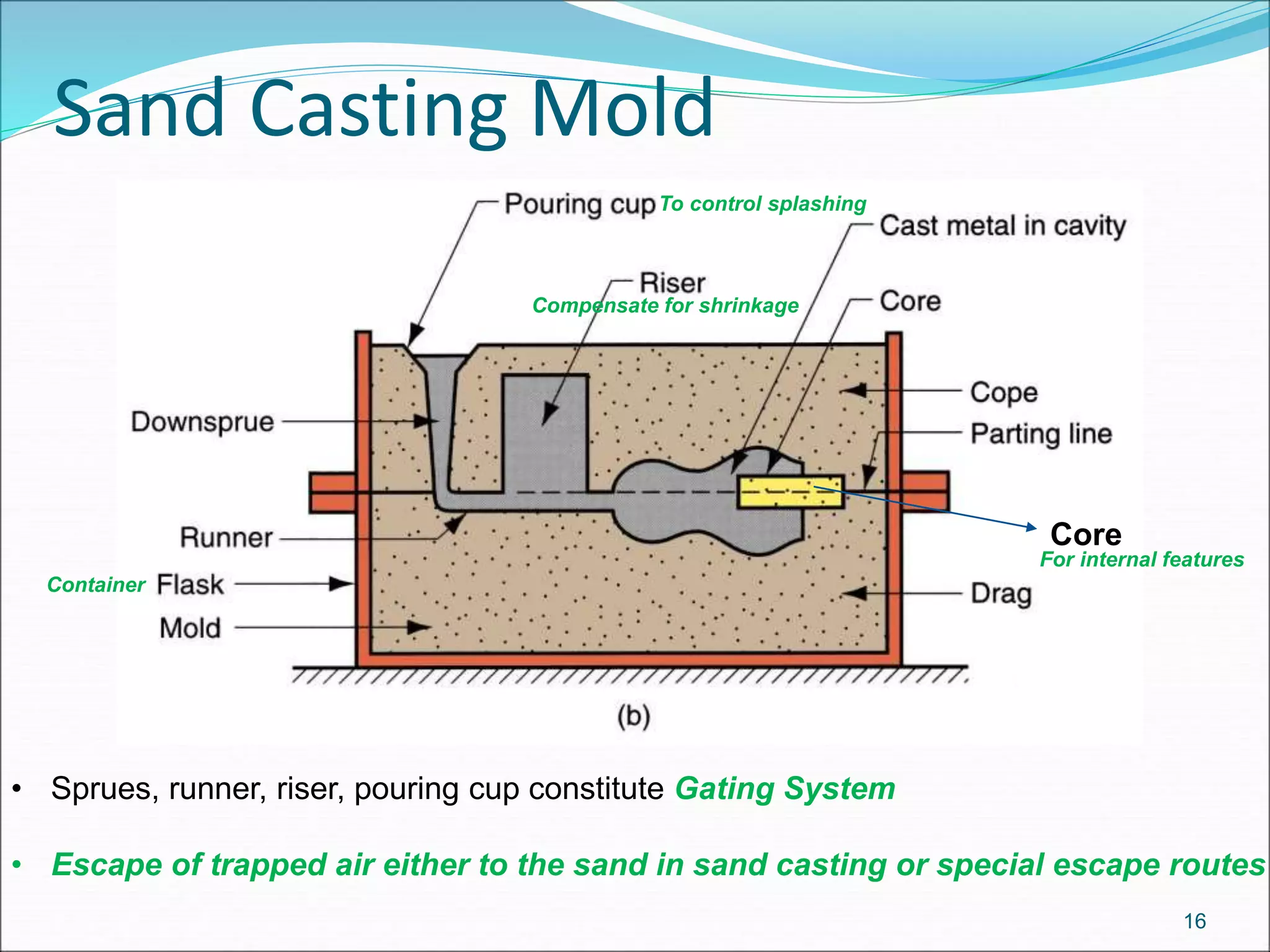
Sand Casting Mold
16
Container
• Sprues, runner, riser, pouring cup constitute Gating System
• Escape of trapped air either to the sand in sand casting or special escape routes
Compensate for shrinkage
To control splashing
Core
For internal features
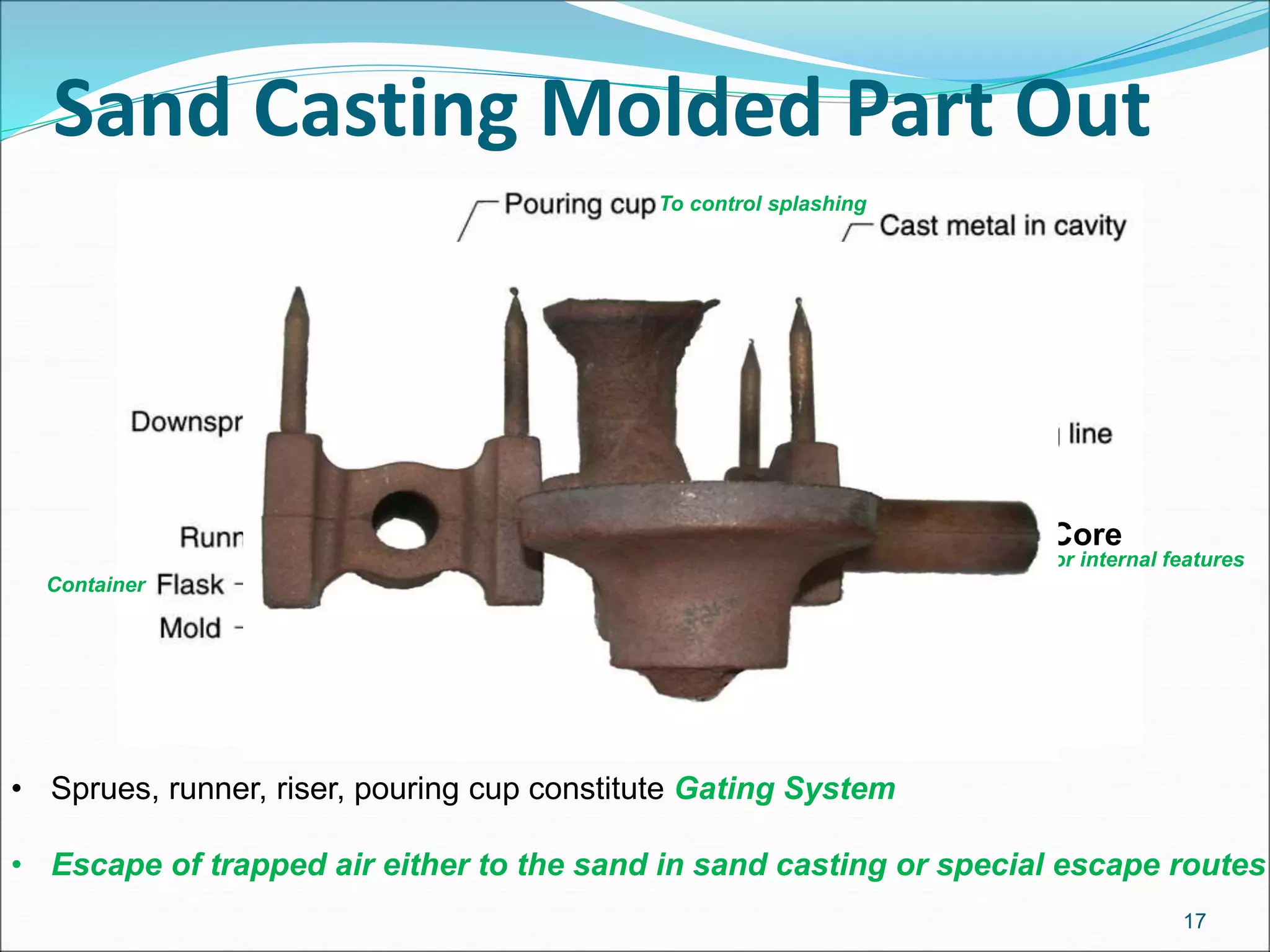
Sand Casting Molded Part Out
17
Container
• Sprues, runner, riser, pouring cup constitute Gating System
• Escape of trapped air either to the sand in sand casting or special escape routes
Compensate for shrinkage
To control splashing
Core
For internal features
Construction of Mold Cavity
 Mold cavity is formed by packing sand around a
pattern, which has the shape of the part
 When the pattern is removed, the remaining cavity of
the packed sand has desired shape of cast part
 The pattern is usually oversized to allow for shrinkage
of metal during solidification and cooling
 Sand for the mold is moist and contains a binder
to maintain its shape
 Ladle: A long-handled spoon with a deep bowl for
serving liquids.
18
Use of a Core in the Mold Cavity`
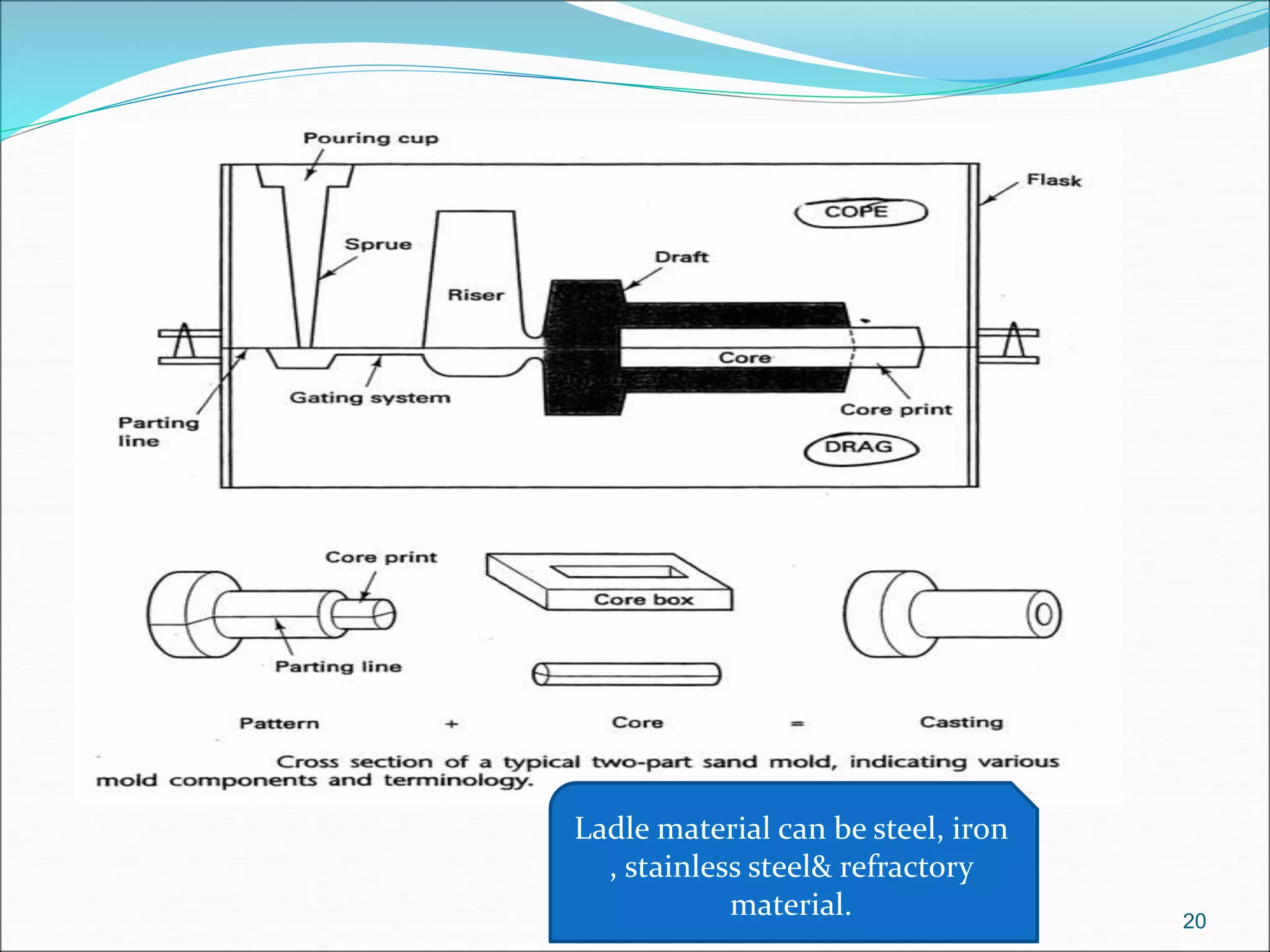
 The mold cavity provides the external surfaces of the
cast part
 In addition, a casting may have internal surfaces,
determined by a core, placed inside the mold cavity to
define the interior geometry of part
 Core Print a region used to support the core
 In sand casting, cores are generally made of sand
19
20
Ladle material can be steel, iron
, stainless steel& refractory
material.
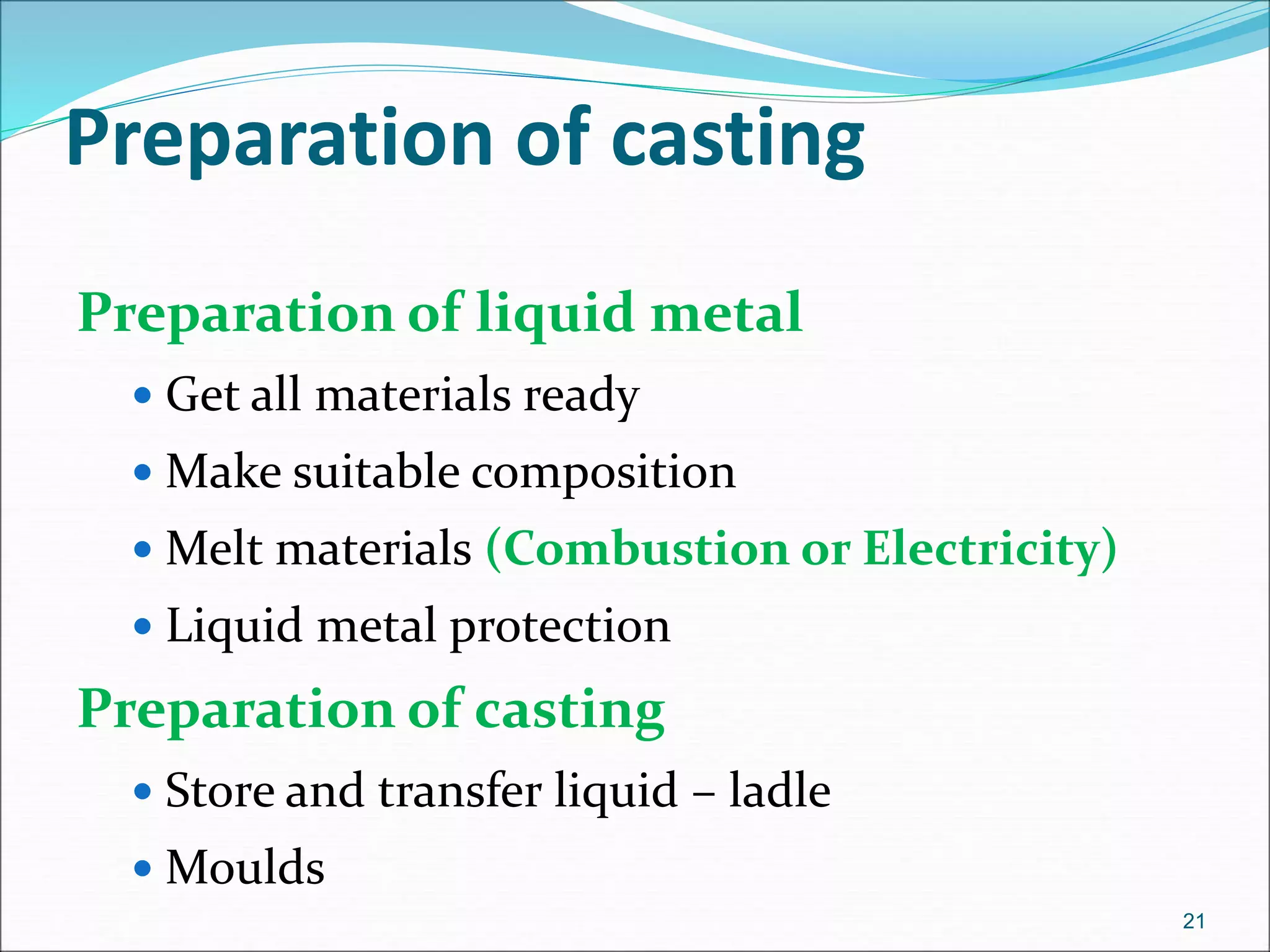
Preparation of casting
Preparation of liquid metal
 Get all materials ready
 Make suitable composition
 Melt materials (Combustion or Electricity)
 Liquid metal protection
Preparation of casting
 Store and transfer liquid – ladle
 Moulds
21
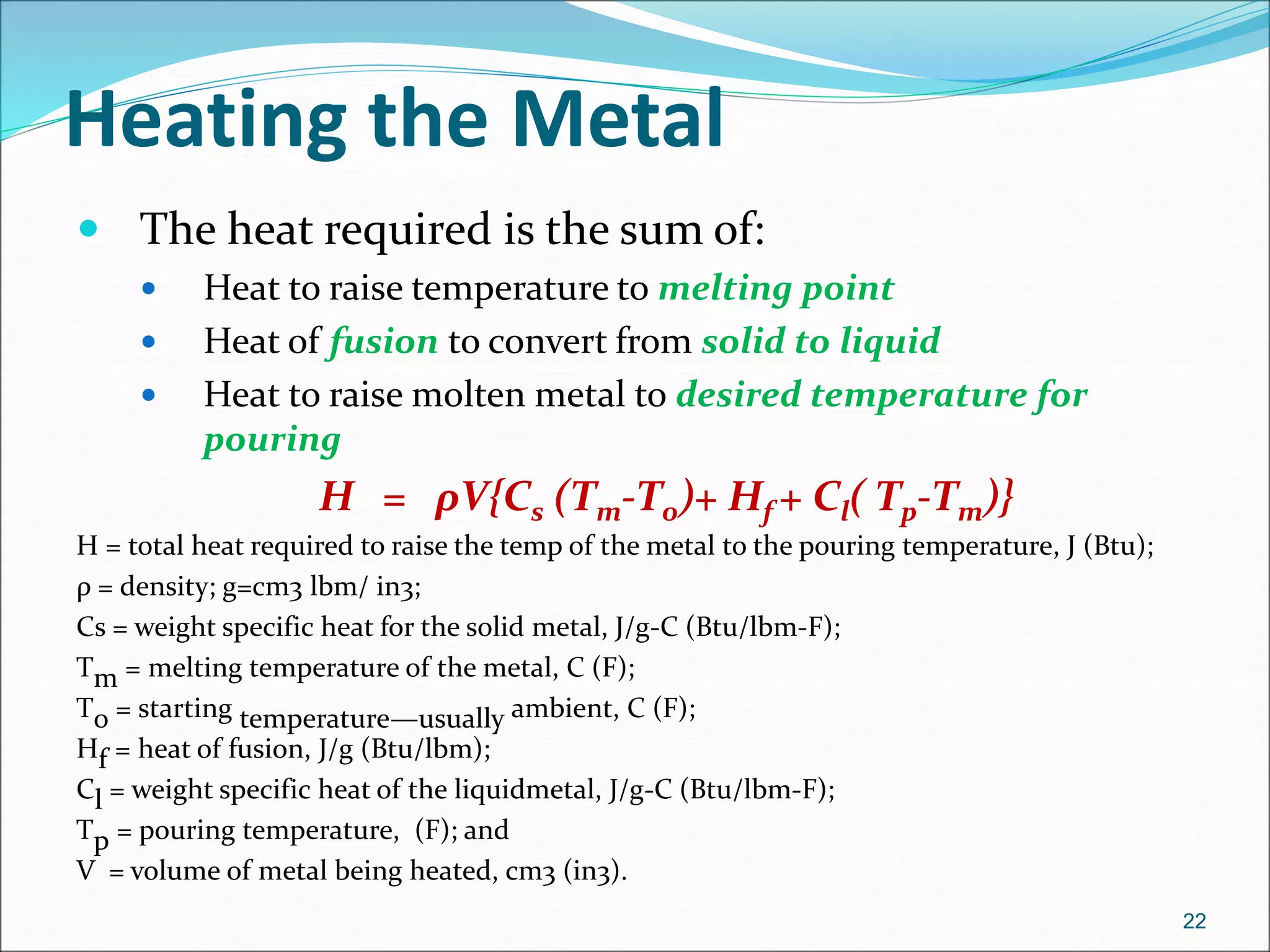
Heating the Metal
 The heat required is the sum of:
 Heat to raise temperature to melting point
 Heat of fusion to convert from solid to liquid
 Heat to raise molten metal to desired temperature for
pouring
H = ρV{Cs (Tm-T0)+ Hf + Cl( Tp-Tm)}
H = total heat required to raise the temp of the metal to the pouring temperature, J (Btu);
ρ = density; g=cm3 lbm/ in3;
Cs = weight specific heat for the solid metal, J/g-C (Btu/lbm-F);
Tm = melting temperature of the metal, C (F);
To = starting temperature—usually ambient, C (F);
Hf = heat of fusion, J/g (Btu/lbm);
Cl = weight specific heat of the liquidmetal, J/g-C (Btu/lbm-F);
Tp = pouring temperature, (F); and
V = volume of metal being heated, cm3 (in3).
22
Heating the Metal
 The heat required is the sum of:
 Heat to raise temperature to melting point
 Heat of fusion to convert from solid to liquid
 Heat to raise molten metal to desired temperature for
pouring
H = ρV{Cs (Tm-T0)+ Hf + Cl( Tp-Tm)}
H = total heat required to raise the temp of the metal to the pouring temperature, J (Btu);
ρ = density; g=cm3 lbm/ in3;
Cs = weight specific heat for the solid metal, J/g-C (Btu/lbm-F);
Tm = melting temperature of the metal, C (F);
To = starting temperature—usually ambient, C (F);
Hf = heat of fusion, J/g (Btu/lbm);
Cl = weight specific heat of the liquidmetal, J/g-C (Btu/lbm-F);
Tp = pouring temperature, (F); and
V = volume of metal being heated, cm3 (in3).
23
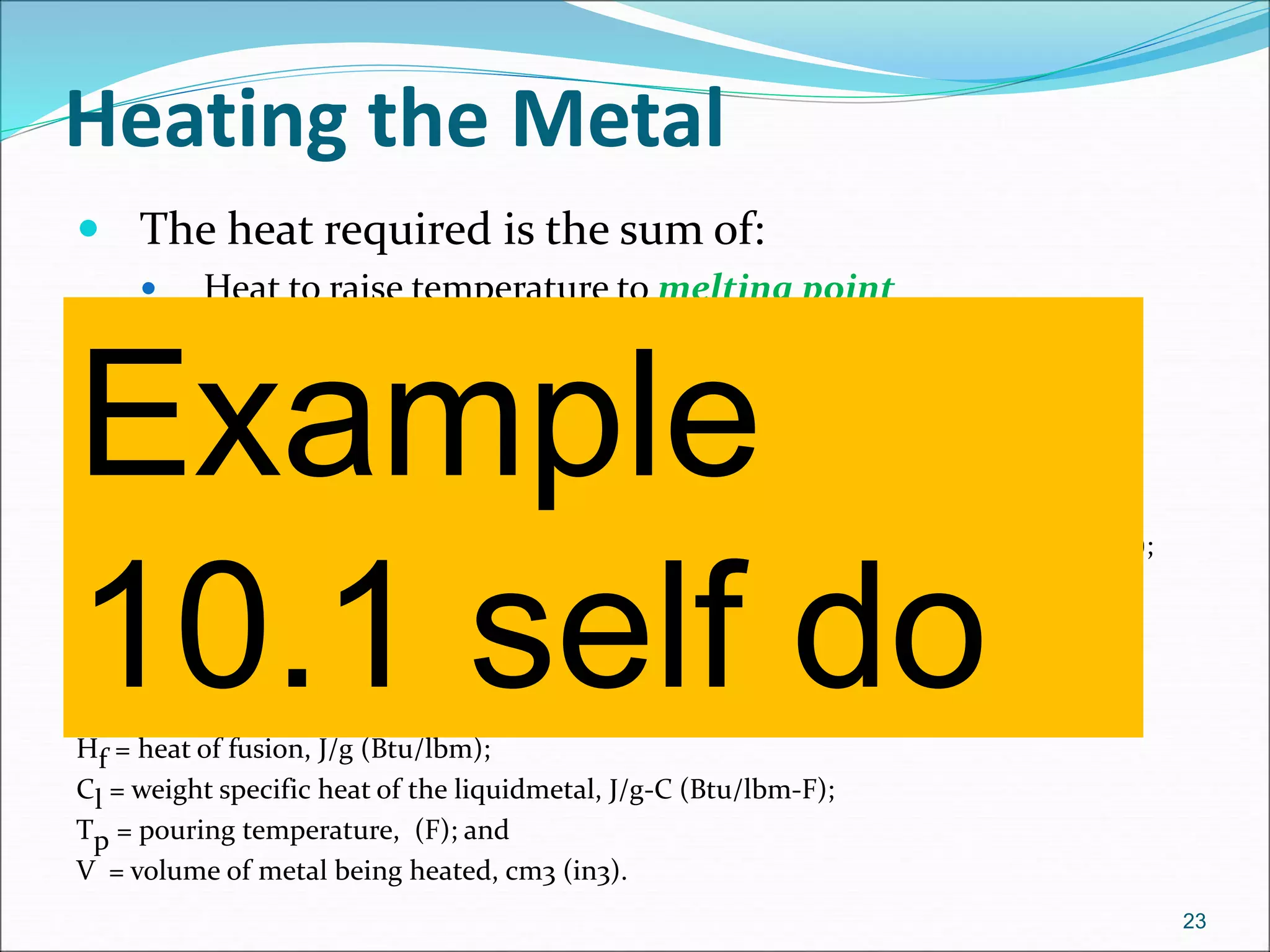
Example
10.1 self do
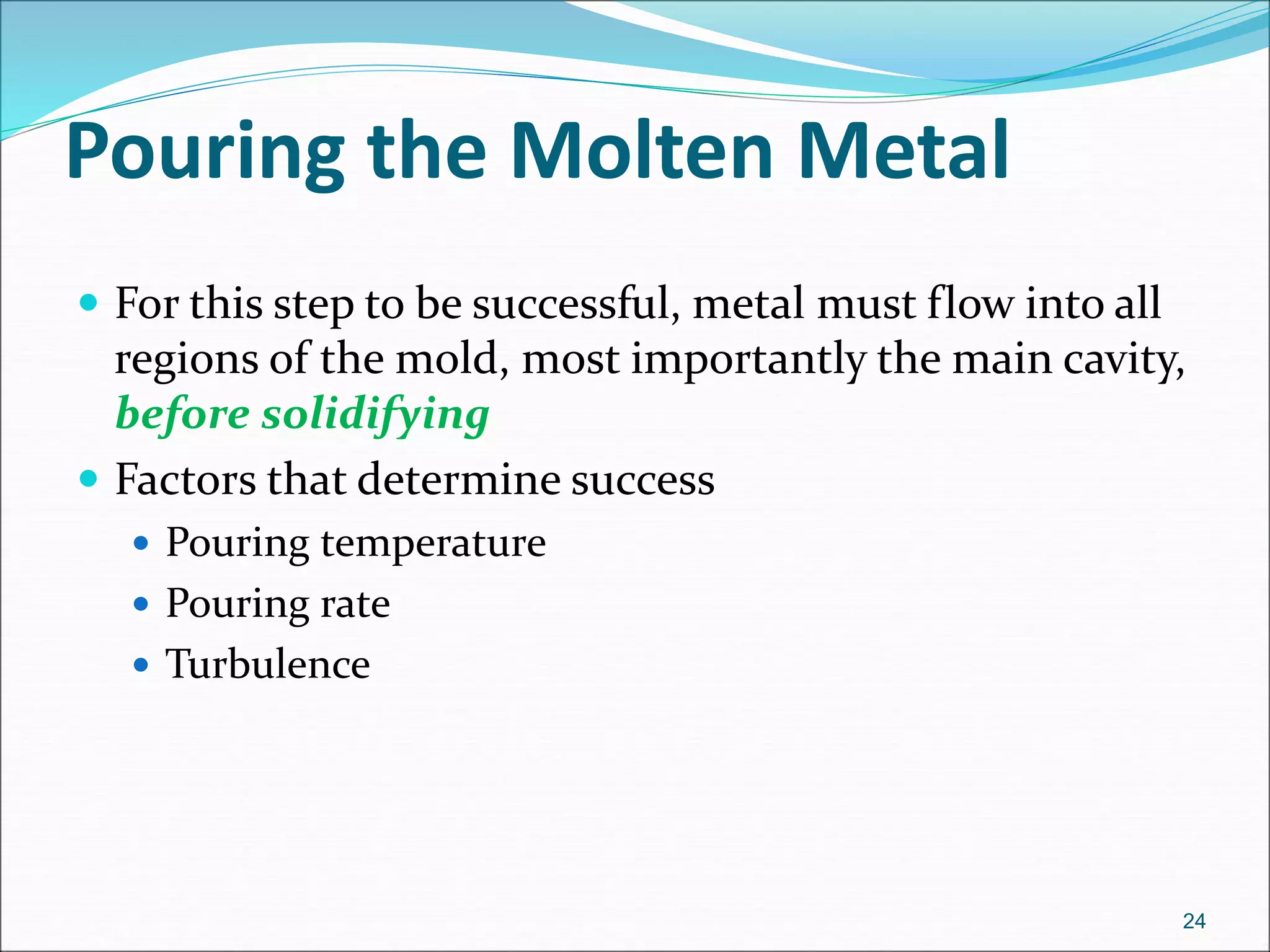
Pouring the Molten Metal
 For this step to be successful, metal must flow into all
regions of the mold, most importantly the main cavity,
before solidifying
 Factors that determine success
 Pouring temperature
 Pouring rate
 Turbulence
24
 Pouring temperature should be sufficiently high in order
to prevent the molten metal to start solidifying on its way
to the cavity.
 Pouring rate should neither be high (may stuck at the
runner – should match viscosity of the metal) nor very
low that may start solidifying on its way to the cavity.
 Turbulence should be kept to a minimum in order to
allow smooth flow and to avoid mold damage and
entrapment of foreign materials.
 Mold Erosion: the gradual wearing away of the mold
surfaces due to impact of the flowing molten metal.
Molten metals are more chemically reactive than at room
temperature.
25
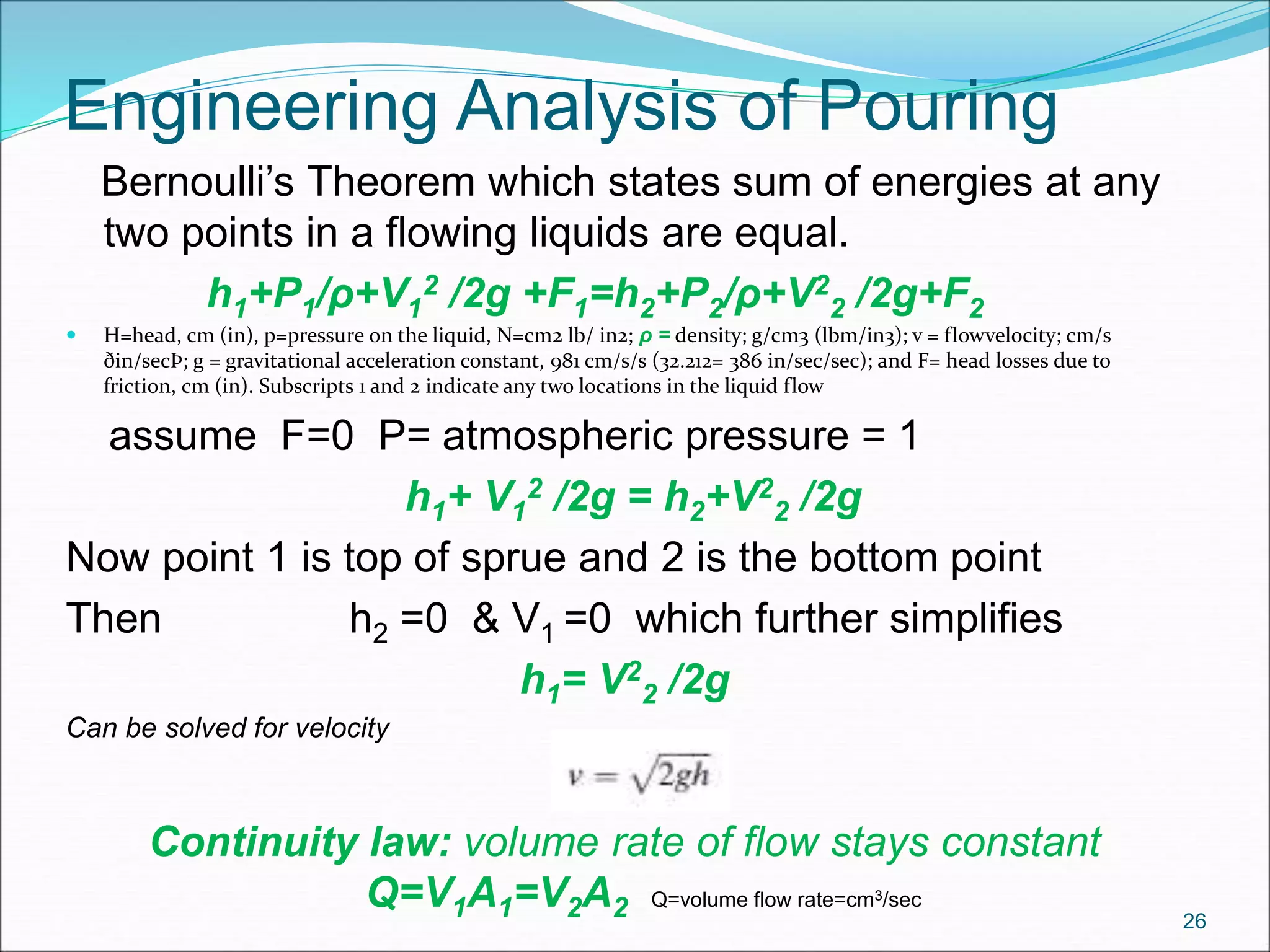
Engineering Analysis of Pouring
Bernoulli’s Theorem which states sum of energies at any
two points in a flowing liquids are equal.
h1+P1/ρ+V1
2 /2g +F1=h2+P2/ρ+V2
2 /2g+F2
 H=head, cm (in), p=pressure on the liquid, N=cm2 lb/ in2; ρ = density; g/cm3 (lbm/in3); v = flowvelocity; cm/s
ðin/secÞ; g = gravitational acceleration constant, 981 cm/s/s (32.212= 386 in/sec/sec); and F= head losses due to
friction, cm (in). Subscripts 1 and 2 indicate any two locations in the liquid flow
assume F=0 P= atmospheric pressure = 1
h1+ V1
2 /2g = h2+V2
2 /2g
Now point 1 is top of sprue and 2 is the bottom point
Then h2 =0 & V1 =0 which further simplifies
h1= V2
2 /2g
Can be solved for velocity
Continuity law: volume rate of flow stays constant
Q=V1A1=V2A2 Q=volume flow rate=cm3/sec
26
Engineering Analysis of Pouring
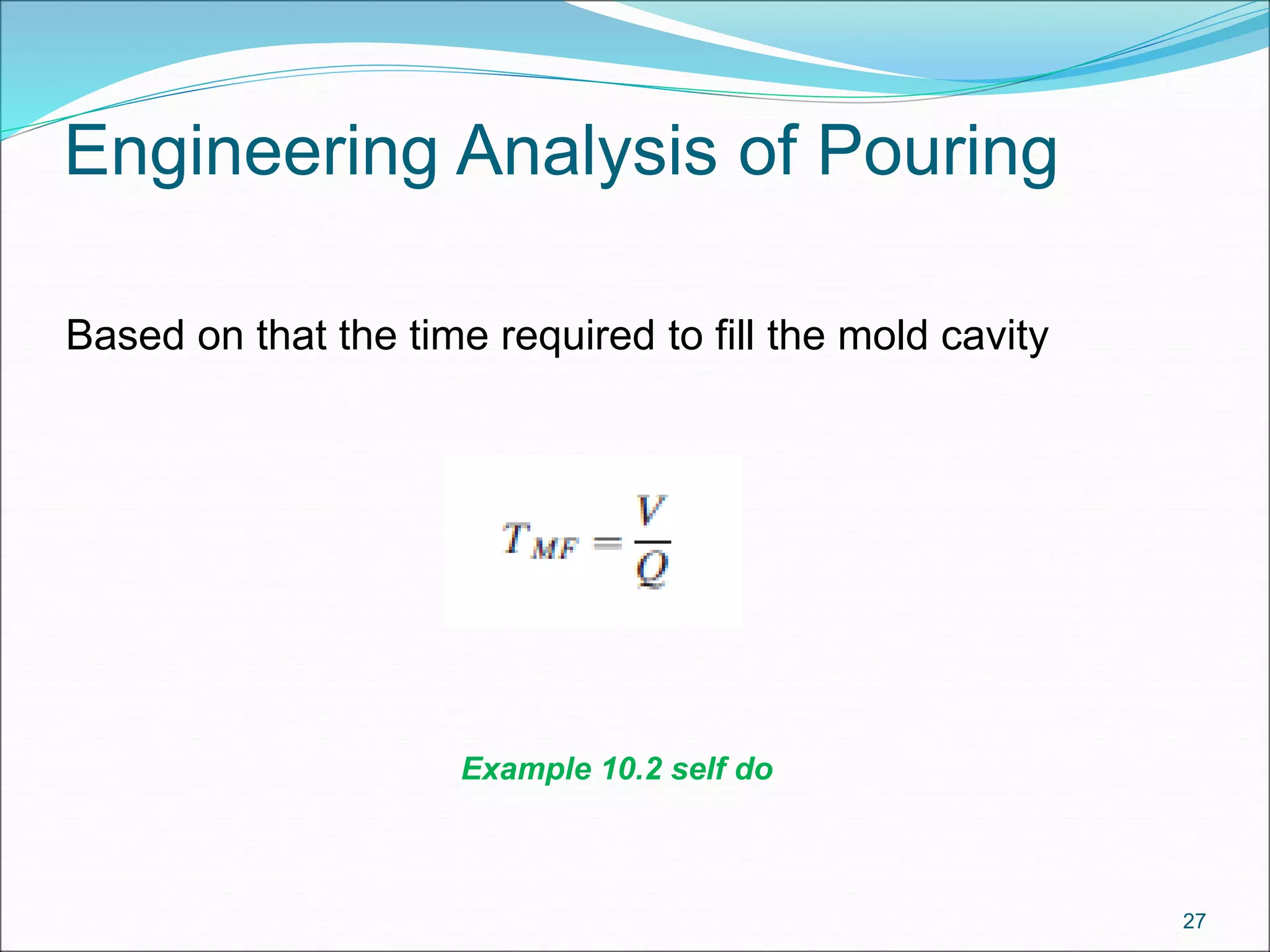
Based on that the time required to fill the mold cavity
27
Example 10.2 self do
Fluidity of Molten Metal
Fluidity
The capability of a molten metal to fill mold cavities
Viscosity
Higher viscosity decreases fluidity
28
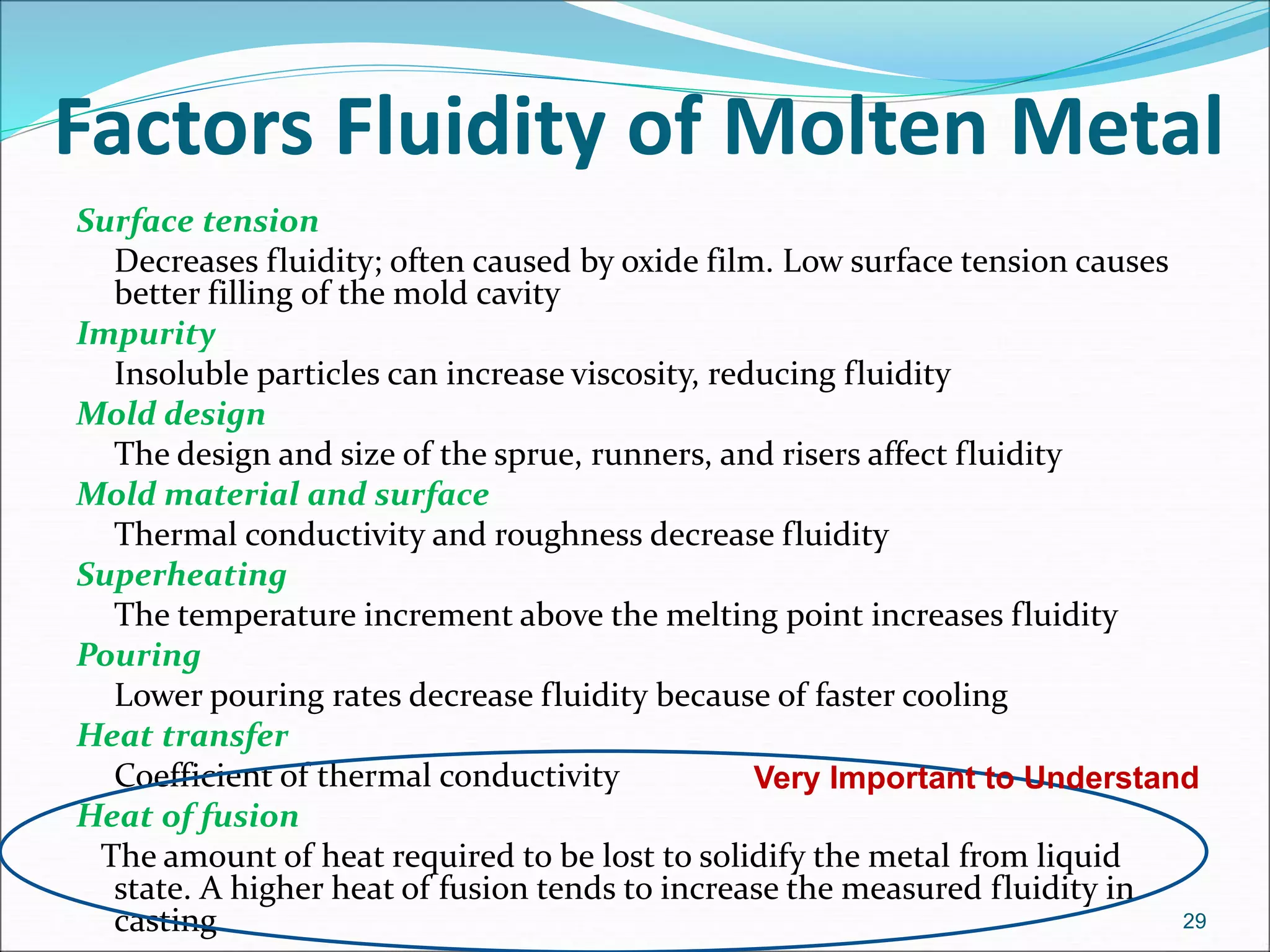
Factors Fluidity of Molten Metal
Surface tension
Decreases fluidity; often caused by oxide film. Low surface tension causes
better filling of the mold cavity
Impurity
Insoluble particles can increase viscosity, reducing fluidity
Mold design
The design and size of the sprue, runners, and risers affect fluidity
Mold material and surface
Thermal conductivity and roughness decrease fluidity
Superheating
The temperature increment above the melting point increases fluidity
Pouring
Lower pouring rates decrease fluidity because of faster cooling
Heat transfer
Coefficient of thermal conductivity
Heat of fusion
The amount of heat required to be lost to solidify the metal from liquid
state. A higher heat of fusion tends to increase the measured fluidity in
casting 29
Very Important to Understand
Solidification of Metals
It is the transformation of molten metal back into solid
state
Solidification differs depending on whether the metal is
 A pure element or
 An alloy
30
 A pure metal solidifies at a constant temperature equal
to its freezing point (same as melting point).
 Chilling action of mold wall, a thin skin of solid metal is
formed at the interface immediately after pouring.
 Rate of freezing depends on heat transfer into mold, as
well as thermal properties of the metal.
 Most alloys freeze over a temperature range rather than
at a single temperature.
 Solidification takes time.
 Layers, consisting of different compositions of the alloy
are formed around the wall of mold.
 It depends upon the melting point and densities of
different constituents in the alloy.
31
Pure Metal
Local solidification Time
“The actual freezing takes time called the local
solidification time in casting during which the metal’s
latent heat of fusion is released into the surrounding
mold.”
Total solidification Time
“It is time taken b/w pouring and complete
solidification. After the casting has completely
solidified, cooling continuous at a rate indicated by the
downward slope of the cooling curve.”
32
33
Cooling Rate
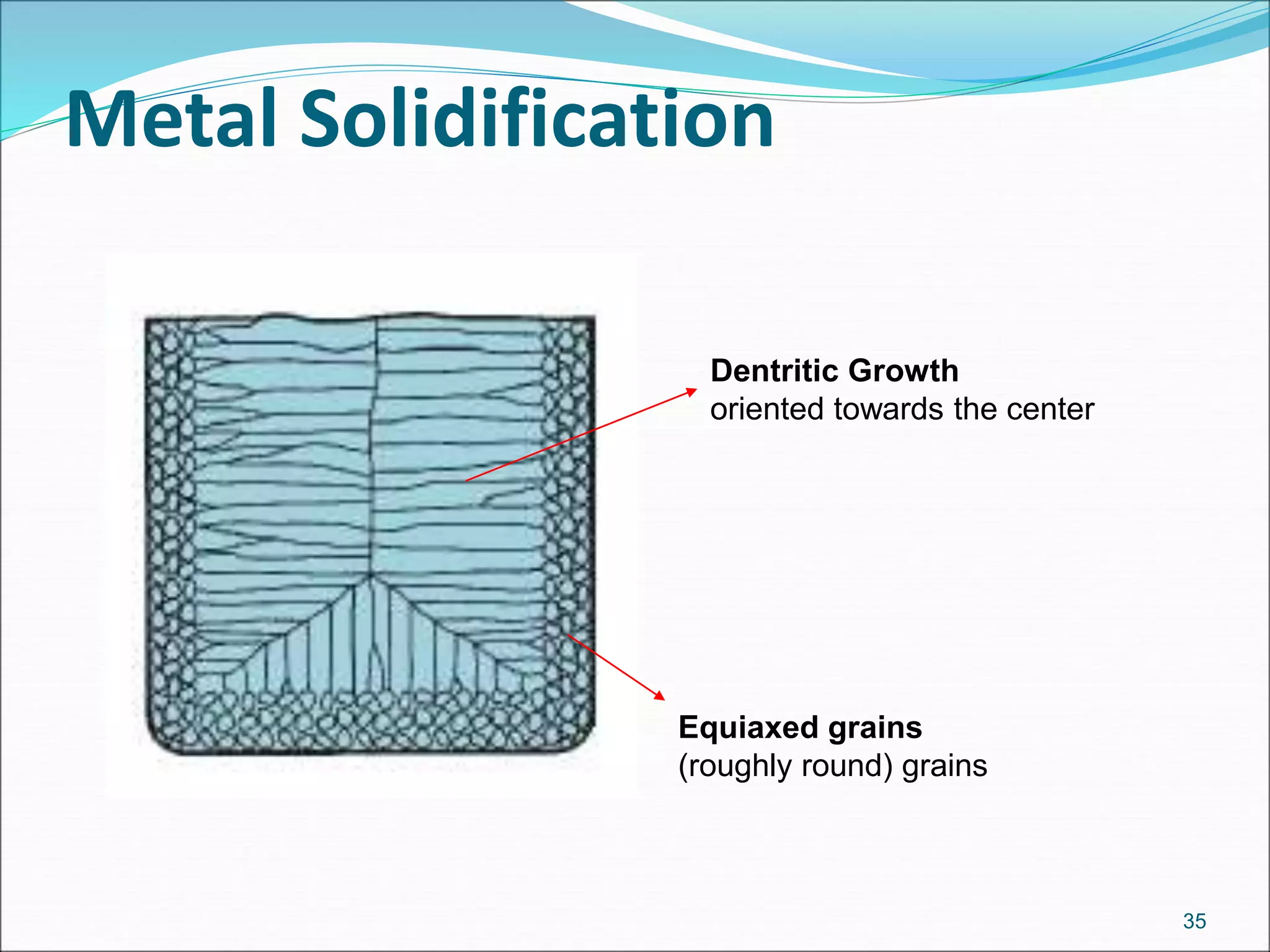
 Rapid cooling at mold walls produces equiaxed
(roughly round) grains
 Slow cooling towards the interior forms long
columnar grains that grow towards the center
 Nucleating Agent: Nucleating agents are additives
that provide sites for crystal formation in the polymer
melt. Chemical substances which when incorporated in
plastics form nuclei for the growth of crystals in the
polymer melt.
34
Metal Solidification
35
Dentritic Growth
oriented towards the center
Equiaxed grains
(roughly round) grains
Effect of Nucleating Agent on
Metal Solidification
36
A nucleating agent
(inoculants) is a
substance that
induces grains to
nucleate and form at
the same time
throughout the
structure.
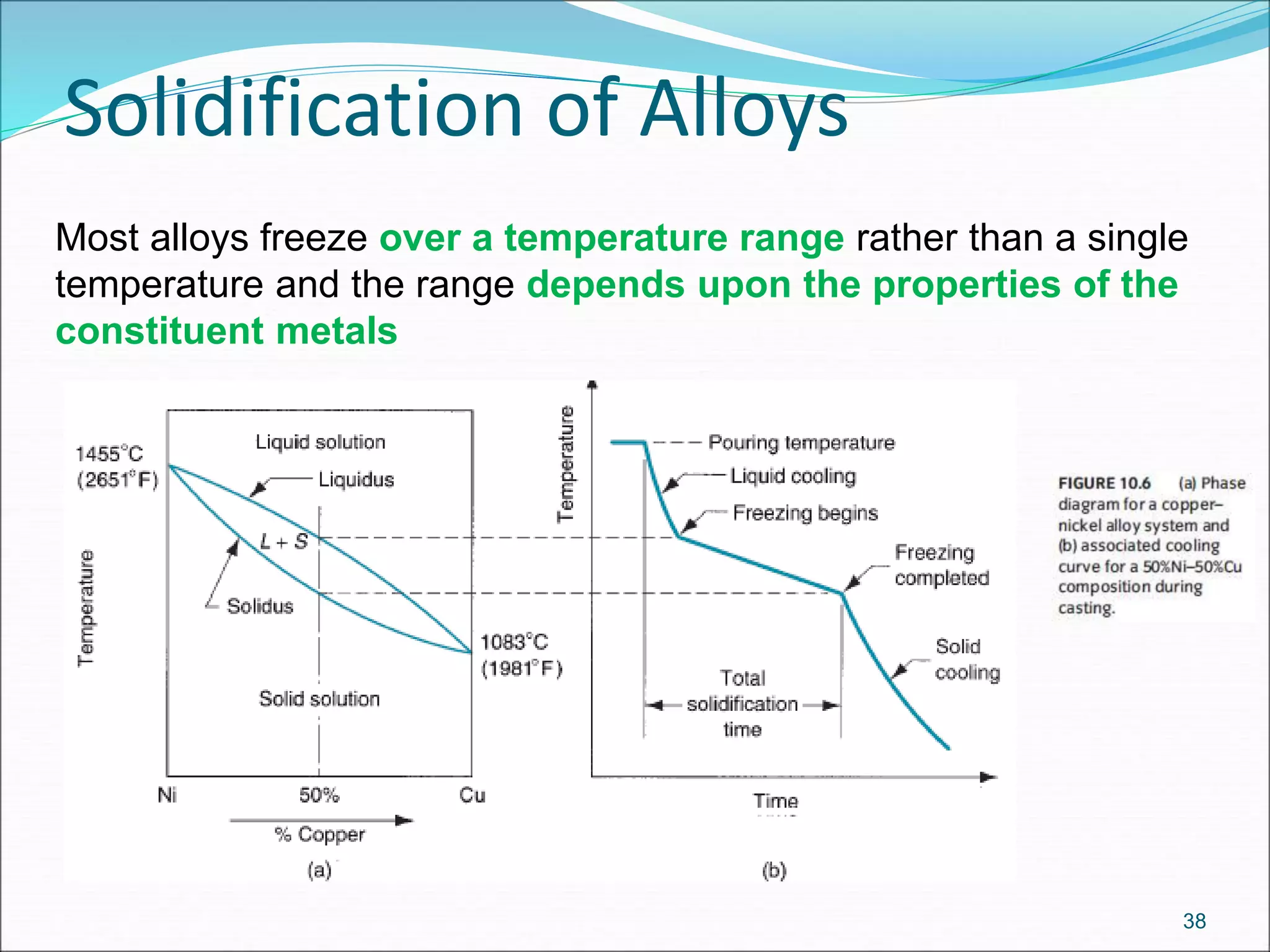
Solidification of Alloys
37
Most alloys freeze over a temperature range rather than a single
temperature and the range depends upon the properties of the
constituent metals
Liquidus: The minimum temperature at which all components of a mixture, such
as an alloy, can be in a liquid state.
Solidus: The minimum temperature at which all components of a mixture, such as
an alloy, can be in a solid state.
Solidification of Alloys
38
Most alloys freeze over a temperature range rather than a single
temperature and the range depends upon the properties of the
constituent metals
Effect of Cooling Rate
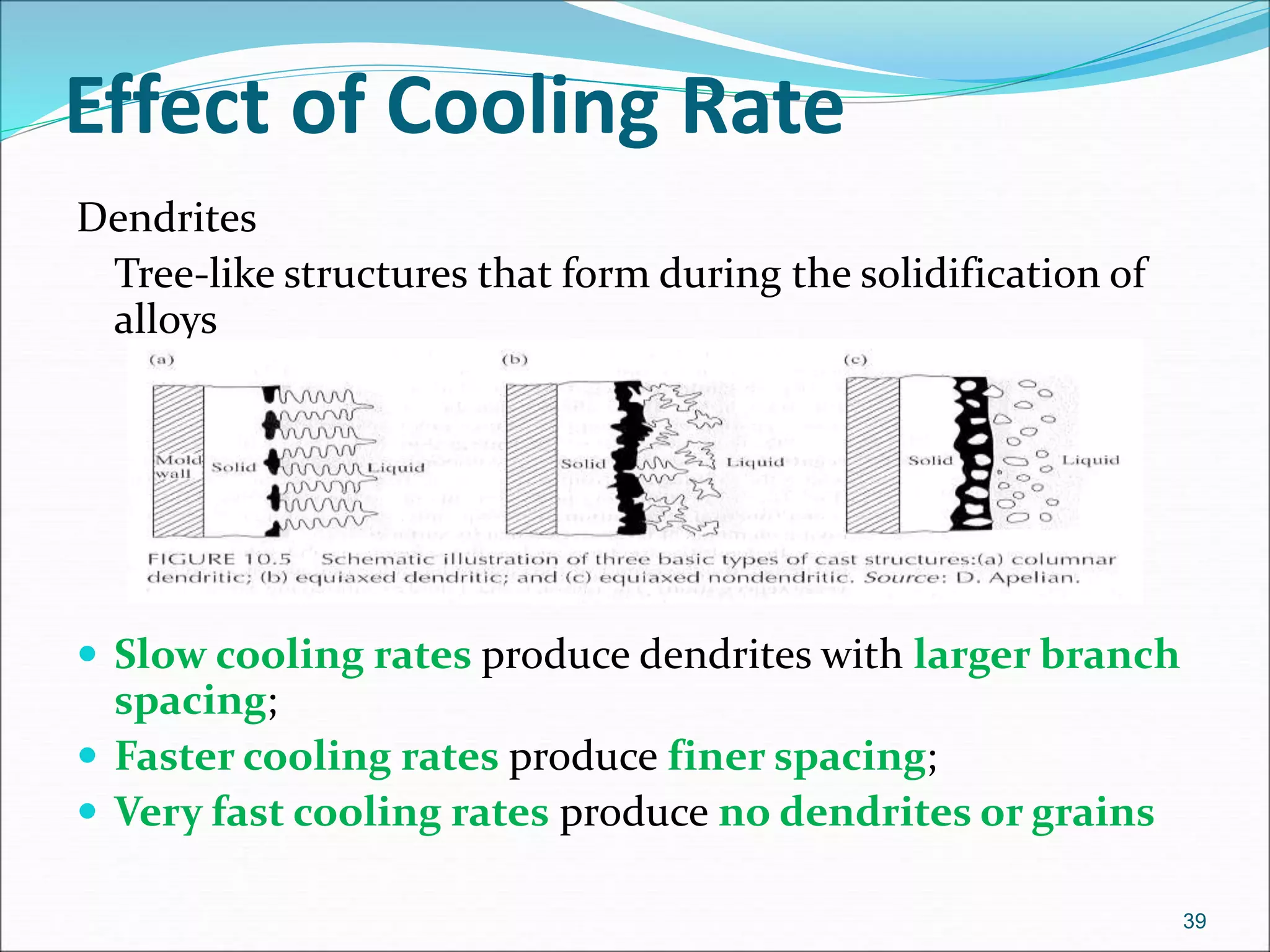
Dendrites
Tree-like structures that form during the solidification of
alloys
 Slow cooling rates produce dendrites with larger branch
spacing;
 Faster cooling rates produce finer spacing;
 Very fast cooling rates produce no dendrites or grains
39
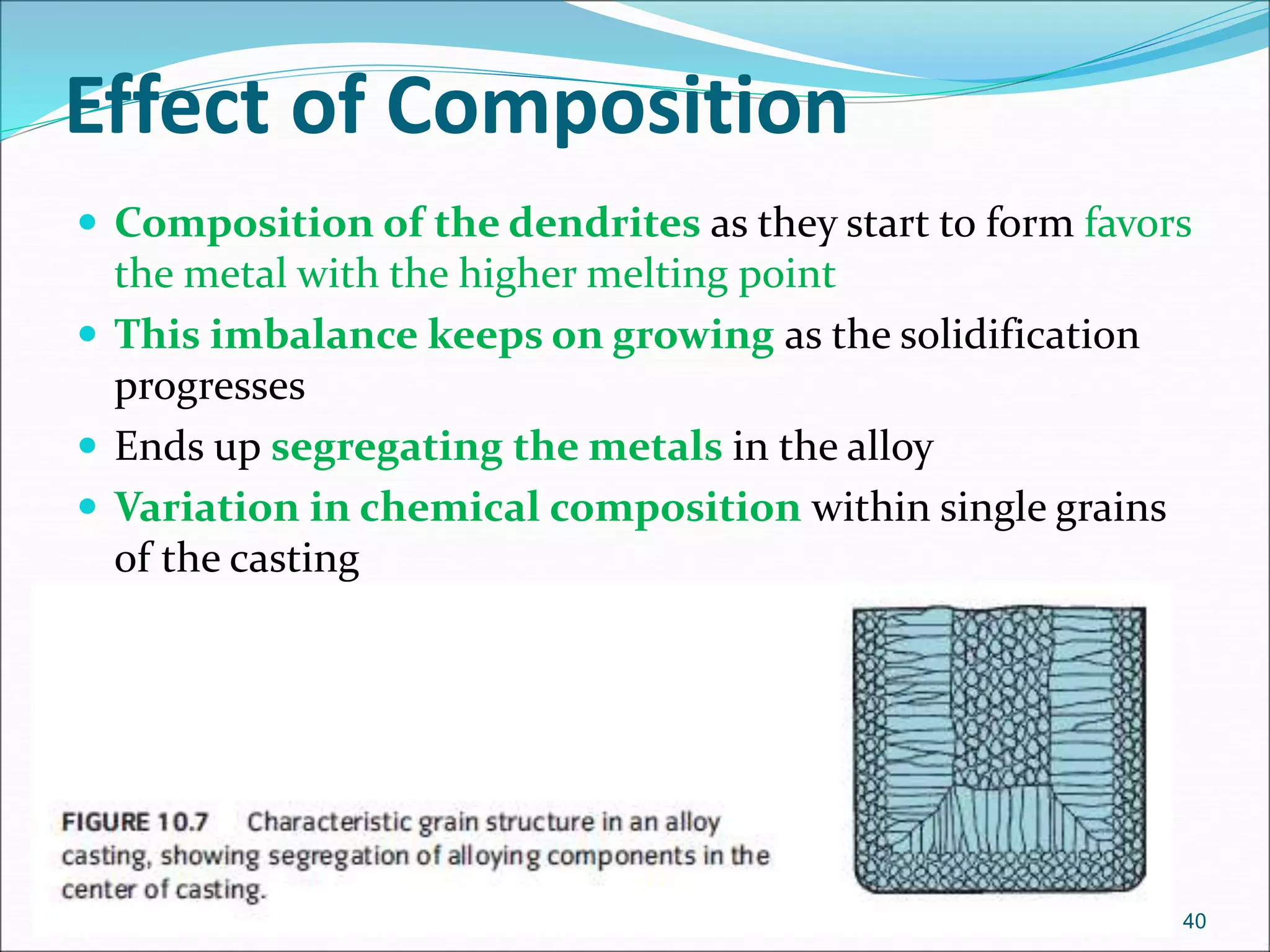
Effect of Composition
 Composition of the dendrites as they start to form favors
the metal with the higher melting point
 This imbalance keeps on growing as the solidification
progresses
 Ends up segregating the metals in the alloy
 Variation in chemical composition within single grains
of the casting
40
Eutectic Alloys
 Eutectic alloy is a particular composition in an alloy system
for which the solidus and liquidus are at the same
temperature.
 Any alloy in theory can be made Eutactic but there has to
be a
 Eutectic Composition
 Eutectic Temperature
41
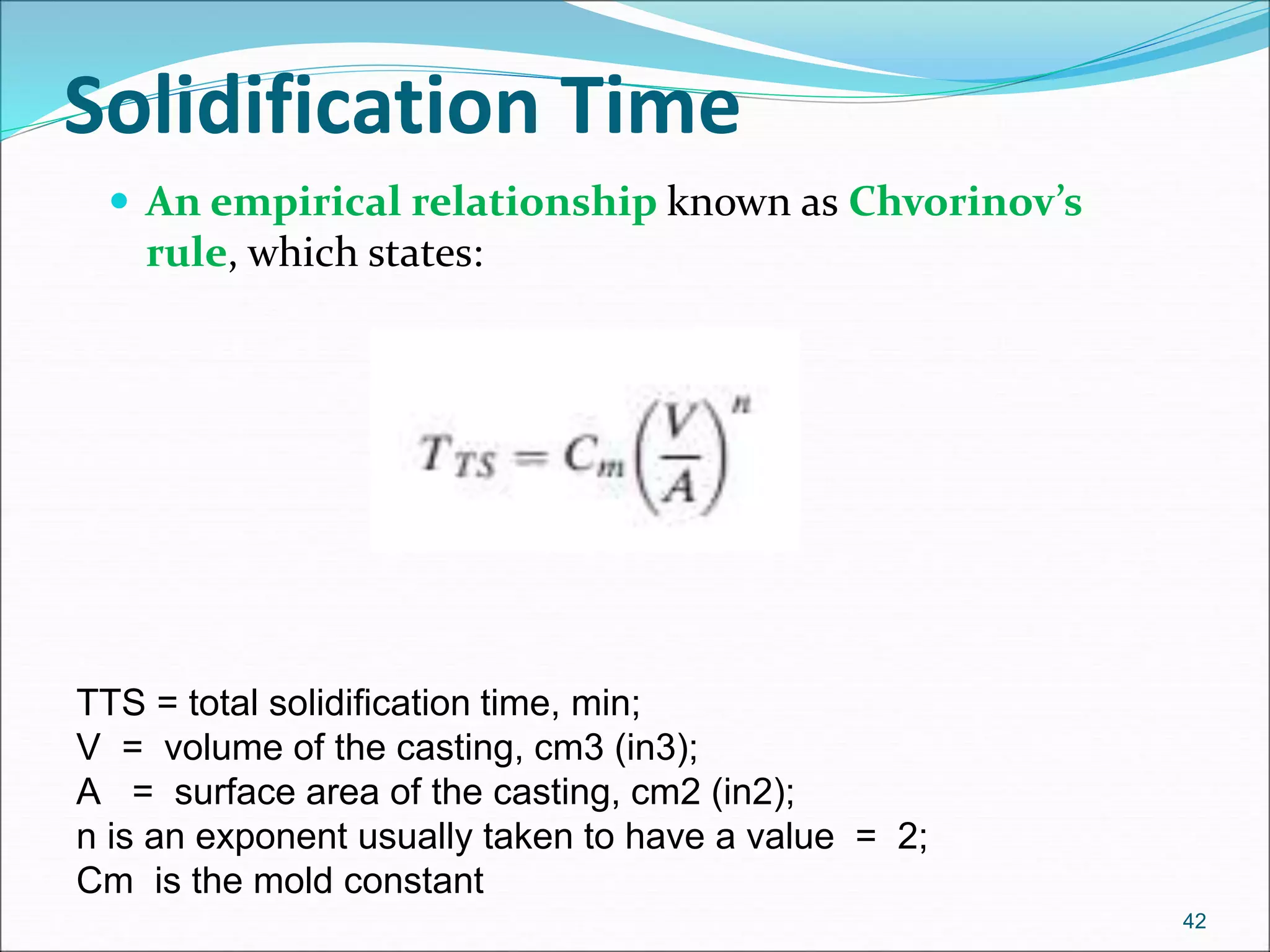
 An empirical relationship known as Chvorinov’s
rule, which states:
42
Solidification Time
TTS = total solidification time, min;
V = volume of the casting, cm3 (in3);
A = surface area of the casting, cm2 (in2);
n is an exponent usually taken to have a value = 2;
Cm is the mold constant
Metals shrink (contract) during solidification. Shrinkage,
causes dimensional changes - and sometimes cracking.
Three kinds are:
 Contraction of the molten metal as it cools prior to its
solidification;
 Contraction of the metal during phase change from
liquid to solid (latent heat of fusion);
 Contraction of the solidified metal (the casting) as its
temperature drops to ambient temperature
43
Shrinkage
Volumetric contraction for different
casting metals
44
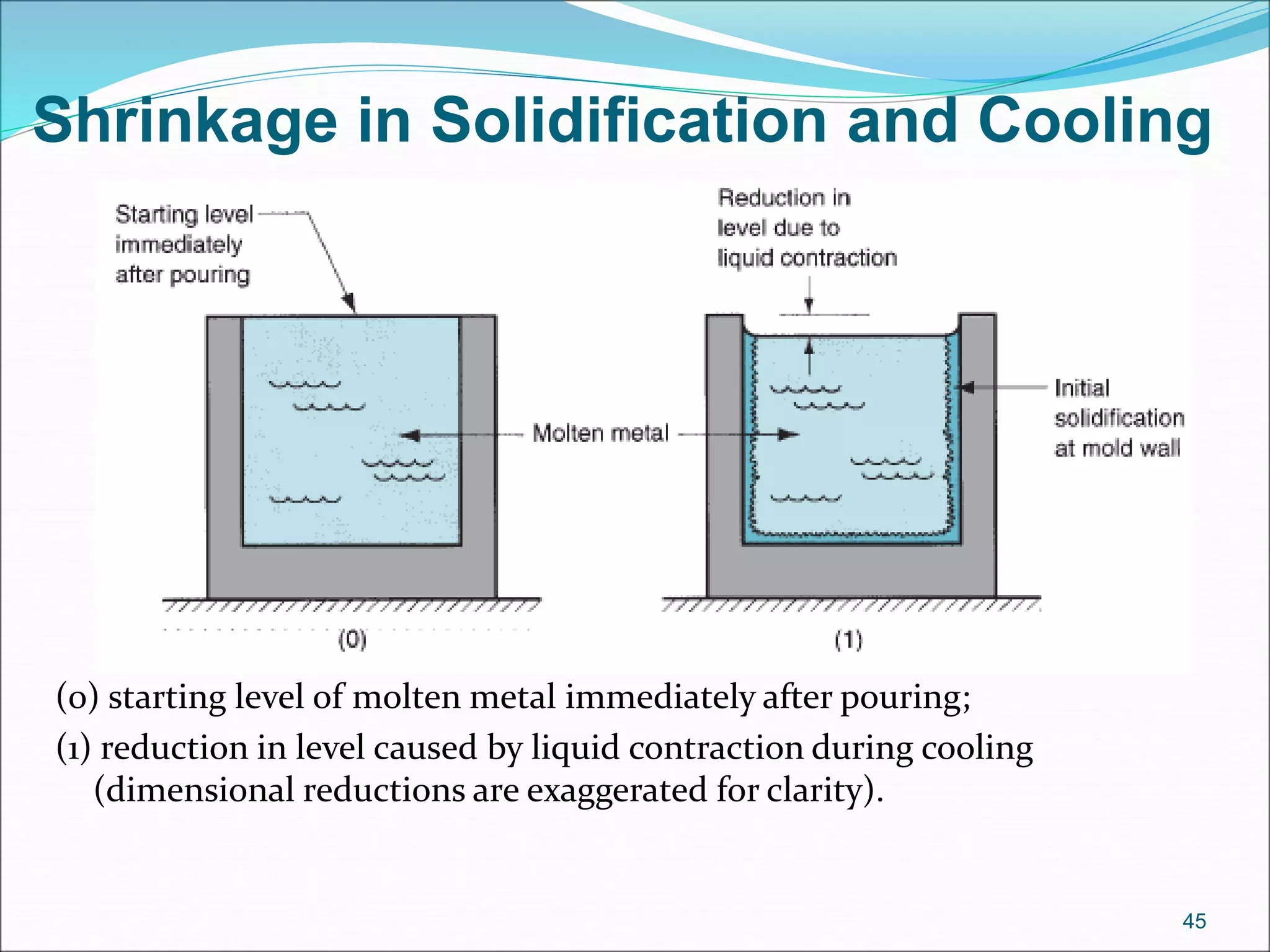
(0) starting level of molten metal immediately after pouring;
(1) reduction in level caused by liquid contraction during cooling
(dimensional reductions are exaggerated for clarity).
45
Shrinkage in Solidification and Cooling
(2) reduction in height and formation of shrinkage cavity caused by
solidification shrinkage; (3) further reduction in height and diameter due
to thermal contraction during cooling of solid metal (dimensional
reductions are exaggerated for clarity).
46
 The cavity (containing liquid metal) remains at upper
level because liquid metal has low density as
compared to solid metal. But it is not at the top because
the layer of the metal has already solidified at the top
due to rapid cooling there.
 The shrinkage cavity is called a pipe by foundaryman.
 The amount by which the mold must be made larger
relative to final casting size is called the pattern
shrinkage allowance.
47
Shrinkage Cavity
Solidification Shrinkage
 Exception: cast iron with high C content
 Graphitization during final stages of freezing
causes expansion that counteracts volumetric decrease
associated with phase change
48
Shrinkage Allowance
 Pattern makers account for solidification shrinkage
and thermal contraction by making mold cavity
oversized
 Amount by which mold is made larger relative to final
casting size is called pattern shrinkage allowance
 Casting dimensions are expressed linearly rather
than volumetrically, so allowances are applied
accordingly
 A pattern is a replica of the object to be cast, used to
prepare the cavity into which molten material will be
poured during the casting process.
49
Directional Solidification
It is desirable for the regions of the
casting most distant from the liquid
metal supply to freeze first and for
solidification to progress from these
remote regions toward the riser(s)
Locating sections of the casting with lower
V/A ratios away from the riser, freezing
will occur first in these regions
50
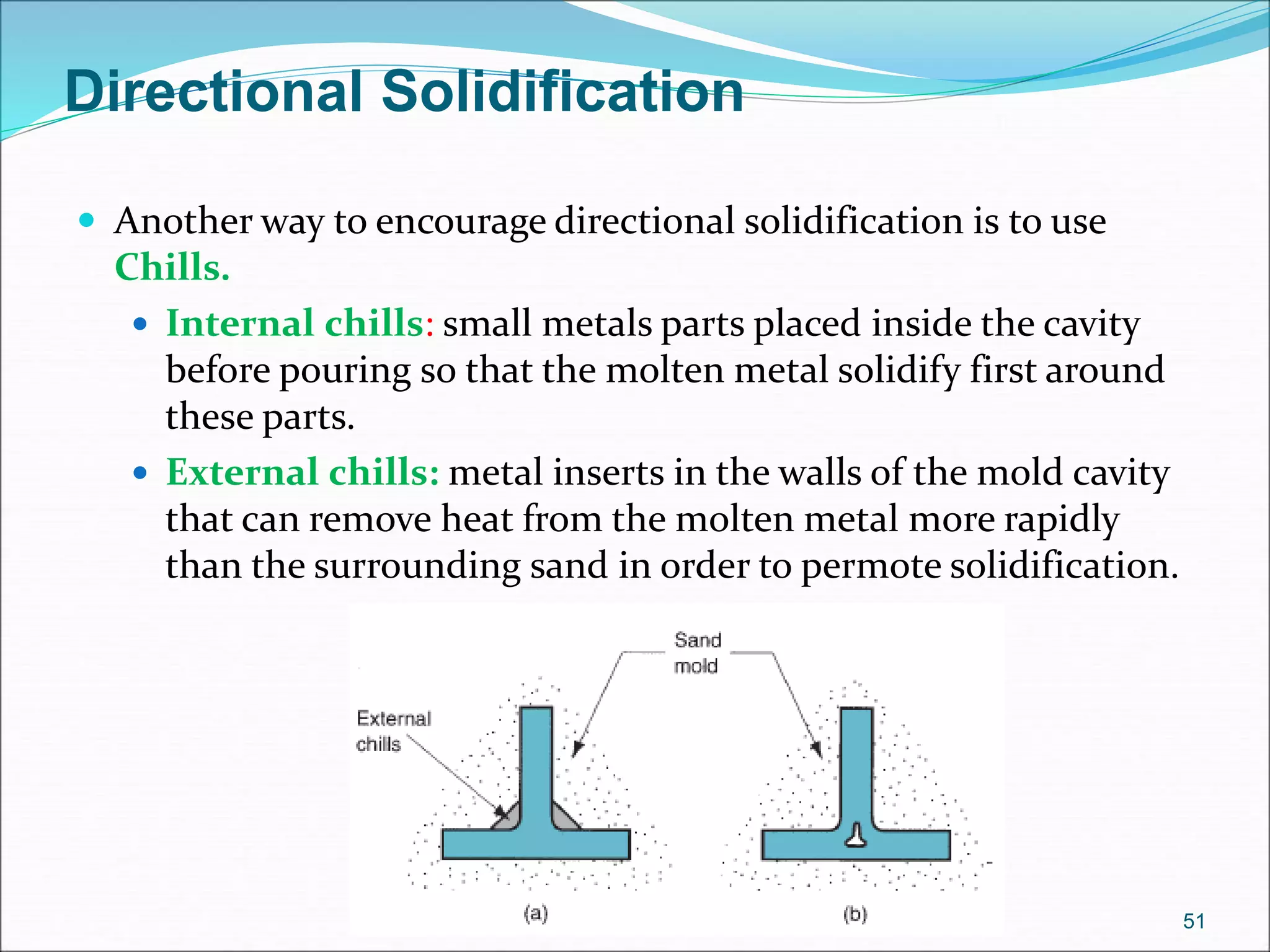
Directional Solidification
 Another way to encourage directional solidification is to use
Chills.
 Internal chills: small metals parts placed inside the cavity
before pouring so that the molten metal solidify first around
these parts.
 External chills: metal inserts in the walls of the mold cavity
that can remove heat from the molten metal more rapidly
than the surrounding sand in order to permote solidification.
51
Riser Design
 Riser must stay liquid as long as all the metal is solidified.
 Riser is waste metal that is separated from the casting and
remelted to make more castings
 To minimize waste in the unit operation, it is desirable for the
volume of metal in the riser to be a minimum
 Since the geometry of the riser is normally selected to maximize
the V/A ratio, this allows riser volume to be reduced to the
minimum possible value
 V/A -> Body volume per unit surface area. Spherical shape has
the maximum value of V/A. If the surface area is going to
increase more material is wasted because of interacting with
surroundings
52
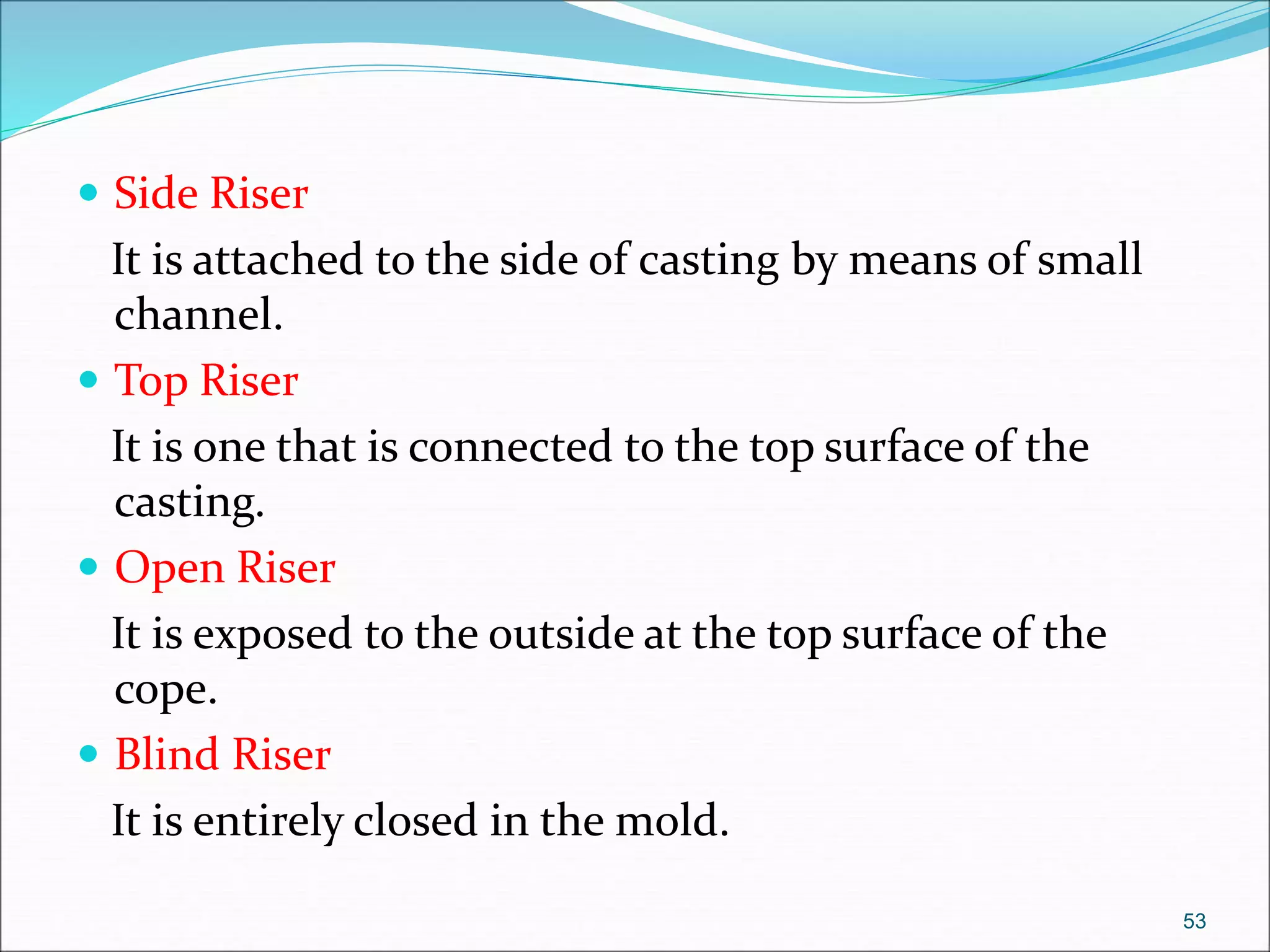
 Side Riser
It is attached to the side of casting by means of small
channel.
 Top Riser
It is one that is connected to the top surface of the
casting.
 Open Riser
It is exposed to the outside at the top surface of the
cope.
 Blind Riser
It is entirely closed in the mold.
53
54
Sample Problem 10.3
DIY
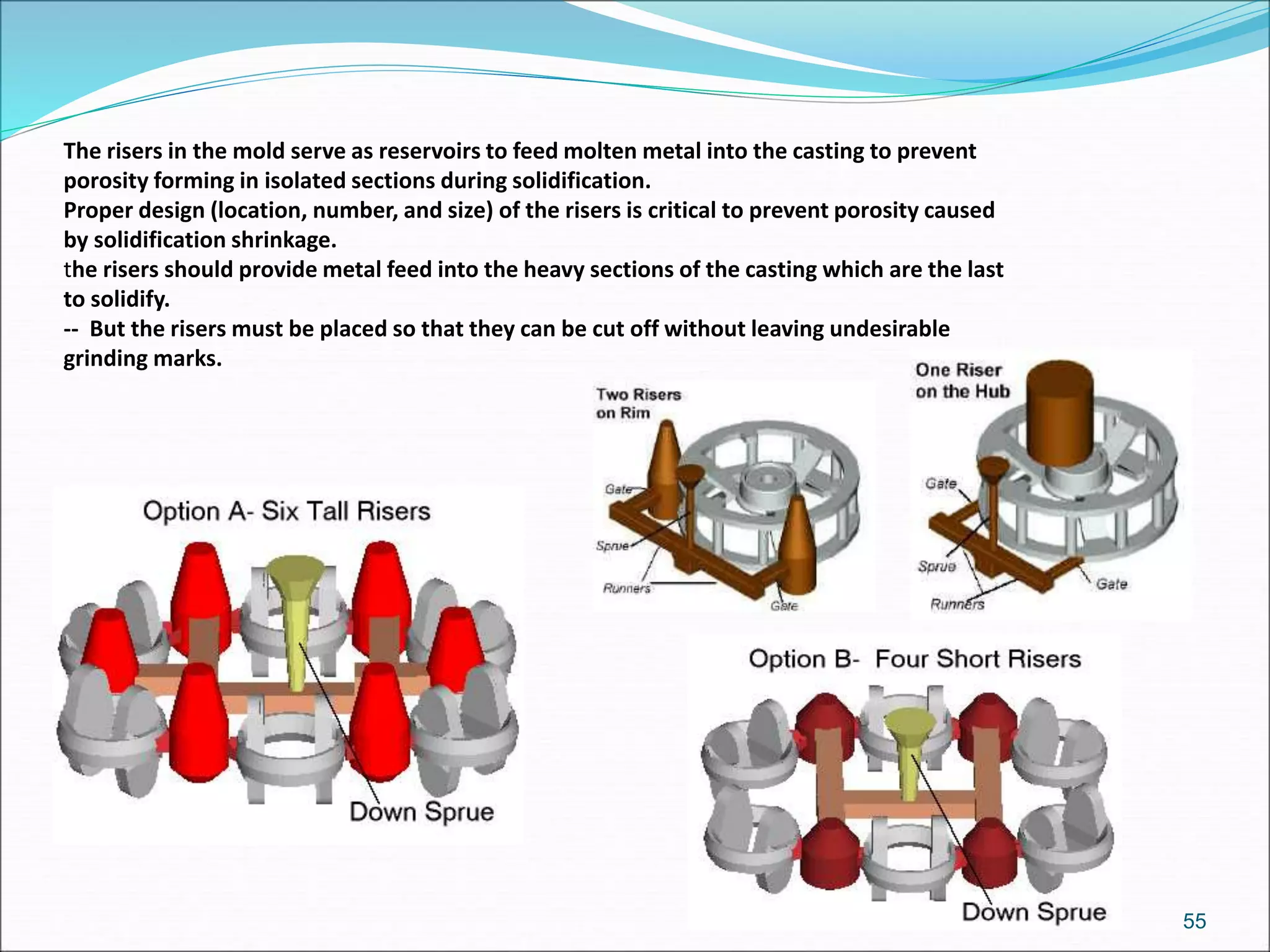
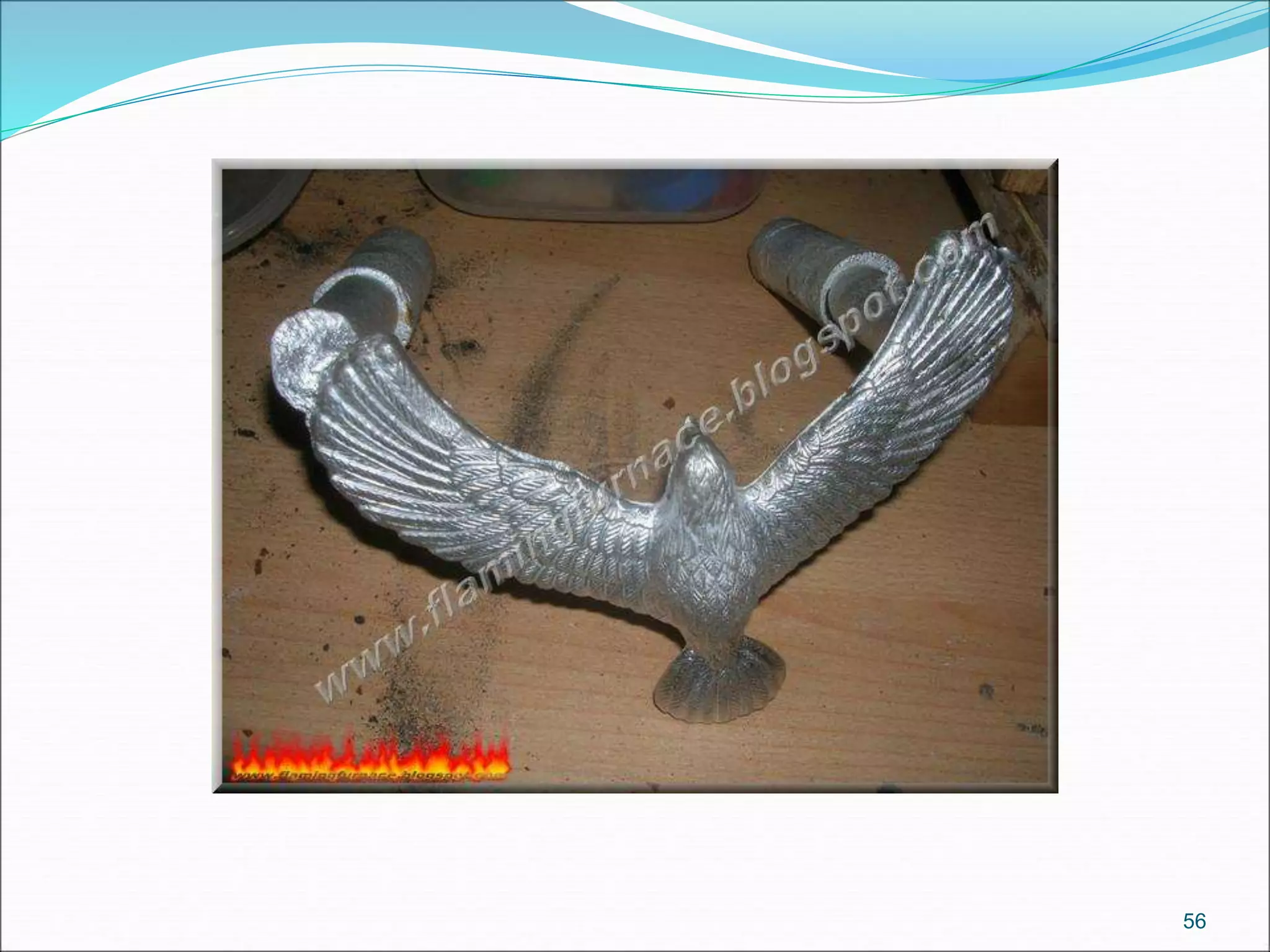
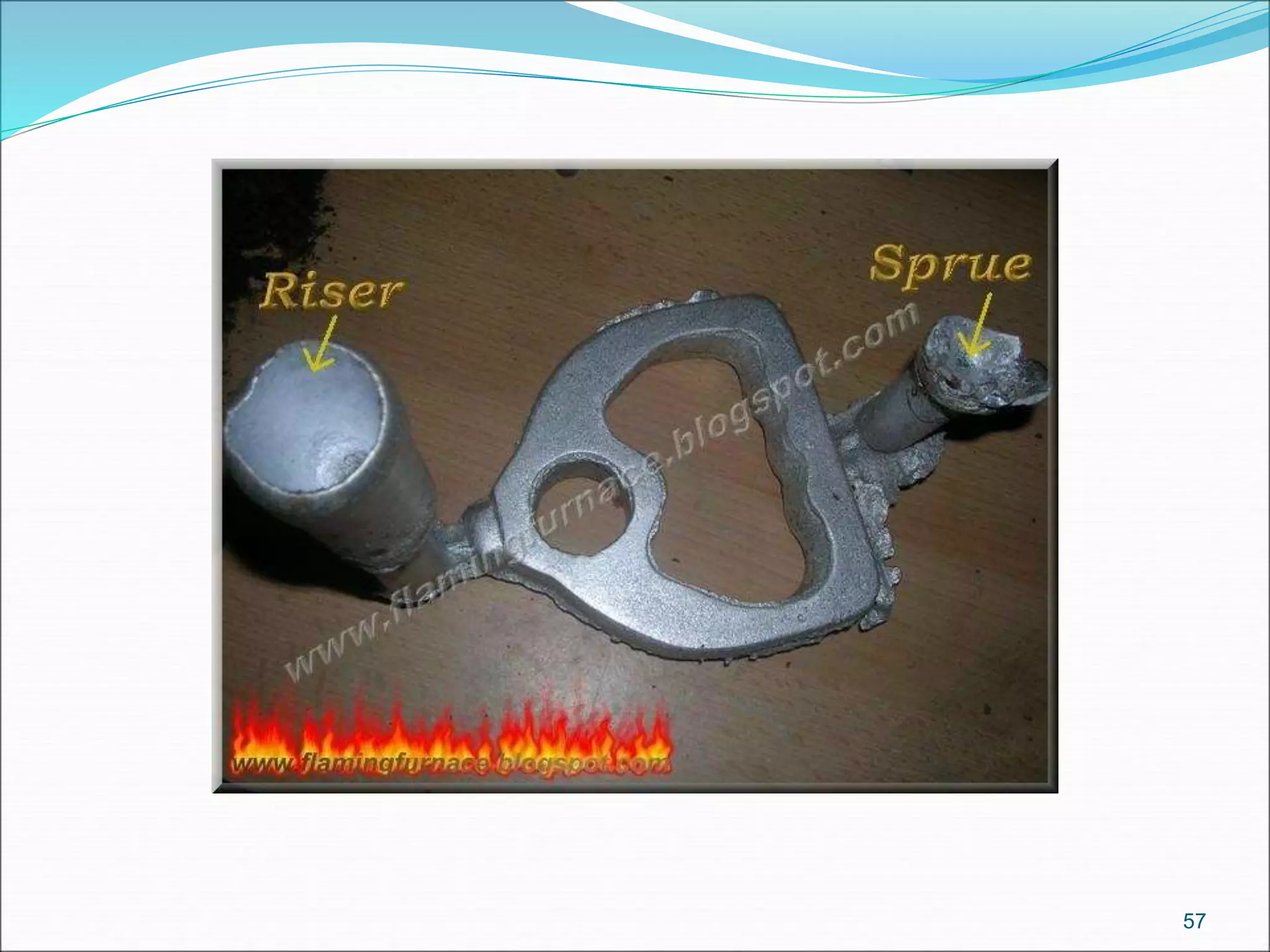
The risers in the mold serve as reservoirs to feed molten metal into the casting to prevent
porosity forming in isolated sections during solidification.
Proper design (location, number, and size) of the risers is critical to prevent porosity caused
by solidification shrinkage.
the risers should provide metal feed into the heavy sections of the casting which are the last
to solidify.
-- But the risers must be placed so that they can be cut off without leaving undesirable
grinding marks.
55
56
57
58
59
60
61

Fundamentals of Metal forming

  • 1.
    Lecture# 03 Hafiz ZahidNabi Dr. Ghulam Moeen uddin 1
  • 2.
    Introduction  Casting isa process in which molten metal flows by gravity or other force into a mold where it solidifies in the shape of the mold cavity.  Done for both  Ingots  Shape Casting(CASTING) 2
  • 3.
     Casting canbe used to create complex part geometries, including both external and internal shapes.  Poor dimensional control, porosity, hardness  Net Shape products (no finishing),  Near Net Shape (finishing)  Can be for Very large parts upto 100 tons  On any metal that can be heated to the liquid state.  Some casting methods are quite suited to mass production. 3
  • 4.
  • 5.
    History of casting Castingof metals can be traced back 4000 B.C. Gold was first metal to be discovered and used by the early civilization. Copper that gave rise to the need for casting. Shapes much more complicated made by casting than by hammering. Alloys Copper, Tin and aluminum based  in 1340 - cast iron  in 1826 - malleable iron  in 1948 - nodular cast iron 5
  • 6.
  • 7.
  • 8.
  • 9.
    Examples of CastParts Crank handle formed by casting; some areas were machined and assembled after casting 9
  • 10.
    Examples of CastParts C-clamps formed by casting (left) and machining (right) 10
  • 11.
    Examples of CastParts Complex part formed by casting 11
  • 12.
    Overview of CastingTechnology  Casting is usually performed in a foundry  Foundry is a factory equipped for making molds, melting and handling molten metal, performing the casting process, and cleaning the finished casting  Workers are called Foundry men  Mold contains a cavity whose geometry determines part shape  PATTERN is a dummy part to build cavity in sand castings  Cavity must be slightly oversized to allow for shrinkage of metal  Types of Casting processes based on type of Molds 12
  • 13.
    Open Molds andClosed Molds 13
  • 14.
    Two Categories ofCasting Processes Expendable mold processes - mold is sacrificed to remove part. Uses an expendable mold which must be destroyed to remove casting. Mold materials: sand, plaster, and similar materials, plus binders  Advantage: more complex shapes possible  Disadvantage: production rates often limited by time to make mold rather than casting itself 14
  • 15.
    Permanent mold processes- mold is made of metal and can be used to make many castings .Uses a permanent mold which can be used over and over to produce many castings. Mold materials :Made of metal (or, less commonly, a ceramic refractory material)  Advantage: higher production rates  Disadvantage: geometries limited by need to open mold 15
  • 16.
    Sand Casting Mold 16 Container •Sprues, runner, riser, pouring cup constitute Gating System • Escape of trapped air either to the sand in sand casting or special escape routes Compensate for shrinkage To control splashing Core For internal features
  • 17.
    Sand Casting MoldedPart Out 17 Container • Sprues, runner, riser, pouring cup constitute Gating System • Escape of trapped air either to the sand in sand casting or special escape routes Compensate for shrinkage To control splashing Core For internal features
  • 18.
    Construction of MoldCavity  Mold cavity is formed by packing sand around a pattern, which has the shape of the part  When the pattern is removed, the remaining cavity of the packed sand has desired shape of cast part  The pattern is usually oversized to allow for shrinkage of metal during solidification and cooling  Sand for the mold is moist and contains a binder to maintain its shape  Ladle: A long-handled spoon with a deep bowl for serving liquids. 18
  • 19.
    Use of aCore in the Mold Cavity`  The mold cavity provides the external surfaces of the cast part  In addition, a casting may have internal surfaces, determined by a core, placed inside the mold cavity to define the interior geometry of part  Core Print a region used to support the core  In sand casting, cores are generally made of sand 19
  • 20.
    20 Ladle material canbe steel, iron , stainless steel& refractory material.
  • 21.
    Preparation of casting Preparationof liquid metal  Get all materials ready  Make suitable composition  Melt materials (Combustion or Electricity)  Liquid metal protection Preparation of casting  Store and transfer liquid – ladle  Moulds 21
  • 22.
    Heating the Metal The heat required is the sum of:  Heat to raise temperature to melting point  Heat of fusion to convert from solid to liquid  Heat to raise molten metal to desired temperature for pouring H = ρV{Cs (Tm-T0)+ Hf + Cl( Tp-Tm)} H = total heat required to raise the temp of the metal to the pouring temperature, J (Btu); ρ = density; g=cm3 lbm/ in3; Cs = weight specific heat for the solid metal, J/g-C (Btu/lbm-F); Tm = melting temperature of the metal, C (F); To = starting temperature—usually ambient, C (F); Hf = heat of fusion, J/g (Btu/lbm); Cl = weight specific heat of the liquidmetal, J/g-C (Btu/lbm-F); Tp = pouring temperature, (F); and V = volume of metal being heated, cm3 (in3). 22
  • 23.
    Heating the Metal The heat required is the sum of:  Heat to raise temperature to melting point  Heat of fusion to convert from solid to liquid  Heat to raise molten metal to desired temperature for pouring H = ρV{Cs (Tm-T0)+ Hf + Cl( Tp-Tm)} H = total heat required to raise the temp of the metal to the pouring temperature, J (Btu); ρ = density; g=cm3 lbm/ in3; Cs = weight specific heat for the solid metal, J/g-C (Btu/lbm-F); Tm = melting temperature of the metal, C (F); To = starting temperature—usually ambient, C (F); Hf = heat of fusion, J/g (Btu/lbm); Cl = weight specific heat of the liquidmetal, J/g-C (Btu/lbm-F); Tp = pouring temperature, (F); and V = volume of metal being heated, cm3 (in3). 23 Example 10.1 self do
  • 24.
    Pouring the MoltenMetal  For this step to be successful, metal must flow into all regions of the mold, most importantly the main cavity, before solidifying  Factors that determine success  Pouring temperature  Pouring rate  Turbulence 24
  • 25.
     Pouring temperatureshould be sufficiently high in order to prevent the molten metal to start solidifying on its way to the cavity.  Pouring rate should neither be high (may stuck at the runner – should match viscosity of the metal) nor very low that may start solidifying on its way to the cavity.  Turbulence should be kept to a minimum in order to allow smooth flow and to avoid mold damage and entrapment of foreign materials.  Mold Erosion: the gradual wearing away of the mold surfaces due to impact of the flowing molten metal. Molten metals are more chemically reactive than at room temperature. 25
  • 26.
    Engineering Analysis ofPouring Bernoulli’s Theorem which states sum of energies at any two points in a flowing liquids are equal. h1+P1/ρ+V1 2 /2g +F1=h2+P2/ρ+V2 2 /2g+F2  H=head, cm (in), p=pressure on the liquid, N=cm2 lb/ in2; ρ = density; g/cm3 (lbm/in3); v = flowvelocity; cm/s ðin/secÞ; g = gravitational acceleration constant, 981 cm/s/s (32.212= 386 in/sec/sec); and F= head losses due to friction, cm (in). Subscripts 1 and 2 indicate any two locations in the liquid flow assume F=0 P= atmospheric pressure = 1 h1+ V1 2 /2g = h2+V2 2 /2g Now point 1 is top of sprue and 2 is the bottom point Then h2 =0 & V1 =0 which further simplifies h1= V2 2 /2g Can be solved for velocity Continuity law: volume rate of flow stays constant Q=V1A1=V2A2 Q=volume flow rate=cm3/sec 26
  • 27.
    Engineering Analysis ofPouring Based on that the time required to fill the mold cavity 27 Example 10.2 self do
  • 28.
    Fluidity of MoltenMetal Fluidity The capability of a molten metal to fill mold cavities Viscosity Higher viscosity decreases fluidity 28
  • 29.
    Factors Fluidity ofMolten Metal Surface tension Decreases fluidity; often caused by oxide film. Low surface tension causes better filling of the mold cavity Impurity Insoluble particles can increase viscosity, reducing fluidity Mold design The design and size of the sprue, runners, and risers affect fluidity Mold material and surface Thermal conductivity and roughness decrease fluidity Superheating The temperature increment above the melting point increases fluidity Pouring Lower pouring rates decrease fluidity because of faster cooling Heat transfer Coefficient of thermal conductivity Heat of fusion The amount of heat required to be lost to solidify the metal from liquid state. A higher heat of fusion tends to increase the measured fluidity in casting 29 Very Important to Understand
  • 30.
    Solidification of Metals Itis the transformation of molten metal back into solid state Solidification differs depending on whether the metal is  A pure element or  An alloy 30
  • 31.
     A puremetal solidifies at a constant temperature equal to its freezing point (same as melting point).  Chilling action of mold wall, a thin skin of solid metal is formed at the interface immediately after pouring.  Rate of freezing depends on heat transfer into mold, as well as thermal properties of the metal.  Most alloys freeze over a temperature range rather than at a single temperature.  Solidification takes time.  Layers, consisting of different compositions of the alloy are formed around the wall of mold.  It depends upon the melting point and densities of different constituents in the alloy. 31
  • 32.
    Pure Metal Local solidificationTime “The actual freezing takes time called the local solidification time in casting during which the metal’s latent heat of fusion is released into the surrounding mold.” Total solidification Time “It is time taken b/w pouring and complete solidification. After the casting has completely solidified, cooling continuous at a rate indicated by the downward slope of the cooling curve.” 32
  • 33.
  • 34.
    Cooling Rate  Rapidcooling at mold walls produces equiaxed (roughly round) grains  Slow cooling towards the interior forms long columnar grains that grow towards the center  Nucleating Agent: Nucleating agents are additives that provide sites for crystal formation in the polymer melt. Chemical substances which when incorporated in plastics form nuclei for the growth of crystals in the polymer melt. 34
  • 35.
    Metal Solidification 35 Dentritic Growth orientedtowards the center Equiaxed grains (roughly round) grains
  • 36.
    Effect of NucleatingAgent on Metal Solidification 36 A nucleating agent (inoculants) is a substance that induces grains to nucleate and form at the same time throughout the structure.
  • 37.
    Solidification of Alloys 37 Mostalloys freeze over a temperature range rather than a single temperature and the range depends upon the properties of the constituent metals Liquidus: The minimum temperature at which all components of a mixture, such as an alloy, can be in a liquid state. Solidus: The minimum temperature at which all components of a mixture, such as an alloy, can be in a solid state.
  • 38.
    Solidification of Alloys 38 Mostalloys freeze over a temperature range rather than a single temperature and the range depends upon the properties of the constituent metals
  • 39.
    Effect of CoolingRate Dendrites Tree-like structures that form during the solidification of alloys  Slow cooling rates produce dendrites with larger branch spacing;  Faster cooling rates produce finer spacing;  Very fast cooling rates produce no dendrites or grains 39
  • 40.
    Effect of Composition Composition of the dendrites as they start to form favors the metal with the higher melting point  This imbalance keeps on growing as the solidification progresses  Ends up segregating the metals in the alloy  Variation in chemical composition within single grains of the casting 40
  • 41.
    Eutectic Alloys  Eutecticalloy is a particular composition in an alloy system for which the solidus and liquidus are at the same temperature.  Any alloy in theory can be made Eutactic but there has to be a  Eutectic Composition  Eutectic Temperature 41
  • 42.
     An empiricalrelationship known as Chvorinov’s rule, which states: 42 Solidification Time TTS = total solidification time, min; V = volume of the casting, cm3 (in3); A = surface area of the casting, cm2 (in2); n is an exponent usually taken to have a value = 2; Cm is the mold constant
  • 43.
    Metals shrink (contract)during solidification. Shrinkage, causes dimensional changes - and sometimes cracking. Three kinds are:  Contraction of the molten metal as it cools prior to its solidification;  Contraction of the metal during phase change from liquid to solid (latent heat of fusion);  Contraction of the solidified metal (the casting) as its temperature drops to ambient temperature 43 Shrinkage
  • 44.
    Volumetric contraction fordifferent casting metals 44
  • 45.
    (0) starting levelof molten metal immediately after pouring; (1) reduction in level caused by liquid contraction during cooling (dimensional reductions are exaggerated for clarity). 45 Shrinkage in Solidification and Cooling
  • 46.
    Shrinkage in Solidificationand Cooling (2) reduction in height and formation of shrinkage cavity caused by solidification shrinkage; (3) further reduction in height and diameter due to thermal contraction during cooling of solid metal (dimensional reductions are exaggerated for clarity). 46
  • 47.
     The cavity(containing liquid metal) remains at upper level because liquid metal has low density as compared to solid metal. But it is not at the top because the layer of the metal has already solidified at the top due to rapid cooling there.  The shrinkage cavity is called a pipe by foundaryman.  The amount by which the mold must be made larger relative to final casting size is called the pattern shrinkage allowance. 47 Shrinkage Cavity
  • 48.
    Solidification Shrinkage  Exception:cast iron with high C content  Graphitization during final stages of freezing causes expansion that counteracts volumetric decrease associated with phase change 48
  • 49.
    Shrinkage Allowance  Patternmakers account for solidification shrinkage and thermal contraction by making mold cavity oversized  Amount by which mold is made larger relative to final casting size is called pattern shrinkage allowance  Casting dimensions are expressed linearly rather than volumetrically, so allowances are applied accordingly  A pattern is a replica of the object to be cast, used to prepare the cavity into which molten material will be poured during the casting process. 49
  • 50.
    Directional Solidification It isdesirable for the regions of the casting most distant from the liquid metal supply to freeze first and for solidification to progress from these remote regions toward the riser(s) Locating sections of the casting with lower V/A ratios away from the riser, freezing will occur first in these regions 50
  • 51.
    Directional Solidification  Anotherway to encourage directional solidification is to use Chills.  Internal chills: small metals parts placed inside the cavity before pouring so that the molten metal solidify first around these parts.  External chills: metal inserts in the walls of the mold cavity that can remove heat from the molten metal more rapidly than the surrounding sand in order to permote solidification. 51
  • 52.
    Riser Design  Risermust stay liquid as long as all the metal is solidified.  Riser is waste metal that is separated from the casting and remelted to make more castings  To minimize waste in the unit operation, it is desirable for the volume of metal in the riser to be a minimum  Since the geometry of the riser is normally selected to maximize the V/A ratio, this allows riser volume to be reduced to the minimum possible value  V/A -> Body volume per unit surface area. Spherical shape has the maximum value of V/A. If the surface area is going to increase more material is wasted because of interacting with surroundings 52
  • 53.
     Side Riser Itis attached to the side of casting by means of small channel.  Top Riser It is one that is connected to the top surface of the casting.  Open Riser It is exposed to the outside at the top surface of the cope.  Blind Riser It is entirely closed in the mold. 53
  • 54.
  • 55.
    The risers inthe mold serve as reservoirs to feed molten metal into the casting to prevent porosity forming in isolated sections during solidification. Proper design (location, number, and size) of the risers is critical to prevent porosity caused by solidification shrinkage. the risers should provide metal feed into the heavy sections of the casting which are the last to solidify. -- But the risers must be placed so that they can be cut off without leaving undesirable grinding marks. 55
  • 56.
  • 57.
  • 58.
  • 59.
  • 60.
  • 61.