1 | MA T H 1 0 - Q 3
Department of Education
Division of Cagayan de Oro City
PUERTO NATIONAL HIGH SCHOOL
Purok 1, Puerto, Cagayan de Oro City
Name
Section
Subject Teacher
MATHEMATICS 10
Quarter 3
LEARNING ACTIVITY SHEET (LAS)
2.
2 | MA T H 1 0 - Q 3
Lesson Title : Statistics and Probability
Learning Competency: Illustrates permutation of objects (M10SP-IIIa-1).
Solve problems involving permutations (M10SP-IIIb-1).
Reference: Mathematics 10 Learner’s Material LAS No.: 3.1
CONCEPT NOTES:
Explore
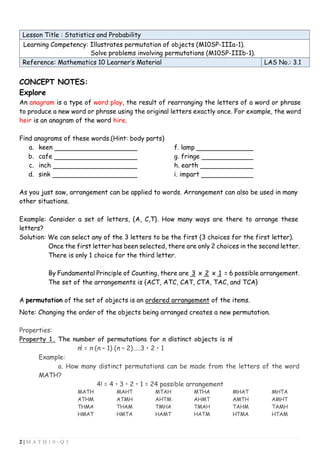
An anagram is a type of word play, the result of rearranging the letters of a word or phrase
to produce a new word or phrase using the original letters exactly once. For example, the word
heir is an anagram of the word hire.
Find anagrams of these words.(Hint: body parts)
a. keen f. lamp
b. cafe g. fringe
c. inch h. earth
d. sink i. impart
As you just saw, arrangement can be applied to words. Arrangement can also be used in many
other situations.
Example: Consider a set of letters, {A, C,T}. How many ways are there to arrange these
letters?
Solution: We can select any of the 3 letters to be the first (3 choices for the first letter).
Once the first letter has been selected, there are only 2 choices in the second letter.
There is only 1 choice for the third letter.
By Fundamental Principle of Counting, there are 3 x 2 x 1 = 6 possible arrangement.
The set of the arrangements is {ACT, ATC, CAT, CTA, TAC, and TCA}
A permutation of the set of objects is an ordered arrangement of the items.
Note: Changing the order of the objects being arranged creates a new permutation.
Properties:
Property 1. The number of permutations for n distinct objects is n!
n! = n (n – 1) (n – 2)…..3 • 2 • 1
Example:
a. How many distinct permutations can be made from the letters of the word
MATH?
4! = 4 • 3 • 2 • 1 = 24 possible arrangement
MATH MAHT MTAH MTHA MHAT MHTA
ATHM ATMH AHTM AHMT AMTH AMHT
THMA THAM TMHA TMAH TAHM TAMH
HMAT HMTA HAMT HATM HTMA HTAM
3.
3 | MA T H 1 0 - Q 3
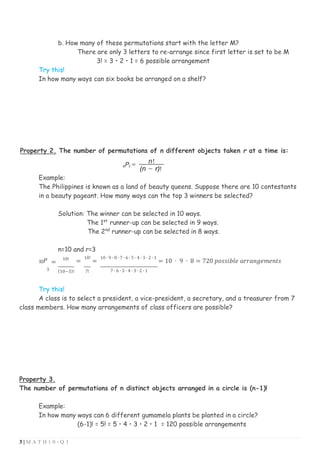
b. How many of these permutations start with the letter M?
There are only 3 letters to re-arrange since first letter is set to be M
3! = 3 • 2 • 1 = 6 possible arrangement
Try this!
In how many ways can six books be arranged on a shelf?
Property 2. The number of permutations of n different objects taken r at a time is:
Example:
The Philippines is known as a land of beauty queens. Suppose there are 10 contestants
in a beauty pageant. How many ways can the top 3 winners be selected?
Solution: The winner can be selected in 10 ways.
The 1st
runner-up can be selected in 9 ways.
The 2nd
runner-up can be selected in 8 ways.
n=10 and r=3
10𝑃 =
10!
=
10!
=
10 ∙ 9 ∙ 8 ∙ 7 ∙ 6 ∙ 5 ∙ 4 ∙ 3 ∙ 2 ∙ 1
= 10 ∙ 9 ∙ 8 = 720 𝑝𝑜𝑠𝑠𝑖𝑏𝑙𝑒 𝑎𝑟𝑟𝑎𝑛𝑔𝑒𝑚𝑒𝑛𝑡𝑠
3 (10−3)! 7! 7 ∙ 6 ∙ 5 ∙ 4 ∙ 3 ∙ 2 ∙ 1
Try this!
A class is to select a president, a vice-president, a secretary, and a treasurer from 7
class members. How many arrangements of class officers are possible?
Property 3.
The number of permutations of n distinct objects arranged in a circle is (n-1)!
Example:
In how many ways can 6 different gumamela plants be planted in a circle?
(6-1)! = 5! = 5 • 4 • 3 • 2 • 1 = 120 possible arrangements
4.
4 | MA T H 1 0 - Q 3
Try this!
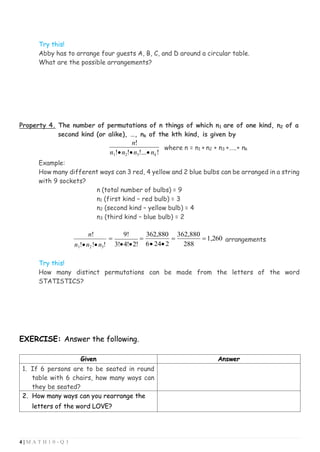
Abby has to arrange four guests A, B, C, and D around a circular table.
What are the possible arrangements?
Property 4. The number of permutations of n things of which n1 are of one kind, n2 of a
second kind (or alike), …, nk of the kth kind, is given by
Example:
n!
n1!•n2!•n3!...• nk!
where n = n1 + n2 + n3 +…..+ nk
How many different ways can 3 red, 4 yellow and 2 blue bulbs can be arranged in a string
with 9 sockets?
n (total number of bulbs) = 9
n1 (first kind – red bulb) = 3
n2 (second kind – yellow bulb) = 4
n3 (third kind – blue bulb) = 2
n!
=
n1!•n2!•n3!
9!
3!•4!•2!
=
362,880
6• 24• 2
=
362,880
=1,260
288
arrangements
Try this!
How many distinct permutations can be made from the letters of the word
STATISTICS?
EXERCISE: Answer the following.
Given Answer
1. If 6 persons are to be seated in round
table with 6 chairs, how many ways can
they be seated?
2. How many ways can you rearrange the
letters of the word LOVE?
5.
5 | MA T H 1 0 - Q 3
3. If 7 numbers will be used to form
telephone numbers, how many possible
telephone numbers can be formed if 3
will be used twice; 2, thrice; and 5, twice?
4. How many ways can 3 female students
and 4 male students be seated on a long
bench if the bench can accommodate only
4 persons?
5. Using the letters of the English
alphabet, how many 5-letter code words
can be formed from the:
a) First 10 letters?
b) Consonants?
c) Vowels?
6. In how many ways can four books be
arranged on a shelf?
7. In how many ways can seven students be
arranged in a line?
8. What is the number of permutations of 9
objects taken 3 at a time?
9. How many different words can be
formed from the letters of the word
a. PHILIPPINES
b. PROBABILITY
10. Rabin has 9 mathematics books and 5
science books. The shelf has space for
only 7 books. If the first four positions
are to be occupied by mathematics books
and the last three by science books, in
how many ways can this be done?
6.
6 | MA T H 1 0 - Q 3
Lesson Title : Statistics and Probability
Learning Competency: Illustrates the combination of objects (M10SP-III-c-1).
Differentiates permutation from combination of n objects taken r at a time (M10SP-III-c-2).
Reference: Mathematics 10 Learner’s Material LAS No.: 3.2
CONCEPT NOTES:
Explore
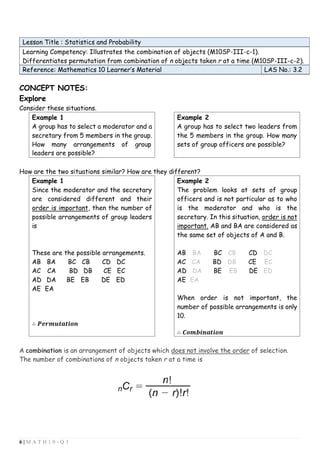
Consider these situations.
Example 1
A group has to select a moderator and a
secretary from 5 members in the group.
How many arrangements of group
leaders are possible?
Example 2
A group has to select two leaders from
the 5 members in the group. How many
sets of group officers are possible?
How are the two situations similar? How are they different?
Example 1
Since the moderator and the secretary
are considered different and their
order is important, then the number of
possible arrangements of group leaders
is
These are the possible arrangements.
AB BA BC CB CD DC
AC CA BD DB CE EC
AD DA BE EB DE ED
AE EA
∴ 𝑷𝒆𝒓𝒎𝒖𝒕𝒂𝒕𝒊𝒐𝒏
Example 2
The problem looks at sets of group
officers and is not particular as to who
is the moderator and who is the
secretary. In this situation, order is not
important. AB and BA are considered as
the same set of objects of A and B.
AB BA BC CB CD DC
AC CA BD DB CE EC
AD DA BE EB DE ED
AE EA
When order is not important, the
number of possible arrangements is only
10.
∴ 𝑪𝒐𝒎𝒃𝒊𝒏𝒂𝒕𝒊𝒐𝒏
A combination is an arrangement of objects which does not involve the order of selection.
The number of combinations of n objects taken r at a time is
7.
7 | MA T H 1 0 - Q 3
( )
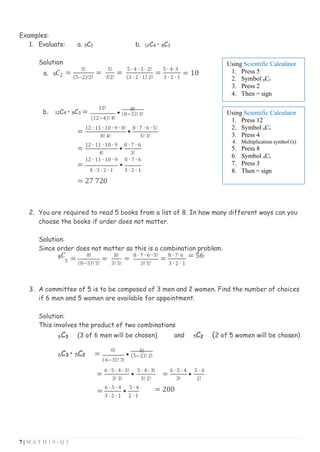
Examples:
1. Evaluate: a. 5C2 b. 12C4 • 8C3
Solution
a. 5𝐶2 =
5!
(5−2)!2!
=
5!
3!2!
=
5 ∙ 4 ∙ 3 ∙ 2!
(3 ∙ 2 ∙ 1) 2!
=
5 ∙ 4∙ 3
3 ∙ 2 ∙ 1
= 10
b. 12C4 • 8C3 =
12!
(12−4)! 4!
•
8!
(8−3)! 3!
=
12 ∙ 11 ∙ 10 ∙ 9 ∙ 8!
•
8 ∙ 7 ∙ 6 ∙ 5!
8! 4! 5! 3!
=
12 ∙ 11 ∙ 10 ∙ 9
•
8 ∙ 7 ∙ 6
4! 3!
12 ∙ 11 ∙ 10 ∙ 9 8 ∙ 7 ∙ 6
= •
4 ∙ 3 ∙ 2 ∙ 1 3 ∙ 2 ∙ 1
= 27 720
2. You are required to read 5 books from a list of 8. In how many different ways can you
choose the books if order does not matter.
Solution:
Since order does not matter so this is a combination problem.
8𝐶 =
8!
=
8!
=
8 ∙ 7 ∙ 6 ∙ 5!
=
8 ∙ 7∙ 6 = 56
5 (8−5)! 5! 3! 5! 3! 5! 3 ∙ 2 ∙ 1
3. A committee of 5 is to be composed of 3 men and 2 women. Find the number of choices
if 6 men and 5 women are available for appointment.
Solution:
This involves the product of two combinations
6C3 (3 of 6 men will be chosen) and 5C2 (2 of 5 women will be chosen)
6C3 • 5C2 =
6!
6−3 ! 3!
•
5!
(5−2)! 2!
=
6 ∙ 5 ∙ 4 ∙ 3!
•
5 ∙ 4 ∙ 3!
=
6 ∙ 5 ∙ 4
•
5 ∙ 4
3! 3!
=
6 ∙ 5 ∙ 4
•
5 ∙ 4
3! 2! 3! 2!
= 200
3 ∙ 2 ∙ 1 2 ∙ 1
Using Scientific Calculator
1. Press 12
2. Symbol nCr
3. Press 4
4. Multiplication symbol (x)
5. Press 8
6. Symbol nCr
7. Press 3
8. Then = sign
Using Scientific Calculator
1. Press 5
2. Symbol nCr
3. Press 2
4. Then = sign
8.
8 | MA T H 1 0 - Q 3
( )
( )
( )
( )
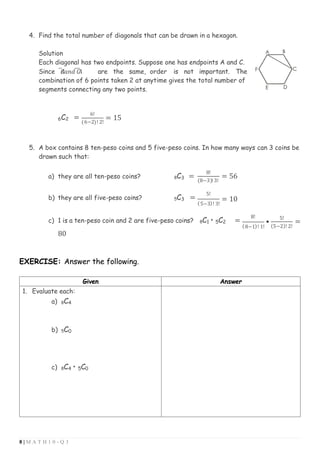
4. Find the total number of diagonals that can be drawn in a hexagon.
Solution
Each diagonal has two endpoints. Suppose one has endpoints A and C.
Since 𝐴
̅̅̅𝐶
̅̅ 𝑎𝑛𝑑 ̅𝐶
̅̅𝐴
̅ are the same, order is not important. The
combination of 6 points taken 2 at anytime gives the total number of
segments connecting any two points.
6C2 =
6!
6−2 ! 2!
= 15
5. A box contains 8 ten-peso coins and 5 five-peso coins. In how many ways can 3 coins be
drawn such that:
a) they are all ten-peso coins? 8C3 =
8!
8−3 ! 3!
b) they are all five-peso coins? 5C3 =
5!
5−3 ! 3!
= 56
= 10
c) 1 is a ten-peso coin and 2 are five-peso coins? 8C1 • 5C2 =
8!
8−1 ! 1!
•
5!
=
(5−2)! 2!
80
EXERCISE: Answer the following.
Given Answer
1. Evaluate each:
a) 8C4
b) 5C0
c) 8C4 • 5C0
9.
9 | MA T H 1 0 - Q 3
2. How many different committees with 3
members can be formed from a group of 5
boys and 4 girls if the members are:
a) all boys?
b) 2 boys and 1 girl?
c) 2 girls and 1 boy?
3. Of the 12 applicants for 8 vacant
positions in a company, 8 are male
applicants and 4 are female applicants.
I how many ways can the 8 vacant
positions be filled up if:
a) 5 male and 3 female applicants
will be accepted?
b) 8 male applicants will be hired?
c) 4 male and 4 female applicants
will be taken in?
4. From 6 English teachers and 5
Mathematics teachers, committee of 5
teachers will be organized. How many
ways can the committee be organized
such that in every committee:
a) 3 are English teachers and 2 are
Mathematics teachers?
b) Any of the teachers can be
included?
c) All are Mathematics teachers?
10.
10 | MA T H 1 0 - Q 3
Lesson Title : Statistics and Probability
Learning Competency: Solves problems involving permutations and combinations (M10SP-III-d-e-1).
Reference: Mathematics 10 Learner’s Material LAS No.: 3.3
CONCEPT NOTES:
A permutation of the set of objects is an ordered arrangement of the items.
Properties:
1. The number of permutations for n objects is n!
n! = n (n – 1) (n – 2)…..3 • 2 • 1
2. The number of permutations of n different objects taken r at a time is:
3. The number of permutations of n distinct objects arranged in a circle is (n-1)!
4. The number of permutations of n things of which n1 are of one kind, n2 of a
second kind (or alike), …, nk of the kth kind, is given by
n!
n1!•n2!•n3!...• nk!
where n = n1 + n2 + n3 +…..+ nk
A combination is an arrangement of objects which does not involve the order of selection.
The number of combinations of n objects taken r at a time is
EXERCISE: Answer the following as directed.
A. Determine whether each situation involves a permutation or a combination.
1. Five badminton players from a group of nine.
2.seven toppings for pizza
3.finding the diagonals of a polygon
4.a classroom sitting chart
5.15 books in a library shelf
6.choosing a class president, vice-president and a secretary
7.eight outfits chosen from fifteen outfits to be modelled
8.a six-person committee from your math class.
9.entering the PIN (Personal Identification Number) of your ATM card
10. choosing 5 questions to answer out of 10 questions in a test
11.
11 | MA T H 1 0 - Q 3
B. Answer the following questions completely.
Given Answer
1. How do you determine if a situation
involves permutations? Or combinations?
2. Explain why 6! given the correct solution
to the possible number of ways to arrange
the letters in the word HONEST.
3. Your class adviser announces that
everyone should buy a permutation lock
for their lockers. Ramon told his friend,
“Doesn’t she mean a combination lock?”
How would his friend answer Ramon?
4. Suppose you are the owner of a sari-sari
store and you want to put 12 pieces of
canned goods in a row on the shelf. If
there are 3 identical cans of meat loaf, 4
identical cans of tomato sauce, 2 identical
cans of sardines, and 3 identical cans of
corned beef, in how many different ways
can you display this goods?
5. A box of Mr. Donuts contains 8 honey
dipped, 6 bavarians, and 4 chocolate filled
donuts. How many ways can 5 donuts be
selected to meet each condition?
a) all Bavarian
b) all chocolate filled
c) all honey dipped
d) 2 bavarian, 2 honey dipped,
1 chocolate filled
12.
12 | MA T H 1 0 - Q 3
Lesson Title : Statistics and Probability
Learning Competency: Illustrates events, and union and intersection of events (M10SP-III-f-1).
Reference: Mathematics 10 Learner’s Material/ Worktext in Mathematics E-math G10 LAS No.: 3.4
CONCEPT NOTES:
Statistical Experiments
- experiments in which results will not be essentially the same through condition maybe
nearly identical
Characteristics:
1. A listing of all outcomes is possible.
2. Any outcome cannot be predicted with certainty.
Sample space - the set of all possible outcomes of a statistical experiment
Sample point - each outcome in a sample space
Event - a subset of a sample space of an experiment
Events can either be:
a. simple event – a set containing only one element of the sample space
b. compound event – union of single events
Examples:
1. Find the number of possible outcomes for each experiment.
a) tossing a coin once c) rolling a die
b) tossing three different coins together d) throwing a coin and a die
Solution:
a) The sample space for this experiment can be written as
𝑆 = {𝐻, 𝑇}
Thus, 𝑛(𝑆) = 2
There are only two possible outcome in the sample space
b) There are eight possible outcomes ( 2 x 2 x 2 = 8)
Two possible outcomes for each coin.
HHH THH
HHT THT
HTH TTH
HTT TTT
Thus, 𝑛(𝑆) = 8.
c) A die has six sides.
𝑆 = {1, 2, 3, 4, 5, 6}
Thus, 𝑛(𝑆) = 6 because there are six possible outcomes.
13.
13 | MA T H 1 0 - Q 3
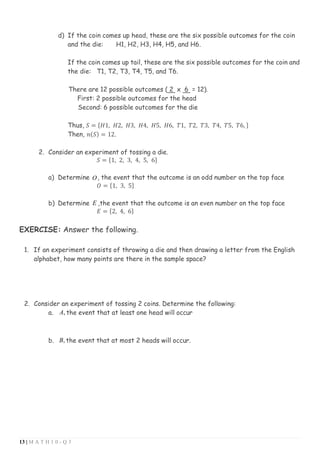
d) If the coin comes up head, these are the six possible outcomes for the coin
and the die: H1, H2, H3, H4, H5, and H6.
If the coin comes up tail, these are the six possible outcomes for the coin and
the die: T1, T2, T3, T4, T5, and T6.
There are 12 possible outcomes ( 2 x 6 = 12).
First: 2 possible outcomes for the head
Second: 6 possible outcomes for the die
Thus, 𝑆 = {𝐻1, 𝐻2, 𝐻3, 𝐻4, 𝐻5, 𝐻6, 𝑇1, 𝑇2, 𝑇3, 𝑇4, 𝑇5, 𝑇6, }
Then, 𝑛(𝑆) = 12.
2. Consider an experiment of tossing a die.
𝑆 = {1, 2, 3, 4, 5, 6}
a) Determine O, the event that the outcome is an odd number on the top face
𝑂 = {1, 3, 5}
b) Determine E ,the event that the outcome is an even number on the top face
𝐸 = {2, 4, 6}
EXERCISE: Answer the following.
1. If an experiment consists of throwing a die and then drawing a letter from the English
alphabet, how many points are there in the sample space?
2. Consider an experiment of tossing 2 coins. Determine the following:
a. A, the event that at least one head will occur
b. B, the event that at most 2 heads will occur.
14.
14 | MA T H 1 0 - Q 3
Lesson Title : Statistics and Probability
Learning Competency: Illustrates events, and union and intersection of events (M10SP-III-f-1).
Reference: Mathematics 10 Learner’s Material/ Worktext in Mathematics E-math G10 LAS No.: 3.5
CONCEPT NOTES:
Union and Intersection of Events
Event - a subset of a sample space of an experiment
Events can either be:
c. simple event – a set containing only one element of the sample space
d. compound event – consists of two or more simple events
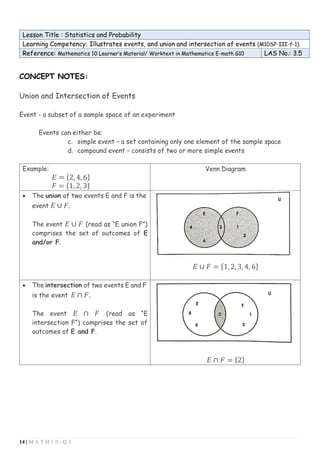
Example:
𝐸 = {2, 4, 6}
𝐹 = {1, 2, 3}
Venn Diagram
• The union of two events E and F is the
event 𝐸 ∪ 𝐹.
The event 𝐸 ∪ 𝐹 (read as “E union F”)
comprises the set of outcomes of E
and/or F.
𝐸 ∪ 𝐹 = {1, 2, 3, 4, 6}
• The intersection of two events E and F
is the event 𝐸 ∩ 𝐹.
The event 𝐸 ∩ 𝐹 (read as “E
intersection F”) comprises the set of
outcomes of E and F.
𝐸 ∩ 𝐹 = {2}
15.
15 | MA T H 1 0 - Q 3
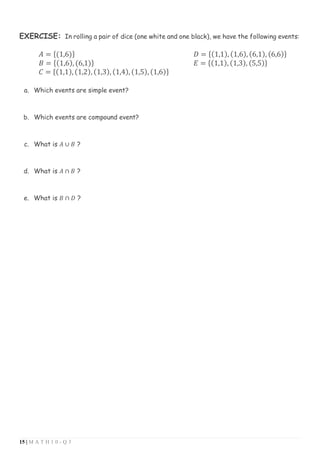
EXERCISE: In rolling a pair of dice (one white and one black), we have the following events:
𝐴 = {(1,6)} 𝐷 = {(1,1), (1,6), (6,1), (6,6)}
𝐵 = {(1,6), (6,1)} 𝐸 = {(1,1), (1,3), (5,5)}
𝐶 = {(1,1), (1,2), (1,3), (1,4), (1,5), (1,6)}
a. Which events are simple event?
b. Which events are compound event?
c. What is 𝐴 ∪ 𝐵 ?
d. What is 𝐴 ∩ 𝐵 ?
e. What is 𝐵 ∩ 𝐷 ?
16.
16 | MA T H 1 0 - Q 3
Lesson Title : Statistics and Probability
Learning Competency: Illustrates the probability of a union of two events (M10SP-III-g-1).
Reference: Mathematics 10 Learner’s Material/ Worktext in Mathematics E-math G10 LAS No.: 3.6
CONCEPT NOTES:
Review on Probability
Classical Definition of Probability
“If an experiment can result in any one of n different equally likely outcomes, and
if exactly m of this ways correspond to event A, then the probability of event A is:
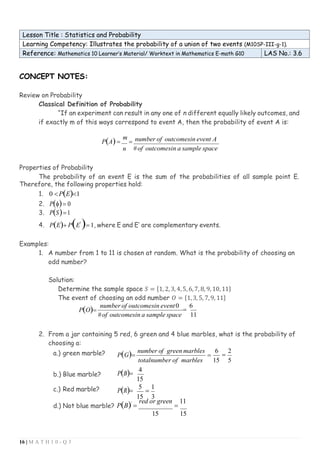
P(A)=
m
=
n
number of outcomesin event A
#of outcomesin a sample space
Properties of Probability
The probability of an event E is the sum of the probabilities of all sample point E.
Therefore, the following properties hold:
1. 0 P(E)1
2. P()= 0
3. P(S)=1
4. P(E)+ P(E'
)= 1, where E and E’ are complementary events.
Examples:
1. A number from 1 to 11 is chosen at random. What is the probability of choosing an
odd number?
Solution:
Determine the sample space 𝑆 = {1, 2,3, 4,5, 6,7, 8, 9, 10,11}
The event of choosing an odd number 𝑂 = {1,3, 5, 7,9, 11}
P(O)=
number of outcomesin event0
=
6
#of outcomesin a sample space 11
2. From a jar containing 5 red, 6 green and 4 blue marbles, what is the probability of
choosing a:
a.) green marble? P(G)=
number of green marbles
=
6
=
2
b.) Blue marble?
c.) Red marble?
P(B)=
P(R)=
totalnumber of marbles
4
15
5
=
1
15 5
15 3
d.) Not blue marble? P(B)'
=
red or green
=
11
15 15
17.
17 | MA T H 1 0 - Q 3
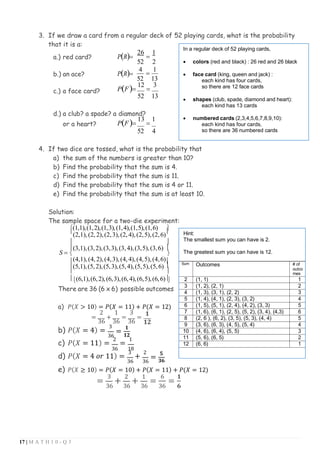
3. If we draw a card from a regular deck of 52 playing cards, what is the probability
that it is a:
a.) red card? P(R)=
26
=
1
52 2
b.) an ace? P(R)=
4
=
1
52 13
c.) a face card? P(F)=
12
=
3
52 13
d.) a club? a spade? a diamond?
or a heart? P(F)=
13
=
1
52 4
4. If two dice are tossed, what is the probability that
a) the sum of the numbers is greater than 10?
b) Find the probability that the sum is 4.
c) Find the probability that the sum is 11.
d) Find the probability that the sum is 4 or 11.
e) Find the probability that the sum is at least 10.
Solution:
The sample space for a two-die experiment:
(1,1),(1,2),(1,3),(1,4),(1,5),(1,6)
(2,1),(2, 2),(2,3),(2, 4),(2,5),(2,6)
(3,1),(3,2),(3,3),(3,4),(3,5),(3,6)
S =
(4,1),(4, 2),(4,3),(4, 4),(4,5),(4,6)
(5,1),(5,2),(5,3),(5,4),(5,5),(5,6)
(6,1),(6,2),(6,3),(6,4),(6,5),(6,6)
There are 36 (6 x 6) possible outcomes
a) 𝑃(𝑋 > 10) = 𝑃(𝑋 = 11) + 𝑃(𝑋 = 12)
2 1
=
36
+
36
=
3
36
=
𝟏
𝟏𝟐
b) 𝑃(𝑋 = 4) =
3
36
=
𝟏
𝟏𝟐
c) 𝑃(𝑋 = 11) =
2
=
1
36 18
d) 𝑃(𝑋 = 4 𝑜𝑟 11) =
3
+
2
36 36
=
𝟓
𝟑𝟔
e) 𝑃(𝑋 ≥ 10) = 𝑃(𝑋 = 10) + 𝑃(𝑋 = 11) + 𝑃(𝑋 = 12)
=
3
+
2
+
1
36 36 36
=
6
=
𝟏
36 𝟔
In a regular deck of 52 playing cards,
• colors (red and black) : 26 red and 26 black
• face card (king, queen and jack) :
each kind has four cards,
so there are 12 face cards
• shapes (club, spade, diamond and heart):
each kind has 13 cards
• numbered cards (2,3,4,5,6,7,8,9,10):
each kind has four cards,
so there are 36 numbered cards
Hint:
The smallest sum you can have is 2.
The greatest sum you can have is 12.
Sum Outcomes # of
outco
mes
2 (1, 1) 1
3 (1, 2), (2, 1) 2
4 (1, 3), (3, 1), (2, 2) 3
5 (1, 4), (4, 1), (2, 3), (3, 2) 4
6 (1, 5), (5, 1), (2, 4), (4, 2), (3, 3) 5
7 (1, 6), (6, 1), (2, 5), (5, 2), (3, 4), (4,3) 6
8 (2, 6 ), (6, 2), (3, 5), (5, 3), (4, 4) 5
9 (3, 6), (6, 3), (4, 5), (5, 4) 4
10 (4, 6), (6, 4), (5, 5) 3
11 (5, 6), (6, 5) 2
12 (6, 6) 1
18.
18 | MA T H 1 0 - Q 3
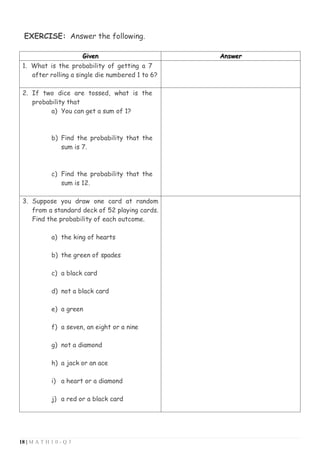
EXERCISE: Answer the following.
Given Answer
1. What is the probability of getting a 7
after rolling a single die numbered 1 to 6?
2. If two dice are tossed, what is the
probability that
a) You can get a sum of 1?
b) Find the probability that the
sum is 7.
c) Find the probability that the
sum is 12.
3. Suppose you draw one card at random
from a standard deck of 52 playing cards.
Find the probability of each outcome.
a) the king of hearts
b) the green of spades
c) a black card
d) not a black card
e) a green
f) a seven, an eight or a nine
g) not a diamond
h) a jack or an ace
i) a heart or a diamond
j) a red or a black card
20 | MA T H 1 0 - Q 3
Lesson Title : Statistics and Probability
Learning Competency: Finds the probability of (𝐴 ∪ 𝐵). (M10SP-III-g-h-1)
Illustrates mutually exclusive events. (M10SP - IIIi – 1)
Reference: Mathematics 10 Learner’s Material/ Worktext in Mathematics E-math G10 LAS No.: 3.7
CONCEPT NOTES:
Mutually Exclusive Events
Two events are mutually exclusive if they cannot occur at the same time.
If A and B are any two events, then 𝐴 ∩ 𝐵 = ∅. Null Set (∅) - contains no element (empty space)
Union of Two Events
P(A B) = P(A)+ P(B)− P(A B) if two events are not mutually exclusive
P(A B) = P(A)+ P(B) if two events are mutually exclusive P(A B) =
Examples:
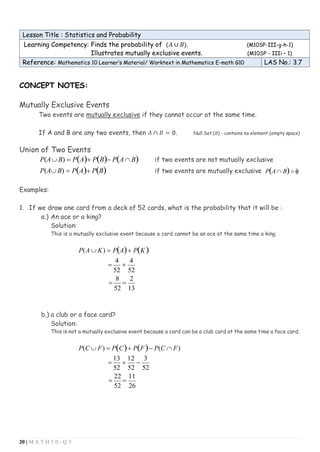
1. If we draw one card from a deck of 52 cards, what is the probability that it will be :
a.) An ace or a king?
Solution:
This is a mutually exclusive event because a card cannot be an ace at the same time a king.
P(A K) = P(A)+ P(K)
=
4
+
4
52 52
=
8
=
2
52 13
b.) a club or a face card?
Solution:
This is not a mutually exclusive event because a card can be a club card at the same time a face card.
P(C F) = P(C)+ P(F)− P(C F)
=
13
+
12
−
3
52 52 52
=
22
=
11
52 26
21.
21 | MA T H 1 0 - Q 3
c.) A red or a king card?
Solution:
This is not a mutually exclusive event because a card can be a red card at the same time a king card.
P(R K) = P(R)+ P(K)− P(R K)
=
26
+
4
−
2
52 52 52
=
28
=
7
52 13
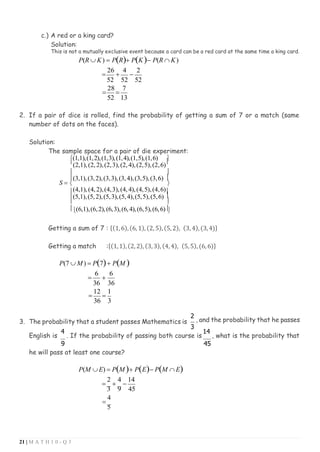
2. If a pair of dice is rolled, find the probability of getting a sum of 7 or a match (same
number of dots on the faces).
Solution:
The sample space for a pair of die experiment:
(1,1),(1,2),(1,3),(1,4),(1,5),(1,6)
(2,1),(2, 2),(2,3),(2, 4),(2,5),(2,6)
(3,1),(3,2),(3,3),(3,4),(3,5),(3,6)
S =
(4,1),(4, 2),(4,3),(4, 4),(4,5),(4,6)
(5,1),(5,2),(5,3),(5,4),(5,5),(5,6)
(6,1),(6,2),(6,3),(6,4),(6,5),(6,6)
Getting a sum of 7 : {(1,6),(6, 1),(2, 5),(5, 2), (3, 4),(3,4)}
Getting a match :{(1,1),(2, 2), (3,3), (4,4), (5, 5), (6, 6)}
P(7 M ) = P(7)+ P(M )
=
6
+
6
36 36
=
12
=
1
36 3
3. The probability that a student passes Mathematics is
2
, and the probability that he passes
3
English is
4
. If the probability of passing both course is
14
, what is the probability that
9 45
he will pass at least one course?
P(M E) = P(M )+ P(E)− P(M E)
=
2
+
4
−
14
3 9 45
=
4
5
22.
22 | MA T H 1 0 - Q 3
EXERCISE: Answer the following as directed.
Given Answer
1. A pair of dice is rolled. What is the
probability of getting:
a.) A sum less than 5?
b.) the number of dots on both dice are
equal?
2. In a college graduating class of 100
students, 54 studied Mathematics, 69
studied History, and 35 studied both
Mathematics and history. If one of these
students is selected at random, find the
probability that
a.) the student takes mathematics or
history;
b.) the student does not take either of
this course.
3. If a card is drawn from a deck of 52
playing cards, what is the probability of
getting:
a.) A number card below seven or a red
card?
b.) A club or a heart card?
c.) A heart or a number card below 7?
d.) A face card or a red card?
e.) A black card or a red card?
23.
23 | MA T H 1 0 - Q 3
Lesson Title : Statistics and Probability
Learning Competency: Solves problems involving probability. (M10SP-III-j-1).
Reference: Mathematics 10 Learner’s Material/ Worktext in Mathematics E-math G10 LAS No.: 3.8
CONCEPT NOTES:
Review
Classical Definition of Probability
“If an experiment can result in any one of n different equally likely outcomes, and
if exactly m of this ways correspond to event A, then the probability of event A is:
P(A)=
m
=
n
number of outcomesin event A
#of outcomesin a sample space
Union of Two Events
P(A B) = P(A)+ P(B)− P(A B) if two events are not mutually exclusive
P(A B) = P(A)+ P(B) if two events are mutually exclusive P(A B)=
EXERCISE: Answer the following.
A. Fill in each blank to make a true statement.
1. The result of an experiment is called a/an .
2. If E and G are mutually exclusive events then 𝐸 ∩ 𝐺 = .
3. An event that has only one outcome is called a/an event.
B. Answer each problem.
Given Answer
1. There are 3 red pens, 4 blue pens, 2 black
pens, and 5 green pens in a drawer.
Suppose you choose a pen at random.
a) What is the probability that the pen
chosen is red?
b) What is the probability that the pen
chosen is blue?
c) What is the probability that the pen
chosen is red or black?
24.
24 | MA T H 1 0 - Q 3
2. Two dice are rolled. What is the
probability of getting
a) a 4 and a 6
b) not 3 and a 5
c) the same number on both dice
d) a sum of 8
e) a sum of 3 and 4
f) a pair where the first number is less
than the second number
g) a sum of 12
h) a sum of 13
i) 3, 4 or 6, 2
j) two even numbers
k) a sum greater than 2
l) a sum less than 8
25.
25 | MA T H 1 0 - Q 3
P E R F O R M A N C E T A S K
Where in the real world?
Answer the following questions. Write a report of your answer using a minimum of 120 words.
Use the remaining pages of this paper for your report.
1. Describe a situation in your life that involves events which are mutually exclusive or not
mutually exclusive. Explain why the events are mutually exclusive or not mutually
exclusive.
2. Think about your daily experience. How probability is utilized in newspaper, television
shows, and radio programs that interest you? What are your general impressions of the
ways in which probability is used in the print media and entertainment industry?




![Differentiate Permutation from combination [Autosaved].pptx](https://cdn.slidesharecdn.com/ss_thumbnails/differentiatepermutationfromcombinationautosaved-251010084315-774f99f3-thumbnail.jpg?width=640&height=640&fit=bounds)


