Higher Unit 1
www.mathsrevision.com

Higher

Outcome 4
Recurrence Relations
Grow and Decay
Linear Recurrence Relation
Divergence / Convergence / Limits
Applications
Find a formula
Exam Type Questions
www.mathsrevision.com
Recurrence Relations
Outcome 4

Higher

www.mathsrevision.com

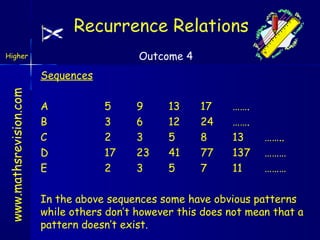
Sequences
A
B
C
D
E

5
3
2
17
2

9
6
3
23
3

13
12
5
41
5

17
24
8
77
7

…….
…….
13
137
11

……..
………
………

In the above sequences some have obvious patterns
while others don’t however this does not mean that a
pattern doesn’t exist.
Recurrence Relations
Outcome 4

Higher

www.mathsrevision.com

Notation
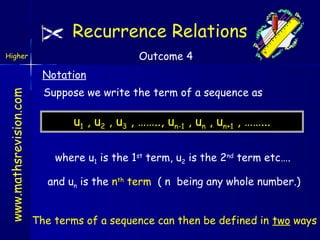
Suppose we write the term of a sequence as

u1 , u2 , u3 , …….., un-1 , un , un+1 , ……...
where u1 is the 1st term, u2 is the 2nd term etc….
and un is the nth term ( n being any whole number.)
The terms of a sequence can then be defined in two ways
Recurrence Relations
Outcome 4

Higher

www.mathsrevision.com

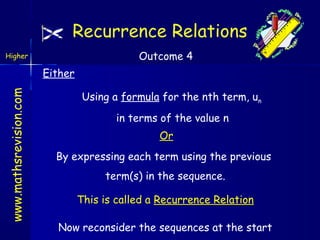
Either
Using a formula for the nth term, un
in terms of the value n
Or
By expressing each term using the previous
term(s) in the sequence.
This is called a Recurrence Relation
Now reconsider the sequences at the start
Recurrence Relations
Outcome 4

www.mathsrevision.com

Higher

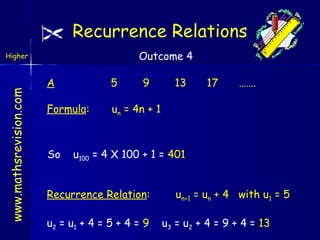
A

5

Formula:

un = 4n + 1

So

9

13

17

…….

u100 = 4 X 100 + 1 = 401

Recurrence Relation:
u2 = u1 + 4 = 5 + 4 = 9

un+1 = un + 4 with u1 = 5
u3 = u2 + 4 = 9 + 4 = 13
Recurrence Relations
Outcome 4

www.mathsrevision.com

Higher

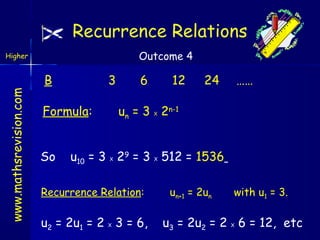
B

3

Formula:
So

6

12

24

……

un = 3 2n-1
X

u10 = 3 29 = 3 512 = 1536
X

Recurrence Relation:

u2 = 2u1 = 2 3 = 6,
X

X

un+1 = 2un

with u1 = 3.

u3 = 2u2 = 2 6 = 12, etc
X
Recurrence Relations
Outcome 4

Higher

www.mathsrevision.com

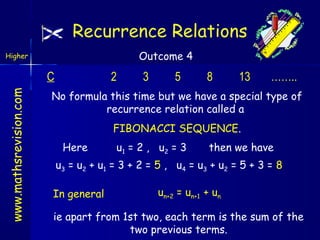
C

2

3

5

8

13

……..

No formula this time but we have a special type of
recurrence relation called a
FIBONACCI SEQUENCE.
Here

u 1 = 2 , u2 = 3

then we have

u3 = u 2 + u 1 = 3 + 2 = 5 , u4 = u 3 + u 2 = 5 + 3 = 8
In general

un+2 = un+1 + un

ie apart from 1st two, each term is the sum of the
two previous terms.
Recurrence Relations
Outcome 4

Higher

www.mathsrevision.com

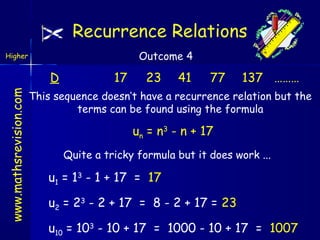
D

17

23

41

77

137 ………

This sequence doesn’t have a recurrence relation but the
terms can be found using the formula

un = n3 - n + 17
Quite a tricky formula but it does work ...

u1 = 13 - 1 + 17 = 17
u2 = 23 - 2 + 17 = 8 - 2 + 17 = 23
u10 = 103 - 10 + 17 = 1000 - 10 + 17 = 1007
Recurrence Relations
Outcome 4

www.mathsrevision.com

Higher

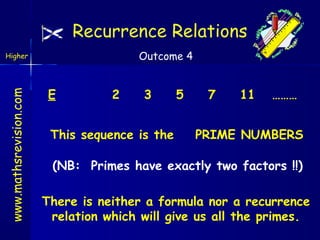
E

2

3

This sequence is the

5

7

11

………

PRIME NUMBERS

(NB: Primes have exactly two factors !!)
There is neither a formula nor a recurrence
relation which will give us all the primes.
Growth & Decay

www.mathsrevision.com

Higher

Outcome 4

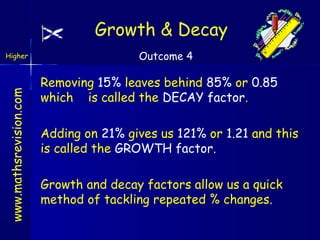
Removing 15% leaves behind 85% or 0.85
which is called the DECAY factor.
Adding on 21% gives us 121% or 1.21 and this
is called the GROWTH factor.
Growth and decay factors allow us a quick
method of tackling repeated % changes.
Growth & Decay

www.mathsrevision.com

Higher

Example 1

Outcome 4

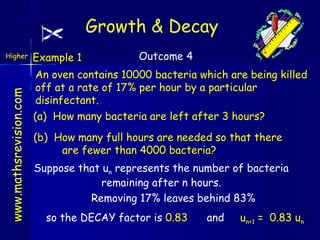
An oven contains 10000 bacteria which are being killed
off at a rate of 17% per hour by a particular
disinfectant.
(a) How many bacteria are left after 3 hours?
(b) How many full hours are needed so that there
are fewer than 4000 bacteria?
Suppose that un represents the number of bacteria
remaining after n hours.
Removing 17% leaves behind 83%
so the DECAY factor is 0.83

and

un+1 = 0.83 un
Growth & Decay
Outcome 4

Higher

www.mathsrevision.com

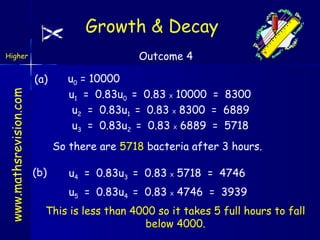
(a)

u0 = 10000
u1 = 0.83u0 = 0.83 X 10000 = 8300
u2 = 0.83u1 = 0.83 X 8300 = 6889
u3 = 0.83u2 = 0.83 X 6889 = 5718
So there are 5718 bacteria after 3 hours.

(b)

u4 = 0.83u3 = 0.83 X 5718 = 4746
u5 = 0.83u4 = 0.83 X 4746 = 3939

This is less than 4000 so it takes 5 full hours to fall
below 4000.
Growth & Decay

www.mathsrevision.com

Higher

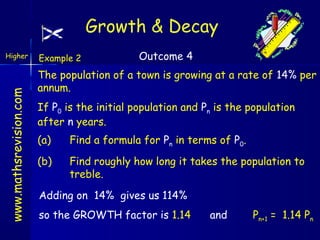
Example 2

Outcome 4

The population of a town is growing at a rate of 14% per
annum.
If P0 is the initial population and Pn is the population
after n years.
(a)

Find a formula for Pn in terms of P0.

(b)

Find roughly how long it takes the population to
treble.

Adding on 14% gives us 114%
so the GROWTH factor is 1.14

and

Pn+1 = 1.14 Pn
Growth & Decay
Outcome 4

www.mathsrevision.com

Higher

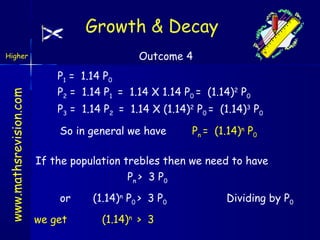
P1 = 1.14 P0
P2 = 1.14 P1 = 1.14 X 1.14 P0 = (1.14)2 P0
P3 = 1.14 P2 = 1.14 X (1.14)2 P0 = (1.14)3 P0
So in general we have

Pn = (1.14)n P0

If the population trebles then we need to have
Pn > 3 P0
or
we get

(1.14)n P0 > 3 P0
(1.14)n > 3

Dividing by P0
Growth & Decay
Outcome 4

www.mathsrevision.com

Higher

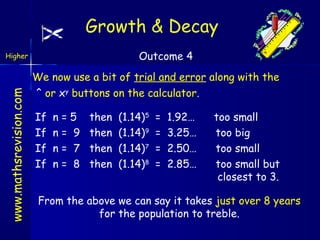
We now use a bit of trial and error along with the
^ or xy buttons on the calculator.
If
If
If
If

n
n
n
n

=5
= 9
= 7
= 8

then
then
then
then

(1.14)5
(1.14)9
(1.14)7
(1.14)8

=
=
=
=

1.92…
3.25…
2.50…
2.85…

too small
too big
too small
too small but
closest to 3.

From the above we can say it takes just over 8 years
for the population to treble.
Linear Recurrence Relations
Outcome 4

www.mathsrevision.com

Higher

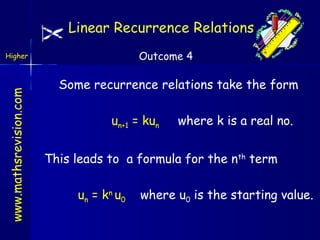
Some recurrence relations take the form
un+1 = kun

where k is a real no.

This leads to a formula for the nth term
un = kn u0

where u0 is the starting value.
Linear Recurrence Relations

www.mathsrevision.com

Higher

Outcome 4
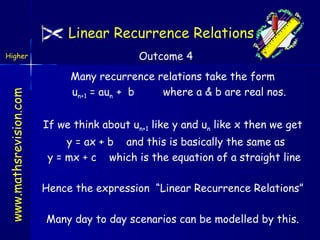
Many recurrence relations take the form
un+1 = aun + b
where a & b are real nos.
If we think about un+1 like y and un like x then we get
y = ax + b and this is basically the same as
y = mx + c which is the equation of a straight line
Hence the expression “Linear Recurrence Relations”
Many day to day scenarios can be modelled by this.
Linear Recurrence Relations

www.mathsrevision.com

Higher

Example

Outcome 4

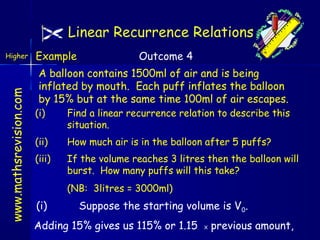
A balloon contains 1500ml of air and is being
inflated by mouth. Each puff inflates the balloon
by 15% but at the same time 100ml of air escapes.
(i)

Find a linear recurrence relation to describe this
situation.

(ii)

How much air is in the balloon after 5 puffs?

(iii)

If the volume reaches 3 litres then the balloon will
burst. How many puffs will this take?
(NB: 3litres = 3000ml)

(i)

Suppose the starting volume is V0.

Adding 15% gives us 115% or 1.15

X

previous amount,
Linear Recurrence Relations
Outcome 4

Higher

www.mathsrevision.com

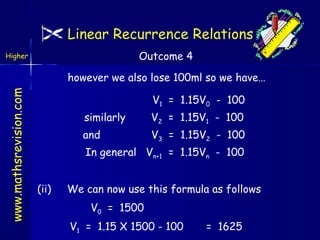
however we also lose 100ml so we have…
V1 = 1.15V0 - 100
similarly

V2 = 1.15V1 - 100

and

V3 = 1.15V2 - 100

In general Vn+1 = 1.15Vn - 100
(ii)

We can now use this formula as follows
V0 = 1500
V1 = 1.15 X 1500 - 100

= 1625
Linear Recurrence Relations
Outcome 4

www.mathsrevision.com

Higher

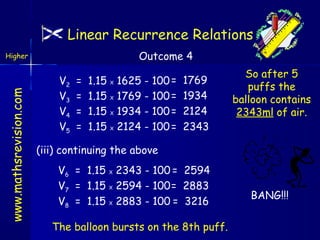
V2
V3
V4
V5

=
=
=
=

1.15
1.15
1.15
1.15

X
X
X
X

1625 - 100 =
1769 - 100 =
1934 - 100 =
2124 - 100 =

1769
1934
2124
2343

So after 5
puffs the
balloon contains
2343ml of air.

(iii) continuing the above
V6 = 1.15 X 2343 - 100 = 2594
V7 = 1.15 X 2594 - 100= 2883
V8 = 1.15 X 2883 - 100 = 3216
The balloon bursts on the 8th puff.

BANG!!!
Linear Recurrence Relations

www.mathsrevision.com

Higher

Example

Outcome 4

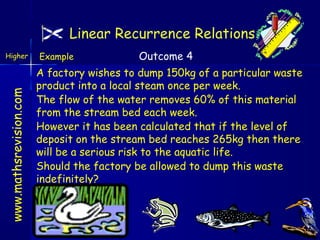
A factory wishes to dump 150kg of a particular waste
product into a local steam once per week.
The flow of the water removes 60% of this material
from the stream bed each week.
However it has been calculated that if the level of
deposit on the stream bed reaches 265kg then there
will be a serious risk to the aquatic life.
Should the factory be allowed to dump this waste
indefinitely?
Linear Recurrence Relations
Outcome 4

Higher

www.mathsrevision.com

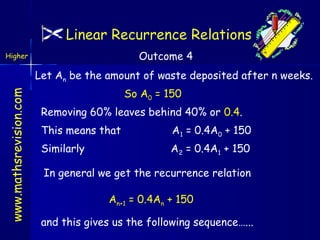
Let An be the amount of waste deposited after n weeks.
So A0 = 150
Removing 60% leaves behind 40% or 0.4.
This means that

A1 = 0.4A0 + 150

Similarly

A 2 = 0.4A1 + 150

In general we get the recurrence relation
An+1 = 0.4An + 150
and this gives us the following sequence…...
Linear Recurrence Relations
Outcome 4

Higher

www.mathsrevision.com

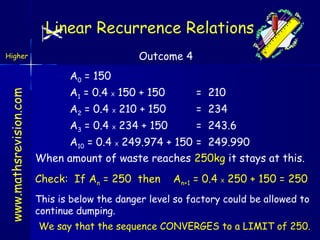
A0 = 150
A1 = 0.4 X 150 + 150

= 210

A2 = 0.4 X 210 + 150

= 234

A3 = 0.4 X 234 + 150

= 243.6

A10 = 0.4 X 249.974 + 150 = 249.990
When amount of waste reaches 250kg it stays at this.
Check: If An = 250 then

An+1 = 0.4 X 250 + 150 = 250

This is below the danger level so factory could be allowed to
continue dumping.
We say that the sequence CONVERGES to a LIMIT of 250.
Divergence / Convergence/Limits
Outcome 4

Higher

www.mathsrevision.com

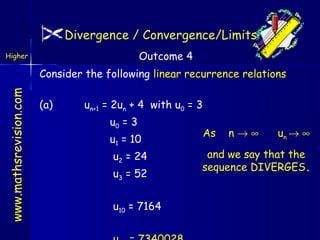
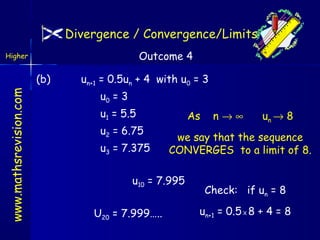
Consider the following linear recurrence relations
(a)

un+1 = 2un + 4 with u0 = 3
u0 = 3
u1 = 10
u2 = 24
u3 = 52
u10 = 7164

As

n→∞

un → ∞

and we say that the
sequence DIVERGES.
Divergence / Convergence/Limits
Outcome 4

Higher

www.mathsrevision.com

(b)

un+1 = 0.5un + 4 with u0 = 3
u0 = 3
u1 = 5.5
u2 = 6.75
u3 = 7.375

As

un → 8

we say that the sequence
CONVERGES to a limit of 8.

u10 = 7.995
U20 = 7.999…..

n→∞

Check: if un = 8
un+1 = 0.5 X 8 + 4 = 8
Divergence / Convergence/Limits
Outcome 4

www.mathsrevision.com

Higher

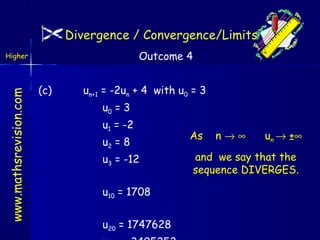
(c)

un+1 = -2un + 4 with u0 = 3
u0 = 3
u1 = -2
u2 = 8
u3 = -12
u10 = 1708
u20 = 1747628

As

n→∞

un → ±∞

and we say that the
sequence DIVERGES.
Divergence / Convergence/Limits
Outcome 4

www.mathsrevision.com

Higher

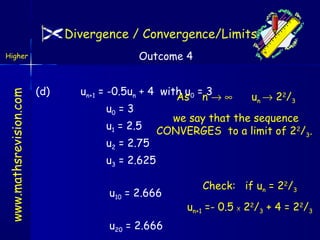
(d)

un+1 = -0.5un + 4 with u0 = 3
As n → ∞
u n → 2 2/ 3
u0 = 3
we say that the sequence
u1 = 2.5 CONVERGES to a limit of 22/ .
3
u2 = 2.75
u3 = 2.625
u10 = 2.666
u20 = 2.666

Check: if un = 22/3
un+1 =- 0.5 X 22/3 + 4 = 22/3
Divergence / Convergence/Limits
Higher

Outcome 4

www.mathsrevision.com

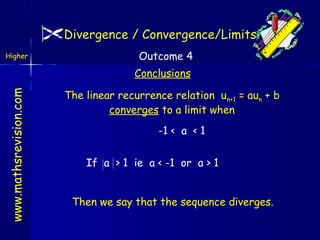
Conclusions
The linear recurrence relation un+1 = aun + b
converges to a limit when
-1 < a < 1
If a > 1 ie a < -1 or a > 1
Then we say that the sequence diverges.
Conclusion:

Divergence / Convergence/Limits

if un+1 = aun + b converges
Outcome 4
to a limit then changing b
changes the limit.

www.mathsrevision.com

Higher

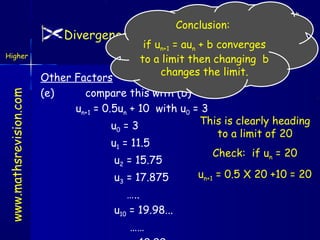
Other Factors
(e)
compare this with (b)
un+1 = 0.5un + 10 with u0 = 3
This is clearly heading
u0 = 3
to a limit of 20
u1 = 11.5
Check: if un = 20
u2 = 15.75
un+1 = 0.5 X 20 +10 = 20
u = 17.875
3

…..
u10 = 19.98...
……
Conclusion:
Divergence / Convergence/Limits
Higher

www.mathsrevision.com

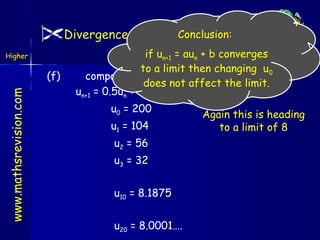
(f)

if un+1 = 4
Outcomeaun + b converges
to a limit then changing u0
compare this with (b)
does not affect the limit.
un+1 = 0.5un + 4 with u0 = 200
u0 = 200
u1 = 104
u2 = 56
u3 = 32
u10 = 8.1875
u20 = 8.0001….

Again this is heading
to a limit of 8
Applications
www.mathsrevision.com

Higher

Outcome 4
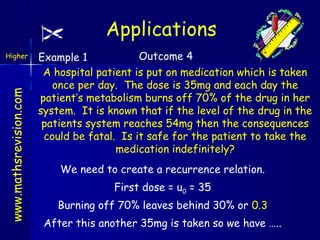
Example 1
A hospital patient is put on medication which is taken
once per day. The dose is 35mg and each day the
patient’s metabolism burns off 70% of the drug in her
system. It is known that if the level of the drug in the
patients system reaches 54mg then the consequences
could be fatal. Is it safe for the patient to take the
medication indefinitely?
We need to create a recurrence relation.
First dose = u0 = 35
Burning off 70% leaves behind 30% or 0.3
After this another 35mg is taken so we have …..
Applications
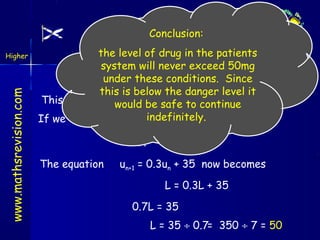
Conclusion:
www.mathsrevision.com

Higher

the level of drug in the patients
Outcome 4
system will never exceed 50mg
under 0.3un +conditions. Since
un+1 = these 35
this is below the danger level it
This sequence has a limit since continue 1
would be safe to 0 < 0.3 <
indefinitely.
If we call the limit L then at this limit we have
un+1 = un = L
The equation

un+1 = 0.3un + 35 now becomes
L = 0.3L + 35
0.7L = 35
L = 35 ÷ 0.7= 350 ÷ 7 = 50
Applications
www.mathsrevision.com

Higher

Example 2

Outcome 4

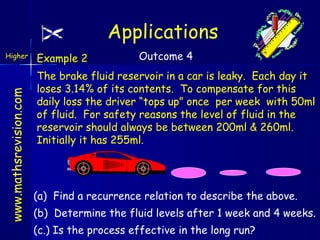
The brake fluid reservoir in a car is leaky. Each day it
loses 3.14% of its contents. To compensate for this
daily loss the driver “tops up” once per week with 50ml
of fluid. For safety reasons the level of fluid in the
reservoir should always be between 200ml & 260ml.
Initially it has 255ml.

(a) Find a recurrence relation to describe the above.
(b) Determine the fluid levels after 1 week and 4 weeks.
(c.) Is the process effective in the long run?
Applications
Higher

Outcome 4

www.mathsrevision.com

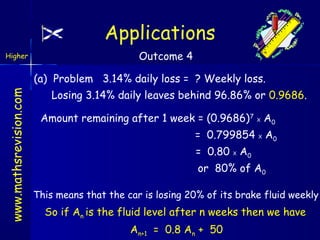
(a) Problem 3.14% daily loss = ? Weekly loss.
Losing 3.14% daily leaves behind 96.86% or 0.9686.
Amount remaining after 1 week = (0.9686)7 X A0
= 0.799854 X A0
= 0.80 X A0
or 80% of A0
This means that the car is losing 20% of its brake fluid weekly

So if An is the fluid level after n weeks then we have
An+1 = 0.8 An + 50
Applications
Outcome 4

Higher

www.mathsrevision.com

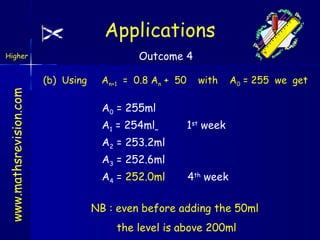
(b) Using

An+1 = 0.8 An + 50

with

A0 = 255 we get

A0 = 255ml
A1 = 254ml

1st week

A2 = 253.2ml
A3 = 252.6ml
A4 = 252.0ml

4th week

NB : even before adding the 50ml
the level is above 200ml
Applications
Outcome 4

www.mathsrevision.com

Higher

(c) considering

An+1 = 0.8 An + 50

Since 0 < 0.8 < 1 then a limit must exist and at this
An+1 = An = L so
An+1 = 0.8 An + 50
ie
L = 0.8L + 50
or 0.2L = 50
or
L = 50 ÷ 0.2 = 500 ÷ 2 = 250
In the long run the weekly level will be 250ml and
won’t fall below 200ml so the driver should be OK
with this routine.
Finding a Formula
www.mathsrevision.com

Higher

Example

Outcome 4

A recurrence relation is defined by the formula
un+1 = aun + b
Given that

u6 = 48 , u7 = 44 and u8 = 42

then find a & b .
u8 = au7 + b becomes 44a + b = 42
u7 = au6 + b becomes

48a + b = 44

Subtract up

Sim.
equations

4a = 2 so a = 0.5

Now put a = 0.5 into 44a + b = 42 to get 22 + b = 42
so b = 20
Finding a Formula

www.mathsrevision.com

Higher

Outcome 4

Example

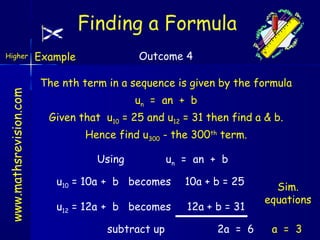
The nth term in a sequence is given by the formula
un = an + b
Given that u10 = 25 and u12 = 31 then find a & b.
Hence find u300 - the 300th term.
Using

un = an + b

u10 = 10a + b becomes

10a + b = 25

u12 = 12a + b becomes

12a + b = 31

subtract up

2a = 6

Sim.
equations
a = 3
Finding a Formula
Outcome 4

www.mathsrevision.com

Higher

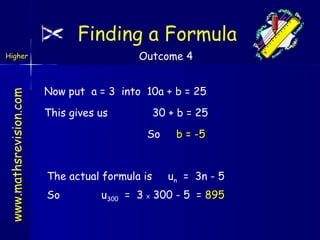
Now put a = 3 into 10a + b = 25
This gives us

30 + b = 25
So

The actual formula is
So

b = -5

un = 3n - 5

u300 = 3 X 300 - 5 = 895
Two Special Series
Outcome 4

www.mathsrevision.com

Higher

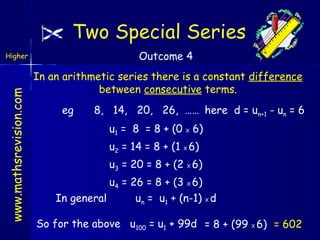
In an arithmetic series there is a constant difference
between consecutive terms.
eg

8, 14, 20, 26, …… here d = un+1 - un = 6
u1 = 8 = 8 + (0 X 6)
u2 = 14 = 8 + (1 X 6)
u3 = 20 = 8 + (2 X 6)

u4 = 26 = 8 + (3 X 6)
In general
un = u1 + (n-1) X d
So for the above u100 = u1 + 99d = 8 + (99 X 6) = 602
Two Special Series
Outcome 4

www.mathsrevision.com

Higher

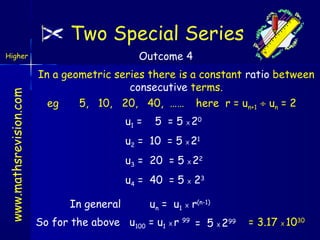
In a geometric series there is a constant ratio between
consecutive terms.
eg
5, 10, 20, 40, …… here r = un+1 ÷ un = 2
u1 =

5 = 5 X 20

u2 = 10 = 5 X 21
u3 = 20 = 5 X 22
u4 = 40 = 5 X 23
In general

un = u1 X r(n-1)

So for the above u100 = u1 X r 99 = 5 X 299

= 3.17 X 1030
www.maths4scotland.co.uk

Higher Maths
Strategies

Sequences

Click to start
Maths4Scotland

Higher

The following questions are on

Sequences
Non-calculator questions will be indicated
You will need a pencil, paper, ruler and rubber.

Click to continue
Maths4Scotland

Higher

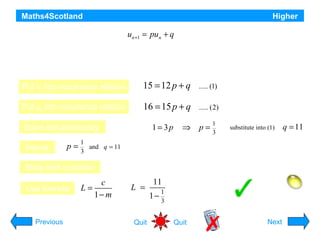
A recurrence relation is defined by

where -1 < p < -1 and u0 = 12

un +1 = pun + q

a) If u1 = 15 and u2 = 16 find the values of p and q
b) Find the limit of this recurrence relation as n → ∞
Put u1 into recurrence relation

15 = 12 p + q

..... (1)

Put u2 into recurrence relation

16 = 15 p + q

..... (2)

Solve simultaneously:
Hence

p=

Previous

1= 3p

⇒

p=

1
3

substitute into (1)

q = 11

1
and q = 11
3

State limit condition
Use formula

(2) – (1)

c
L=
1− m

-1 < p < 1, so a limit L exists

L =

Quit

11
1
1−
3

Limit = 16½
Hint
Quit

Next
Maths4Scotland

Higher

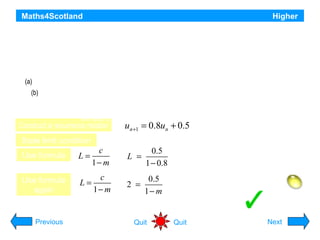
A man decides to plant a number of fast-growing trees as a boundary between his property and the property of
his neighbour. He has been warned however by the local garden centre, that during any year, the trees
are expected to increase in height by 0.5 metres.
In response to this warning, he decides to trim 20% off the height of the trees at the start of any year.
(a)

If he adopts the “20% pruning policy”, to what height will he expect the trees to grow in the long run.

(b)

His neighbour is concerned that the trees are growing at an alarming rate and wants assurance
that the trees will grow no taller than 2 metres. What is the minimum percentage that the trees
will need to be trimmed each year so as to meet this condition.

Construct a recurrence relation
State limit condition
Use formula

L=

c
1− m

Use formula
again

L=

c
1− m

Previous

un +1 = 0.8un + 0.5

un = height at the start of year

-1 < 0.8 < 1, so a limit L exists

L =

0.5
1 − 0.8

2 =

0.5
1− m

Quit

Limit = 2.5 metres
m = 0.75 Minimum prune = 25%
Hint
Quit

Next
Maths4Scotland

Higher

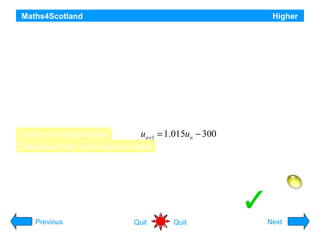
On the first day of March, a bank loans a man £2500 at a fixed rate of interest of 1.5% per month.
This interest is added on the last day of each month and is calculated on the amount due on the first day of the
month. He agrees to make repayments on the first day of each subsequent month. Each repayment is £300
except for the smaller final amount which will pay off the loan.
a) The amount that he owes at the start of each month is taken to be the amount still owing just after the
monthly repayment has been made.
Let un and un+1 and represent the amounts that he owes at the starts of two successive months.
Write down a recurrence relation involving un and un+1
b) Find the date and amount of the final payment.

Construct a recurrence relation

un +1 = 1.015un − 300

Calculate each term in the recurrence relation
1 Mar

u0 = 2500.00

1 Aug

u5 = 1147.53

1 Apr

u1 = 2237.50

1 Sept

u6 = 864.74

1 May

u2 = 1971.06

1 Oct

u7 = 577.71

1 Jun

u3 = 1700.62

1 Nov

u0 = 2500

u8 = 286.38

Previous

1 Jul

u4 = 1426.14

Quit

1 Dec

Quit

Final payment £290.68

Hint
Next
Maths4Scotland

Higher

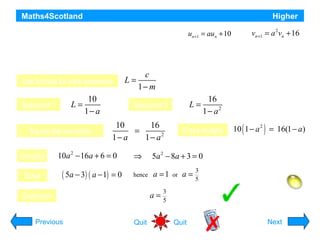
Two sequences are generated by the recurrence relations au + 10
un +1 = n

vnand a 2vn + 16
+1 =

The two sequences approach the same limit as n → ∞.
Determine the value of a and evaluate the limit.
Use formula for each sequence

L=

Sequence 1

10
1− a

Equate the two limits
Simplify
Solve

L=

10
16
=
1− a
1− a2

( 5a − 3) ( a − 1) = 0

Previous

c
1− m

Sequence 2

10a 2 − 16a + 6 = 0

Deduction

L=

16
1 − a2

Cross multiply

⇒

5a 2 − 8a + 3 = 0

hence

a =1

10 ( 1 − a 2 ) = 16(1 − a)

Since limit exists a ≠ 1, so a =
Quit

3
5

or

a=

3
5

Limit = 25
Quit

Hint
Next
Maths4Scotland
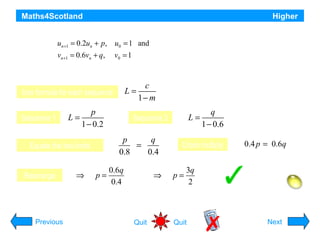
Two sequences are defined by the recurrence relations

Higher

un +1 = 0.2un + p, u0 = 1 and
vn +1 = 0.6vn + q,

v0 = 1

If both sequences have the same limit, express p in terms of q.

L=

Use formula for each sequence
Sequence 1

L=

p
1 − 0.2

⇒

p=

L=

Sequence 2

p
q
=
0.8
0.4

Equate the two limits

Rearrange

c
1− m

0.6q
0.4

⇒

q
1 − 0.6

Cross multiply

p=

0.4 p = 0.6q

3q
2
Hint

Previous

Quit

Quit

Next
Maths4Scotland
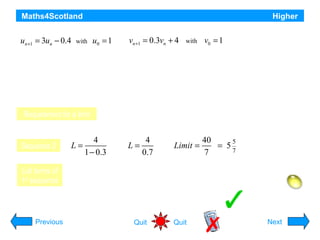
Two sequences are defined by these recurrence relations

un +1 = 3un − 0.4

with

u0 = 1

vn +1 = 0.3vn + 4

with

Higher

v0 = 1

a) Explain why only one of these sequences approaches a limit as n → ∞
b) Find algebraically the exact value of the limit.
c) For the other sequence find
i) the smallest value of n for which the nth term exceeds 1000, and
ii) the value of that term.
Requirement for a limit

First sequence has no limit since 3 is not between –1 and 1
2nd sequence has a limit since –1 < 0.3 < 1

L=

Sequence 2

4
1 − 0.3

L=

4
0.7

Limit =

40
5
= 5
7
7

u0 = 1

u3 = 21.8

u6 = 583.4

u1 = 2.6

List terms of
1st sequence

u4 = 65

u7 = 1749.8
Hint

u2 = 7.4
u = of 8th
Smallest value of n is 8;5 value194.6 term = 1749.8
Previous

Quit

Quit

Next
Maths4Scotland

Higher

You have completed all

Previous

6 questions in this presentation

Quit

Quit

Back to start
Maths4Scotland

Higher

Hint
Previous

Quit

Quit

Next

Reccurrence relations

  • 1.
    Higher Unit 1 www.mathsrevision.com Higher Outcome4 Recurrence Relations Grow and Decay Linear Recurrence Relation Divergence / Convergence / Limits Applications Find a formula Exam Type Questions www.mathsrevision.com
  • 2.
    Recurrence Relations Outcome 4 Higher www.mathsrevision.com Sequences A B C D E 5 3 2 17 2 9 6 3 23 3 13 12 5 41 5 17 24 8 77 7 ……. ……. 13 137 11 …….. ……… ……… Inthe above sequences some have obvious patterns while others don’t however this does not mean that a pattern doesn’t exist.
  • 3.
    Recurrence Relations Outcome 4 Higher www.mathsrevision.com Notation Supposewe write the term of a sequence as u1 , u2 , u3 , …….., un-1 , un , un+1 , ……... where u1 is the 1st term, u2 is the 2nd term etc…. and un is the nth term ( n being any whole number.) The terms of a sequence can then be defined in two ways
  • 4.
    Recurrence Relations Outcome 4 Higher www.mathsrevision.com Either Usinga formula for the nth term, un in terms of the value n Or By expressing each term using the previous term(s) in the sequence. This is called a Recurrence Relation Now reconsider the sequences at the start
  • 5.
    Recurrence Relations Outcome 4 www.mathsrevision.com Higher A 5 Formula: un= 4n + 1 So 9 13 17 ……. u100 = 4 X 100 + 1 = 401 Recurrence Relation: u2 = u1 + 4 = 5 + 4 = 9 un+1 = un + 4 with u1 = 5 u3 = u2 + 4 = 9 + 4 = 13
  • 6.
    Recurrence Relations Outcome 4 www.mathsrevision.com Higher B 3 Formula: So 6 12 24 …… un= 3 2n-1 X u10 = 3 29 = 3 512 = 1536 X Recurrence Relation: u2 = 2u1 = 2 3 = 6, X X un+1 = 2un with u1 = 3. u3 = 2u2 = 2 6 = 12, etc X
  • 7.
    Recurrence Relations Outcome 4 Higher www.mathsrevision.com C 2 3 5 8 13 …….. Noformula this time but we have a special type of recurrence relation called a FIBONACCI SEQUENCE. Here u 1 = 2 , u2 = 3 then we have u3 = u 2 + u 1 = 3 + 2 = 5 , u4 = u 3 + u 2 = 5 + 3 = 8 In general un+2 = un+1 + un ie apart from 1st two, each term is the sum of the two previous terms.
  • 8.
    Recurrence Relations Outcome 4 Higher www.mathsrevision.com D 17 23 41 77 137……… This sequence doesn’t have a recurrence relation but the terms can be found using the formula un = n3 - n + 17 Quite a tricky formula but it does work ... u1 = 13 - 1 + 17 = 17 u2 = 23 - 2 + 17 = 8 - 2 + 17 = 23 u10 = 103 - 10 + 17 = 1000 - 10 + 17 = 1007
  • 9.
    Recurrence Relations Outcome 4 www.mathsrevision.com Higher E 2 3 Thissequence is the 5 7 11 ……… PRIME NUMBERS (NB: Primes have exactly two factors !!) There is neither a formula nor a recurrence relation which will give us all the primes.
  • 10.
    Growth & Decay www.mathsrevision.com Higher Outcome4 Removing 15% leaves behind 85% or 0.85 which is called the DECAY factor. Adding on 21% gives us 121% or 1.21 and this is called the GROWTH factor. Growth and decay factors allow us a quick method of tackling repeated % changes.
  • 11.
    Growth & Decay www.mathsrevision.com Higher Example1 Outcome 4 An oven contains 10000 bacteria which are being killed off at a rate of 17% per hour by a particular disinfectant. (a) How many bacteria are left after 3 hours? (b) How many full hours are needed so that there are fewer than 4000 bacteria? Suppose that un represents the number of bacteria remaining after n hours. Removing 17% leaves behind 83% so the DECAY factor is 0.83 and un+1 = 0.83 un
  • 12.
    Growth & Decay Outcome4 Higher www.mathsrevision.com (a) u0 = 10000 u1 = 0.83u0 = 0.83 X 10000 = 8300 u2 = 0.83u1 = 0.83 X 8300 = 6889 u3 = 0.83u2 = 0.83 X 6889 = 5718 So there are 5718 bacteria after 3 hours. (b) u4 = 0.83u3 = 0.83 X 5718 = 4746 u5 = 0.83u4 = 0.83 X 4746 = 3939 This is less than 4000 so it takes 5 full hours to fall below 4000.
  • 13.
    Growth & Decay www.mathsrevision.com Higher Example2 Outcome 4 The population of a town is growing at a rate of 14% per annum. If P0 is the initial population and Pn is the population after n years. (a) Find a formula for Pn in terms of P0. (b) Find roughly how long it takes the population to treble. Adding on 14% gives us 114% so the GROWTH factor is 1.14 and Pn+1 = 1.14 Pn
  • 14.
    Growth & Decay Outcome4 www.mathsrevision.com Higher P1 = 1.14 P0 P2 = 1.14 P1 = 1.14 X 1.14 P0 = (1.14)2 P0 P3 = 1.14 P2 = 1.14 X (1.14)2 P0 = (1.14)3 P0 So in general we have Pn = (1.14)n P0 If the population trebles then we need to have Pn > 3 P0 or we get (1.14)n P0 > 3 P0 (1.14)n > 3 Dividing by P0
  • 15.
    Growth & Decay Outcome4 www.mathsrevision.com Higher We now use a bit of trial and error along with the ^ or xy buttons on the calculator. If If If If n n n n =5 = 9 = 7 = 8 then then then then (1.14)5 (1.14)9 (1.14)7 (1.14)8 = = = = 1.92… 3.25… 2.50… 2.85… too small too big too small too small but closest to 3. From the above we can say it takes just over 8 years for the population to treble.
  • 16.
    Linear Recurrence Relations Outcome4 www.mathsrevision.com Higher Some recurrence relations take the form un+1 = kun where k is a real no. This leads to a formula for the nth term un = kn u0 where u0 is the starting value.
  • 17.
    Linear Recurrence Relations www.mathsrevision.com Higher Outcome4 Many recurrence relations take the form un+1 = aun + b where a & b are real nos. If we think about un+1 like y and un like x then we get y = ax + b and this is basically the same as y = mx + c which is the equation of a straight line Hence the expression “Linear Recurrence Relations” Many day to day scenarios can be modelled by this.
  • 18.
    Linear Recurrence Relations www.mathsrevision.com Higher Example Outcome4 A balloon contains 1500ml of air and is being inflated by mouth. Each puff inflates the balloon by 15% but at the same time 100ml of air escapes. (i) Find a linear recurrence relation to describe this situation. (ii) How much air is in the balloon after 5 puffs? (iii) If the volume reaches 3 litres then the balloon will burst. How many puffs will this take? (NB: 3litres = 3000ml) (i) Suppose the starting volume is V0. Adding 15% gives us 115% or 1.15 X previous amount,
  • 19.
    Linear Recurrence Relations Outcome4 Higher www.mathsrevision.com however we also lose 100ml so we have… V1 = 1.15V0 - 100 similarly V2 = 1.15V1 - 100 and V3 = 1.15V2 - 100 In general Vn+1 = 1.15Vn - 100 (ii) We can now use this formula as follows V0 = 1500 V1 = 1.15 X 1500 - 100 = 1625
  • 20.
    Linear Recurrence Relations Outcome4 www.mathsrevision.com Higher V2 V3 V4 V5 = = = = 1.15 1.15 1.15 1.15 X X X X 1625 - 100 = 1769 - 100 = 1934 - 100 = 2124 - 100 = 1769 1934 2124 2343 So after 5 puffs the balloon contains 2343ml of air. (iii) continuing the above V6 = 1.15 X 2343 - 100 = 2594 V7 = 1.15 X 2594 - 100= 2883 V8 = 1.15 X 2883 - 100 = 3216 The balloon bursts on the 8th puff. BANG!!!
  • 21.
    Linear Recurrence Relations www.mathsrevision.com Higher Example Outcome4 A factory wishes to dump 150kg of a particular waste product into a local steam once per week. The flow of the water removes 60% of this material from the stream bed each week. However it has been calculated that if the level of deposit on the stream bed reaches 265kg then there will be a serious risk to the aquatic life. Should the factory be allowed to dump this waste indefinitely?
  • 22.
    Linear Recurrence Relations Outcome4 Higher www.mathsrevision.com Let An be the amount of waste deposited after n weeks. So A0 = 150 Removing 60% leaves behind 40% or 0.4. This means that A1 = 0.4A0 + 150 Similarly A 2 = 0.4A1 + 150 In general we get the recurrence relation An+1 = 0.4An + 150 and this gives us the following sequence…...
  • 23.
    Linear Recurrence Relations Outcome4 Higher www.mathsrevision.com A0 = 150 A1 = 0.4 X 150 + 150 = 210 A2 = 0.4 X 210 + 150 = 234 A3 = 0.4 X 234 + 150 = 243.6 A10 = 0.4 X 249.974 + 150 = 249.990 When amount of waste reaches 250kg it stays at this. Check: If An = 250 then An+1 = 0.4 X 250 + 150 = 250 This is below the danger level so factory could be allowed to continue dumping. We say that the sequence CONVERGES to a LIMIT of 250.
  • 24.
    Divergence / Convergence/Limits Outcome4 Higher www.mathsrevision.com Consider the following linear recurrence relations (a) un+1 = 2un + 4 with u0 = 3 u0 = 3 u1 = 10 u2 = 24 u3 = 52 u10 = 7164 As n→∞ un → ∞ and we say that the sequence DIVERGES.
  • 25.
    Divergence / Convergence/Limits Outcome4 Higher www.mathsrevision.com (b) un+1 = 0.5un + 4 with u0 = 3 u0 = 3 u1 = 5.5 u2 = 6.75 u3 = 7.375 As un → 8 we say that the sequence CONVERGES to a limit of 8. u10 = 7.995 U20 = 7.999….. n→∞ Check: if un = 8 un+1 = 0.5 X 8 + 4 = 8
  • 26.
    Divergence / Convergence/Limits Outcome4 www.mathsrevision.com Higher (c) un+1 = -2un + 4 with u0 = 3 u0 = 3 u1 = -2 u2 = 8 u3 = -12 u10 = 1708 u20 = 1747628 As n→∞ un → ±∞ and we say that the sequence DIVERGES.
  • 27.
    Divergence / Convergence/Limits Outcome4 www.mathsrevision.com Higher (d) un+1 = -0.5un + 4 with u0 = 3 As n → ∞ u n → 2 2/ 3 u0 = 3 we say that the sequence u1 = 2.5 CONVERGES to a limit of 22/ . 3 u2 = 2.75 u3 = 2.625 u10 = 2.666 u20 = 2.666 Check: if un = 22/3 un+1 =- 0.5 X 22/3 + 4 = 22/3
  • 28.
    Divergence / Convergence/Limits Higher Outcome4 www.mathsrevision.com Conclusions The linear recurrence relation un+1 = aun + b converges to a limit when -1 < a < 1 If a > 1 ie a < -1 or a > 1 Then we say that the sequence diverges.
  • 29.
    Conclusion: Divergence / Convergence/Limits ifun+1 = aun + b converges Outcome 4 to a limit then changing b changes the limit. www.mathsrevision.com Higher Other Factors (e) compare this with (b) un+1 = 0.5un + 10 with u0 = 3 This is clearly heading u0 = 3 to a limit of 20 u1 = 11.5 Check: if un = 20 u2 = 15.75 un+1 = 0.5 X 20 +10 = 20 u = 17.875 3 ….. u10 = 19.98... ……
  • 30.
    Conclusion: Divergence / Convergence/Limits Higher www.mathsrevision.com (f) ifun+1 = 4 Outcomeaun + b converges to a limit then changing u0 compare this with (b) does not affect the limit. un+1 = 0.5un + 4 with u0 = 200 u0 = 200 u1 = 104 u2 = 56 u3 = 32 u10 = 8.1875 u20 = 8.0001…. Again this is heading to a limit of 8
  • 31.
    Applications www.mathsrevision.com Higher Outcome 4 Example 1 Ahospital patient is put on medication which is taken once per day. The dose is 35mg and each day the patient’s metabolism burns off 70% of the drug in her system. It is known that if the level of the drug in the patients system reaches 54mg then the consequences could be fatal. Is it safe for the patient to take the medication indefinitely? We need to create a recurrence relation. First dose = u0 = 35 Burning off 70% leaves behind 30% or 0.3 After this another 35mg is taken so we have …..
  • 32.
    Applications Conclusion: www.mathsrevision.com Higher the level ofdrug in the patients Outcome 4 system will never exceed 50mg under 0.3un +conditions. Since un+1 = these 35 this is below the danger level it This sequence has a limit since continue 1 would be safe to 0 < 0.3 < indefinitely. If we call the limit L then at this limit we have un+1 = un = L The equation un+1 = 0.3un + 35 now becomes L = 0.3L + 35 0.7L = 35 L = 35 ÷ 0.7= 350 ÷ 7 = 50
  • 33.
    Applications www.mathsrevision.com Higher Example 2 Outcome 4 Thebrake fluid reservoir in a car is leaky. Each day it loses 3.14% of its contents. To compensate for this daily loss the driver “tops up” once per week with 50ml of fluid. For safety reasons the level of fluid in the reservoir should always be between 200ml & 260ml. Initially it has 255ml. (a) Find a recurrence relation to describe the above. (b) Determine the fluid levels after 1 week and 4 weeks. (c.) Is the process effective in the long run?
  • 34.
    Applications Higher Outcome 4 www.mathsrevision.com (a) Problem3.14% daily loss = ? Weekly loss. Losing 3.14% daily leaves behind 96.86% or 0.9686. Amount remaining after 1 week = (0.9686)7 X A0 = 0.799854 X A0 = 0.80 X A0 or 80% of A0 This means that the car is losing 20% of its brake fluid weekly So if An is the fluid level after n weeks then we have An+1 = 0.8 An + 50
  • 35.
    Applications Outcome 4 Higher www.mathsrevision.com (b) Using An+1= 0.8 An + 50 with A0 = 255 we get A0 = 255ml A1 = 254ml 1st week A2 = 253.2ml A3 = 252.6ml A4 = 252.0ml 4th week NB : even before adding the 50ml the level is above 200ml
  • 36.
    Applications Outcome 4 www.mathsrevision.com Higher (c) considering An+1= 0.8 An + 50 Since 0 < 0.8 < 1 then a limit must exist and at this An+1 = An = L so An+1 = 0.8 An + 50 ie L = 0.8L + 50 or 0.2L = 50 or L = 50 ÷ 0.2 = 500 ÷ 2 = 250 In the long run the weekly level will be 250ml and won’t fall below 200ml so the driver should be OK with this routine.
  • 37.
    Finding a Formula www.mathsrevision.com Higher Example Outcome4 A recurrence relation is defined by the formula un+1 = aun + b Given that u6 = 48 , u7 = 44 and u8 = 42 then find a & b . u8 = au7 + b becomes 44a + b = 42 u7 = au6 + b becomes 48a + b = 44 Subtract up Sim. equations 4a = 2 so a = 0.5 Now put a = 0.5 into 44a + b = 42 to get 22 + b = 42 so b = 20
  • 38.
    Finding a Formula www.mathsrevision.com Higher Outcome4 Example The nth term in a sequence is given by the formula un = an + b Given that u10 = 25 and u12 = 31 then find a & b. Hence find u300 - the 300th term. Using un = an + b u10 = 10a + b becomes 10a + b = 25 u12 = 12a + b becomes 12a + b = 31 subtract up 2a = 6 Sim. equations a = 3
  • 39.
    Finding a Formula Outcome4 www.mathsrevision.com Higher Now put a = 3 into 10a + b = 25 This gives us 30 + b = 25 So The actual formula is So b = -5 un = 3n - 5 u300 = 3 X 300 - 5 = 895
  • 40.
    Two Special Series Outcome4 www.mathsrevision.com Higher In an arithmetic series there is a constant difference between consecutive terms. eg 8, 14, 20, 26, …… here d = un+1 - un = 6 u1 = 8 = 8 + (0 X 6) u2 = 14 = 8 + (1 X 6) u3 = 20 = 8 + (2 X 6) u4 = 26 = 8 + (3 X 6) In general un = u1 + (n-1) X d So for the above u100 = u1 + 99d = 8 + (99 X 6) = 602
  • 41.
    Two Special Series Outcome4 www.mathsrevision.com Higher In a geometric series there is a constant ratio between consecutive terms. eg 5, 10, 20, 40, …… here r = un+1 ÷ un = 2 u1 = 5 = 5 X 20 u2 = 10 = 5 X 21 u3 = 20 = 5 X 22 u4 = 40 = 5 X 23 In general un = u1 X r(n-1) So for the above u100 = u1 X r 99 = 5 X 299 = 3.17 X 1030
  • 42.
  • 43.
    Maths4Scotland Higher The following questionsare on Sequences Non-calculator questions will be indicated You will need a pencil, paper, ruler and rubber. Click to continue
  • 44.
    Maths4Scotland Higher A recurrence relationis defined by where -1 < p < -1 and u0 = 12 un +1 = pun + q a) If u1 = 15 and u2 = 16 find the values of p and q b) Find the limit of this recurrence relation as n → ∞ Put u1 into recurrence relation 15 = 12 p + q ..... (1) Put u2 into recurrence relation 16 = 15 p + q ..... (2) Solve simultaneously: Hence p= Previous 1= 3p ⇒ p= 1 3 substitute into (1) q = 11 1 and q = 11 3 State limit condition Use formula (2) – (1) c L= 1− m -1 < p < 1, so a limit L exists L = Quit 11 1 1− 3 Limit = 16½ Hint Quit Next
  • 45.
    Maths4Scotland Higher A man decidesto plant a number of fast-growing trees as a boundary between his property and the property of his neighbour. He has been warned however by the local garden centre, that during any year, the trees are expected to increase in height by 0.5 metres. In response to this warning, he decides to trim 20% off the height of the trees at the start of any year. (a) If he adopts the “20% pruning policy”, to what height will he expect the trees to grow in the long run. (b) His neighbour is concerned that the trees are growing at an alarming rate and wants assurance that the trees will grow no taller than 2 metres. What is the minimum percentage that the trees will need to be trimmed each year so as to meet this condition. Construct a recurrence relation State limit condition Use formula L= c 1− m Use formula again L= c 1− m Previous un +1 = 0.8un + 0.5 un = height at the start of year -1 < 0.8 < 1, so a limit L exists L = 0.5 1 − 0.8 2 = 0.5 1− m Quit Limit = 2.5 metres m = 0.75 Minimum prune = 25% Hint Quit Next
  • 46.
    Maths4Scotland Higher On the firstday of March, a bank loans a man £2500 at a fixed rate of interest of 1.5% per month. This interest is added on the last day of each month and is calculated on the amount due on the first day of the month. He agrees to make repayments on the first day of each subsequent month. Each repayment is £300 except for the smaller final amount which will pay off the loan. a) The amount that he owes at the start of each month is taken to be the amount still owing just after the monthly repayment has been made. Let un and un+1 and represent the amounts that he owes at the starts of two successive months. Write down a recurrence relation involving un and un+1 b) Find the date and amount of the final payment. Construct a recurrence relation un +1 = 1.015un − 300 Calculate each term in the recurrence relation 1 Mar u0 = 2500.00 1 Aug u5 = 1147.53 1 Apr u1 = 2237.50 1 Sept u6 = 864.74 1 May u2 = 1971.06 1 Oct u7 = 577.71 1 Jun u3 = 1700.62 1 Nov u0 = 2500 u8 = 286.38 Previous 1 Jul u4 = 1426.14 Quit 1 Dec Quit Final payment £290.68 Hint Next
  • 47.
    Maths4Scotland Higher Two sequences aregenerated by the recurrence relations au + 10 un +1 = n vnand a 2vn + 16 +1 = The two sequences approach the same limit as n → ∞. Determine the value of a and evaluate the limit. Use formula for each sequence L= Sequence 1 10 1− a Equate the two limits Simplify Solve L= 10 16 = 1− a 1− a2 ( 5a − 3) ( a − 1) = 0 Previous c 1− m Sequence 2 10a 2 − 16a + 6 = 0 Deduction L= 16 1 − a2 Cross multiply ⇒ 5a 2 − 8a + 3 = 0 hence a =1 10 ( 1 − a 2 ) = 16(1 − a) Since limit exists a ≠ 1, so a = Quit 3 5 or a= 3 5 Limit = 25 Quit Hint Next
  • 48.
    Maths4Scotland Two sequences aredefined by the recurrence relations Higher un +1 = 0.2un + p, u0 = 1 and vn +1 = 0.6vn + q, v0 = 1 If both sequences have the same limit, express p in terms of q. L= Use formula for each sequence Sequence 1 L= p 1 − 0.2 ⇒ p= L= Sequence 2 p q = 0.8 0.4 Equate the two limits Rearrange c 1− m 0.6q 0.4 ⇒ q 1 − 0.6 Cross multiply p= 0.4 p = 0.6q 3q 2 Hint Previous Quit Quit Next
  • 49.
    Maths4Scotland Two sequences aredefined by these recurrence relations un +1 = 3un − 0.4 with u0 = 1 vn +1 = 0.3vn + 4 with Higher v0 = 1 a) Explain why only one of these sequences approaches a limit as n → ∞ b) Find algebraically the exact value of the limit. c) For the other sequence find i) the smallest value of n for which the nth term exceeds 1000, and ii) the value of that term. Requirement for a limit First sequence has no limit since 3 is not between –1 and 1 2nd sequence has a limit since –1 < 0.3 < 1 L= Sequence 2 4 1 − 0.3 L= 4 0.7 Limit = 40 5 = 5 7 7 u0 = 1 u3 = 21.8 u6 = 583.4 u1 = 2.6 List terms of 1st sequence u4 = 65 u7 = 1749.8 Hint u2 = 7.4 u = of 8th Smallest value of n is 8;5 value194.6 term = 1749.8 Previous Quit Quit Next
  • 50.
    Maths4Scotland Higher You have completedall Previous 6 questions in this presentation Quit Quit Back to start
  • 51.