Discrete Mathematics
Saint-Petersburg Electrotechnical
University «LETI»
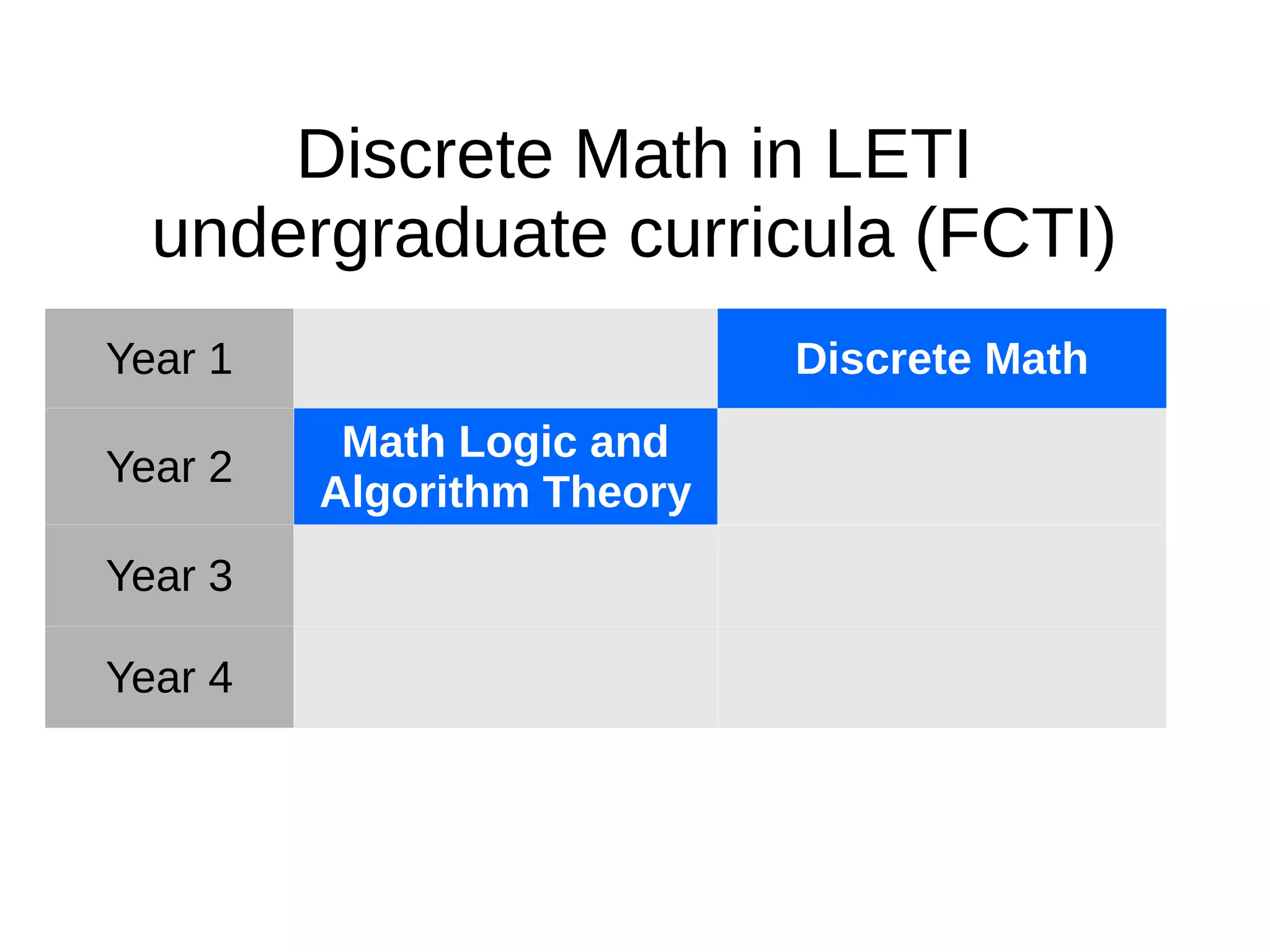
Discrete Math in LETI
undergraduate curricula (FCTI)
Year 1 Discrete Math
Year 2
Math Logic and
Algorithm Theory
Year 3
Year 4
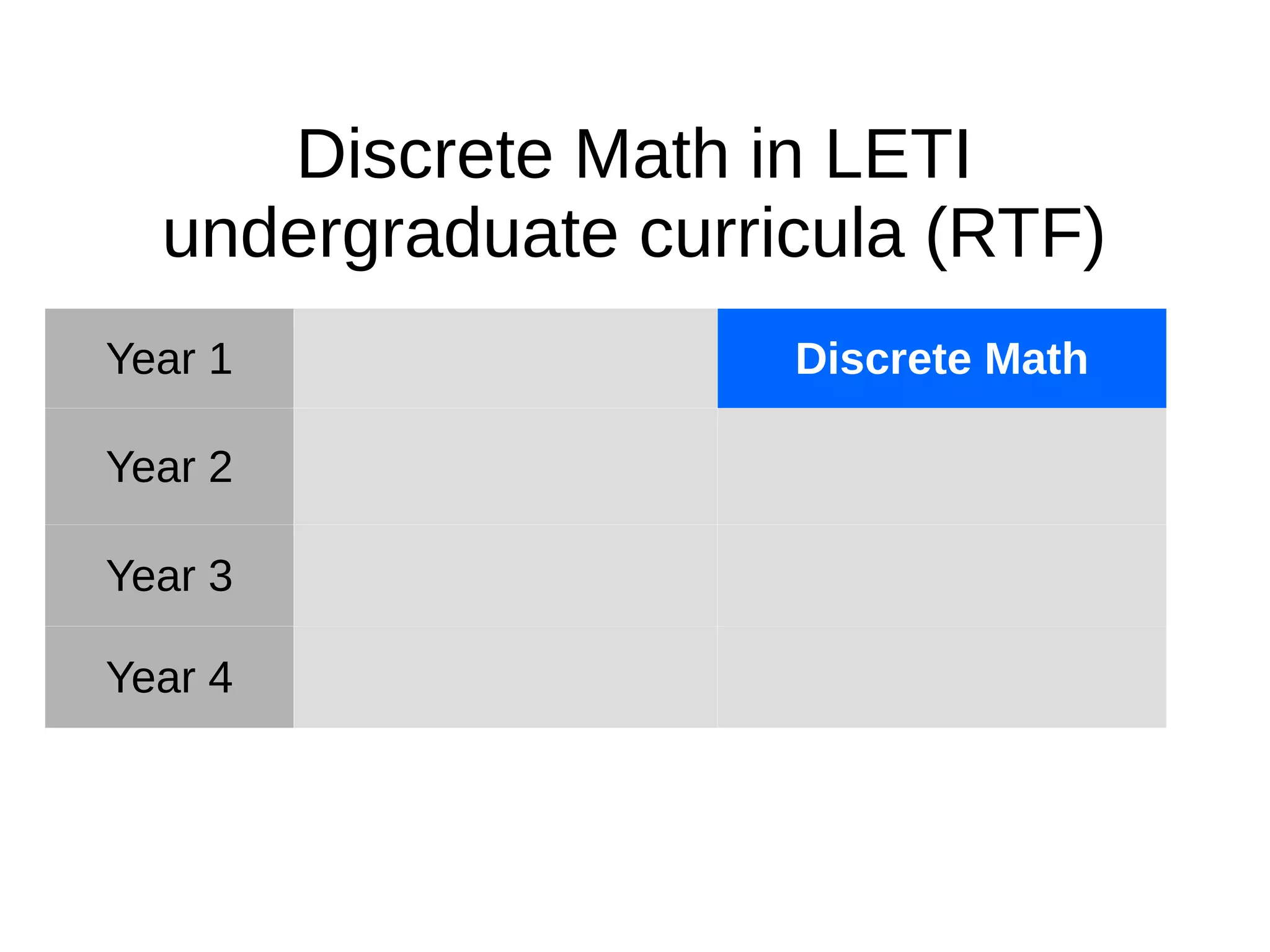
Discrete Math in LETI
undergraduate curricula (RTF)
Year 1 Discrete Math
Year 2
Year 3
Year 4
Course parameters: TUT and LETI
TUT LETI
Amount of credits 4 5 (1 cu = 36 hours in Russia)
Duration 7 weeks 19 weeks (1 semester)
Student hours 105 180
Lectures 28 36
Laboratory work /
tutorials
12 36
Homework (%
mandatory)
36(40%) 72 (50%)
Internship 0
Exam preparation 16 36
Exam 3 1 (not included in total amount)
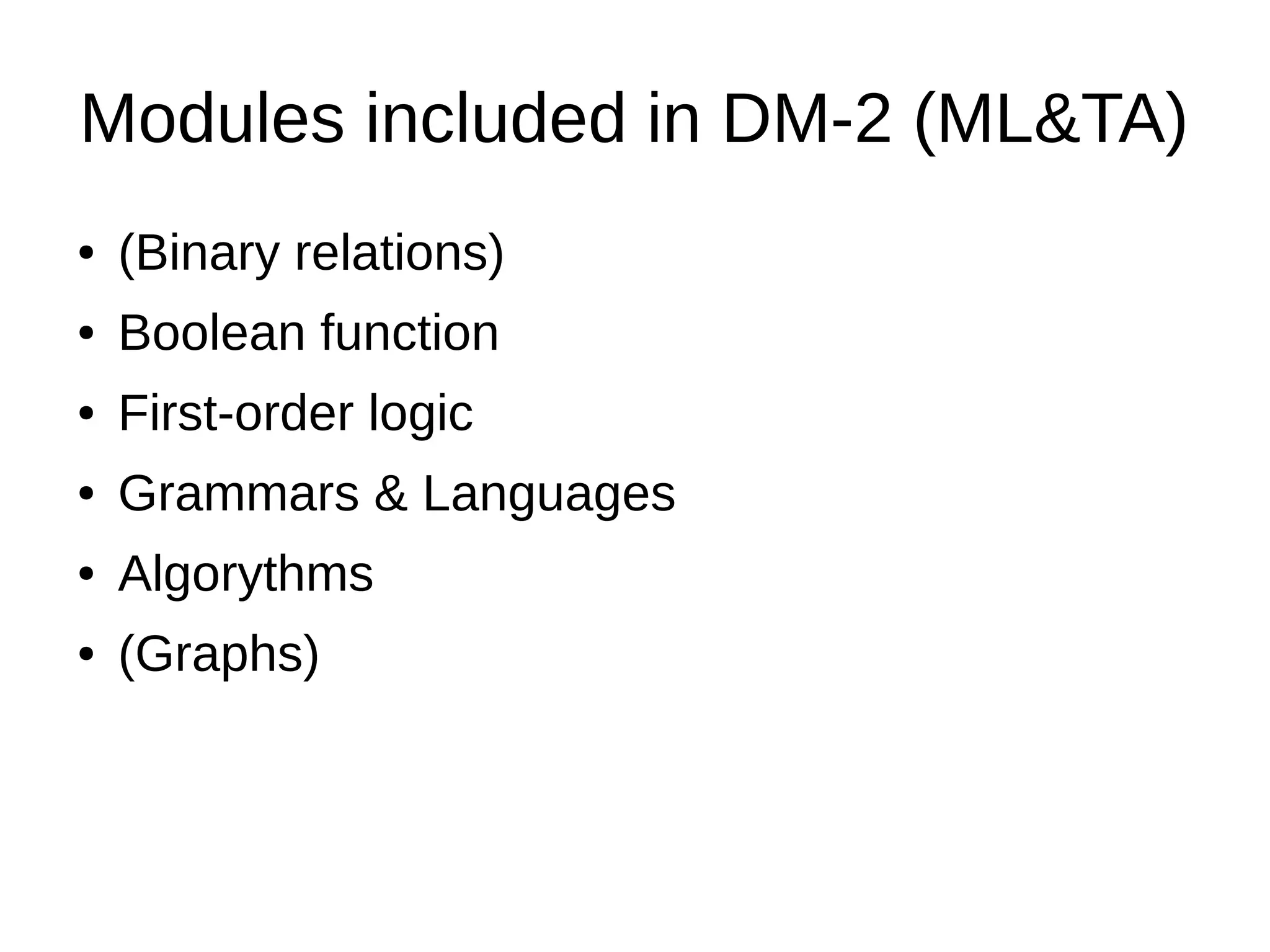
Modules included in DM-2 (ML&TA)
● (Binary relations)
● Boolean function
● First-order logic
● Grammars & Languages
● Algorythms
● (Graphs)
Let's use this colouring to distinguish competences which are
treated different ways in LETI
For competences, which are included into Discrete Math curriculum
For competences, which are not included in LETI Math curricula
For competences, which are driven out to other Math cources
For competences, which should be obtained by students to the end of semester 1
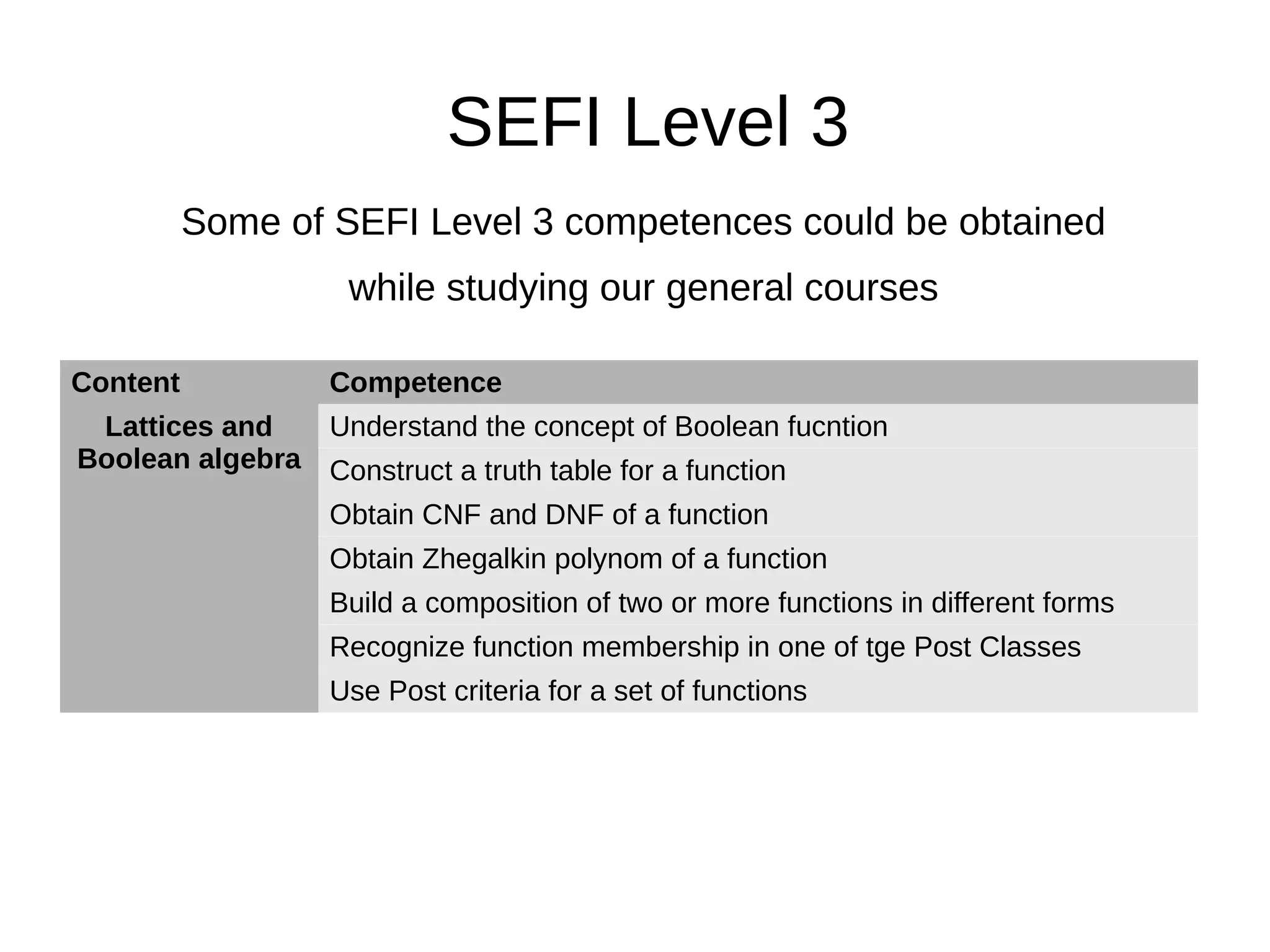
SEFI Level 3
Some of SEFI Level 3 competences could be obtained
while studying our general courses
Content Competence
Lattices and
Boolean algebra
Understand the concept of Boolean fucntion
Construct a truth table for a function
Obtain CNF and DNF of a function
Obtain Zhegalkin polynom of a function
Build a composition of two or more functions in different forms
Recognize function membership in one of tge Post Classes
Use Post criteria for a set of functions
SEFI Level 1
Content Competence
Mathematical logic
recognise a proposition
negate a proposition
form a compound proposition using the connectives AND,
OR, IMPLICATION
construct a truth table for a compound proposition
construct a truth table for an implication
verify the equivalence of two propositions using a truth table
identify a contradiction and a tautology
construct the converse of a proposition
obtain the contrapositive form of an implication
understand the unversal quantifier 'for all'
understand the existential quantifier 'there exists'
negate propositions with quantifiers
follow simple examples of direct and indirect proof
follow a simple example of a proof by contradiction
In addition at LETI
All those competences should be obtained by LETI students in
the Semester 3, which gives students the ability to work at the
area of ATP (Automatical Theorem proving)
Content Competence
Mathematical logic
recognize prenex and Scolem form of first-order
formulas
obtain prenex and scolem form for a certain formula
unify first-order logic formulas
use resolution method for propositions and first order
logic
SEFI Level 1
Sometimes DM-1
Content Competence
Graphs
recognise a graph (directed and/or undirected) in a
real Situation
understand the notions of a path and a cycle
In addition at LETI
Sometimes DM-1
Content Competence
Graphs Obtain an incidence matrix for a graph
Content Competence
Relations
understand the notion of binary relation
find the composition of two binary relations
find the inverse of a binary relation
understand the notion of a ternary relation
understand the notion of an equivalence relation on a set
verify whether a given relation is an equivalence relation or not
understand the notion of a partition on a set
view an equivalence either as a relation or a partition
understand the notion of a partial order on a set
understand the differnce between maximal and greatest element,
and between minimal and smallest element
SEFI Level 2 (sometimes DM-1)
In addition at LETI
Content Competence
Relations
Obtain a the graph and his matrix for a relation
Use topological sort algorithm and transitive closure algorithms
Content Competence
Graphs
recognise an Euler trail in a graph and/or an Euler graph
recognise a Hamilton cycle (path) in a graph
find components of connectivity in a graph
find components of strong connectivity in a directed graph
find a minimal spanning tree of a given connected graph
SEFI Level 2
(sometimes DM-1)
In addition at LETI
Content Competence
Graphs
Find the distance (shortest way) between two vertices in a graph
Recognize planar graph
Content Competence
Algorithms
understand when an algorithm solves a problem
understand the 'big O' notantion for functions
understand the worst case analysis of an algorithm
understand one of the sorting algorithms
understand the idea of depth-first search
understand the idea of breadth-first search
understand a multi-stage algorithm (for example, finding the
shortest path, finding the minimal spanning tree or finding
maximal flow)
understand the notion of a polynomial-time-solvable problem
understand the notion of an NP problem (as a problem for
which It is 'easy' to verify an affirmative answer)
understand the notion of an NP-complete problem (as a
hardest problem among NP problems).
SEFI Level 2
In addition at LETI
Content Competence
Algorithms understand the notion of Turing machine
run simple turing machines on paper
construct simple Turing machine
run Markov algorithm
Grammars and
languages
Recognize context-free grammar
Construct context-free grammar for a simple language
Build a parser for a grammar using Virt algorithm
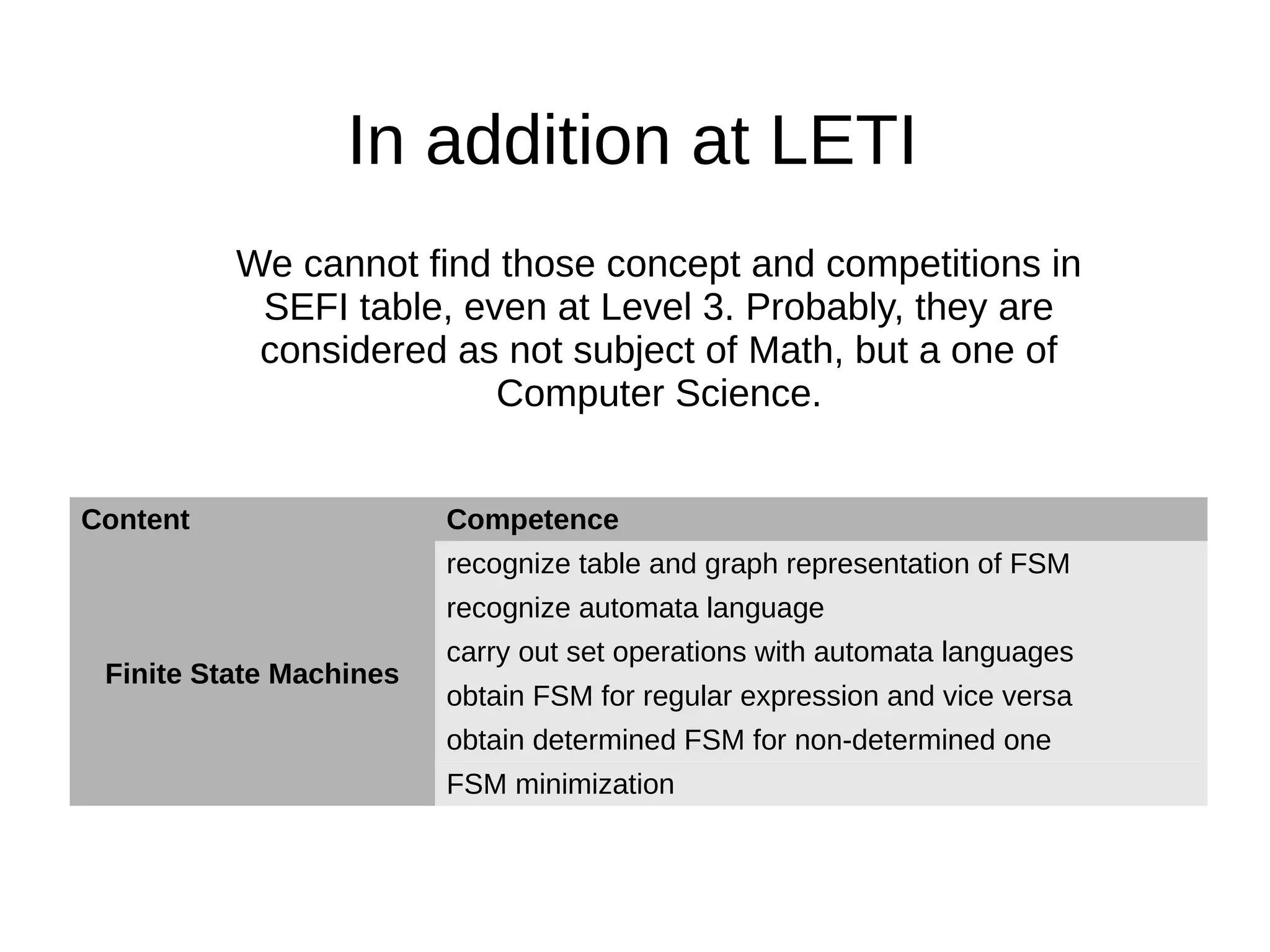
SEFI Level 3
We cannot find those concept and competitions in
SEFI table, even at Level 3. Probably, they are
considered as not subject of Math, but a one of
Computer Science.
In addition at LETI
Content Competence
Finite State Machines
recognize table and graph representation of FSM
recognize automata language
carry out set operations with automata languages
obtain FSM for regular expression and vice versa
obtain determined FSM for non-determined one
FSM minimization
Modification ideas
● More strict module structure: each module should give a fixed percent of a final
mark
● More strict «game rules»
● Improving TEL usage, especially MathBridge (or similar)
● Some modules may be completely moved to Mathbridge (or similar)
● Some modules may be elective

Discrete Mathematics

  • 1.
  • 2.
    Discrete Math inLETI undergraduate curricula (FCTI) Year 1 Discrete Math Year 2 Math Logic and Algorithm Theory Year 3 Year 4
  • 3.
    Discrete Math inLETI undergraduate curricula (RTF) Year 1 Discrete Math Year 2 Year 3 Year 4
  • 4.
    Course parameters: TUTand LETI TUT LETI Amount of credits 4 5 (1 cu = 36 hours in Russia) Duration 7 weeks 19 weeks (1 semester) Student hours 105 180 Lectures 28 36 Laboratory work / tutorials 12 36 Homework (% mandatory) 36(40%) 72 (50%) Internship 0 Exam preparation 16 36 Exam 3 1 (not included in total amount)
  • 5.
    Modules included inDM-2 (ML&TA) ● (Binary relations) ● Boolean function ● First-order logic ● Grammars & Languages ● Algorythms ● (Graphs)
  • 6.
    Let's use thiscolouring to distinguish competences which are treated different ways in LETI For competences, which are included into Discrete Math curriculum For competences, which are not included in LETI Math curricula For competences, which are driven out to other Math cources For competences, which should be obtained by students to the end of semester 1
  • 7.
    SEFI Level 3 Someof SEFI Level 3 competences could be obtained while studying our general courses Content Competence Lattices and Boolean algebra Understand the concept of Boolean fucntion Construct a truth table for a function Obtain CNF and DNF of a function Obtain Zhegalkin polynom of a function Build a composition of two or more functions in different forms Recognize function membership in one of tge Post Classes Use Post criteria for a set of functions
  • 8.
    SEFI Level 1 ContentCompetence Mathematical logic recognise a proposition negate a proposition form a compound proposition using the connectives AND, OR, IMPLICATION construct a truth table for a compound proposition construct a truth table for an implication verify the equivalence of two propositions using a truth table identify a contradiction and a tautology construct the converse of a proposition obtain the contrapositive form of an implication understand the unversal quantifier 'for all' understand the existential quantifier 'there exists' negate propositions with quantifiers follow simple examples of direct and indirect proof follow a simple example of a proof by contradiction
  • 9.
    In addition atLETI All those competences should be obtained by LETI students in the Semester 3, which gives students the ability to work at the area of ATP (Automatical Theorem proving) Content Competence Mathematical logic recognize prenex and Scolem form of first-order formulas obtain prenex and scolem form for a certain formula unify first-order logic formulas use resolution method for propositions and first order logic
  • 10.
    SEFI Level 1 SometimesDM-1 Content Competence Graphs recognise a graph (directed and/or undirected) in a real Situation understand the notions of a path and a cycle In addition at LETI Sometimes DM-1 Content Competence Graphs Obtain an incidence matrix for a graph
  • 11.
    Content Competence Relations understand thenotion of binary relation find the composition of two binary relations find the inverse of a binary relation understand the notion of a ternary relation understand the notion of an equivalence relation on a set verify whether a given relation is an equivalence relation or not understand the notion of a partition on a set view an equivalence either as a relation or a partition understand the notion of a partial order on a set understand the differnce between maximal and greatest element, and between minimal and smallest element SEFI Level 2 (sometimes DM-1) In addition at LETI Content Competence Relations Obtain a the graph and his matrix for a relation Use topological sort algorithm and transitive closure algorithms
  • 12.
    Content Competence Graphs recognise anEuler trail in a graph and/or an Euler graph recognise a Hamilton cycle (path) in a graph find components of connectivity in a graph find components of strong connectivity in a directed graph find a minimal spanning tree of a given connected graph SEFI Level 2 (sometimes DM-1) In addition at LETI Content Competence Graphs Find the distance (shortest way) between two vertices in a graph Recognize planar graph
  • 13.
    Content Competence Algorithms understand whenan algorithm solves a problem understand the 'big O' notantion for functions understand the worst case analysis of an algorithm understand one of the sorting algorithms understand the idea of depth-first search understand the idea of breadth-first search understand a multi-stage algorithm (for example, finding the shortest path, finding the minimal spanning tree or finding maximal flow) understand the notion of a polynomial-time-solvable problem understand the notion of an NP problem (as a problem for which It is 'easy' to verify an affirmative answer) understand the notion of an NP-complete problem (as a hardest problem among NP problems). SEFI Level 2
  • 14.
    In addition atLETI Content Competence Algorithms understand the notion of Turing machine run simple turing machines on paper construct simple Turing machine run Markov algorithm Grammars and languages Recognize context-free grammar Construct context-free grammar for a simple language Build a parser for a grammar using Virt algorithm SEFI Level 3
  • 15.
    We cannot findthose concept and competitions in SEFI table, even at Level 3. Probably, they are considered as not subject of Math, but a one of Computer Science. In addition at LETI Content Competence Finite State Machines recognize table and graph representation of FSM recognize automata language carry out set operations with automata languages obtain FSM for regular expression and vice versa obtain determined FSM for non-determined one FSM minimization
  • 16.
    Modification ideas ● Morestrict module structure: each module should give a fixed percent of a final mark ● More strict «game rules» ● Improving TEL usage, especially MathBridge (or similar) ● Some modules may be completely moved to Mathbridge (or similar) ● Some modules may be elective