Maths Project

Class – 7B
Roll Nos - 17 & 18
Roll No.s - Name

17 - Tushar Gupta
18 - Samarth Enosh Harrison
In math, geometry is the basic concepts which explain the
size, shape and their positions. Geometry also explains the
basic properties for every shape. Generally, the geometry is
classified into two types such as plane geometry and solid
geometry. The geometry shapes can be drawn by using the
tools such as compass, protractor, ruler etc. The
fundamental concepts of geometry deals with lines, points,
planes, shapes line segments, midpoints etc. There are
certain formulas available for measuring the geometry
concepts. By studying the fundamental concepts of
geometry, we can solve the geometry problems easily.
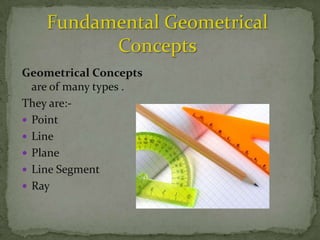
Geometrical Concepts
are of many types .
They are: Point
 Line
 Plane
 Line Segment
 Ray
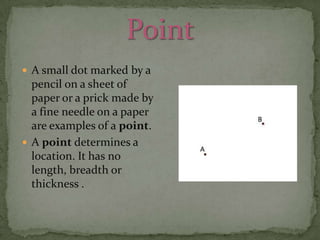
 A small dot marked by a

pencil on a sheet of
paper or a prick made by
a fine needle on a paper
are examples of a point.
 A point determines a
location. It has no
length, breadth or
thickness .
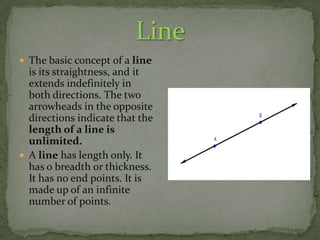
 The basic concept of a line

is its straightness, and it
extends indefinitely in
both directions. The two
arrowheads in the opposite
directions indicate that the
length of a line is
unlimited.
 A line has length only. It
has o breadth or thickness.
It has no end points. It is
made up of an infinite
number of points.
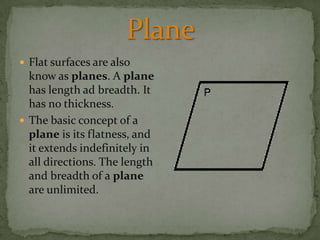
 Flat surfaces are also

know as planes. A plane
has length ad breadth. It
has no thickness.
 The basic concept of a
plane is its flatness, and
it extends indefinitely in
all directions. The length
and breadth of a plane
are unlimited.
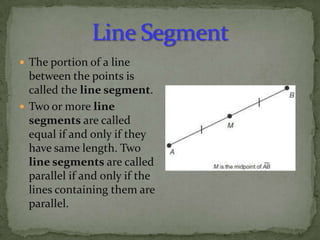
 The portion of a line

between the points is
called the line segment.
 Two or more line
segments are called
equal if and only if they
have same length. Two
line segments are called
parallel if and only if the
lines containing them are
parallel.
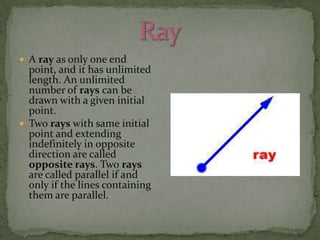
 A ray as only one end

point, and it has unlimited
length. An unlimited
number of rays can be
drawn with a given initial
point.
 Two rays with same initial
point and extending
indefinitely in opposite
direction are called
opposite rays. Two rays
are called parallel if and
only if the lines containing
them are parallel.
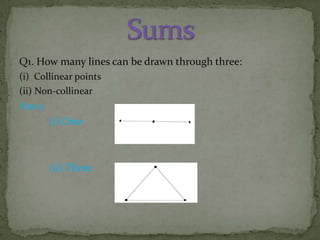
Q1. How many lines can be drawn through three:
(i) Collinear points
(ii) Non-collinear

Ans.1
(i).One

(ii) Three
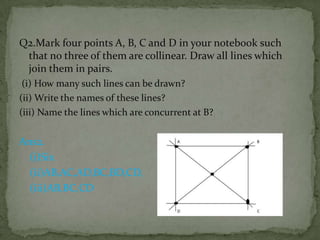
Q2.Mark four points A, B, C and D in your notebook such
that no three of them are collinear. Draw all lines which
join them in pairs.
(i) How many such lines can be drawn?
(ii) Write the names of these lines?
(iii) Name the lines which are concurrent at B?

Ans2.
(i)Six
(ii)AB,AC,AD,BC,BD,CD,
(iii)AB,BC,CD
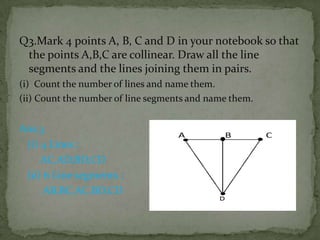
Q3.Mark 4 points A, B, C and D in your notebook so that
the points A,B,C are collinear. Draw all the line
segments and the lines joining them in pairs.
(i) Count the number of lines and name them.
(ii) Count the number of line segments and name them.

Ans.3
(i) 4 Lines ;
AC,AD,BD,CD
(ii) 6 Line segments ;
AB,BC,AC,BD,CD
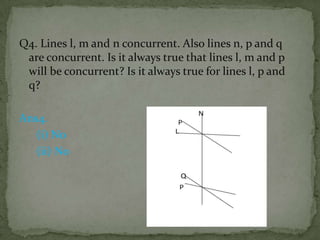
Q4. Lines l, m and n concurrent. Also lines n, p and q
are concurrent. Is it always true that lines l, m and p
will be concurrent? Is it always true for lines l, p and
q?
Ans4.
(i) No
(ii) No
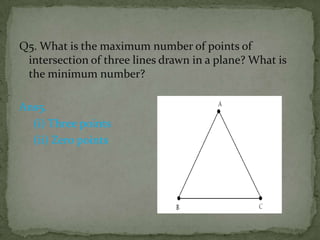
Q5. What is the maximum number of points of
intersection of three lines drawn in a plane? What is
the minimum number?
Ans5.
(i) Three points
(ii) Zero points

Fundamental Geometrical Concepts Class 7

  • 1.
    Maths Project Class –7B Roll Nos - 17 & 18
  • 2.
    Roll No.s -Name 17 - Tushar Gupta 18 - Samarth Enosh Harrison
  • 3.
    In math, geometryis the basic concepts which explain the size, shape and their positions. Geometry also explains the basic properties for every shape. Generally, the geometry is classified into two types such as plane geometry and solid geometry. The geometry shapes can be drawn by using the tools such as compass, protractor, ruler etc. The fundamental concepts of geometry deals with lines, points, planes, shapes line segments, midpoints etc. There are certain formulas available for measuring the geometry concepts. By studying the fundamental concepts of geometry, we can solve the geometry problems easily.
  • 4.
    Geometrical Concepts are ofmany types . They are: Point  Line  Plane  Line Segment  Ray
  • 5.
     A smalldot marked by a pencil on a sheet of paper or a prick made by a fine needle on a paper are examples of a point.  A point determines a location. It has no length, breadth or thickness .
  • 6.
     The basicconcept of a line is its straightness, and it extends indefinitely in both directions. The two arrowheads in the opposite directions indicate that the length of a line is unlimited.  A line has length only. It has o breadth or thickness. It has no end points. It is made up of an infinite number of points.
  • 7.
     Flat surfacesare also know as planes. A plane has length ad breadth. It has no thickness.  The basic concept of a plane is its flatness, and it extends indefinitely in all directions. The length and breadth of a plane are unlimited.
  • 8.
     The portionof a line between the points is called the line segment.  Two or more line segments are called equal if and only if they have same length. Two line segments are called parallel if and only if the lines containing them are parallel.
  • 9.
     A rayas only one end point, and it has unlimited length. An unlimited number of rays can be drawn with a given initial point.  Two rays with same initial point and extending indefinitely in opposite direction are called opposite rays. Two rays are called parallel if and only if the lines containing them are parallel.
  • 10.
    Q1. How manylines can be drawn through three: (i) Collinear points (ii) Non-collinear Ans.1 (i).One (ii) Three
  • 11.
    Q2.Mark four pointsA, B, C and D in your notebook such that no three of them are collinear. Draw all lines which join them in pairs. (i) How many such lines can be drawn? (ii) Write the names of these lines? (iii) Name the lines which are concurrent at B? Ans2. (i)Six (ii)AB,AC,AD,BC,BD,CD, (iii)AB,BC,CD
  • 12.
    Q3.Mark 4 pointsA, B, C and D in your notebook so that the points A,B,C are collinear. Draw all the line segments and the lines joining them in pairs. (i) Count the number of lines and name them. (ii) Count the number of line segments and name them. Ans.3 (i) 4 Lines ; AC,AD,BD,CD (ii) 6 Line segments ; AB,BC,AC,BD,CD
  • 13.
    Q4. Lines l,m and n concurrent. Also lines n, p and q are concurrent. Is it always true that lines l, m and p will be concurrent? Is it always true for lines l, p and q? Ans4. (i) No (ii) No
  • 14.
    Q5. What isthe maximum number of points of intersection of three lines drawn in a plane? What is the minimum number? Ans5. (i) Three points (ii) Zero points