Geometry
Vocabulary
Created by Dani Krejci referencing:
http://mrsdell.org/geometry/vocabulary.html
point
An exact location in space, usually
represented by a dot.
Example:
A
This is point A.
line
A straight path in a plane that goes
on forever in opposite directions.
Example:
A B
This is line AB or BA.
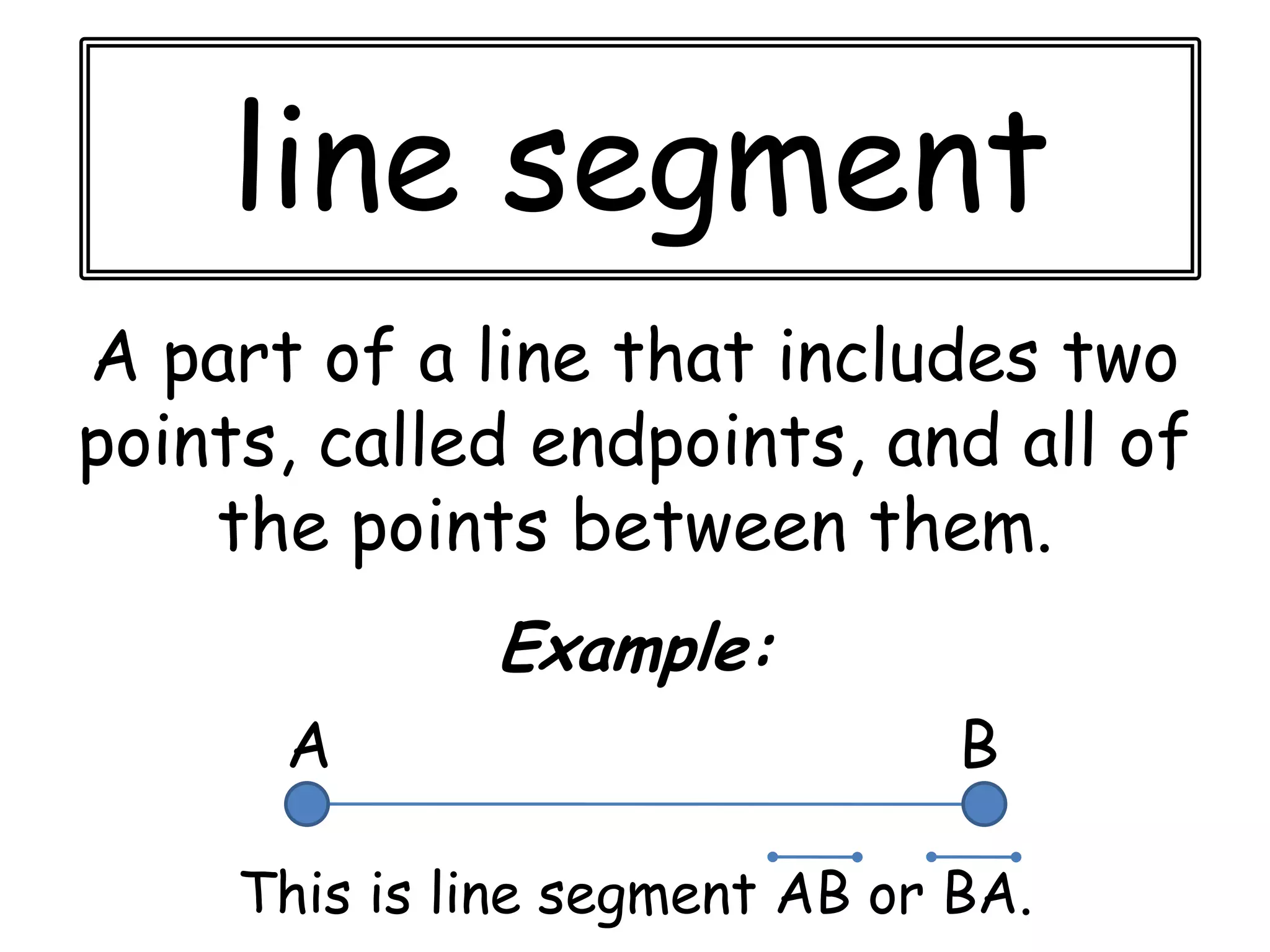
line segment
A part of a line that includes two
points, called endpoints, and all of
the points between them.
Example:
A B
This is line segment AB or BA.
ray
A part of a line, with one endpoint, that
continues without end in one direction.
Example:
This is ray CD. It is NOT ray DC.
You must name the point first.
C D
angle
A figure formed by two rays that
have a common endpoint.
Example:
right angle
An angle formed by perpendicular
lines, line segments, or rays and with
a measure of 90°
Example: This is a symbol
that means
90°.
acute angle
An angle that has a measure less than
a right angle (less than 90°) .
Examples:
These are both
examples of
acute angles.
90° 90°
obtuse angle
An angle whose measure is greater
than 90° and less than 180°.
Examples:
These are both
examples of
obtuse angles.
vertex
The point where rays meet; the point
of intersection of any two or more
side or edges; the plural is vertices
Examples:
E
D
F
vertices
parallel line
Lines in a plane that never intersect.
Example:
E F
G H
EF is parallel to GH. Or EF GH
This is a symbol
that means
parallel.
perpendicular lines
Two lines that intersect to form four
right angles.
Example:E
F
HG
EF is perpendicular to GH. Or EF GH
This is a symbol
that means
perpendicular.
intersecting lines
Lines that cross at exactly one point.
Example:I
J
K
L
Line IJ intersects line KL.
circle
A closed plane figure with all points on the
figure the same distance from the center.
Example:
This is the
center – center
means “exact
middle.”
circumference
The distance around a circle.
Example:
If you measure
from any point,
all the way
around a circle,
that will give you
the
circumference.
chord
A line segment with its endpoints
on a circle.
Examples:
I
J
K
L
Line segments
IJ and KL are both chords.
diameter
A line segment that passes through
the center of a circle and has
its endpoints on the circle.
M
N
Line segment MN is the diameter.
Example:
radius
A line segment with one endpoint at
the center of a circle and the other
endpoint on the circle.
M N
Line segment MN is the radius.
Example:
triangle
A polygon with three sides.
Examples:
right triangle
A triangle with one right angle (90°).
Example:
Note that this triangle
has a 90° angle
marked with the
symbol.
obtuse triangle
A triangle that has one obtuse angle –
which means an angle greater than 90°.
Example:
Note that this angle is
110° - which is greater
than 90 °. So, this is
the obtuse angle that
makes this an obtuse
triangle.
equilateral triangle
A triangle with three congruent sides.
Example:
O
P
Q
Line segments OP, PQ, and QO are congruent.
The word congruent
means equal or the same.
The sides of this triangle
all measure 3 cm each.
3 cm 3 cm
3 cm
isosceles triangle
A triangle with two congruent sides.
Example:
O
P
Q
Line segments OP and PQ are both 3 cm = congruent.
Line segment OQ is smaller at 2 cm.
The word congruent
means equal or the same.
Only two sides of this
triangle measure 3 cm, the
other side measures 2 cm.
3 cm 3 cm
2 cm
scalene triangle
A triangle with NO congruent sides.
Example:
Note that each side of
this triangle is a
different length. If any
sides are the same, it
is not scalene.
polygon
A closed plane figure formed by
three or more line segments.
Examples:
1
2 3
4
5
6
78
9
10
1
2
3
1
2
3
4
5
1
2
3
4
parallelogram
A quadrilateral whose opposite sides are
parallel and congruent.
Examples:
R S
T U
R S
T U
Note that on both shapes,
line segments RS and TU
are congruent, or equal.
Line segments RT and SU
are also congruent. That
makes both of these shapes
parallelograms.
quadrilateral
A polygon with four sides
Examples:
1 2
34
1
2
3
4
4
4
1
1
2
2
3
3
rectangle
A parallelogram with four right angles.
Example:
Note that each vertex has
a 90° angle marked with
the symbol. Because
there are four, we know
this is a rectangle.
1 2
3 4
square
A rectangle with four equal sides.
Example:
3 cm
3 cm
3 cm
3 cm
trapezoid
A quadrilateral with one pair of
parallel sides.
Examples:V W
X Y
V
W
X
Y
Line segments VW and XY are parallel on both
quadrilaterals, so we know that they are trapezoids.
hexagon
A polygon with six sides and six angles.
Examples:
1
2
3
4
5
6
Note that there are six
sides and there are also six
angles. That proves that
this quadrilateral is a
hexagon.
octagon
A polygon with eight sides.
Example:
1
2
3
4
5
6
7
8 1
2
3
4
5
67
8
Note that even though
these shapes may look
different, they both have
8 sides. So, we know
that they are octagons.
pentagon
A polygon with five sides.
Example:
1 2
3
4
5
1
2
3
4
5
Note that even though
these shapes may look
different, they both have
5 sides. So, we know
that they are pentagons.
cone
A cone is a shape that has a point
at one end and is circular
at the other end.
Example:
crescent
A shape that resembles a moon.
It is similar to a half-circle.
Example:
cube
A three dimensional solid figure
with 6 faces.
Example:
curve
A wavy live or surface that
changes direction.
Example:
Note that even though
one is a curved line and
one is a curved segment,
these are both curves.
cylinder
A three dimensional solid figure
with two circular ends and one
face connecting them.
Example:
ellipse
A flattened circle.
Example:
crescent
An exact location in space, usually
represented by a dot.
Example:
sphere
A three dimensional solid figure much
like a circle. It has no ends and no
points. A ball is an example.
Example:
semicircle
A shapes that resembles a half
circle.
Example:
spiral
A curve that winds around itself.
Example:
zigzag
A line that turns back and forth
sharply.
Example:

Geometry vocabulary

  • 1.
    Geometry Vocabulary Created by DaniKrejci referencing: http://mrsdell.org/geometry/vocabulary.html
  • 2.
    point An exact locationin space, usually represented by a dot. Example: A This is point A.
  • 3.
    line A straight pathin a plane that goes on forever in opposite directions. Example: A B This is line AB or BA.
  • 4.
    line segment A partof a line that includes two points, called endpoints, and all of the points between them. Example: A B This is line segment AB or BA.
  • 5.
    ray A part ofa line, with one endpoint, that continues without end in one direction. Example: This is ray CD. It is NOT ray DC. You must name the point first. C D
  • 6.
    angle A figure formedby two rays that have a common endpoint. Example:
  • 7.
    right angle An angleformed by perpendicular lines, line segments, or rays and with a measure of 90° Example: This is a symbol that means 90°.
  • 8.
    acute angle An anglethat has a measure less than a right angle (less than 90°) . Examples: These are both examples of acute angles. 90° 90°
  • 9.
    obtuse angle An anglewhose measure is greater than 90° and less than 180°. Examples: These are both examples of obtuse angles.
  • 10.
    vertex The point whererays meet; the point of intersection of any two or more side or edges; the plural is vertices Examples: E D F vertices
  • 11.
    parallel line Lines ina plane that never intersect. Example: E F G H EF is parallel to GH. Or EF GH This is a symbol that means parallel.
  • 12.
    perpendicular lines Two linesthat intersect to form four right angles. Example:E F HG EF is perpendicular to GH. Or EF GH This is a symbol that means perpendicular.
  • 13.
    intersecting lines Lines thatcross at exactly one point. Example:I J K L Line IJ intersects line KL.
  • 14.
    circle A closed planefigure with all points on the figure the same distance from the center. Example: This is the center – center means “exact middle.”
  • 15.
    circumference The distance arounda circle. Example: If you measure from any point, all the way around a circle, that will give you the circumference.
  • 16.
    chord A line segmentwith its endpoints on a circle. Examples: I J K L Line segments IJ and KL are both chords.
  • 17.
    diameter A line segmentthat passes through the center of a circle and has its endpoints on the circle. M N Line segment MN is the diameter. Example:
  • 18.
    radius A line segmentwith one endpoint at the center of a circle and the other endpoint on the circle. M N Line segment MN is the radius. Example:
  • 19.
    triangle A polygon withthree sides. Examples:
  • 20.
    right triangle A trianglewith one right angle (90°). Example: Note that this triangle has a 90° angle marked with the symbol.
  • 21.
    obtuse triangle A trianglethat has one obtuse angle – which means an angle greater than 90°. Example: Note that this angle is 110° - which is greater than 90 °. So, this is the obtuse angle that makes this an obtuse triangle.
  • 22.
    equilateral triangle A trianglewith three congruent sides. Example: O P Q Line segments OP, PQ, and QO are congruent. The word congruent means equal or the same. The sides of this triangle all measure 3 cm each. 3 cm 3 cm 3 cm
  • 23.
    isosceles triangle A trianglewith two congruent sides. Example: O P Q Line segments OP and PQ are both 3 cm = congruent. Line segment OQ is smaller at 2 cm. The word congruent means equal or the same. Only two sides of this triangle measure 3 cm, the other side measures 2 cm. 3 cm 3 cm 2 cm
  • 24.
    scalene triangle A trianglewith NO congruent sides. Example: Note that each side of this triangle is a different length. If any sides are the same, it is not scalene.
  • 25.
    polygon A closed planefigure formed by three or more line segments. Examples: 1 2 3 4 5 6 78 9 10 1 2 3 1 2 3 4 5 1 2 3 4
  • 26.
    parallelogram A quadrilateral whoseopposite sides are parallel and congruent. Examples: R S T U R S T U Note that on both shapes, line segments RS and TU are congruent, or equal. Line segments RT and SU are also congruent. That makes both of these shapes parallelograms.
  • 27.
    quadrilateral A polygon withfour sides Examples: 1 2 34 1 2 3 4 4 4 1 1 2 2 3 3
  • 28.
    rectangle A parallelogram withfour right angles. Example: Note that each vertex has a 90° angle marked with the symbol. Because there are four, we know this is a rectangle. 1 2 3 4
  • 29.
    square A rectangle withfour equal sides. Example: 3 cm 3 cm 3 cm 3 cm
  • 30.
    trapezoid A quadrilateral withone pair of parallel sides. Examples:V W X Y V W X Y Line segments VW and XY are parallel on both quadrilaterals, so we know that they are trapezoids.
  • 31.
    hexagon A polygon withsix sides and six angles. Examples: 1 2 3 4 5 6 Note that there are six sides and there are also six angles. That proves that this quadrilateral is a hexagon.
  • 32.
    octagon A polygon witheight sides. Example: 1 2 3 4 5 6 7 8 1 2 3 4 5 67 8 Note that even though these shapes may look different, they both have 8 sides. So, we know that they are octagons.
  • 33.
    pentagon A polygon withfive sides. Example: 1 2 3 4 5 1 2 3 4 5 Note that even though these shapes may look different, they both have 5 sides. So, we know that they are pentagons.
  • 34.
    cone A cone isa shape that has a point at one end and is circular at the other end. Example:
  • 35.
    crescent A shape thatresembles a moon. It is similar to a half-circle. Example:
  • 36.
    cube A three dimensionalsolid figure with 6 faces. Example:
  • 37.
    curve A wavy liveor surface that changes direction. Example: Note that even though one is a curved line and one is a curved segment, these are both curves.
  • 38.
    cylinder A three dimensionalsolid figure with two circular ends and one face connecting them. Example:
  • 39.
  • 40.
    crescent An exact locationin space, usually represented by a dot. Example:
  • 41.
    sphere A three dimensionalsolid figure much like a circle. It has no ends and no points. A ball is an example. Example:
  • 42.
    semicircle A shapes thatresembles a half circle. Example:
  • 43.
    spiral A curve thatwinds around itself. Example:
  • 44.
    zigzag A line thatturns back and forth sharply. Example: