Section 5.1
              Areas and Distances
                    V63.0121.006/016, Calculus I

                           New York University


                           April 13, 2010


Announcements

   Quiz April 16 on §§4.1–4.4
   Final Exam: Monday, May 10, 12:00noon
Announcements


          Quiz April 16 on §§4.1–4.4
          Final Exam: Monday, May
          10, 12:00noon


V63.0121.006/016, Calculus I (NYU)   Section 5.1 Areas and Distances   April 13, 2010   2 / 30
Objectives


          Compute the area of a
          region by approximating it
          with rectangles and letting
          the size of the rectangles
          tend to zero.
          Compute the total distance
          traveled by a particle by
          approximating it as distance
          = (rate)(time) and letting
          the time intervals over which
          one approximates tend to
          zero.


V63.0121.006/016, Calculus I (NYU)   Section 5.1 Areas and Distances   April 13, 2010   3 / 30
Outline


Area through the Centuries
   Euclid
   Archimedes
   Cavalieri

Generalizing Cavalieri’s method
  Analogies

Distances
   Other applications


V63.0121.006/016, Calculus I (NYU)   Section 5.1 Areas and Distances   April 13, 2010   4 / 30
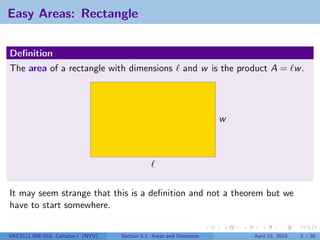
Easy Areas: Rectangle


Definition
The area of a rectangle with dimensions                      and w is the product A = w .


                                                                       w


It may seem strange that this is a definition and not a theorem but we
have to start somewhere.


V63.0121.006/016, Calculus I (NYU)   Section 5.1 Areas and Distances         April 13, 2010   5 / 30
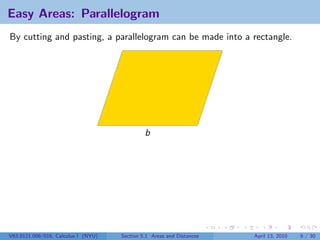
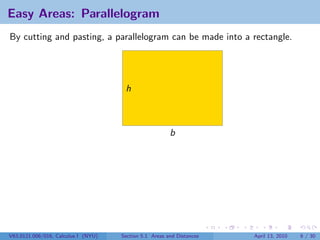
Easy Areas: Parallelogram
By cutting and pasting, a parallelogram can be made into a rectangle.


                                              b


V63.0121.006/016, Calculus I (NYU)   Section 5.1 Areas and Distances   April 13, 2010   6 / 30
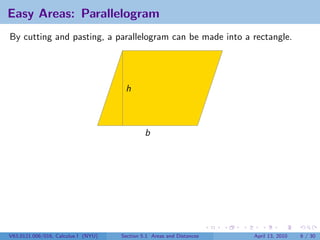
Easy Areas: Parallelogram
By cutting and pasting, a parallelogram can be made into a rectangle.


                                      h


                                              b


V63.0121.006/016, Calculus I (NYU)   Section 5.1 Areas and Distances   April 13, 2010   6 / 30
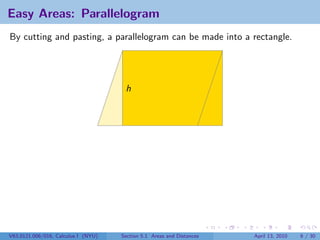
Easy Areas: Parallelogram
By cutting and pasting, a parallelogram can be made into a rectangle.


                                      h


V63.0121.006/016, Calculus I (NYU)   Section 5.1 Areas and Distances   April 13, 2010   6 / 30
Easy Areas: Parallelogram
By cutting and pasting, a parallelogram can be made into a rectangle.


                                      h


                                                        b


V63.0121.006/016, Calculus I (NYU)   Section 5.1 Areas and Distances   April 13, 2010   6 / 30
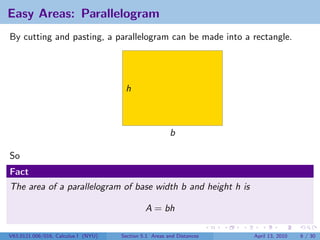
Easy Areas: Parallelogram
By cutting and pasting, a parallelogram can be made into a rectangle.


                                      h


                                                        b

So
Fact
The area of a parallelogram of base width b and height h is

                                              A = bh

V63.0121.006/016, Calculus I (NYU)   Section 5.1 Areas and Distances   April 13, 2010   6 / 30
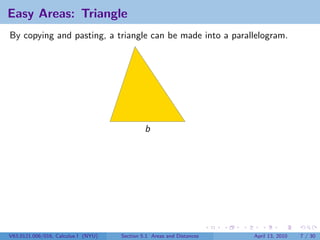
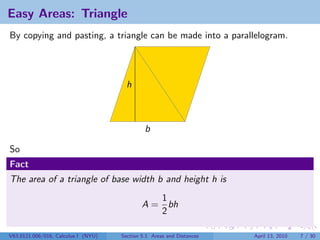
Easy Areas: Triangle
By copying and pasting, a triangle can be made into a parallelogram.


                                              b


V63.0121.006/016, Calculus I (NYU)   Section 5.1 Areas and Distances   April 13, 2010   7 / 30
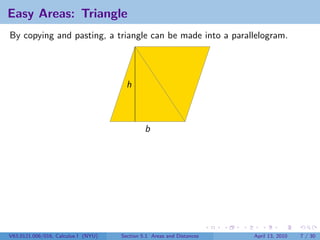
Easy Areas: Triangle
By copying and pasting, a triangle can be made into a parallelogram.


                                       h


                                              b


V63.0121.006/016, Calculus I (NYU)   Section 5.1 Areas and Distances   April 13, 2010   7 / 30
Easy Areas: Triangle
By copying and pasting, a triangle can be made into a parallelogram.


                                       h


                                              b

So
Fact
The area of a triangle of base width b and height h is
                                                1
                                             A = bh
                                                2

V63.0121.006/016, Calculus I (NYU)   Section 5.1 Areas and Distances   April 13, 2010   7 / 30
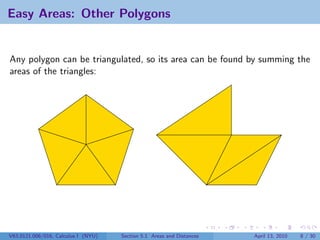
Easy Areas: Other Polygons


Any polygon can be triangulated, so its area can be found by summing the
areas of the triangles:


V63.0121.006/016, Calculus I (NYU)   Section 5.1 Areas and Distances   April 13, 2010   8 / 30
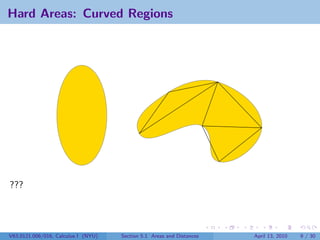
Hard Areas: Curved Regions


???


V63.0121.006/016, Calculus I (NYU)   Section 5.1 Areas and Distances   April 13, 2010   9 / 30
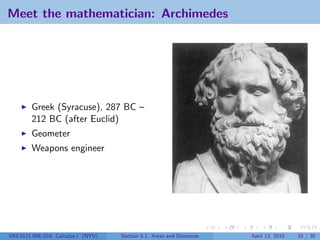
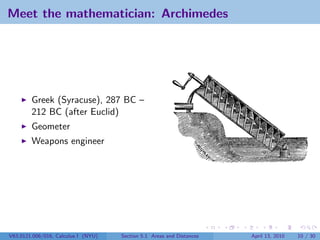
Meet the mathematician: Archimedes


        Greek (Syracuse), 287 BC –
        212 BC (after Euclid)
        Geometer
        Weapons engineer


V63.0121.006/016, Calculus I (NYU)   Section 5.1 Areas and Distances   April 13, 2010   10 / 30
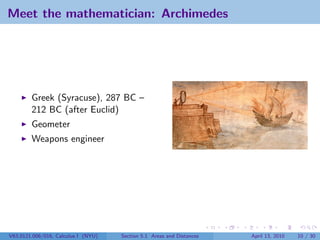
Meet the mathematician: Archimedes


        Greek (Syracuse), 287 BC –
        212 BC (after Euclid)
        Geometer
        Weapons engineer


V63.0121.006/016, Calculus I (NYU)   Section 5.1 Areas and Distances   April 13, 2010   10 / 30
Meet the mathematician: Archimedes


        Greek (Syracuse), 287 BC –
        212 BC (after Euclid)
        Geometer
        Weapons engineer


V63.0121.006/016, Calculus I (NYU)   Section 5.1 Areas and Distances   April 13, 2010   10 / 30
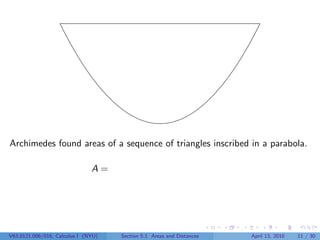
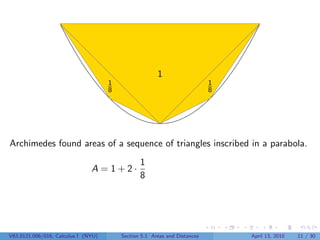
Archimedes found areas of a sequence of triangles inscribed in a parabola.

                               A=


V63.0121.006/016, Calculus I (NYU)   Section 5.1 Areas and Distances   April 13, 2010   11 / 30
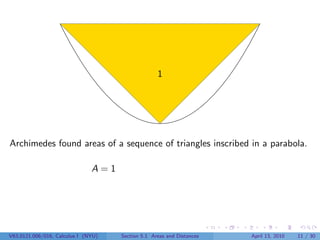
1


Archimedes found areas of a sequence of triangles inscribed in a parabola.

                               A=1


V63.0121.006/016, Calculus I (NYU)   Section 5.1 Areas and Distances   April 13, 2010   11 / 30
1
                                     1                                     1
                                     8                                     8


Archimedes found areas of a sequence of triangles inscribed in a parabola.
                                                1
                               A=1+2·
                                                8


V63.0121.006/016, Calculus I (NYU)       Section 5.1 Areas and Distances       April 13, 2010   11 / 30
1                                                   1
                           64                                                  64
                                                       1
                                     1                                     1
                                     8                                     8

                                            1                    1
                                            64                   64


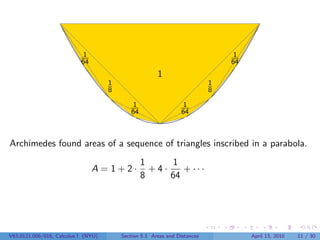
Archimedes found areas of a sequence of triangles inscribed in a parabola.
                                                 1     1
                                A=1+2·             +4·    + ···
                                                 8     64


V63.0121.006/016, Calculus I (NYU)       Section 5.1 Areas and Distances            April 13, 2010   11 / 30
1                                                    1
                           64                                                   64
                                                        1
                                      1                                     1
                                      8                                     8

                                             1                    1
                                             64                   64


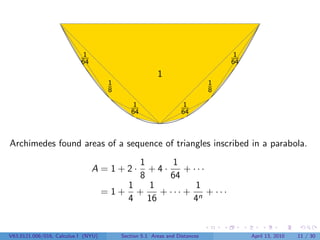
Archimedes found areas of a sequence of triangles inscribed in a parabola.
                                          1      1
                                A=1+2·      +4·     + ···
                                          8     64
                                        1   1          1
                                     =1+ +    + ··· + n + ···
                                        4 16          4


V63.0121.006/016, Calculus I (NYU)        Section 5.1 Areas and Distances            April 13, 2010   11 / 30
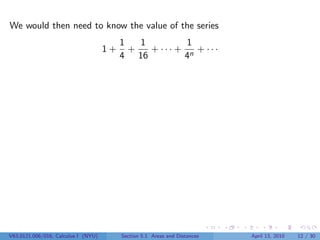
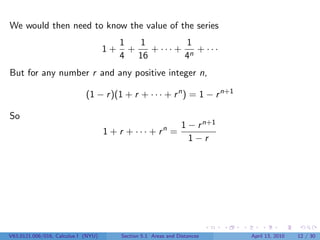
We would then need to know the value of the series
                                          1   1         1
                                     1+     +   + ··· + n + ···
                                          4 16         4


V63.0121.006/016, Calculus I (NYU)        Section 5.1 Areas and Distances   April 13, 2010   12 / 30
We would then need to know the value of the series
                                          1   1         1
                                     1+     +   + ··· + n + ···
                                          4 16         4
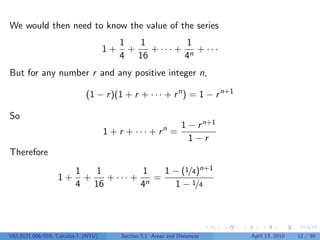
But for any number r and any positive integer n,

                             (1 − r )(1 + r + · · · + r n ) = 1 − r n+1

So
                                                                 1 − r n+1
                                     1 + r + · · · + rn =
                                                                   1−r


V63.0121.006/016, Calculus I (NYU)        Section 5.1 Areas and Distances    April 13, 2010   12 / 30
We would then need to know the value of the series
                                          1   1         1
                                     1+     +   + ··· + n + ···
                                          4 16         4
But for any number r and any positive integer n,

                             (1 − r )(1 + r + · · · + r n ) = 1 − r n+1

So
                                                                 1 − r n+1
                                     1 + r + · · · + rn =
                                                                   1−r
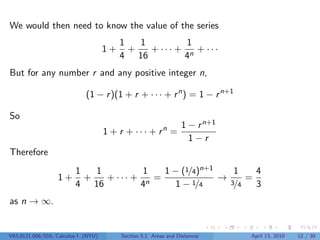
Therefore
                         1   1         1   1 − (1/4)n+1
                  1+       +   + ··· + n =
                         4 16         4       1 − 1/4


V63.0121.006/016, Calculus I (NYU)        Section 5.1 Areas and Distances    April 13, 2010   12 / 30
We would then need to know the value of the series
                                          1   1         1
                                     1+     +   + ··· + n + ···
                                          4 16         4
But for any number r and any positive integer n,

                             (1 − r )(1 + r + · · · + r n ) = 1 − r n+1

So
                                                                 1 − r n+1
                                     1 + r + · · · + rn =
                                                                   1−r
Therefore
                         1   1         1   1 − (1/4)n+1   1  4
                  1+       +   + ··· + n =              →3 =
                         4 16         4       1 − 1/4     /4 3
as n → ∞.


V63.0121.006/016, Calculus I (NYU)        Section 5.1 Areas and Distances    April 13, 2010   12 / 30
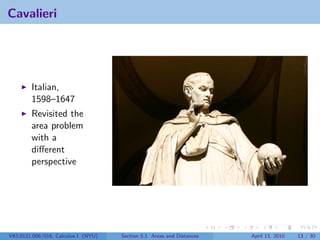
Cavalieri


        Italian,
        1598–1647
        Revisited the
        area problem
        with a
        different
        perspective


V63.0121.006/016, Calculus I (NYU)   Section 5.1 Areas and Distances   April 13, 2010   13 / 30
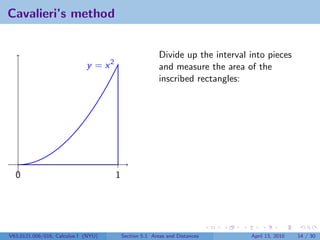
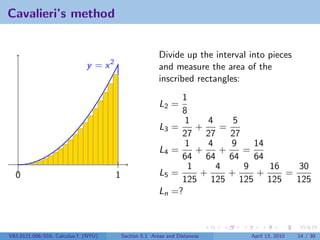
Cavalieri’s method


                                                         Divide up the interval into pieces
                             y = x2                      and measure the area of the
                                                         inscribed rectangles:


  0                                   1


V63.0121.006/016, Calculus I (NYU)        Section 5.1 Areas and Distances       April 13, 2010   14 / 30
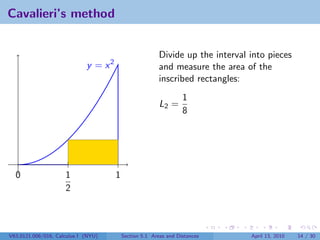
Cavalieri’s method


                                                         Divide up the interval into pieces
                             y = x2                      and measure the area of the
                                                         inscribed rectangles:
                                                                  1
                                                         L2 =
                                                                  8


  0                  1                1
                     2


V63.0121.006/016, Calculus I (NYU)        Section 5.1 Areas and Distances       April 13, 2010   14 / 30
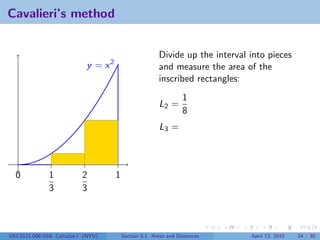
Cavalieri’s method


                                                         Divide up the interval into pieces
                             y = x2                      and measure the area of the
                                                         inscribed rectangles:
                                                                  1
                                                         L2 =
                                                                  8
                                                         L3 =


  0            1            2         1
               3            3


V63.0121.006/016, Calculus I (NYU)        Section 5.1 Areas and Distances       April 13, 2010   14 / 30
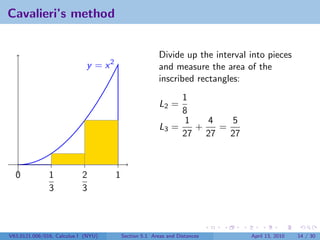
Cavalieri’s method


                                                         Divide up the interval into pieces
                             y = x2                      and measure the area of the
                                                         inscribed rectangles:
                                                              1
                                                         L2 =
                                                              8
                                                              1   4   5
                                                         L3 =   +   =
                                                              27 27   27


  0            1            2         1
               3            3


V63.0121.006/016, Calculus I (NYU)        Section 5.1 Areas and Distances       April 13, 2010   14 / 30
Cavalieri’s method


                                                         Divide up the interval into pieces
                             y = x2                      and measure the area of the
                                                         inscribed rectangles:
                                                              1
                                                         L2 =
                                                              8
                                                              1   4   5
                                                         L3 =   +   =
                                                              27 27   27
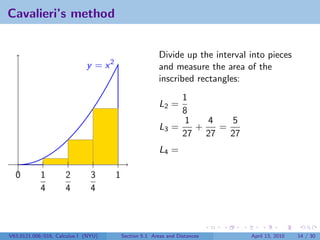
                                                         L4 =

  0         1        2         3      1
            4        4         4


V63.0121.006/016, Calculus I (NYU)        Section 5.1 Areas and Distances       April 13, 2010   14 / 30
Cavalieri’s method


                                                         Divide up the interval into pieces
                             y = x2                      and measure the area of the
                                                         inscribed rectangles:
                                                              1
                                                         L2 =
                                                              8
                                                              1   4   5
                                                         L3 =   +   =
                                                              27 27   27
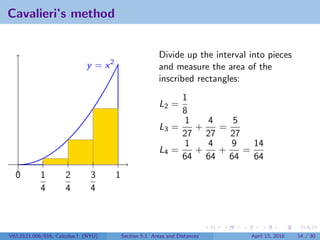
                                                              1   4   9    14
                                                         L4 =   +   +    =
                                                              64 64 64     64
  0         1        2         3      1
            4        4         4


V63.0121.006/016, Calculus I (NYU)        Section 5.1 Areas and Distances       April 13, 2010   14 / 30
Cavalieri’s method


                                                         Divide up the interval into pieces
                             y = x2                      and measure the area of the
                                                         inscribed rectangles:
                                                              1
                                                         L2 =
                                                              8
                                                              1   4   5
                                                         L3 =   +   =
                                                              27 27   27
                                                              1   4   9    14
                                                         L4 =   +   +    =
                                                              64 64 64     64
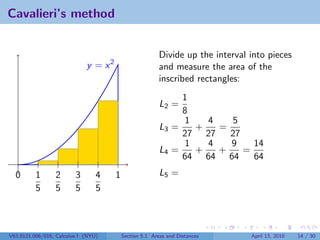
  0       1      2       3       4    1                  L5 =
          5      5       5       5


V63.0121.006/016, Calculus I (NYU)        Section 5.1 Areas and Distances       April 13, 2010   14 / 30
Cavalieri’s method


                                                         Divide up the interval into pieces
                             y = x2                      and measure the area of the
                                                         inscribed rectangles:
                                                              1
                                                         L2 =
                                                              8
                                                              1      4     5
                                                         L3 =     +     =
                                                              27 27       27
                                                              1      4    9    14
                                                         L4 =     +     +    =
                                                              64 64 64         64
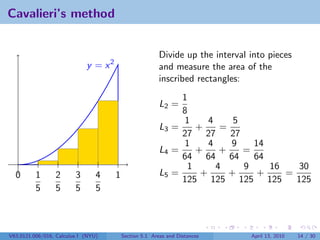
                                                                1      4     9    16   30
  0       1      2       3       4    1                  L5 =      +      +     +    =
                                                              125 125 125 125          125
          5      5       5       5


V63.0121.006/016, Calculus I (NYU)        Section 5.1 Areas and Distances       April 13, 2010   14 / 30
Cavalieri’s method


                                                         Divide up the interval into pieces
                             y = x2                      and measure the area of the
                                                         inscribed rectangles:
                                                                1
                                                         L2 =
                                                                8
                                                                 1     4     5
                                                         L3   =     +     =
                                                                27 27       27
                                                                 1     4    9    14
                                                         L4   =     +     +    =
                                                                64 64 64         64
                                                                  1      4     9    16   30
  0                                   1                  L5   =      +      +     +    =
                                                                125 125 125 125          125
                                                         Ln   =?


V63.0121.006/016, Calculus I (NYU)        Section 5.1 Areas and Distances       April 13, 2010   14 / 30
What is Ln ?
                                                                        1
Divide the interval [0, 1] into n pieces. Then each has width             .
                                                                        n


V63.0121.006/016, Calculus I (NYU)   Section 5.1 Areas and Distances   April 13, 2010   15 / 30
What is Ln ?
                                                              1
Divide the interval [0, 1] into n pieces. Then each has width . The
                                                             n
rectangle over the ith interval and under the parabola has area
                                                         2
                                     1        i −1               (i − 1)2
                                       ·                     =            .
                                     n          n                   n3


V63.0121.006/016, Calculus I (NYU)         Section 5.1 Areas and Distances    April 13, 2010   15 / 30
What is Ln ?
                                                              1
Divide the interval [0, 1] into n pieces. Then each has width . The
                                                             n
rectangle over the ith interval and under the parabola has area
                                                         2
                                     1        i −1               (i − 1)2
                                       ·                     =            .
                                     n          n                   n3
So
                 1  22         (n − 1)2   1 + 22 + 32 + · · · + (n − 1)2
        Ln =       + 3 + ··· +          =
                 n3 n             n3                   n3


V63.0121.006/016, Calculus I (NYU)         Section 5.1 Areas and Distances    April 13, 2010   15 / 30
What is Ln ?
                                                              1
Divide the interval [0, 1] into n pieces. Then each has width . The
                                                             n
rectangle over the ith interval and under the parabola has area
                                                          2
                                      1        i −1               (i − 1)2
                                        ·                     =            .
                                      n          n                   n3
So
                 1  22         (n − 1)2   1 + 22 + 32 + · · · + (n − 1)2
        Ln =       + 3 + ··· +          =
                 n3 n             n3                   n3
The Arabs knew that
                                                                       n(n − 1)(2n − 1)
                   1 + 22 + 32 + · · · + (n − 1)2 =
                                                                              6
So
                                             n(n − 1)(2n − 1)
                                     Ln =
                                                   6n3
V63.0121.006/016, Calculus I (NYU)          Section 5.1 Areas and Distances          April 13, 2010   15 / 30
What is Ln ?
                                                              1
Divide the interval [0, 1] into n pieces. Then each has width . The
                                                             n
rectangle over the ith interval and under the parabola has area
                                                          2
                                      1        i −1               (i − 1)2
                                        ·                     =            .
                                      n          n                   n3
So
                 1  22         (n − 1)2   1 + 22 + 32 + · · · + (n − 1)2
        Ln =       + 3 + ··· +          =
                 n3 n             n3                   n3
The Arabs knew that
                                                                       n(n − 1)(2n − 1)
                   1 + 22 + 32 + · · · + (n − 1)2 =
                                                                              6
So
                                             n(n − 1)(2n − 1)   1
                                     Ln =                     →
                                                   6n3          3
as n → ∞.
V63.0121.006/016, Calculus I (NYU)          Section 5.1 Areas and Distances          April 13, 2010   15 / 30
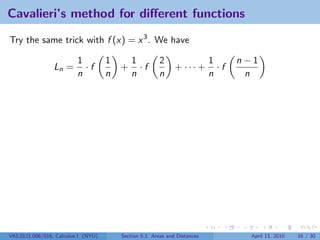
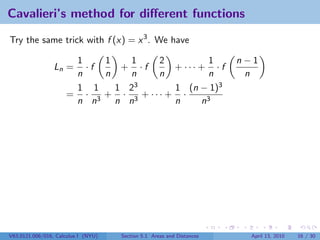
Cavalieri’s method for different functions

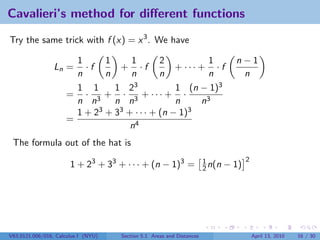
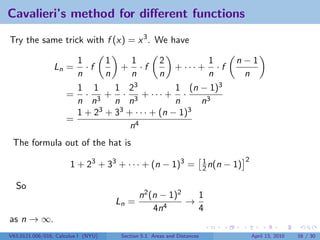
Try the same trick with f (x) = x 3 . We have

                          1          1       1          2                  1      n−1
                 Ln =       ·f           +     ·f             + ··· +        ·f
                          n          n       n          n                  n       n


V63.0121.006/016, Calculus I (NYU)       Section 5.1 Areas and Distances            April 13, 2010   16 / 30
Cavalieri’s method for different functions

Try the same trick with f (x) = x 3 . We have

                      1    1    1    2          1                      n−1
                 Ln =   ·f    + ·f      + ··· + · f
                      n    n   n     n          n                       n
                      1 1    1 2 3      1 (n − 1)3
                     = · 3 + · 3 + ··· + ·
                      n n    n n        n     n3


V63.0121.006/016, Calculus I (NYU)   Section 5.1 Areas and Distances     April 13, 2010   16 / 30
Cavalieri’s method for different functions

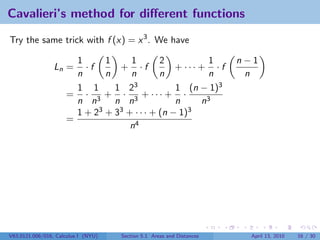
Try the same trick with f (x) = x 3 . We have

                       1      1     1        2           1             n−1
                 Ln =    ·f      + ·f            + ··· + · f
                       n      n     n        n           n              n
                       1 1      1 2  3           1 (n − 1)3
                     = · 3 + · 3 + ··· + ·
                       n n      n n              n     n3
                       1+2  3 + 33 + · · · + (n − 1)3
                     =
                                    n4


V63.0121.006/016, Calculus I (NYU)   Section 5.1 Areas and Distances     April 13, 2010   16 / 30
Cavalieri’s method for different functions

Try the same trick with f (x) = x 3 . We have

                       1      1     1        2           1                       n−1
                 Ln =    ·f      + ·f            + ··· + · f
                       n      n     n        n           n                        n
                       1 1      1 2  3           1 (n − 1)3
                     = · 3 + · 3 + ··· + ·
                       n n      n n              n     n3
                       1+2  3 + 33 + · · · + (n − 1)3
                     =
                                    n4
 The formula out of the hat is
                                                                                      2
                       1 + 23 + 33 + · · · + (n − 1)3 =                1
                                                                       2 n(n   − 1)


V63.0121.006/016, Calculus I (NYU)   Section 5.1 Areas and Distances                      April 13, 2010   16 / 30
Cavalieri’s method for different functions

Try the same trick with f (x) = x 3 . We have

                       1      1     1        2           1                        n−1
                 Ln =    ·f      + ·f            + ··· + · f
                       n      n     n        n           n                         n
                       1 1      1 2  3           1 (n − 1)3
                     = · 3 + · 3 + ··· + ·
                       n n      n n              n     n3
                       1+2  3 + 33 + · · · + (n − 1)3
                     =
                                    n4
 The formula out of the hat is
                                                                                       2
                       1 + 23 + 33 + · · · + (n − 1)3 =                 1
                                                                        2 n(n   − 1)

  So
                                             n2 (n − 1)2   1
                                     Ln =                →
                                                 4n4       4
as n → ∞.
V63.0121.006/016, Calculus I (NYU)    Section 5.1 Areas and Distances                      April 13, 2010   16 / 30
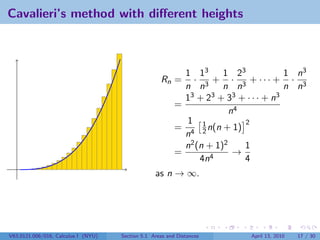
Cavalieri’s method with different heights


                                                            1 13      1 23            1 n3
                                                    Rn =      · 3 + · 3 + ··· + · 3
                                                            n n       n n             n n
                                                            13 + 23 + 33 + · · · + n3
                                                          =
                                                                        n4
                                                            1 1            2
                                                          = 4 2 n(n + 1)
                                                            n
                                                            n2 (n + 1)2    1
                                                          =              →
                                                                4n4        4
                                                  as n → ∞.


V63.0121.006/016, Calculus I (NYU)   Section 5.1 Areas and Distances        April 13, 2010   17 / 30
Cavalieri’s method with different heights


                                                            1 13      1 23            1 n3
                                                    Rn =      · 3 + · 3 + ··· + · 3
                                                            n n       n n             n n
                                                            13 + 23 + 33 + · · · + n3
                                                          =
                                                                        n4
                                                            1 1            2
                                                          = 4 2 n(n + 1)
                                                            n
                                                            n2 (n + 1)2    1
                                                          =              →
                                                                4n4        4
                                   as n → ∞.
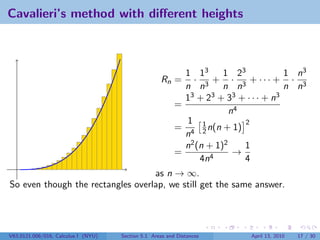
So even though the rectangles overlap, we still get the same answer.


V63.0121.006/016, Calculus I (NYU)   Section 5.1 Areas and Distances        April 13, 2010   17 / 30
Outline


Area through the Centuries
   Euclid
   Archimedes
   Cavalieri

Generalizing Cavalieri’s method
  Analogies

Distances
   Other applications


V63.0121.006/016, Calculus I (NYU)   Section 5.1 Areas and Distances   April 13, 2010   18 / 30
Cavalieri’s method in general
Let f be a positive function defined on the interval [a, b]. We want to find the area
between x = a, x = b, y = 0, and y = f (x).
                                                                             b−a
For each positive integer n, divide up the interval into n pieces. Then ∆x =      .
                                                                               n
For each i between 1 and n, let xi be the nth step between a and b. So

                                                                  x0 = a
                                                                                     b−a
                                                                  x1 = x0 + ∆x = a +
                                                                                        n
                                                                                         b−a
                                                                  x2 = x1 + ∆x = a + 2 ·
                                                                                          n
                                                                 ······
                                                                               b−a
                                                                  xi = a + i ·
                                                                                n
                                                                 ······
             a                     b                                           b−a
             x0 x1 x2 . . . xi xn−1xn                             xn = a + n ·     =b
                                                                                n

V63.0121.006/016, Calculus I (NYU)      Section 5.1 Areas and Distances          April 13, 2010   19 / 30
Cavalieri’s method in general
Let f be a positive function defined on the interval [a, b]. We want to find the area
between x = a, x = b, y = 0, and y = f (x).
                                                                             b−a
For each positive integer n, divide up the interval into n pieces. Then ∆x =      .
                                                                               n
For each i between 1 and n, let xi be the nth step between a and b. So

                                                                  x0 = a
                                                                                     b−a
                                                                  x1 = x0 + ∆x = a +
                                                                                        n
                                                                                         b−a
                                                                  x2 = x1 + ∆x = a + 2 ·
                                                                                          n
                                                                 ······
                                                                               b−a
                                                                  xi = a + i ·
                                                                                n
                                                                 ······
             a                     b                                           b−a
             x0 x1 x2 . . . xi xn−1xn                             xn = a + n ·     =b
                                                                                n

V63.0121.006/016, Calculus I (NYU)      Section 5.1 Areas and Distances          April 13, 2010   19 / 30
Cavalieri’s method in general
Let f be a positive function defined on the interval [a, b]. We want to find the area
between x = a, x = b, y = 0, and y = f (x).
                                                                             b−a
For each positive integer n, divide up the interval into n pieces. Then ∆x =      .
                                                                               n
For each i between 1 and n, let xi be the nth step between a and b. So

                                                                  x0 = a
                                                                                     b−a
                                                                  x1 = x0 + ∆x = a +
                                                                                        n
                                                                                         b−a
                                                                  x2 = x1 + ∆x = a + 2 ·
                                                                                          n
                                                                 ······
                                                                               b−a
                                                                  xi = a + i ·
                                                                                n
                                                                 ······
             a                     b                                           b−a
             x0 x1 x2 . . . xi xn−1xn                             xn = a + n ·     =b
                                                                                n

V63.0121.006/016, Calculus I (NYU)      Section 5.1 Areas and Distances          April 13, 2010   19 / 30
Cavalieri’s method in general
Let f be a positive function defined on the interval [a, b]. We want to find the area
between x = a, x = b, y = 0, and y = f (x).
                                                                             b−a
For each positive integer n, divide up the interval into n pieces. Then ∆x =      .
                                                                               n
For each i between 1 and n, let xi be the nth step between a and b. So

                                                                  x0 = a
                                                                                     b−a
                                                                  x1 = x0 + ∆x = a +
                                                                                        n
                                                                                         b−a
                                                                  x2 = x1 + ∆x = a + 2 ·
                                                                                          n
                                                                 ······
                                                                               b−a
                                                                  xi = a + i ·
                                                                                n
                                                                 ······
             a                     b                                           b−a
             x0 x1 x2 . . . xi xn−1xn                             xn = a + n ·     =b
                                                                                n

V63.0121.006/016, Calculus I (NYU)      Section 5.1 Areas and Distances          April 13, 2010   19 / 30
Cavalieri’s method in general
Let f be a positive function defined on the interval [a, b]. We want to find the area
between x = a, x = b, y = 0, and y = f (x).
                                                                             b−a
For each positive integer n, divide up the interval into n pieces. Then ∆x =      .
                                                                               n
For each i between 1 and n, let xi be the nth step between a and b. So

                                                                  x0 = a
                                                                                     b−a
                                                                  x1 = x0 + ∆x = a +
                                                                                        n
                                                                                         b−a
                                                                  x2 = x1 + ∆x = a + 2 ·
                                                                                          n
                                                                 ······
                                                                               b−a
                                                                  xi = a + i ·
                                                                                n
                                                                 ······
             a                     b                                           b−a
             x0 x1 x2 . . . xi xn−1xn                             xn = a + n ·     =b
                                                                                n

V63.0121.006/016, Calculus I (NYU)      Section 5.1 Areas and Distances          April 13, 2010   19 / 30
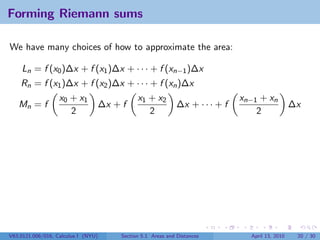
Forming Riemann sums

We have many choices of how to approximate the area:

    Ln = f (x0 )∆x + f (x1 )∆x + · · · + f (xn−1 )∆x
    Rn = f (x1 )∆x + f (x2 )∆x + · · · + f (xn )∆x
                   x0 + x1                  x1 + x2                          xn−1 + xn
   Mn = f                        ∆x + f                     ∆x + · · · + f                      ∆x
                      2                        2                                 2


V63.0121.006/016, Calculus I (NYU)    Section 5.1 Areas and Distances          April 13, 2010    20 / 30
Forming Riemann sums

We have many choices of how to approximate the area:

    Ln = f (x0 )∆x + f (x1 )∆x + · · · + f (xn−1 )∆x
    Rn = f (x1 )∆x + f (x2 )∆x + · · · + f (xn )∆x
                   x0 + x1                       x1 + x2                          xn−1 + xn
   Mn = f                        ∆x + f                          ∆x + · · · + f                      ∆x
                      2                             2                                 2

In general, choose ci to be a point in the ith interval [xi−1 , xi ]. Form the
Riemann sum
                        Sn = f (c1 )∆x + f (c2 )∆x + · · · + f (cn )∆x
                                     n
                             =           f (ci )∆x
                                 i=1


V63.0121.006/016, Calculus I (NYU)         Section 5.1 Areas and Distances          April 13, 2010    20 / 30
Theorem of the Day


  Theorem
  If f is a continuous function or
  has finitely many jump
  discontinuities on [a, b], then
                                n
       lim Sn = lim                  f (ci )∆x
      n→∞             n→∞
                               i=1

  exists and is the same value no
                                                                a           b
                                                                            x1
  matter what choice of ci we
  made.


V63.0121.006/016, Calculus I (NYU)       Section 5.1 Areas and Distances   April 13, 2010   21 / 30
Theorem of the Day


  Theorem
  If f is a continuous function or
  has finitely many jump
  discontinuities on [a, b], then
                                n
       lim Sn = lim                  f (ci )∆x
      n→∞             n→∞
                               i=1

  exists and is the same value no
                                                                a          x1    b
                                                                                 x2
  matter what choice of ci we
  made.


V63.0121.006/016, Calculus I (NYU)       Section 5.1 Areas and Distances        April 13, 2010   21 / 30
Theorem of the Day


  Theorem
  If f is a continuous function or
  has finitely many jump
  discontinuities on [a, b], then
                                n
       lim Sn = lim                  f (ci )∆x
      n→∞             n→∞
                               i=1

  exists and is the same value no
                                                                a          x1   x2    b
                                                                                      x3
  matter what choice of ci we
  made.


V63.0121.006/016, Calculus I (NYU)       Section 5.1 Areas and Distances             April 13, 2010   21 / 30
Theorem of the Day


  Theorem
  If f is a continuous function or
  has finitely many jump
  discontinuities on [a, b], then
                                n
       lim Sn = lim                  f (ci )∆x
      n→∞             n→∞
                               i=1

  exists and is the same value no
                                                                a      x1   x2   x3    b
                                                                                       x4
  matter what choice of ci we
  made.


V63.0121.006/016, Calculus I (NYU)       Section 5.1 Areas and Distances              April 13, 2010   21 / 30
Theorem of the Day


  Theorem
  If f is a continuous function or
  has finitely many jump
  discontinuities on [a, b], then
                                n
       lim Sn = lim                  f (ci )∆x
      n→∞             n→∞
                               i=1

  exists and is the same value no
                                                                a x x x x x
  matter what choice of ci we                                      1 2 3 4 b5
  made.


V63.0121.006/016, Calculus I (NYU)       Section 5.1 Areas and Distances   April 13, 2010   21 / 30
Theorem of the Day


  Theorem
  If f is a continuous function or
  has finitely many jump
  discontinuities on [a, b], then
                                n
       lim Sn = lim                  f (ci )∆x
      n→∞             n→∞
                               i=1

  exists and is the same value no
                                                                a x x x x x x
  matter what choice of ci we                                      1 2 3 4 5 b6
  made.


V63.0121.006/016, Calculus I (NYU)       Section 5.1 Areas and Distances     April 13, 2010   21 / 30
Theorem of the Day


  Theorem
  If f is a continuous function or
  has finitely many jump
  discontinuities on [a, b], then
                                n
       lim Sn = lim                  f (ci )∆x
      n→∞             n→∞
                               i=1

  exists and is the same value no
                                                                a x x x x x x x
  matter what choice of ci we                                      1 2 3 4 5 6 b7
  made.


V63.0121.006/016, Calculus I (NYU)       Section 5.1 Areas and Distances      April 13, 2010   21 / 30
Theorem of the Day


  Theorem
  If f is a continuous function or
  has finitely many jump
  discontinuities on [a, b], then
                                n
       lim Sn = lim                  f (ci )∆x
      n→∞             n→∞
                               i=1

  exists and is the same value no
                                                                ax x x x x x x x
  matter what choice of ci we                                     1 2 3 4 5 6 7 b8
  made.


V63.0121.006/016, Calculus I (NYU)       Section 5.1 Areas and Distances       April 13, 2010   21 / 30
Theorem of the Day


  Theorem
  If f is a continuous function or
  has finitely many jump
  discontinuities on [a, b], then
                                n
       lim Sn = lim                  f (ci )∆x
      n→∞             n→∞
                               i=1

  exists and is the same value no
                                                                ax x x x x x x x x
  matter what choice of ci we                                     1 2 3 4 5 6 7 8b9
  made.


V63.0121.006/016, Calculus I (NYU)       Section 5.1 Areas and Distances        April 13, 2010   21 / 30
Theorem of the Day


  Theorem
  If f is a continuous function or
  has finitely many jump
  discontinuities on [a, b], then
                                n
       lim Sn = lim                  f (ci )∆x
      n→∞             n→∞
                               i=1

  exists and is the same value no
                                                                a x x x x x x x x x xb
  matter what choice of ci we                                      1 2 3 4 5 6 7 8 9 10
  made.


V63.0121.006/016, Calculus I (NYU)       Section 5.1 Areas and Distances           April 13, 2010   21 / 30
Theorem of the Day


  Theorem
  If f is a continuous function or
  has finitely many jump
  discontinuities on [a, b], then
                                n
       lim Sn = lim                  f (ci )∆x
      n→∞             n→∞
                               i=1

  exists and is the same value no
                                                                ax x x x x x x x x x xb
  matter what choice of ci we                                       1 2 3 4 5 6 7 8 9 1011
  made.


V63.0121.006/016, Calculus I (NYU)       Section 5.1 Areas and Distances              April 13, 2010   21 / 30
Theorem of the Day


  Theorem
  If f is a continuous function or
  has finitely many jump
  discontinuities on [a, b], then
                                n
       lim Sn = lim                  f (ci )∆x
      n→∞             n→∞
                               i=1

  exists and is the same value no
                                                                ax x x x x x x x xx x xb
  matter what choice of ci we                                     1 2 3 4 5 6 7 8 9 101112
  made.


V63.0121.006/016, Calculus I (NYU)       Section 5.1 Areas and Distances              April 13, 2010   21 / 30
Theorem of the Day


  Theorem
  If f is a continuous function or
  has finitely many jump
  discontinuities on [a, b], then
                                n
       lim Sn = lim                  f (ci )∆x
      n→∞             n→∞
                               i=1

  exists and is the same value no
                                                                ax x x x x x x x xx x x xb
  matter what choice of ci we                                     1 2 3 4 5 6 7 8 910 12
                                                                                     11 13
  made.


V63.0121.006/016, Calculus I (NYU)       Section 5.1 Areas and Distances              April 13, 2010   21 / 30
Theorem of the Day


  Theorem
  If f is a continuous function or
  has finitely many jump
  discontinuities on [a, b], then
                                n
       lim Sn = lim                  f (ci )∆x
      n→∞             n→∞
                               i=1

  exists and is the same value no
                                                                ax x x x x x x x xx x x x xb
  matter what choice of ci we                                     1 2 3 4 5 6 7 8 910 12 14
                                                                                     11 13
  made.


V63.0121.006/016, Calculus I (NYU)       Section 5.1 Areas and Distances               April 13, 2010   21 / 30
Theorem of the Day


  Theorem
  If f is a continuous function or
  has finitely many jump
  discontinuities on [a, b], then
                                n
       lim Sn = lim                  f (ci )∆x
      n→∞             n→∞
                               i=1

  exists and is the same value no
                                                                ax x x x x x x x xx x x x x xb
  matter what choice of ci we                                     1 2 3 4 5 6 7 8 910 12 14
                                                                                     11 13 15
  made.


V63.0121.006/016, Calculus I (NYU)       Section 5.1 Areas and Distances                 April 13, 2010   21 / 30
Theorem of the Day


  Theorem
  If f is a continuous function or
  has finitely many jump
  discontinuities on [a, b], then
                                n
       lim Sn = lim                  f (ci )∆x
      n→∞             n→∞
                               i=1

  exists and is the same value no
                                                                axxxxxxxxxxxxxxxxb
  matter what choice of ci we                                     1 2 3 4 5 6 7 8 910 12 14 16
                                                                                    11 13 15
  made.


V63.0121.006/016, Calculus I (NYU)       Section 5.1 Areas and Distances                 April 13, 2010   21 / 30
Theorem of the Day


  Theorem
  If f is a continuous function or
  has finitely many jump
  discontinuities on [a, b], then
                                n
       lim Sn = lim                  f (ci )∆x
      n→∞             n→∞
                               i=1

  exists and is the same value no
                                                                a xxxxxxxxxxxxxxxxb
                                                                 x1 2 3 4 5 6 7 8 910 12 14 16
  matter what choice of ci we                                                       11 13 15 17
  made.


V63.0121.006/016, Calculus I (NYU)       Section 5.1 Areas and Distances                  April 13, 2010   21 / 30
Theorem of the Day


  Theorem
  If f is a continuous function or
  has finitely many jump
  discontinuities on [a, b], then
                                n
       lim Sn = lim                  f (ci )∆x
      n→∞             n→∞
                               i=1

  exists and is the same value no
                                                                a xxxxxxxx xxxxxxxxb
                                                                x1 2 3 4 5 6 7 8x10 12 14 16 18
  matter what choice of ci we                                                   9 11 13 15 17
  made.


V63.0121.006/016, Calculus I (NYU)       Section 5.1 Areas and Distances                  April 13, 2010   21 / 30
Theorem of the Day


  Theorem
  If f is a continuous function or
  has finitely many jump
  discontinuities on [a, b], then
                                n
       lim Sn = lim                  f (ci )∆x
      n→∞             n→∞
                               i=1

  exists and is the same value no
                                                                a xxxxxxxx xxxxxxxxxb
                                                                x12345678910 12 14 16 18
                                                                         x 11 13 15 17 19
  matter what choice of ci we
  made.


V63.0121.006/016, Calculus I (NYU)       Section 5.1 Areas and Distances             April 13, 2010   21 / 30
Theorem of the Day


  Theorem
  If f is a continuous function or
  has finitely many jump
  discontinuities on [a, b], then
                                n
       lim Sn = lim                  f (ci )∆x
      n→∞             n→∞
                               i=1

  exists and is the same value no
                                                                a xxxxxxxx xxxxxxxxxxb
                                                                x123456789101214161820
                                                                         x 1113151719
  matter what choice of ci we
  made.


V63.0121.006/016, Calculus I (NYU)       Section 5.1 Areas and Distances          April 13, 2010   21 / 30
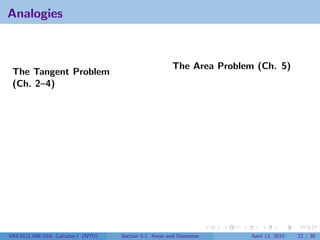
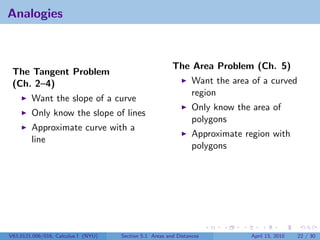
Analogies


                                                         The Area Problem (Ch. 5)
 The Tangent Problem
 (Ch. 2–4)


V63.0121.006/016, Calculus I (NYU)   Section 5.1 Areas and Distances    April 13, 2010   22 / 30
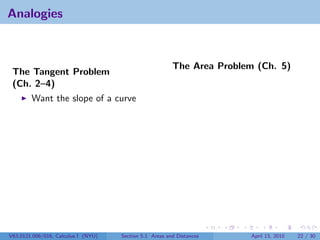
Analogies


                                                         The Area Problem (Ch. 5)
 The Tangent Problem
 (Ch. 2–4)
        Want the slope of a curve


V63.0121.006/016, Calculus I (NYU)   Section 5.1 Areas and Distances    April 13, 2010   22 / 30
Analogies


                                                         The Area Problem (Ch. 5)
 The Tangent Problem
 (Ch. 2–4)                                                       Want the area of a curved
                                                                 region
        Want the slope of a curve


V63.0121.006/016, Calculus I (NYU)   Section 5.1 Areas and Distances           April 13, 2010   22 / 30
Analogies


                                                         The Area Problem (Ch. 5)
 The Tangent Problem
 (Ch. 2–4)                                                       Want the area of a curved
                                                                 region
        Want the slope of a curve
        Only know the slope of lines


V63.0121.006/016, Calculus I (NYU)   Section 5.1 Areas and Distances           April 13, 2010   22 / 30
Analogies


                                                         The Area Problem (Ch. 5)
 The Tangent Problem
 (Ch. 2–4)                                                       Want the area of a curved
                                                                 region
        Want the slope of a curve
                                                                 Only know the area of
        Only know the slope of lines
                                                                 polygons


V63.0121.006/016, Calculus I (NYU)   Section 5.1 Areas and Distances           April 13, 2010   22 / 30
Analogies


                                                         The Area Problem (Ch. 5)
 The Tangent Problem
 (Ch. 2–4)                                                       Want the area of a curved
                                                                 region
        Want the slope of a curve
                                                                 Only know the area of
        Only know the slope of lines
                                                                 polygons
        Approximate curve with a
        line


V63.0121.006/016, Calculus I (NYU)   Section 5.1 Areas and Distances           April 13, 2010   22 / 30
Analogies


                                                         The Area Problem (Ch. 5)
 The Tangent Problem
 (Ch. 2–4)                                                       Want the area of a curved
                                                                 region
        Want the slope of a curve
                                                                 Only know the area of
        Only know the slope of lines
                                                                 polygons
        Approximate curve with a
                                                                 Approximate region with
        line
                                                                 polygons


V63.0121.006/016, Calculus I (NYU)   Section 5.1 Areas and Distances           April 13, 2010   22 / 30
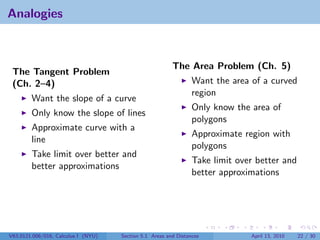
Analogies


                                                         The Area Problem (Ch. 5)
 The Tangent Problem
 (Ch. 2–4)                                                       Want the area of a curved
                                                                 region
        Want the slope of a curve
                                                                 Only know the area of
        Only know the slope of lines
                                                                 polygons
        Approximate curve with a
                                                                 Approximate region with
        line
                                                                 polygons
        Take limit over better and
                                                                 Take limit over better and
        better approximations
                                                                 better approximations


V63.0121.006/016, Calculus I (NYU)   Section 5.1 Areas and Distances           April 13, 2010   22 / 30
Outline


Area through the Centuries
   Euclid
   Archimedes
   Cavalieri

Generalizing Cavalieri’s method
  Analogies

Distances
   Other applications


V63.0121.006/016, Calculus I (NYU)   Section 5.1 Areas and Distances   April 13, 2010   23 / 30
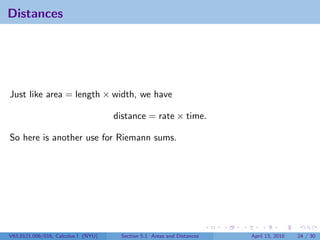
Distances


Just like area = length × width, we have

                                     distance = rate × time.

So here is another use for Riemann sums.


V63.0121.006/016, Calculus I (NYU)    Section 5.1 Areas and Distances   April 13, 2010   24 / 30
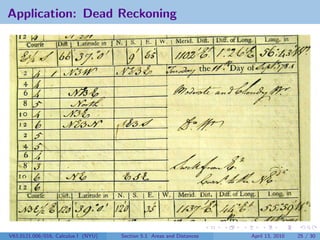
Application: Dead Reckoning


V63.0121.006/016, Calculus I (NYU)   Section 5.1 Areas and Distances   April 13, 2010   25 / 30
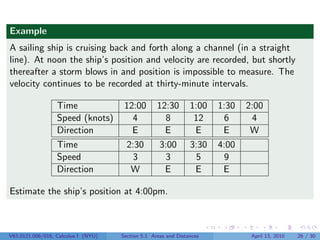
Example
A sailing ship is cruising back and forth along a channel (in a straight
line). At noon the ship’s position and velocity are recorded, but shortly
thereafter a storm blows in and position is impossible to measure. The
velocity continues to be recorded at thirty-minute intervals.

                  Time                12:00        12:30        1:00   1:30   2:00
                  Speed (knots)         4            8           12      6      4
                  Direction             E            E           E      E      W
                  Time                 2:30        3:00         3:30   4:00
                  Speed                 3            3            5      9
                  Direction             W            E           E      E

Estimate the ship’s position at 4:00pm.


V63.0121.006/016, Calculus I (NYU)   Section 5.1 Areas and Distances           April 13, 2010   26 / 30
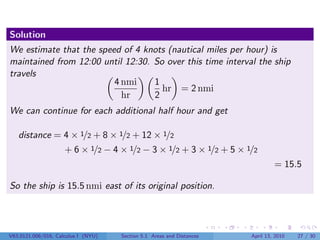
Solution
We estimate that the speed of 4 knots (nautical miles per hour) is
maintained from 12:00 until 12:30. So over this time interval the ship
travels
                         4 nmi     1
                                     hr = 2 nmi
                           hr      2
We can continue for each additional half hour and get

   distance = 4 × 1/2 + 8 × 1/2 + 12 × 1/2
                     + 6 × 1/2 − 4 × 1/2 − 3 × 1/2 + 3 × 1/2 + 5 × 1/2
                                                                                = 15.5

So the ship is 15.5 nmi east of its original position.


V63.0121.006/016, Calculus I (NYU)   Section 5.1 Areas and Distances   April 13, 2010   27 / 30
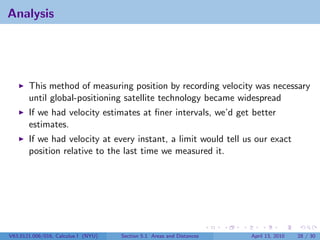
Analysis


       This method of measuring position by recording velocity was necessary
       until global-positioning satellite technology became widespread
       If we had velocity estimates at finer intervals, we’d get better
       estimates.
       If we had velocity at every instant, a limit would tell us our exact
       position relative to the last time we measured it.


V63.0121.006/016, Calculus I (NYU)   Section 5.1 Areas and Distances   April 13, 2010   28 / 30
Other uses of Riemann sums


Anything with a product!
       Area, volume
       Anything with a density: Population, mass
       Anything with a “speed:” distance, throughput, power
       Consumer surplus
       Expected value of a random variable


V63.0121.006/016, Calculus I (NYU)   Section 5.1 Areas and Distances   April 13, 2010   29 / 30
Summary


       We can compute the area of a curved region with a limit of Riemann
       sums
       We can compute the distance traveled from the velocity with a limit
       of Riemann sums
       Many other important uses of this process.


V63.0121.006/016, Calculus I (NYU)   Section 5.1 Areas and Distances   April 13, 2010   30 / 30

Lesson 22: Areas and Distances

  • 1.
    Section 5.1 Areas and Distances V63.0121.006/016, Calculus I New York University April 13, 2010 Announcements Quiz April 16 on §§4.1–4.4 Final Exam: Monday, May 10, 12:00noon
  • 2.
    Announcements Quiz April 16 on §§4.1–4.4 Final Exam: Monday, May 10, 12:00noon V63.0121.006/016, Calculus I (NYU) Section 5.1 Areas and Distances April 13, 2010 2 / 30
  • 3.
    Objectives Compute the area of a region by approximating it with rectangles and letting the size of the rectangles tend to zero. Compute the total distance traveled by a particle by approximating it as distance = (rate)(time) and letting the time intervals over which one approximates tend to zero. V63.0121.006/016, Calculus I (NYU) Section 5.1 Areas and Distances April 13, 2010 3 / 30
  • 4.
    Outline Area through theCenturies Euclid Archimedes Cavalieri Generalizing Cavalieri’s method Analogies Distances Other applications V63.0121.006/016, Calculus I (NYU) Section 5.1 Areas and Distances April 13, 2010 4 / 30
  • 5.
    Easy Areas: Rectangle Definition Thearea of a rectangle with dimensions and w is the product A = w . w It may seem strange that this is a definition and not a theorem but we have to start somewhere. V63.0121.006/016, Calculus I (NYU) Section 5.1 Areas and Distances April 13, 2010 5 / 30
  • 6.
    Easy Areas: Parallelogram Bycutting and pasting, a parallelogram can be made into a rectangle. b V63.0121.006/016, Calculus I (NYU) Section 5.1 Areas and Distances April 13, 2010 6 / 30
  • 7.
    Easy Areas: Parallelogram Bycutting and pasting, a parallelogram can be made into a rectangle. h b V63.0121.006/016, Calculus I (NYU) Section 5.1 Areas and Distances April 13, 2010 6 / 30
  • 8.
    Easy Areas: Parallelogram Bycutting and pasting, a parallelogram can be made into a rectangle. h V63.0121.006/016, Calculus I (NYU) Section 5.1 Areas and Distances April 13, 2010 6 / 30
  • 9.
    Easy Areas: Parallelogram Bycutting and pasting, a parallelogram can be made into a rectangle. h b V63.0121.006/016, Calculus I (NYU) Section 5.1 Areas and Distances April 13, 2010 6 / 30
  • 10.
    Easy Areas: Parallelogram Bycutting and pasting, a parallelogram can be made into a rectangle. h b So Fact The area of a parallelogram of base width b and height h is A = bh V63.0121.006/016, Calculus I (NYU) Section 5.1 Areas and Distances April 13, 2010 6 / 30
  • 11.
    Easy Areas: Triangle Bycopying and pasting, a triangle can be made into a parallelogram. b V63.0121.006/016, Calculus I (NYU) Section 5.1 Areas and Distances April 13, 2010 7 / 30
  • 12.
    Easy Areas: Triangle Bycopying and pasting, a triangle can be made into a parallelogram. h b V63.0121.006/016, Calculus I (NYU) Section 5.1 Areas and Distances April 13, 2010 7 / 30
  • 13.
    Easy Areas: Triangle Bycopying and pasting, a triangle can be made into a parallelogram. h b So Fact The area of a triangle of base width b and height h is 1 A = bh 2 V63.0121.006/016, Calculus I (NYU) Section 5.1 Areas and Distances April 13, 2010 7 / 30
  • 14.
    Easy Areas: OtherPolygons Any polygon can be triangulated, so its area can be found by summing the areas of the triangles: V63.0121.006/016, Calculus I (NYU) Section 5.1 Areas and Distances April 13, 2010 8 / 30
  • 15.
    Hard Areas: CurvedRegions ??? V63.0121.006/016, Calculus I (NYU) Section 5.1 Areas and Distances April 13, 2010 9 / 30
  • 16.
    Meet the mathematician:Archimedes Greek (Syracuse), 287 BC – 212 BC (after Euclid) Geometer Weapons engineer V63.0121.006/016, Calculus I (NYU) Section 5.1 Areas and Distances April 13, 2010 10 / 30
  • 17.
    Meet the mathematician:Archimedes Greek (Syracuse), 287 BC – 212 BC (after Euclid) Geometer Weapons engineer V63.0121.006/016, Calculus I (NYU) Section 5.1 Areas and Distances April 13, 2010 10 / 30
  • 18.
    Meet the mathematician:Archimedes Greek (Syracuse), 287 BC – 212 BC (after Euclid) Geometer Weapons engineer V63.0121.006/016, Calculus I (NYU) Section 5.1 Areas and Distances April 13, 2010 10 / 30
  • 19.
    Archimedes found areasof a sequence of triangles inscribed in a parabola. A= V63.0121.006/016, Calculus I (NYU) Section 5.1 Areas and Distances April 13, 2010 11 / 30
  • 20.
    1 Archimedes found areasof a sequence of triangles inscribed in a parabola. A=1 V63.0121.006/016, Calculus I (NYU) Section 5.1 Areas and Distances April 13, 2010 11 / 30
  • 21.
    1 1 1 8 8 Archimedes found areas of a sequence of triangles inscribed in a parabola. 1 A=1+2· 8 V63.0121.006/016, Calculus I (NYU) Section 5.1 Areas and Distances April 13, 2010 11 / 30
  • 22.
    1 1 64 64 1 1 1 8 8 1 1 64 64 Archimedes found areas of a sequence of triangles inscribed in a parabola. 1 1 A=1+2· +4· + ··· 8 64 V63.0121.006/016, Calculus I (NYU) Section 5.1 Areas and Distances April 13, 2010 11 / 30
  • 23.
    1 1 64 64 1 1 1 8 8 1 1 64 64 Archimedes found areas of a sequence of triangles inscribed in a parabola. 1 1 A=1+2· +4· + ··· 8 64 1 1 1 =1+ + + ··· + n + ··· 4 16 4 V63.0121.006/016, Calculus I (NYU) Section 5.1 Areas and Distances April 13, 2010 11 / 30
  • 24.
    We would thenneed to know the value of the series 1 1 1 1+ + + ··· + n + ··· 4 16 4 V63.0121.006/016, Calculus I (NYU) Section 5.1 Areas and Distances April 13, 2010 12 / 30
  • 25.
    We would thenneed to know the value of the series 1 1 1 1+ + + ··· + n + ··· 4 16 4 But for any number r and any positive integer n, (1 − r )(1 + r + · · · + r n ) = 1 − r n+1 So 1 − r n+1 1 + r + · · · + rn = 1−r V63.0121.006/016, Calculus I (NYU) Section 5.1 Areas and Distances April 13, 2010 12 / 30
  • 26.
    We would thenneed to know the value of the series 1 1 1 1+ + + ··· + n + ··· 4 16 4 But for any number r and any positive integer n, (1 − r )(1 + r + · · · + r n ) = 1 − r n+1 So 1 − r n+1 1 + r + · · · + rn = 1−r Therefore 1 1 1 1 − (1/4)n+1 1+ + + ··· + n = 4 16 4 1 − 1/4 V63.0121.006/016, Calculus I (NYU) Section 5.1 Areas and Distances April 13, 2010 12 / 30
  • 27.
    We would thenneed to know the value of the series 1 1 1 1+ + + ··· + n + ··· 4 16 4 But for any number r and any positive integer n, (1 − r )(1 + r + · · · + r n ) = 1 − r n+1 So 1 − r n+1 1 + r + · · · + rn = 1−r Therefore 1 1 1 1 − (1/4)n+1 1 4 1+ + + ··· + n = →3 = 4 16 4 1 − 1/4 /4 3 as n → ∞. V63.0121.006/016, Calculus I (NYU) Section 5.1 Areas and Distances April 13, 2010 12 / 30
  • 28.
    Cavalieri Italian, 1598–1647 Revisited the area problem with a different perspective V63.0121.006/016, Calculus I (NYU) Section 5.1 Areas and Distances April 13, 2010 13 / 30
  • 29.
    Cavalieri’s method Divide up the interval into pieces y = x2 and measure the area of the inscribed rectangles: 0 1 V63.0121.006/016, Calculus I (NYU) Section 5.1 Areas and Distances April 13, 2010 14 / 30
  • 30.
    Cavalieri’s method Divide up the interval into pieces y = x2 and measure the area of the inscribed rectangles: 1 L2 = 8 0 1 1 2 V63.0121.006/016, Calculus I (NYU) Section 5.1 Areas and Distances April 13, 2010 14 / 30
  • 31.
    Cavalieri’s method Divide up the interval into pieces y = x2 and measure the area of the inscribed rectangles: 1 L2 = 8 L3 = 0 1 2 1 3 3 V63.0121.006/016, Calculus I (NYU) Section 5.1 Areas and Distances April 13, 2010 14 / 30
  • 32.
    Cavalieri’s method Divide up the interval into pieces y = x2 and measure the area of the inscribed rectangles: 1 L2 = 8 1 4 5 L3 = + = 27 27 27 0 1 2 1 3 3 V63.0121.006/016, Calculus I (NYU) Section 5.1 Areas and Distances April 13, 2010 14 / 30
  • 33.
    Cavalieri’s method Divide up the interval into pieces y = x2 and measure the area of the inscribed rectangles: 1 L2 = 8 1 4 5 L3 = + = 27 27 27 L4 = 0 1 2 3 1 4 4 4 V63.0121.006/016, Calculus I (NYU) Section 5.1 Areas and Distances April 13, 2010 14 / 30
  • 34.
    Cavalieri’s method Divide up the interval into pieces y = x2 and measure the area of the inscribed rectangles: 1 L2 = 8 1 4 5 L3 = + = 27 27 27 1 4 9 14 L4 = + + = 64 64 64 64 0 1 2 3 1 4 4 4 V63.0121.006/016, Calculus I (NYU) Section 5.1 Areas and Distances April 13, 2010 14 / 30
  • 35.
    Cavalieri’s method Divide up the interval into pieces y = x2 and measure the area of the inscribed rectangles: 1 L2 = 8 1 4 5 L3 = + = 27 27 27 1 4 9 14 L4 = + + = 64 64 64 64 0 1 2 3 4 1 L5 = 5 5 5 5 V63.0121.006/016, Calculus I (NYU) Section 5.1 Areas and Distances April 13, 2010 14 / 30
  • 36.
    Cavalieri’s method Divide up the interval into pieces y = x2 and measure the area of the inscribed rectangles: 1 L2 = 8 1 4 5 L3 = + = 27 27 27 1 4 9 14 L4 = + + = 64 64 64 64 1 4 9 16 30 0 1 2 3 4 1 L5 = + + + = 125 125 125 125 125 5 5 5 5 V63.0121.006/016, Calculus I (NYU) Section 5.1 Areas and Distances April 13, 2010 14 / 30
  • 37.
    Cavalieri’s method Divide up the interval into pieces y = x2 and measure the area of the inscribed rectangles: 1 L2 = 8 1 4 5 L3 = + = 27 27 27 1 4 9 14 L4 = + + = 64 64 64 64 1 4 9 16 30 0 1 L5 = + + + = 125 125 125 125 125 Ln =? V63.0121.006/016, Calculus I (NYU) Section 5.1 Areas and Distances April 13, 2010 14 / 30
  • 38.
    What is Ln? 1 Divide the interval [0, 1] into n pieces. Then each has width . n V63.0121.006/016, Calculus I (NYU) Section 5.1 Areas and Distances April 13, 2010 15 / 30
  • 39.
    What is Ln? 1 Divide the interval [0, 1] into n pieces. Then each has width . The n rectangle over the ith interval and under the parabola has area 2 1 i −1 (i − 1)2 · = . n n n3 V63.0121.006/016, Calculus I (NYU) Section 5.1 Areas and Distances April 13, 2010 15 / 30
  • 40.
    What is Ln? 1 Divide the interval [0, 1] into n pieces. Then each has width . The n rectangle over the ith interval and under the parabola has area 2 1 i −1 (i − 1)2 · = . n n n3 So 1 22 (n − 1)2 1 + 22 + 32 + · · · + (n − 1)2 Ln = + 3 + ··· + = n3 n n3 n3 V63.0121.006/016, Calculus I (NYU) Section 5.1 Areas and Distances April 13, 2010 15 / 30
  • 41.
    What is Ln? 1 Divide the interval [0, 1] into n pieces. Then each has width . The n rectangle over the ith interval and under the parabola has area 2 1 i −1 (i − 1)2 · = . n n n3 So 1 22 (n − 1)2 1 + 22 + 32 + · · · + (n − 1)2 Ln = + 3 + ··· + = n3 n n3 n3 The Arabs knew that n(n − 1)(2n − 1) 1 + 22 + 32 + · · · + (n − 1)2 = 6 So n(n − 1)(2n − 1) Ln = 6n3 V63.0121.006/016, Calculus I (NYU) Section 5.1 Areas and Distances April 13, 2010 15 / 30
  • 42.
    What is Ln? 1 Divide the interval [0, 1] into n pieces. Then each has width . The n rectangle over the ith interval and under the parabola has area 2 1 i −1 (i − 1)2 · = . n n n3 So 1 22 (n − 1)2 1 + 22 + 32 + · · · + (n − 1)2 Ln = + 3 + ··· + = n3 n n3 n3 The Arabs knew that n(n − 1)(2n − 1) 1 + 22 + 32 + · · · + (n − 1)2 = 6 So n(n − 1)(2n − 1) 1 Ln = → 6n3 3 as n → ∞. V63.0121.006/016, Calculus I (NYU) Section 5.1 Areas and Distances April 13, 2010 15 / 30
  • 43.
    Cavalieri’s method fordifferent functions Try the same trick with f (x) = x 3 . We have 1 1 1 2 1 n−1 Ln = ·f + ·f + ··· + ·f n n n n n n V63.0121.006/016, Calculus I (NYU) Section 5.1 Areas and Distances April 13, 2010 16 / 30
  • 44.
    Cavalieri’s method fordifferent functions Try the same trick with f (x) = x 3 . We have 1 1 1 2 1 n−1 Ln = ·f + ·f + ··· + · f n n n n n n 1 1 1 2 3 1 (n − 1)3 = · 3 + · 3 + ··· + · n n n n n n3 V63.0121.006/016, Calculus I (NYU) Section 5.1 Areas and Distances April 13, 2010 16 / 30
  • 45.
    Cavalieri’s method fordifferent functions Try the same trick with f (x) = x 3 . We have 1 1 1 2 1 n−1 Ln = ·f + ·f + ··· + · f n n n n n n 1 1 1 2 3 1 (n − 1)3 = · 3 + · 3 + ··· + · n n n n n n3 1+2 3 + 33 + · · · + (n − 1)3 = n4 V63.0121.006/016, Calculus I (NYU) Section 5.1 Areas and Distances April 13, 2010 16 / 30
  • 46.
    Cavalieri’s method fordifferent functions Try the same trick with f (x) = x 3 . We have 1 1 1 2 1 n−1 Ln = ·f + ·f + ··· + · f n n n n n n 1 1 1 2 3 1 (n − 1)3 = · 3 + · 3 + ··· + · n n n n n n3 1+2 3 + 33 + · · · + (n − 1)3 = n4 The formula out of the hat is 2 1 + 23 + 33 + · · · + (n − 1)3 = 1 2 n(n − 1) V63.0121.006/016, Calculus I (NYU) Section 5.1 Areas and Distances April 13, 2010 16 / 30
  • 47.
    Cavalieri’s method fordifferent functions Try the same trick with f (x) = x 3 . We have 1 1 1 2 1 n−1 Ln = ·f + ·f + ··· + · f n n n n n n 1 1 1 2 3 1 (n − 1)3 = · 3 + · 3 + ··· + · n n n n n n3 1+2 3 + 33 + · · · + (n − 1)3 = n4 The formula out of the hat is 2 1 + 23 + 33 + · · · + (n − 1)3 = 1 2 n(n − 1) So n2 (n − 1)2 1 Ln = → 4n4 4 as n → ∞. V63.0121.006/016, Calculus I (NYU) Section 5.1 Areas and Distances April 13, 2010 16 / 30
  • 48.
    Cavalieri’s method withdifferent heights 1 13 1 23 1 n3 Rn = · 3 + · 3 + ··· + · 3 n n n n n n 13 + 23 + 33 + · · · + n3 = n4 1 1 2 = 4 2 n(n + 1) n n2 (n + 1)2 1 = → 4n4 4 as n → ∞. V63.0121.006/016, Calculus I (NYU) Section 5.1 Areas and Distances April 13, 2010 17 / 30
  • 49.
    Cavalieri’s method withdifferent heights 1 13 1 23 1 n3 Rn = · 3 + · 3 + ··· + · 3 n n n n n n 13 + 23 + 33 + · · · + n3 = n4 1 1 2 = 4 2 n(n + 1) n n2 (n + 1)2 1 = → 4n4 4 as n → ∞. So even though the rectangles overlap, we still get the same answer. V63.0121.006/016, Calculus I (NYU) Section 5.1 Areas and Distances April 13, 2010 17 / 30
  • 50.
    Outline Area through theCenturies Euclid Archimedes Cavalieri Generalizing Cavalieri’s method Analogies Distances Other applications V63.0121.006/016, Calculus I (NYU) Section 5.1 Areas and Distances April 13, 2010 18 / 30
  • 51.
    Cavalieri’s method ingeneral Let f be a positive function defined on the interval [a, b]. We want to find the area between x = a, x = b, y = 0, and y = f (x). b−a For each positive integer n, divide up the interval into n pieces. Then ∆x = . n For each i between 1 and n, let xi be the nth step between a and b. So x0 = a b−a x1 = x0 + ∆x = a + n b−a x2 = x1 + ∆x = a + 2 · n ······ b−a xi = a + i · n ······ a b b−a x0 x1 x2 . . . xi xn−1xn xn = a + n · =b n V63.0121.006/016, Calculus I (NYU) Section 5.1 Areas and Distances April 13, 2010 19 / 30
  • 52.
    Cavalieri’s method ingeneral Let f be a positive function defined on the interval [a, b]. We want to find the area between x = a, x = b, y = 0, and y = f (x). b−a For each positive integer n, divide up the interval into n pieces. Then ∆x = . n For each i between 1 and n, let xi be the nth step between a and b. So x0 = a b−a x1 = x0 + ∆x = a + n b−a x2 = x1 + ∆x = a + 2 · n ······ b−a xi = a + i · n ······ a b b−a x0 x1 x2 . . . xi xn−1xn xn = a + n · =b n V63.0121.006/016, Calculus I (NYU) Section 5.1 Areas and Distances April 13, 2010 19 / 30
  • 53.
    Cavalieri’s method ingeneral Let f be a positive function defined on the interval [a, b]. We want to find the area between x = a, x = b, y = 0, and y = f (x). b−a For each positive integer n, divide up the interval into n pieces. Then ∆x = . n For each i between 1 and n, let xi be the nth step between a and b. So x0 = a b−a x1 = x0 + ∆x = a + n b−a x2 = x1 + ∆x = a + 2 · n ······ b−a xi = a + i · n ······ a b b−a x0 x1 x2 . . . xi xn−1xn xn = a + n · =b n V63.0121.006/016, Calculus I (NYU) Section 5.1 Areas and Distances April 13, 2010 19 / 30
  • 54.
    Cavalieri’s method ingeneral Let f be a positive function defined on the interval [a, b]. We want to find the area between x = a, x = b, y = 0, and y = f (x). b−a For each positive integer n, divide up the interval into n pieces. Then ∆x = . n For each i between 1 and n, let xi be the nth step between a and b. So x0 = a b−a x1 = x0 + ∆x = a + n b−a x2 = x1 + ∆x = a + 2 · n ······ b−a xi = a + i · n ······ a b b−a x0 x1 x2 . . . xi xn−1xn xn = a + n · =b n V63.0121.006/016, Calculus I (NYU) Section 5.1 Areas and Distances April 13, 2010 19 / 30
  • 55.
    Cavalieri’s method ingeneral Let f be a positive function defined on the interval [a, b]. We want to find the area between x = a, x = b, y = 0, and y = f (x). b−a For each positive integer n, divide up the interval into n pieces. Then ∆x = . n For each i between 1 and n, let xi be the nth step between a and b. So x0 = a b−a x1 = x0 + ∆x = a + n b−a x2 = x1 + ∆x = a + 2 · n ······ b−a xi = a + i · n ······ a b b−a x0 x1 x2 . . . xi xn−1xn xn = a + n · =b n V63.0121.006/016, Calculus I (NYU) Section 5.1 Areas and Distances April 13, 2010 19 / 30
  • 56.
    Forming Riemann sums Wehave many choices of how to approximate the area: Ln = f (x0 )∆x + f (x1 )∆x + · · · + f (xn−1 )∆x Rn = f (x1 )∆x + f (x2 )∆x + · · · + f (xn )∆x x0 + x1 x1 + x2 xn−1 + xn Mn = f ∆x + f ∆x + · · · + f ∆x 2 2 2 V63.0121.006/016, Calculus I (NYU) Section 5.1 Areas and Distances April 13, 2010 20 / 30
  • 57.
    Forming Riemann sums Wehave many choices of how to approximate the area: Ln = f (x0 )∆x + f (x1 )∆x + · · · + f (xn−1 )∆x Rn = f (x1 )∆x + f (x2 )∆x + · · · + f (xn )∆x x0 + x1 x1 + x2 xn−1 + xn Mn = f ∆x + f ∆x + · · · + f ∆x 2 2 2 In general, choose ci to be a point in the ith interval [xi−1 , xi ]. Form the Riemann sum Sn = f (c1 )∆x + f (c2 )∆x + · · · + f (cn )∆x n = f (ci )∆x i=1 V63.0121.006/016, Calculus I (NYU) Section 5.1 Areas and Distances April 13, 2010 20 / 30
  • 58.
    Theorem of theDay Theorem If f is a continuous function or has finitely many jump discontinuities on [a, b], then n lim Sn = lim f (ci )∆x n→∞ n→∞ i=1 exists and is the same value no a b x1 matter what choice of ci we made. V63.0121.006/016, Calculus I (NYU) Section 5.1 Areas and Distances April 13, 2010 21 / 30
  • 59.
    Theorem of theDay Theorem If f is a continuous function or has finitely many jump discontinuities on [a, b], then n lim Sn = lim f (ci )∆x n→∞ n→∞ i=1 exists and is the same value no a x1 b x2 matter what choice of ci we made. V63.0121.006/016, Calculus I (NYU) Section 5.1 Areas and Distances April 13, 2010 21 / 30
  • 60.
    Theorem of theDay Theorem If f is a continuous function or has finitely many jump discontinuities on [a, b], then n lim Sn = lim f (ci )∆x n→∞ n→∞ i=1 exists and is the same value no a x1 x2 b x3 matter what choice of ci we made. V63.0121.006/016, Calculus I (NYU) Section 5.1 Areas and Distances April 13, 2010 21 / 30
  • 61.
    Theorem of theDay Theorem If f is a continuous function or has finitely many jump discontinuities on [a, b], then n lim Sn = lim f (ci )∆x n→∞ n→∞ i=1 exists and is the same value no a x1 x2 x3 b x4 matter what choice of ci we made. V63.0121.006/016, Calculus I (NYU) Section 5.1 Areas and Distances April 13, 2010 21 / 30
  • 62.
    Theorem of theDay Theorem If f is a continuous function or has finitely many jump discontinuities on [a, b], then n lim Sn = lim f (ci )∆x n→∞ n→∞ i=1 exists and is the same value no a x x x x x matter what choice of ci we 1 2 3 4 b5 made. V63.0121.006/016, Calculus I (NYU) Section 5.1 Areas and Distances April 13, 2010 21 / 30
  • 63.
    Theorem of theDay Theorem If f is a continuous function or has finitely many jump discontinuities on [a, b], then n lim Sn = lim f (ci )∆x n→∞ n→∞ i=1 exists and is the same value no a x x x x x x matter what choice of ci we 1 2 3 4 5 b6 made. V63.0121.006/016, Calculus I (NYU) Section 5.1 Areas and Distances April 13, 2010 21 / 30
  • 64.
    Theorem of theDay Theorem If f is a continuous function or has finitely many jump discontinuities on [a, b], then n lim Sn = lim f (ci )∆x n→∞ n→∞ i=1 exists and is the same value no a x x x x x x x matter what choice of ci we 1 2 3 4 5 6 b7 made. V63.0121.006/016, Calculus I (NYU) Section 5.1 Areas and Distances April 13, 2010 21 / 30
  • 65.
    Theorem of theDay Theorem If f is a continuous function or has finitely many jump discontinuities on [a, b], then n lim Sn = lim f (ci )∆x n→∞ n→∞ i=1 exists and is the same value no ax x x x x x x x matter what choice of ci we 1 2 3 4 5 6 7 b8 made. V63.0121.006/016, Calculus I (NYU) Section 5.1 Areas and Distances April 13, 2010 21 / 30
  • 66.
    Theorem of theDay Theorem If f is a continuous function or has finitely many jump discontinuities on [a, b], then n lim Sn = lim f (ci )∆x n→∞ n→∞ i=1 exists and is the same value no ax x x x x x x x x matter what choice of ci we 1 2 3 4 5 6 7 8b9 made. V63.0121.006/016, Calculus I (NYU) Section 5.1 Areas and Distances April 13, 2010 21 / 30
  • 67.
    Theorem of theDay Theorem If f is a continuous function or has finitely many jump discontinuities on [a, b], then n lim Sn = lim f (ci )∆x n→∞ n→∞ i=1 exists and is the same value no a x x x x x x x x x xb matter what choice of ci we 1 2 3 4 5 6 7 8 9 10 made. V63.0121.006/016, Calculus I (NYU) Section 5.1 Areas and Distances April 13, 2010 21 / 30
  • 68.
    Theorem of theDay Theorem If f is a continuous function or has finitely many jump discontinuities on [a, b], then n lim Sn = lim f (ci )∆x n→∞ n→∞ i=1 exists and is the same value no ax x x x x x x x x x xb matter what choice of ci we 1 2 3 4 5 6 7 8 9 1011 made. V63.0121.006/016, Calculus I (NYU) Section 5.1 Areas and Distances April 13, 2010 21 / 30
  • 69.
    Theorem of theDay Theorem If f is a continuous function or has finitely many jump discontinuities on [a, b], then n lim Sn = lim f (ci )∆x n→∞ n→∞ i=1 exists and is the same value no ax x x x x x x x xx x xb matter what choice of ci we 1 2 3 4 5 6 7 8 9 101112 made. V63.0121.006/016, Calculus I (NYU) Section 5.1 Areas and Distances April 13, 2010 21 / 30
  • 70.
    Theorem of theDay Theorem If f is a continuous function or has finitely many jump discontinuities on [a, b], then n lim Sn = lim f (ci )∆x n→∞ n→∞ i=1 exists and is the same value no ax x x x x x x x xx x x xb matter what choice of ci we 1 2 3 4 5 6 7 8 910 12 11 13 made. V63.0121.006/016, Calculus I (NYU) Section 5.1 Areas and Distances April 13, 2010 21 / 30
  • 71.
    Theorem of theDay Theorem If f is a continuous function or has finitely many jump discontinuities on [a, b], then n lim Sn = lim f (ci )∆x n→∞ n→∞ i=1 exists and is the same value no ax x x x x x x x xx x x x xb matter what choice of ci we 1 2 3 4 5 6 7 8 910 12 14 11 13 made. V63.0121.006/016, Calculus I (NYU) Section 5.1 Areas and Distances April 13, 2010 21 / 30
  • 72.
    Theorem of theDay Theorem If f is a continuous function or has finitely many jump discontinuities on [a, b], then n lim Sn = lim f (ci )∆x n→∞ n→∞ i=1 exists and is the same value no ax x x x x x x x xx x x x x xb matter what choice of ci we 1 2 3 4 5 6 7 8 910 12 14 11 13 15 made. V63.0121.006/016, Calculus I (NYU) Section 5.1 Areas and Distances April 13, 2010 21 / 30
  • 73.
    Theorem of theDay Theorem If f is a continuous function or has finitely many jump discontinuities on [a, b], then n lim Sn = lim f (ci )∆x n→∞ n→∞ i=1 exists and is the same value no axxxxxxxxxxxxxxxxb matter what choice of ci we 1 2 3 4 5 6 7 8 910 12 14 16 11 13 15 made. V63.0121.006/016, Calculus I (NYU) Section 5.1 Areas and Distances April 13, 2010 21 / 30
  • 74.
    Theorem of theDay Theorem If f is a continuous function or has finitely many jump discontinuities on [a, b], then n lim Sn = lim f (ci )∆x n→∞ n→∞ i=1 exists and is the same value no a xxxxxxxxxxxxxxxxb x1 2 3 4 5 6 7 8 910 12 14 16 matter what choice of ci we 11 13 15 17 made. V63.0121.006/016, Calculus I (NYU) Section 5.1 Areas and Distances April 13, 2010 21 / 30
  • 75.
    Theorem of theDay Theorem If f is a continuous function or has finitely many jump discontinuities on [a, b], then n lim Sn = lim f (ci )∆x n→∞ n→∞ i=1 exists and is the same value no a xxxxxxxx xxxxxxxxb x1 2 3 4 5 6 7 8x10 12 14 16 18 matter what choice of ci we 9 11 13 15 17 made. V63.0121.006/016, Calculus I (NYU) Section 5.1 Areas and Distances April 13, 2010 21 / 30
  • 76.
    Theorem of theDay Theorem If f is a continuous function or has finitely many jump discontinuities on [a, b], then n lim Sn = lim f (ci )∆x n→∞ n→∞ i=1 exists and is the same value no a xxxxxxxx xxxxxxxxxb x12345678910 12 14 16 18 x 11 13 15 17 19 matter what choice of ci we made. V63.0121.006/016, Calculus I (NYU) Section 5.1 Areas and Distances April 13, 2010 21 / 30
  • 77.
    Theorem of theDay Theorem If f is a continuous function or has finitely many jump discontinuities on [a, b], then n lim Sn = lim f (ci )∆x n→∞ n→∞ i=1 exists and is the same value no a xxxxxxxx xxxxxxxxxxb x123456789101214161820 x 1113151719 matter what choice of ci we made. V63.0121.006/016, Calculus I (NYU) Section 5.1 Areas and Distances April 13, 2010 21 / 30
  • 78.
    Analogies The Area Problem (Ch. 5) The Tangent Problem (Ch. 2–4) V63.0121.006/016, Calculus I (NYU) Section 5.1 Areas and Distances April 13, 2010 22 / 30
  • 79.
    Analogies The Area Problem (Ch. 5) The Tangent Problem (Ch. 2–4) Want the slope of a curve V63.0121.006/016, Calculus I (NYU) Section 5.1 Areas and Distances April 13, 2010 22 / 30
  • 80.
    Analogies The Area Problem (Ch. 5) The Tangent Problem (Ch. 2–4) Want the area of a curved region Want the slope of a curve V63.0121.006/016, Calculus I (NYU) Section 5.1 Areas and Distances April 13, 2010 22 / 30
  • 81.
    Analogies The Area Problem (Ch. 5) The Tangent Problem (Ch. 2–4) Want the area of a curved region Want the slope of a curve Only know the slope of lines V63.0121.006/016, Calculus I (NYU) Section 5.1 Areas and Distances April 13, 2010 22 / 30
  • 82.
    Analogies The Area Problem (Ch. 5) The Tangent Problem (Ch. 2–4) Want the area of a curved region Want the slope of a curve Only know the area of Only know the slope of lines polygons V63.0121.006/016, Calculus I (NYU) Section 5.1 Areas and Distances April 13, 2010 22 / 30
  • 83.
    Analogies The Area Problem (Ch. 5) The Tangent Problem (Ch. 2–4) Want the area of a curved region Want the slope of a curve Only know the area of Only know the slope of lines polygons Approximate curve with a line V63.0121.006/016, Calculus I (NYU) Section 5.1 Areas and Distances April 13, 2010 22 / 30
  • 84.
    Analogies The Area Problem (Ch. 5) The Tangent Problem (Ch. 2–4) Want the area of a curved region Want the slope of a curve Only know the area of Only know the slope of lines polygons Approximate curve with a Approximate region with line polygons V63.0121.006/016, Calculus I (NYU) Section 5.1 Areas and Distances April 13, 2010 22 / 30
  • 85.
    Analogies The Area Problem (Ch. 5) The Tangent Problem (Ch. 2–4) Want the area of a curved region Want the slope of a curve Only know the area of Only know the slope of lines polygons Approximate curve with a Approximate region with line polygons Take limit over better and Take limit over better and better approximations better approximations V63.0121.006/016, Calculus I (NYU) Section 5.1 Areas and Distances April 13, 2010 22 / 30
  • 86.
    Outline Area through theCenturies Euclid Archimedes Cavalieri Generalizing Cavalieri’s method Analogies Distances Other applications V63.0121.006/016, Calculus I (NYU) Section 5.1 Areas and Distances April 13, 2010 23 / 30
  • 87.
    Distances Just like area= length × width, we have distance = rate × time. So here is another use for Riemann sums. V63.0121.006/016, Calculus I (NYU) Section 5.1 Areas and Distances April 13, 2010 24 / 30
  • 88.
    Application: Dead Reckoning V63.0121.006/016,Calculus I (NYU) Section 5.1 Areas and Distances April 13, 2010 25 / 30
  • 89.
    Example A sailing shipis cruising back and forth along a channel (in a straight line). At noon the ship’s position and velocity are recorded, but shortly thereafter a storm blows in and position is impossible to measure. The velocity continues to be recorded at thirty-minute intervals. Time 12:00 12:30 1:00 1:30 2:00 Speed (knots) 4 8 12 6 4 Direction E E E E W Time 2:30 3:00 3:30 4:00 Speed 3 3 5 9 Direction W E E E Estimate the ship’s position at 4:00pm. V63.0121.006/016, Calculus I (NYU) Section 5.1 Areas and Distances April 13, 2010 26 / 30
  • 90.
    Solution We estimate thatthe speed of 4 knots (nautical miles per hour) is maintained from 12:00 until 12:30. So over this time interval the ship travels 4 nmi 1 hr = 2 nmi hr 2 We can continue for each additional half hour and get distance = 4 × 1/2 + 8 × 1/2 + 12 × 1/2 + 6 × 1/2 − 4 × 1/2 − 3 × 1/2 + 3 × 1/2 + 5 × 1/2 = 15.5 So the ship is 15.5 nmi east of its original position. V63.0121.006/016, Calculus I (NYU) Section 5.1 Areas and Distances April 13, 2010 27 / 30
  • 91.
    Analysis This method of measuring position by recording velocity was necessary until global-positioning satellite technology became widespread If we had velocity estimates at finer intervals, we’d get better estimates. If we had velocity at every instant, a limit would tell us our exact position relative to the last time we measured it. V63.0121.006/016, Calculus I (NYU) Section 5.1 Areas and Distances April 13, 2010 28 / 30
  • 92.
    Other uses ofRiemann sums Anything with a product! Area, volume Anything with a density: Population, mass Anything with a “speed:” distance, throughput, power Consumer surplus Expected value of a random variable V63.0121.006/016, Calculus I (NYU) Section 5.1 Areas and Distances April 13, 2010 29 / 30
  • 93.
    Summary We can compute the area of a curved region with a limit of Riemann sums We can compute the distance traveled from the velocity with a limit of Riemann sums Many other important uses of this process. V63.0121.006/016, Calculus I (NYU) Section 5.1 Areas and Distances April 13, 2010 30 / 30