
Ajay Naik, Abhishek Shah, Saumya Baheti
 Our group has been given the task to analyze,
   understand and present the plane of symmetry of
   3D objects.

 We have to connect the information we obtain to
   our guiding question.

 This task is MYP based, and will be graded on the
   investigate criterion.
 Our Guiding Question is: How Is our Reflection in
   the mirror our true selves?

 Objectively, this guiding question seems to be weak,
   but when you think about it subjectively, a whole
   new realm of ideas is unleashed.

 The guiding question uses our syllabus very
   carefully, as a metaphor, to connect it to real life.
 A plane of symmetry divides a three dimensional
   shape into two congruent halves that are mirror
   images of each other.

 This means that if you cut a 3-D object from any
   side or angle and it turns out to be congruent with
   the other, its called a plane of symmetry.
 Symmetry seems to be such a small aspect of the study
   of Geometry, however it is an integral component
   connecting Mathematics to the real world.
 Symmetry can be found in everyday items, however the
   connections to Mathematics are rarely noted.
 Symmetry, in the real world, is expressed in many pieces
   of art, for example, quilts are highly mathematical in
   their creation, and depict how symmetry and
   mathematics are linked to real-life uses.
 Symmetry aids students in learning how to classify
   objects according to     the arrangement of their
   constituent parts.
   Ordering and classification are skills that are used throughout
    many daily tasks, and the ability to notice patterns or
    similarities will make these tasks much easier to carry out.

   The study of symmetry in schools should look beyond
    geometric forms to organic shapes, meaning animals, plants,
    and everyday items.

   Children learn concepts about geometric shapes at a very
    early age. They learn, first, about a shape as a whole, but,
    with the help of symmetry, children learn how to focus on the
    characteristics and parts of an object.

   The teaching of symmetry holds great importance in the
    development of mathematical minds of students as it gives
    students a different perspective of the world around them.
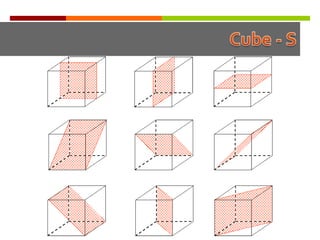
 It has six flat sides, each of which is a square of the same size,
   with three meeting at each vertex.

 All edges are equal and any two intersection edges form right
   angles.

 A cube is also a prism, because it is a square throughout its
   length.

 It is also called a regular hexahedron.
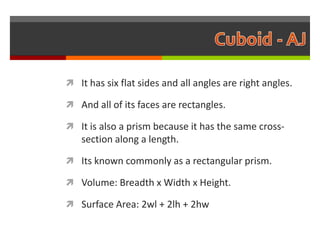
 It has six flat sides and all angles are right angles.

 And all of its faces are rectangles.

 It is also a prism because it has the same cross-
   section along a length.

 Its known commonly as a rectangular prism.

 Volume: Breadth x Width x Height.

 Surface Area: 2wl + 2lh + 2hw
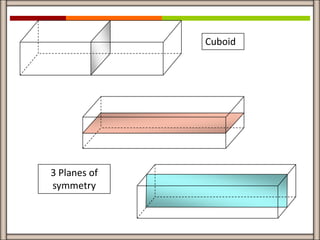
Cuboid


3 Planes of
symmetry
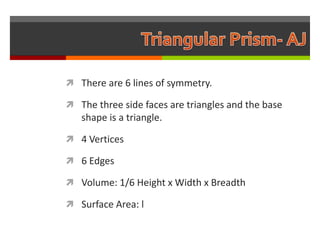
 There are 6 lines of symmetry.

 The three side faces are triangles and the base
   shape is a triangle.

 4 Vertices

 6 Edges

 Volume: 1/6 Height x Width x Breadth

 Surface Area: l
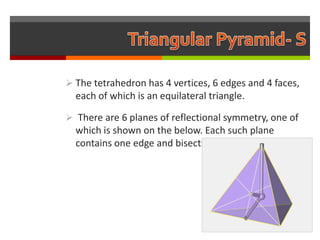
 The tetrahedron has 4 vertices, 6 edges and 4 faces,
  each of which is an equilateral triangle.

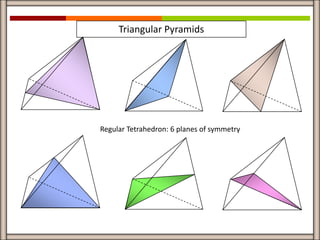
 There are 6 planes of reflectional symmetry, one of
  which is shown on the below. Each such plane
  contains one edge and bisects the opposite edge.
Triangular Pyramids


Regular Tetrahedron: 6 planes of symmetry
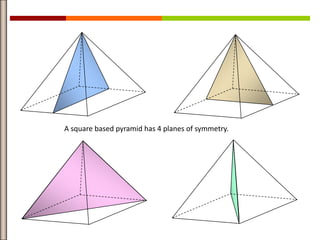
   A square based pyramid is a very interesting object.
   It has 4 planes of symmetry:
   The 4 Side Faces are Triangles
   The Base is a Square
   It has 5 Vertices (corner points)
   It has 8 Edges
   Surface Area = [Base Area] + 1/2 × Perimeter × [Slant Length]
   Volume = 1/3 × [Base Area] × Height
A square based pyramid has 4 planes of symmetry.
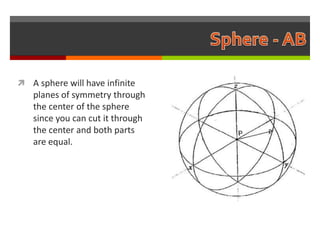
 A sphere will have infinite
   planes of symmetry through
   the center of the sphere
   since you can cut it through
   the center and both parts
   are equal.
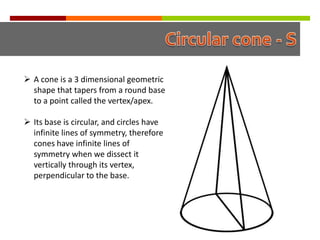
 A cone is a 3 dimensional geometric
  shape that tapers from a round base
  to a point called the vertex/apex.

 Its base is circular, and circles have
  infinite lines of symmetry, therefore
  cones have infinite lines of
  symmetry when we dissect it
  vertically through its vertex,
  perpendicular to the base.
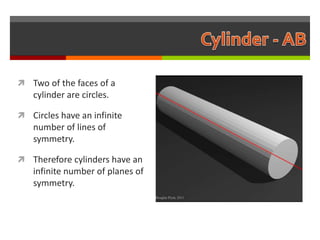
 Two of the faces of a
   cylinder are circles.

 Circles have an infinite
   number of lines of
   symmetry.

 Therefore cylinders have an
   infinite number of planes of
   symmetry.
This MYP Assessment has helped me learn a lot. This assessment.
This assessment made me realize the importance of MYP, and how
helpful it is. By completing this assignment, I have gained skills in
many areas:

    Problem Solving: My friends and I overcame many problems that
     arose during the process of our presentation.

    Team-Work: Whatever work we have done, and whatever
     problems we have overcome, we have done it as a team.

    Critical thinking: We used critical thinking to analyze our guiding
     question, and work around it.
   I would connect this assessment to the AOI Human Ingenuity. I
    believe this Is appropriate, because this topic, and the guiding
    question itself, is derived from the critical thinking skills that
    humans have been rewarded with.

   I believe that working with my teammates has been a pleasure. I
    truly want to commend the organizational skills, and the quick,
    intuitive thinking that both my peers, Saumya, and Abhishek
    clearly displayed during the course of the assignment. I look
    forward to getting more opportunities to work with them in the
    near future.

Final plane symmetry

  • 1.
     Ajay Naik, AbhishekShah, Saumya Baheti
  • 2.
     Our grouphas been given the task to analyze, understand and present the plane of symmetry of 3D objects.  We have to connect the information we obtain to our guiding question.  This task is MYP based, and will be graded on the investigate criterion.
  • 3.
     Our GuidingQuestion is: How Is our Reflection in the mirror our true selves?  Objectively, this guiding question seems to be weak, but when you think about it subjectively, a whole new realm of ideas is unleashed.  The guiding question uses our syllabus very carefully, as a metaphor, to connect it to real life.
  • 4.
     A planeof symmetry divides a three dimensional shape into two congruent halves that are mirror images of each other.  This means that if you cut a 3-D object from any side or angle and it turns out to be congruent with the other, its called a plane of symmetry.
  • 5.
     Symmetry seemsto be such a small aspect of the study of Geometry, however it is an integral component connecting Mathematics to the real world.  Symmetry can be found in everyday items, however the connections to Mathematics are rarely noted.  Symmetry, in the real world, is expressed in many pieces of art, for example, quilts are highly mathematical in their creation, and depict how symmetry and mathematics are linked to real-life uses.  Symmetry aids students in learning how to classify objects according to the arrangement of their constituent parts.
  • 6.
    Ordering and classification are skills that are used throughout many daily tasks, and the ability to notice patterns or similarities will make these tasks much easier to carry out.  The study of symmetry in schools should look beyond geometric forms to organic shapes, meaning animals, plants, and everyday items.  Children learn concepts about geometric shapes at a very early age. They learn, first, about a shape as a whole, but, with the help of symmetry, children learn how to focus on the characteristics and parts of an object.  The teaching of symmetry holds great importance in the development of mathematical minds of students as it gives students a different perspective of the world around them.
  • 7.
     It hassix flat sides, each of which is a square of the same size, with three meeting at each vertex.  All edges are equal and any two intersection edges form right angles.  A cube is also a prism, because it is a square throughout its length.  It is also called a regular hexahedron.
  • 9.
     It hassix flat sides and all angles are right angles.  And all of its faces are rectangles.  It is also a prism because it has the same cross- section along a length.  Its known commonly as a rectangular prism.  Volume: Breadth x Width x Height.  Surface Area: 2wl + 2lh + 2hw
  • 10.
  • 11.
     There are6 lines of symmetry.  The three side faces are triangles and the base shape is a triangle.  4 Vertices  6 Edges  Volume: 1/6 Height x Width x Breadth  Surface Area: l
  • 12.
     The tetrahedronhas 4 vertices, 6 edges and 4 faces, each of which is an equilateral triangle.  There are 6 planes of reflectional symmetry, one of which is shown on the below. Each such plane contains one edge and bisects the opposite edge.
  • 13.
  • 14.
    A square based pyramid is a very interesting object.  It has 4 planes of symmetry:  The 4 Side Faces are Triangles  The Base is a Square  It has 5 Vertices (corner points)  It has 8 Edges  Surface Area = [Base Area] + 1/2 × Perimeter × [Slant Length]  Volume = 1/3 × [Base Area] × Height
  • 15.
    A square basedpyramid has 4 planes of symmetry.
  • 16.
     A spherewill have infinite planes of symmetry through the center of the sphere since you can cut it through the center and both parts are equal.
  • 17.
     A coneis a 3 dimensional geometric shape that tapers from a round base to a point called the vertex/apex.  Its base is circular, and circles have infinite lines of symmetry, therefore cones have infinite lines of symmetry when we dissect it vertically through its vertex, perpendicular to the base.
  • 18.
     Two ofthe faces of a cylinder are circles.  Circles have an infinite number of lines of symmetry.  Therefore cylinders have an infinite number of planes of symmetry.
  • 19.
    This MYP Assessmenthas helped me learn a lot. This assessment. This assessment made me realize the importance of MYP, and how helpful it is. By completing this assignment, I have gained skills in many areas:  Problem Solving: My friends and I overcame many problems that arose during the process of our presentation.  Team-Work: Whatever work we have done, and whatever problems we have overcome, we have done it as a team.  Critical thinking: We used critical thinking to analyze our guiding question, and work around it.
  • 20.
    I would connect this assessment to the AOI Human Ingenuity. I believe this Is appropriate, because this topic, and the guiding question itself, is derived from the critical thinking skills that humans have been rewarded with.  I believe that working with my teammates has been a pleasure. I truly want to commend the organizational skills, and the quick, intuitive thinking that both my peers, Saumya, and Abhishek clearly displayed during the course of the assignment. I look forward to getting more opportunities to work with them in the near future.