Positive Behavior Supports
School-Wide
Class-Wide
Individual Student
Professional Development in Autism Center
Maryland Coalition for Inclusive
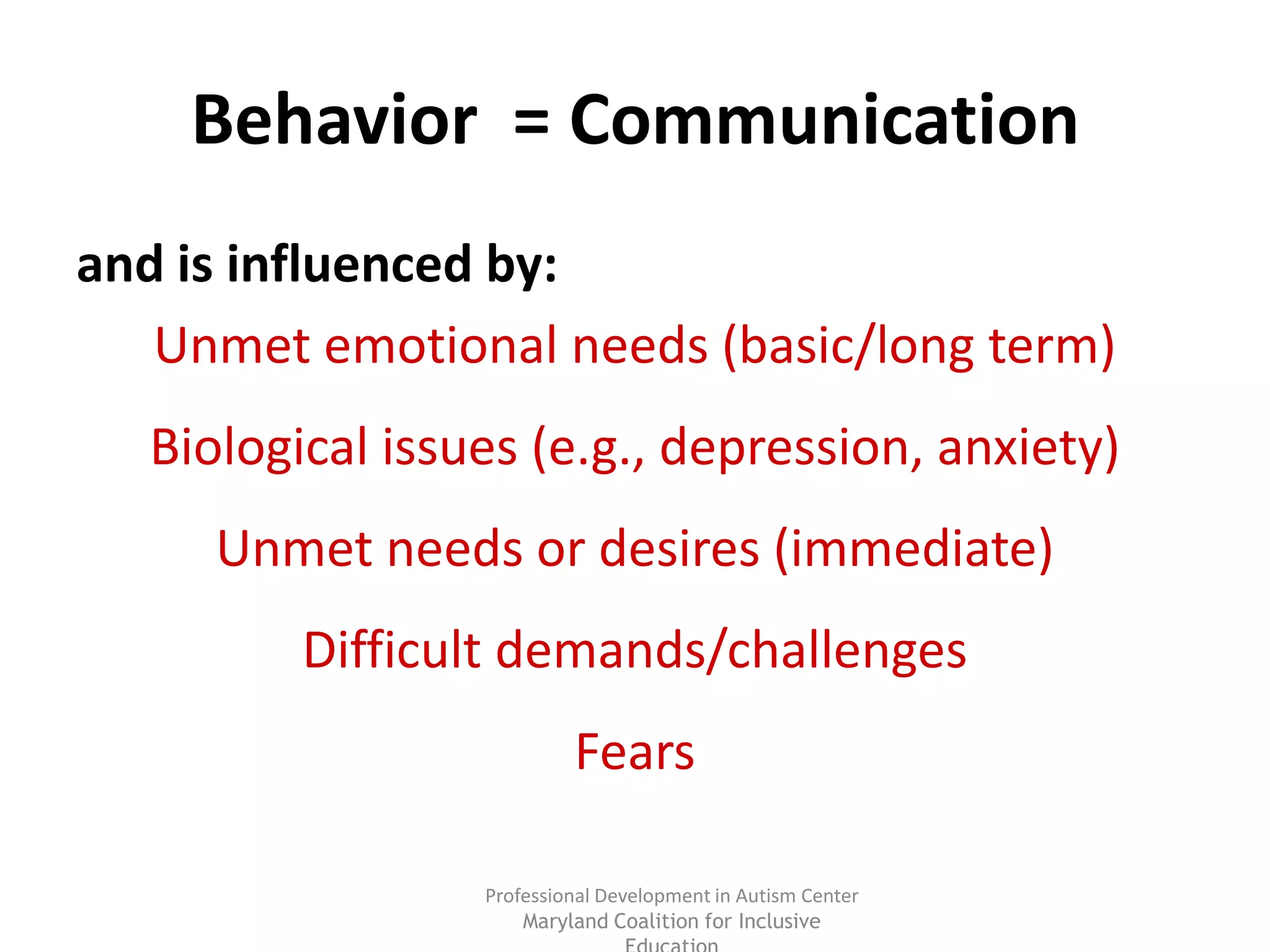
Behavior = Communication
and is influenced by:
Unmet emotional needs (basic/long term)
Biological issues (e.g., depression, anxiety)
Unmet needs or desires (immediate)
Difficult demands/challenges
Fears
Professional Development in Autism Center
Maryland Coalition for Inclusive
Behavior is Communication
A person may have a need for:
Attention
Avoidance/escape
All behavior is about:
Power and control
Jamie Burke, Student
Syracuse, NY
“Bad behavior, my
friends,
is just violent
speech”
Professional Development in Autism Center
Maryland Coalition for Inclusive
What is problem behavior?
• Results in exclusion
– Classes
– Social groups
– Community settings
• Impedes social relationships
• Results in reduced quality of life (person/family)
• Requires a plan to resolve!
When behavior interferes with personal
relationships and endangers inclusion:
We need to figure out:
• WHY the person uses the behavior,
• WHAT they get out of it, and
• How they can communicate the
same thing in an acceptable way
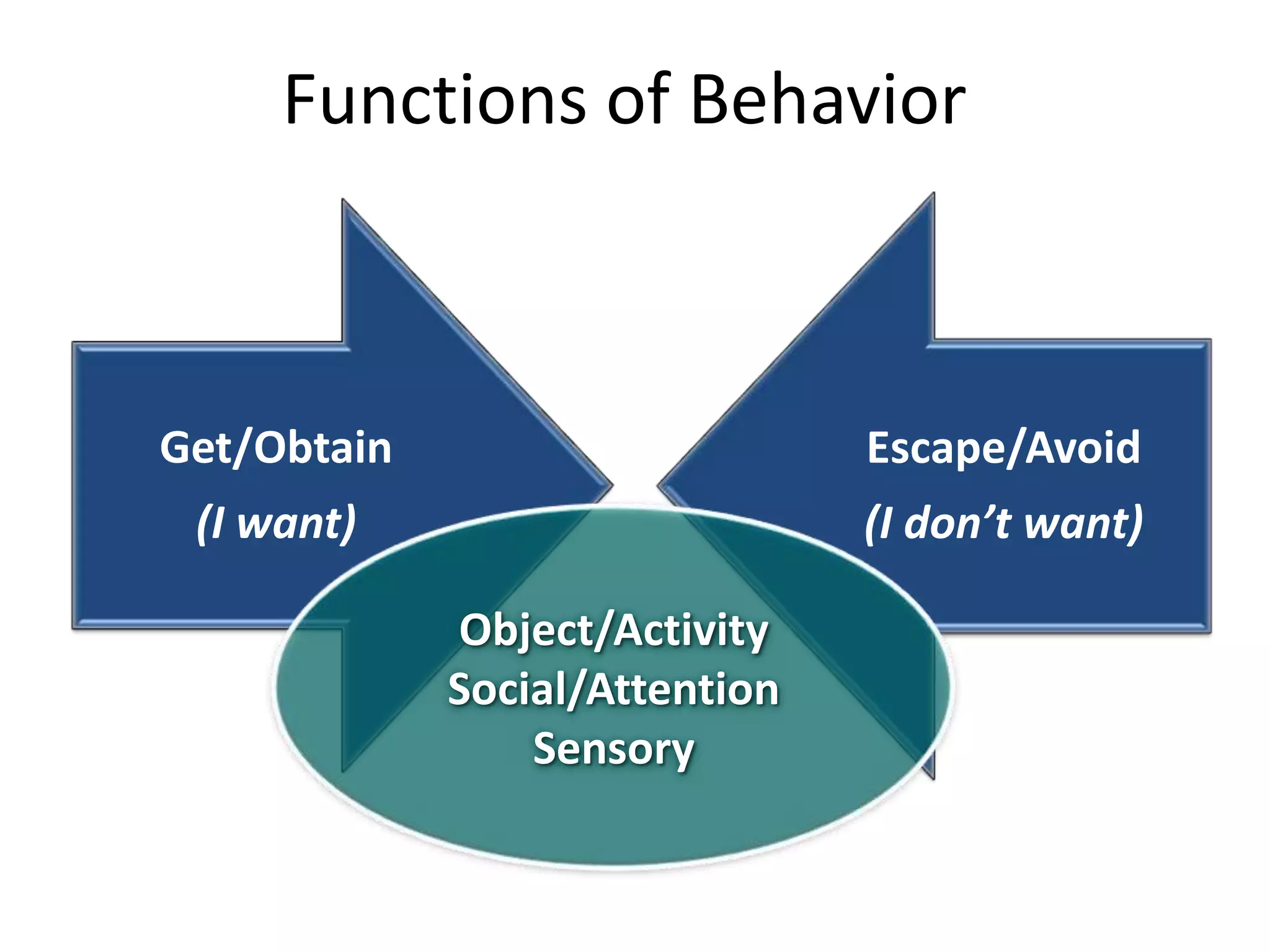
Functions of Behavior
Get/Obtain
(I want)
Escape/Avoid
(I don’t want)
Object/Activity
Social/Attention
Sensory
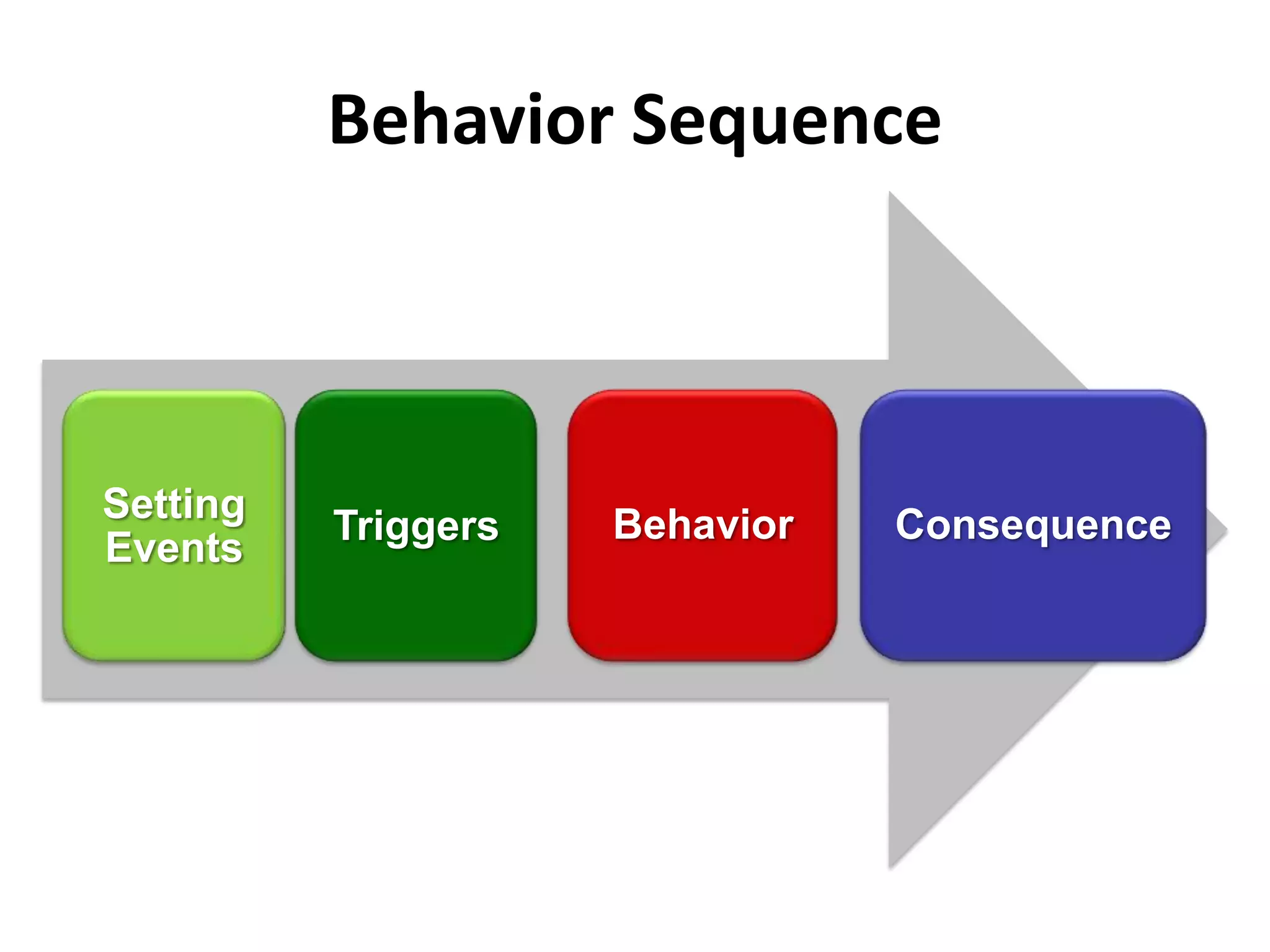
Setting
Events
Triggers Behavior Consequence
Behavior Sequence
Professional Development in Autism Center
Maryland Coalition for Inclusive
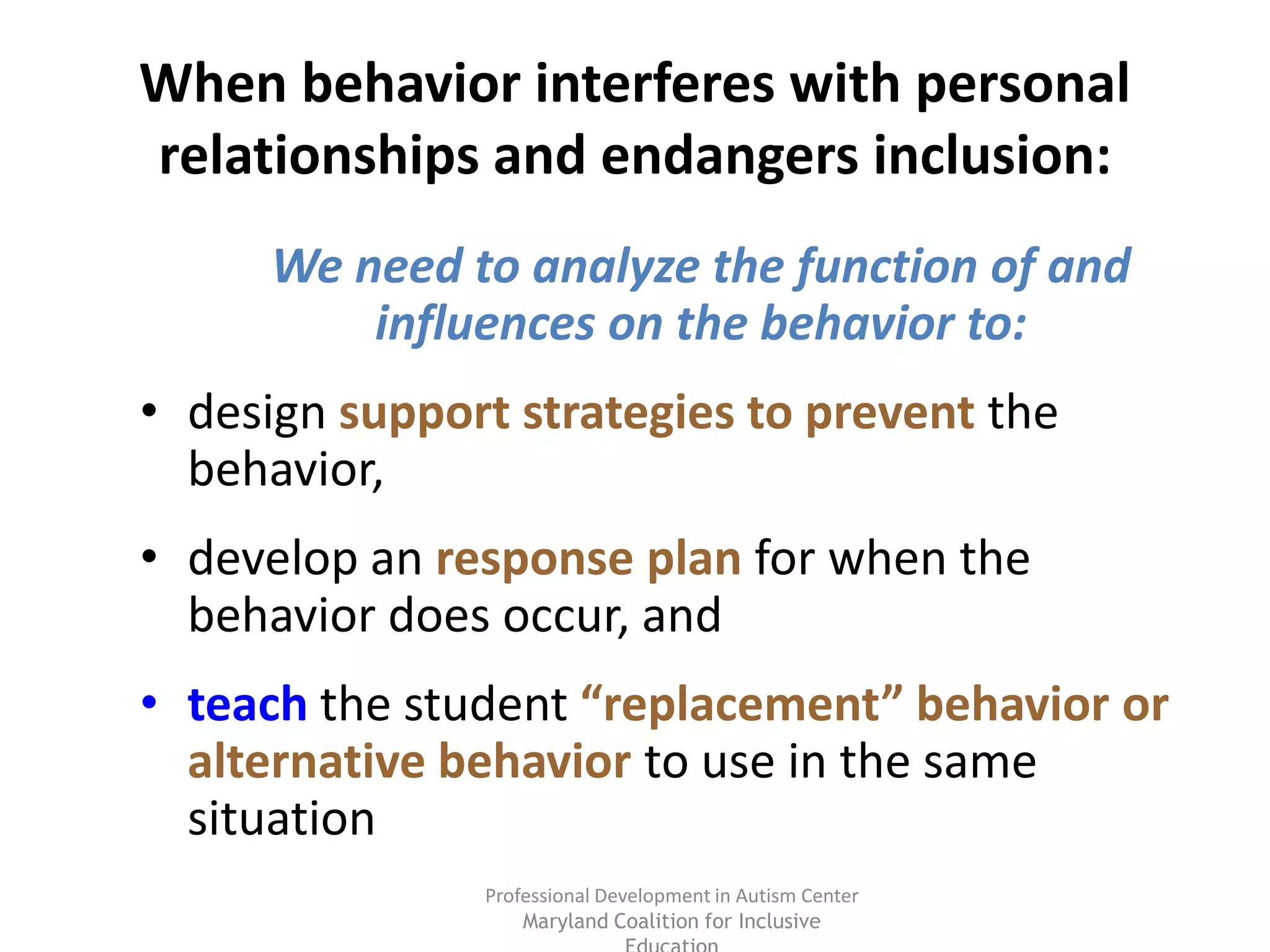
When behavior interferes with personal
relationships and endangers inclusion:
We need to analyze the function of and
influences on the behavior to:
• design support strategies to prevent the
behavior,
• develop an response plan for when the
behavior does occur, and
• teach the student “replacement” behavior or
alternative behavior to use in the same
situation
Functional Behavior
Assessment
A team process
For gathering information
To design a behavior plan
Functional Behavior Assessment
• Who is this Student
• Define the Behavior of Concern
• Gather Information About the Behavior of Concern
• Identify the Setting Events and the Triggers
• Develop a Hypothesis
• Make a Plan
• Use the Plan
• Reconsider the Plan
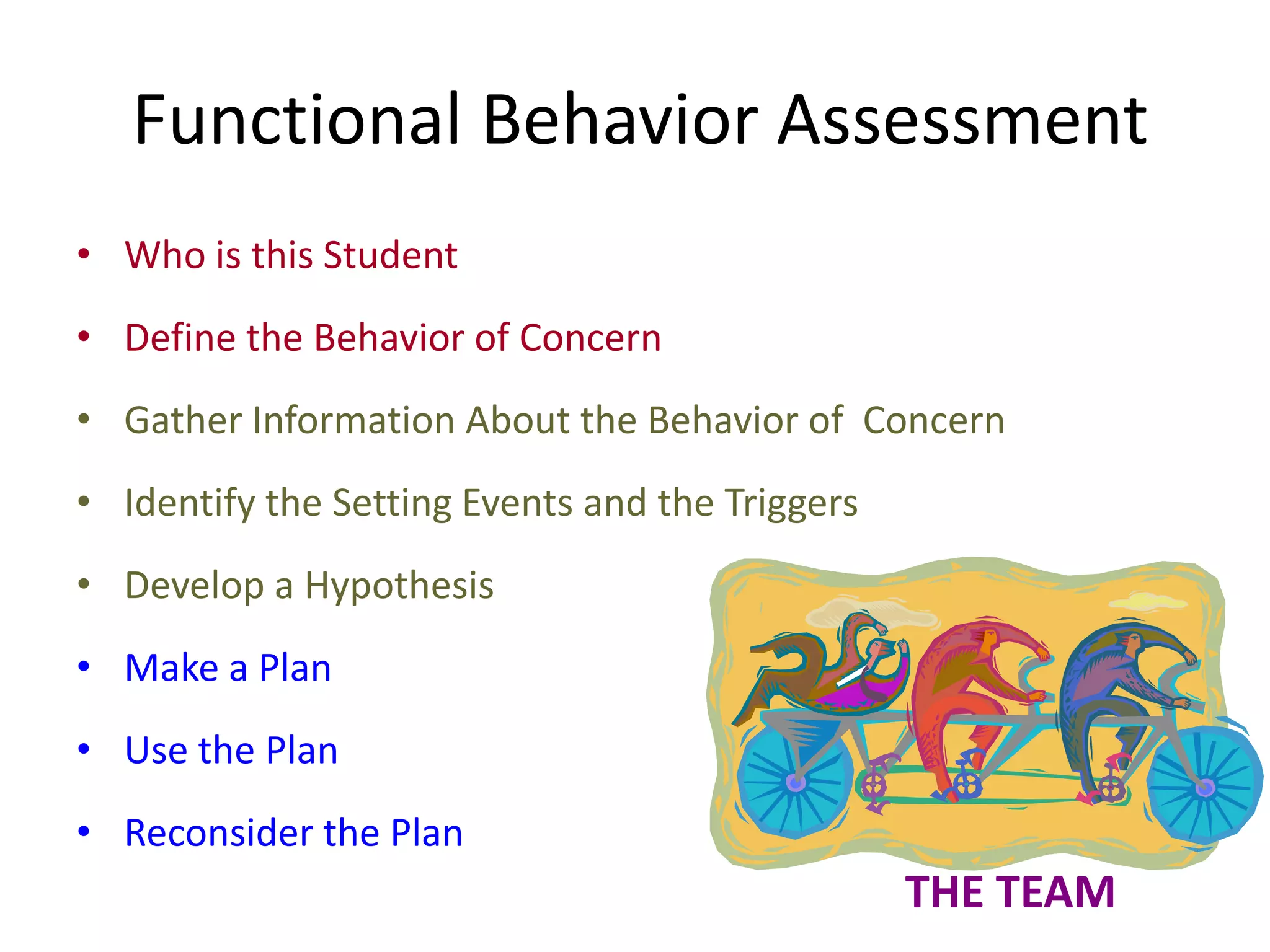
THE TEAM
Functional Behavior Assessment
It enables us to understand
• why the person uses the behavior,
• what influences the need to use the
behavior,
• how to decrease this need and
• how to increase the person’s use of
alternatives when the need does occur.
Professional Development in Autism Center
Maryland Coalition for Inclusive
Start with the Student
• What is valued in the Student’s life
• What about the student is valued by others?
• Clarify the behavior:
– Individual behaviors
– Behavior sequences
– Response classes
Antecedent events
 Stimuli that precede & “trigger” or
occasion behavioral events
 Occurs before response & signals or
occasions response
• When told to be quiet, Talia yells
• When a peer teases the way she walks, Nadia is
may throw her books
• When sitting next to Malia, Alexander hits her
Setting Events
Unique situations that make problem behavior more
intense or more likely to occur (e.g., illness, fatigue,
hunger, social conflict).
– Work completion is less important to Anton after he
has had an argument with her friend before class, or
– Raisa yells when she hasn’t had enough sleep night
before, or
– Peer attention and talking is distracting when Yulia
isn’t feeling well
Triggers
• Setting events may be considered “slow” triggers –
things that are going on in the background of the
person’s life.
– Environmental (light, noise, heat, proximity)
– Physical (tiredness, medication, illness)
– Instructional (task difficulty, content, materials)
– Interpersonal (type of interaction from others)
– Control (extent of choices and predictability of routine)
• Fast triggers are those things that seem to cause the
behavior to happen NOW.
Peer
provocation
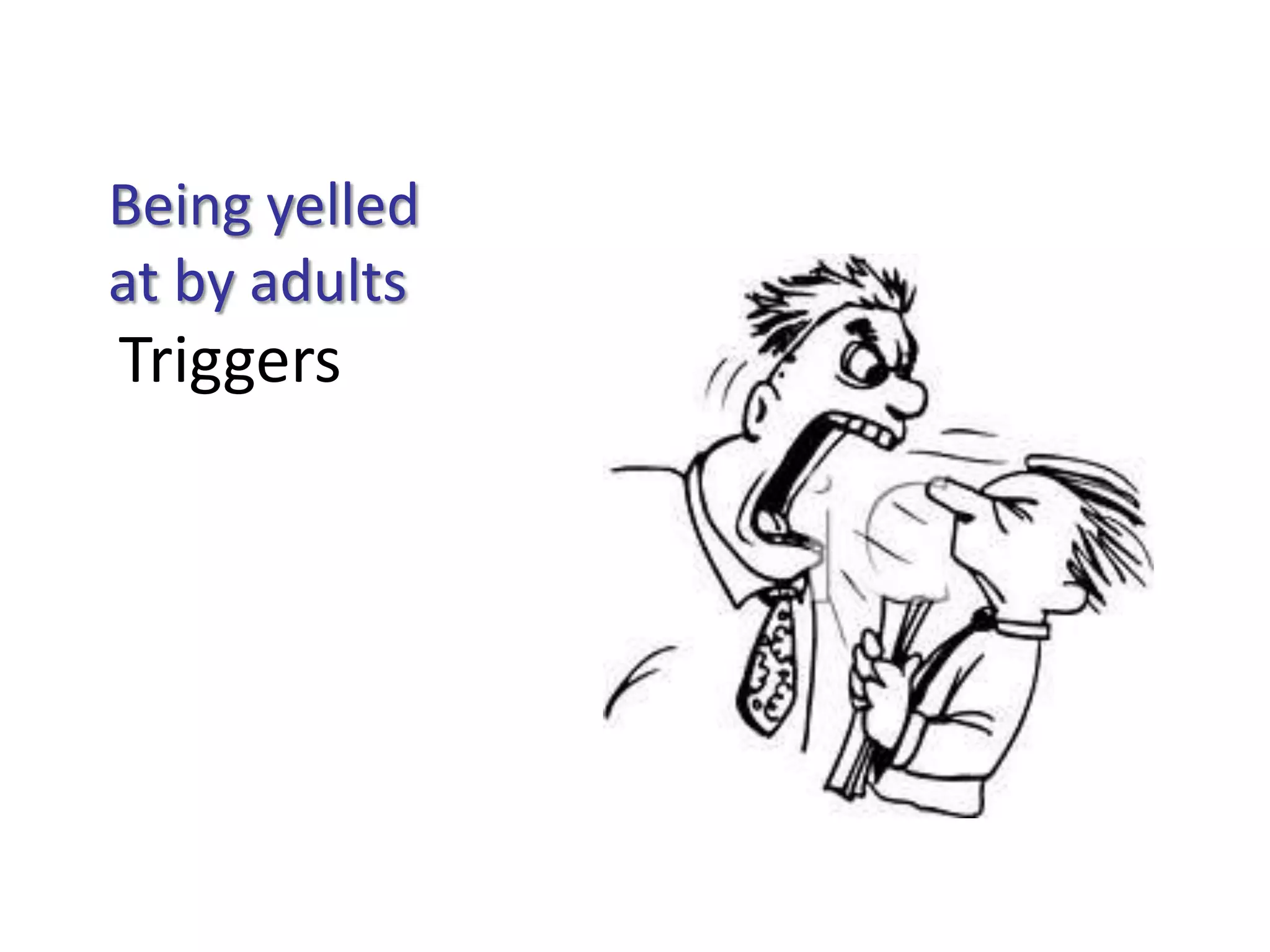
Triggers
Triggers
Being yelled
at by adults
Triggers
Work that is
too difficult
Consequence events
 Stimuli that follow & maintain or increase likelihood of a
behavioral event.
 Presented contingent upon performance of a response
– Whenever Yolanda raises her hand & smiles, her
teachers call on her.
– When Irinia uses refuses to do her work, her teacher
gives her more attention.
– When Alek destroys his homework, his mother asks
the teacher to help him the next day.
COLLECT DATA!
• When the behavior is likely to
occur
• When the behavior is NOT likely
to occur
• Continue looking at setting
events and triggers as part of
the assessment
Good FBA Questions
• When is the behavior likely to occur?
• What specific events or factors seem to contribute to
the student’s behavior?
• What function(s) does the behavior serve for the
student?
• What might the student be communicating with the
behavior?
• When is the student most successful, and therefore less
likely to engage in the behavior?
• What other factors might be contributing to the
student’s behavior?
Behavior Analysis
• A-B-C data (anecdotal charting about what
happens each time the behavior occur)
• Frequency counts (counting each time the
behavior occurs during a specific period)
• Duration (how long does the behavior go on when
it does occur)
• Level of independence (how many & what kind of
cues does the person need before they display the
behavior)
Professional Development in Autism Center
Maryland Coalition for Inclusive
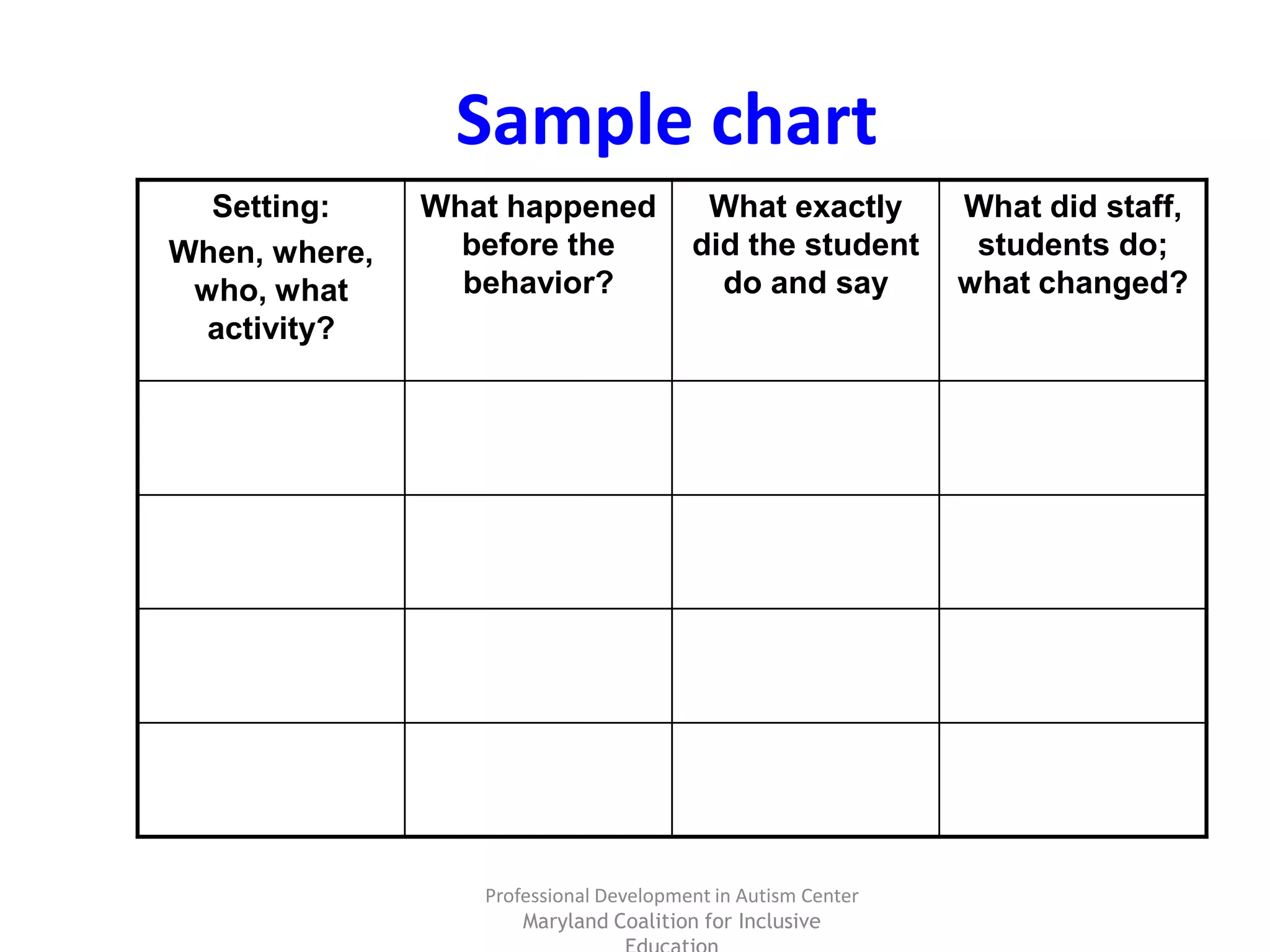
Sample chart
Setting:
When, where,
who, what
activity?
What happened
before the
behavior?
What exactly
did the student
do and say
What did staff,
students do;
what changed?
Event Sampling
Frequency or duration of behavior is recorded during a specific period of time. The
specific interval could be a classroom period or a specific time of day.
It is appropriate for measuring behaviors that are discreet; that is, they begin and end in
a clearly observable way. The events could be tabulated by marking the frequency
during the targeted time or a yes/no occurrence during the targeted time.
Mark each
time behavior
occurs in class
Date: Date: Date:
Math
Science
Time Sampling
For frequent/multiple behaviors. For example, if a student made disruptive
noises with his/her voice and hands during classes, a particular time period could
be divided into short intervals (10 or 20 seconds for example). The recorder
indicates whether or not the behavior occurred during that time interval at all
(yes or no).
Behavior:
Yes or
NO?
Date: Date: Date:
Math
Recess
Professional Development in Autism Center
Maryland Coalition for Inclusive
Develop a Hypothesis
When (trigger) happens, this student is does
(behavior) in order express (function). This is
more likely to occur when (setting event)…
… and test it
Setting Events Triggering
Antecedents
Maintaining
Consequences
Problem
Behavior
Following
events that
maintain
behaviors of
concern
Preceding
events that
trigger or
occasion
Set of
related
behaviors of
concern
Infrequent
events that
affect value
of maint.
conseq.
“Best guess” about behavior & conditions under which it is
observed
Directly guides development of BIP
Testable Hypothesis
Setting Events Triggering
Antecedents
Maintaining
Consequences
Problem
Behavior
Lack of peer
contact in 30
minutes.
Do difficult
math
assignment.
Noncompliance,
profanity,
physical
aggression,
Avoid task,
remove from
class.
Desired
Alternative
Typical
Consequence
Points,
grades,
questions,
more work.
Do work
w/o
complaints.
Summary Statement
Acceptable
Alternative
Ask for
break,
ask for
help.
Why is function
important?
Because consequences
compete!!
Function
Professional Development in
Autism Center
Maryland Coalition for
Setting Events
Unstructured
social time
Triggering
Antecedents
Peers try to
engage Billy
in
conversations.
Maintaining
Consequences
AVOID
peer
interactions
Problem
Behavior
Turns eyes
away, does
not respond
verbally,
pulls sweater
over his head.
Desired
Alternative
Appropriate
Verbal response
And wave
Walk away
Acceptable
Alternative
Walk away
Typical
Consequence
AVOID
peer
interactions
Summary Statement
Making a Behavior Plan
It is necessary to develop prevention support strategies to
decrease the likelihood that the behavior will occur.
AND
It is often helpful to teach students alternative ways to
express these needs in more typical ways (replacement
behaviors).
AND
If the behavior does occur, you’ll need a response plan to
minimize its negative impact on the student and others.
SUPPORTS
Things that will be done to decrease the
likelihood of the behavior occurring.
Changing the environment to prevent the
behaviors from occurring and reinforcing other
ways to communicate the same function.
Rearranging the environment so that the
challenging behavior is no longer effective,
efficient, or relevant
Professional Development in Autism Center
Maryland Coalition for Inclusive
Planning Supports:
• Changes to the physical environment – e.g., changing lighting, noise
levels
• Curriculum modifications to support the student’s learning style –
e.g., use of manipulatives, visual materials, written directions
• Accommodations – e.g., AlphaSmart for writing tasks, visual
schedules, graphic organizers, repetition of directions, warnings for
changes in routine
• Communication supports – e.g., use of augmentative communication,
print supports
The supports will be specific to the situation in which the
behavior occurs. Strategies used at school will be different from
those used at home.
Professional Development in Autism Center
Maryland Coalition for Inclusive
Increase opportunities for choice-making.
• Within tasks/activities/lessons
• With materials to be used
• With people to work with
• With places
• When to do work/activity
• When student can stop work/activity
RESPONSE PLAN
• This behavior has been a very effective way for the student
to communicate his or her needs, or it wouldn’t be used.
• There are times when the student will exhibit the
challenging behavior.
• How will staff respond when the behavior does occur?
…to minimizes the behavior and redirects the student to
the current task at hand.
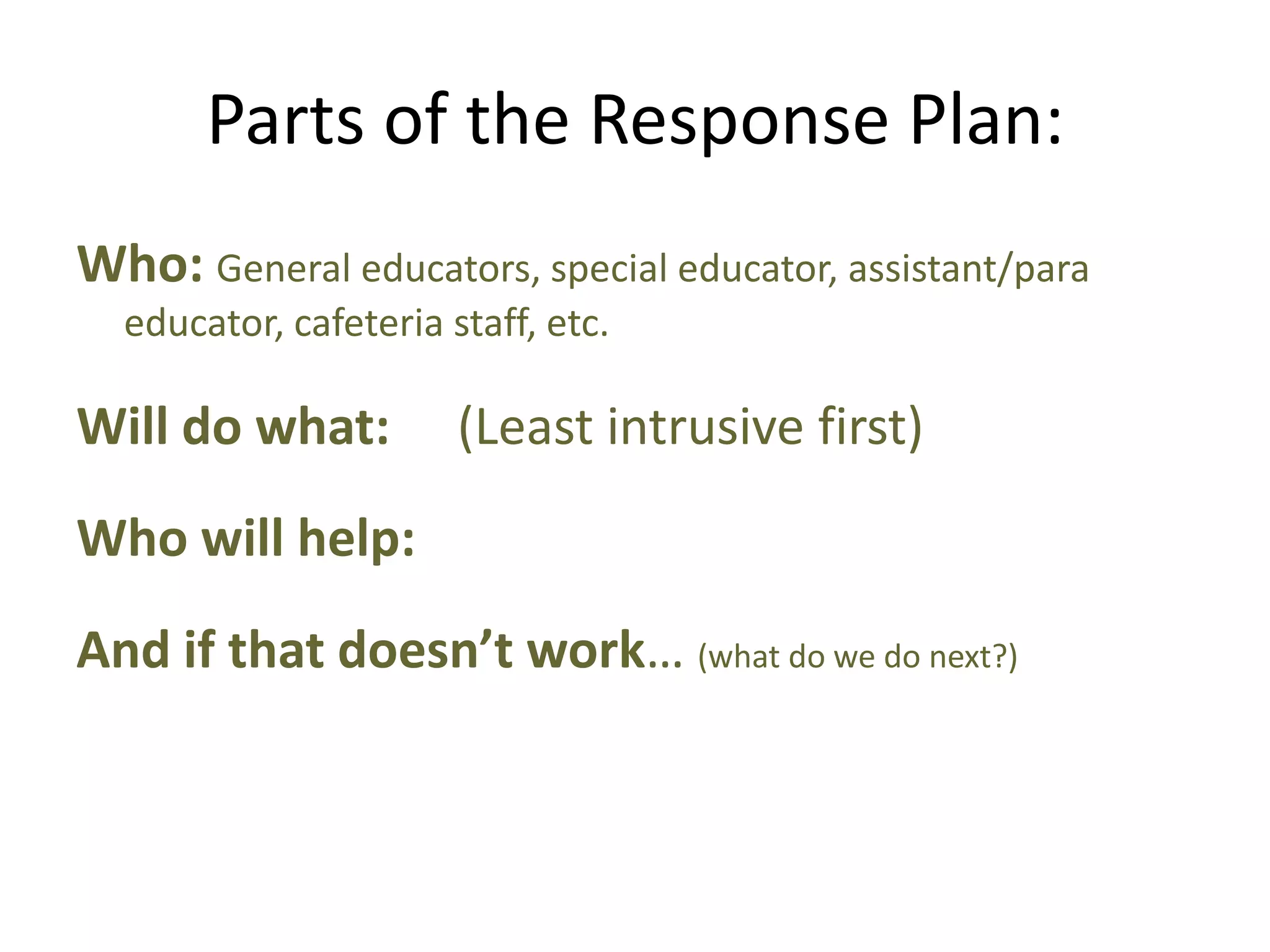
Parts of the Response Plan:
Who: General educators, special educator, assistant/para
educator, cafeteria staff, etc.
Will do what: (Least intrusive first)
Who will help:
And if that doesn’t work… (what do we do next?)
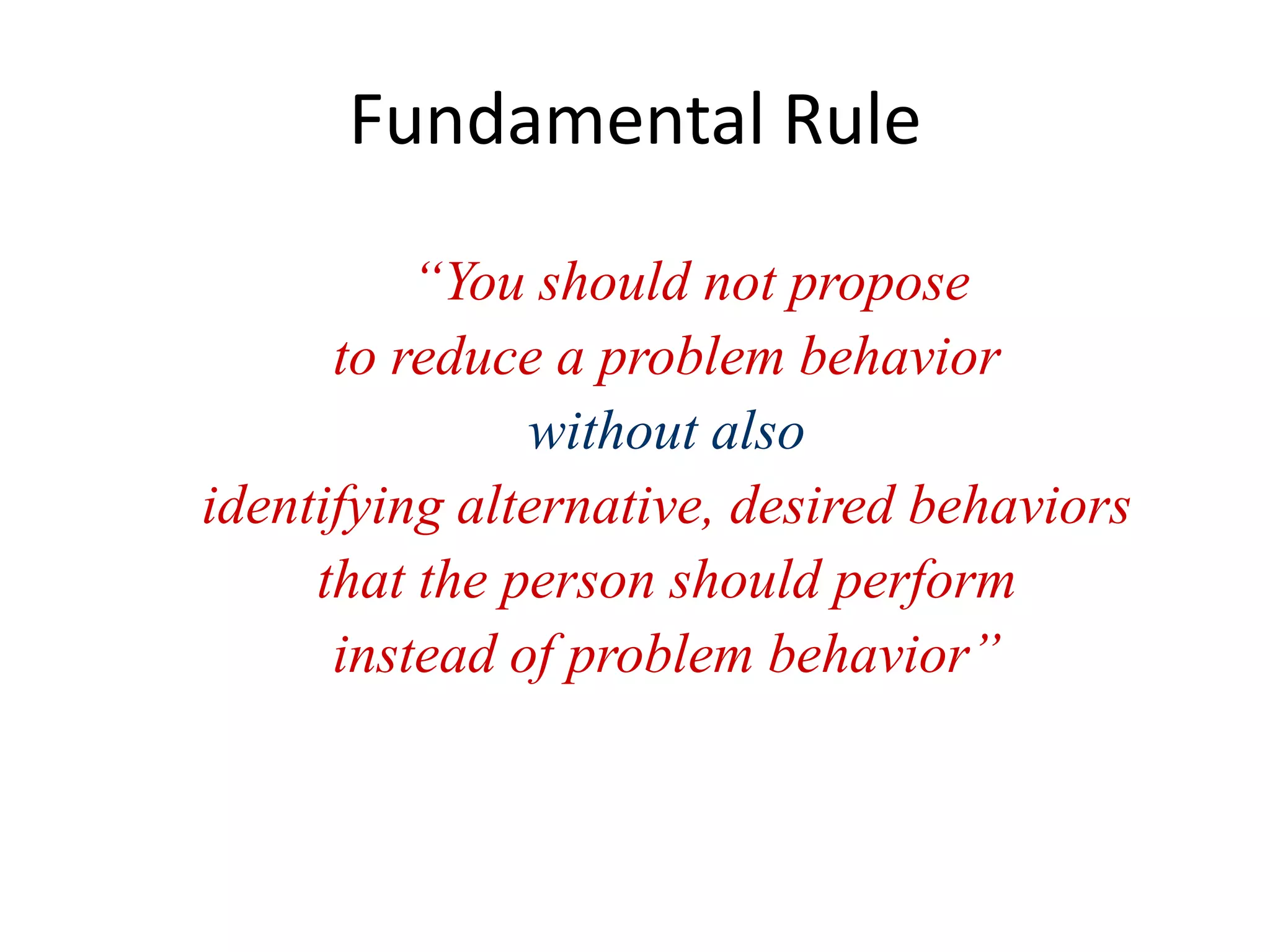
Fundamental Rule
“You should not propose
to reduce a problem behavior
without also
identifying alternative, desired behaviors
that the person should perform
instead of problem behavior”
TEACHING PLAN
• Replacement behaviors should accomplish the
same goal for the student, (but in a more
conventional and acceptable way.
• The new behavior MUST serve the same
FUNCTION!
Guidelines for Teaching Plans:
 Provide planned opportunities to practice the new behavior
 Reinforce the new behavior immediately when it occurs
 Use repetition (repeated practice) in functional, realistic
situations
 Use cues (visual cues, gestural cues, or verbal cues) to prompt
the new response as necessary
 Be able to be consistently implemented
 Be revisited and adjusted, particularly in the first few weeks of
implementation
Team Planning = Success
When a team works
together, they are more
likely to come up with an
accurate plan in a quicker
time frame!
Behavior Supports
School-Wide and Class-Wide
Individually Designed
Behavior Interventions
Individually Designed
Academic Interventions
Targeted Group
Behavior Interventions
Targeted Group
Academic Interventions
School-Wide Expectations and Rules
Clear & explicit
Reasonable
Positively worded
Few in number
Posted and Visible
Encourage & Reinforce Expected Behaviors
• Use Positive Reinforcement
• Be Specific
• Be consistent
• 4:1 Positive to Negative
Interactions
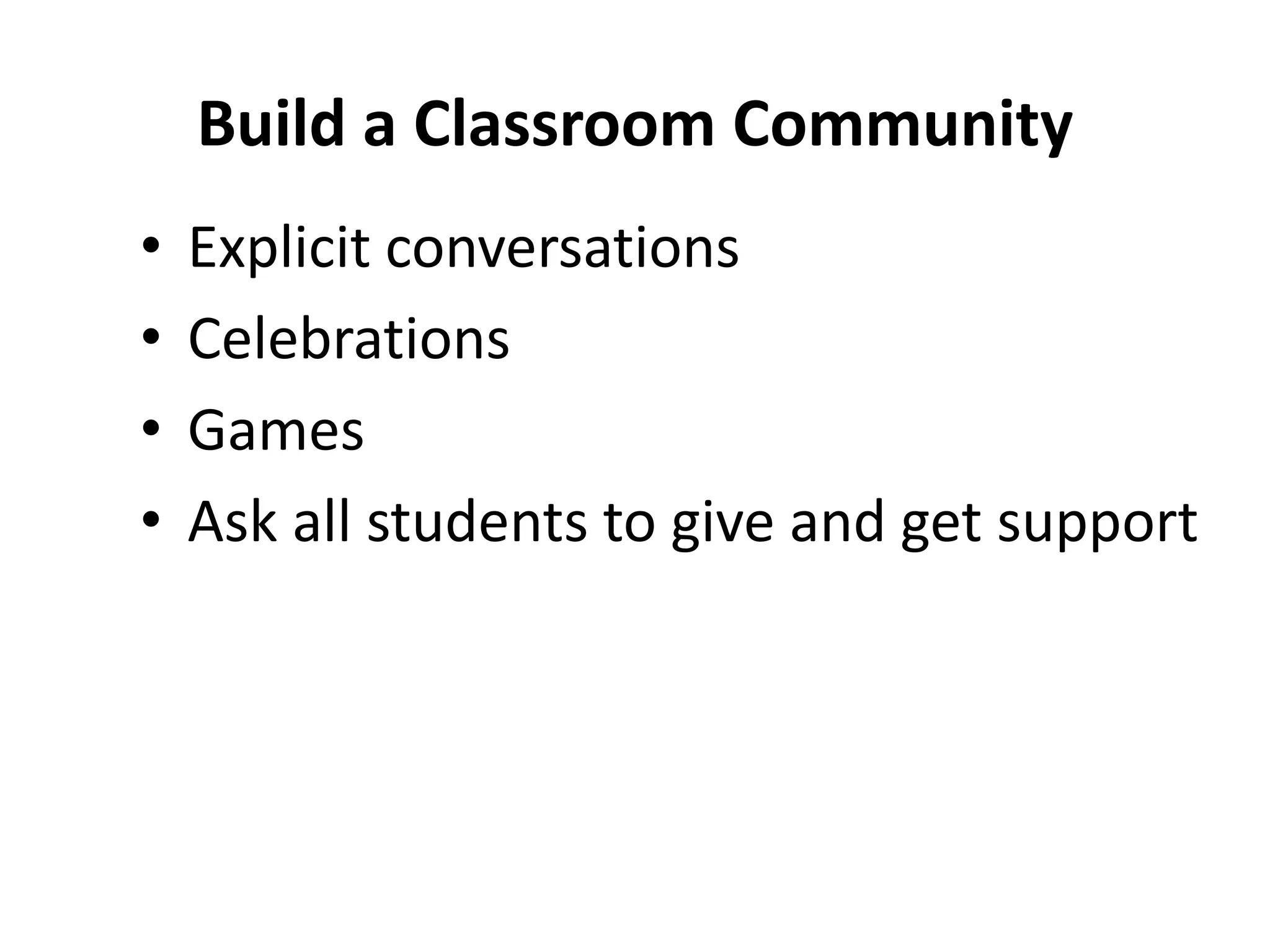
Build a Classroom Community
• Explicit conversations
• Celebrations
• Games
• Ask all students to give and get support
To Conclude
• Work from a person-centered, function-
based approach
• Focus on adult behavior
• Utilize data to make decisions
• Give priority to academic success
• Teach & acknowledge behavioral
expectations

Carol Quirk: Positive Behavior Supports

  • 1.
  • 2.
    Professional Development inAutism Center Maryland Coalition for Inclusive Behavior = Communication and is influenced by: Unmet emotional needs (basic/long term) Biological issues (e.g., depression, anxiety) Unmet needs or desires (immediate) Difficult demands/challenges Fears
  • 3.
    Professional Development inAutism Center Maryland Coalition for Inclusive Behavior is Communication A person may have a need for: Attention Avoidance/escape All behavior is about: Power and control
  • 4.
    Jamie Burke, Student Syracuse,NY “Bad behavior, my friends, is just violent speech”
  • 5.
    Professional Development inAutism Center Maryland Coalition for Inclusive What is problem behavior? • Results in exclusion – Classes – Social groups – Community settings • Impedes social relationships • Results in reduced quality of life (person/family) • Requires a plan to resolve!
  • 6.
    When behavior interfereswith personal relationships and endangers inclusion: We need to figure out: • WHY the person uses the behavior, • WHAT they get out of it, and • How they can communicate the same thing in an acceptable way
  • 7.
    Functions of Behavior Get/Obtain (Iwant) Escape/Avoid (I don’t want) Object/Activity Social/Attention Sensory
  • 8.
  • 9.
    Professional Development inAutism Center Maryland Coalition for Inclusive When behavior interferes with personal relationships and endangers inclusion: We need to analyze the function of and influences on the behavior to: • design support strategies to prevent the behavior, • develop an response plan for when the behavior does occur, and • teach the student “replacement” behavior or alternative behavior to use in the same situation
  • 10.
    Functional Behavior Assessment A teamprocess For gathering information To design a behavior plan
  • 11.
    Functional Behavior Assessment •Who is this Student • Define the Behavior of Concern • Gather Information About the Behavior of Concern • Identify the Setting Events and the Triggers • Develop a Hypothesis • Make a Plan • Use the Plan • Reconsider the Plan THE TEAM
  • 12.
    Functional Behavior Assessment Itenables us to understand • why the person uses the behavior, • what influences the need to use the behavior, • how to decrease this need and • how to increase the person’s use of alternatives when the need does occur.
  • 13.
    Professional Development inAutism Center Maryland Coalition for Inclusive Start with the Student • What is valued in the Student’s life • What about the student is valued by others? • Clarify the behavior: – Individual behaviors – Behavior sequences – Response classes
  • 14.
    Antecedent events  Stimulithat precede & “trigger” or occasion behavioral events  Occurs before response & signals or occasions response • When told to be quiet, Talia yells • When a peer teases the way she walks, Nadia is may throw her books • When sitting next to Malia, Alexander hits her
  • 15.
    Setting Events Unique situationsthat make problem behavior more intense or more likely to occur (e.g., illness, fatigue, hunger, social conflict). – Work completion is less important to Anton after he has had an argument with her friend before class, or – Raisa yells when she hasn’t had enough sleep night before, or – Peer attention and talking is distracting when Yulia isn’t feeling well
  • 16.
    Triggers • Setting eventsmay be considered “slow” triggers – things that are going on in the background of the person’s life. – Environmental (light, noise, heat, proximity) – Physical (tiredness, medication, illness) – Instructional (task difficulty, content, materials) – Interpersonal (type of interaction from others) – Control (extent of choices and predictability of routine) • Fast triggers are those things that seem to cause the behavior to happen NOW.
  • 17.
  • 18.
  • 19.
  • 20.
    Consequence events  Stimulithat follow & maintain or increase likelihood of a behavioral event.  Presented contingent upon performance of a response – Whenever Yolanda raises her hand & smiles, her teachers call on her. – When Irinia uses refuses to do her work, her teacher gives her more attention. – When Alek destroys his homework, his mother asks the teacher to help him the next day.
  • 21.
    COLLECT DATA! • Whenthe behavior is likely to occur • When the behavior is NOT likely to occur • Continue looking at setting events and triggers as part of the assessment
  • 22.
    Good FBA Questions •When is the behavior likely to occur? • What specific events or factors seem to contribute to the student’s behavior? • What function(s) does the behavior serve for the student? • What might the student be communicating with the behavior? • When is the student most successful, and therefore less likely to engage in the behavior? • What other factors might be contributing to the student’s behavior?
  • 23.
    Behavior Analysis • A-B-Cdata (anecdotal charting about what happens each time the behavior occur) • Frequency counts (counting each time the behavior occurs during a specific period) • Duration (how long does the behavior go on when it does occur) • Level of independence (how many & what kind of cues does the person need before they display the behavior)
  • 24.
    Professional Development inAutism Center Maryland Coalition for Inclusive Sample chart Setting: When, where, who, what activity? What happened before the behavior? What exactly did the student do and say What did staff, students do; what changed?
  • 25.
    Event Sampling Frequency orduration of behavior is recorded during a specific period of time. The specific interval could be a classroom period or a specific time of day. It is appropriate for measuring behaviors that are discreet; that is, they begin and end in a clearly observable way. The events could be tabulated by marking the frequency during the targeted time or a yes/no occurrence during the targeted time. Mark each time behavior occurs in class Date: Date: Date: Math Science
  • 26.
    Time Sampling For frequent/multiplebehaviors. For example, if a student made disruptive noises with his/her voice and hands during classes, a particular time period could be divided into short intervals (10 or 20 seconds for example). The recorder indicates whether or not the behavior occurred during that time interval at all (yes or no). Behavior: Yes or NO? Date: Date: Date: Math Recess
  • 27.
    Professional Development inAutism Center Maryland Coalition for Inclusive Develop a Hypothesis When (trigger) happens, this student is does (behavior) in order express (function). This is more likely to occur when (setting event)… … and test it
  • 28.
    Setting Events Triggering Antecedents Maintaining Consequences Problem Behavior Following eventsthat maintain behaviors of concern Preceding events that trigger or occasion Set of related behaviors of concern Infrequent events that affect value of maint. conseq. “Best guess” about behavior & conditions under which it is observed Directly guides development of BIP Testable Hypothesis
  • 29.
    Setting Events Triggering Antecedents Maintaining Consequences Problem Behavior Lackof peer contact in 30 minutes. Do difficult math assignment. Noncompliance, profanity, physical aggression, Avoid task, remove from class. Desired Alternative Typical Consequence Points, grades, questions, more work. Do work w/o complaints. Summary Statement Acceptable Alternative Ask for break, ask for help. Why is function important? Because consequences compete!! Function
  • 30.
    Professional Development in AutismCenter Maryland Coalition for Setting Events Unstructured social time Triggering Antecedents Peers try to engage Billy in conversations. Maintaining Consequences AVOID peer interactions Problem Behavior Turns eyes away, does not respond verbally, pulls sweater over his head. Desired Alternative Appropriate Verbal response And wave Walk away Acceptable Alternative Walk away Typical Consequence AVOID peer interactions Summary Statement
  • 31.
    Making a BehaviorPlan It is necessary to develop prevention support strategies to decrease the likelihood that the behavior will occur. AND It is often helpful to teach students alternative ways to express these needs in more typical ways (replacement behaviors). AND If the behavior does occur, you’ll need a response plan to minimize its negative impact on the student and others.
  • 32.
    SUPPORTS Things that willbe done to decrease the likelihood of the behavior occurring. Changing the environment to prevent the behaviors from occurring and reinforcing other ways to communicate the same function. Rearranging the environment so that the challenging behavior is no longer effective, efficient, or relevant
  • 33.
    Professional Development inAutism Center Maryland Coalition for Inclusive Planning Supports: • Changes to the physical environment – e.g., changing lighting, noise levels • Curriculum modifications to support the student’s learning style – e.g., use of manipulatives, visual materials, written directions • Accommodations – e.g., AlphaSmart for writing tasks, visual schedules, graphic organizers, repetition of directions, warnings for changes in routine • Communication supports – e.g., use of augmentative communication, print supports The supports will be specific to the situation in which the behavior occurs. Strategies used at school will be different from those used at home.
  • 34.
    Professional Development inAutism Center Maryland Coalition for Inclusive Increase opportunities for choice-making. • Within tasks/activities/lessons • With materials to be used • With people to work with • With places • When to do work/activity • When student can stop work/activity
  • 35.
    RESPONSE PLAN • Thisbehavior has been a very effective way for the student to communicate his or her needs, or it wouldn’t be used. • There are times when the student will exhibit the challenging behavior. • How will staff respond when the behavior does occur? …to minimizes the behavior and redirects the student to the current task at hand.
  • 36.
    Parts of theResponse Plan: Who: General educators, special educator, assistant/para educator, cafeteria staff, etc. Will do what: (Least intrusive first) Who will help: And if that doesn’t work… (what do we do next?)
  • 37.
    Fundamental Rule “You shouldnot propose to reduce a problem behavior without also identifying alternative, desired behaviors that the person should perform instead of problem behavior”
  • 38.
    TEACHING PLAN • Replacementbehaviors should accomplish the same goal for the student, (but in a more conventional and acceptable way. • The new behavior MUST serve the same FUNCTION!
  • 39.
    Guidelines for TeachingPlans:  Provide planned opportunities to practice the new behavior  Reinforce the new behavior immediately when it occurs  Use repetition (repeated practice) in functional, realistic situations  Use cues (visual cues, gestural cues, or verbal cues) to prompt the new response as necessary  Be able to be consistently implemented  Be revisited and adjusted, particularly in the first few weeks of implementation
  • 40.
    Team Planning =Success When a team works together, they are more likely to come up with an accurate plan in a quicker time frame!
  • 41.
  • 42.
    Individually Designed Behavior Interventions IndividuallyDesigned Academic Interventions Targeted Group Behavior Interventions Targeted Group Academic Interventions
  • 43.
    School-Wide Expectations andRules Clear & explicit Reasonable Positively worded Few in number Posted and Visible
  • 44.
    Encourage & ReinforceExpected Behaviors • Use Positive Reinforcement • Be Specific • Be consistent • 4:1 Positive to Negative Interactions
  • 45.
    Build a ClassroomCommunity • Explicit conversations • Celebrations • Games • Ask all students to give and get support
  • 46.
    To Conclude • Workfrom a person-centered, function- based approach • Focus on adult behavior • Utilize data to make decisions • Give priority to academic success • Teach & acknowledge behavioral expectations

Editor's Notes

  • #9 Setting events often occur out of context/at a different time than the bx so can be overlooked as contributing factors. include things like time of day, day of week, illness/fatigue