Applied Behavior
Analysis for Children
    with Autism
   Jonathan Tarbox, PhD, BCBA, & Bill Roth, PhD, BCBA


                         ITC
Presentation Outline

• Brief introduction to ABA and autism
• How to teach: Components of a comprehensive ABA
  program for children with autism
• What to teach: ABA curriculum
• Note: Don’t be afraid to raise your hand with a question
  at any time!
What is ABA?

• Applied Behavior Analysis
• ABA is the use of scientific principles of learning and
  motivation to teach effectively
• The core concept is that the consequences of what we
  do affect what we learn and what we will do in the
  future
• Positive reinforcement: behaviors that produce a good
  outcome are more likely to occur in the future
• People are motivated by what they get out of what
  they do
   – Examples: money, feeling good for helping someone, approval
     from others, satisfaction of a good book, etc.
Positive Reinforcement


• The ABA approach to autism is to identify what
  motivates each individual child
• Every child is different
• Teaching must use what is motivating to the child, not
  what we think should be motivating to the child
• Then we teach the child by teaching new skills in very
  small steps and rewarding the child with positive
  reinforcement when they make an effort at learning
Accountability and
                     Effectiveness

• ABA assumes that if a child is not learning, it is NOT
  the child’s fault, it is our fault
• We must change the way we are teaching
• We must continue to try different ways of teaching
  until we find one that works
• ABA is the best method for finding what works
• We never blame the child if learning does not happen
• We believe it’s our responsibility to figure out how to
  teach whatever the child needs to learn
Comprehensive ABA Programs

• Earliest versions of ABA programs focused mostly on
  discrete trial training.
• Comprehensive ABA programs now include a variety of
  behavioral teaching strategies
  –   Discrete Trial Training (DTT)
  –   Natural Environment Training (NET)
  –   Verbal Behavior
  –   Challenging behavior
  –   Data collection
  –   Programming for generalization
Discrete Trial Training

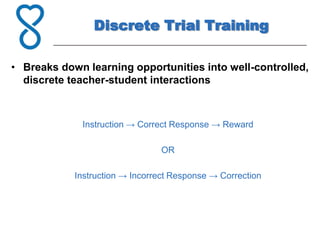
• Breaks down learning opportunities into well-controlled,
  discrete teacher-student interactions


             Instruction → Correct Response → Reward

                                OR

            Instruction → Incorrect Response → Correction
Discrete Trial Training

• Provides structure for the learning interaction
• Provides a very large number of learning opportunities
  in a small amount of time
• Is proven by hundreds of studies to be an effective
  teaching procedure
Natural Environment
                           Training
•       Basic approach:
    –     Teach in the natural environment
    –     Set up situations where the child will be motivated (e.g., toy out of
          reach)
    –     Wait for child to initiate
    –     Prompt the correct behavior
    –     Reinforce it
Natural Environment
                     Training
•   Much more natural approach than DTT
•   Less structured
•   Looks more like typical interactions
•   Great for teaching play and social skills
•   Great for establishing generalization of skills learned
    in DTT
•   Some children prefer NET over DTT
•   Proven by dozens of studies to be an effective
    teaching procedure
Verbal Behavior

• Separates language into categories by function
• Reminds us to teach all functions of words
• Teaching one function does not necessarily lead
  to learning other functions of the same word
  – Example: if we teach a child how to say “red,” he may not
    actually be able to say “red” when he wants something
    that is red
Challenging Behavior

• Examples: aggression, self-injury, self-stimulatory
  behavior, tantrums
• ABA assumes that children are getting something they
  want from challenging behavior
  –   Attention
  –   Escape
  –   Toys or food
  –   Sensory stimulation
• Autism is NOT the cause of bad behavior
Challenging Behavior

• First step is to do a “functional assessment”
• This means assess what the child is getting from their
  challenging behavior
• The next step is to not give it to them any more when
  they have the behavior (“extinction”)
• AND teach the child a more appropriate behavior that
  will get them what they want
   – Example: asking for a break, playing with a toy, asking for attention,
     etc.
Data Collection

• Good ABA programs take lots of data on the child’s
  progress
• Frequency of challenging behavior
• Percent correct on skill teaching
• Data are graphed after every teaching session
• The percent correct should be increasing over time if the
  child is learning
Generalization

• Comprehensive ABA programs must explicitly focus
  on generalization
• Generalization does NOT occur automatically
• Generalization is NOT an afterthought or side-effect
• Generalization is THE central goal of intervention
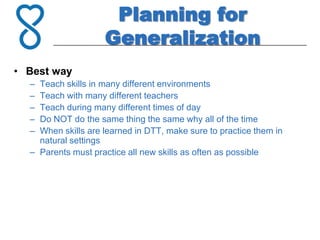
Planning for
                    Generalization
• Best way
  – Teach skills in many different environments
  – Teach with many different teachers
  – Teach during many different times of day
  – Do NOT do the same thing the same why all of the time
  – When skills are learned in DTT, make sure to practice them in
    natural settings
  – Parents must practice all new skills as often as possible
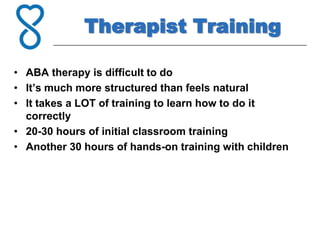
Therapist Training

• ABA therapy is difficult to do
• It’s much more structured than feels natural
• It takes a LOT of training to learn how to do it
  correctly
• 20-30 hours of initial classroom training
• Another 30 hours of hands-on training with children
Supervision

• Good ABA programs provide approximately 2 hours
  of supervision for every child, every two weeks
• Supervisors must be experts in ABA, with several
  years of experience
• Every therapist that works with the child is directly
  observed working with the child
• Every therapist is given specific and immediate
  feedback on good and bad performance
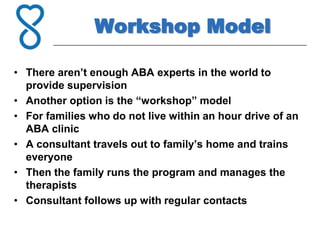
Workshop Model

• There aren’t enough ABA experts in the world to
  provide supervision
• Another option is the “workshop” model
• For families who do not live within an hour drive of an
  ABA clinic
• A consultant travels out to family’s home and trains
  everyone
• Then the family runs the program and manages the
  therapists
• Consultant follows up with regular contacts
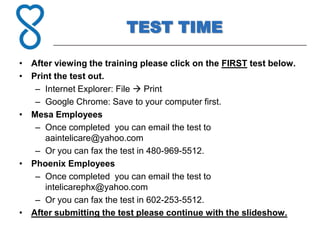
TEST TIME

• After viewing the training please click on the FIRST test below.
• Print the test out.
   – Internet Explorer: File  Print
   – Google Chrome: Save to your computer first.
• Mesa Employees
   – Once completed you can email the test to
     aaintelicare@yahoo.com
   – Or you can fax the test in 480-969-5512.
• Phoenix Employees
   – Once completed you can email the test to
     intelicarephx@yahoo.com
   – Or you can fax the test in 602-253-5512.
• After submitting the test please continue with the slideshow.
Overview of ABA
  Curriculum
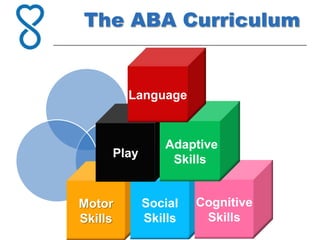
The ABA Curriculum


         Language


               Adaptive
     Play
                Skills


Motor       Social   Cognitive
Skills      Skills    Skills
A Comprehensive Curriculum


• What needs to be taught in ABA programs for kids with
  autism?
• Autism is defined by global deficits…
• If we want to catch kids up to typical development, we
  need to teach EVERYTHING that they are delayed in!
• That is what the ABA curriculum was designed for
ABA Curriculum


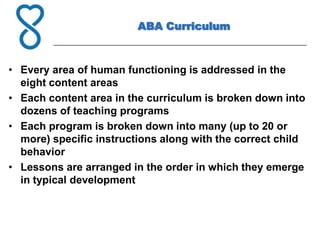
• Every area of human functioning is addressed in the
  eight content areas
• Each content area in the curriculum is broken down into
  dozens of teaching programs
• Each program is broken down into many (up to 20 or
  more) specific instructions along with the correct child
  behavior
• Lessons are arranged in the order in which they emerge
  in typical development
Language
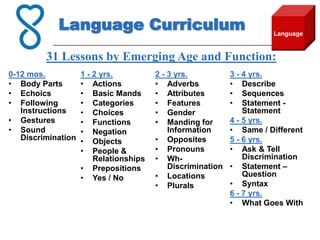
Language Curriculum                                        Language


         31 Lessons by Emerging Age and Function:
0-12 mos.           1 - 2 yrs.          2 - 3 yrs.           3 - 4 yrs.
• Body Parts        • Actions           • Adverbs            • Describe
• Echoics           • Basic Mands       • Attributes         • Sequences
• Following         • Categories        • Features           • Statement -
   Instructions     • Choices           • Gender                 Statement
• Gestures          • Functions         • Manding for        4 - 5 yrs.
• Sound             • Negation              Information      • Same / Different
   Discrimination   • Objects           • Opposites          5 - 6 yrs.
                    • People &          • Pronouns           • Ask & Tell
                        Relationships   • Wh-                    Discrimination
                    • Prepositions          Discrimination   • Statement –
                    • Yes / No          • Locations              Question
                                        • Plurals            • Syntax
                                                             6 - 7 yrs.
                                                             • What Goes With
Language Curriculum                      Language


• Each lesson
  – Goes beyond teaching the meaning of words
  – Because we cannot assume that once the child
    has learned the meaning of a word that she will
    use it in all possible situations
  – We need to make sure a child can use a word in
    all of its functions
Language Curriculum                       Language


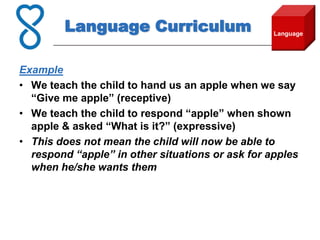
Example
• We teach the child to hand us an apple when we say
  “Give me apple” (receptive)
• We teach the child to respond “apple” when shown
  apple & asked “What is it?” (expressive)
• This does not mean the child will now be able to
  respond “apple” in other situations or ask for apples
  when he/she wants them
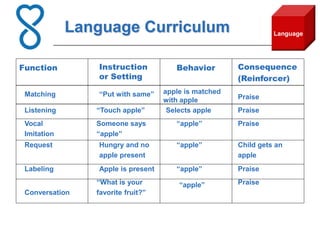
Language Curriculum                                Language


Function        Instruction           Behavior        Consequence
                or Setting                            (Reinforcer)
 Matching       “Put with same”    apple is matched
                                   with apple         Praise
 Listening      “Touch apple”       Selects apple     Praise
 Vocal          Someone says          “apple”         Praise
 Imitation      “apple”
 Request        Hungry and no         “apple”         Child gets an
                apple present                         apple
 Labeling       Apple is present      “apple”         Praise
                “What is your          “apple”        Praise
 Conversation   favorite fruit?”
Play
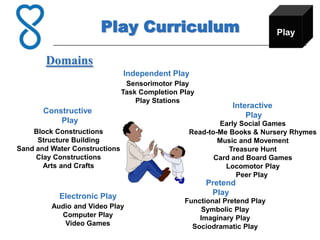
Play Curriculum                                      Play


       Domains
                               Independent Play
                                Sensorimotor Play
                               Task Completion Play
                                   Play Stations
                                                             Interactive
       Constructive
                                                                 Play
           Play                                          Early Social Games
    Block Constructions                          Read-to-Me Books & Nursery Rhymes
     Structure Building                                  Music and Movement
Sand and Water Constructions                                Treasure Hunt
     Clay Constructions                                 Card and Board Games
       Arts and Crafts                                     Locomotor Play
                                                              Peer Play
                                                      Pretend
           Electronic Play                             Play
                                                Functional Pretend Play
         Audio and Video Play                        Symbolic Play
           Computer Play                            Imaginary Play
            Video Games                           Sociodramatic Play
The ABA Curriculum


   Adaptive
    Skills
Adaptive Curriculum                                   Adaptive
                                                       Skills


          Domestic
           Pet Care
   Setting & Clearing Table
       Telephone Skills
            Tidying                    Safety
       Meal Preparation          Safety Awareness
           Cleaning
                               Safety Equipment
          Gardening
           Laundry
    School Backpack Prep
         Making a Bed

          Personal
            Feeding
           Toileting
          Undressing
          Unfastening
                                    Community
           Dressing
  Preventing Spread of Germs         Shopping
            Bathing            Restaurant Readiness
           Fastening
          Teeth Care
           Hair Care
           Nail Care
          Health Care
The ABA Curriculum


   Motor
   Skills
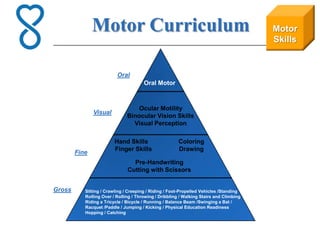
Motor Curriculum                                                          Motor
                                                                                         Skills


                          Oral
                                       Oral Motor


                                   Ocular Motility
               Visual
                               Binocular Vision Skills
                                 Visual Perception

                         Hand Skills                    Coloring
                         Finger Skills                  Drawing
        Fine
                                 Pre-Handwriting
                               Cutting with Scissors


Gross      Sitting / Crawling / Creeping / Riding / Foot-Propelled Vehicles /Standing
           Rolling Over / Rolling / Throwing / Dribbling / Walking Stairs and Climbing
           Riding a Tricycle / Bicycle / Running / Balance Beam /Swinging a Bat /
           Racquet /Paddle / Jumping / Kicking / Physical Education Readiness
           Hopping / Catching
The ABA Curriculum


    Social
    Skills
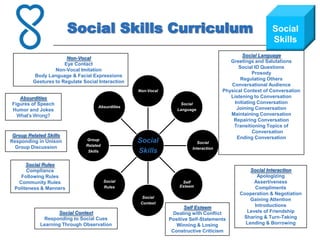
Social Skills Curriculum                                                          Social
                                                                                                          Skills
                                                                                               Social Language
                       Non-Vocal
                                                                                         Greetings and Salutations
                      Eye Contact
                                                                                             Social ID Questions
                  Non-Vocal Imitation
                                                                                                    Prosody
          Body Language & Facial Expressions
                                                                                              Regulating Others
         Gestures to Regulate Social Interaction
                                                                                         Conversational Audience
                                                   Non-Vocal                          Physical Context of Conversation
   Absurdities                                                                           Listening to Conversation
Figures of Speech                                                   Social                 Initiating Conversation
                                    Absurdities                                             Joining Conversation
Humor and Jokes                                                   Language
  What’s Wrong?                                                                          Maintaining Conversation
                                                                                          Repairing Conversation
                                                                                          Transitioning Topics of
                                                                                                    Conversation
 Group Related Skills                                                                       Ending Conversation
Responding in Unison           Group               Social                  Social
  Group Discussion             Related
                                                                        Interaction
                                Skills             Skills
      Social Rules
      Compliance                                                                                 Social Interaction
   Following Rules                                                                                 Apologizing
  Community Rules                        Social                     Self                          Assertiveness
                                         Rules                     Esteem                          Compliments
 Politeness & Manners
                                                                                             Cooperation & Negotiation
                                                     Social
                                                                                                 Gaining Attention
                                                    Context
                                                                      Self Esteem                 Introductions
                   Social Context                                Dealing with Conflict         Levels of Friendship
             Responding to Social Cues                         Positive Self-Statements       Sharing & Turn-Taking
            Learning Through Observation                          Winning & Losing             Lending & Borrowing
                                                                Constructive Criticism
The ABA Curriculum


 Cognitive
  Skills
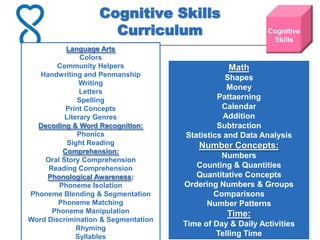
Cognitive Skills
                     Curriculum                            Cognitive
                                                            Skills
          Language Arts
               Colors
        Community Helpers                        Math
   Handwriting and Penmanship                   Shapes
               Writing
                                                 Money
               Letters
              Spelling                        Pattaerning
          Print Concepts                       Calendar
          Literary Genres                       Addition
  Decoding & Word Recognition:                Subtraction
              Phonics                Statistics and Data Analysis
           Sight Reading                 Number Concepts:
         Comprehension:
                                              Numbers
    Oral Story Comprehension
     Reading Comprehension              Counting & Quantities
     Phonological Awareness:            Quantitative Concepts
        Phoneme Isolation            Ordering Numbers & Groups
Phoneme Blending & Segmentation             Comparisons
        Phoneme Matching                  Number Patterns
      Phoneme Manipulation                      Time:
Word Discrimination & Segmentation
                                     Time of Day & Daily Activities
              Rhyming
              Syllables                      Telling Time
The ABA Curriculum


         Language


               Adaptive
     Play
                Skills


Motor       Social   Cognitive
Skills      Skills    Skills
Conclusion

• ABA is the only treatment for autism that has substantial
  science evidence for causing large improvements in
  children
• ABA programs should be comprehensive:
   –   25 or more hours per week of one-to-one
   –   Address all skills areas
   –   Two years or more of treatment
   –   Verbal behavior
   –   Generalization
   –   Discrete Trial Training
   –   Natural Environment Training
   –   Top-quality supervision

ABA

  • 1.
    Applied Behavior Analysis forChildren with Autism Jonathan Tarbox, PhD, BCBA, & Bill Roth, PhD, BCBA ITC
  • 2.
    Presentation Outline • Briefintroduction to ABA and autism • How to teach: Components of a comprehensive ABA program for children with autism • What to teach: ABA curriculum • Note: Don’t be afraid to raise your hand with a question at any time!
  • 3.
    What is ABA? •Applied Behavior Analysis • ABA is the use of scientific principles of learning and motivation to teach effectively • The core concept is that the consequences of what we do affect what we learn and what we will do in the future • Positive reinforcement: behaviors that produce a good outcome are more likely to occur in the future • People are motivated by what they get out of what they do – Examples: money, feeling good for helping someone, approval from others, satisfaction of a good book, etc.
  • 4.
    Positive Reinforcement • TheABA approach to autism is to identify what motivates each individual child • Every child is different • Teaching must use what is motivating to the child, not what we think should be motivating to the child • Then we teach the child by teaching new skills in very small steps and rewarding the child with positive reinforcement when they make an effort at learning
  • 5.
    Accountability and Effectiveness • ABA assumes that if a child is not learning, it is NOT the child’s fault, it is our fault • We must change the way we are teaching • We must continue to try different ways of teaching until we find one that works • ABA is the best method for finding what works • We never blame the child if learning does not happen • We believe it’s our responsibility to figure out how to teach whatever the child needs to learn
  • 6.
    Comprehensive ABA Programs •Earliest versions of ABA programs focused mostly on discrete trial training. • Comprehensive ABA programs now include a variety of behavioral teaching strategies – Discrete Trial Training (DTT) – Natural Environment Training (NET) – Verbal Behavior – Challenging behavior – Data collection – Programming for generalization
  • 7.
    Discrete Trial Training •Breaks down learning opportunities into well-controlled, discrete teacher-student interactions Instruction → Correct Response → Reward OR Instruction → Incorrect Response → Correction
  • 8.
    Discrete Trial Training •Provides structure for the learning interaction • Provides a very large number of learning opportunities in a small amount of time • Is proven by hundreds of studies to be an effective teaching procedure
  • 9.
    Natural Environment Training • Basic approach: – Teach in the natural environment – Set up situations where the child will be motivated (e.g., toy out of reach) – Wait for child to initiate – Prompt the correct behavior – Reinforce it
  • 10.
    Natural Environment Training • Much more natural approach than DTT • Less structured • Looks more like typical interactions • Great for teaching play and social skills • Great for establishing generalization of skills learned in DTT • Some children prefer NET over DTT • Proven by dozens of studies to be an effective teaching procedure
  • 11.
    Verbal Behavior • Separateslanguage into categories by function • Reminds us to teach all functions of words • Teaching one function does not necessarily lead to learning other functions of the same word – Example: if we teach a child how to say “red,” he may not actually be able to say “red” when he wants something that is red
  • 12.
    Challenging Behavior • Examples:aggression, self-injury, self-stimulatory behavior, tantrums • ABA assumes that children are getting something they want from challenging behavior – Attention – Escape – Toys or food – Sensory stimulation • Autism is NOT the cause of bad behavior
  • 13.
    Challenging Behavior • Firststep is to do a “functional assessment” • This means assess what the child is getting from their challenging behavior • The next step is to not give it to them any more when they have the behavior (“extinction”) • AND teach the child a more appropriate behavior that will get them what they want – Example: asking for a break, playing with a toy, asking for attention, etc.
  • 14.
    Data Collection • GoodABA programs take lots of data on the child’s progress • Frequency of challenging behavior • Percent correct on skill teaching • Data are graphed after every teaching session • The percent correct should be increasing over time if the child is learning
  • 15.
    Generalization • Comprehensive ABAprograms must explicitly focus on generalization • Generalization does NOT occur automatically • Generalization is NOT an afterthought or side-effect • Generalization is THE central goal of intervention
  • 16.
    Planning for Generalization • Best way – Teach skills in many different environments – Teach with many different teachers – Teach during many different times of day – Do NOT do the same thing the same why all of the time – When skills are learned in DTT, make sure to practice them in natural settings – Parents must practice all new skills as often as possible
  • 17.
    Therapist Training • ABAtherapy is difficult to do • It’s much more structured than feels natural • It takes a LOT of training to learn how to do it correctly • 20-30 hours of initial classroom training • Another 30 hours of hands-on training with children
  • 18.
    Supervision • Good ABAprograms provide approximately 2 hours of supervision for every child, every two weeks • Supervisors must be experts in ABA, with several years of experience • Every therapist that works with the child is directly observed working with the child • Every therapist is given specific and immediate feedback on good and bad performance
  • 19.
    Workshop Model • Therearen’t enough ABA experts in the world to provide supervision • Another option is the “workshop” model • For families who do not live within an hour drive of an ABA clinic • A consultant travels out to family’s home and trains everyone • Then the family runs the program and manages the therapists • Consultant follows up with regular contacts
  • 20.
    TEST TIME • Afterviewing the training please click on the FIRST test below. • Print the test out. – Internet Explorer: File  Print – Google Chrome: Save to your computer first. • Mesa Employees – Once completed you can email the test to aaintelicare@yahoo.com – Or you can fax the test in 480-969-5512. • Phoenix Employees – Once completed you can email the test to intelicarephx@yahoo.com – Or you can fax the test in 602-253-5512. • After submitting the test please continue with the slideshow.
  • 21.
    Overview of ABA Curriculum
  • 22.
    The ABA Curriculum Language Adaptive Play Skills Motor Social Cognitive Skills Skills Skills
  • 23.
    A Comprehensive Curriculum •What needs to be taught in ABA programs for kids with autism? • Autism is defined by global deficits… • If we want to catch kids up to typical development, we need to teach EVERYTHING that they are delayed in! • That is what the ABA curriculum was designed for
  • 24.
    ABA Curriculum • Everyarea of human functioning is addressed in the eight content areas • Each content area in the curriculum is broken down into dozens of teaching programs • Each program is broken down into many (up to 20 or more) specific instructions along with the correct child behavior • Lessons are arranged in the order in which they emerge in typical development
  • 25.
  • 26.
    Language Curriculum Language 31 Lessons by Emerging Age and Function: 0-12 mos. 1 - 2 yrs. 2 - 3 yrs. 3 - 4 yrs. • Body Parts • Actions • Adverbs • Describe • Echoics • Basic Mands • Attributes • Sequences • Following • Categories • Features • Statement - Instructions • Choices • Gender Statement • Gestures • Functions • Manding for 4 - 5 yrs. • Sound • Negation Information • Same / Different Discrimination • Objects • Opposites 5 - 6 yrs. • People & • Pronouns • Ask & Tell Relationships • Wh- Discrimination • Prepositions Discrimination • Statement – • Yes / No • Locations Question • Plurals • Syntax 6 - 7 yrs. • What Goes With
  • 27.
    Language Curriculum Language • Each lesson – Goes beyond teaching the meaning of words – Because we cannot assume that once the child has learned the meaning of a word that she will use it in all possible situations – We need to make sure a child can use a word in all of its functions
  • 28.
    Language Curriculum Language Example • We teach the child to hand us an apple when we say “Give me apple” (receptive) • We teach the child to respond “apple” when shown apple & asked “What is it?” (expressive) • This does not mean the child will now be able to respond “apple” in other situations or ask for apples when he/she wants them
  • 29.
    Language Curriculum Language Function Instruction Behavior Consequence or Setting (Reinforcer) Matching “Put with same” apple is matched with apple Praise Listening “Touch apple” Selects apple Praise Vocal Someone says “apple” Praise Imitation “apple” Request Hungry and no “apple” Child gets an apple present apple Labeling Apple is present “apple” Praise “What is your “apple” Praise Conversation favorite fruit?”
  • 30.
  • 31.
    Play Curriculum Play Domains Independent Play Sensorimotor Play Task Completion Play Play Stations Interactive Constructive Play Play Early Social Games Block Constructions Read-to-Me Books & Nursery Rhymes Structure Building Music and Movement Sand and Water Constructions Treasure Hunt Clay Constructions Card and Board Games Arts and Crafts Locomotor Play Peer Play Pretend Electronic Play Play Functional Pretend Play Audio and Video Play Symbolic Play Computer Play Imaginary Play Video Games Sociodramatic Play
  • 32.
    The ABA Curriculum Adaptive Skills
  • 33.
    Adaptive Curriculum Adaptive Skills Domestic Pet Care Setting & Clearing Table Telephone Skills Tidying Safety Meal Preparation Safety Awareness Cleaning Safety Equipment Gardening Laundry School Backpack Prep Making a Bed Personal Feeding Toileting Undressing Unfastening Community Dressing Preventing Spread of Germs Shopping Bathing Restaurant Readiness Fastening Teeth Care Hair Care Nail Care Health Care
  • 34.
    The ABA Curriculum Motor Skills
  • 35.
    Motor Curriculum Motor Skills Oral Oral Motor Ocular Motility Visual Binocular Vision Skills Visual Perception Hand Skills Coloring Finger Skills Drawing Fine Pre-Handwriting Cutting with Scissors Gross Sitting / Crawling / Creeping / Riding / Foot-Propelled Vehicles /Standing Rolling Over / Rolling / Throwing / Dribbling / Walking Stairs and Climbing Riding a Tricycle / Bicycle / Running / Balance Beam /Swinging a Bat / Racquet /Paddle / Jumping / Kicking / Physical Education Readiness Hopping / Catching
  • 36.
    The ABA Curriculum Social Skills
  • 37.
    Social Skills Curriculum Social Skills Social Language Non-Vocal Greetings and Salutations Eye Contact Social ID Questions Non-Vocal Imitation Prosody Body Language & Facial Expressions Regulating Others Gestures to Regulate Social Interaction Conversational Audience Non-Vocal Physical Context of Conversation Absurdities Listening to Conversation Figures of Speech Social Initiating Conversation Absurdities Joining Conversation Humor and Jokes Language What’s Wrong? Maintaining Conversation Repairing Conversation Transitioning Topics of Conversation Group Related Skills Ending Conversation Responding in Unison Group Social Social Group Discussion Related Interaction Skills Skills Social Rules Compliance Social Interaction Following Rules Apologizing Community Rules Social Self Assertiveness Rules Esteem Compliments Politeness & Manners Cooperation & Negotiation Social Gaining Attention Context Self Esteem Introductions Social Context Dealing with Conflict Levels of Friendship Responding to Social Cues Positive Self-Statements Sharing & Turn-Taking Learning Through Observation Winning & Losing Lending & Borrowing Constructive Criticism
  • 38.
    The ABA Curriculum Cognitive Skills
  • 39.
    Cognitive Skills Curriculum Cognitive Skills Language Arts Colors Community Helpers Math Handwriting and Penmanship Shapes Writing Money Letters Spelling Pattaerning Print Concepts Calendar Literary Genres Addition Decoding & Word Recognition: Subtraction Phonics Statistics and Data Analysis Sight Reading Number Concepts: Comprehension: Numbers Oral Story Comprehension Reading Comprehension Counting & Quantities Phonological Awareness: Quantitative Concepts Phoneme Isolation Ordering Numbers & Groups Phoneme Blending & Segmentation Comparisons Phoneme Matching Number Patterns Phoneme Manipulation Time: Word Discrimination & Segmentation Time of Day & Daily Activities Rhyming Syllables Telling Time
  • 40.
    The ABA Curriculum Language Adaptive Play Skills Motor Social Cognitive Skills Skills Skills
  • 41.
    Conclusion • ABA isthe only treatment for autism that has substantial science evidence for causing large improvements in children • ABA programs should be comprehensive: – 25 or more hours per week of one-to-one – Address all skills areas – Two years or more of treatment – Verbal behavior – Generalization – Discrete Trial Training – Natural Environment Training – Top-quality supervision