S.O.A.K Meeting
    4-12-12
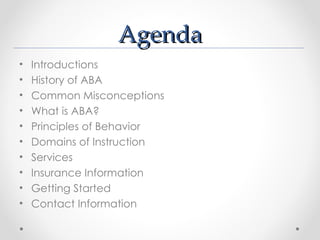
Agenda
•   Introductions
•   History of ABA
•   Common Misconceptions
•   What is ABA?
•   Principles of Behavior
•   Domains of Instruction
•   Services
•   Insurance Information
•   Getting Started
•   Contact Information
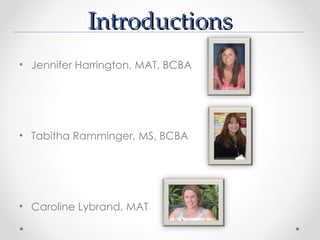
Introductions
• Jennifer Harrington, MAT, BCBA


• Tabitha Ramminger, MS, BCBA


• Caroline Lybrand, MAT
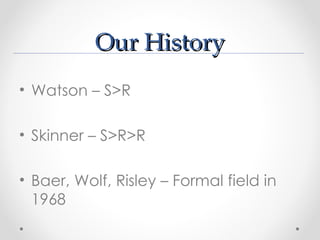
Our History
• Watson – S>R

• Skinner – S>R>R

• Baer, Wolf, Risley – Formal field in
  1968
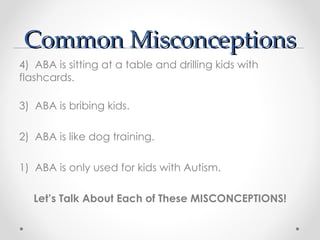
Common Misconceptions
4) ABA is sitting at a table and drilling kids with
flashcards.

3) ABA is bribing kids.

2) ABA is like dog training.

1) ABA is only used for kids with Autism.

   Let’s Talk About Each of These MISCONCEPTIONS!
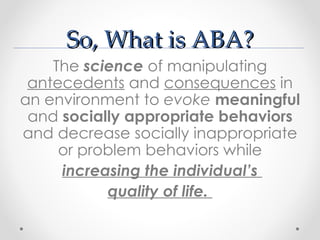
So, What is ABA?
    The science of manipulating
 antecedents and consequences in
an environment to evoke meaningful
 and socially appropriate behaviors
and decrease socially inappropriate
     or problem behaviors while
     increasing the individual’s
           quality of life.
In other words….
We implement programs that:
2.Use proactive strategies (PREVENTION)
3.Focus on teaching replacement skills,
that are valuable to the learner, which
helps to reduce problem behaviors
4.Foster independence, self-determination
and advocacy
5.Make the individuals life easier and
better.
Behavioral Paradigm
Antecedent – Behavior – Consequence
What happens before   What happens   What happens after


                ABC Model

        The ABC’s are all observable
ABC
Some typical antecedents:
   Social task demands
 Academic task demands
        Downtime
     Told wait or no
       Transitioning
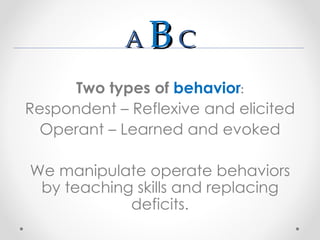
ABC
     Two types of behavior:
Respondent – Reflexive and elicited
  Operant – Learned and evoked

We manipulate operate behaviors
 by teaching skills and replacing
            deficits.
ABC
    Consequences:
 Positive Reinforcement
Negative Reinforcement
        Punishment
         Extinction

Differential Reinforcement
Communication


 Social     Domains          Self-Help


               of
           Instruction
Academic                     Leisure


              Vocational
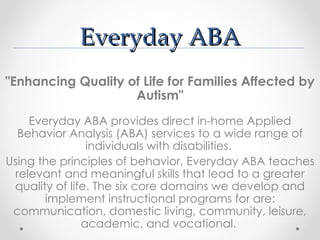
Everyday ABA
"Enhancing Quality of Life for Families Affected by
                    Autism"
    Everyday ABA provides direct in-home Applied
  Behavior Analysis (ABA) services to a wide range of
                individuals with disabilities.
Using the principles of behavior, Everyday ABA teaches
 relevant and meaningful skills that lead to a greater
 quality of life. The six core domains we develop and
       implement instructional programs for are:
 communication, domestic living, community, leisure,
               academic, and vocational.
Our Providers
BCBA – Board Certified Behavior
Analyst
BCaBA – Board Certified Assistant
Behavior Analyst
Advanced Therapist – paraprofessional
with minimum 5 years experience
Support Therapist – paraprofessional with
minimum of 1 year experience
Our Services
o Direct Services

   • BCBA vs. Paraprofessional
o Consultations (IEPs)
o Parent Training
o Social Skills Groups
o Treatment Planning
o Supervision
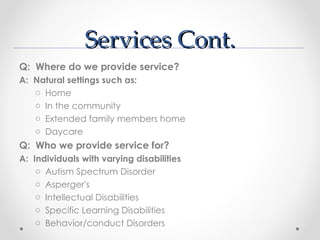
Services Cont.
Q: Where do we provide service?
A: Natural settings such as:
   o Home
   o In the community
   o Extended family members home
   o Daycare
Q: Who we provide service for?
A: Individuals with varying disabilities
    o Autism Spectrum Disorder
    o Asperger's
    o Intellectual Disabilities
    o Specific Learning Disabilities
    o Behavior/conduct Disorders
Insurance
      Currently In-Network Providers for:
•United Healthcare
•Cigna
•Tricare
•Aetna

  *Must have the ABA benefit to receive
                services*
Getting Started
Contact Us!
      www.everydayaba.com

Email:
info@everydayaba.com


Phone:
321-536-3532

Everyday ABA Presenation

  • 1.
  • 2.
    Agenda • Introductions • History of ABA • Common Misconceptions • What is ABA? • Principles of Behavior • Domains of Instruction • Services • Insurance Information • Getting Started • Contact Information
  • 3.
    Introductions • Jennifer Harrington,MAT, BCBA • Tabitha Ramminger, MS, BCBA • Caroline Lybrand, MAT
  • 4.
    Our History • Watson– S>R • Skinner – S>R>R • Baer, Wolf, Risley – Formal field in 1968
  • 5.
    Common Misconceptions 4) ABAis sitting at a table and drilling kids with flashcards. 3) ABA is bribing kids. 2) ABA is like dog training. 1) ABA is only used for kids with Autism. Let’s Talk About Each of These MISCONCEPTIONS!
  • 6.
    So, What isABA? The science of manipulating antecedents and consequences in an environment to evoke meaningful and socially appropriate behaviors and decrease socially inappropriate or problem behaviors while increasing the individual’s quality of life.
  • 7.
    In other words…. Weimplement programs that: 2.Use proactive strategies (PREVENTION) 3.Focus on teaching replacement skills, that are valuable to the learner, which helps to reduce problem behaviors 4.Foster independence, self-determination and advocacy 5.Make the individuals life easier and better.
  • 8.
    Behavioral Paradigm Antecedent –Behavior – Consequence What happens before What happens What happens after ABC Model The ABC’s are all observable
  • 9.
    ABC Some typical antecedents: Social task demands Academic task demands Downtime Told wait or no Transitioning
  • 10.
    ABC Two types of behavior: Respondent – Reflexive and elicited Operant – Learned and evoked We manipulate operate behaviors by teaching skills and replacing deficits.
  • 11.
    ABC Consequences: Positive Reinforcement Negative Reinforcement Punishment Extinction Differential Reinforcement
  • 12.
    Communication Social Domains Self-Help of Instruction Academic Leisure Vocational
  • 13.
    Everyday ABA "Enhancing Qualityof Life for Families Affected by Autism" Everyday ABA provides direct in-home Applied Behavior Analysis (ABA) services to a wide range of individuals with disabilities. Using the principles of behavior, Everyday ABA teaches relevant and meaningful skills that lead to a greater quality of life. The six core domains we develop and implement instructional programs for are: communication, domestic living, community, leisure, academic, and vocational.
  • 14.
    Our Providers BCBA –Board Certified Behavior Analyst BCaBA – Board Certified Assistant Behavior Analyst Advanced Therapist – paraprofessional with minimum 5 years experience Support Therapist – paraprofessional with minimum of 1 year experience
  • 15.
    Our Services o DirectServices • BCBA vs. Paraprofessional o Consultations (IEPs) o Parent Training o Social Skills Groups o Treatment Planning o Supervision
  • 16.
    Services Cont. Q: Wheredo we provide service? A: Natural settings such as: o Home o In the community o Extended family members home o Daycare Q: Who we provide service for? A: Individuals with varying disabilities o Autism Spectrum Disorder o Asperger's o Intellectual Disabilities o Specific Learning Disabilities o Behavior/conduct Disorders
  • 17.
    Insurance Currently In-Network Providers for: •United Healthcare •Cigna •Tricare •Aetna *Must have the ABA benefit to receive services*
  • 18.
  • 19.
    Contact Us! www.everydayaba.com Email: info@everydayaba.com Phone: 321-536-3532