
Mohanad Elsherif
‫الرحيم‬‫الرحمن‬‫هللا‬‫بسم‬
Ibn Sina University
Faculty of Dentistry
Department of Orthodontics
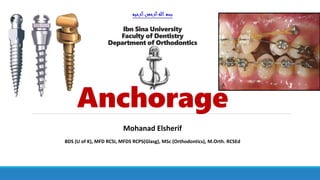
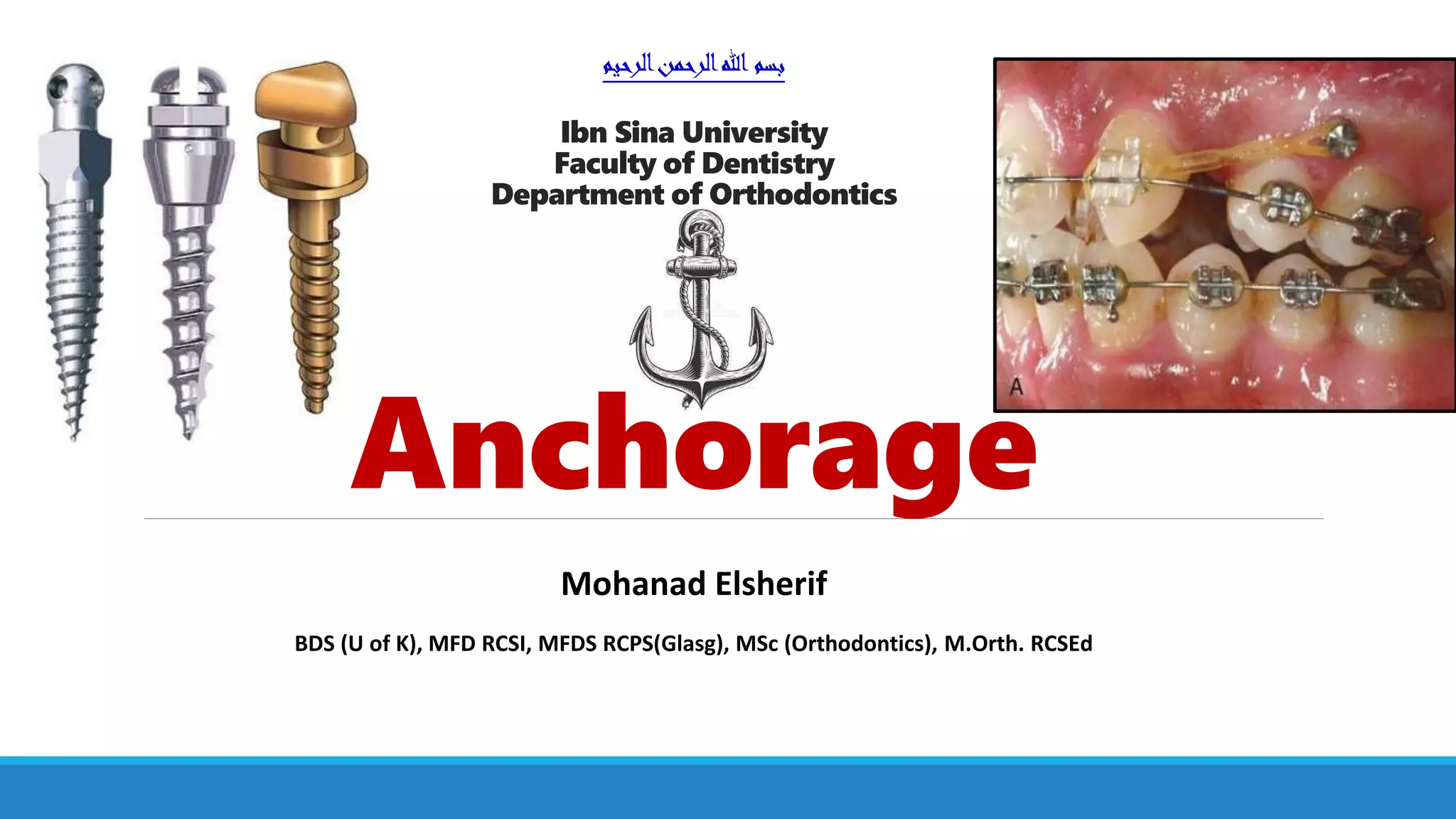
Anchorage
BDS (U of K), MFD RCSI, MFDS RCPS(Glasg), MSc (Orthodontics), M.Orth. RCSEd
Definition
 Resistance to unwanted tooth
movement.
Profitt 1993
Source of anchorage
a) Intra oral:
 Teeth.
 Alveolar bone.
 Basal bone.
Source of anchorage
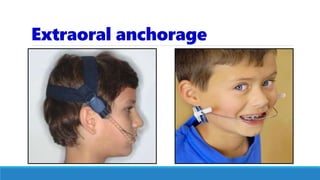
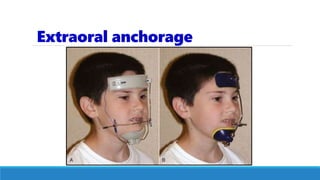
b) Extra oral
 Occipital bone.
 Cervical bone.
 Facial bones.
Extraoral anchorage
Extraoral anchorage
Anchorage value of a tooth
1. The number of roots.
2. The size and length of the root.
3. The periodontal support of the tooth.
4. The form of the root.
5. The inclination of the tooth.
Classification of anchorage
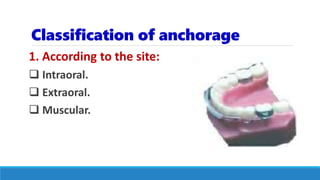
1. According to the site:
 Intraoral.
 Extraoral.
 Muscular.
Classification of anchorage
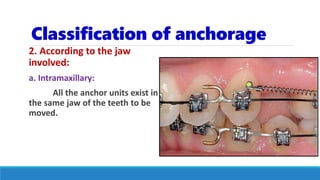
2. According to the jaw
involved:
a. Intramaxillary:
All the anchor units exist in
the same jaw of the teeth to be
moved.
Classification of anchorage
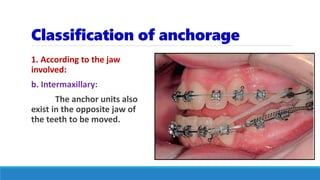
1. According to the jaw
involved:
b. Intermaxillary:
The anchor units also
exist in the opposite jaw of
the teeth to be moved.
Classification of anchorage
3. According to the number of anchorage unit:
a. Single or primary:
Single tooth with greater alveolar support is used to move a
tooth with lesser alveolar support.
b. Compound:
Multiple teeth are used.
c. Multiple or reinforced:
More than one type of anchorage is used e.g. more teeth
with intermaxillary and extraoral anchorage.
Classification of anchorage
4. According to the manner of force applications:
 Simple.
 Reciprocal.
 Stationary.
Classification of anchorage
4. According to the manner of force applications:
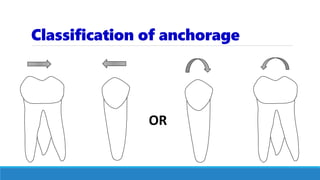
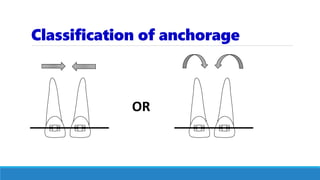
a. Simple:
 The resistance of anchor unit- which has greater alveolar
support- to tipping/bodily movement is used to cause
tipping/bodily movement of the intended teeth which have lesser
alveolar support.
 i.e. similar movements but the anchor unit has a greater alveolar
support.
Classification of anchorage
OR
Classification of anchorage
4. According to the manner of force applications:
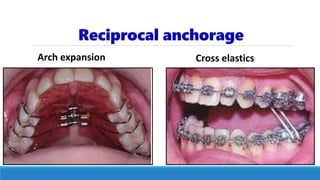
b. Reciprocal:
 The resistance of anchor unit to tipping or bodily movement is
used to cause tipping or bodily movement of the intended teeth,
both unit have the same alveolar support.
 Here the two units have the same strength so they move the
same distance.
Classification of anchorage
OR
Reciprocal anchorage
Arch expansion Cross elastics
Classification of anchorage
4. According to the manner of force applications:
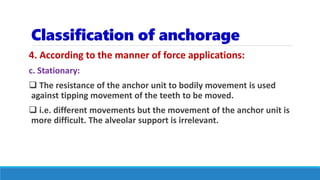
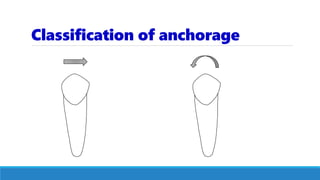
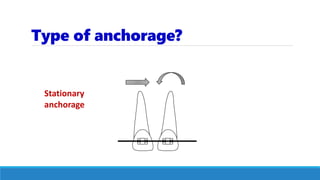
c. Stationary:
 The resistance of the anchor unit to bodily movement is used
against tipping movement of the teeth to be moved.
 i.e. different movements but the movement of the anchor unit is
more difficult. The alveolar support is irrelevant.
Classification of anchorage
Type of anchorage?
Stationary
anchorage
Factors affecting anchorage
1. The size and number of teeth being moved.
2. Types of tooth movement.
2. Duration of tooth movement.
3. The space between the teeth.
4. Tendency for tooth movement in the arch.
5. The facial height.
Anchorage loss
 Anchorage loss is the unintentional movement of
the anchor units instead of the teeth which was
intended to be moved.
 It is very important to plan for your anchorage in
order to avoid unwanted anchorage loss.
 Anchorage burn??.
Anchorage planning
 Absolute anchorage:
Zero anchorage loss.
 Maximum anchorage:
1/3 of the space available is utilized by the anchor
unit.
 Moderate anchorage:
Up to ½ of the space.
 Minimum anchorage:
2/3 of the space.
How to reinforce your
anchorage?
 Add more teeth to anchorage unit.
 Decrease the teeth in the moving unit (i.e.
move one tooth at a time).
 Use light force.
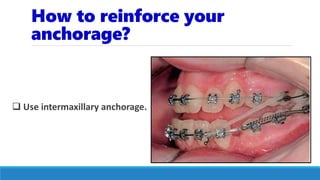
How to reinforce your
anchorage?
 Use intermaxillary anchorage.
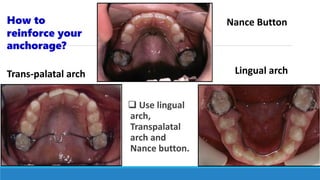
Trans-palatal arch Lingual arch
 Use lingual
arch,
Transpalatal
arch and
Nance button.
Nance ButtonHow to
reinforce your
anchorage?
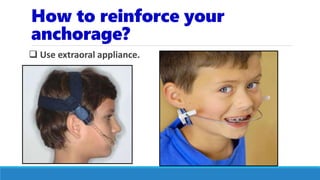
How to reinforce your
anchorage?
 Use extraoral appliance.
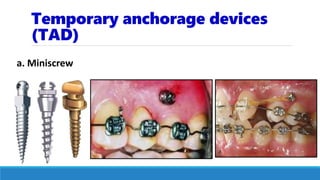
Temporary anchorage devices
(TAD)
a. Miniscrew
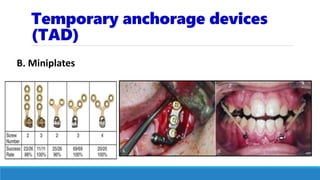
Temporary anchorage devices
(TAD)
B. Miniplates
Anchorage Reinforcement
 Add more teeth to anchorage unit.
 Decrease the teeth in the moving unit (i.e. move one tooth
at a time).
 Use light force.
 Use intermaxillary anchorage.
 Use lingual arch, Transpalatal arch and Nance bottom.
 Use extraoral appliance.
 Use Temporary anchorage devices (TADs).
Declaration
 The author wish to declare that; these presentations are his original work, all
materials and pictures collection, typing and slide design has been done by the
author.
 Most of these materials has been done for undergraduate students, although
postgraduate students may find some useful basic and advanced information.
 The universities title at the front page indicate where the lecture was first
presented. The author was working as a lecturer of orthodontics at Ibn Sina
University, Sudan International University, and as a Master student in Orthodontics at
University of Khartoum.
 The author declare that all materials and photos in these presentations has been
collected from different textbooks, papers and online websites. These pictures are
presented here for education and demonstration purposes only. The author are not
attempting to plagiarize or reproduced unauthorized material, and the intellectual
properties of these photos belong to their original authors.
Declaration
 As the authors reviews several textbooks, papers and other references during
preparation of these materials, it was impossible to cite every textbook and journal
article, the main textbooks that has been reviewed during preparation of these
presentations were:
Contemporary Orthodontics 5th edition; Proffit, William R, Henry W. Fields, and
David M. Sarver.
Handbook of Orthodontics. 1st edition; Cobourne, Martyn T, and Andrew T. DiBiase.
 Clinical cases in orthodontics. Martyn T. Cobourne, Padhraig S. Fleming, Andrew T.
DiBiase, Sofia Ahmad
Essentials of orthodontics: Diagnosis and Treatment; Robert N. Staley, Neil T. Reske
Orthodontics: Current Principles & Techniques 5th edition; Graber, Lee W, Robert L.
Vanarsdall, and Katherine W. L. Vig
Orthodontics: The Art and Science. 3rd Edition. Bhalajhi, S.I.
Declaration
 For the purposes of dissemination and sharing of knowledge, these
lectures were given to several colleagues and students. It were also
uploaded to SlideShare website by the author. Colleagues and students
may download, use, and modify these materials as they see fit for non-
profit purposes. The author retain the copyright of the original work.
 The author wish to thank his family, teachers, colleagues and students
for their love and support throughout his career. I also wish to express
my sincere gratitude to all orthodontic pillars for their tremendous
contribution to our specialty.
 Finally, the author welcome any advices and enquires through his
email address: Mohanad-07@hotmail.com
Thank You

Anchorage in Orthodontic

  • 1.
    Mohanad Elsherif ‫الرحيم‬‫الرحمن‬‫هللا‬‫بسم‬ Ibn SinaUniversity Faculty of Dentistry Department of Orthodontics Anchorage BDS (U of K), MFD RCSI, MFDS RCPS(Glasg), MSc (Orthodontics), M.Orth. RCSEd
  • 2.
    Definition  Resistance tounwanted tooth movement. Profitt 1993
  • 3.
    Source of anchorage a)Intra oral:  Teeth.  Alveolar bone.  Basal bone.
  • 4.
    Source of anchorage b)Extra oral  Occipital bone.  Cervical bone.  Facial bones.
  • 5.
  • 6.
  • 7.
    Anchorage value ofa tooth 1. The number of roots. 2. The size and length of the root. 3. The periodontal support of the tooth. 4. The form of the root. 5. The inclination of the tooth.
  • 8.
    Classification of anchorage 1.According to the site:  Intraoral.  Extraoral.  Muscular.
  • 9.
    Classification of anchorage 2.According to the jaw involved: a. Intramaxillary: All the anchor units exist in the same jaw of the teeth to be moved.
  • 10.
    Classification of anchorage 1.According to the jaw involved: b. Intermaxillary: The anchor units also exist in the opposite jaw of the teeth to be moved.
  • 11.
    Classification of anchorage 3.According to the number of anchorage unit: a. Single or primary: Single tooth with greater alveolar support is used to move a tooth with lesser alveolar support. b. Compound: Multiple teeth are used. c. Multiple or reinforced: More than one type of anchorage is used e.g. more teeth with intermaxillary and extraoral anchorage.
  • 12.
    Classification of anchorage 4.According to the manner of force applications:  Simple.  Reciprocal.  Stationary.
  • 13.
    Classification of anchorage 4.According to the manner of force applications: a. Simple:  The resistance of anchor unit- which has greater alveolar support- to tipping/bodily movement is used to cause tipping/bodily movement of the intended teeth which have lesser alveolar support.  i.e. similar movements but the anchor unit has a greater alveolar support.
  • 14.
  • 15.
    Classification of anchorage 4.According to the manner of force applications: b. Reciprocal:  The resistance of anchor unit to tipping or bodily movement is used to cause tipping or bodily movement of the intended teeth, both unit have the same alveolar support.  Here the two units have the same strength so they move the same distance.
  • 16.
  • 17.
  • 18.
    Classification of anchorage 4.According to the manner of force applications: c. Stationary:  The resistance of the anchor unit to bodily movement is used against tipping movement of the teeth to be moved.  i.e. different movements but the movement of the anchor unit is more difficult. The alveolar support is irrelevant.
  • 19.
  • 20.
  • 21.
    Factors affecting anchorage 1.The size and number of teeth being moved. 2. Types of tooth movement. 2. Duration of tooth movement. 3. The space between the teeth. 4. Tendency for tooth movement in the arch. 5. The facial height.
  • 22.
    Anchorage loss  Anchorageloss is the unintentional movement of the anchor units instead of the teeth which was intended to be moved.  It is very important to plan for your anchorage in order to avoid unwanted anchorage loss.  Anchorage burn??.
  • 23.
    Anchorage planning  Absoluteanchorage: Zero anchorage loss.  Maximum anchorage: 1/3 of the space available is utilized by the anchor unit.  Moderate anchorage: Up to ½ of the space.  Minimum anchorage: 2/3 of the space.
  • 24.
    How to reinforceyour anchorage?  Add more teeth to anchorage unit.  Decrease the teeth in the moving unit (i.e. move one tooth at a time).  Use light force.
  • 25.
    How to reinforceyour anchorage?  Use intermaxillary anchorage.
  • 26.
    Trans-palatal arch Lingualarch  Use lingual arch, Transpalatal arch and Nance button. Nance ButtonHow to reinforce your anchorage?
  • 27.
    How to reinforceyour anchorage?  Use extraoral appliance.
  • 28.
  • 29.
  • 30.
    Anchorage Reinforcement  Addmore teeth to anchorage unit.  Decrease the teeth in the moving unit (i.e. move one tooth at a time).  Use light force.  Use intermaxillary anchorage.  Use lingual arch, Transpalatal arch and Nance bottom.  Use extraoral appliance.  Use Temporary anchorage devices (TADs).
  • 31.
    Declaration  The authorwish to declare that; these presentations are his original work, all materials and pictures collection, typing and slide design has been done by the author.  Most of these materials has been done for undergraduate students, although postgraduate students may find some useful basic and advanced information.  The universities title at the front page indicate where the lecture was first presented. The author was working as a lecturer of orthodontics at Ibn Sina University, Sudan International University, and as a Master student in Orthodontics at University of Khartoum.  The author declare that all materials and photos in these presentations has been collected from different textbooks, papers and online websites. These pictures are presented here for education and demonstration purposes only. The author are not attempting to plagiarize or reproduced unauthorized material, and the intellectual properties of these photos belong to their original authors.
  • 32.
    Declaration  As theauthors reviews several textbooks, papers and other references during preparation of these materials, it was impossible to cite every textbook and journal article, the main textbooks that has been reviewed during preparation of these presentations were: Contemporary Orthodontics 5th edition; Proffit, William R, Henry W. Fields, and David M. Sarver. Handbook of Orthodontics. 1st edition; Cobourne, Martyn T, and Andrew T. DiBiase.  Clinical cases in orthodontics. Martyn T. Cobourne, Padhraig S. Fleming, Andrew T. DiBiase, Sofia Ahmad Essentials of orthodontics: Diagnosis and Treatment; Robert N. Staley, Neil T. Reske Orthodontics: Current Principles & Techniques 5th edition; Graber, Lee W, Robert L. Vanarsdall, and Katherine W. L. Vig Orthodontics: The Art and Science. 3rd Edition. Bhalajhi, S.I.
  • 33.
    Declaration  For thepurposes of dissemination and sharing of knowledge, these lectures were given to several colleagues and students. It were also uploaded to SlideShare website by the author. Colleagues and students may download, use, and modify these materials as they see fit for non- profit purposes. The author retain the copyright of the original work.  The author wish to thank his family, teachers, colleagues and students for their love and support throughout his career. I also wish to express my sincere gratitude to all orthodontic pillars for their tremendous contribution to our specialty.  Finally, the author welcome any advices and enquires through his email address: Mohanad-07@hotmail.com
  • 34.