
Ibn Sina University
Faculty of Dentistry
Department of Orthodontics
Biomechanics,
Mechanics of tooth
Movement
Mohanad Elsherif
BDS (U of K), MFD RCSI, MFDS RCPS(Glasg), MSc (Orthodontics), M.Orth. RCSEd
Mechanics and Biomechanics
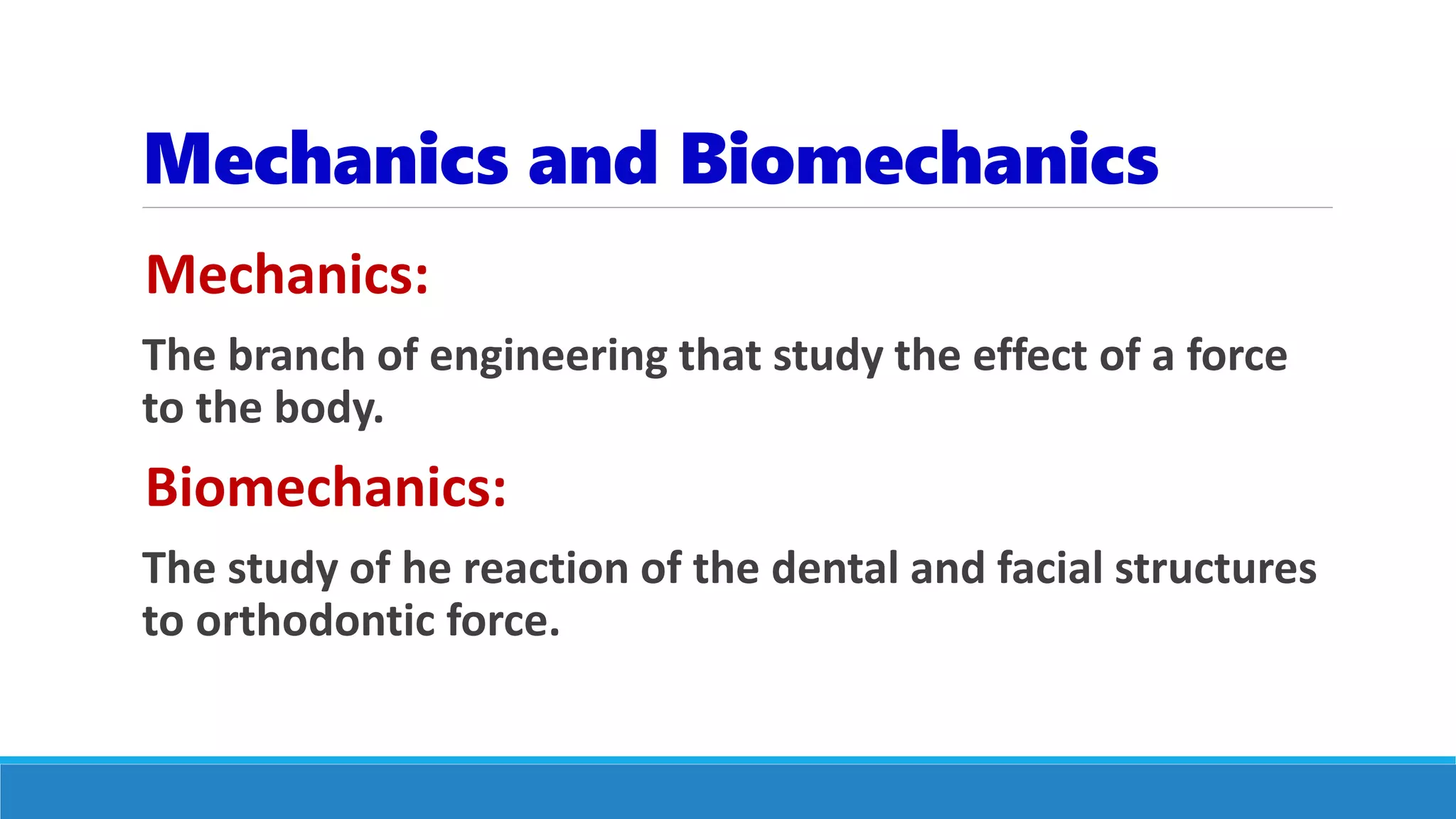
Mechanics:
The branch of engineering that study the effect of a force
to the body.
Biomechanics:
The study of he reaction of the dental and facial structures
to orthodontic force.
Basic proprieties of wire material
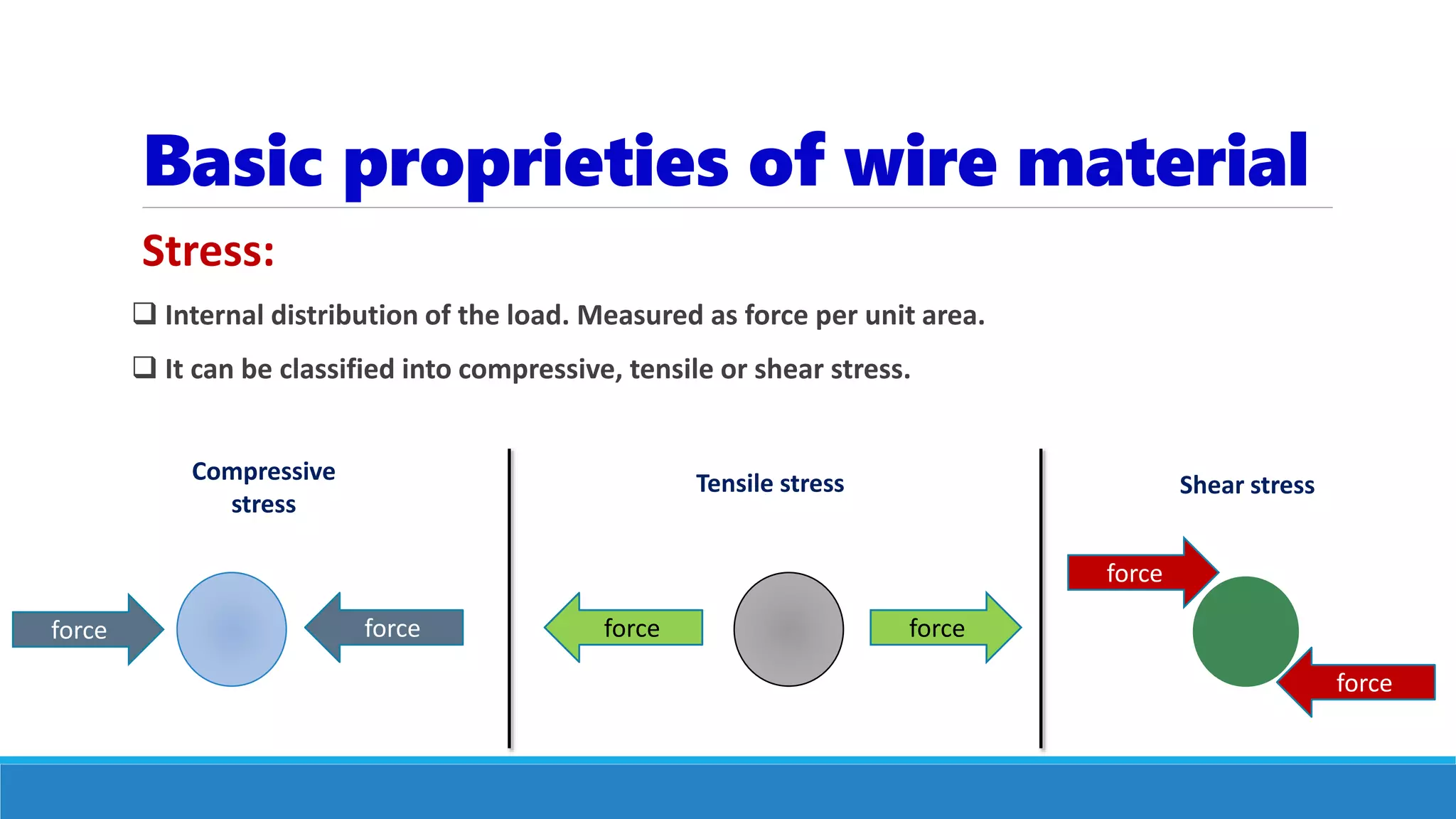
Stress:
 Internal distribution of the load. Measured as force per unit area.
 It can be classified into compressive, tensile or shear stress.
force force
force
force
forceforce
Compressive
stress
Tensile stress Shear stress
Basic proprieties of wire material
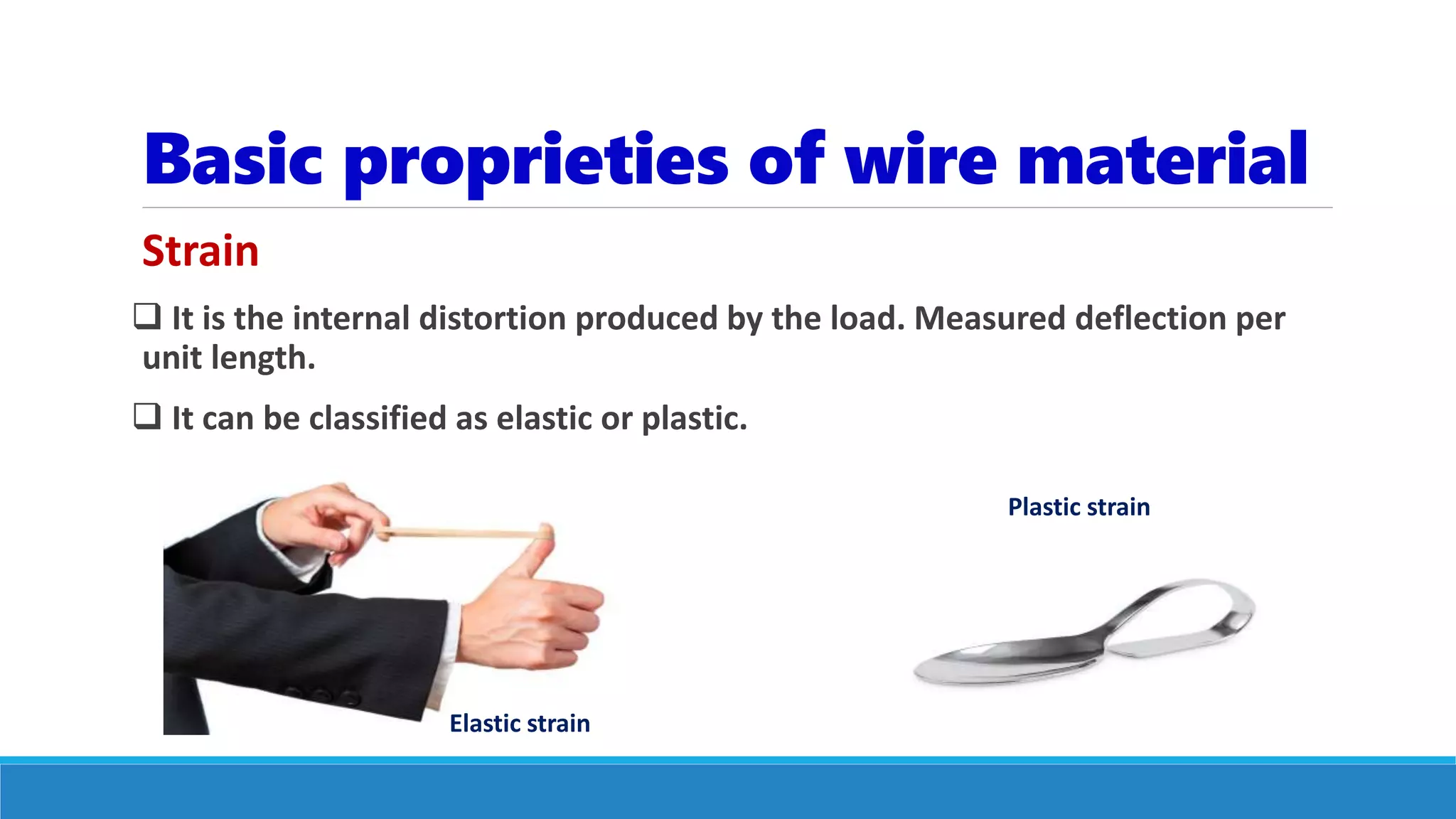
Strain
 It is the internal distortion produced by the load. Measured deflection per
unit length.
 It can be classified as elastic or plastic.
Elastic strain
Plastic strain
Basic proprieties of wire material
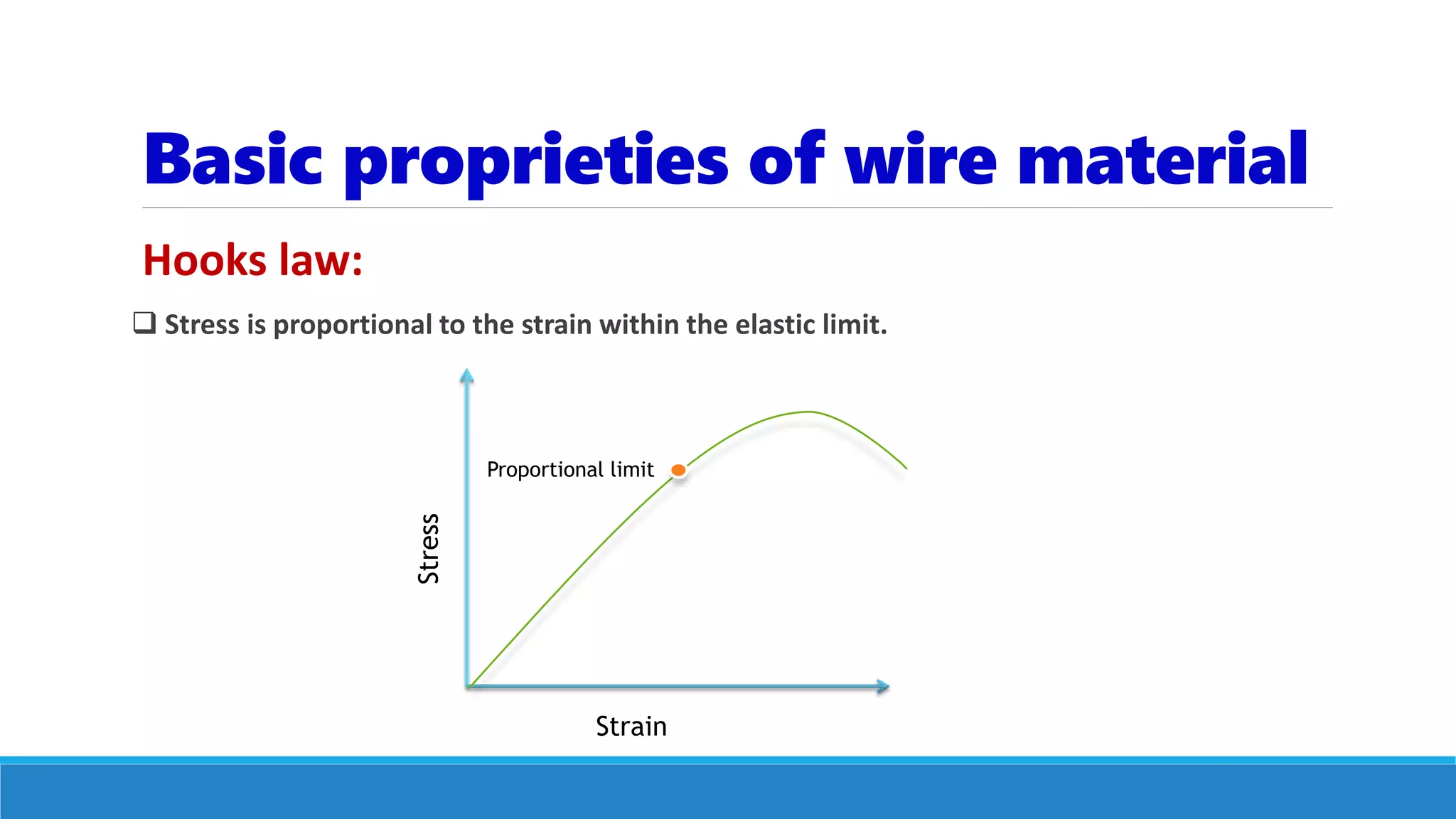
Hooks law:
 Stress is proportional to the strain within the elastic limit.
Proportional limit
Stress
Strain
Basic proprieties of wire material
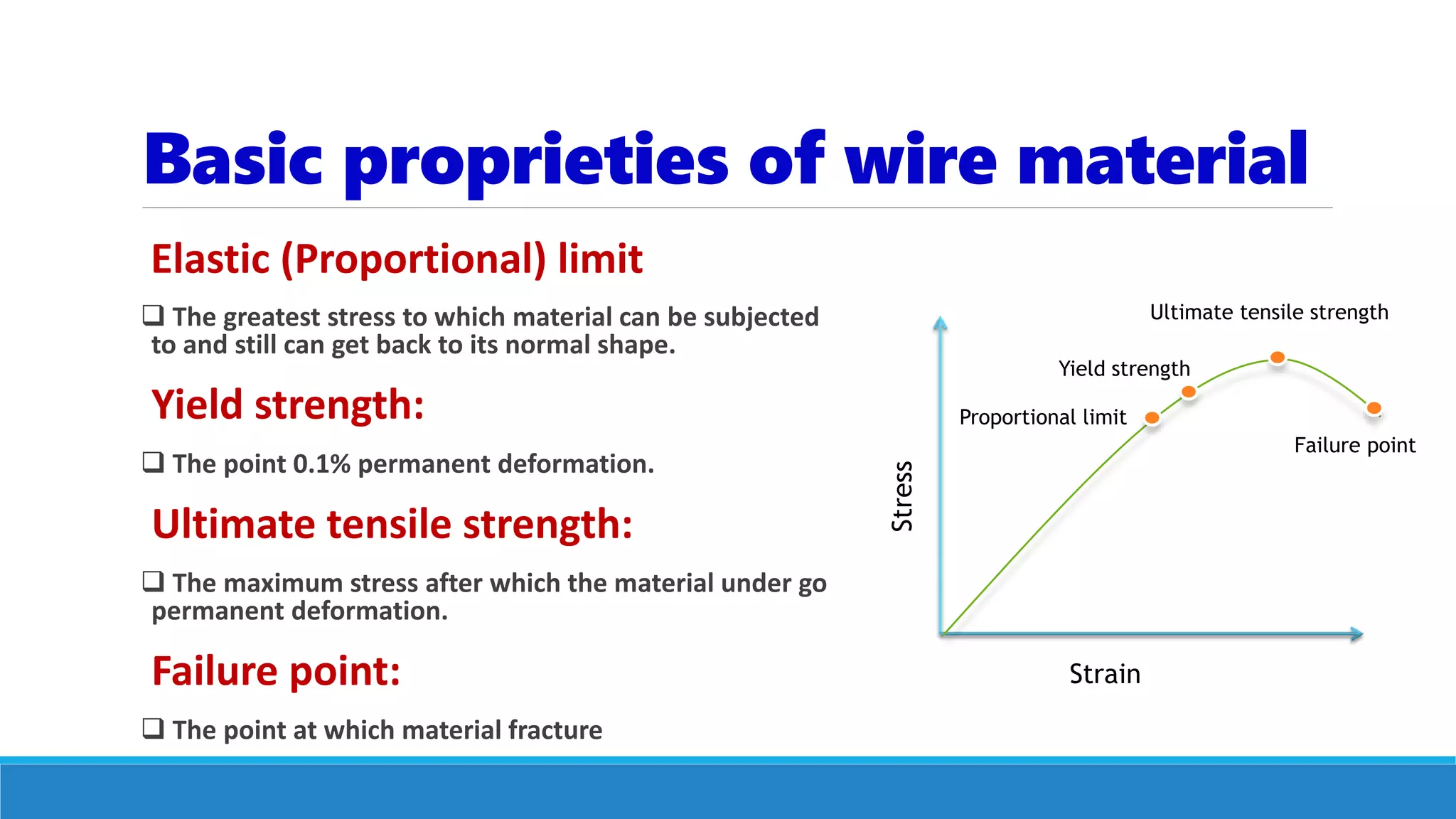
Elastic (Proportional) limit
 The greatest stress to which material can be subjected
to and still can get back to its normal shape.
Yield strength:
 The point 0.1% permanent deformation.
Ultimate tensile strength:
 The maximum stress after which the material under go
permanent deformation.
Failure point:
 The point at which material fracture
Ultimate tensile strength
Yield strength
Proportional limit
Failure point
Stress
Strain
Basic proprieties of wire material
Stiffness:
 The ability of the material to resist deformation.
Strength:
 The ability of the material to resist deformation without
fracture.
Elasticity
 The ability of a stressed material to return to its original
form
Basic proprieties of wire material
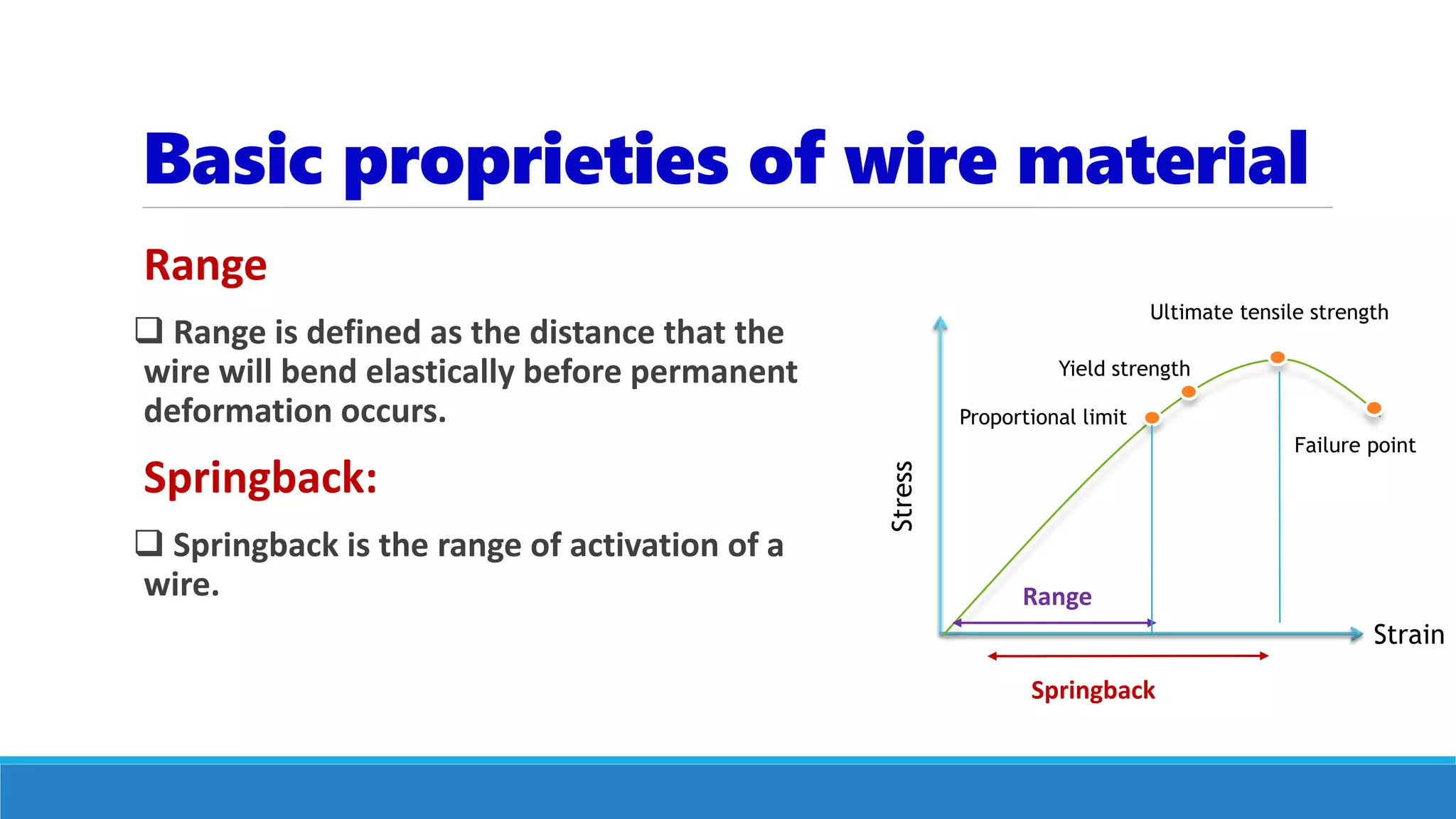
Range
 Range is defined as the distance that the
wire will bend elastically before permanent
deformation occurs.
Springback:
 Springback is the range of activation of a
wire.
Ultimate tensile strength
Yield strength
Proportional limit
Failure point
Stress
Strain
Range
Springback
Basic proprieties of wire material
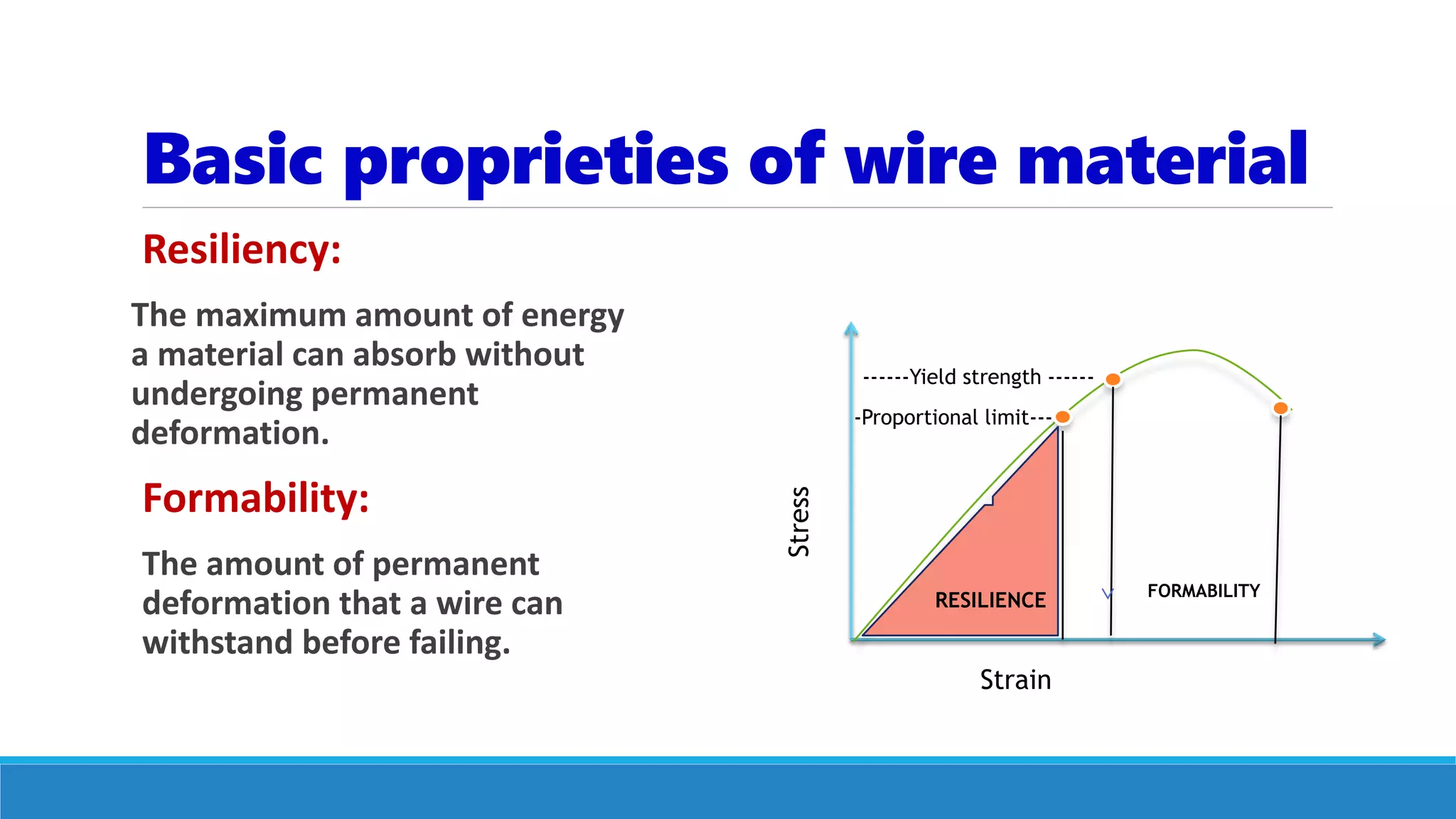
Resiliency:
The maximum amount of energy
a material can absorb without
undergoing permanent
deformation.
Formability:
The amount of permanent
deformation that a wire can
withstand before failing.
------Yield strength ------
-Proportional limit---
Strain
Stress
FORMABILITY
RESILIENCE
The Biologic Basis of
Orthodontic Therapy
 Orthodontic treatment is based on the principle that if
prolonged pressure is applied to a tooth, tooth movement
will occur as the bone around the tooth remodels.
 In essence, the tooth moves through the bone carrying
its attachment apparatus with it, as the socket of the tooth
migrates.
 Because the bony response is mediated by the
periodontal ligament, tooth movement is primarily a
periodontal ligament phenomenon.
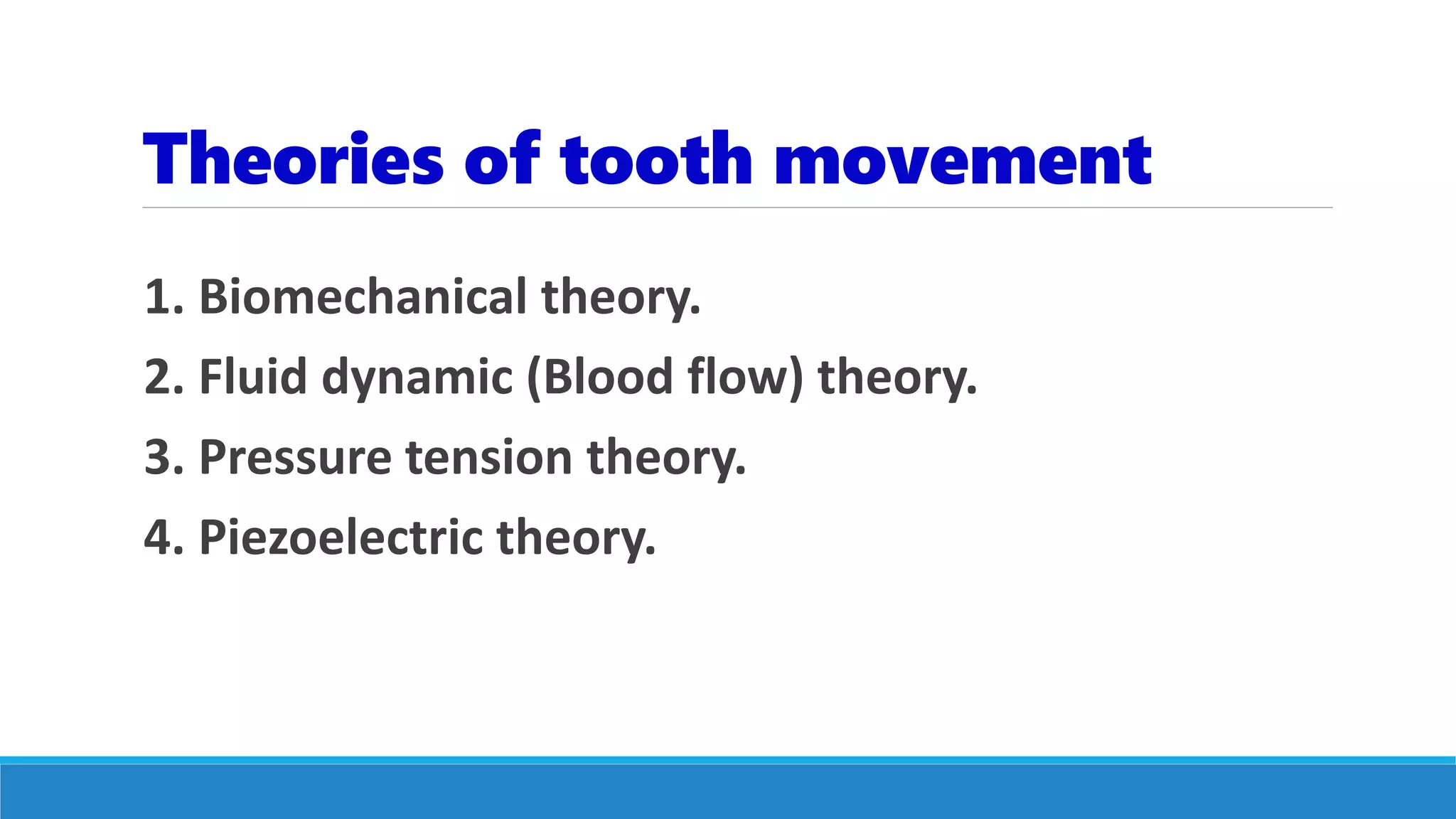
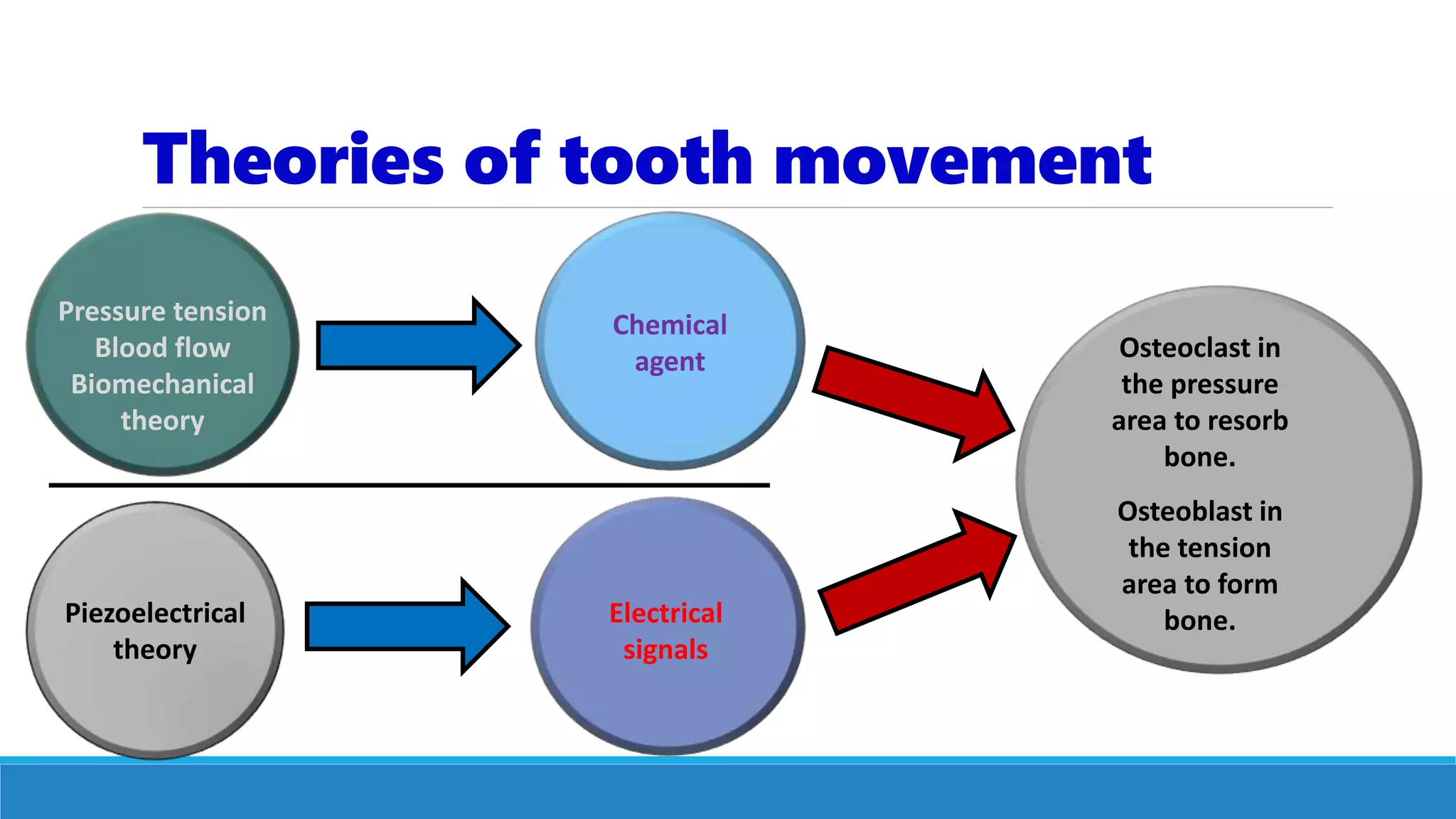
Theories of tooth movement
1. Biomechanical theory.
2. Fluid dynamic (Blood flow) theory.
3. Pressure tension theory.
4. Piezoelectric theory.
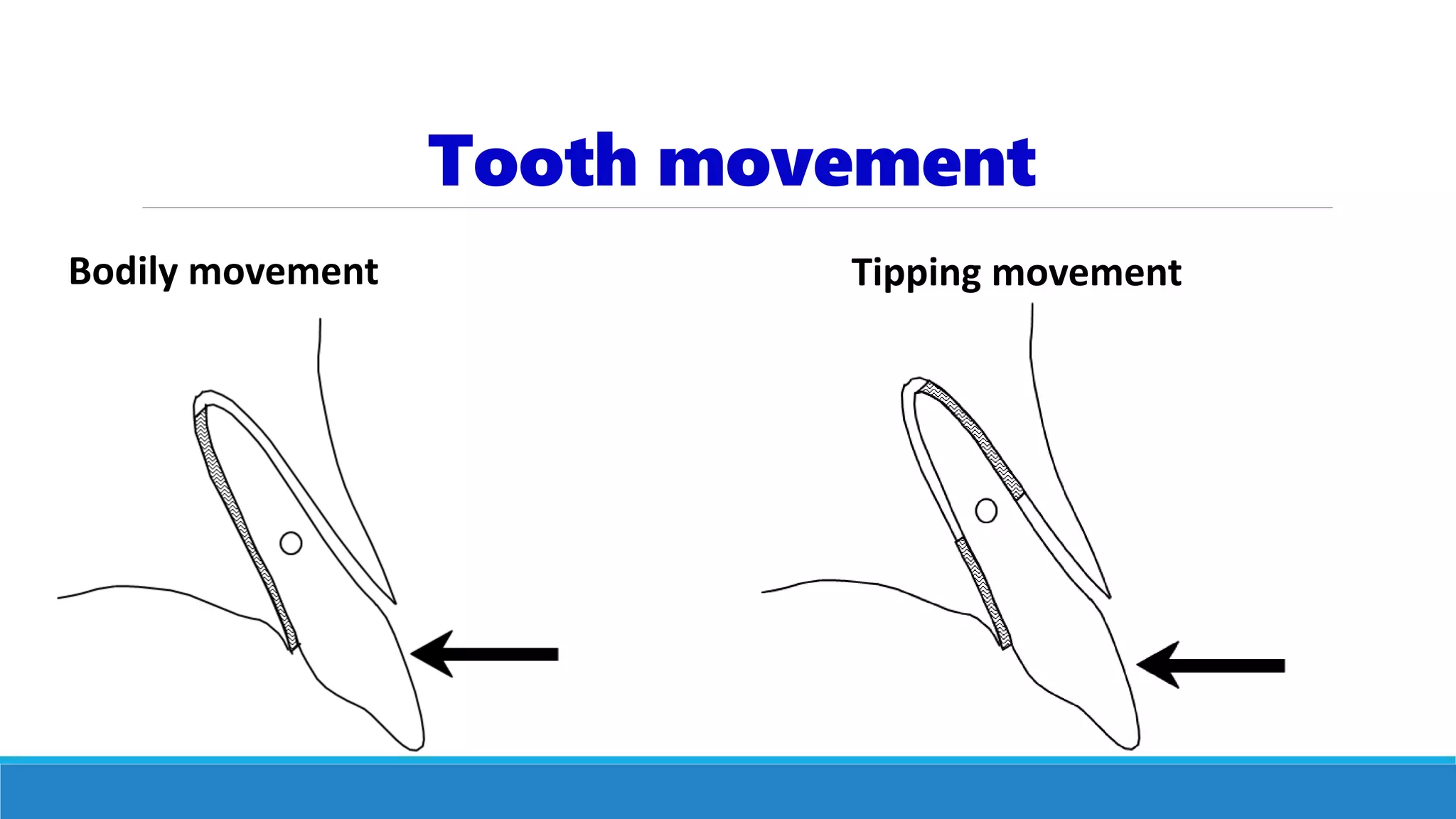
Tooth movement
Tipping movementBodily movement
Theories of tooth movement
Osteoclast in
the pressure
area to resorb
bone.
Osteoblast in
the tension
area to form
bone.
Chemical
agent
Electrical
signals
Pressure tension
Blood flow
Biomechanical
theory
Piezoelectrical
theory
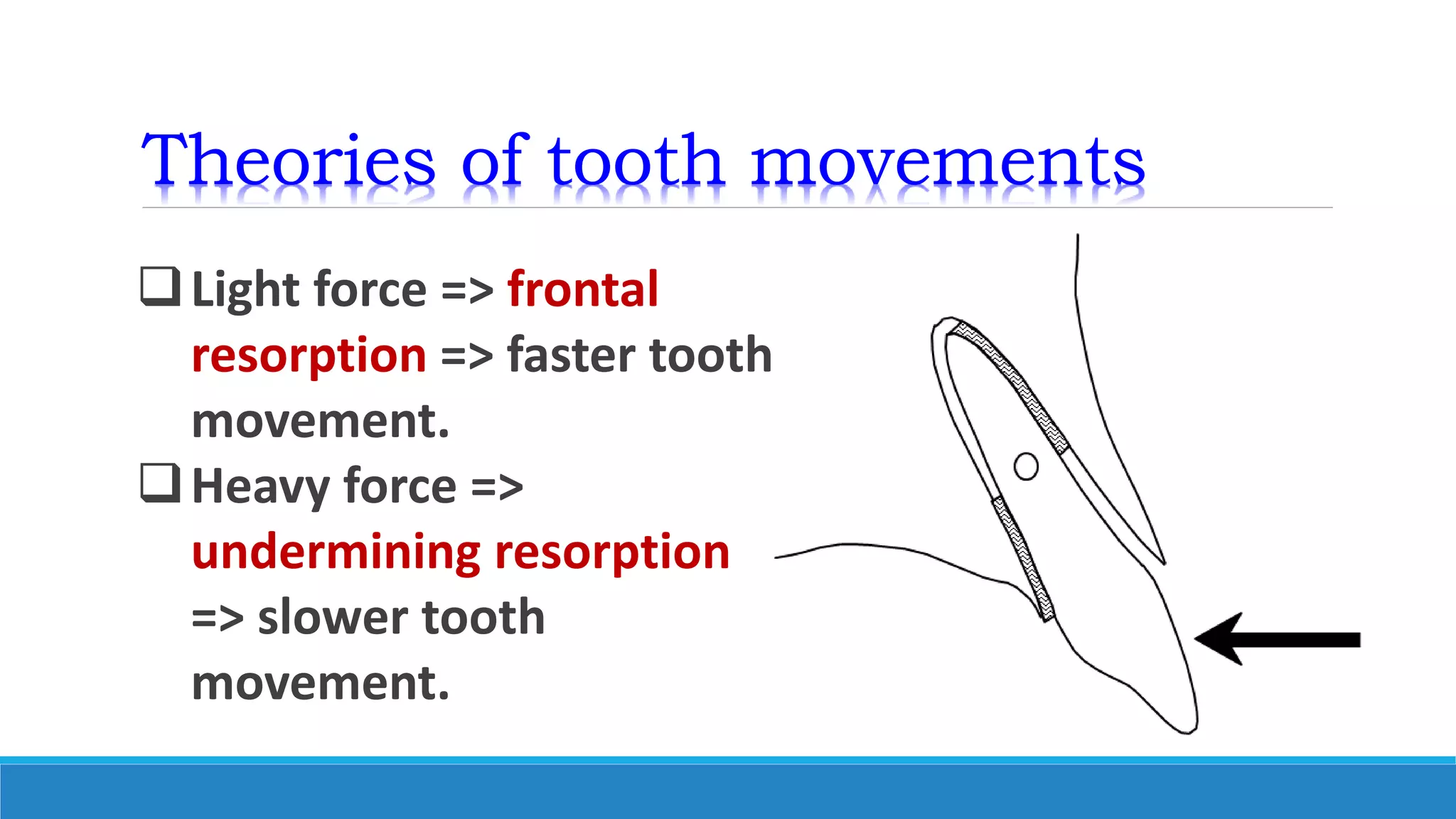
Theories of tooth movements
Light force => frontal
resorption => faster tooth
movement.
Heavy force =>
undermining resorption
=> slower tooth
movement.
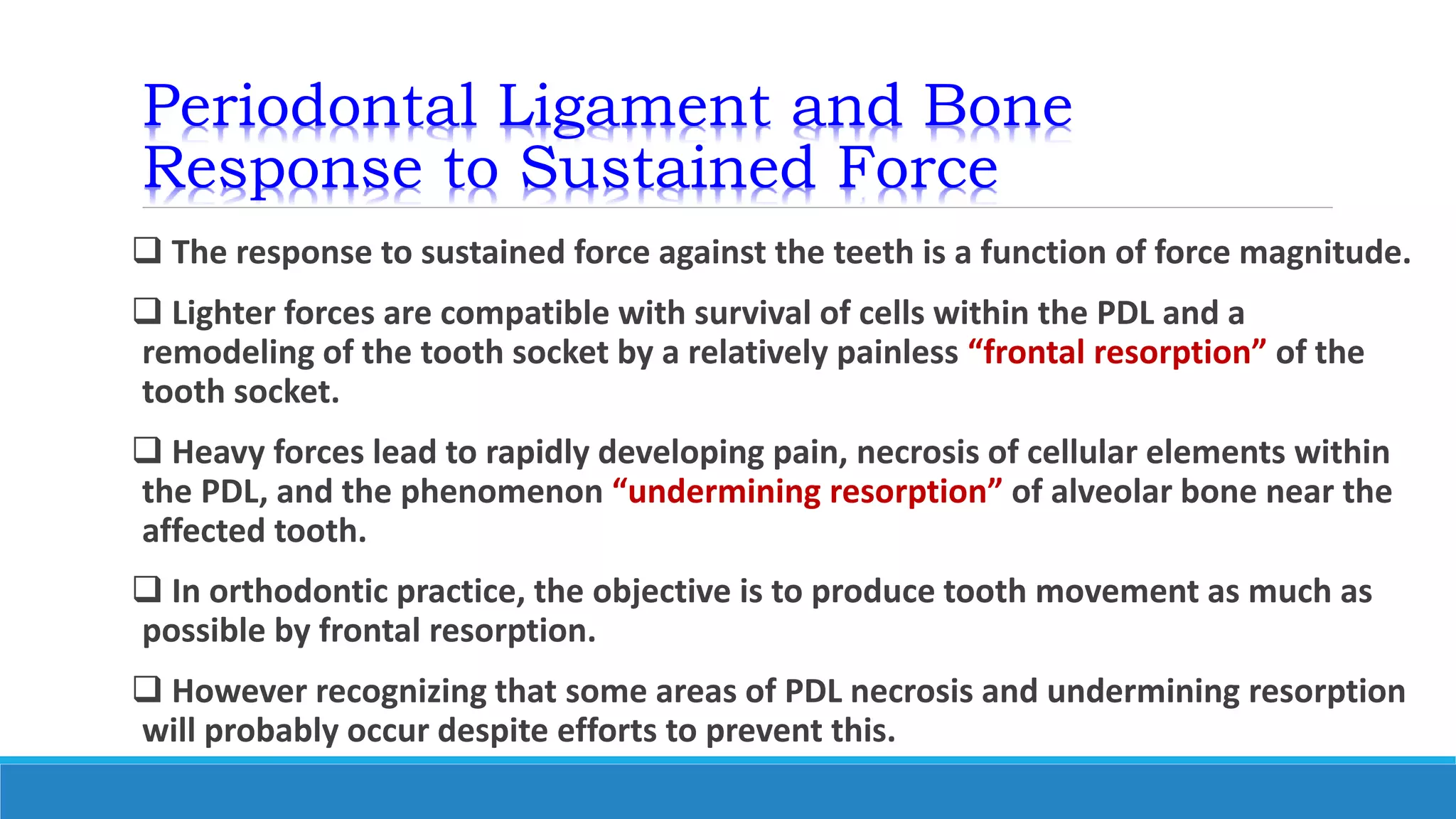
Periodontal Ligament and Bone
Response to Sustained Force
 The response to sustained force against the teeth is a function of force magnitude.
 Lighter forces are compatible with survival of cells within the PDL and a
remodeling of the tooth socket by a relatively painless “frontal resorption” of the
tooth socket.
 Heavy forces lead to rapidly developing pain, necrosis of cellular elements within
the PDL, and the phenomenon “undermining resorption” of alveolar bone near the
affected tooth.
 In orthodontic practice, the objective is to produce tooth movement as much as
possible by frontal resorption.
 However recognizing that some areas of PDL necrosis and undermining resorption
will probably occur despite efforts to prevent this.
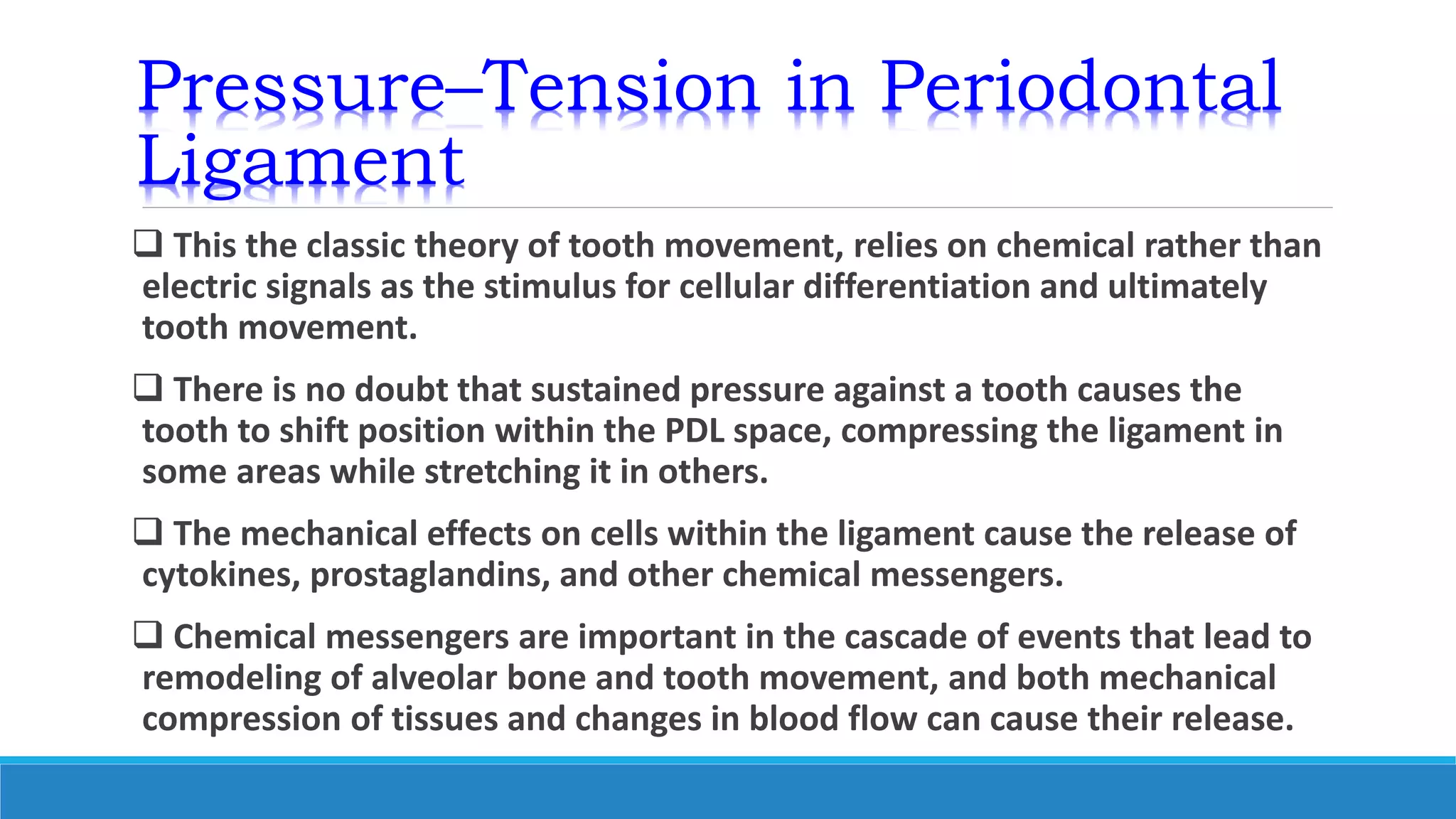
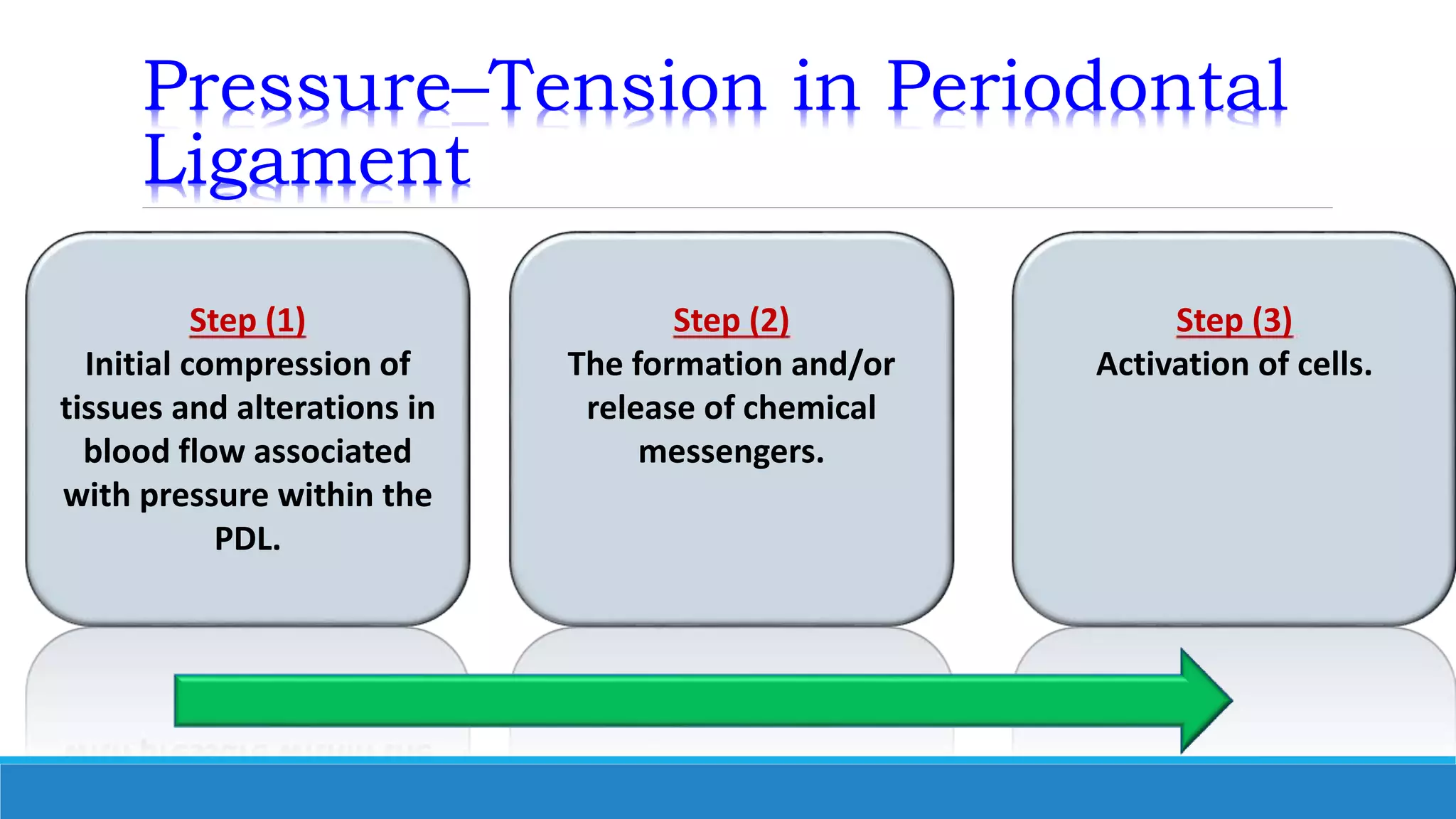
Pressure–Tension in Periodontal
Ligament
 This the classic theory of tooth movement, relies on chemical rather than
electric signals as the stimulus for cellular differentiation and ultimately
tooth movement.
 There is no doubt that sustained pressure against a tooth causes the
tooth to shift position within the PDL space, compressing the ligament in
some areas while stretching it in others.
 The mechanical effects on cells within the ligament cause the release of
cytokines, prostaglandins, and other chemical messengers.
 Chemical messengers are important in the cascade of events that lead to
remodeling of alveolar bone and tooth movement, and both mechanical
compression of tissues and changes in blood flow can cause their release.
Pressure–Tension in Periodontal
Ligament
Step (1)
Initial compression of
tissues and alterations in
blood flow associated
with pressure within the
PDL.
Step (2)
The formation and/or
release of chemical
messengers.
Step (3)
Activation of cells.
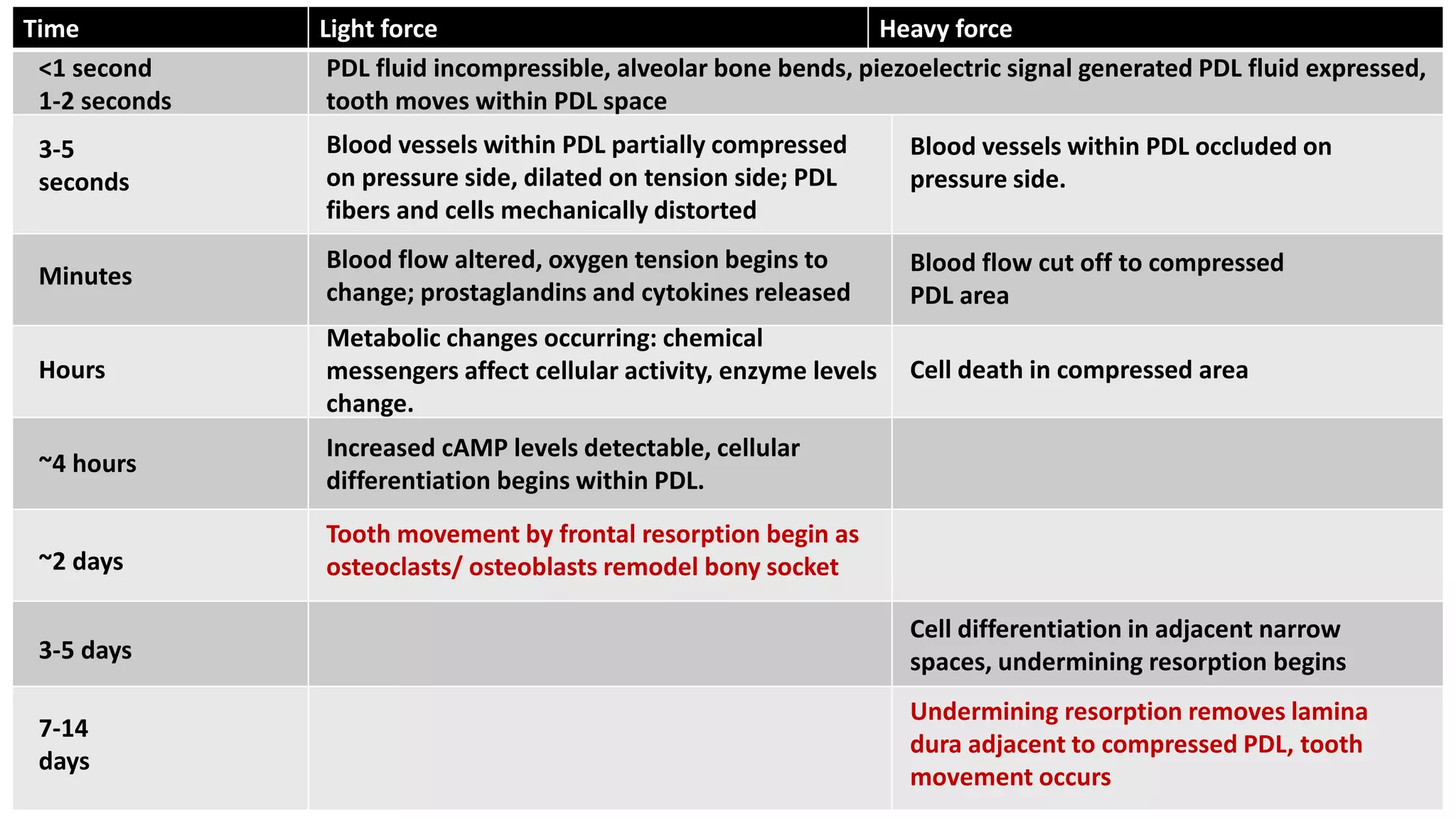
Time Light force Heavy force
<1 second
1-2 seconds
PDL fluid incompressible, alveolar bone bends, piezoelectric signal generated PDL fluid expressed,
tooth moves within PDL space
3-5
seconds
Blood vessels within PDL partially compressed
on pressure side, dilated on tension side; PDL
fibers and cells mechanically distorted
Blood vessels within PDL occluded on
pressure side.
Blood flow altered, oxygen tension begins to
change; prostaglandins and cytokines released
Blood flow cut off to compressed
PDL area
Metabolic changes occurring: chemical
messengers affect cellular activity, enzyme levels
change.
Minutes
Hours Cell death in compressed area
~4 hours
Increased cAMP levels detectable, cellular
differentiation begins within PDL.
~2 days
Tooth movement by frontal resorption begin as
osteoclasts/ osteoblasts remodel bony socket
3-5 days
Cell differentiation in adjacent narrow
spaces, undermining resorption begins
7-14
days
Undermining resorption removes lamina
dura adjacent to compressed PDL, tooth
movement occurs
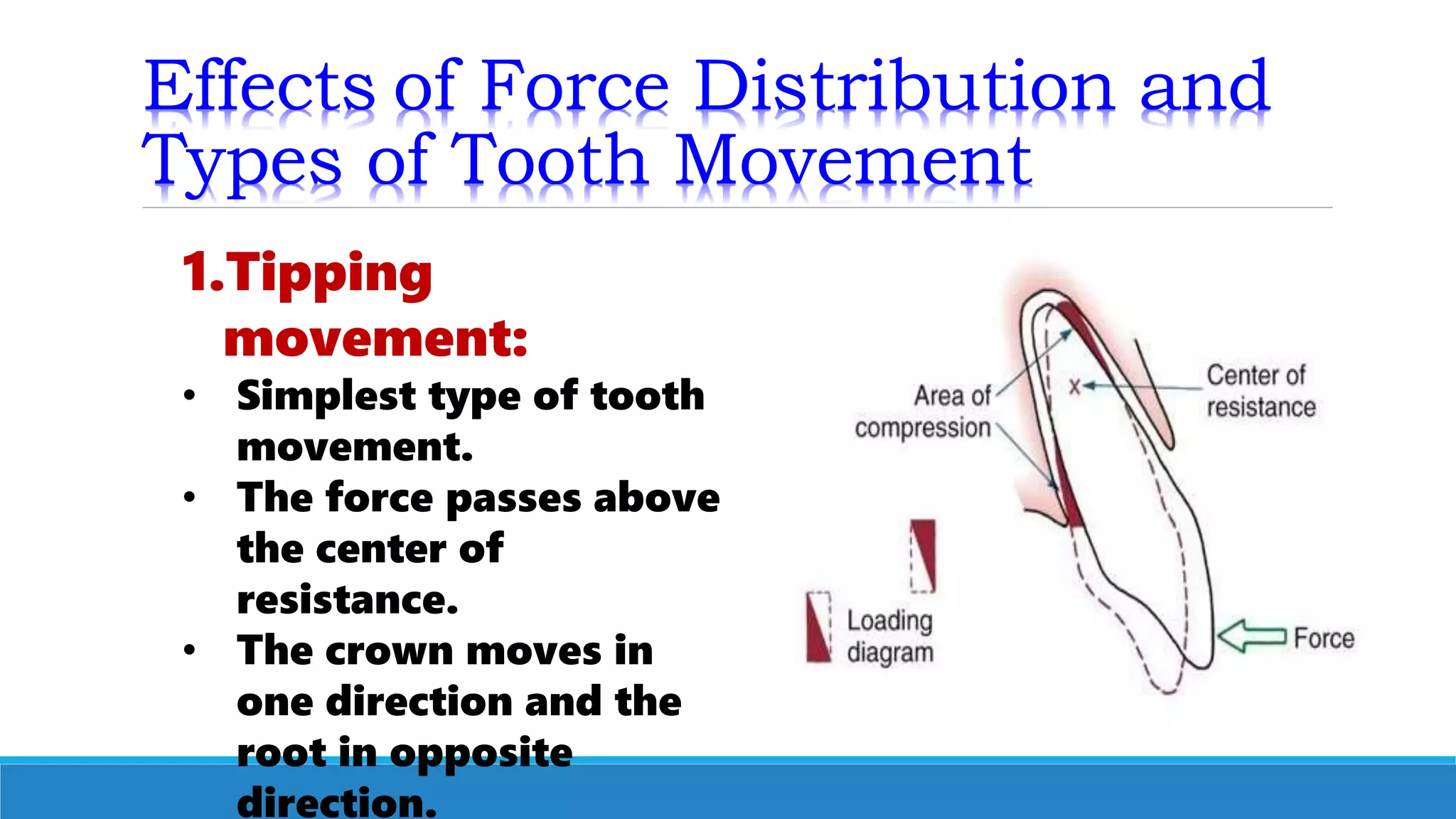
Effects of Force Distribution and
Types of Tooth Movement
1.Tipping
movement:
• Simplest type of tooth
movement.
• The force passes above
the center of
resistance.
• The crown moves in
one direction and the
root in opposite
direction.
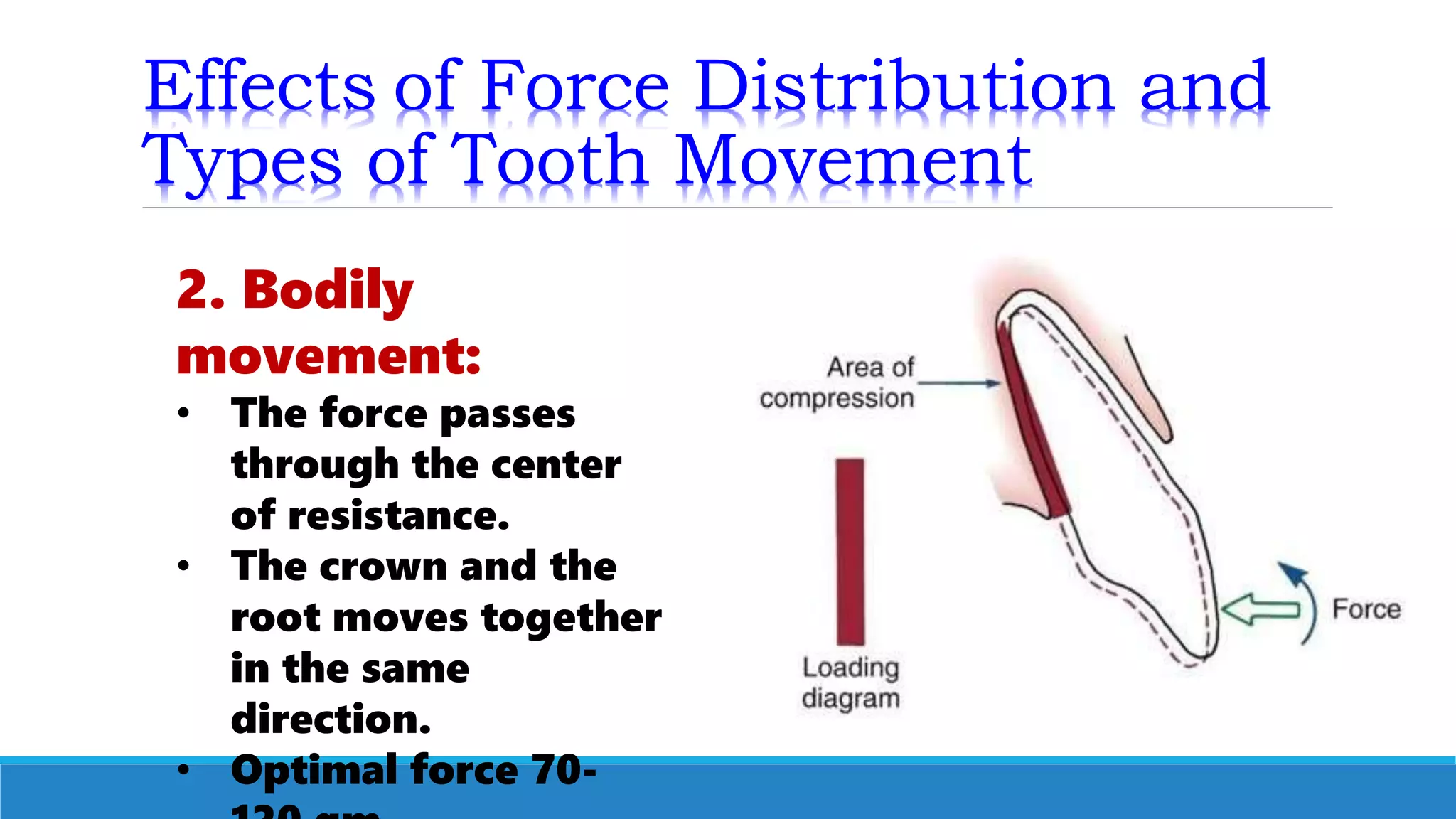
Effects of Force Distribution and
Types of Tooth Movement
2. Bodily
movement:
• The force passes
through the center
of resistance.
• The crown and the
root moves together
in the same
direction.
• Optimal force 70-
Effects of Force Distribution and
Types of Tooth Movement
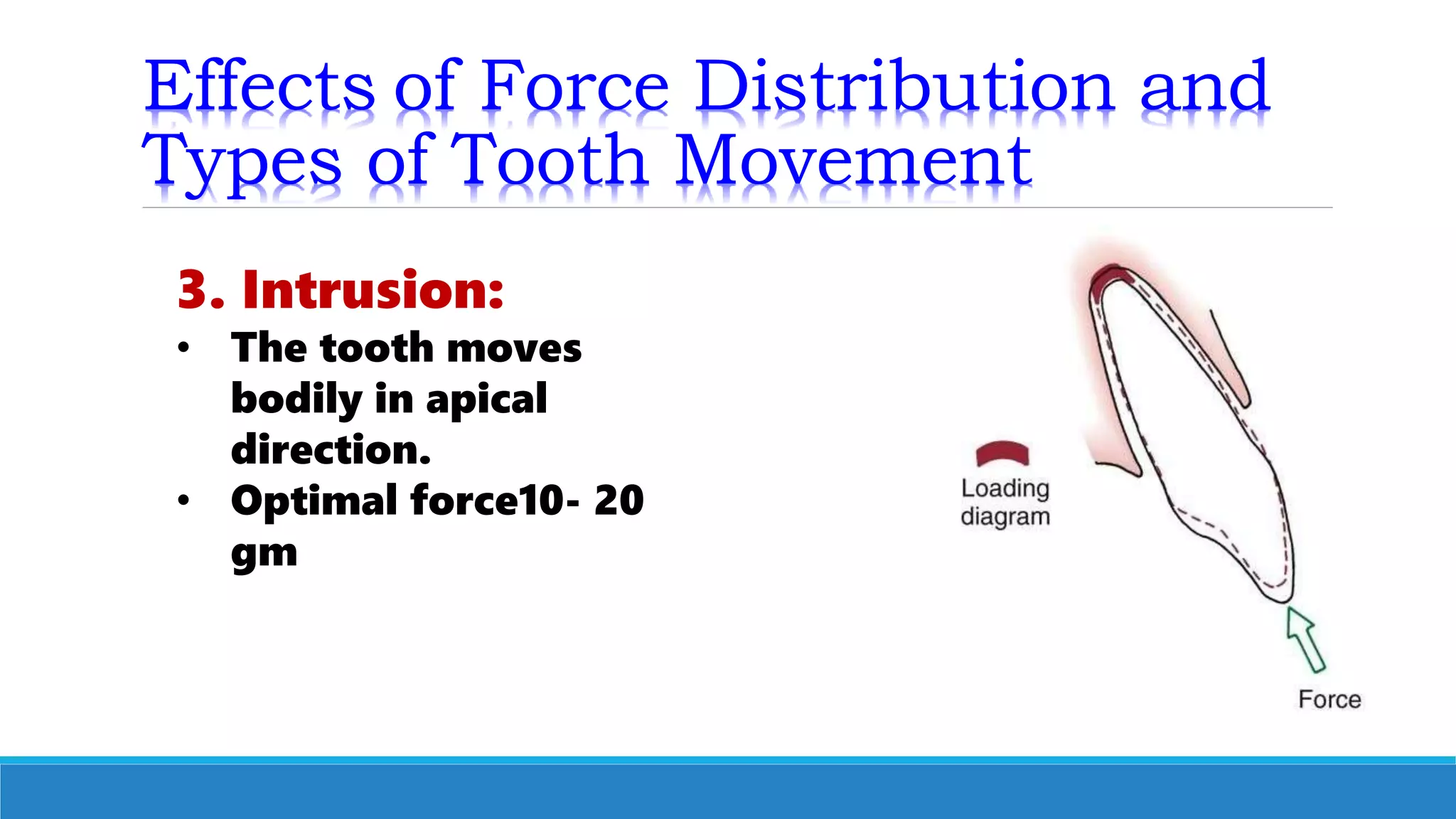
3. Intrusion:
• The tooth moves
bodily in apical
direction.
• Optimal force10- 20
gm
Effects of Force Distribution and
Types of Tooth Movement
4. Extrusion:
• The tooth moves bodily in
coronal direction.
• Optimal force 35- 60 gm
Effects of Force Distribution and
Types of Tooth Movement
5. Rotation:
• The tooth moves around
it’s long axis.
• Optimal force 35- 60 gm.
Effects of Force Distribution and
Types of Tooth Movement
6. Root uprighting
(torqueing):
• Movement of the root without
the movement of the crown.
• Optimal force 50- 100 gm.
Effects of Force Duration and
Force Decay
 The key to producing orthodontic tooth movement is the
application of sustained force, which does not mean that the
force must be absolutely continuous.
 It does mean that the force must be present for a
considerable percentage of the time, certainly hours rather
than minutes per day.
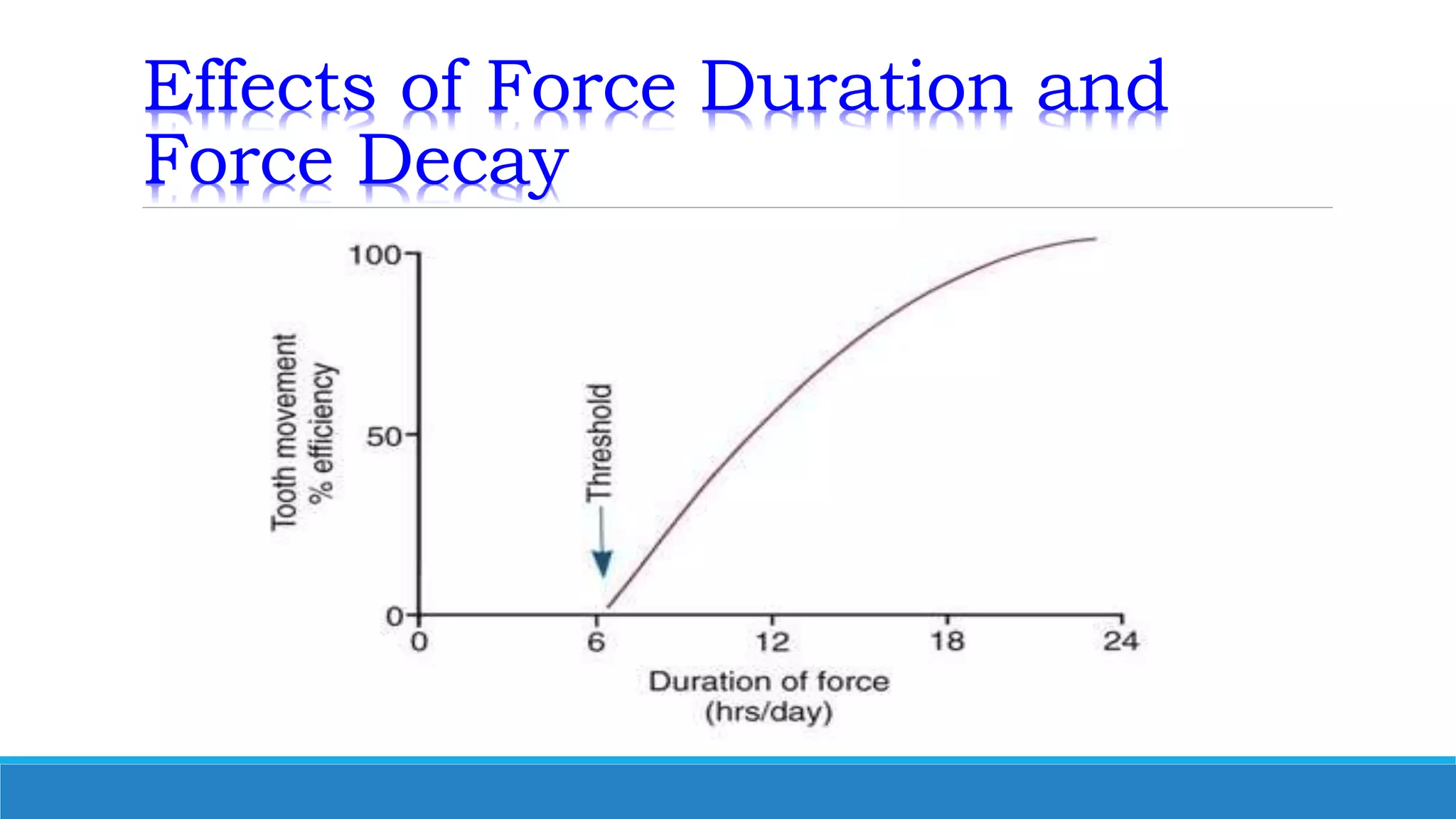
 Clinical experience suggests that there is a threshold for
force duration in humans in the 4 to 8 hour range (Mean is 6
hours) and that increasingly effective tooth movement is
produced if force is maintained for longer durations.
Effects of Force Duration and
Force Decay
Effects of Force Duration and
Force Decay
 Duration of force has another aspect, related to how force magnitude
changes as the tooth responds by moving.
 Only in theory is it possible to make a perfect spring, one that would
deliver the same force day after day, no matter how much or how little
the tooth moved in response to that force.
 In reality, some decline in force magnitude (i.e., force decay) is noted
with even the springiest device after the tooth has moved a short
distance though with the superelastic nickel–titanium materials, the
decrease is amazingly small.
 With many orthodontic devices, the force may drop all the way to zero.
Effects of Force Duration and
Force Decay
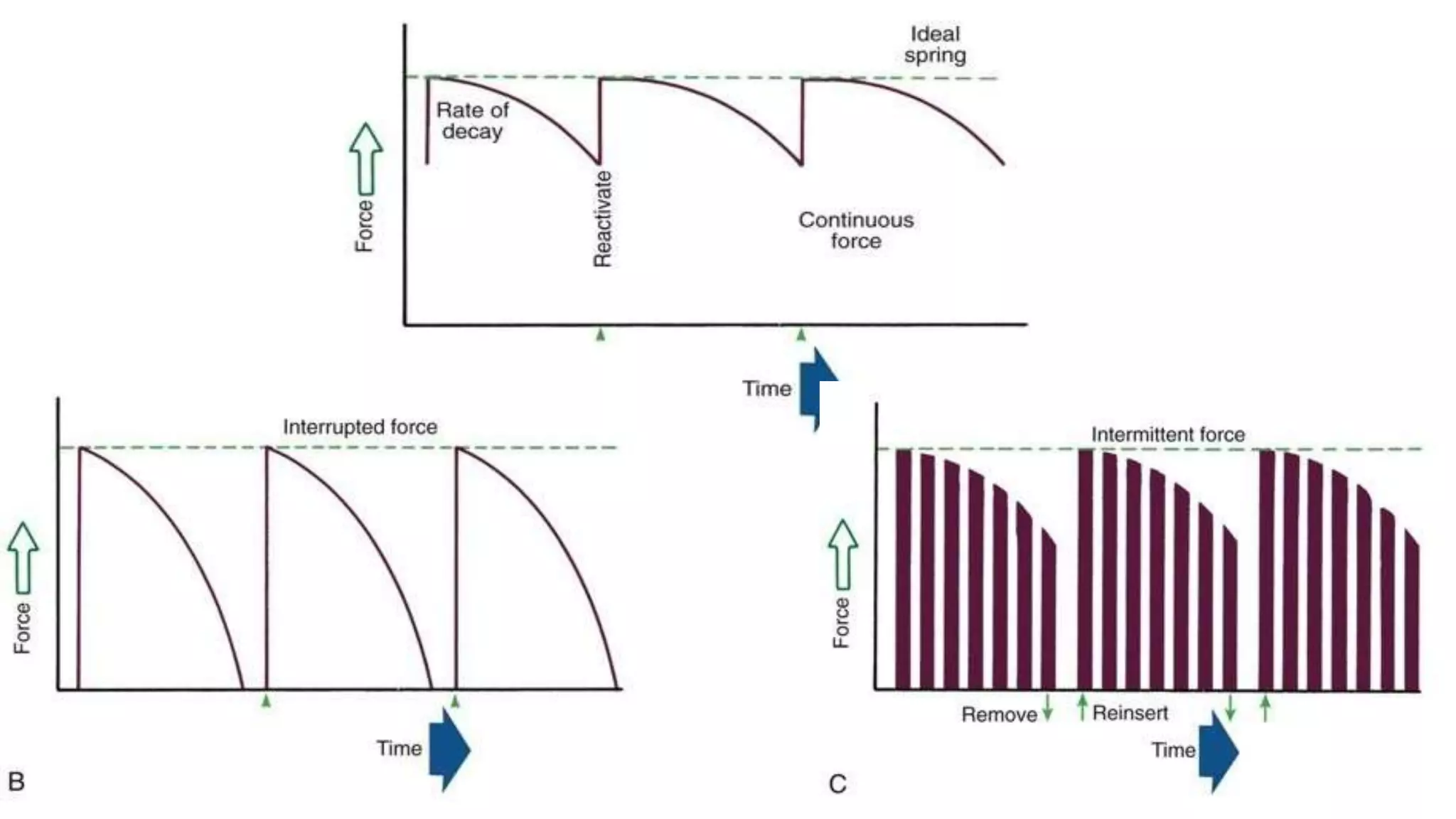
 From this perspective, orthodontic force duration
is classified by the rate of decay as:
 Continuous—force maintained at some appreciable
fraction of the original from one patient visit to the next
(e.g. fixed appliances).
 Interrupted—force levels decline to zero between
activations (e.g. closing loops).
 Intermittent—force levels decline abruptly to zero when
the appliance is removed (e.g. removable appliances).
Effects of Force Duration and
Force Decay
 Both continuous and interrupted forces can be produced by
fixed appliances that are constantly present.
 Intermittent forces are produced by all patient-activated
appliances such as removable plates, headgear, and elastics.
 Forces generated during normal function (e.g., chewing,
swallowing, speaking) can be viewed as a special case of
intermittently applied forces, most of which are not
maintained for enough hours per day to have significant
effects on the position of the teeth.
Effects of Force Duration and
Force Decay
 There is an important interaction between force magnitude and
how rapidly the force declines as the tooth responds.
 Light continues force is desirable, however heavy continuous
forces are to be avoided because there is no time for the PDL to
heal.
 Heavy intermittent forces, though less efficient, can be clinically
acceptable.
 To say it another way: the more perfect the spring in the sense
of its ability to provide continuous force, the more careful the
clinician must be that only light force is applied.
Effects of Force Duration and
Force Decay
 Experience has shown that orthodontic appliances should not be
reactivated more frequently than at 3-week intervals, and a 4- to 6-week
appointment cycle is more typical in clinical practice.
 Undermining resorption requires 7 to 14 days the tooth movement
occurs in the first 10 days or so, and there is an equal or longer period
for PDL regeneration and repair before force is applied again.
 This repair phase is highly desirable and needed with many
appliances.
 Activating an appliance too frequently, short circuiting the repair
process, can produce damage to the teeth or bone that a longer
appointment cycle would have prevented or at least minimized.
Declaration
 The author wish to declare that; these presentations are his original work, all
materials and pictures collection, typing and slide design has been done by the
author.
 Most of these materials has been done for undergraduate students, although
postgraduate students may find some useful basic and advanced information.
 The universities title at the front page indicate where the lecture was first
presented. The author was working as a lecturer of orthodontics at Ibn Sina
University, Sudan International University, and as a Master student in Orthodontics at
University of Khartoum.
 The author declare that all materials and photos in these presentations has been
collected from different textbooks, papers and online websites. These pictures are
presented here for education and demonstration purposes only. The author are not
attempting to plagiarize or reproduced unauthorized material, and the intellectual
properties of these photos belong to their original authors.
Declaration
 As the authors reviews several textbooks, papers and other references during
preparation of these materials, it was impossible to cite every textbook and journal
article, the main textbooks that has been reviewed during preparation of these
presentations were:
Contemporary Orthodontics 5th edition; Proffit, William R, Henry W. Fields, and
David M. Sarver.
Handbook of Orthodontics. 1st edition; Cobourne, Martyn T, and Andrew T. DiBiase.
Clinical cases in orthodontics. Martyn T. Cobourne, Padhraig S. Fleming, Andrew T.
DiBiase, Sofia Ahmad
Essentials of orthodontics: Diagnosis and Treatment; Robert N. Staley, Neil T. Reske
Orthodontics: Current Principles & Techniques 5th edition; Graber, Lee W, Robert L.
Vanarsdall, and Katherine W. L. Vig
Orthodontics: The Art and Science. 3rd Edition. Bhalajhi, S.I.
Declaration
 For the purposes of dissemination and sharing of knowledge, these
lectures were given to several colleagues and students. It were also
uploaded to SlideShare website by the author. Colleagues and students
may download, use, and modify these materials as they see fit for non-
profit purposes. The author retain the copyright of the original work.
 The author wish to thank his family, teachers, colleagues and students
for their love and support throughout his career. I also wish to express
my sincere gratitude to all orthodontic pillars for their tremendous
contribution to our specialty.
 Finally, the author welcome any advices and enquires through his
email address: Mohanad-07@hotmail.com
Thank You

Biomechanics and mechanics of tooth movement

  • 1.
    Ibn Sina University Facultyof Dentistry Department of Orthodontics Biomechanics, Mechanics of tooth Movement Mohanad Elsherif BDS (U of K), MFD RCSI, MFDS RCPS(Glasg), MSc (Orthodontics), M.Orth. RCSEd
  • 2.
    Mechanics and Biomechanics Mechanics: Thebranch of engineering that study the effect of a force to the body. Biomechanics: The study of he reaction of the dental and facial structures to orthodontic force.
  • 3.
    Basic proprieties ofwire material Stress:  Internal distribution of the load. Measured as force per unit area.  It can be classified into compressive, tensile or shear stress. force force force force forceforce Compressive stress Tensile stress Shear stress
  • 4.
    Basic proprieties ofwire material Strain  It is the internal distortion produced by the load. Measured deflection per unit length.  It can be classified as elastic or plastic. Elastic strain Plastic strain
  • 5.
    Basic proprieties ofwire material Hooks law:  Stress is proportional to the strain within the elastic limit. Proportional limit Stress Strain
  • 6.
    Basic proprieties ofwire material Elastic (Proportional) limit  The greatest stress to which material can be subjected to and still can get back to its normal shape. Yield strength:  The point 0.1% permanent deformation. Ultimate tensile strength:  The maximum stress after which the material under go permanent deformation. Failure point:  The point at which material fracture Ultimate tensile strength Yield strength Proportional limit Failure point Stress Strain
  • 7.
    Basic proprieties ofwire material Stiffness:  The ability of the material to resist deformation. Strength:  The ability of the material to resist deformation without fracture. Elasticity  The ability of a stressed material to return to its original form
  • 8.
    Basic proprieties ofwire material Range  Range is defined as the distance that the wire will bend elastically before permanent deformation occurs. Springback:  Springback is the range of activation of a wire. Ultimate tensile strength Yield strength Proportional limit Failure point Stress Strain Range Springback
  • 9.
    Basic proprieties ofwire material Resiliency: The maximum amount of energy a material can absorb without undergoing permanent deformation. Formability: The amount of permanent deformation that a wire can withstand before failing. ------Yield strength ------ -Proportional limit--- Strain Stress FORMABILITY RESILIENCE
  • 10.
    The Biologic Basisof Orthodontic Therapy  Orthodontic treatment is based on the principle that if prolonged pressure is applied to a tooth, tooth movement will occur as the bone around the tooth remodels.  In essence, the tooth moves through the bone carrying its attachment apparatus with it, as the socket of the tooth migrates.  Because the bony response is mediated by the periodontal ligament, tooth movement is primarily a periodontal ligament phenomenon.
  • 11.
    Theories of toothmovement 1. Biomechanical theory. 2. Fluid dynamic (Blood flow) theory. 3. Pressure tension theory. 4. Piezoelectric theory.
  • 12.
  • 13.
    Theories of toothmovement Osteoclast in the pressure area to resorb bone. Osteoblast in the tension area to form bone. Chemical agent Electrical signals Pressure tension Blood flow Biomechanical theory Piezoelectrical theory
  • 14.
    Theories of toothmovements Light force => frontal resorption => faster tooth movement. Heavy force => undermining resorption => slower tooth movement.
  • 15.
    Periodontal Ligament andBone Response to Sustained Force  The response to sustained force against the teeth is a function of force magnitude.  Lighter forces are compatible with survival of cells within the PDL and a remodeling of the tooth socket by a relatively painless “frontal resorption” of the tooth socket.  Heavy forces lead to rapidly developing pain, necrosis of cellular elements within the PDL, and the phenomenon “undermining resorption” of alveolar bone near the affected tooth.  In orthodontic practice, the objective is to produce tooth movement as much as possible by frontal resorption.  However recognizing that some areas of PDL necrosis and undermining resorption will probably occur despite efforts to prevent this.
  • 16.
    Pressure–Tension in Periodontal Ligament This the classic theory of tooth movement, relies on chemical rather than electric signals as the stimulus for cellular differentiation and ultimately tooth movement.  There is no doubt that sustained pressure against a tooth causes the tooth to shift position within the PDL space, compressing the ligament in some areas while stretching it in others.  The mechanical effects on cells within the ligament cause the release of cytokines, prostaglandins, and other chemical messengers.  Chemical messengers are important in the cascade of events that lead to remodeling of alveolar bone and tooth movement, and both mechanical compression of tissues and changes in blood flow can cause their release.
  • 17.
    Pressure–Tension in Periodontal Ligament Step(1) Initial compression of tissues and alterations in blood flow associated with pressure within the PDL. Step (2) The formation and/or release of chemical messengers. Step (3) Activation of cells.
  • 18.
    Time Light forceHeavy force <1 second 1-2 seconds PDL fluid incompressible, alveolar bone bends, piezoelectric signal generated PDL fluid expressed, tooth moves within PDL space 3-5 seconds Blood vessels within PDL partially compressed on pressure side, dilated on tension side; PDL fibers and cells mechanically distorted Blood vessels within PDL occluded on pressure side. Blood flow altered, oxygen tension begins to change; prostaglandins and cytokines released Blood flow cut off to compressed PDL area Metabolic changes occurring: chemical messengers affect cellular activity, enzyme levels change. Minutes Hours Cell death in compressed area ~4 hours Increased cAMP levels detectable, cellular differentiation begins within PDL. ~2 days Tooth movement by frontal resorption begin as osteoclasts/ osteoblasts remodel bony socket 3-5 days Cell differentiation in adjacent narrow spaces, undermining resorption begins 7-14 days Undermining resorption removes lamina dura adjacent to compressed PDL, tooth movement occurs
  • 19.
    Effects of ForceDistribution and Types of Tooth Movement 1.Tipping movement: • Simplest type of tooth movement. • The force passes above the center of resistance. • The crown moves in one direction and the root in opposite direction.
  • 20.
    Effects of ForceDistribution and Types of Tooth Movement 2. Bodily movement: • The force passes through the center of resistance. • The crown and the root moves together in the same direction. • Optimal force 70-
  • 21.
    Effects of ForceDistribution and Types of Tooth Movement 3. Intrusion: • The tooth moves bodily in apical direction. • Optimal force10- 20 gm
  • 22.
    Effects of ForceDistribution and Types of Tooth Movement 4. Extrusion: • The tooth moves bodily in coronal direction. • Optimal force 35- 60 gm
  • 23.
    Effects of ForceDistribution and Types of Tooth Movement 5. Rotation: • The tooth moves around it’s long axis. • Optimal force 35- 60 gm.
  • 24.
    Effects of ForceDistribution and Types of Tooth Movement 6. Root uprighting (torqueing): • Movement of the root without the movement of the crown. • Optimal force 50- 100 gm.
  • 25.
    Effects of ForceDuration and Force Decay  The key to producing orthodontic tooth movement is the application of sustained force, which does not mean that the force must be absolutely continuous.  It does mean that the force must be present for a considerable percentage of the time, certainly hours rather than minutes per day.  Clinical experience suggests that there is a threshold for force duration in humans in the 4 to 8 hour range (Mean is 6 hours) and that increasingly effective tooth movement is produced if force is maintained for longer durations.
  • 26.
    Effects of ForceDuration and Force Decay
  • 27.
    Effects of ForceDuration and Force Decay  Duration of force has another aspect, related to how force magnitude changes as the tooth responds by moving.  Only in theory is it possible to make a perfect spring, one that would deliver the same force day after day, no matter how much or how little the tooth moved in response to that force.  In reality, some decline in force magnitude (i.e., force decay) is noted with even the springiest device after the tooth has moved a short distance though with the superelastic nickel–titanium materials, the decrease is amazingly small.  With many orthodontic devices, the force may drop all the way to zero.
  • 28.
    Effects of ForceDuration and Force Decay  From this perspective, orthodontic force duration is classified by the rate of decay as:  Continuous—force maintained at some appreciable fraction of the original from one patient visit to the next (e.g. fixed appliances).  Interrupted—force levels decline to zero between activations (e.g. closing loops).  Intermittent—force levels decline abruptly to zero when the appliance is removed (e.g. removable appliances).
  • 30.
    Effects of ForceDuration and Force Decay  Both continuous and interrupted forces can be produced by fixed appliances that are constantly present.  Intermittent forces are produced by all patient-activated appliances such as removable plates, headgear, and elastics.  Forces generated during normal function (e.g., chewing, swallowing, speaking) can be viewed as a special case of intermittently applied forces, most of which are not maintained for enough hours per day to have significant effects on the position of the teeth.
  • 31.
    Effects of ForceDuration and Force Decay  There is an important interaction between force magnitude and how rapidly the force declines as the tooth responds.  Light continues force is desirable, however heavy continuous forces are to be avoided because there is no time for the PDL to heal.  Heavy intermittent forces, though less efficient, can be clinically acceptable.  To say it another way: the more perfect the spring in the sense of its ability to provide continuous force, the more careful the clinician must be that only light force is applied.
  • 32.
    Effects of ForceDuration and Force Decay  Experience has shown that orthodontic appliances should not be reactivated more frequently than at 3-week intervals, and a 4- to 6-week appointment cycle is more typical in clinical practice.  Undermining resorption requires 7 to 14 days the tooth movement occurs in the first 10 days or so, and there is an equal or longer period for PDL regeneration and repair before force is applied again.  This repair phase is highly desirable and needed with many appliances.  Activating an appliance too frequently, short circuiting the repair process, can produce damage to the teeth or bone that a longer appointment cycle would have prevented or at least minimized.
  • 33.
    Declaration  The authorwish to declare that; these presentations are his original work, all materials and pictures collection, typing and slide design has been done by the author.  Most of these materials has been done for undergraduate students, although postgraduate students may find some useful basic and advanced information.  The universities title at the front page indicate where the lecture was first presented. The author was working as a lecturer of orthodontics at Ibn Sina University, Sudan International University, and as a Master student in Orthodontics at University of Khartoum.  The author declare that all materials and photos in these presentations has been collected from different textbooks, papers and online websites. These pictures are presented here for education and demonstration purposes only. The author are not attempting to plagiarize or reproduced unauthorized material, and the intellectual properties of these photos belong to their original authors.
  • 34.
    Declaration  As theauthors reviews several textbooks, papers and other references during preparation of these materials, it was impossible to cite every textbook and journal article, the main textbooks that has been reviewed during preparation of these presentations were: Contemporary Orthodontics 5th edition; Proffit, William R, Henry W. Fields, and David M. Sarver. Handbook of Orthodontics. 1st edition; Cobourne, Martyn T, and Andrew T. DiBiase. Clinical cases in orthodontics. Martyn T. Cobourne, Padhraig S. Fleming, Andrew T. DiBiase, Sofia Ahmad Essentials of orthodontics: Diagnosis and Treatment; Robert N. Staley, Neil T. Reske Orthodontics: Current Principles & Techniques 5th edition; Graber, Lee W, Robert L. Vanarsdall, and Katherine W. L. Vig Orthodontics: The Art and Science. 3rd Edition. Bhalajhi, S.I.
  • 35.
    Declaration  For thepurposes of dissemination and sharing of knowledge, these lectures were given to several colleagues and students. It were also uploaded to SlideShare website by the author. Colleagues and students may download, use, and modify these materials as they see fit for non- profit purposes. The author retain the copyright of the original work.  The author wish to thank his family, teachers, colleagues and students for their love and support throughout his career. I also wish to express my sincere gratitude to all orthodontic pillars for their tremendous contribution to our specialty.  Finally, the author welcome any advices and enquires through his email address: Mohanad-07@hotmail.com
  • 36.