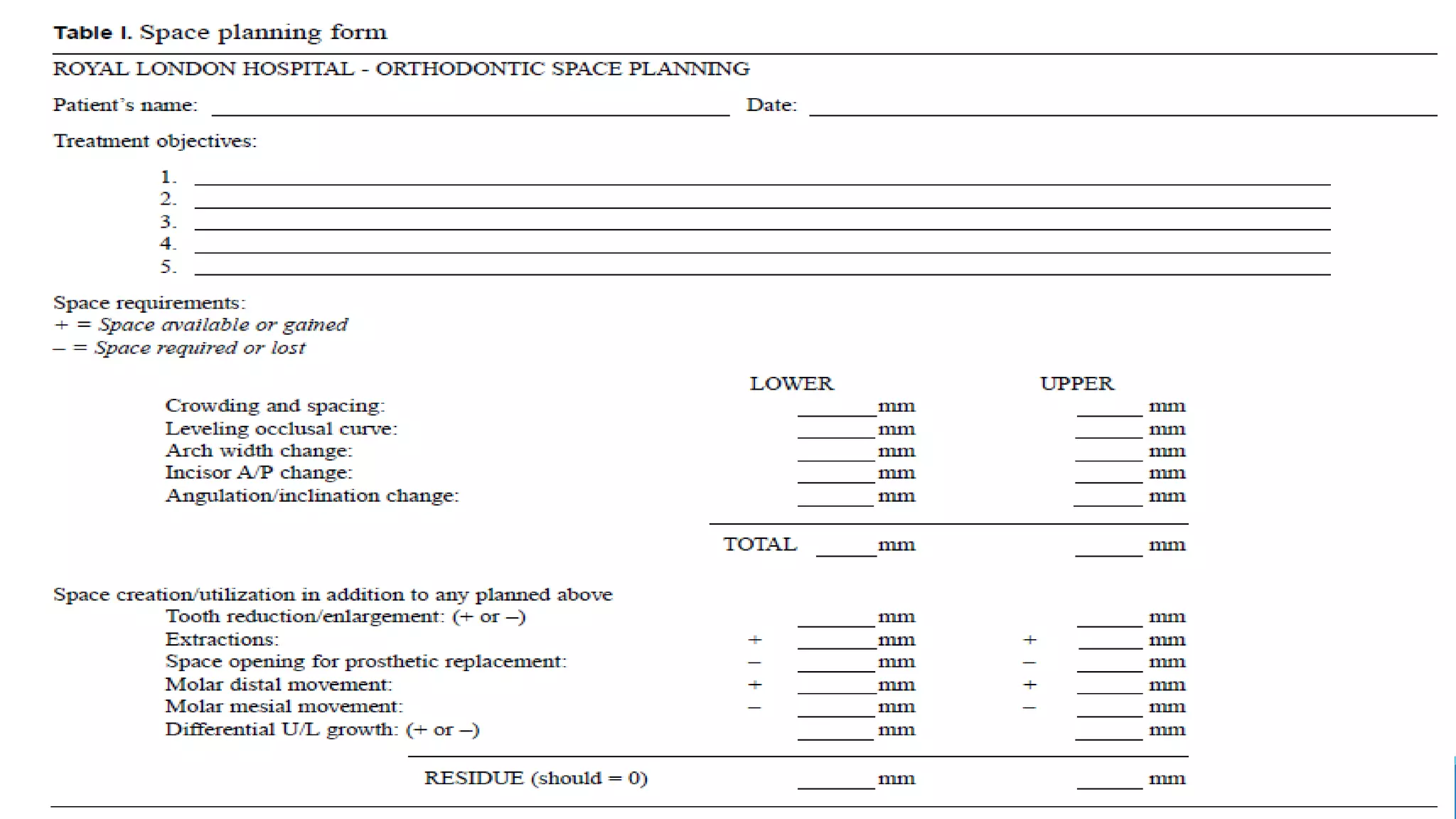
The Royal London Space Planning:
The effect of other treatment
procedures on space
Robert H. Kirschen et. al.
‫الرحيم‬‫الرحمن‬‫هللا‬ ‫بسم‬
Mohanad Elsherif
BDS (U of K), MFD RCSI, MFDS RCPS(Glasg), MSc (Orthodontics), M.Orth. RCSEd
University of Khartoum
Faculty of Dentistry
Department of Orthodontics
Introduction
 The Royal London Space Planning process is carried out
in 2 stages. The first stage, assessing the space required to
attain the treatment objectives.
 In Part II, the process of integrating space analysis with
treatment planning continues with consideration of the
effects other treatment procedures have on space.
 In this stage, any additional space to be created or used
during treatment is assessed and recorded is special form.
Introduction
 The procedures that may have an effect on the
space are:
 Tooth enlargement or reduction.
 Tooth extraction.
 The creation of space for prosthetic replacement.
 Mesial and distal molar movement.
 The effects of favorable and unfavorable growth.
ASSESSMENT OF ADDITIONAL SPACE
CREATION AND USE
1. Tooth Reduction and Enlargement:
 Good occlusion can only be achieved when the
amount of tooth material in both arches is in
proportion.
 Therefore, space is required to enlarge small tooth
(e.g. peg shaped laterals)
 Conversely, space is gained from reducing the
mesiodistal width of an unusually broad tooth by
proximal enamel reduction.
ASSESSMENT OF ADDITIONAL SPACE
CREATION AND USE
2. Extractions:
 The space gained by extraction is not entirely available for relief
of anterior crowding unless the posterior teeth are prevented from
moving forward.
 Where no anchorage reinforcement is used, the net space
available is determined by several factors, including the following:
Which teeth are extracted.
Which arch is considered.
Whether second molars are banded.
ASSESSMENT OF ADDITIONAL SPACE
CREATION AND USE
 Whether the crowding is located anteriorly or in the buccal segments.
 The degree of incisor crowding and therefore the amount of canine
retraction.
 The angulation and inclination changes needed mesial of the extraction
spaces.
 The angulation of teeth distal to the extraction spaces.
 These wide-ranging variables make it impossible to recommend a
percentage space available after loss of first or second premolars.
 It is therefore wise to think of a range of space availability from
extractions, and it is thus necessary to base clinical judgments on the
anchorage in terms e demands of each case.
ASSESSMENT OF ADDITIONAL SPACE
CREATION AND USE
 Typically, 40% to 65% of first premolar space will be
available for the benefit of the labial segment without
anchorage reinforcement.
 This reduces to 25% to 50% for second premolar
extractions.
 The net space available is less in the upper arch than for
the equivalent lower extraction, as the tendency is for
greater mesial movement of the upper molar.
ASSESSMENT OF ADDITIONAL SPACE
CREATION AND USE
The analysis:
In the analysis, the entire mesiodistal width of the
permanent teeth to be extracted is recorded, and mesial
movement of the posterior teeth is recorded separately.
ASSESSMENT OF ADDITIONAL SPACE
CREATION AND USE
3. Absent Teeth
 The initial assessment of crowding and spacing does not
take absent teeth into consideration.
 Thus, the decision to open space for the prosthetic
replacement of absent teeth is an extension of the
principle of building up small teeth. For example, the space
to be taken up by a prosthetic upper lateral incisor is
recorded as –6 mm to –7 mm.
ASSESSMENT OF ADDITIONAL SPACE
CREATION AND USE
4. Distal and Mesial Molar Movement
 The distal and mesial movement of molars requires
particularly careful consideration.
 Except in unusual cases where the molar relationship is
perfect Class I at the outset, or where treatment is carried
out in one arch only, changes in molar relationship will
inevitably involve a combination of relative mesial and
distal movements.
ASSESSMENT OF ADDITIONAL SPACE
CREATION AND USE
 The changes in the molar relationship will usually involve some of the
following:
 Distalizing headgear.
 Protraction headgear.
 Intra-arch traction.
 Anchorage loss.
 Intermaxillary elastics.
 Functional appliances.
 Orthognathic surgery.
 Natural growth.
ASSESSMENT OF ADDITIONAL SPACE
CREATION AND USE
 Clearly, this aspect of space planning is undertaken at the same time
as decisions on mechanotherapy are being made.
 For example, should a given Class II molar relationship be converted to
Class I by means of headgear, intermaxillary elastics, or functional
appliances, or will orthognathic surgery be necessary?
 The anchorage demands of the labial segments are also relevant, for
example: correcting the angulation and inclination of teeth may be
associated with only small amounts of space, but these factors may be
very significant in terms of anchorage with greater mesial movement of
the molars during treatment unless additional measures are taken to
control anchorage.
ASSESSMENT OF ADDITIONAL SPACE
CREATION AND USE
5. Differential Maxillary/Mandibular Growth
 Space planning requires an assessment of the difference in A/P
growth between the maxilla and mandible.
 In the majority of cases in the permanent dentition, there will be
little quantifiable difference between upper and lower
anteroposterior growth during the period of treatment.
 The most relevant are Class II and Class III malocclusions,
particularly in boys, with normal lower face heights or with forward
mandibular growth rotations, and where there is a significant
horizontal component of growth.
ASSESSMENT OF ADDITIONAL SPACE
CREATION AND USE
 The effect of favorable mandibular growth in some Class II
patients is to reduce the overjet. However, in space planning terms,
there is a paradox as the additional mandibular growth is
equivalent to reducing upper arch space requirements, and a +2
mm upper arch score (1 mm per side) might be given in appropriate
cases, in addition to the changes anticipated from treatment.
 Conversely, the deterioration in Class III cases has no impact on
the upper arch but can significantly increase the space requirement
in the lower arch. Space for additional lower incisor compensation
should thus be planned, (eg, –2 mm to –4 mm).
ASSESSMENT OF ADDITIONAL SPACE
CREATION AND USE
 Residual Space at Completion of the Analysis
 Once all the aspects of treatment planning and the space
implications of the mechanics are assessed, the residual
space requirement for each arch should return to zero.
 If this cannot be achieved, it may signify either that the
treatment objectives cannot be attained or that different
treatment mechanics are necessary.
Case report
 This patient presented at 11 years with a Class II Division 2 incisor relationship.
Case report
 Upper arch crowding = 6 mm
 Lower arch crowding = 5 mm
 Upper occlusal curve = 5 mm
 Lower occlusal curve = 3 mm
 Upper arch is narrow by 2 mm
Case report
 Upper and lower A-P
incisor position?
 Upper incisor torque?
Case report
Case report
CONCLUSION
 The Royal London Space Planning process integrates space analysis with
treatment planning.
 The first stage quantifies the space required in each dental arch to attain
the treatment objectives.
 The second stage combines this information with the space implications
of planned treatment procedures.
 The outcome is an ability to identify whether the treatment objectives
are attainable and whether the planned treatment mechanics are
appropriate.
 One of the strengths of the Royal London Space Planning is that it is not
linked to any particular treatment philosophy or appliance technique.
Declaration
 The author wish to declare that; these presentations are his original work, all
materials and pictures collection, typing and slide design has been done by the
author.
 Most of these materials has been done for undergraduate students, although
postgraduate students may find some useful basic and advanced information.
 The universities title at the front page indicate where the lecture was first
presented. The author was working as a lecturer of orthodontics at Ibn Sina
University, Sudan International University, and as a Master student in Orthodontics at
University of Khartoum.
 The author declare that all materials and photos in these presentations has been
collected from different textbooks, papers and online websites. These pictures are
presented here for education and demonstration purposes only. The author are not
attempting to plagiarize or reproduced unauthorized material, and the intellectual
properties of these photos belong to their original authors.
Declaration
 As the authors reviews several textbooks, papers and other references during
preparation of these materials, it was impossible to cite every textbook and journal
article, the main textbooks that has been reviewed during preparation of these
presentations were:
Contemporary Orthodontics 5th edition; Proffit, William R, Henry W. Fields, and
David M. Sarver.
Handbook of Orthodontics. 1st edition; Cobourne, Martyn T, and Andrew T. DiBiase.
Clinical cases in orthodontics; Martyn T. Cobourne, Padhraig S. Fleming, Andrew T.
DiBiase, Sofia Ahmad
Essentials of orthodontics: Diagnosis and Treatment; Robert N. Staley, Neil T. Reske
Orthodontics: Current Principles & Techniques 5th edition; Graber, Lee W, Robert L.
Vanarsdall, and Katherine W. L. Vig
Evidence based Orthodontics; Greg J. Huang, Stephen Richmond, Katherine W.L. Vig.
Declaration
 For the purposes of dissemination and sharing of knowledge, these
lectures were given to several colleagues and students. It were also
uploaded to SlideShare website by the author. Colleagues and students
may download, use, and modify these materials as they see fit for non-
profit purposes. The author retain the copyright of the original work.
 The author wish to thank his family, teachers, colleagues and students
for their love and support throughout his career. I also wish to express
my sincere gratitude to all orthodontic pillars for their tremendous
contribution to our specialty.
 Finally, the author welcome any advices and enquires through his
email address: Mohanad-07@hotmail.com
Thank You

Part two the royal london space planning

  • 1.
    The Royal LondonSpace Planning: The effect of other treatment procedures on space Robert H. Kirschen et. al. ‫الرحيم‬‫الرحمن‬‫هللا‬ ‫بسم‬ Mohanad Elsherif BDS (U of K), MFD RCSI, MFDS RCPS(Glasg), MSc (Orthodontics), M.Orth. RCSEd University of Khartoum Faculty of Dentistry Department of Orthodontics
  • 2.
    Introduction  The RoyalLondon Space Planning process is carried out in 2 stages. The first stage, assessing the space required to attain the treatment objectives.  In Part II, the process of integrating space analysis with treatment planning continues with consideration of the effects other treatment procedures have on space.  In this stage, any additional space to be created or used during treatment is assessed and recorded is special form.
  • 4.
    Introduction  The proceduresthat may have an effect on the space are:  Tooth enlargement or reduction.  Tooth extraction.  The creation of space for prosthetic replacement.  Mesial and distal molar movement.  The effects of favorable and unfavorable growth.
  • 5.
    ASSESSMENT OF ADDITIONALSPACE CREATION AND USE 1. Tooth Reduction and Enlargement:  Good occlusion can only be achieved when the amount of tooth material in both arches is in proportion.  Therefore, space is required to enlarge small tooth (e.g. peg shaped laterals)  Conversely, space is gained from reducing the mesiodistal width of an unusually broad tooth by proximal enamel reduction.
  • 6.
    ASSESSMENT OF ADDITIONALSPACE CREATION AND USE 2. Extractions:  The space gained by extraction is not entirely available for relief of anterior crowding unless the posterior teeth are prevented from moving forward.  Where no anchorage reinforcement is used, the net space available is determined by several factors, including the following: Which teeth are extracted. Which arch is considered. Whether second molars are banded.
  • 7.
    ASSESSMENT OF ADDITIONALSPACE CREATION AND USE  Whether the crowding is located anteriorly or in the buccal segments.  The degree of incisor crowding and therefore the amount of canine retraction.  The angulation and inclination changes needed mesial of the extraction spaces.  The angulation of teeth distal to the extraction spaces.  These wide-ranging variables make it impossible to recommend a percentage space available after loss of first or second premolars.  It is therefore wise to think of a range of space availability from extractions, and it is thus necessary to base clinical judgments on the anchorage in terms e demands of each case.
  • 8.
    ASSESSMENT OF ADDITIONALSPACE CREATION AND USE  Typically, 40% to 65% of first premolar space will be available for the benefit of the labial segment without anchorage reinforcement.  This reduces to 25% to 50% for second premolar extractions.  The net space available is less in the upper arch than for the equivalent lower extraction, as the tendency is for greater mesial movement of the upper molar.
  • 9.
    ASSESSMENT OF ADDITIONALSPACE CREATION AND USE The analysis: In the analysis, the entire mesiodistal width of the permanent teeth to be extracted is recorded, and mesial movement of the posterior teeth is recorded separately.
  • 10.
    ASSESSMENT OF ADDITIONALSPACE CREATION AND USE 3. Absent Teeth  The initial assessment of crowding and spacing does not take absent teeth into consideration.  Thus, the decision to open space for the prosthetic replacement of absent teeth is an extension of the principle of building up small teeth. For example, the space to be taken up by a prosthetic upper lateral incisor is recorded as –6 mm to –7 mm.
  • 11.
    ASSESSMENT OF ADDITIONALSPACE CREATION AND USE 4. Distal and Mesial Molar Movement  The distal and mesial movement of molars requires particularly careful consideration.  Except in unusual cases where the molar relationship is perfect Class I at the outset, or where treatment is carried out in one arch only, changes in molar relationship will inevitably involve a combination of relative mesial and distal movements.
  • 12.
    ASSESSMENT OF ADDITIONALSPACE CREATION AND USE  The changes in the molar relationship will usually involve some of the following:  Distalizing headgear.  Protraction headgear.  Intra-arch traction.  Anchorage loss.  Intermaxillary elastics.  Functional appliances.  Orthognathic surgery.  Natural growth.
  • 13.
    ASSESSMENT OF ADDITIONALSPACE CREATION AND USE  Clearly, this aspect of space planning is undertaken at the same time as decisions on mechanotherapy are being made.  For example, should a given Class II molar relationship be converted to Class I by means of headgear, intermaxillary elastics, or functional appliances, or will orthognathic surgery be necessary?  The anchorage demands of the labial segments are also relevant, for example: correcting the angulation and inclination of teeth may be associated with only small amounts of space, but these factors may be very significant in terms of anchorage with greater mesial movement of the molars during treatment unless additional measures are taken to control anchorage.
  • 14.
    ASSESSMENT OF ADDITIONALSPACE CREATION AND USE 5. Differential Maxillary/Mandibular Growth  Space planning requires an assessment of the difference in A/P growth between the maxilla and mandible.  In the majority of cases in the permanent dentition, there will be little quantifiable difference between upper and lower anteroposterior growth during the period of treatment.  The most relevant are Class II and Class III malocclusions, particularly in boys, with normal lower face heights or with forward mandibular growth rotations, and where there is a significant horizontal component of growth.
  • 15.
    ASSESSMENT OF ADDITIONALSPACE CREATION AND USE  The effect of favorable mandibular growth in some Class II patients is to reduce the overjet. However, in space planning terms, there is a paradox as the additional mandibular growth is equivalent to reducing upper arch space requirements, and a +2 mm upper arch score (1 mm per side) might be given in appropriate cases, in addition to the changes anticipated from treatment.  Conversely, the deterioration in Class III cases has no impact on the upper arch but can significantly increase the space requirement in the lower arch. Space for additional lower incisor compensation should thus be planned, (eg, –2 mm to –4 mm).
  • 16.
    ASSESSMENT OF ADDITIONALSPACE CREATION AND USE  Residual Space at Completion of the Analysis  Once all the aspects of treatment planning and the space implications of the mechanics are assessed, the residual space requirement for each arch should return to zero.  If this cannot be achieved, it may signify either that the treatment objectives cannot be attained or that different treatment mechanics are necessary.
  • 17.
    Case report  Thispatient presented at 11 years with a Class II Division 2 incisor relationship.
  • 18.
    Case report  Upperarch crowding = 6 mm  Lower arch crowding = 5 mm  Upper occlusal curve = 5 mm  Lower occlusal curve = 3 mm  Upper arch is narrow by 2 mm
  • 19.
    Case report  Upperand lower A-P incisor position?  Upper incisor torque?
  • 20.
  • 21.
  • 22.
    CONCLUSION  The RoyalLondon Space Planning process integrates space analysis with treatment planning.  The first stage quantifies the space required in each dental arch to attain the treatment objectives.  The second stage combines this information with the space implications of planned treatment procedures.  The outcome is an ability to identify whether the treatment objectives are attainable and whether the planned treatment mechanics are appropriate.  One of the strengths of the Royal London Space Planning is that it is not linked to any particular treatment philosophy or appliance technique.
  • 23.
    Declaration  The authorwish to declare that; these presentations are his original work, all materials and pictures collection, typing and slide design has been done by the author.  Most of these materials has been done for undergraduate students, although postgraduate students may find some useful basic and advanced information.  The universities title at the front page indicate where the lecture was first presented. The author was working as a lecturer of orthodontics at Ibn Sina University, Sudan International University, and as a Master student in Orthodontics at University of Khartoum.  The author declare that all materials and photos in these presentations has been collected from different textbooks, papers and online websites. These pictures are presented here for education and demonstration purposes only. The author are not attempting to plagiarize or reproduced unauthorized material, and the intellectual properties of these photos belong to their original authors.
  • 24.
    Declaration  As theauthors reviews several textbooks, papers and other references during preparation of these materials, it was impossible to cite every textbook and journal article, the main textbooks that has been reviewed during preparation of these presentations were: Contemporary Orthodontics 5th edition; Proffit, William R, Henry W. Fields, and David M. Sarver. Handbook of Orthodontics. 1st edition; Cobourne, Martyn T, and Andrew T. DiBiase. Clinical cases in orthodontics; Martyn T. Cobourne, Padhraig S. Fleming, Andrew T. DiBiase, Sofia Ahmad Essentials of orthodontics: Diagnosis and Treatment; Robert N. Staley, Neil T. Reske Orthodontics: Current Principles & Techniques 5th edition; Graber, Lee W, Robert L. Vanarsdall, and Katherine W. L. Vig Evidence based Orthodontics; Greg J. Huang, Stephen Richmond, Katherine W.L. Vig.
  • 25.
    Declaration  For thepurposes of dissemination and sharing of knowledge, these lectures were given to several colleagues and students. It were also uploaded to SlideShare website by the author. Colleagues and students may download, use, and modify these materials as they see fit for non- profit purposes. The author retain the copyright of the original work.  The author wish to thank his family, teachers, colleagues and students for their love and support throughout his career. I also wish to express my sincere gratitude to all orthodontic pillars for their tremendous contribution to our specialty.  Finally, the author welcome any advices and enquires through his email address: Mohanad-07@hotmail.com
  • 26.