‫الرحيم‬‫الرحمن‬‫هللا‬‫بسم‬
Ibn Sina University
Faculty of Dentistry
Department of Orthodontics
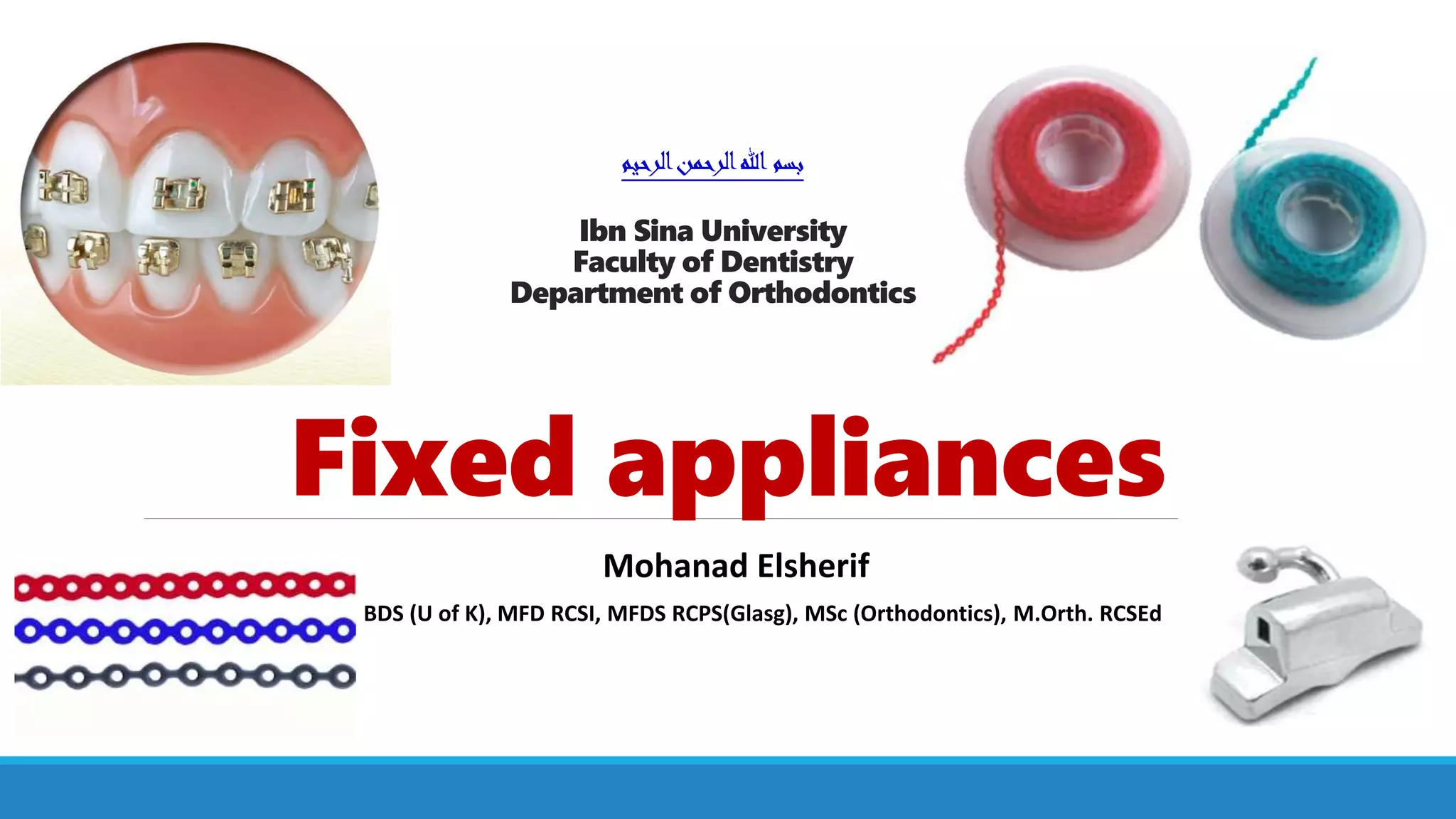
Fixed appliances
Mohanad Elsherif
BDS (U of K), MFD RCSI, MFDS RCPS(Glasg), MSc (Orthodontics), M.Orth. RCSEd
Definition
 A group of orthodontic appliances
that are fixed to the teeth and cannot
be removed by the patient.
Advantages
 They are fixed thus less patient cooperation
is needed.
 More accurate results because precise tooth
movement can be done.
 All types of tooth movement can be done.
 Multiple types of tooth movement can be
done at the same time.
Disadvantages
 Require more oral hygiene measures by the patient.
 Need specialist orthodontist.
 High and precise anchorage control.
 Long chairside time.
 Poor aesthetics compared to removable appliances.
 High cost.
Absolute indications
tooth movements are required.
 Correction of mild to moderate skeletal discrepancies.
 Active intrusion/ Extrusion of teeth.
 Correction of sever rotation.
 Overbite reduction by intrusion of incisors.
 Multiple tooth movements required in one arch.
 Active closure of spaces: extraction spaces/hypodontia.
Components
1. Brackets.
2. Bands or buccal tubes.
3. Archwires.
4. Auxiliaries
1. Brackets
 The force required for
orthodontic tooth
movement is transmitted
from the active
components to the teeth
through the brackets.
 Conventional brackets
consist of base, slots and
wings.
Types of brackets
A. according to material
 Metal brackets (stainless steel, Titanum, gold)
 Ceramic brackets
 Plastic brackets
Clear brackets
Plastic brackets Ceramic brackets
Good aesthetic initially but get
staining and discoloration with time
Aesthetic, Durable and resist staining
Poor dimensional stability Dimensionally stable
Hight friction Hight friction
Bulker than metal bracket
Can cause wearing of teeth.
Brittle thus it is liable to fracture
Can result in enamel damage during
deboning
Green=advantage
Types of brackets
B. According to bonding mechanism
A. Weldable brackets.
B. Bondable brackets.
Types of brackets
C. According to bracket slot:
1. Slot direction:
◦ Horizontal slot e.g. Edgewise
brackets
◦ Vertical slot e.g. Begg
bracket
2. Slot size:
◦ 0.018”x0.025” inch
◦ 0.022”x0.025” inch
Types of brackets
D. According to ligation of bracket:
◦ Conventional ligation brackets.
◦ Self-ligating brackets.
Types of brackets
E. According to bracket system
 Standard Edgewise brackets.
 Preadjusted (Straight-wire) edgewise
brackets.
 Begg brackets.
 Tip-edge brackets.
Standard Edgewise brackets
 Frist order bend (in-out)
 Second order bend (tip)
 Third order bend
(torque)
Preadjusted (Straight-wire) edgewise
brackets
Begg brackets
Tip edge brackets
2. Bands
 Bands are thin strips of stainless steel which are adapted to the
contours of the tooth to which attachments are welded or soldered.
 TYPES :
It can be:
a. Preformed b. Custom made
OR:
1. molar band
2. premolar band
3. incisors bands
Indications for banding
 Teeth that will receive heavy
intermittent forces against the
attachments.
 Teeth that will require both
labial and lingual attachments.
 Teeth with short clinical
crowns.
 Teeth with extensive
restorations.
2. Buccal tubes
 Can be used in posterior teeth instead of bands.
 They are usually bonded to the teeth just like
brackets.
Advantages of bonding over
banding
 It is aesthetically superior.
 It is faster (i.e. less chairside time).
 It is easier to maintain good oral
hygiene.
 It can be done in teeth with abnormal
morphology.
 The risk of caries under the loose band
is eliminated.
3. Archwires
 These is the main
active component used
to produce tooth
movement in fixed
appliances.
 Comes in verity of
shape, size and
diameter.
 The basic three
archwire form are
square, ovoid and
tapered.
Tapered Square Ovoid
Types of Archwires
1. According to wire material:
 Stainless steel.
 Nickel-Titanium.
 Beta-Titanium.
 Cobalt chromium.
 Precious metal.
 Composite Plastics.
Stainless steel wires
 Steel is an alloy of Iron and Carbon with up to 2%
carbon.
 If chromium of morae than 11% is added the alloy
is referred to as stainless steel.
 Stainless steel used in orthodontic wires is named
18-8 stainless steel according to its chromium (18%)
and Nickle (8%) respectively.
Nickle - Titanium wires
 Originally developed for US space
program
 Ni-Ti alloys have two unique properties:
1. Shape memory:
The wire gets back to its original shape.
2. Superelasticity:
Thus the wire would exert the same force
regardless of the amount of deflection.
Types of Archwires
2. According to cross-section:
A. Round.
B. Square.
C. Rectangular.
Round
Square Rectangular
Types of Archwires
3. According to diameter of the wire:
A. Round: 0.012, 0.014, 0.016, ...etc.
B. Square: 0.016 x 0.016, 0.017 x 0.017…etc.
C. Rectangular: 0.016 x 0.022, 0.019 x 0.025 …etc.
Types of Archwires
According to number of the strands
 Single stranded.
 Multi-stranded.
4. Auxiliaries
1. Separators.
2. Ligature wires.
3. Elastic modules.
4. Elastic chains.
5. Elastic bands.
6. Springs.
1. Separators
 Tight proximal contacts
does not allow proper
banding of teeth.
 Separators are used to
create space for banding
teeth.
 Types:
 Metal separators
 Elastic separators
2. Ligature wires (active ties)
 These are soft
stainless steel wires of
0.009-0.011 inches in
diameter.
 Used to secure the
arch wire to the
brackets.
3. Elastic modules
 Used to secure the
archwire to the bracket.
 Available in different
colors.
 They are faster to place
and replace compared to
ligature wires.
4. Elastic (power) chains
 Made of synthetic
polyuraethene material
arranged in a long chain of
interconnected rings.
 Available in different colors.
 It can be light, medium or
heavy depending on the
distance between the rings.
5. Elastic Bands
 They are usually made of
latex rubber (although latex
free elastics are now available).
 Available is various diameter,
thickness and colors.
Types of elastics bands
1. Class I elastics:
 Intra-arch elastics
stretched between
molars and anteriors.
 Used for closer of
space and retraction
of teeth.
Types of elastics bands
2. Class II elastics:
 Intermaxillary elastics,
stretched between lower
molars and upper anteriors.
 Used in treatment of class II
malocclusion ( retraction of
upper anteriors and mesial
movement of lower molars.
Types of elastics bands
3. Class III elastics:
 Intermaxillary elastics, stretched
between the upper molars ad
lower anteriors.
 Used in treatment of class III
malocclusion to bring about mesial
movement of upper buccal teeth
and retraction of anteriors.
Types of elastics bands
4. Crossbite elastics:
 Used to treat molar
crossbite.
 They are intermaxillary
elastics extend between
the palatal surface of
upper molar and the
buccal surface of the
lower molar and vice
versa.
Types of elastics bands
5. Box elastics:
Used to correct
anterior open bite,
the elastic is stretched
between the upper
and lower anteriors
like a box
6. Springs
1. Open coil spring:
Compressed between two teeth to open up space
between them.
Springs
2. Closed coil spring:
Stretched between teeth to close space.
Springs
3. Rotation spring:
Used to correct rotated
teeth.
4. Uprighting springs:
Move teeth in mesial or
distal direction.
5. Torqueing spring:
Move teeth in lingual or
palatal directions.
Components of fixed appliances
Active components
Seperators
metal elastic
Arch wires Elastics Springs
Passive components
Brackets Bands Accessories
Lock pins
Ligature
wire modules
Molar tube
Distal end cutter
Ligature cutter
Matheiu forceps
Bracket holder
Separator forceps
Band Pusher
Band Seater
Bracket Remover
Band Remover
Esthetic and Ortho!!?
Clear Polymer Archwires With
ceramic brackets
Lingual appliance
Clear aligners
Declaration
 The author wish to declare that; these presentations are his original work, all
materials and pictures collection, typing and slide design has been done by the
author.
 Most of these materials has been done for undergraduate students, although
postgraduate students may find some useful basic and advanced information.
 The universities title at the front page indicate where the lecture was first
presented. The author was working as a lecturer of orthodontics at Ibn Sina
University, Sudan International University, and as a Master student in Orthodontics at
University of Khartoum.
 The author declare that all materials and photos in these presentations has been
collected from different textbooks, papers and online websites. These pictures are
presented here for education and demonstration purposes only. The author are not
attempting to plagiarize or reproduced unauthorized material, and the intellectual
properties of these photos belong to their original authors.
Declaration
 As the authors reviews several textbooks, papers and other references during
preparation of these materials, it was impossible to cite every textbook and journal
article, the main textbooks that has been reviewed during preparation of these
presentations were:
Contemporary Orthodontics 5th edition; Proffit, William R, Henry W. Fields, and
David M. Sarver.
Handbook of Orthodontics. 1st edition; Cobourne, Martyn T, and Andrew T. DiBiase.
Clinical cases in orthodontics. Martyn T. Cobourne, Padhraig S. Fleming, Andrew T.
DiBiase, Sofia Ahmad
Essentials of orthodontics: Diagnosis and Treatment; Robert N. Staley, Neil T. Reske
Orthodontics: Current Principles & Techniques 5th edition; Graber, Lee W, Robert L.
Vanarsdall, and Katherine W. L. Vig
Orthodontics: The Art and Science. 3rd Edition. Bhalajhi, S.I.
Declaration
 For the purposes of dissemination and sharing of knowledge, these
lectures were given to several colleagues and students. It were also
uploaded to SlideShare website by the author. Colleagues and students
may download, use, and modify these materials as they see fit for non-
profit purposes. The author retain the copyright of the original work.
 The author wish to thank his family, teachers, colleagues and students
for their love and support throughout his career. I also wish to express
my sincere gratitude to all orthodontic pillars for their tremendous
contribution to our specialty.
 Finally, the author welcome any advices and enquires through his
email address: Mohanad-07@hotmail.com
Thank You

Fixed appliances

  • 1.
    ‫الرحيم‬‫الرحمن‬‫هللا‬‫بسم‬ Ibn Sina University Facultyof Dentistry Department of Orthodontics Fixed appliances Mohanad Elsherif BDS (U of K), MFD RCSI, MFDS RCPS(Glasg), MSc (Orthodontics), M.Orth. RCSEd
  • 2.
    Definition  A groupof orthodontic appliances that are fixed to the teeth and cannot be removed by the patient.
  • 3.
    Advantages  They arefixed thus less patient cooperation is needed.  More accurate results because precise tooth movement can be done.  All types of tooth movement can be done.  Multiple types of tooth movement can be done at the same time.
  • 4.
    Disadvantages  Require moreoral hygiene measures by the patient.  Need specialist orthodontist.  High and precise anchorage control.  Long chairside time.  Poor aesthetics compared to removable appliances.  High cost.
  • 5.
    Absolute indications tooth movementsare required.  Correction of mild to moderate skeletal discrepancies.  Active intrusion/ Extrusion of teeth.  Correction of sever rotation.  Overbite reduction by intrusion of incisors.  Multiple tooth movements required in one arch.  Active closure of spaces: extraction spaces/hypodontia.
  • 6.
    Components 1. Brackets. 2. Bandsor buccal tubes. 3. Archwires. 4. Auxiliaries
  • 7.
    1. Brackets  Theforce required for orthodontic tooth movement is transmitted from the active components to the teeth through the brackets.  Conventional brackets consist of base, slots and wings.
  • 8.
    Types of brackets A.according to material  Metal brackets (stainless steel, Titanum, gold)  Ceramic brackets  Plastic brackets
  • 9.
    Clear brackets Plastic bracketsCeramic brackets Good aesthetic initially but get staining and discoloration with time Aesthetic, Durable and resist staining Poor dimensional stability Dimensionally stable Hight friction Hight friction Bulker than metal bracket Can cause wearing of teeth. Brittle thus it is liable to fracture Can result in enamel damage during deboning Green=advantage
  • 10.
    Types of brackets B.According to bonding mechanism A. Weldable brackets. B. Bondable brackets.
  • 11.
    Types of brackets C.According to bracket slot: 1. Slot direction: ◦ Horizontal slot e.g. Edgewise brackets ◦ Vertical slot e.g. Begg bracket 2. Slot size: ◦ 0.018”x0.025” inch ◦ 0.022”x0.025” inch
  • 12.
    Types of brackets D.According to ligation of bracket: ◦ Conventional ligation brackets. ◦ Self-ligating brackets.
  • 13.
    Types of brackets E.According to bracket system  Standard Edgewise brackets.  Preadjusted (Straight-wire) edgewise brackets.  Begg brackets.  Tip-edge brackets.
  • 14.
    Standard Edgewise brackets Frist order bend (in-out)  Second order bend (tip)  Third order bend (torque)
  • 15.
  • 16.
  • 17.
  • 18.
    2. Bands  Bandsare thin strips of stainless steel which are adapted to the contours of the tooth to which attachments are welded or soldered.  TYPES : It can be: a. Preformed b. Custom made OR: 1. molar band 2. premolar band 3. incisors bands
  • 19.
    Indications for banding Teeth that will receive heavy intermittent forces against the attachments.  Teeth that will require both labial and lingual attachments.  Teeth with short clinical crowns.  Teeth with extensive restorations.
  • 20.
    2. Buccal tubes Can be used in posterior teeth instead of bands.  They are usually bonded to the teeth just like brackets.
  • 21.
    Advantages of bondingover banding  It is aesthetically superior.  It is faster (i.e. less chairside time).  It is easier to maintain good oral hygiene.  It can be done in teeth with abnormal morphology.  The risk of caries under the loose band is eliminated.
  • 22.
    3. Archwires  Theseis the main active component used to produce tooth movement in fixed appliances.  Comes in verity of shape, size and diameter.  The basic three archwire form are square, ovoid and tapered. Tapered Square Ovoid
  • 23.
    Types of Archwires 1.According to wire material:  Stainless steel.  Nickel-Titanium.  Beta-Titanium.  Cobalt chromium.  Precious metal.  Composite Plastics.
  • 24.
    Stainless steel wires Steel is an alloy of Iron and Carbon with up to 2% carbon.  If chromium of morae than 11% is added the alloy is referred to as stainless steel.  Stainless steel used in orthodontic wires is named 18-8 stainless steel according to its chromium (18%) and Nickle (8%) respectively.
  • 25.
    Nickle - Titaniumwires  Originally developed for US space program  Ni-Ti alloys have two unique properties: 1. Shape memory: The wire gets back to its original shape. 2. Superelasticity: Thus the wire would exert the same force regardless of the amount of deflection.
  • 26.
    Types of Archwires 2.According to cross-section: A. Round. B. Square. C. Rectangular. Round Square Rectangular
  • 27.
    Types of Archwires 3.According to diameter of the wire: A. Round: 0.012, 0.014, 0.016, ...etc. B. Square: 0.016 x 0.016, 0.017 x 0.017…etc. C. Rectangular: 0.016 x 0.022, 0.019 x 0.025 …etc.
  • 28.
    Types of Archwires Accordingto number of the strands  Single stranded.  Multi-stranded.
  • 29.
    4. Auxiliaries 1. Separators. 2.Ligature wires. 3. Elastic modules. 4. Elastic chains. 5. Elastic bands. 6. Springs.
  • 30.
    1. Separators  Tightproximal contacts does not allow proper banding of teeth.  Separators are used to create space for banding teeth.  Types:  Metal separators  Elastic separators
  • 31.
    2. Ligature wires(active ties)  These are soft stainless steel wires of 0.009-0.011 inches in diameter.  Used to secure the arch wire to the brackets.
  • 32.
    3. Elastic modules Used to secure the archwire to the bracket.  Available in different colors.  They are faster to place and replace compared to ligature wires.
  • 33.
    4. Elastic (power)chains  Made of synthetic polyuraethene material arranged in a long chain of interconnected rings.  Available in different colors.  It can be light, medium or heavy depending on the distance between the rings.
  • 34.
    5. Elastic Bands They are usually made of latex rubber (although latex free elastics are now available).  Available is various diameter, thickness and colors.
  • 35.
    Types of elasticsbands 1. Class I elastics:  Intra-arch elastics stretched between molars and anteriors.  Used for closer of space and retraction of teeth.
  • 36.
    Types of elasticsbands 2. Class II elastics:  Intermaxillary elastics, stretched between lower molars and upper anteriors.  Used in treatment of class II malocclusion ( retraction of upper anteriors and mesial movement of lower molars.
  • 37.
    Types of elasticsbands 3. Class III elastics:  Intermaxillary elastics, stretched between the upper molars ad lower anteriors.  Used in treatment of class III malocclusion to bring about mesial movement of upper buccal teeth and retraction of anteriors.
  • 38.
    Types of elasticsbands 4. Crossbite elastics:  Used to treat molar crossbite.  They are intermaxillary elastics extend between the palatal surface of upper molar and the buccal surface of the lower molar and vice versa.
  • 39.
    Types of elasticsbands 5. Box elastics: Used to correct anterior open bite, the elastic is stretched between the upper and lower anteriors like a box
  • 40.
    6. Springs 1. Opencoil spring: Compressed between two teeth to open up space between them.
  • 41.
    Springs 2. Closed coilspring: Stretched between teeth to close space.
  • 42.
    Springs 3. Rotation spring: Usedto correct rotated teeth. 4. Uprighting springs: Move teeth in mesial or distal direction. 5. Torqueing spring: Move teeth in lingual or palatal directions.
  • 43.
    Components of fixedappliances Active components Seperators metal elastic Arch wires Elastics Springs Passive components Brackets Bands Accessories Lock pins Ligature wire modules Molar tube
  • 44.
  • 45.
  • 46.
  • 47.
  • 48.
  • 49.
  • 50.
  • 51.
  • 52.
  • 53.
  • 54.
    Clear Polymer ArchwiresWith ceramic brackets
  • 55.
  • 56.
  • 57.
    Declaration  The authorwish to declare that; these presentations are his original work, all materials and pictures collection, typing and slide design has been done by the author.  Most of these materials has been done for undergraduate students, although postgraduate students may find some useful basic and advanced information.  The universities title at the front page indicate where the lecture was first presented. The author was working as a lecturer of orthodontics at Ibn Sina University, Sudan International University, and as a Master student in Orthodontics at University of Khartoum.  The author declare that all materials and photos in these presentations has been collected from different textbooks, papers and online websites. These pictures are presented here for education and demonstration purposes only. The author are not attempting to plagiarize or reproduced unauthorized material, and the intellectual properties of these photos belong to their original authors.
  • 58.
    Declaration  As theauthors reviews several textbooks, papers and other references during preparation of these materials, it was impossible to cite every textbook and journal article, the main textbooks that has been reviewed during preparation of these presentations were: Contemporary Orthodontics 5th edition; Proffit, William R, Henry W. Fields, and David M. Sarver. Handbook of Orthodontics. 1st edition; Cobourne, Martyn T, and Andrew T. DiBiase. Clinical cases in orthodontics. Martyn T. Cobourne, Padhraig S. Fleming, Andrew T. DiBiase, Sofia Ahmad Essentials of orthodontics: Diagnosis and Treatment; Robert N. Staley, Neil T. Reske Orthodontics: Current Principles & Techniques 5th edition; Graber, Lee W, Robert L. Vanarsdall, and Katherine W. L. Vig Orthodontics: The Art and Science. 3rd Edition. Bhalajhi, S.I.
  • 59.
    Declaration  For thepurposes of dissemination and sharing of knowledge, these lectures were given to several colleagues and students. It were also uploaded to SlideShare website by the author. Colleagues and students may download, use, and modify these materials as they see fit for non- profit purposes. The author retain the copyright of the original work.  The author wish to thank his family, teachers, colleagues and students for their love and support throughout his career. I also wish to express my sincere gratitude to all orthodontic pillars for their tremendous contribution to our specialty.  Finally, the author welcome any advices and enquires through his email address: Mohanad-07@hotmail.com
  • 60.