‫الرحيم‬‫الرحمن‬‫هللا‬‫بسم‬
Sudan International University
Faculty of Dentistry
Department of Orthodontics
Space analysis
Mohanad Elsherif
BDS (U of K), MFD RCSI, MFDS RCPS(Glasg), MSc (Orthodontics), M.Orth. RCSEd
Space analysis
Definition
It is the quantification
of the space required
for correction of
malocclusion.
Cary’s analysis
Step 1: measurement of the arch length (circumference) (space
available):
From the mesial surface of the first molar, across the buccal cusps of posteriors
and incisal edges of anteriors, to the mesial surface of the other first molar.
Cary’s analysis
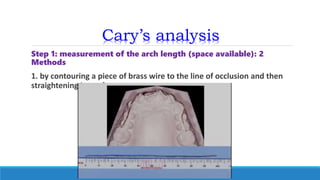
Step 1: measurement of the arch length (space available): 2
Methods
1. by contouring a piece of brass wire to the line of occlusion and then
straightening it out for measurement.
Cary’s analysis
Step 1: measurement of the arch length (space available): 2 Methods
2. By dividing the dental arch into segments that can be measured as
straight line approximations of the arch.
 Segment (1): mesial to 6 –mesial to canine.
 Segment (2): mesial to canine- midline.
 Segment (3): midline – mesial to canine.
 Segment (4): mesial to 6 – mesial to canine.
Cary’s analysis
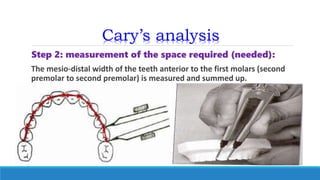
Step 2: measurement of the space required (needed):
The mesio-distal width of the teeth anterior to the first molars (second
premolar to second premolar) is measured and summed up.
Cary’s analysis
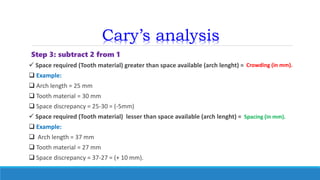
Step 3: subtract 2 from 1
 Space required (Tooth material) greater than space available (arch lenght) =
 Example:
 Arch length = 25 mm
 Tooth material = 30 mm
 Space discrepancy = 25-30 = (-5mm)
 Space required (Tooth material) lesser than space available (arch lenght) =
 Example:
 Arch length = 37 mm
 Tooth material = 27 mm
 Space discrepancy = 37-27 = (+ 10 mm).
Crowding (in mm).
Spacing (in mm).
Cary’s analysis
 Discrepancy up to 2.5mm (-) do proximal stripping.
 Discrepancy between 2.5mm - 5mm (-) extract the
second premolar.
 Discrepancy more than 5 mm (-) extract the first
premolar.
Classification of crowding
 Mild crowding: Up to 4 mm
 Moderate crowding 5 – 8 mm
 Sever crowding: 9 mm and more
Mixed Dentition analysis
 Arch length = 28 mm.
 Tooth materials = 9 +
9 + 6.5 + 6.5 = 31
 Canines + first premolars
+ second premolars?
Mixed Dentition analysis
Aim:
To calculate the size of the un-erupted canines and premolars.
How :
1. Radiographic methods (Huckaba’s analysis).
2. Non radiographic methods (Tanaka & Johnson analysis).
3. Combination of both.
Radiographic methods
(Huckaba’s analysis)
True width of the primary teeth = True width of the unerpted permanent teeth
Apparent width of the primary teeth Apparent width of the width of the permanent teeth
40 = 80
20 = 40
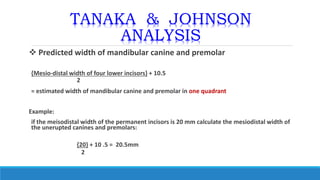
TANAKA & JOHNSON
ANALYSIS
 Predicted width of mandibular canine and premolar
{Mesio-distal width of four lower incisors} + 10.5
2
= estimated width of mandibular canine and premolar in one quadrant
Example:
if the meisodistal width of the permanent incisors is 20 mm calculate the mesiodistal width of
the unerupted canines and premolars:
{20} + 10 .5 = 20.5mm
2
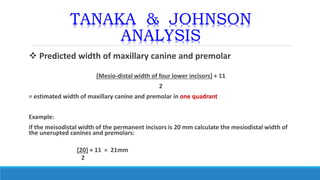
TANAKA & JOHNSON
ANALYSIS
 Predicted width of maxillary canine and premolar
{Mesio-distal width of four lower incisors} + 11
2
= estimated width of maxillary canine and premolar in one quadrant
Example:
if the meisodistal width of the permanent incisors is 20 mm calculate the mesiodistal width of
the unerupted canines and premolars:
{20} + 11 = 21mm
2
Mixed Dentition analysis
 Arch length = 68 mm.
 Tooth materials = 9 +
9 + 6.5 + 6.5 = 31
 Canines + first premolars +
second premolars = 21 + 21
Bolton analysis
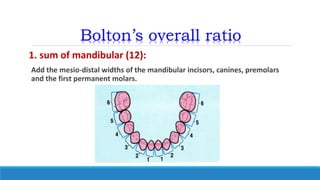
Bolton’s overall ratio
1. sum of mandibular (12):
Add the mesio-distal widths of the mandibular incisors, canines, premolars
and the first permanent molars.
Bolton’s overall ratio
2. sum of maxillary (12):
Add the mesio-distal width of the maxillary incisors, canines, premolars and
the first permanent molars.
Bolton’s overall ratio
Overall ratio =
Sum of Mandibular 12 X100% = 91.3%
Sum of Maxillary 12
Bolton’s overall ratio
11 7 7.5 8 7 9 9 7 8 7.5 7 11
12 7.5 7 7 6 5 5 6 7 7 7.5 12
 Sum of mandibular (12) =
 Sum of maxillary (12) =
 Overall Ratio =
Example:
89 mm
99 mm
89/99 X 100% = 89.9%
91.3%
Bolton’s overall ratio
 If the calculated overall ratio is greater than the mean value (91.3 %) It
indicates that the mandibular tooth size is in excess.
Sum of mandibular 12 – (sum of maxillary 12 X 91.3)
100
 If the calculated overall ratio is smaller than the mean value than it implies
that the maxillary tooth size is in excess compared to the mandibular tooth size.
Sum of maxillary 12 – (sum of mandibular 12 X 100)
91.3
Sum of Mandibular 12 X100% = 91.3%
Sum of Maxillary 12
Sum of Mandibular 12 X100 = Sum of Maxillary 12 x 91.3
Sum of Maxillary 12 x 100 = Sum of mandibular 12 x 100
91.3 91.3
Sum of maxillary 12 = Sum of mandibular x 100
91.3
Sum of maxillary 12 – (sum of mandibular 12 X 100)
91.3
99 - ( 89 x 100) = 1.5 mm
91.3
 Sum of mandibular (12) = 89
 Sum of maxillary (12) = 99
 Overall Ratio = 89/99 x 100% = 89.9%
How to
measure
the
excess?
Bolton’s anterior ratio
Sum of mandibular (6):
Add the mesio-distal widths of the mandibular
incisors and canines
Sum of maxillary (6):
Add the mesio-distal width of the maxillary
incisors and canines.
Anterior Ratio =
Sum of mandibular 6 X 100% = 77.2%
Sum of maxillary 6
Measure the excess the same way.
Declaration
 The author wish to declare that; these presentations are his original work, all
materials and pictures collection, typing and slide design has been done by the
author.
 Most of these materials has been done for undergraduate students, although
postgraduate students may find some useful basic and advanced information.
 The universities title at the front page indicate where the lecture was first
presented. The author was working as a lecturer of orthodontics at Ibn Sina
University, Sudan International University, and as a Master student in Orthodontics at
University of Khartoum.
 The author declare that all materials and photos in these presentations has been
collected from different textbooks, papers and online websites. These pictures are
presented here for education and demonstration purposes only. The author are not
attempting to plagiarize or reproduced unauthorized material, and the intellectual
properties of these photos belong to their original authors.
Declaration
 As the authors reviews several textbooks, papers and other references during
preparation of these materials, it was impossible to cite every textbook and journal
article, the main textbooks that has been reviewed during preparation of these
presentations were:
Contemporary Orthodontics 5th edition; Proffit, William R, Henry W. Fields, and
David M. Sarver.
Handbook of Orthodontics. 1st edition; Cobourne, Martyn T, and Andrew T. DiBiase.
Clinical cases in orthodontics. Martyn T. Cobourne, Padhraig S. Fleming, Andrew T.
DiBiase, Sofia Ahmad
Essentials of orthodontics: Diagnosis and Treatment; Robert N. Staley, Neil T. Reske
Orthodontics: Current Principles & Techniques 5th edition; Graber, Lee W, Robert L.
Vanarsdall, and Katherine W. L. Vig
Orthodontics: The Art and Science. 3rd Edition. Bhalajhi, S.I.
Declaration
 For the purposes of dissemination and sharing of knowledge, these
lectures were given to several colleagues and students. It were also
uploaded to SlideShare website by the author. Colleagues and students
may download, use, and modify these materials as they see fit for non-
profit purposes. The author retain the copyright of the original work.
 The author wish to thank his family, teachers, colleagues and students
for their love and support throughout his career. I also wish to express
my sincere gratitude to all orthodontic pillars for their tremendous
contribution to our specialty.
 Finally, the author welcome any advices and enquires through his
email address: Mohanad-07@hotmail.com
Thank You

Cast analysis

  • 1.
    ‫الرحيم‬‫الرحمن‬‫هللا‬‫بسم‬ Sudan International University Facultyof Dentistry Department of Orthodontics Space analysis Mohanad Elsherif BDS (U of K), MFD RCSI, MFDS RCPS(Glasg), MSc (Orthodontics), M.Orth. RCSEd
  • 2.
    Space analysis Definition It isthe quantification of the space required for correction of malocclusion.
  • 3.
    Cary’s analysis Step 1:measurement of the arch length (circumference) (space available): From the mesial surface of the first molar, across the buccal cusps of posteriors and incisal edges of anteriors, to the mesial surface of the other first molar.
  • 4.
    Cary’s analysis Step 1:measurement of the arch length (space available): 2 Methods 1. by contouring a piece of brass wire to the line of occlusion and then straightening it out for measurement.
  • 5.
    Cary’s analysis Step 1:measurement of the arch length (space available): 2 Methods 2. By dividing the dental arch into segments that can be measured as straight line approximations of the arch.  Segment (1): mesial to 6 –mesial to canine.  Segment (2): mesial to canine- midline.  Segment (3): midline – mesial to canine.  Segment (4): mesial to 6 – mesial to canine.
  • 6.
    Cary’s analysis Step 2:measurement of the space required (needed): The mesio-distal width of the teeth anterior to the first molars (second premolar to second premolar) is measured and summed up.
  • 7.
    Cary’s analysis Step 3:subtract 2 from 1  Space required (Tooth material) greater than space available (arch lenght) =  Example:  Arch length = 25 mm  Tooth material = 30 mm  Space discrepancy = 25-30 = (-5mm)  Space required (Tooth material) lesser than space available (arch lenght) =  Example:  Arch length = 37 mm  Tooth material = 27 mm  Space discrepancy = 37-27 = (+ 10 mm). Crowding (in mm). Spacing (in mm).
  • 8.
    Cary’s analysis  Discrepancyup to 2.5mm (-) do proximal stripping.  Discrepancy between 2.5mm - 5mm (-) extract the second premolar.  Discrepancy more than 5 mm (-) extract the first premolar.
  • 9.
    Classification of crowding Mild crowding: Up to 4 mm  Moderate crowding 5 – 8 mm  Sever crowding: 9 mm and more
  • 10.
    Mixed Dentition analysis Arch length = 28 mm.  Tooth materials = 9 + 9 + 6.5 + 6.5 = 31  Canines + first premolars + second premolars?
  • 11.
    Mixed Dentition analysis Aim: Tocalculate the size of the un-erupted canines and premolars. How : 1. Radiographic methods (Huckaba’s analysis). 2. Non radiographic methods (Tanaka & Johnson analysis). 3. Combination of both.
  • 12.
    Radiographic methods (Huckaba’s analysis) Truewidth of the primary teeth = True width of the unerpted permanent teeth Apparent width of the primary teeth Apparent width of the width of the permanent teeth 40 = 80 20 = 40
  • 13.
    TANAKA & JOHNSON ANALYSIS Predicted width of mandibular canine and premolar {Mesio-distal width of four lower incisors} + 10.5 2 = estimated width of mandibular canine and premolar in one quadrant Example: if the meisodistal width of the permanent incisors is 20 mm calculate the mesiodistal width of the unerupted canines and premolars: {20} + 10 .5 = 20.5mm 2
  • 14.
    TANAKA & JOHNSON ANALYSIS Predicted width of maxillary canine and premolar {Mesio-distal width of four lower incisors} + 11 2 = estimated width of maxillary canine and premolar in one quadrant Example: if the meisodistal width of the permanent incisors is 20 mm calculate the mesiodistal width of the unerupted canines and premolars: {20} + 11 = 21mm 2
  • 15.
    Mixed Dentition analysis Arch length = 68 mm.  Tooth materials = 9 + 9 + 6.5 + 6.5 = 31  Canines + first premolars + second premolars = 21 + 21
  • 16.
  • 17.
    Bolton’s overall ratio 1.sum of mandibular (12): Add the mesio-distal widths of the mandibular incisors, canines, premolars and the first permanent molars.
  • 18.
    Bolton’s overall ratio 2.sum of maxillary (12): Add the mesio-distal width of the maxillary incisors, canines, premolars and the first permanent molars.
  • 19.
    Bolton’s overall ratio Overallratio = Sum of Mandibular 12 X100% = 91.3% Sum of Maxillary 12
  • 20.
    Bolton’s overall ratio 117 7.5 8 7 9 9 7 8 7.5 7 11 12 7.5 7 7 6 5 5 6 7 7 7.5 12  Sum of mandibular (12) =  Sum of maxillary (12) =  Overall Ratio = Example: 89 mm 99 mm 89/99 X 100% = 89.9% 91.3%
  • 21.
    Bolton’s overall ratio If the calculated overall ratio is greater than the mean value (91.3 %) It indicates that the mandibular tooth size is in excess. Sum of mandibular 12 – (sum of maxillary 12 X 91.3) 100  If the calculated overall ratio is smaller than the mean value than it implies that the maxillary tooth size is in excess compared to the mandibular tooth size. Sum of maxillary 12 – (sum of mandibular 12 X 100) 91.3
  • 22.
    Sum of Mandibular12 X100% = 91.3% Sum of Maxillary 12 Sum of Mandibular 12 X100 = Sum of Maxillary 12 x 91.3 Sum of Maxillary 12 x 100 = Sum of mandibular 12 x 100 91.3 91.3 Sum of maxillary 12 = Sum of mandibular x 100 91.3 Sum of maxillary 12 – (sum of mandibular 12 X 100) 91.3 99 - ( 89 x 100) = 1.5 mm 91.3  Sum of mandibular (12) = 89  Sum of maxillary (12) = 99  Overall Ratio = 89/99 x 100% = 89.9% How to measure the excess?
  • 23.
    Bolton’s anterior ratio Sumof mandibular (6): Add the mesio-distal widths of the mandibular incisors and canines Sum of maxillary (6): Add the mesio-distal width of the maxillary incisors and canines. Anterior Ratio = Sum of mandibular 6 X 100% = 77.2% Sum of maxillary 6 Measure the excess the same way.
  • 24.
    Declaration  The authorwish to declare that; these presentations are his original work, all materials and pictures collection, typing and slide design has been done by the author.  Most of these materials has been done for undergraduate students, although postgraduate students may find some useful basic and advanced information.  The universities title at the front page indicate where the lecture was first presented. The author was working as a lecturer of orthodontics at Ibn Sina University, Sudan International University, and as a Master student in Orthodontics at University of Khartoum.  The author declare that all materials and photos in these presentations has been collected from different textbooks, papers and online websites. These pictures are presented here for education and demonstration purposes only. The author are not attempting to plagiarize or reproduced unauthorized material, and the intellectual properties of these photos belong to their original authors.
  • 25.
    Declaration  As theauthors reviews several textbooks, papers and other references during preparation of these materials, it was impossible to cite every textbook and journal article, the main textbooks that has been reviewed during preparation of these presentations were: Contemporary Orthodontics 5th edition; Proffit, William R, Henry W. Fields, and David M. Sarver. Handbook of Orthodontics. 1st edition; Cobourne, Martyn T, and Andrew T. DiBiase. Clinical cases in orthodontics. Martyn T. Cobourne, Padhraig S. Fleming, Andrew T. DiBiase, Sofia Ahmad Essentials of orthodontics: Diagnosis and Treatment; Robert N. Staley, Neil T. Reske Orthodontics: Current Principles & Techniques 5th edition; Graber, Lee W, Robert L. Vanarsdall, and Katherine W. L. Vig Orthodontics: The Art and Science. 3rd Edition. Bhalajhi, S.I.
  • 26.
    Declaration  For thepurposes of dissemination and sharing of knowledge, these lectures were given to several colleagues and students. It were also uploaded to SlideShare website by the author. Colleagues and students may download, use, and modify these materials as they see fit for non- profit purposes. The author retain the copyright of the original work.  The author wish to thank his family, teachers, colleagues and students for their love and support throughout his career. I also wish to express my sincere gratitude to all orthodontic pillars for their tremendous contribution to our specialty.  Finally, the author welcome any advices and enquires through his email address: Mohanad-07@hotmail.com
  • 27.