Ideal Gas
• Thermodynamic tables provide very accurate
information about the properties, but they are
bulky and vulnerable to typographical errors.
A more practical and desirable approach
would be to have some simple relations
among the properties that are sufficiently
general and accurate.
• Any equation that relates the pressure,
temperature, and specific volume of a
substance is called an equation of state
• The simplest and best-known equation of state for
substances in the gas phase is the ideal-gas
equation of state.
• This equation predicts the P-v-T behavior of a gas
quite accurately within some properly selected
region.
• Pv = RT is called the ideal-gas equation of state, or
simply the ideal-gas relation, and a gas that obeys
this relation is called an ideal gas. In this equation,
P is the absolute pressure, T is the absolute
temperature, and v is the specific volume
P v = RT or PV = mRT
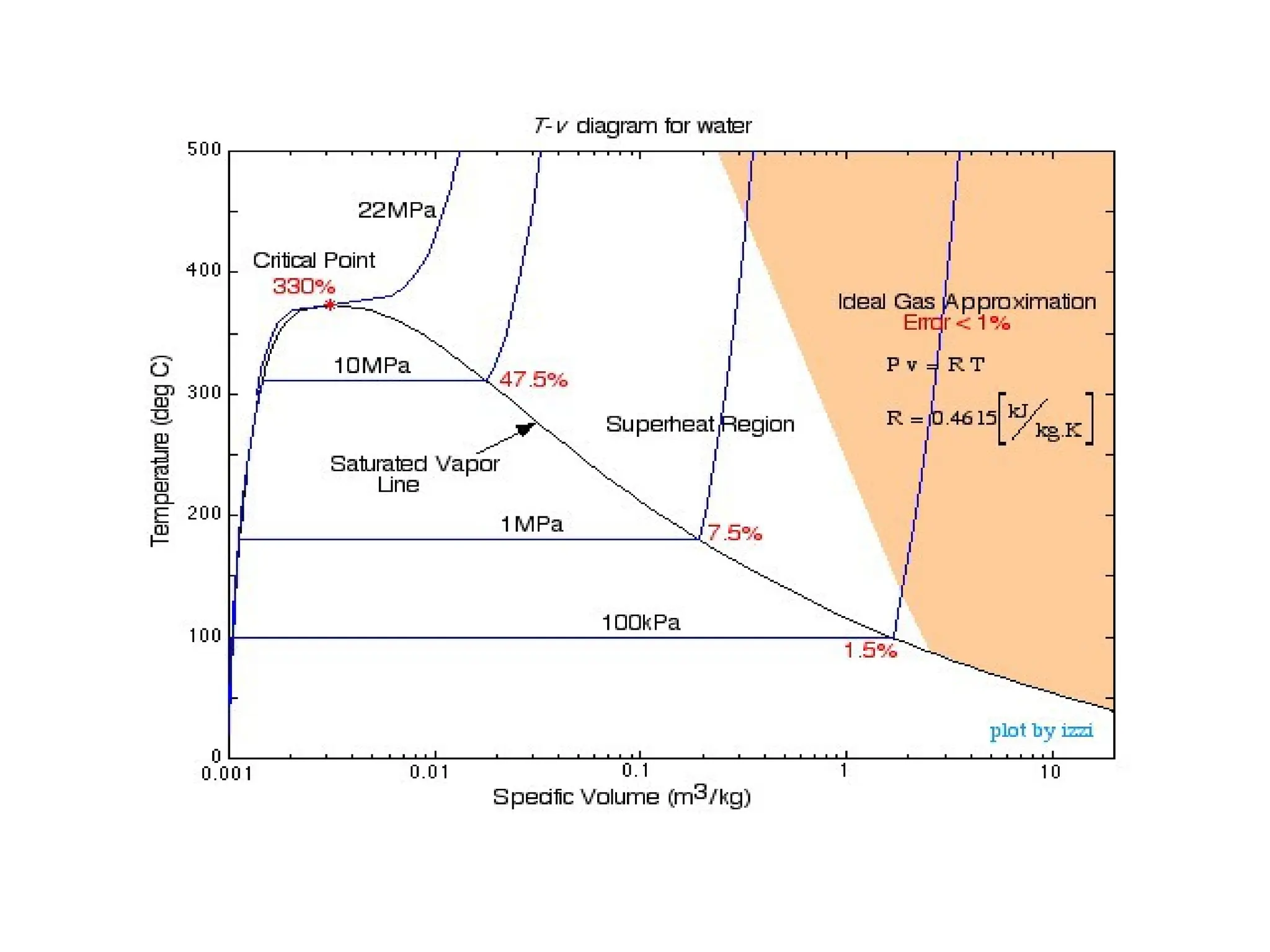
• It approximates the P-v-T behaviour of a gas at
high temperatures and low pressures in the
superheated vapour region.
• ideal-gas relation given closely approximates the
P-v-T behavior of real gases at low densities.
• At low pressures and high temperatures, the
density of a gas decreases, and the gas behaves
as an ideal gas under these conditions
Compressibility Factor: A measure of deviation
From ideal-gas behaviour
• When a gas is at a state near the saturation
region or its critical point, the gas behaviour
deviates from the ideal gas model significantly.
• This deviation from ideal-gas behavior at a
given temperature and pressure can accurately
be accounted for by the introduction of a
correction factor called the compressibility
factor Z
• Z=1(Ideal gas)
Compressibility Factor Z=Pv/RT
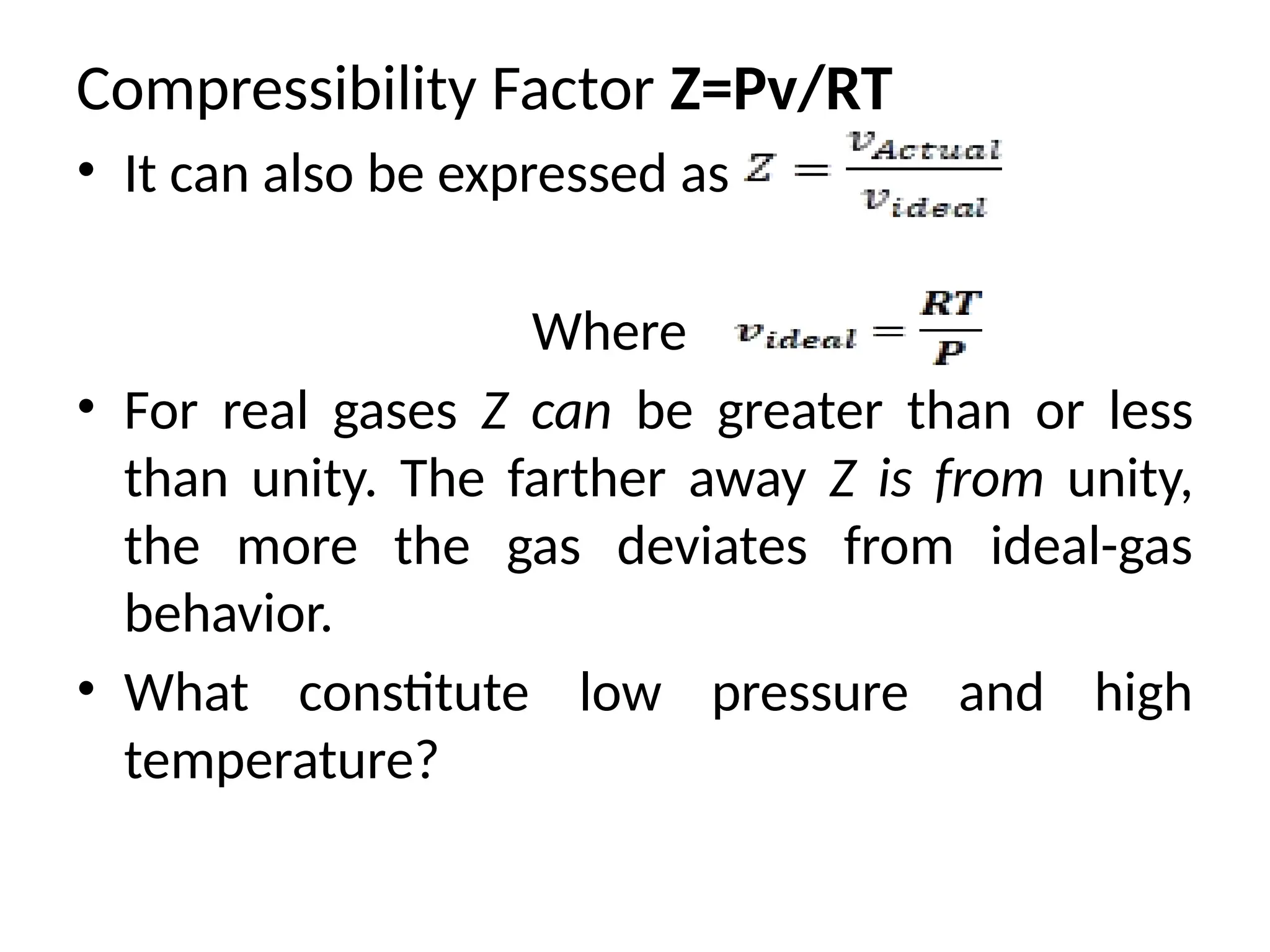
• It can also be expressed as
Where
• For real gases Z can be greater than or less
than unity. The farther away Z is from unity,
the more the gas deviates from ideal-gas
behavior.
• What constitute low pressure and high
temperature?
• Is -100°C a low temperature? It definitely is for most
substances but not for air. Air (or nitrogen) can be
treated as an ideal gas at this temperature and
atmospheric pressure with an error under 1 percent.
• This is because nitrogen is well over its critical
temperature (-147°C) and away from the saturation
region. At this temperature and pressure, however,
most substances would exist in the solid phase.
Therefore, the pressure or temperature of a
substance is high or low relative to its critical
temperature or pressure
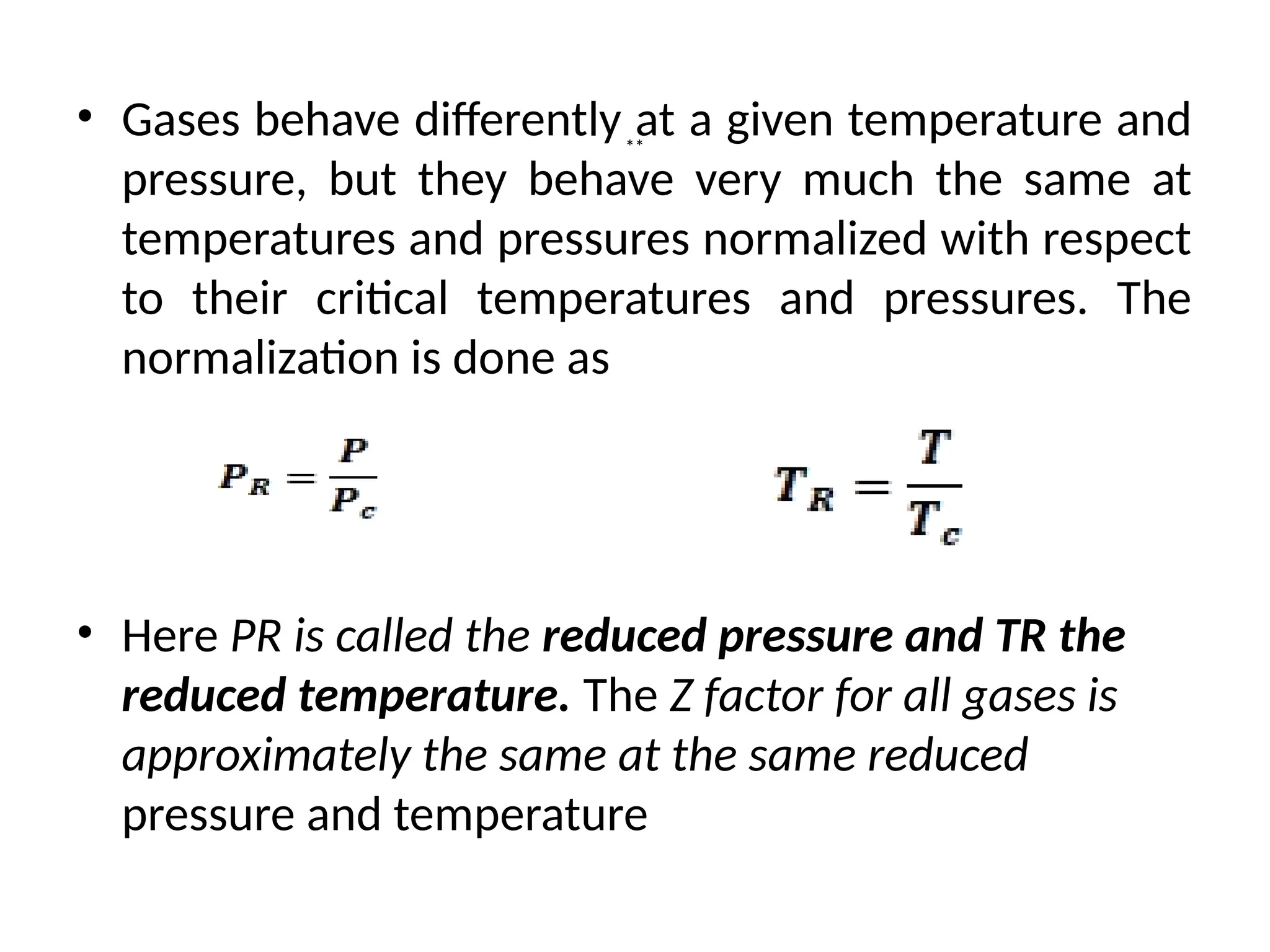
• Gases behave differently at a given temperature and
pressure, but they behave very much the same at
temperatures and pressures normalized with respect
to their critical temperatures and pressures. The
normalization is done as
• Here PR is called the reduced pressure and TR the
reduced temperature. The Z factor for all gases is
approximately the same at the same reduced
pressure and temperature
**
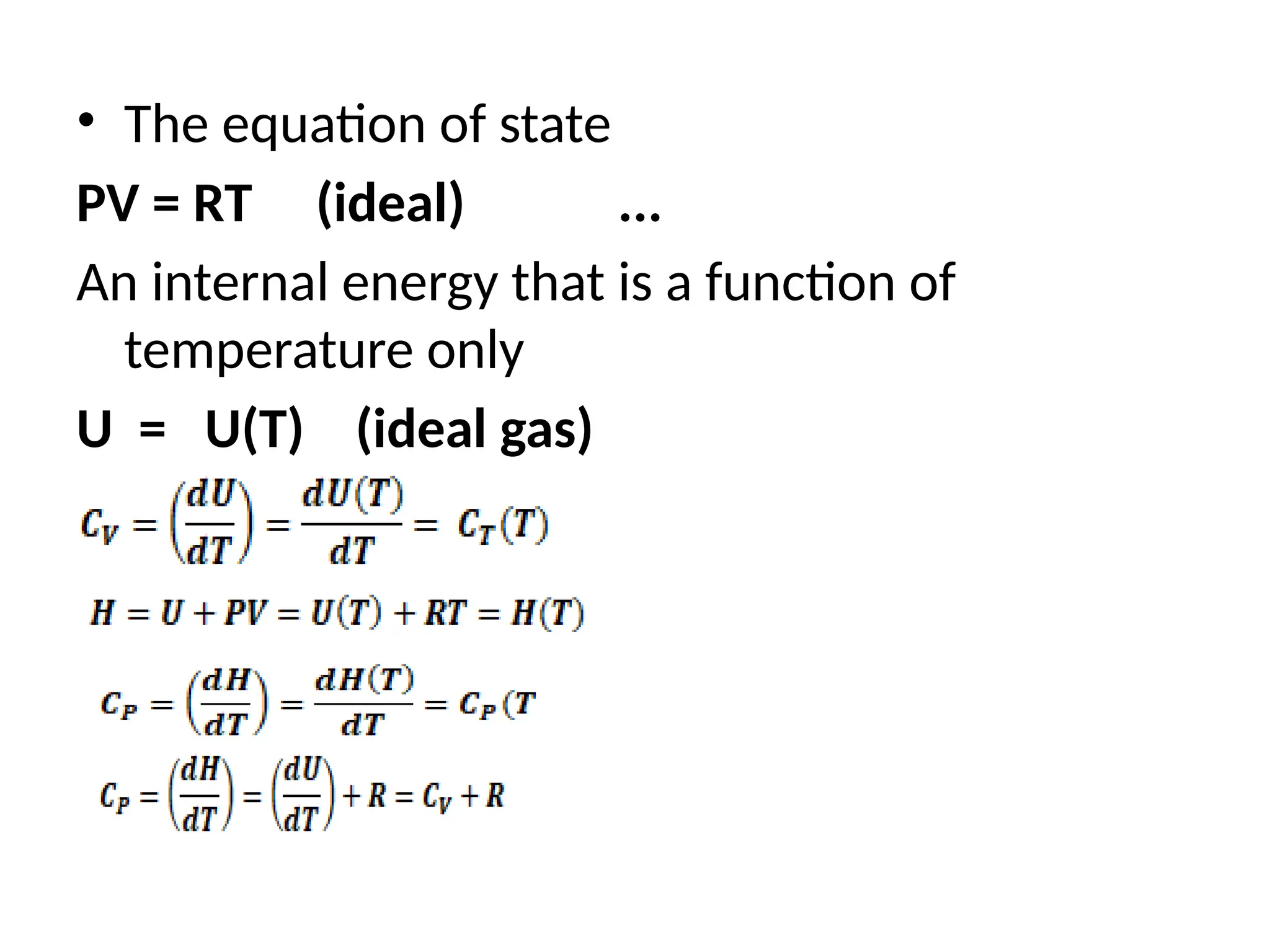
• The equation of state
PV = RT (ideal) ...
An internal energy that is a function of
temperature only
U = U(T) (ideal gas)
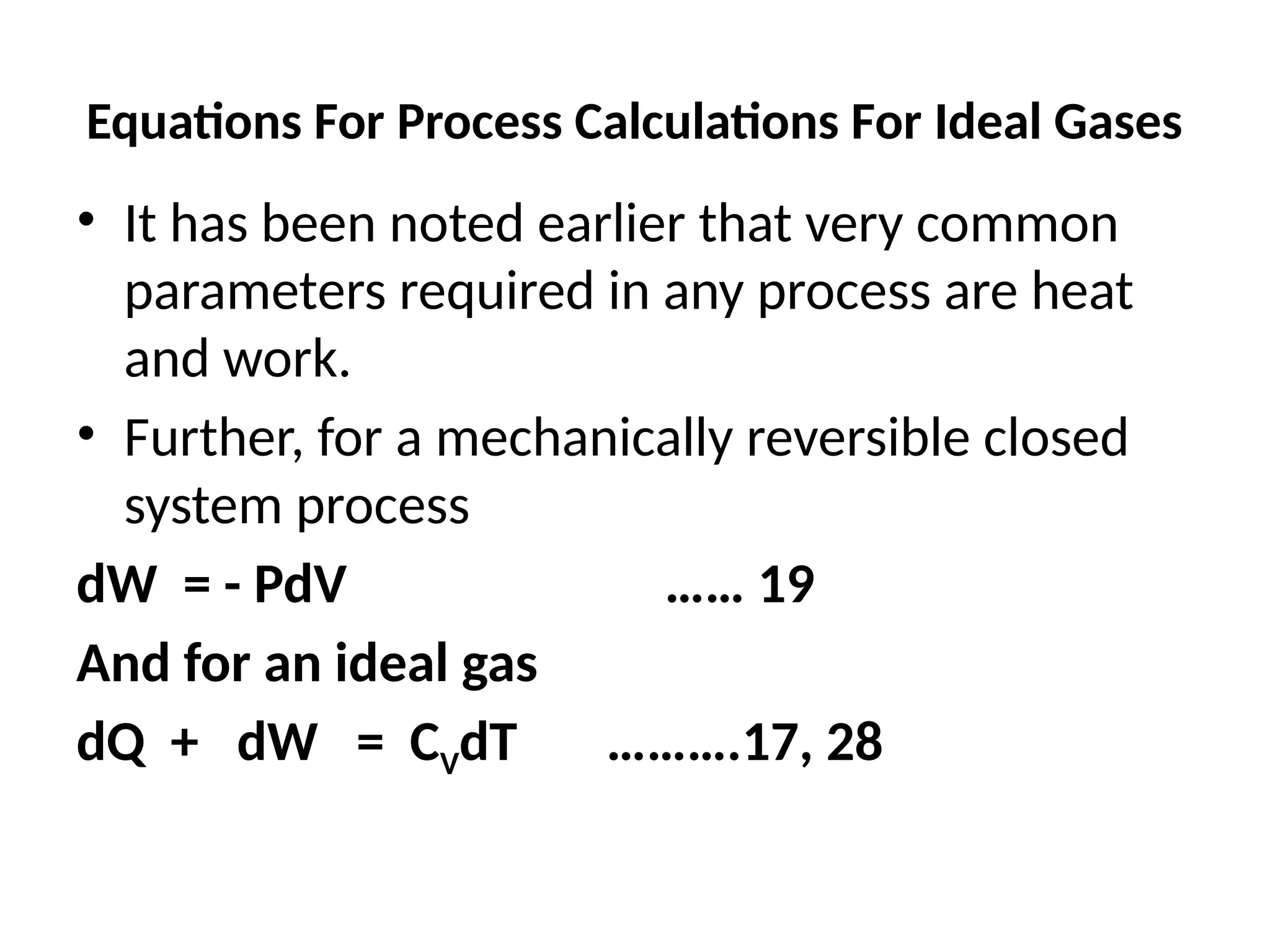
Equations For Process Calculations For Ideal Gases
• It has been noted earlier that very common
parameters required in any process are heat
and work.
• Further, for a mechanically reversible closed
system process
dW = - PdV …… 19
And for an ideal gas
dQ + dW = CVdT ……….17, 28
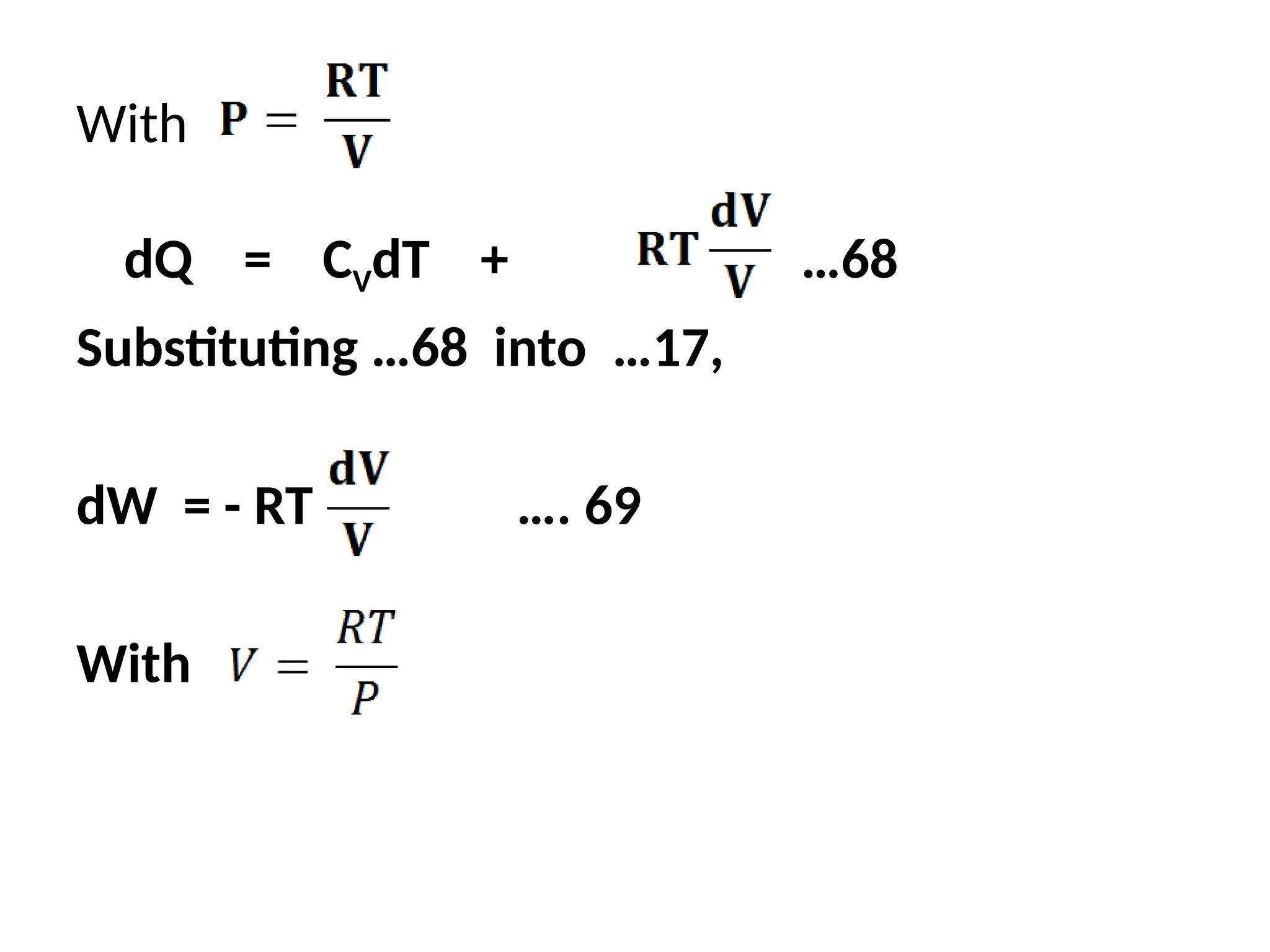
With
dQ = CVdT + …68
Substituting …68 into …17,
dW = - RT …. 69
With
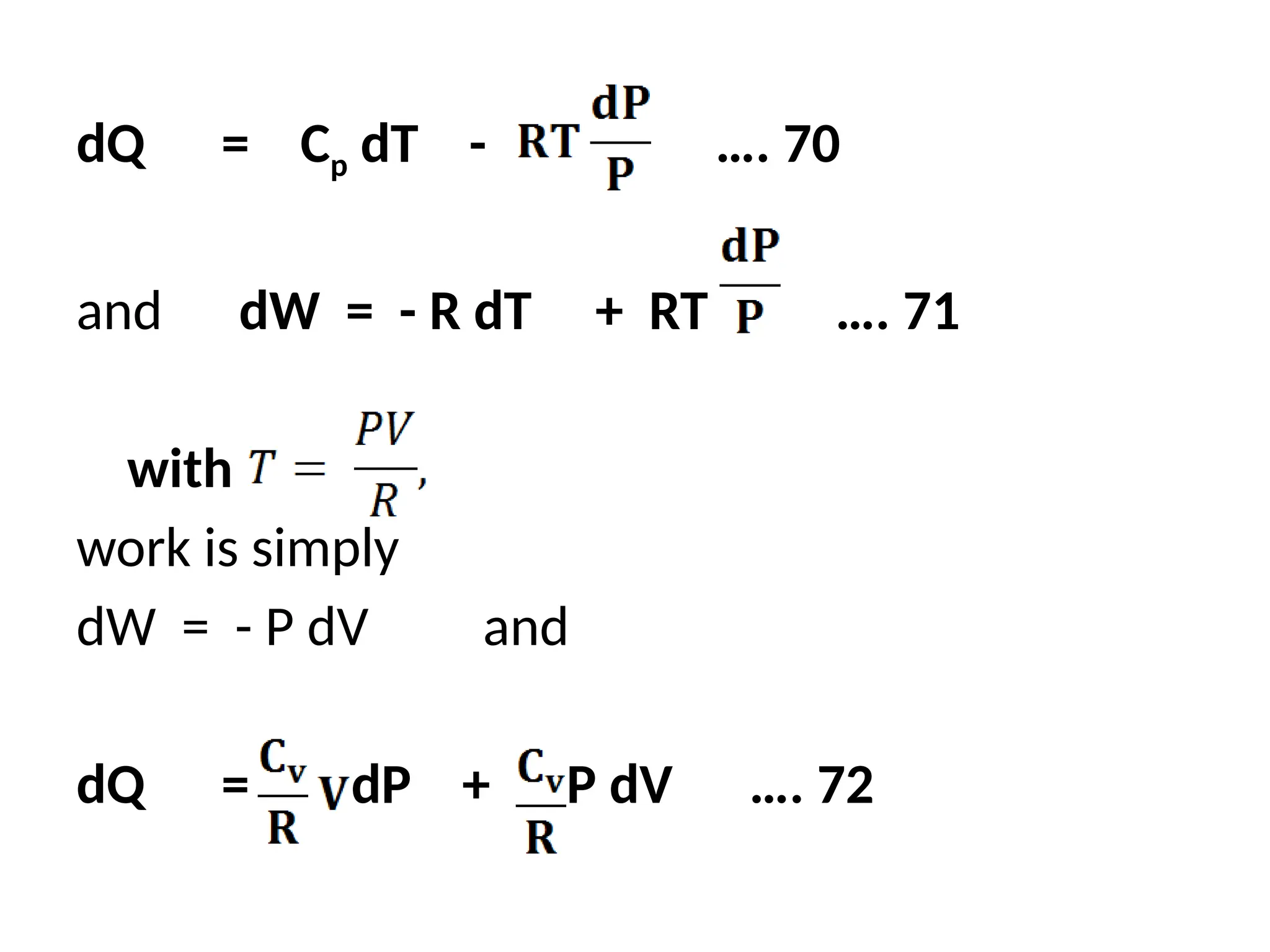
dQ = Cp dT - …. 70
and dW = - R dT + RT …. 71
with
work is simply
dW = - P dV and
dQ = dP + P dV …. 72
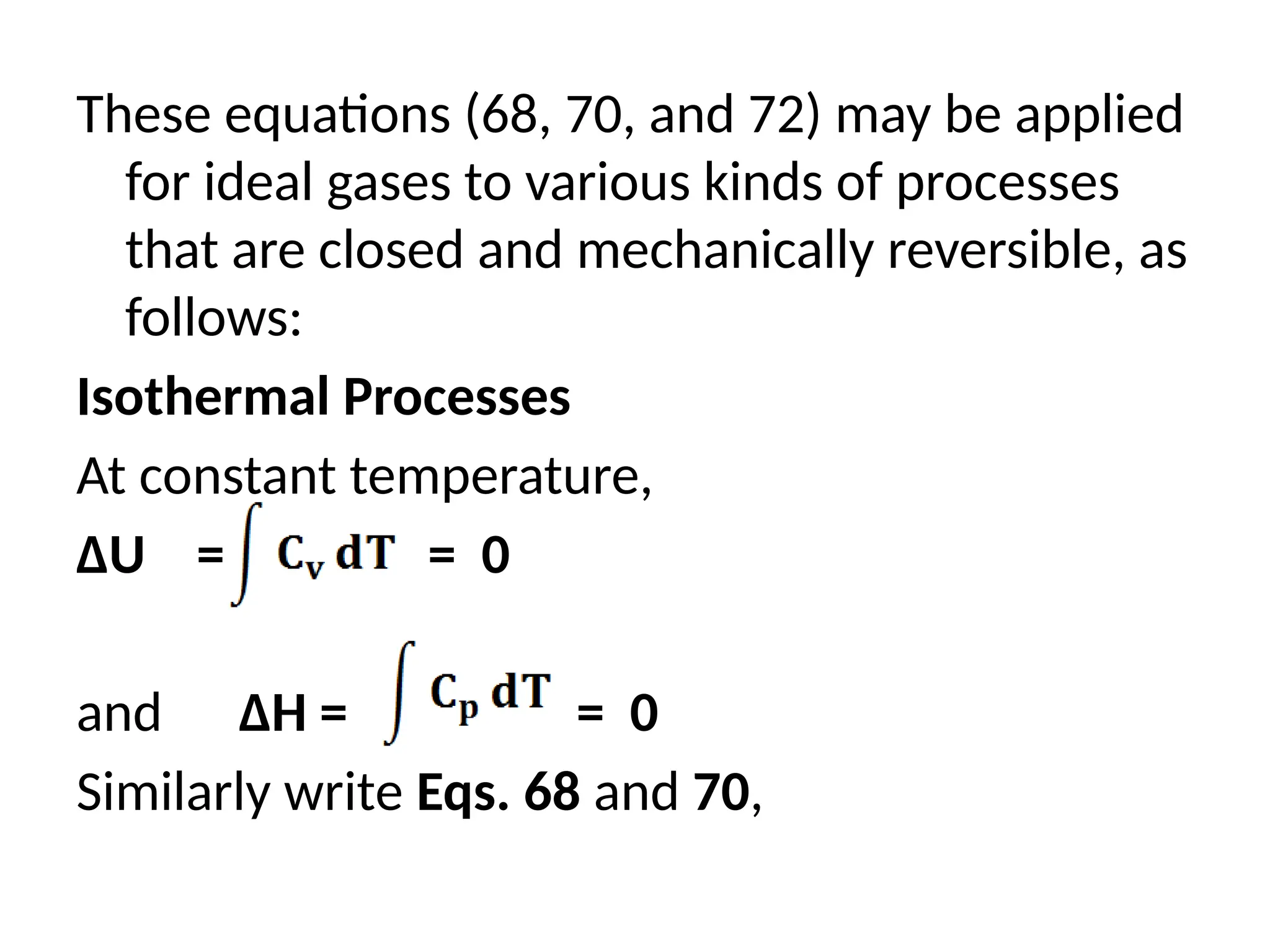
These equations (68, 70, and 72) may be applied
for ideal gases to various kinds of processes
that are closed and mechanically reversible, as
follows:
Isothermal Processes
At constant temperature,
ΔU = = 0
and ΔH = = 0
Similarly write Eqs. 68 and 70,
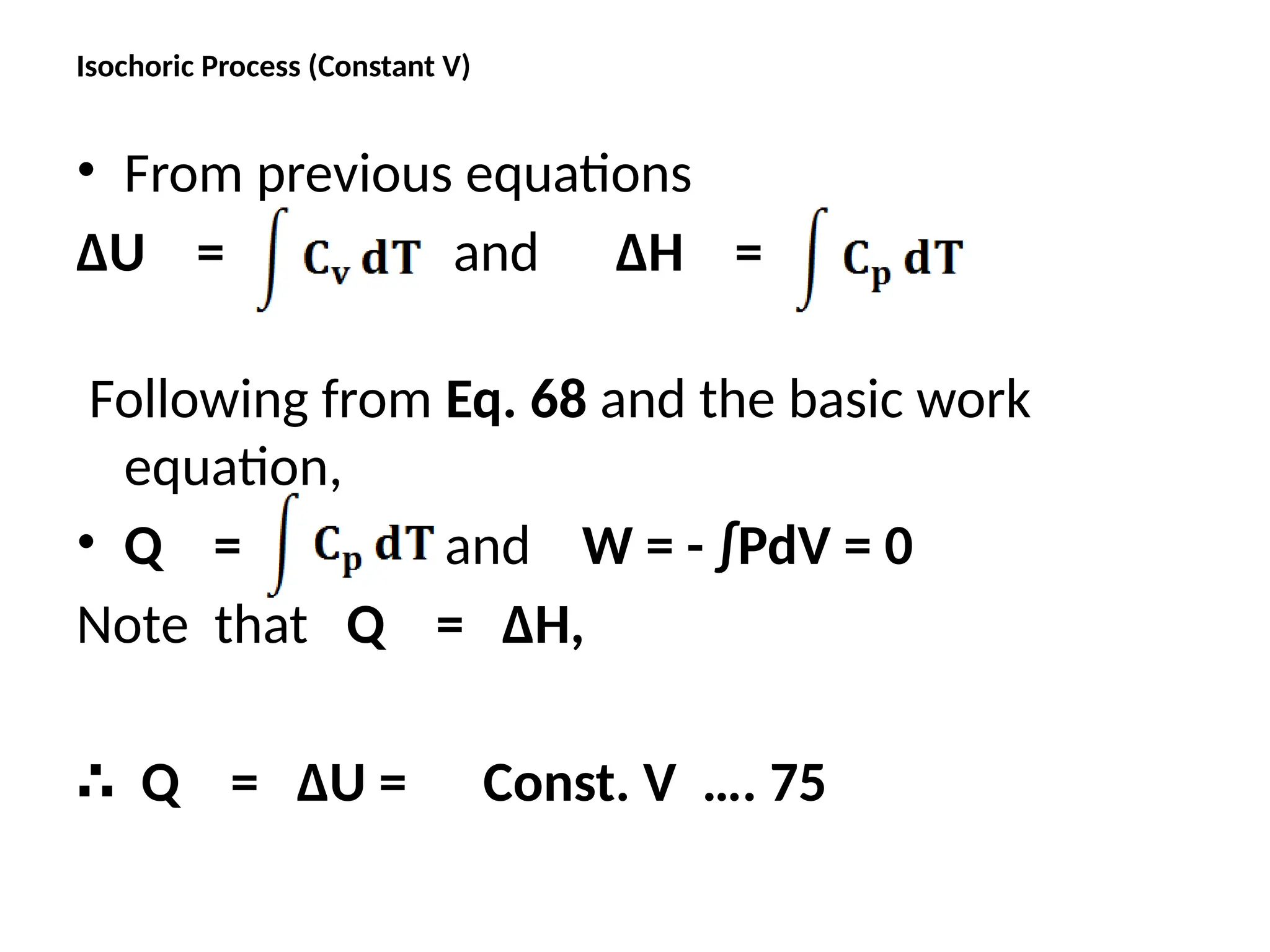
Isochoric Process (Constant V)
• From previous equations
ΔU = and ΔH =
Following from Eq. 68 and the basic work
equation,
• Q = and W = - ∫PdV = 0
Note that Q = ΔH,
∴ Q = ΔU = Const. V …. 75
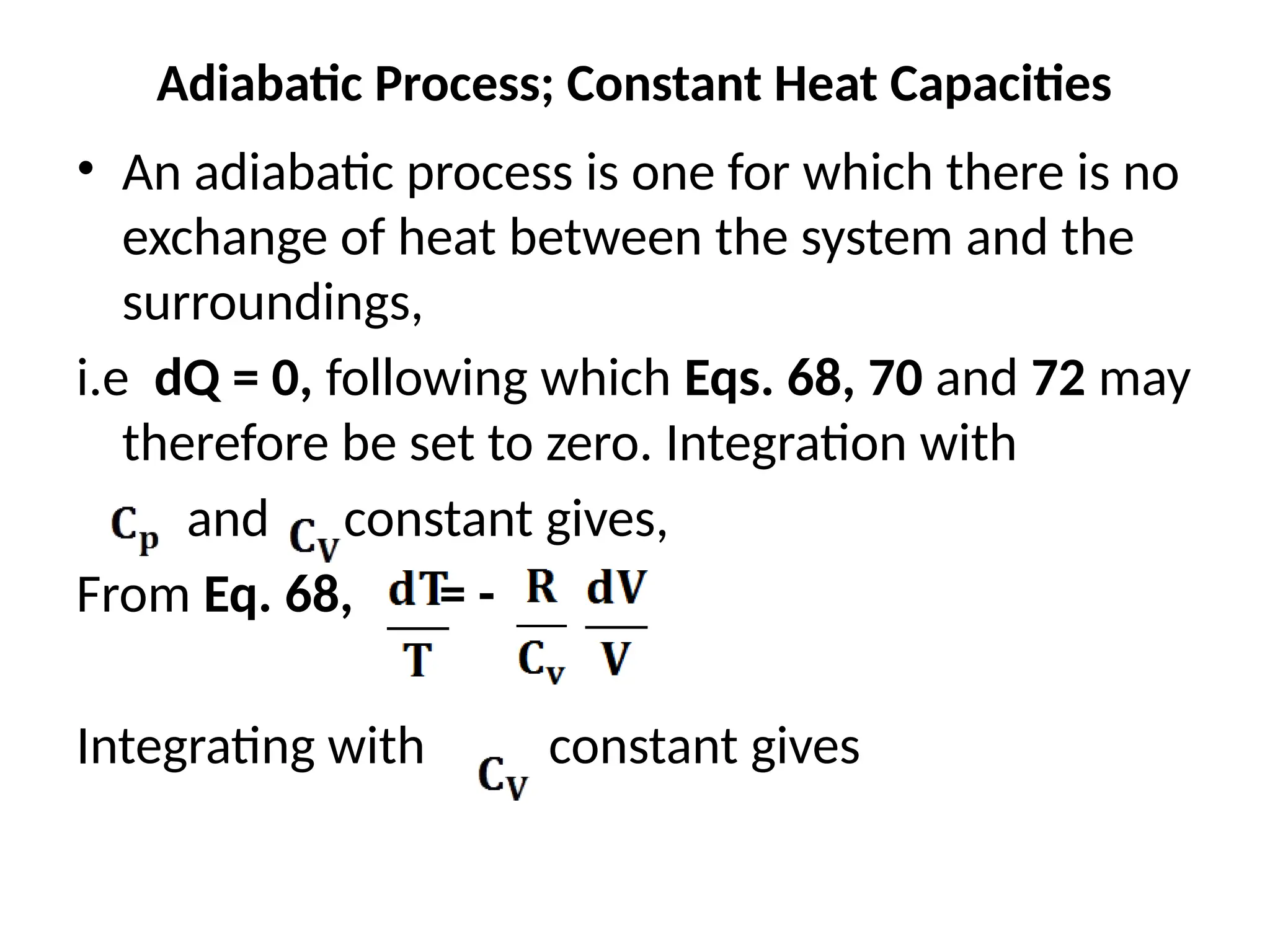
Adiabatic Process; Constant Heat Capacities
• An adiabatic process is one for which there is no
exchange of heat between the system and the
surroundings,
i.e dQ = 0, following which Eqs. 68, 70 and 72 may
therefore be set to zero. Integration with
and constant gives,
From Eq. 68, = -
Integrating with constant gives
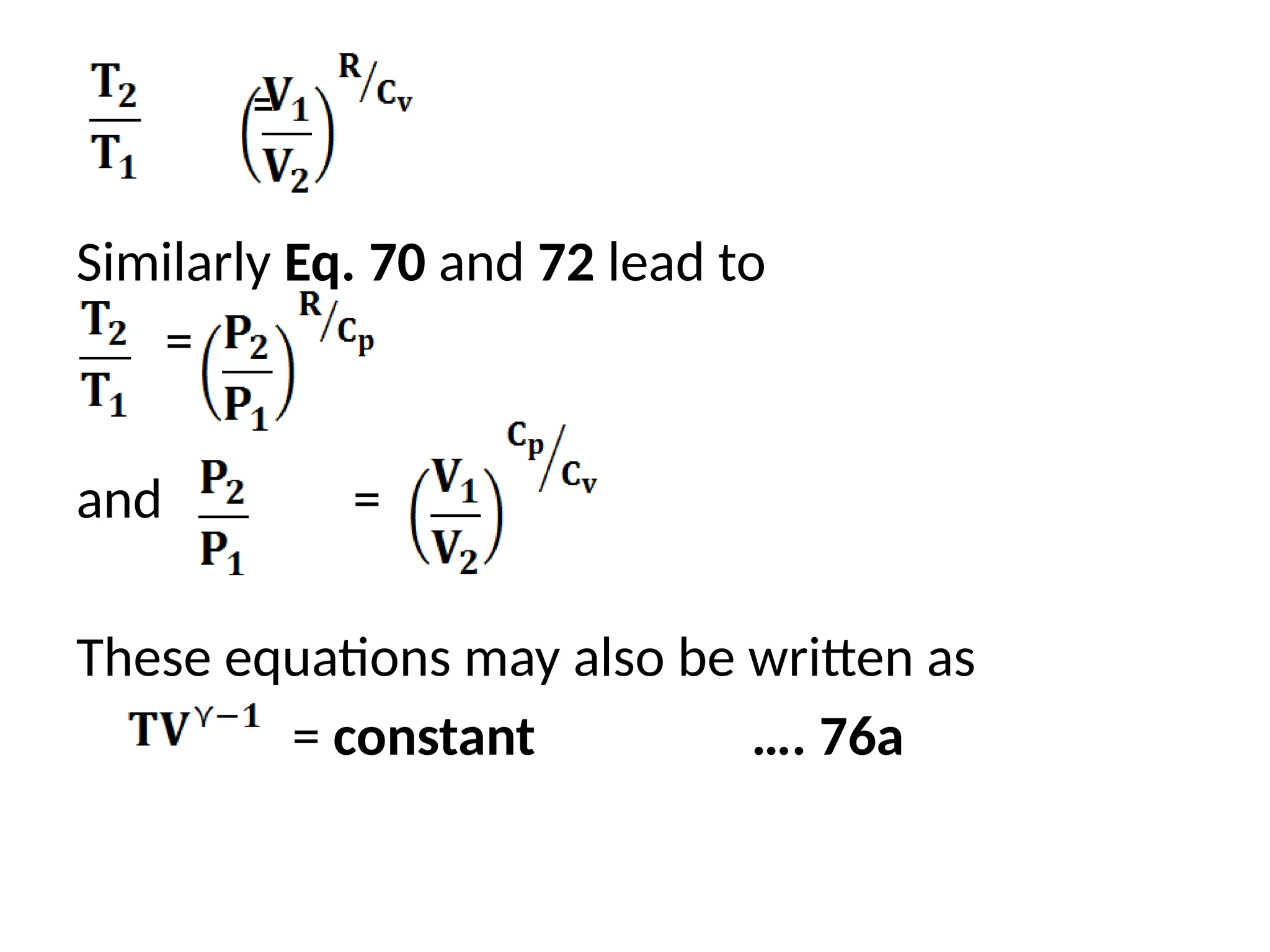
=
Similarly Eq. 70 and 72 lead to
=
and =
These equations may also be written as
= constant …. 76a
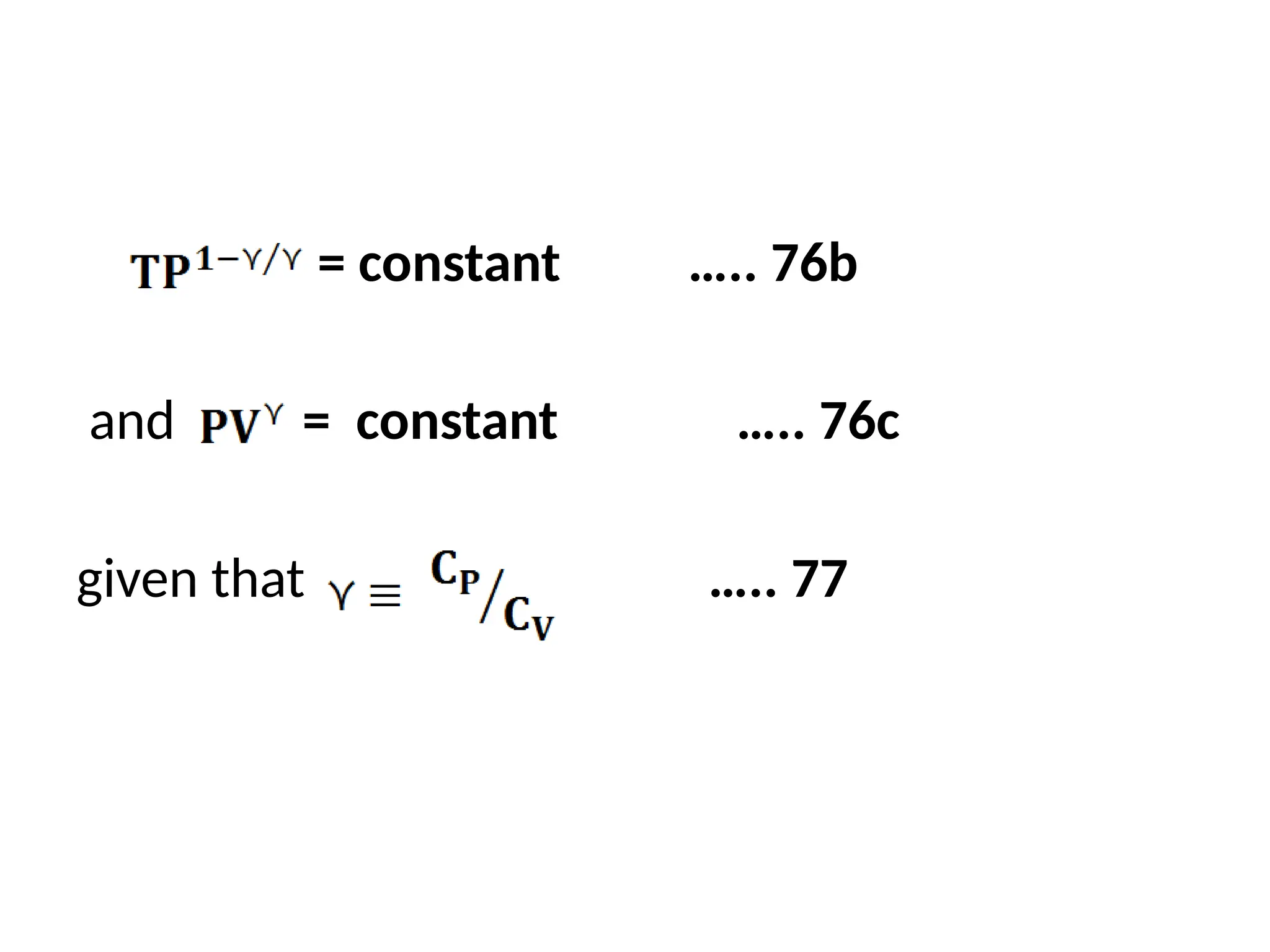
= constant ….. 76b
and = constant ….. 76c
given that ….. 77

Week 5 lecture.pptx ideal gas are known to

  • 1.
    Ideal Gas • Thermodynamictables provide very accurate information about the properties, but they are bulky and vulnerable to typographical errors. A more practical and desirable approach would be to have some simple relations among the properties that are sufficiently general and accurate. • Any equation that relates the pressure, temperature, and specific volume of a substance is called an equation of state
  • 2.
    • The simplestand best-known equation of state for substances in the gas phase is the ideal-gas equation of state. • This equation predicts the P-v-T behavior of a gas quite accurately within some properly selected region. • Pv = RT is called the ideal-gas equation of state, or simply the ideal-gas relation, and a gas that obeys this relation is called an ideal gas. In this equation, P is the absolute pressure, T is the absolute temperature, and v is the specific volume
  • 3.
    P v =RT or PV = mRT • It approximates the P-v-T behaviour of a gas at high temperatures and low pressures in the superheated vapour region. • ideal-gas relation given closely approximates the P-v-T behavior of real gases at low densities. • At low pressures and high temperatures, the density of a gas decreases, and the gas behaves as an ideal gas under these conditions
  • 4.
    Compressibility Factor: Ameasure of deviation From ideal-gas behaviour • When a gas is at a state near the saturation region or its critical point, the gas behaviour deviates from the ideal gas model significantly. • This deviation from ideal-gas behavior at a given temperature and pressure can accurately be accounted for by the introduction of a correction factor called the compressibility factor Z • Z=1(Ideal gas)
  • 5.
    Compressibility Factor Z=Pv/RT •It can also be expressed as Where • For real gases Z can be greater than or less than unity. The farther away Z is from unity, the more the gas deviates from ideal-gas behavior. • What constitute low pressure and high temperature?
  • 6.
    • Is -100°Ca low temperature? It definitely is for most substances but not for air. Air (or nitrogen) can be treated as an ideal gas at this temperature and atmospheric pressure with an error under 1 percent. • This is because nitrogen is well over its critical temperature (-147°C) and away from the saturation region. At this temperature and pressure, however, most substances would exist in the solid phase. Therefore, the pressure or temperature of a substance is high or low relative to its critical temperature or pressure
  • 7.
    • Gases behavedifferently at a given temperature and pressure, but they behave very much the same at temperatures and pressures normalized with respect to their critical temperatures and pressures. The normalization is done as • Here PR is called the reduced pressure and TR the reduced temperature. The Z factor for all gases is approximately the same at the same reduced pressure and temperature **
  • 9.
    • The equationof state PV = RT (ideal) ... An internal energy that is a function of temperature only U = U(T) (ideal gas)
  • 10.
    Equations For ProcessCalculations For Ideal Gases • It has been noted earlier that very common parameters required in any process are heat and work. • Further, for a mechanically reversible closed system process dW = - PdV …… 19 And for an ideal gas dQ + dW = CVdT ……….17, 28
  • 11.
    With dQ = CVdT+ …68 Substituting …68 into …17, dW = - RT …. 69 With
  • 12.
    dQ = CpdT - …. 70 and dW = - R dT + RT …. 71 with work is simply dW = - P dV and dQ = dP + P dV …. 72
  • 13.
    These equations (68,70, and 72) may be applied for ideal gases to various kinds of processes that are closed and mechanically reversible, as follows: Isothermal Processes At constant temperature, ΔU = = 0 and ΔH = = 0 Similarly write Eqs. 68 and 70,
  • 14.
    Isochoric Process (ConstantV) • From previous equations ΔU = and ΔH = Following from Eq. 68 and the basic work equation, • Q = and W = - ∫PdV = 0 Note that Q = ΔH, ∴ Q = ΔU = Const. V …. 75
  • 15.
    Adiabatic Process; ConstantHeat Capacities • An adiabatic process is one for which there is no exchange of heat between the system and the surroundings, i.e dQ = 0, following which Eqs. 68, 70 and 72 may therefore be set to zero. Integration with and constant gives, From Eq. 68, = - Integrating with constant gives
  • 16.
    = Similarly Eq. 70and 72 lead to = and = These equations may also be written as = constant …. 76a
  • 17.
    = constant …..76b and = constant ….. 76c given that ….. 77