1. Fuels and Combustion
Dr.M.Vivekanandan M.E.,PhD
Adjunct Faculty, Kongunadu College of Engineering
and Technology,
CEO, TryCAE Industrial Engineering Pvt Ltd.,
Syllabus
• Introduction to Fuels
• Properties of Fuel oil, Coal and Gas
• Storage, handling and preparation of fuels
• Principle of Combustion
• Combustion of Oil, Coal, and Gas
Introduction to Fuels
• Different type of fuels such as liquid, solid and
gas are available for firing in boilers and
furnaces.
• What is the criteria for selecting the fuel type?
– Availability
– Storage & handling
– Pollution
– Cost of fuel
– Fuel properties
Properties of Liquid Fuels and its impacts
• Density: mass of the fuel
volume of the fuel
At a reference temperature typically 15°C. (kg/m3.)
• Specific gravity: weight of a given volume of oil
weight of the same volume of water
at a given temperature.
– If specific gravity is more, heating value is also more.
e.g Light Oil =0.85-0.87, Furnace oil=0.89-0.95, L.S.H.S=0.88-0.98
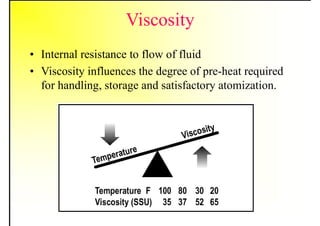
Viscosity
• Internal resistance to flow of fluid
• Viscosity influences the degree of pre-heat required
for handling, storage and satisfactory atomization.
Specific Heat
• Specific heat is the amount of kcals needed
to raise the temperature of 1 kg of oil by 1oC.
The unit of specific heat is kcal/kgoC. It
varies from 0.22 to 0.28 depending on the oil
specific gravity.
It helps to quantify how much steam or
electrical energy required for preheating.
Flash Point & Pour Point
• Flash Point: The lowest temperature at which the
fuel can be heated so that the vapour gives off
flashes momentarily when an open flame is passed
over it. Ex.Flash point for furnace oil is 66oC.
• Pour Point: The lowest temperature at which it
will pour or flow when cooled under prescribed
conditions. It is a very rough indication of the
lowest temperature at which fuel oil is readily
pumpable.
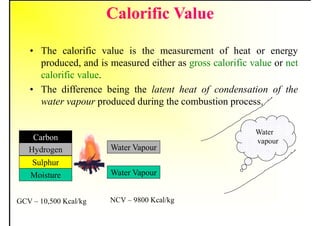
Calorific Value
• The calorific value is the measurement of heat or energy
produced, and is measured either as gross calorific value or net
calorific value.
• The difference being the latent heat of condensation of the
water vapour produced during the combustion process.
Water
vapour
Carbon
Hydrogen
Sulphur
Moisture
GCV – 10,500 Kcal/kg
Water Vapour
Water Vapour
NCV – 9800 Kcal/kg
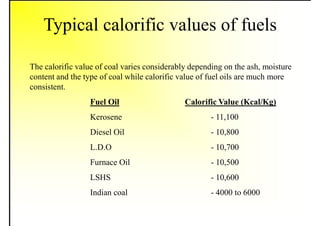
Typical calorific values of fuels
The calorific value of coal varies considerably depending on the ash, moisture
content and the type of coal while calorific value of fuel oils are much more
consistent.
Fuel Oil Calorific Value (Kcal/Kg)
Kerosene - 11,100
Diesel Oil - 10,800
L.D.O - 10,700
Furnace Oil - 10,500
LSHS - 10,600
Indian coal - 4000 to 6000
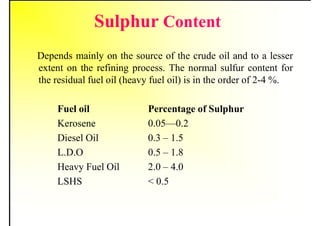
Sulphur Content
Depends mainly on the source of the crude oil and to a lesser
extent on the refining process. The normal sulfur content for
the residual fuel oil (heavy fuel oil) is in the order of 2-4 %.
Fuel oil Percentage of Sulphur
Kerosene 0.05—0.2
Diesel Oil 0.3 – 1.5
L.D.O 0.5 – 1.8
Heavy Fuel Oil 2.0 – 4.0
LSHS < 0.5
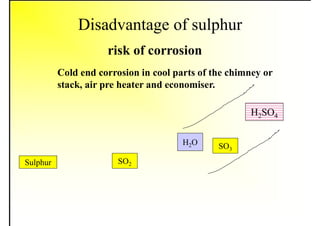
Disadvantage of sulphur
risk of corrosion
Cold end corrosion in cool parts of the chimney or
stack, air pre heater and economiser.
Sulphur SO2
SO3
H2SO4
H2O
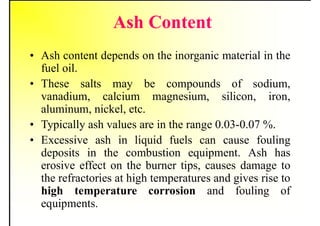
Ash Content
• Ash content depends on the inorganic material in the
fuel oil.
• These salts may be compounds of sodium,
vanadium, calcium magnesium, silicon, iron,
aluminum, nickel, etc.
• Typically ash values are in the range 0.03-0.07 %.
• Excessive ash in liquid fuels can cause fouling
deposits in the combustion equipment. Ash has
erosive effect on the burner tips, causes damage to
the refractories at high temperatures and gives rise to
high temperature corrosion and fouling of
equipments.
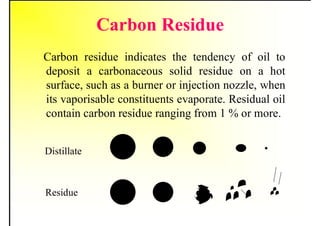
Carbon Residue
Carbon residue indicates the tendency of oil to
deposit a carbonaceous solid residue on a hot
surface, such as a burner or injection nozzle, when
its vaporisable constituents evaporate. Residual oil
contain carbon residue ranging from 1 % or more.
.
Distillate
Residue
Water Content
• Water content of furnace oil when supplied is
normally very low as the product at refinery site is
handled hot and maximum limit of 1% is specified
in the standard.
• Water may be present in free or emulsified form
• Water can cause damage to the inside furnace
surfaces during combustion especially if it contains
dissolved salts.
• It can also cause spluttering of the flame at the
burner tip, possibly extinguishing the flame and
reducing the flame temperature or lengthening the
flame.
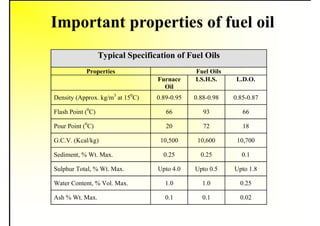
Important properties of fuel oil
Typical Specification of Fuel Oils
Properties Fuel Oils
Furnace
Oil
LS.H.S. L.D.O.
Density (Approx. kg/m3
at 150
C) 0.89-0.95 0.88-0.98 0.85-0.87
Flash Point (0
C) 66 93 66
Pour Point (0
C) 20 72 18
G.C.V. (Kcal/kg) 10,500 10,600 10,700
Sediment, % Wt. Max. 0.25 0.25 0.1
Sulphur Total, % Wt. Max. Upto 4.0 Upto 0.5 Upto 1.8
Water Content, % Vol. Max. 1.0 1.0 0.25
Ash % Wt. Max. 0.1 0.1 0.02
Storage of Fuel oil
• Hazardous to store furnace oil in barrels.
• Stored in cylindrical tanks
– either above or below the ground.
• Storage capacity
– - at least 10 days of normal consumption.
• Build bund walls around tanks.
• Periodical cleaning of tanks
– annually for heavy fuels and every two years for light fuels.
• leaks
– from joints, flanges and pipelines must be attended at the earliest.
– LOSS OF EVEN ONE DROP OF OIL EVERY SECOND CAN
COST YOU OVER 4000 LITRES A YEAR
• Fuel oil
– should be free from contaminants such as dirt, sludge and water before
it is fed to the combustion system.
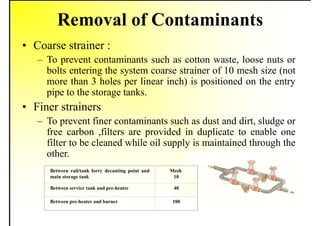
Removal of Contaminants
• Coarse strainer :
– To prevent contaminants such as cotton waste, loose nuts or
bolts entering the system coarse strainer of 10 mesh size (not
more than 3 holes per linear inch) is positioned on the entry
pipe to the storage tanks.
• Finer strainers
– To prevent finer contaminants such as dust and dirt, sludge or
free carbon ,filters are provided in duplicate to enable one
filter to be cleaned while oil supply is maintained through the
other.
Between rail/tank lorry decanting point and
main storage tank
Mesh
10
Between service tank and pre-heater 40
Between pre-heater and burner 100
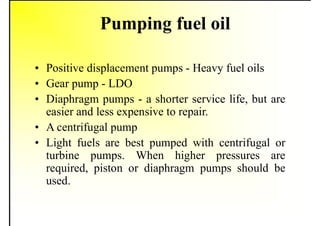
Pumping fuel oil
• Positive displacement pumps - Heavy fuel oils
• Gear pump - LDO
• Diaphragm pumps - a shorter service life, but are
easier and less expensive to repair.
• A centrifugal pump
• Light fuels are best pumped with centrifugal or
turbine pumps. When higher pressures are
required, piston or diaphragm pumps should be
used.
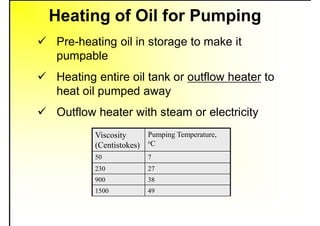
Heating of Oil for Pumping
 Pre-heating oil in storage to make it
pumpable
 Heating entire oil tank or outflow heater to
heat oil pumped away
 Outflow heater with steam or electricity
Viscosity
(Centistokes)
Pumping Temperature,
oC
50 7
230 27
900 38
1500 49
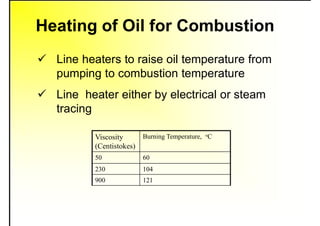
Heating of Oil for Combustion
 Line heaters to raise oil temperature from
pumping to combustion temperature
 Line heater either by electrical or steam
tracing
Viscosity
(Centistokes)
Burning Temperature, oC
50 60
230 104
900 121
Properties of Coal
Coal Classification
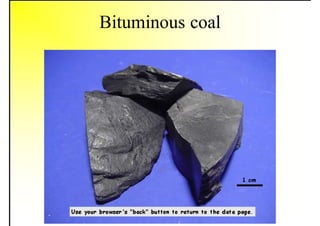
• Three main coal classes: anthracite, bituminous, and
lignite(Sub class- semi anthracite, semi bituminous,
and sub bituminous)
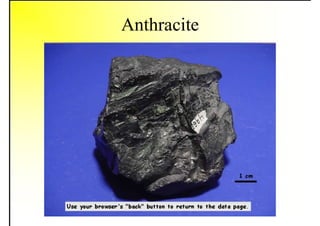
• Anthracite-oldest coal,hard coal composed mainly
of carbon with little volatile content and practically
no moisture.
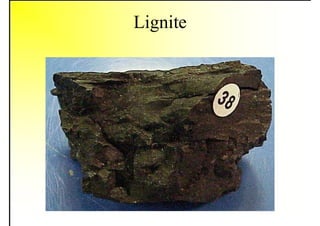
• Lignite -the youngest coal.
• Chemical composition of coal has a strong influence
on its combustibility.
Anthracite
Bituminous coal
Lignite
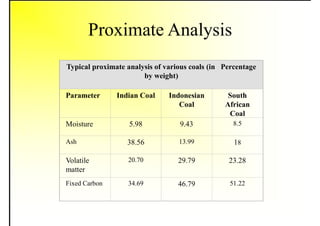
Proximate Analysis
Typical proximate analysis of various coals (in Percentage
by weight)
Parameter Indian Coal Indonesian
Coal
South
African
Coal
Moisture 5.98 9.43 8.5
Ash 38.56 13.99 18
Volatile
matter
20.70 29.79 23.28
Fixed Carbon 34.69 46.79 51.22
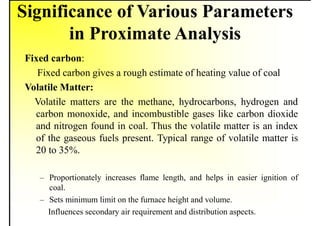
Significance of Various Parameters
in Proximate Analysis
Fixed carbon:
Fixed carbon gives a rough estimate of heating value of coal
Volatile Matter:
Volatile matters are the methane, hydrocarbons, hydrogen and
carbon monoxide, and incombustible gases like carbon dioxide
and nitrogen found in coal. Thus the volatile matter is an index
of the gaseous fuels present. Typical range of volatile matter is
20 to 35%.
– Proportionately increases flame length, and helps in easier ignition of
coal.
– Sets minimum limit on the furnace height and volume.
Influences secondary air requirement and distribution aspects.
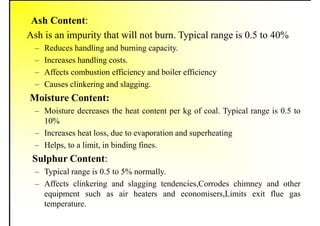
Ash Content:
Ash is an impurity that will not burn. Typical range is 0.5 to 40%
– Reduces handling and burning capacity.
– Increases handling costs.
– Affects combustion efficiency and boiler efficiency
– Causes clinkering and slagging.
Moisture Content:
– Moisture decreases the heat content per kg of coal. Typical range is 0.5 to
10%
– Increases heat loss, due to evaporation and superheating
– Helps, to a limit, in binding fines.
Sulphur Content:
– Typical range is 0.5 to 5% normally.
– Affects clinkering and slagging tendencies,Corrodes chimney and other
equipment such as air heaters and economisers,Limits exit flue gas
temperature.
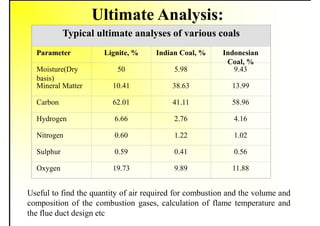
Ultimate Analysis:
Typical ultimate analyses of various coals
Parameter Lignite, % Indian Coal, % Indonesian
Coal, %
Moisture(Dry
basis)
50 5.98 9.43
Mineral Matter 10.41 38.63 13.99
Carbon 62.01 41.11 58.96
Hydrogen 6.66 2.76 4.16
Nitrogen 0.60 1.22 1.02
Sulphur 0.59 0.41 0.56
Oxygen 19.73 9.89 11.88
Useful to find the quantity of air required for combustion and the volume and
composition of the combustion gases, calculation of flame temperature and
the flue duct design etc
Storage & Handling of Coal
Stocking of coal has its own disadvantages like build-up of
inventory, space constraints, deterioration in quality and potential
fire hazards. Other minor losses associated with the storage of
coal include oxidation, wind and carpet loss.
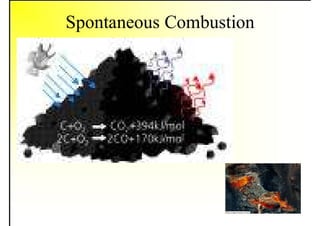
• Minimise carpet loss and the loss due to spontaneous
combustion.
• The measures to reduce the carpet loses are
– Preparing a hard ground for coal to be stacked upon.
– Preparing standard storage bays out of concrete and brick
• In process Industry, modes of coal handling range from manual to
conveyor systems. It would be advisable to minimise the handling
of coal so that further generation of fines .
Preparation of Coal
• Sizing of Coal
– Proper coal sizing, with specific relevance to the type of firing system,
helps towards even burning, reduced ash losses and better combustion
efficiency.
Conditioning of Coal
– Segregation of fines from larger coal pieces can be reduced to a great
extent by conditioning coal with water. Water helps fine particles to stick
to the bigger lumps due to surface tension of the moisture, thus stopping
fines from falling through grate bars or being carried away by the furnace
draft.
– Blending of Coal
– In case of coal lots having excessive fines, it is advisable to blend the
predominantly lumped coal with lots containing excessive fines. Coal
blending may thus help to limit the extent of fines in coal being fired to
not more than 25%. Blending of different qualities of coal may also help
to supply a uniform coal feed to the boiler.
Spontaneous Combustion
LPG & N.Gas
• LPG is a predominant mixture of propane and Butane with a small
percentage of unsaturates (Propylene and Butylene)
• LPG -gaseous at normal atmospheric pressure, but may be
condensed to the liquid state at normal temperature, by the
application of moderate pressures. Liquid LPG evaporates to
produce about 250 times volume of gas.
• LPG vapour is denser than air
• Natural Gas
• Methane is the main constituent of Natural gas and accounting for
about 95% of the total volume. Other components are: Ethane,
Propane, Butane, Pentane, Nitrogen.sulphur negligible.
• It is lighter than air and disperses into air easily in case
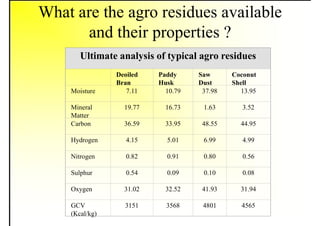
What are the agro residues available
and their properties ?
Ultimate analysis of typical agro residues
Deoiled
Bran
Paddy
Husk
Saw
Dust
Coconut
Shell
Moisture 7.11 10.79 37.98 13.95
Mineral
Matter
19.77 16.73 1.63 3.52
Carbon 36.59 33.95 48.55 44.95
Hydrogen 4.15 5.01 6.99 4.99
Nitrogen 0.82 0.91 0.80 0.56
Sulphur 0.54 0.09 0.10 0.08
Oxygen 31.02 32.52 41.93 31.94
GCV
(Kcal/kg)
3151 3568 4801 4565
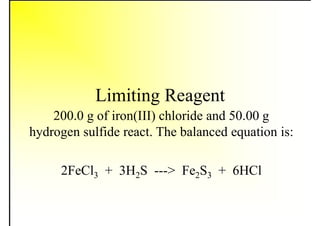
Limiting Reagent
200.0 g of iron(III) chloride and 50.00 g
hydrogen sulfide react. The balanced equation is:
2FeCl3 + 3H2S ---> Fe2S3 + 6HCl
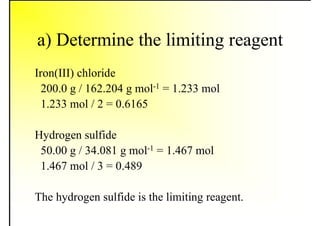
a) Determine the limiting reagent
Iron(III) chloride
200.0 g / 162.204 g mol-1 = 1.233 mol
1.233 mol / 2 = 0.6165
Hydrogen sulfide
50.00 g / 34.081 g mol-1 = 1.467 mol
1.467 mol / 3 = 0.489
The hydrogen sulfide is the limiting reagent.
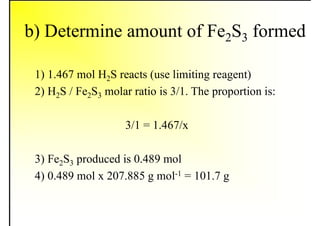
b) Determine amount of Fe2S3 formed
1) 1.467 mol H2S reacts (use limiting reagent)
2) H2S / Fe2S3 molar ratio is 3/1. The proportion is:
3/1 = 1.467/x
3) Fe2S3 produced is 0.489 mol
4) 0.489 mol x 207.885 g mol-1 = 101.7 g
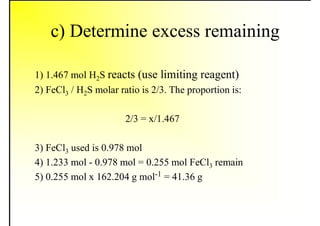
c) Determine excess remaining
1) 1.467 mol H2S reacts (use limiting reagent)
2) FeCl3 / H2S molar ratio is 2/3. The proportion is:
2/3 = x/1.467
3) FeCl3 used is 0.978 mol
4) 1.233 mol - 0.978 mol = 0.255 mol FeCl3 remain
5) 0.255 mol x 162.204 g mol-1 = 41.36 g
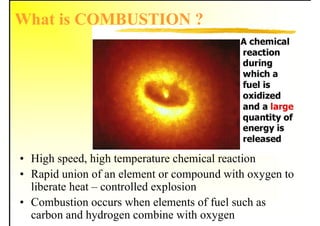
What is COMBUSTION ?
• High speed, high temperature chemical reaction
• Rapid union of an element or compound with oxygen to
liberate heat – controlled explosion
• Combustion occurs when elements of fuel such as
carbon and hydrogen combine with oxygen
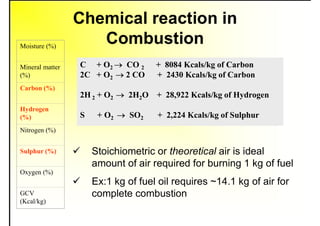
Chemical reaction in
Combustion
 Stoichiometric or theoretical air is ideal
amount of air required for burning 1 kg of fuel
 Ex:1 kg of fuel oil requires ~14.1 kg of air for
complete combustion
C + O2  CO 2 + 8084 Kcals/kg of Carbon
2C + O2  2 CO + 2430 Kcals/kg of Carbon
2H 2 + O2  2H2O + 28,922 Kcals/kg of Hydrogen
S + O2  SO2 + 2,224 Kcals/kg of Sulphur
Moisture (%)
Mineral matter
(%)
Carbon (%)
Hydrogen
(%)
Nitrogen (%)
Sulphur (%)
Oxygen (%)
GCV
(Kcal/kg)
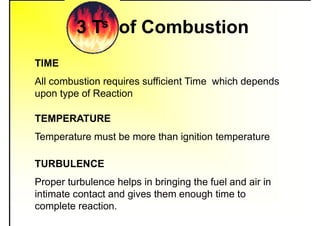
3 Ts of Combustion
TIME
All combustion requires sufficient Time which depends
upon type of Reaction
TEMPERATURE
Temperature must be more than ignition temperature
TURBULENCE
Proper turbulence helps in bringing the fuel and air in
intimate contact and gives them enough time to
complete reaction.
What are the three types of
combustion?
• Perfect Combustion is achieved when all the fuel is burned using only
the theoretical amount of air, but perfect combustion cannot be achieved
in a boiler.
• Good / Complete Combustion is achieved when all the fuel is burned
using the minimal amount of air above the theoretical amount of air
needed to burn the fuel. Complete combustion is always our goal. With
complete combustion, the fuel is burned at the highest combustion
efficiency with low pollution.
• Incomplete Combustion occurs when all the fuel is not burned, which
results in the formation of soot and smoke.
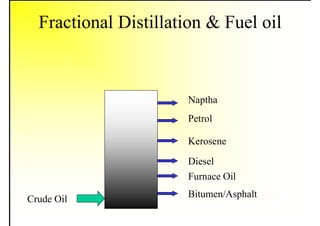
Fractional Distillation & Fuel oil
Naptha
Petrol
Diesel
Furnace Oil
Bitumen/Asphalt
Crude Oil
Kerosene
Distillate Fuel
• Ignite Readily
• Can be stored and handled at ambient
temperatures
• Low sulphur content
• Short flame
Residual fuels
• Residues from crude distillation
• Cheaper
• Vary in viscosity. Sulphur and ash content
• Blended with distillates to desired viscosity
range
• Heated for pumpability
• Higher sulphur and contains vanadium
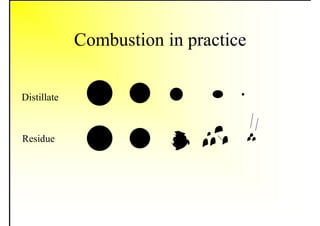
Combustion in practice
.
Distillate
Residue
Combustion of Fuel oil
• Viscosity of 100 Redwood secs I at burners
• Atomising air 1- 3 Kg/cm2 (about 2 % of total air
requirement)
• 14 Kg of air/kg fuel is required for complete
combustion. Optimum efficiency with 10 %
excess air
• Flue gas should be analysed for CO2 or O2
• Sulphur dewpoint at 160oC. Corrosion max at
30oC below dew point
Combustion of Fuel oil (contd.)
• Slightest damage to burner tip may increase fuel
consumption by 10-15 % and hence worn out tips
should be replaced immediately
• Oil pressure at burner should be 17-20 Kg/cm2
• Correct flame is normally short. Impingment on
walls, tubes cause carbon formation
• Too short a flame indicates high excess air and air
supply to burners should be adjusted for light haze
brown out of chimney
Burners
 Burners convert fuel oil into millions of small
droplets –process called atomization
 High surface to volume ratio in oil to facilitate
evaporation and combustion
 3 basic types of burners are pressure jet, air or
steam blast burners and Rotary Cup
TURNDOWN ratio is the relationship between the maximum
and minimum fuel input without affecting the excess air level
is called ‘Turn-Down Ratio’.
For example, a burner whose maximum input is 250,000
Kcals and minimum rate is 50,000 Kcals, has a ‘Turn-Down
Ratio’ of 5 to 1.
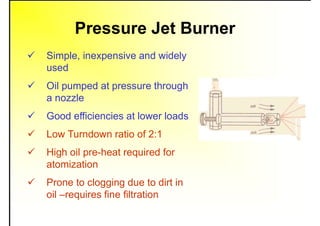
Pressure Jet Burner
 Simple, inexpensive and widely
used
 Oil pumped at pressure through
a nozzle
 Good efficiencies at lower loads
 Low Turndown ratio of 2:1
 High oil pre-heat required for
atomization
 Prone to clogging due to dirt in
oil –requires fine filtration
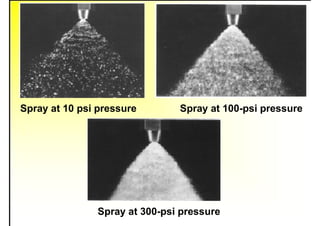
Spray at 10 psi pressure Spray at 100-psi pressure
Spray at 300-psi pressure
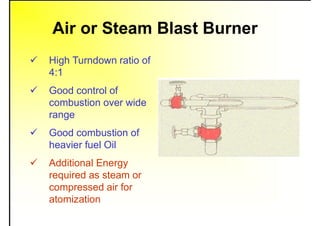
Air or Steam Blast Burner
 High Turndown ratio of
4:1
 Good control of
combustion over wide
range
 Good combustion of
heavier fuel Oil
 Additional Energy
required as steam or
compressed air for
atomization
Burner Controls
 ON/OFF-Burner firing at either full rate
or OFF
 HIGH/LOW/OFF – Burner operates at
slow firing rate and full firing rate as per
load
 MODULATING BURNER – Firing rate
matches the boiler load
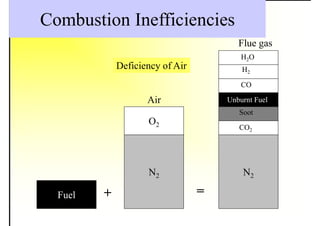
Combustion Inefficiencies
Fuel
N2
O2
N2
CO2
Soot
Unburnt Fuel
CO
H2
H2O
+ =
Deficiency of Air
Air
Flue gas
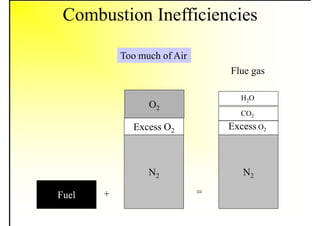
Combustion Inefficiencies
Fuel
N2
Excess O2
N2
CO2
Excess O2
H2O
+ =
Too much of Air
Air
Flue gas
O2
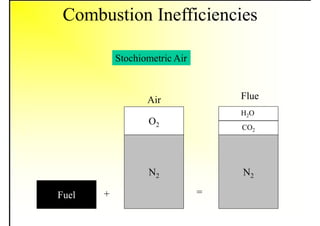
Combustion Inefficiencies
Fuel
N2
O2
N2
CO2
H2O
+ =
Stochiometric Air
Air Flue
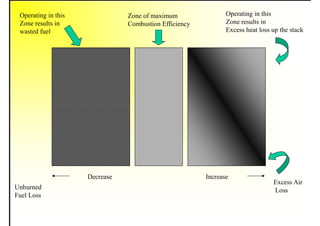
Operating in this
Zone results in
wasted fuel
Zone of maximum
Combustion Efficiency
Operating in this
Zone results in
Excess heat loss up the stack
Unburned
Fuel Loss
Excess Air
Loss
Decrease Increase
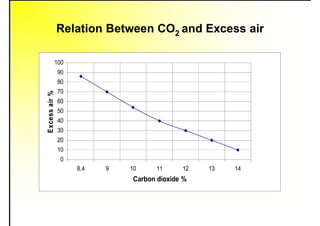
Relation Between CO2 and Excess air
0
10
20
30
40
50
60
70
80
90
100
8.4 9 10 11 12 13 14
Carbon dioxide %
Excess
air
%
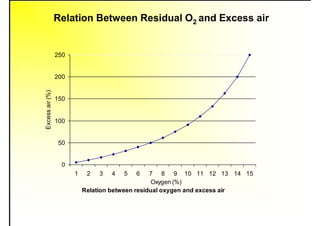
Relation Between Residual O2 and Excess air
Relation between residual oxygen and excess air
0
50
100
150
200
250
1 2 3 4 5 6 7 8 9 10 11 12 13 14 15
Oxygen (%)
Excess
air
(%)
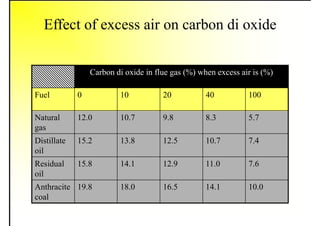
Effect of excess air on carbon di oxide
Carbon di oxide in flue gas (%) when excess air is (%)
Fuel 0 10 20 40 100
Natural
gas
12.0 10.7 9.8 8.3 5.7
Distillate
oil
15.2 13.8 12.5 10.7 7.4
Residual
oil
15.8 14.1 12.9 11.0 7.6
Anthracite
coal
19.8 18.0 16.5 14.1 10.0
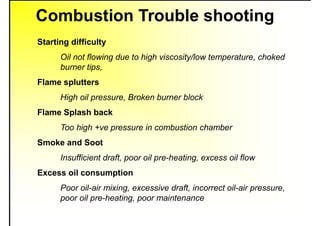
Combustion Trouble shooting
Starting difficulty
Oil not flowing due to high viscosity/low temperature, choked
burner tips,
Flame splutters
High oil pressure, Broken burner block
Flame Splash back
Too high +ve pressure in combustion chamber
Smoke and Soot
Insufficient draft, poor oil pre-heating, excess oil flow
Excess oil consumption
Poor oil-air mixing, excessive draft, incorrect oil-air pressure,
poor oil pre-heating, poor maintenance
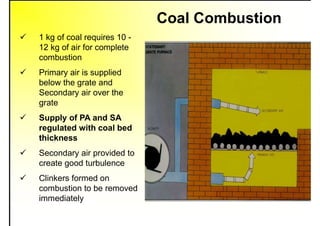
Coal Combustion
 1 kg of coal requires 10 -
12 kg of air for complete
combustion
 Primary air is supplied
below the grate and
Secondary air over the
grate
 Supply of PA and SA
regulated with coal bed
thickness
 Secondary air provided to
create good turbulence
 Clinkers formed on
combustion to be removed
immediately

Fuels &combustion part1

  • 1.
    1. Fuels andCombustion Dr.M.Vivekanandan M.E.,PhD Adjunct Faculty, Kongunadu College of Engineering and Technology, CEO, TryCAE Industrial Engineering Pvt Ltd.,
  • 2.
    Syllabus • Introduction toFuels • Properties of Fuel oil, Coal and Gas • Storage, handling and preparation of fuels • Principle of Combustion • Combustion of Oil, Coal, and Gas
  • 3.
    Introduction to Fuels •Different type of fuels such as liquid, solid and gas are available for firing in boilers and furnaces. • What is the criteria for selecting the fuel type? – Availability – Storage & handling – Pollution – Cost of fuel – Fuel properties
  • 4.
    Properties of LiquidFuels and its impacts • Density: mass of the fuel volume of the fuel At a reference temperature typically 15°C. (kg/m3.) • Specific gravity: weight of a given volume of oil weight of the same volume of water at a given temperature. – If specific gravity is more, heating value is also more. e.g Light Oil =0.85-0.87, Furnace oil=0.89-0.95, L.S.H.S=0.88-0.98
  • 5.
    Viscosity • Internal resistanceto flow of fluid • Viscosity influences the degree of pre-heat required for handling, storage and satisfactory atomization.
  • 6.
    Specific Heat • Specificheat is the amount of kcals needed to raise the temperature of 1 kg of oil by 1oC. The unit of specific heat is kcal/kgoC. It varies from 0.22 to 0.28 depending on the oil specific gravity. It helps to quantify how much steam or electrical energy required for preheating.
  • 7.
    Flash Point &Pour Point • Flash Point: The lowest temperature at which the fuel can be heated so that the vapour gives off flashes momentarily when an open flame is passed over it. Ex.Flash point for furnace oil is 66oC. • Pour Point: The lowest temperature at which it will pour or flow when cooled under prescribed conditions. It is a very rough indication of the lowest temperature at which fuel oil is readily pumpable.
  • 8.
    Calorific Value • Thecalorific value is the measurement of heat or energy produced, and is measured either as gross calorific value or net calorific value. • The difference being the latent heat of condensation of the water vapour produced during the combustion process. Water vapour Carbon Hydrogen Sulphur Moisture GCV – 10,500 Kcal/kg Water Vapour Water Vapour NCV – 9800 Kcal/kg
  • 9.
    Typical calorific valuesof fuels The calorific value of coal varies considerably depending on the ash, moisture content and the type of coal while calorific value of fuel oils are much more consistent. Fuel Oil Calorific Value (Kcal/Kg) Kerosene - 11,100 Diesel Oil - 10,800 L.D.O - 10,700 Furnace Oil - 10,500 LSHS - 10,600 Indian coal - 4000 to 6000
  • 10.
    Sulphur Content Depends mainlyon the source of the crude oil and to a lesser extent on the refining process. The normal sulfur content for the residual fuel oil (heavy fuel oil) is in the order of 2-4 %. Fuel oil Percentage of Sulphur Kerosene 0.05—0.2 Diesel Oil 0.3 – 1.5 L.D.O 0.5 – 1.8 Heavy Fuel Oil 2.0 – 4.0 LSHS < 0.5
  • 11.
    Disadvantage of sulphur riskof corrosion Cold end corrosion in cool parts of the chimney or stack, air pre heater and economiser. Sulphur SO2 SO3 H2SO4 H2O
  • 12.
    Ash Content • Ashcontent depends on the inorganic material in the fuel oil. • These salts may be compounds of sodium, vanadium, calcium magnesium, silicon, iron, aluminum, nickel, etc. • Typically ash values are in the range 0.03-0.07 %. • Excessive ash in liquid fuels can cause fouling deposits in the combustion equipment. Ash has erosive effect on the burner tips, causes damage to the refractories at high temperatures and gives rise to high temperature corrosion and fouling of equipments.
  • 13.
    Carbon Residue Carbon residueindicates the tendency of oil to deposit a carbonaceous solid residue on a hot surface, such as a burner or injection nozzle, when its vaporisable constituents evaporate. Residual oil contain carbon residue ranging from 1 % or more. . Distillate Residue
  • 14.
    Water Content • Watercontent of furnace oil when supplied is normally very low as the product at refinery site is handled hot and maximum limit of 1% is specified in the standard. • Water may be present in free or emulsified form • Water can cause damage to the inside furnace surfaces during combustion especially if it contains dissolved salts. • It can also cause spluttering of the flame at the burner tip, possibly extinguishing the flame and reducing the flame temperature or lengthening the flame.
  • 15.
    Important properties offuel oil Typical Specification of Fuel Oils Properties Fuel Oils Furnace Oil LS.H.S. L.D.O. Density (Approx. kg/m3 at 150 C) 0.89-0.95 0.88-0.98 0.85-0.87 Flash Point (0 C) 66 93 66 Pour Point (0 C) 20 72 18 G.C.V. (Kcal/kg) 10,500 10,600 10,700 Sediment, % Wt. Max. 0.25 0.25 0.1 Sulphur Total, % Wt. Max. Upto 4.0 Upto 0.5 Upto 1.8 Water Content, % Vol. Max. 1.0 1.0 0.25 Ash % Wt. Max. 0.1 0.1 0.02
  • 16.
    Storage of Fueloil • Hazardous to store furnace oil in barrels. • Stored in cylindrical tanks – either above or below the ground. • Storage capacity – - at least 10 days of normal consumption. • Build bund walls around tanks. • Periodical cleaning of tanks – annually for heavy fuels and every two years for light fuels. • leaks – from joints, flanges and pipelines must be attended at the earliest. – LOSS OF EVEN ONE DROP OF OIL EVERY SECOND CAN COST YOU OVER 4000 LITRES A YEAR • Fuel oil – should be free from contaminants such as dirt, sludge and water before it is fed to the combustion system.
  • 17.
    Removal of Contaminants •Coarse strainer : – To prevent contaminants such as cotton waste, loose nuts or bolts entering the system coarse strainer of 10 mesh size (not more than 3 holes per linear inch) is positioned on the entry pipe to the storage tanks. • Finer strainers – To prevent finer contaminants such as dust and dirt, sludge or free carbon ,filters are provided in duplicate to enable one filter to be cleaned while oil supply is maintained through the other. Between rail/tank lorry decanting point and main storage tank Mesh 10 Between service tank and pre-heater 40 Between pre-heater and burner 100
  • 18.
    Pumping fuel oil •Positive displacement pumps - Heavy fuel oils • Gear pump - LDO • Diaphragm pumps - a shorter service life, but are easier and less expensive to repair. • A centrifugal pump • Light fuels are best pumped with centrifugal or turbine pumps. When higher pressures are required, piston or diaphragm pumps should be used.
  • 19.
    Heating of Oilfor Pumping  Pre-heating oil in storage to make it pumpable  Heating entire oil tank or outflow heater to heat oil pumped away  Outflow heater with steam or electricity Viscosity (Centistokes) Pumping Temperature, oC 50 7 230 27 900 38 1500 49
  • 20.
    Heating of Oilfor Combustion  Line heaters to raise oil temperature from pumping to combustion temperature  Line heater either by electrical or steam tracing Viscosity (Centistokes) Burning Temperature, oC 50 60 230 104 900 121
  • 21.
    Properties of Coal CoalClassification • Three main coal classes: anthracite, bituminous, and lignite(Sub class- semi anthracite, semi bituminous, and sub bituminous) • Anthracite-oldest coal,hard coal composed mainly of carbon with little volatile content and practically no moisture. • Lignite -the youngest coal. • Chemical composition of coal has a strong influence on its combustibility.
  • 22.
  • 23.
  • 24.
  • 25.
    Proximate Analysis Typical proximateanalysis of various coals (in Percentage by weight) Parameter Indian Coal Indonesian Coal South African Coal Moisture 5.98 9.43 8.5 Ash 38.56 13.99 18 Volatile matter 20.70 29.79 23.28 Fixed Carbon 34.69 46.79 51.22
  • 26.
    Significance of VariousParameters in Proximate Analysis Fixed carbon: Fixed carbon gives a rough estimate of heating value of coal Volatile Matter: Volatile matters are the methane, hydrocarbons, hydrogen and carbon monoxide, and incombustible gases like carbon dioxide and nitrogen found in coal. Thus the volatile matter is an index of the gaseous fuels present. Typical range of volatile matter is 20 to 35%. – Proportionately increases flame length, and helps in easier ignition of coal. – Sets minimum limit on the furnace height and volume. Influences secondary air requirement and distribution aspects.
  • 27.
    Ash Content: Ash isan impurity that will not burn. Typical range is 0.5 to 40% – Reduces handling and burning capacity. – Increases handling costs. – Affects combustion efficiency and boiler efficiency – Causes clinkering and slagging. Moisture Content: – Moisture decreases the heat content per kg of coal. Typical range is 0.5 to 10% – Increases heat loss, due to evaporation and superheating – Helps, to a limit, in binding fines. Sulphur Content: – Typical range is 0.5 to 5% normally. – Affects clinkering and slagging tendencies,Corrodes chimney and other equipment such as air heaters and economisers,Limits exit flue gas temperature.
  • 28.
    Ultimate Analysis: Typical ultimateanalyses of various coals Parameter Lignite, % Indian Coal, % Indonesian Coal, % Moisture(Dry basis) 50 5.98 9.43 Mineral Matter 10.41 38.63 13.99 Carbon 62.01 41.11 58.96 Hydrogen 6.66 2.76 4.16 Nitrogen 0.60 1.22 1.02 Sulphur 0.59 0.41 0.56 Oxygen 19.73 9.89 11.88 Useful to find the quantity of air required for combustion and the volume and composition of the combustion gases, calculation of flame temperature and the flue duct design etc
  • 29.
    Storage & Handlingof Coal Stocking of coal has its own disadvantages like build-up of inventory, space constraints, deterioration in quality and potential fire hazards. Other minor losses associated with the storage of coal include oxidation, wind and carpet loss. • Minimise carpet loss and the loss due to spontaneous combustion. • The measures to reduce the carpet loses are – Preparing a hard ground for coal to be stacked upon. – Preparing standard storage bays out of concrete and brick • In process Industry, modes of coal handling range from manual to conveyor systems. It would be advisable to minimise the handling of coal so that further generation of fines .
  • 30.
    Preparation of Coal •Sizing of Coal – Proper coal sizing, with specific relevance to the type of firing system, helps towards even burning, reduced ash losses and better combustion efficiency. Conditioning of Coal – Segregation of fines from larger coal pieces can be reduced to a great extent by conditioning coal with water. Water helps fine particles to stick to the bigger lumps due to surface tension of the moisture, thus stopping fines from falling through grate bars or being carried away by the furnace draft. – Blending of Coal – In case of coal lots having excessive fines, it is advisable to blend the predominantly lumped coal with lots containing excessive fines. Coal blending may thus help to limit the extent of fines in coal being fired to not more than 25%. Blending of different qualities of coal may also help to supply a uniform coal feed to the boiler.
  • 31.
  • 32.
    LPG & N.Gas •LPG is a predominant mixture of propane and Butane with a small percentage of unsaturates (Propylene and Butylene) • LPG -gaseous at normal atmospheric pressure, but may be condensed to the liquid state at normal temperature, by the application of moderate pressures. Liquid LPG evaporates to produce about 250 times volume of gas. • LPG vapour is denser than air • Natural Gas • Methane is the main constituent of Natural gas and accounting for about 95% of the total volume. Other components are: Ethane, Propane, Butane, Pentane, Nitrogen.sulphur negligible. • It is lighter than air and disperses into air easily in case
  • 33.
    What are theagro residues available and their properties ? Ultimate analysis of typical agro residues Deoiled Bran Paddy Husk Saw Dust Coconut Shell Moisture 7.11 10.79 37.98 13.95 Mineral Matter 19.77 16.73 1.63 3.52 Carbon 36.59 33.95 48.55 44.95 Hydrogen 4.15 5.01 6.99 4.99 Nitrogen 0.82 0.91 0.80 0.56 Sulphur 0.54 0.09 0.10 0.08 Oxygen 31.02 32.52 41.93 31.94 GCV (Kcal/kg) 3151 3568 4801 4565
  • 34.
    Limiting Reagent 200.0 gof iron(III) chloride and 50.00 g hydrogen sulfide react. The balanced equation is: 2FeCl3 + 3H2S ---> Fe2S3 + 6HCl
  • 35.
    a) Determine thelimiting reagent Iron(III) chloride 200.0 g / 162.204 g mol-1 = 1.233 mol 1.233 mol / 2 = 0.6165 Hydrogen sulfide 50.00 g / 34.081 g mol-1 = 1.467 mol 1.467 mol / 3 = 0.489 The hydrogen sulfide is the limiting reagent.
  • 36.
    b) Determine amountof Fe2S3 formed 1) 1.467 mol H2S reacts (use limiting reagent) 2) H2S / Fe2S3 molar ratio is 3/1. The proportion is: 3/1 = 1.467/x 3) Fe2S3 produced is 0.489 mol 4) 0.489 mol x 207.885 g mol-1 = 101.7 g
  • 37.
    c) Determine excessremaining 1) 1.467 mol H2S reacts (use limiting reagent) 2) FeCl3 / H2S molar ratio is 2/3. The proportion is: 2/3 = x/1.467 3) FeCl3 used is 0.978 mol 4) 1.233 mol - 0.978 mol = 0.255 mol FeCl3 remain 5) 0.255 mol x 162.204 g mol-1 = 41.36 g
  • 38.
    What is COMBUSTION? • High speed, high temperature chemical reaction • Rapid union of an element or compound with oxygen to liberate heat – controlled explosion • Combustion occurs when elements of fuel such as carbon and hydrogen combine with oxygen
  • 39.
    Chemical reaction in Combustion Stoichiometric or theoretical air is ideal amount of air required for burning 1 kg of fuel  Ex:1 kg of fuel oil requires ~14.1 kg of air for complete combustion C + O2  CO 2 + 8084 Kcals/kg of Carbon 2C + O2  2 CO + 2430 Kcals/kg of Carbon 2H 2 + O2  2H2O + 28,922 Kcals/kg of Hydrogen S + O2  SO2 + 2,224 Kcals/kg of Sulphur Moisture (%) Mineral matter (%) Carbon (%) Hydrogen (%) Nitrogen (%) Sulphur (%) Oxygen (%) GCV (Kcal/kg)
  • 40.
    3 Ts ofCombustion TIME All combustion requires sufficient Time which depends upon type of Reaction TEMPERATURE Temperature must be more than ignition temperature TURBULENCE Proper turbulence helps in bringing the fuel and air in intimate contact and gives them enough time to complete reaction.
  • 41.
    What are thethree types of combustion? • Perfect Combustion is achieved when all the fuel is burned using only the theoretical amount of air, but perfect combustion cannot be achieved in a boiler. • Good / Complete Combustion is achieved when all the fuel is burned using the minimal amount of air above the theoretical amount of air needed to burn the fuel. Complete combustion is always our goal. With complete combustion, the fuel is burned at the highest combustion efficiency with low pollution. • Incomplete Combustion occurs when all the fuel is not burned, which results in the formation of soot and smoke.
  • 42.
    Fractional Distillation &Fuel oil Naptha Petrol Diesel Furnace Oil Bitumen/Asphalt Crude Oil Kerosene
  • 43.
    Distillate Fuel • IgniteReadily • Can be stored and handled at ambient temperatures • Low sulphur content • Short flame
  • 44.
    Residual fuels • Residuesfrom crude distillation • Cheaper • Vary in viscosity. Sulphur and ash content • Blended with distillates to desired viscosity range • Heated for pumpability • Higher sulphur and contains vanadium
  • 45.
  • 46.
    Combustion of Fueloil • Viscosity of 100 Redwood secs I at burners • Atomising air 1- 3 Kg/cm2 (about 2 % of total air requirement) • 14 Kg of air/kg fuel is required for complete combustion. Optimum efficiency with 10 % excess air • Flue gas should be analysed for CO2 or O2 • Sulphur dewpoint at 160oC. Corrosion max at 30oC below dew point
  • 47.
    Combustion of Fueloil (contd.) • Slightest damage to burner tip may increase fuel consumption by 10-15 % and hence worn out tips should be replaced immediately • Oil pressure at burner should be 17-20 Kg/cm2 • Correct flame is normally short. Impingment on walls, tubes cause carbon formation • Too short a flame indicates high excess air and air supply to burners should be adjusted for light haze brown out of chimney
  • 48.
    Burners  Burners convertfuel oil into millions of small droplets –process called atomization  High surface to volume ratio in oil to facilitate evaporation and combustion  3 basic types of burners are pressure jet, air or steam blast burners and Rotary Cup TURNDOWN ratio is the relationship between the maximum and minimum fuel input without affecting the excess air level is called ‘Turn-Down Ratio’. For example, a burner whose maximum input is 250,000 Kcals and minimum rate is 50,000 Kcals, has a ‘Turn-Down Ratio’ of 5 to 1.
  • 49.
    Pressure Jet Burner Simple, inexpensive and widely used  Oil pumped at pressure through a nozzle  Good efficiencies at lower loads  Low Turndown ratio of 2:1  High oil pre-heat required for atomization  Prone to clogging due to dirt in oil –requires fine filtration
  • 50.
    Spray at 10psi pressure Spray at 100-psi pressure Spray at 300-psi pressure
  • 51.
    Air or SteamBlast Burner  High Turndown ratio of 4:1  Good control of combustion over wide range  Good combustion of heavier fuel Oil  Additional Energy required as steam or compressed air for atomization
  • 52.
    Burner Controls  ON/OFF-Burnerfiring at either full rate or OFF  HIGH/LOW/OFF – Burner operates at slow firing rate and full firing rate as per load  MODULATING BURNER – Firing rate matches the boiler load
  • 53.
  • 54.
    Combustion Inefficiencies Fuel N2 Excess O2 N2 CO2 ExcessO2 H2O + = Too much of Air Air Flue gas O2
  • 55.
  • 56.
    Operating in this Zoneresults in wasted fuel Zone of maximum Combustion Efficiency Operating in this Zone results in Excess heat loss up the stack Unburned Fuel Loss Excess Air Loss Decrease Increase
  • 57.
    Relation Between CO2and Excess air 0 10 20 30 40 50 60 70 80 90 100 8.4 9 10 11 12 13 14 Carbon dioxide % Excess air %
  • 58.
    Relation Between ResidualO2 and Excess air Relation between residual oxygen and excess air 0 50 100 150 200 250 1 2 3 4 5 6 7 8 9 10 11 12 13 14 15 Oxygen (%) Excess air (%)
  • 59.
    Effect of excessair on carbon di oxide Carbon di oxide in flue gas (%) when excess air is (%) Fuel 0 10 20 40 100 Natural gas 12.0 10.7 9.8 8.3 5.7 Distillate oil 15.2 13.8 12.5 10.7 7.4 Residual oil 15.8 14.1 12.9 11.0 7.6 Anthracite coal 19.8 18.0 16.5 14.1 10.0
  • 60.
    Combustion Trouble shooting Startingdifficulty Oil not flowing due to high viscosity/low temperature, choked burner tips, Flame splutters High oil pressure, Broken burner block Flame Splash back Too high +ve pressure in combustion chamber Smoke and Soot Insufficient draft, poor oil pre-heating, excess oil flow Excess oil consumption Poor oil-air mixing, excessive draft, incorrect oil-air pressure, poor oil pre-heating, poor maintenance
  • 61.
    Coal Combustion  1kg of coal requires 10 - 12 kg of air for complete combustion  Primary air is supplied below the grate and Secondary air over the grate  Supply of PA and SA regulated with coal bed thickness  Secondary air provided to create good turbulence  Clinkers formed on combustion to be removed immediately