Download as PDF, PPTX

![Task[A]
8](https://image.slidesharecdn.com/fs2forfunandprofit-160625171858/85/FS2-for-Fun-and-Profit-8-320.jpg)

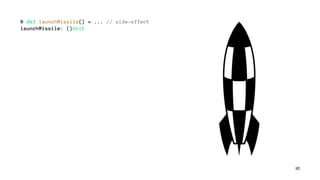
![@ val launchFuture = Future { launchMissile() }
launchFuture: scala.concurrent.Future[Unit] = ...
// A missile has already launched!
11](https://image.slidesharecdn.com/fs2forfunandprofit-160625171858/85/FS2-for-Fun-and-Profit-11-320.jpg)
![@ val launchTask = Task { launchMissile() }
launchTask: fs2.util.Task[Unit]= ...
13](https://image.slidesharecdn.com/fs2forfunandprofit-160625171858/85/FS2-for-Fun-and-Profit-13-320.jpg)


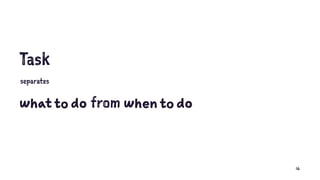
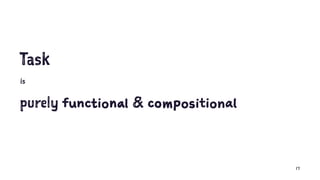
: Task[A]
4 delay[A](a: => A): Task[A]
4 fail(e: Throwable): Task[Nothing]
4 fork[A](a: => Task[A]): Task[A]
18](https://image.slidesharecdn.com/fs2forfunandprofit-160625171858/85/FS2-for-Fun-and-Profit-18-320.jpg)
![Example: Retrieve Tweets
@ import twitter4j._
@ def statuses(query: Query): Task[List[Status]] = Task {
twitterClient.search(query).getTweets.toList
}
19](https://image.slidesharecdn.com/fs2forfunandprofit-160625171858/85/FS2-for-Fun-and-Profit-19-320.jpg)
![File IO using FS2
import java.nio.file.Paths
def fahrenheitToCelsius(f: Double): Double = (f - 32.0) * (5.0/9.0)
val streamConverter: Task[Unit] =
io.file.readAll[Task](Paths.get("testdata/fahrenheit.txt"), 4096)
.through(text.utf8Decode)
.through(text.lines)
.filter(s => !s.trim.isEmpty && !s.startsWith("//"))
.map(line => fahrenheitToCelsius(line.toDouble).toString)
.intersperse("n")
.through(text.utf8Encode)
.through(io.file.writeAll(Paths.get("testdata/celsius.txt")))
.run
streamConverter.unsafeRun()
24](https://image.slidesharecdn.com/fs2forfunandprofit-160625171858/85/FS2-for-Fun-and-Profit-24-320.jpg)
![Stream[F[_], O]
26](https://image.slidesharecdn.com/fs2forfunandprofit-160625171858/85/FS2-for-Fun-and-Profit-26-320.jpg)
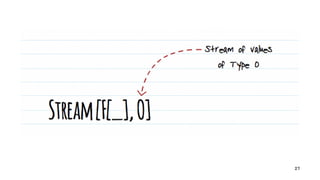
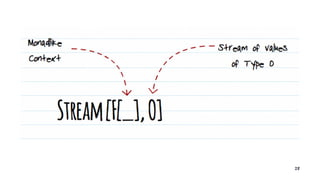
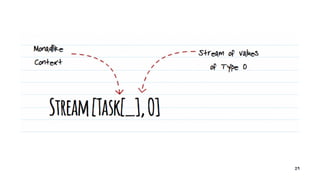
![Example: Pure Streams
@ Stream(1,2,3)
res29: Stream[Nothing, Int] =
Segment(Emit(Chunk(1, 2, 3)))
@ Stream(1,2,3) ++ Stream(4,5,6)
res30: Stream[Nothing, Int] =
append(Segment(Emit(Chunk(1, 2, 3))), Segment(Emit(Chunk(()))).flatMap(<function1>))
30](https://image.slidesharecdn.com/fs2forfunandprofit-160625171858/85/FS2-for-Fun-and-Profit-30-320.jpg)
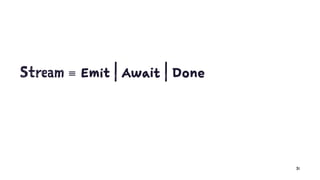
![Emit
Emit[F[_],O](
head: Seq[O],
tail: Stream[F, O] = Done)
32](https://image.slidesharecdn.com/fs2forfunandprofit-160625171858/85/FS2-for-Fun-and-Profit-32-320.jpg)
![Example: Pure Streams
@ import Stream._
import Stream._
@ emit(1) // emits value
res30: Stream[Nothing, Int] = Segment(Emit(Chunk(1)))
@ emits(Seq(1,4,10,20)) // <- emits sequence
res31: Stream[Nothing, Int] = Segment(Emit(Chunk(1, 4, 10, 20)))
33](https://image.slidesharecdn.com/fs2forfunandprofit-160625171858/85/FS2-for-Fun-and-Profit-33-320.jpg)
![Await
Await[F[_], I, O](
req: F[I], // side-effect
recv: I Stream[F, O]) // continuation of Stream.
34](https://image.slidesharecdn.com/fs2forfunandprofit-160625171858/85/FS2-for-Fun-and-Profit-34-320.jpg)
![Example: Effectful Stream
@ def statuses(query: Query): Task[List[Status]] = ...
35](https://image.slidesharecdn.com/fs2forfunandprofit-160625171858/85/FS2-for-Fun-and-Profit-35-320.jpg)
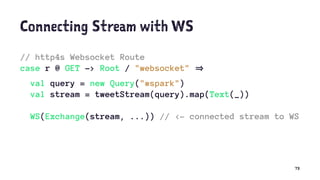
![// Builds a Twitter Search Process for a given Query
@ def tweetStream(query: Query): Stream[Task, Status] = {
val queryTask: Task[List[Status]] = statuses(query)
eval(queryTask).flatMap { statusList
emitAll(statusList)
}
}
36](https://image.slidesharecdn.com/fs2forfunandprofit-160625171858/85/FS2-for-Fun-and-Profit-36-320.jpg)
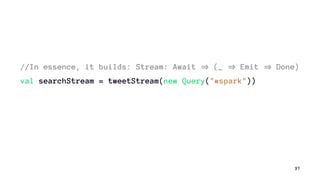
![Example: A Stream of Positive Integers
@ import Stream._
import Stream._
@ def integerStream: Stream[Task, Int] = {
def next (i: Int) : Stream[Task, Int] = eval(Task(i)).flatMap { i
emit(i) ++ next(i + 1)
}
next(1)
}
// in essence, it describes Stream of {1, 2, 3, 4 ....}
38](https://image.slidesharecdn.com/fs2forfunandprofit-160625171858/85/FS2-for-Fun-and-Profit-38-320.jpg)
![Stream[F, O]
... represents a stream of O values
which can interleave external requests
to evaluate computation of form F[_]
39](https://image.slidesharecdn.com/fs2forfunandprofit-160625171858/85/FS2-for-Fun-and-Profit-39-320.jpg)
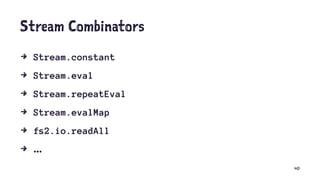

![Stream.run
@ integerStream.take(10)
res23: Stream[Task, Int] = ...
@ integerStream.take(10).run
res24: Task[Unit] = Task
@ integerStream.take(10).run.unsafeRun
42](https://image.slidesharecdn.com/fs2forfunandprofit-160625171858/85/FS2-for-Fun-and-Profit-42-320.jpg)
![Stream.runLog
scala> integerStream.take(10).runLog.unsafeRun
res4: Vector[Int] = Vector(1, 2, 3, 4, 5, 6, 7, 8, 9, 10)
43](https://image.slidesharecdn.com/fs2forfunandprofit-160625171858/85/FS2-for-Fun-and-Profit-43-320.jpg)
![Stream.runLog
What does happen when we execute
integerStream.runLog.run?
@ def integerStream: Stream[Task, Int] = {
def next (i: Int) : Stream[Task, Int] = eval(Task(i)).flatMap { i
emit(i) ++ next(i + 1)
}
next(1)
}
@ integerStream.runLog.unsafeRun // <--- ?
44](https://image.slidesharecdn.com/fs2forfunandprofit-160625171858/85/FS2-for-Fun-and-Profit-44-320.jpg)
![Other Run Combinators
> def runFree: fs2.util.Free[F,Unit]
> def runFold[B](z: B)(f: (B, A) => B): F[B]
45](https://image.slidesharecdn.com/fs2forfunandprofit-160625171858/85/FS2-for-Fun-and-Profit-45-320.jpg)

![Stream.map
@ val stream = integerStream.map(_ * 100)
stream: Stream[Task, Int] =
attemptEval(Task).flatMap(<function1>).flatMap(<function1>).mapChunks(<function1>)
@ stream.take(5).runLog.unsafeRun
res39: Vector[Int] = Vector(100, 200, 300, 400, 500)
47](https://image.slidesharecdn.com/fs2forfunandprofit-160625171858/85/FS2-for-Fun-and-Profit-47-320.jpg)
![Stream.flatMap
@ integerStream.flatMap { i =>
emits(List.fill(i)(i))
}
.take(10)
.runLog
.unsafeRun
res45: Vector[Int] = Vector(1, 2, 2, 3, 3, 3, 4, 4, 4, 4)
48](https://image.slidesharecdn.com/fs2forfunandprofit-160625171858/85/FS2-for-Fun-and-Profit-48-320.jpg)
![Stream.zip
@ val zippedStream = integerStream zip emitAll(Seq("A", "B"))
res52: Stream[Task, (Int, String)] =
evalScope(Scope(Bind(Eval(Snapshot),<function1>))).flatMap(<function1>)
@ zippedStream.runLog.unsafeRun
res54: Vector[(Int, String)] = Vector((1, "A"), (2, "B"))
49](https://image.slidesharecdn.com/fs2forfunandprofit-160625171858/85/FS2-for-Fun-and-Profit-49-320.jpg)

![Pipe
> Stream[F, A].through(Pipe[A, B]) => Stream[F, B]
51](https://image.slidesharecdn.com/fs2forfunandprofit-160625171858/85/FS2-for-Fun-and-Profit-51-320.jpg)
![Pipe
type Pipe[F[_],-I,+O] = Stream[F,I] => Stream[F,O]
52](https://image.slidesharecdn.com/fs2forfunandprofit-160625171858/85/FS2-for-Fun-and-Profit-52-320.jpg)
![Example
@ integerStream |> filter( _%2 == 0)
res59: Stream[Task, Int] = ...
54](https://image.slidesharecdn.com/fs2forfunandprofit-160625171858/85/FS2-for-Fun-and-Profit-54-320.jpg)
![Example
@ integerStream |> filter( _%2 == 0) |> exists(_ == 10)
res60: Stream[Task, Boolean] = ...
55](https://image.slidesharecdn.com/fs2forfunandprofit-160625171858/85/FS2-for-Fun-and-Profit-55-320.jpg)
![Pipe2
type Pipe2[F[_],-I,-I2,+O] =
(Stream[F,I], Stream[F,I2]) => Stream[F,O]
56](https://image.slidesharecdn.com/fs2forfunandprofit-160625171858/85/FS2-for-Fun-and-Profit-56-320.jpg)
![Sink
> Stream[F, A].to(Sink[F, A]) => Stream[F, Unit]
57](https://image.slidesharecdn.com/fs2forfunandprofit-160625171858/85/FS2-for-Fun-and-Profit-57-320.jpg)
![Sink
type Sink[F[_],-I] = Pipe[F,I,Unit]
58](https://image.slidesharecdn.com/fs2forfunandprofit-160625171858/85/FS2-for-Fun-and-Profit-58-320.jpg)
![Example
@ def log[A]: Sink[Task, A] = _.evalMap{ x =>
Task{
println(s"$x")
}
}
59](https://image.slidesharecdn.com/fs2forfunandprofit-160625171858/85/FS2-for-Fun-and-Profit-59-320.jpg)
![Example
scala> val streamWithSink: Stream[Task, Unit]
| = integerStream.take(5) to printInts
scala> streamWithSink.run.unsafeRun
1
2
3
4
5
60](https://image.slidesharecdn.com/fs2forfunandprofit-160625171858/85/FS2-for-Fun-and-Profit-60-320.jpg)
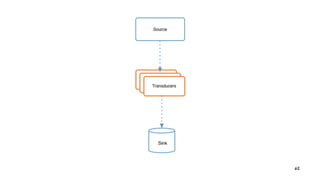
![Building Source
@ def src: Stream[Task, Query] =
awakeEvery[Task](15 seconds).map { _
new Query("#spark")
}
63](https://image.slidesharecdn.com/fs2forfunandprofit-160625171858/85/FS2-for-Fun-and-Profit-63-320.jpg)
![Twitter Query Pipe
// defined earlier
def statuses(query: Query): Task[List[Status]] = ...
def twitterPipe: Pipe[Task, Query, List[Status]] =
_.evalMap{ query statuses(query) }
64](https://image.slidesharecdn.com/fs2forfunandprofit-160625171858/85/FS2-for-Fun-and-Profit-64-320.jpg)
![Stream Pipeline
src
.through(twitterPipe) // Stream[Task, List[Status]]
.flatMap(Stream.emits(_)) // Stream[Task, Status]
.map(s Tweet(s)) // Stream[Task, Tweet]
65](https://image.slidesharecdn.com/fs2forfunandprofit-160625171858/85/FS2-for-Fun-and-Profit-65-320.jpg)
![Sentiment Analysis Pipe
@ import SentimentAnalyzer._
@ def analyze(t: Tweet): Task[EnrichedTweet] = Task {
EnrichedTweet(
t.author,
t.body,
t.retweetCount,
sentiment(t.body))
}
66](https://image.slidesharecdn.com/fs2forfunandprofit-160625171858/85/FS2-for-Fun-and-Profit-66-320.jpg)
![@ def analysisPipe: Pipe[Task, Tweet, EnrichedTweet] =
_.evalMap{tweet analyze(tweet)}
67](https://image.slidesharecdn.com/fs2forfunandprofit-160625171858/85/FS2-for-Fun-and-Profit-67-320.jpg)
![Stream Pipeline (so far)
src
.through(twitterPipe) // Stream[Task, List[Status]]
.flatMap(Stream.emits(_)) // Stream[Task, Status]
.map(s Tweet(s)) // Stream[Task, Tweet]
68](https://image.slidesharecdn.com/fs2forfunandprofit-160625171858/85/FS2-for-Fun-and-Profit-68-320.jpg)
![Stream Pipeline
src
.through(twitterPipe) // Stream[Task, List[Status]]
.flatMap(Stream.emits(_)) // Stream[Task, Status]
.map(s Tweet(s)) // Stream[Task, Tweet]
.through(analysisPipe) // Stream[Task, EnrichedTweet]
69](https://image.slidesharecdn.com/fs2forfunandprofit-160625171858/85/FS2-for-Fun-and-Profit-69-320.jpg)
![Stream Pipeline
@ val tweetStream =
src
.through(twitterPipe) // Stream[Task, List[Status]]
.flatMap(Stream.emits(_)) // Stream[Task, Status]
.map(s Tweet(s)) // Stream[Task, Tweet]
.through(analysisPipe) // Stream[Task, EnrichedTweet]
70](https://image.slidesharecdn.com/fs2forfunandprofit-160625171858/85/FS2-for-Fun-and-Profit-70-320.jpg)
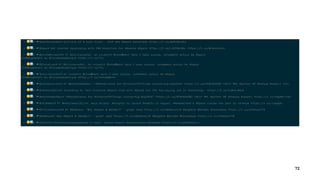
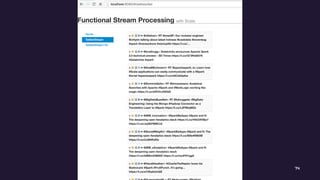
![Evaluating Stream Pipeline
@ val consoleTweetStream =
tweetStream.to(snk) // Stream[Task, Unit]
@ consoleTweetStream.run.unsafeRun
71](https://image.slidesharecdn.com/fs2forfunandprofit-160625171858/85/FS2-for-Fun-and-Profit-71-320.jpg)

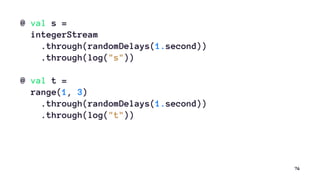
![Interleave
@ s interleave t
res89: Stream[Task, Int] = ...
@ (s interleave t).through(log("interleaved")).runLog.unsafeRun
s > 1
t > 1
interleaved > 1
interleaved > 1
s > 2
t > 2
interleaved > 2
interleaved > 2
s > 3
res90: Vector[Int] = Vector(1, 1, 2, 2)
77](https://image.slidesharecdn.com/fs2forfunandprofit-160625171858/85/FS2-for-Fun-and-Profit-77-320.jpg)
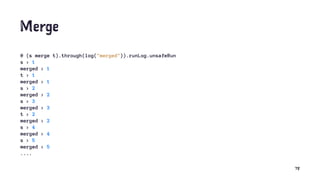
![Either
@ s either t
res22: Stream[Task, Either[Int, Int]] = ...
@ Stream.emit("A, B, C") either t
res23: Stream[Task, Either[String, Int]]
79](https://image.slidesharecdn.com/fs2forfunandprofit-160625171858/85/FS2-for-Fun-and-Profit-79-320.jpg)
![Join
@ val u = Stream.range(10, 20)
u: Stream[Nothing, Int] = ...
@
@ val streams: Stream[Task, Stream[Task, Int]] = Stream(s, t, u)
streams: Stream[Task, Stream[Task, Int]] = ...
@ concurrent.join(3)(streams)
res27: Stream[Task, Int] = ...
80](https://image.slidesharecdn.com/fs2forfunandprofit-160625171858/85/FS2-for-Fun-and-Profit-80-320.jpg)



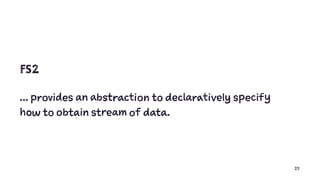
This document provides an overview of FS2, a Scala library for functional streaming and asynchronous computation. It explains the key features of FS2, including its task abstraction for handling side effects, the definition of streams, and various stream combinators for processing data. The document includes examples of stream manipulation, resource management, and integrating external IO operations in a purely functional way.


![[Let'Swift 2019] 실용적인 함수형 프로그래밍 워크샵](https://cdn.slidesharecdn.com/ss_thumbnails/practicalfunctionalprogramming-191113054017-thumbnail.jpg?width=640&height=640&fit=bounds)


