Marton Balassi
Flink committer
data Artisans
@MartonBalassi
Flink
Streaming
Stream
processing
2
3
Stream
Infinite sequence of data
arriving in a continuous fashion.
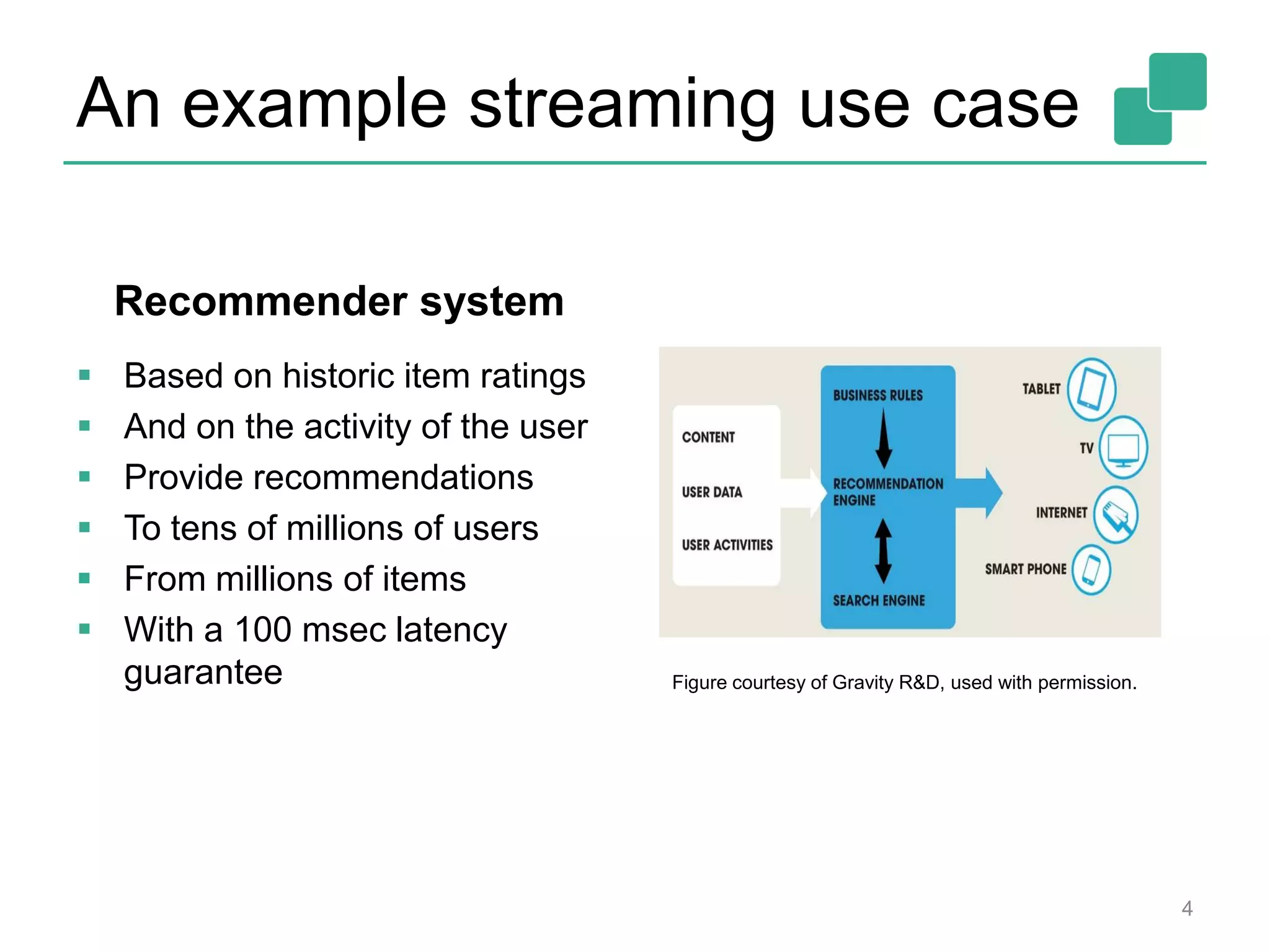
An example streaming use case
 Based on historic item ratings
 And on the activity of the user
 Provide recommendations
 To tens of millions of users
 From millions of items
 With a 100 msec latency
guarantee
4
Figure courtesy of Gravity R&D, used with permission.
Recommender system
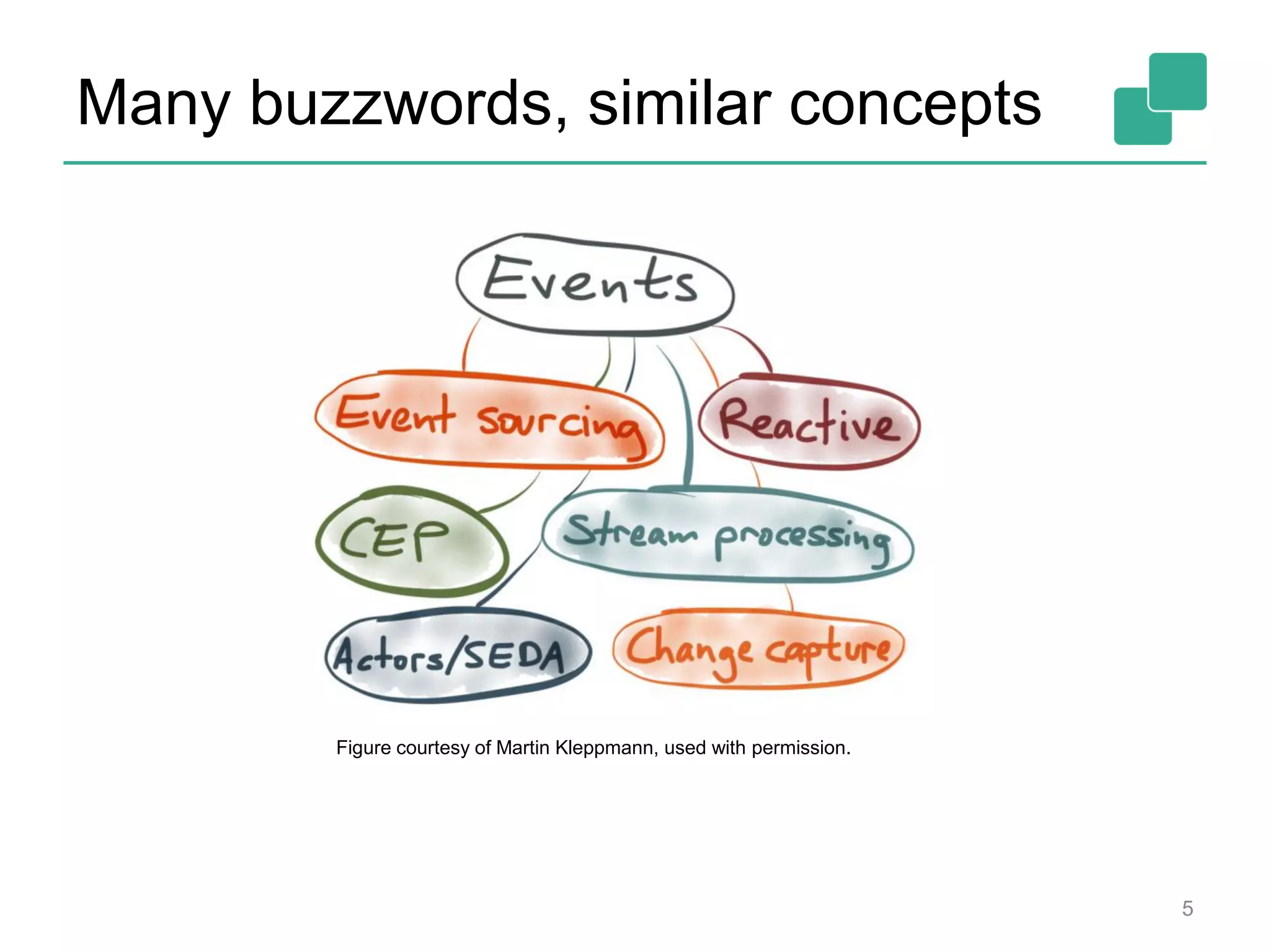
Many buzzwords, similar concepts
5
Figure courtesy of Martin Kleppmann, used with permission.
Streaming systems
6
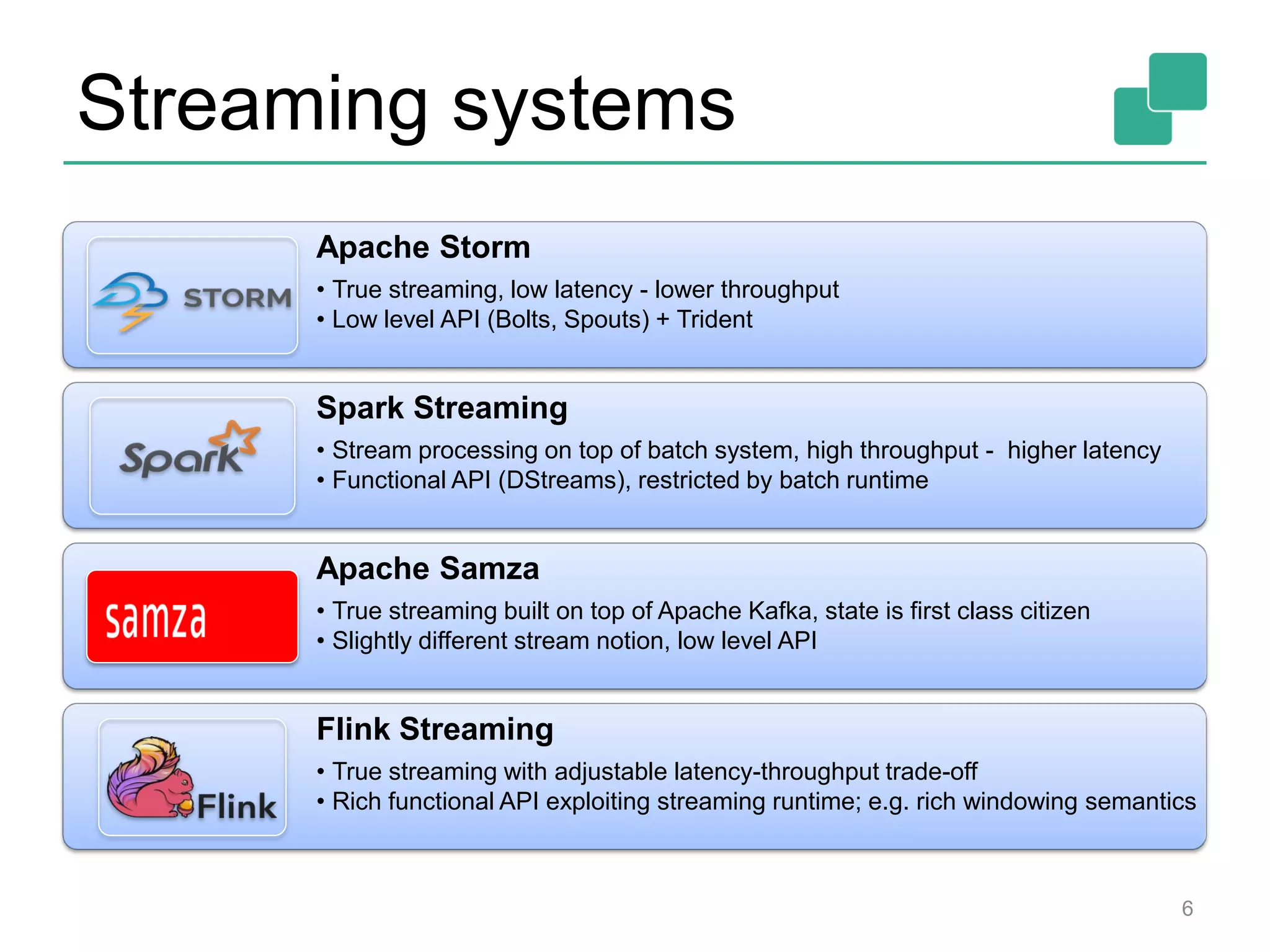
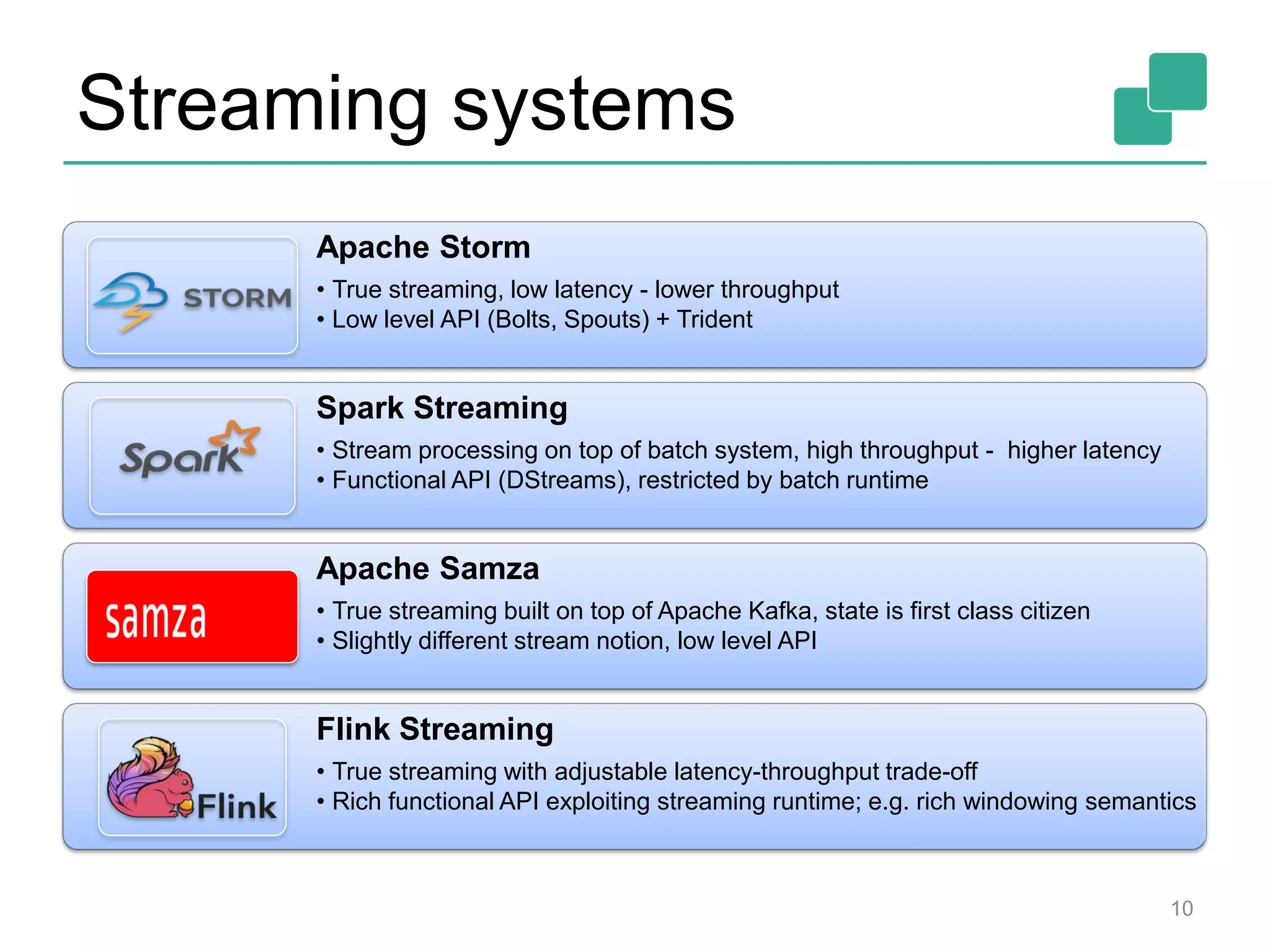
Apache Storm
• True streaming, low latency - lower throughput
• Low level API (Bolts, Spouts) + Trident
Spark Streaming
• Stream processing on top of batch system, high throughput - higher latency
• Functional API (DStreams), restricted by batch runtime
Apache Samza
• True streaming built on top of Apache Kafka, state is first class citizen
• Slightly different stream notion, low level API
Flink Streaming
• True streaming with adjustable latency-throughput trade-off
• Rich functional API exploiting streaming runtime; e.g. rich windowing semantics
Streaming systems
7
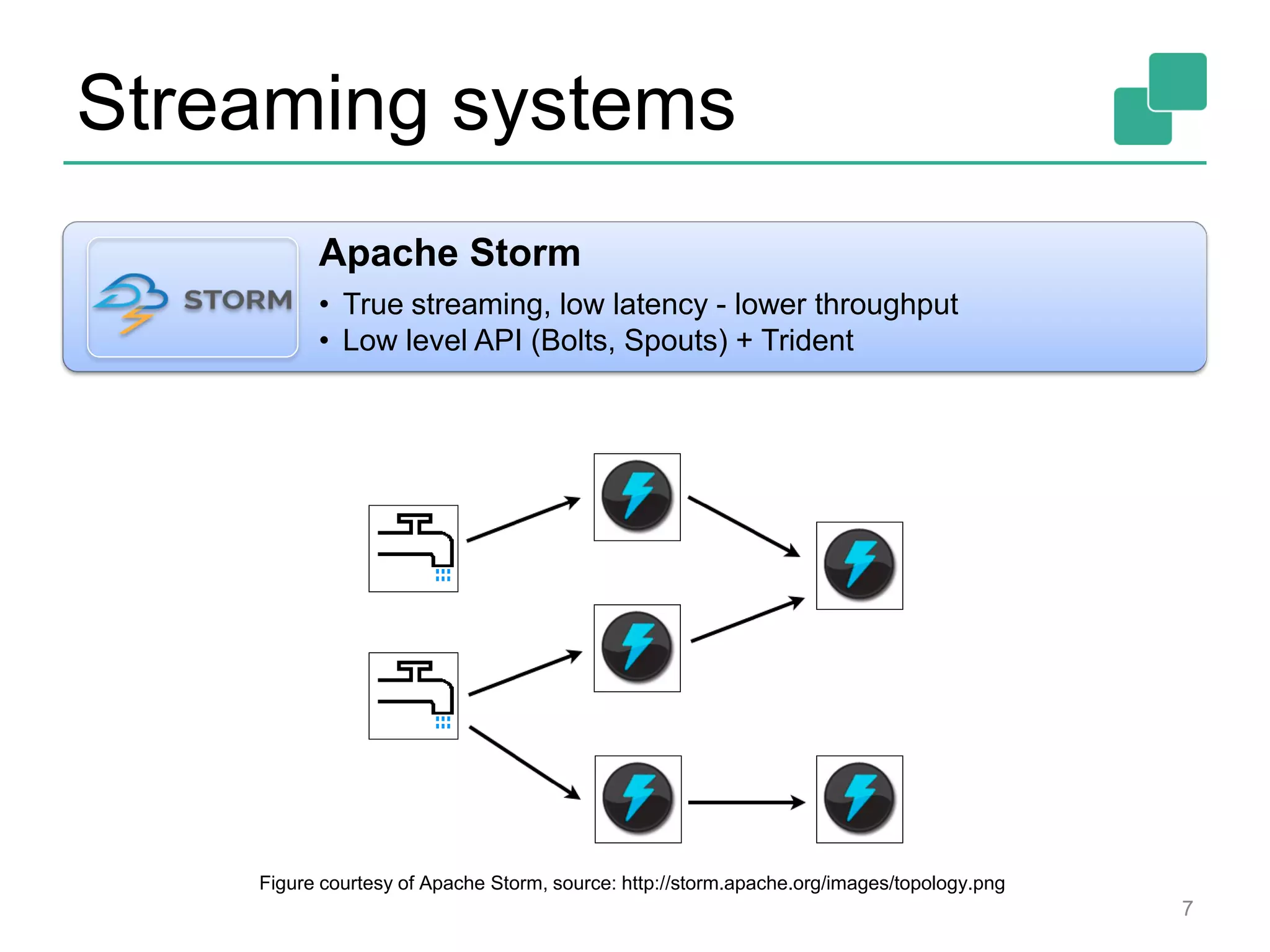
Apache Storm
• True streaming, low latency - lower throughput
• Low level API (Bolts, Spouts) + Trident
Figure courtesy of Apache Storm, source: http://storm.apache.org/images/topology.png
Streaming systems
8
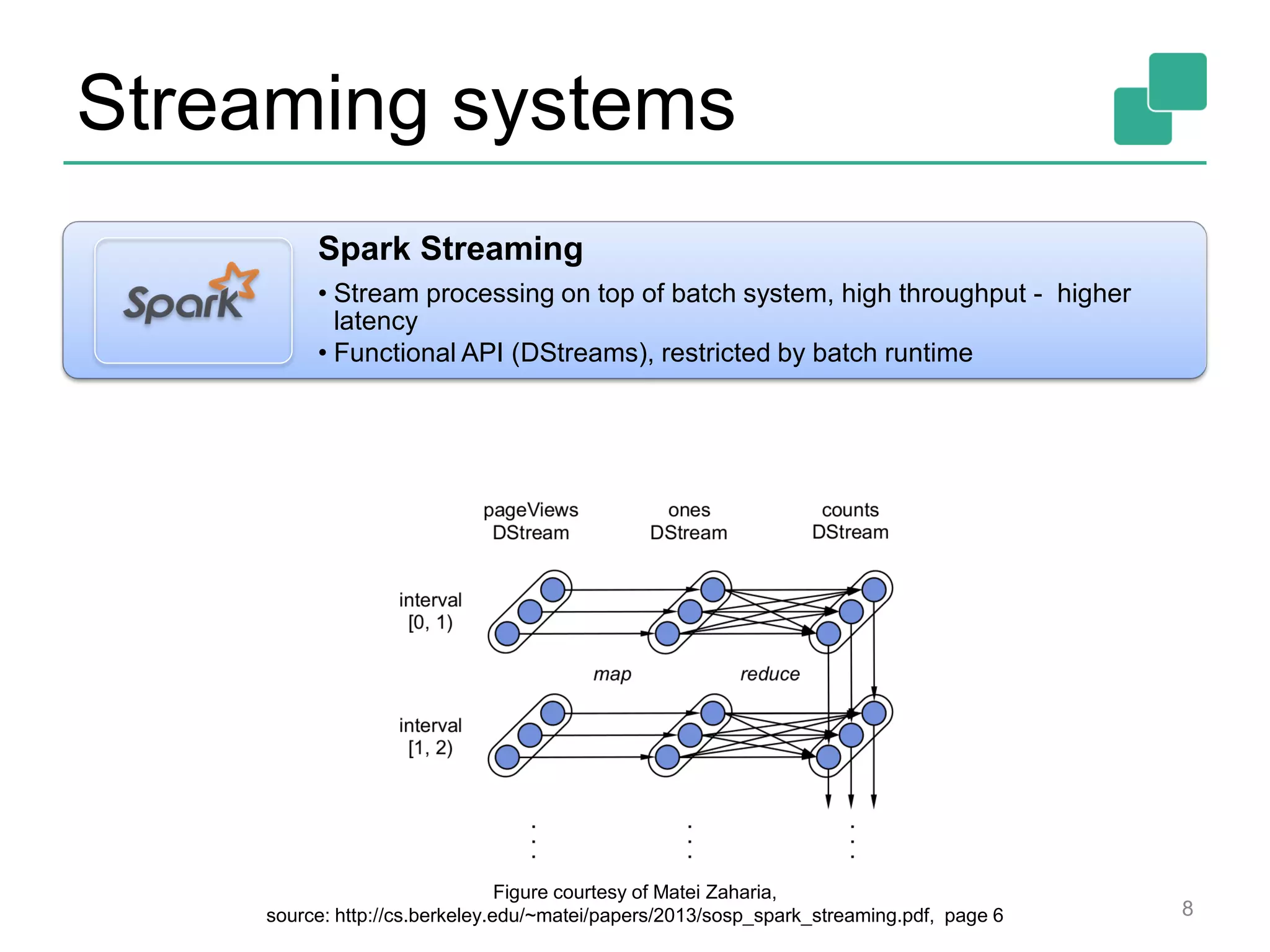
Spark Streaming
• Stream processing on top of batch system, high throughput - higher
latency
• Functional API (DStreams), restricted by batch runtime
Figure courtesy of Matei Zaharia,
source: http://cs.berkeley.edu/~matei/papers/2013/sosp_spark_streaming.pdf, page 6
Streaming systems
9
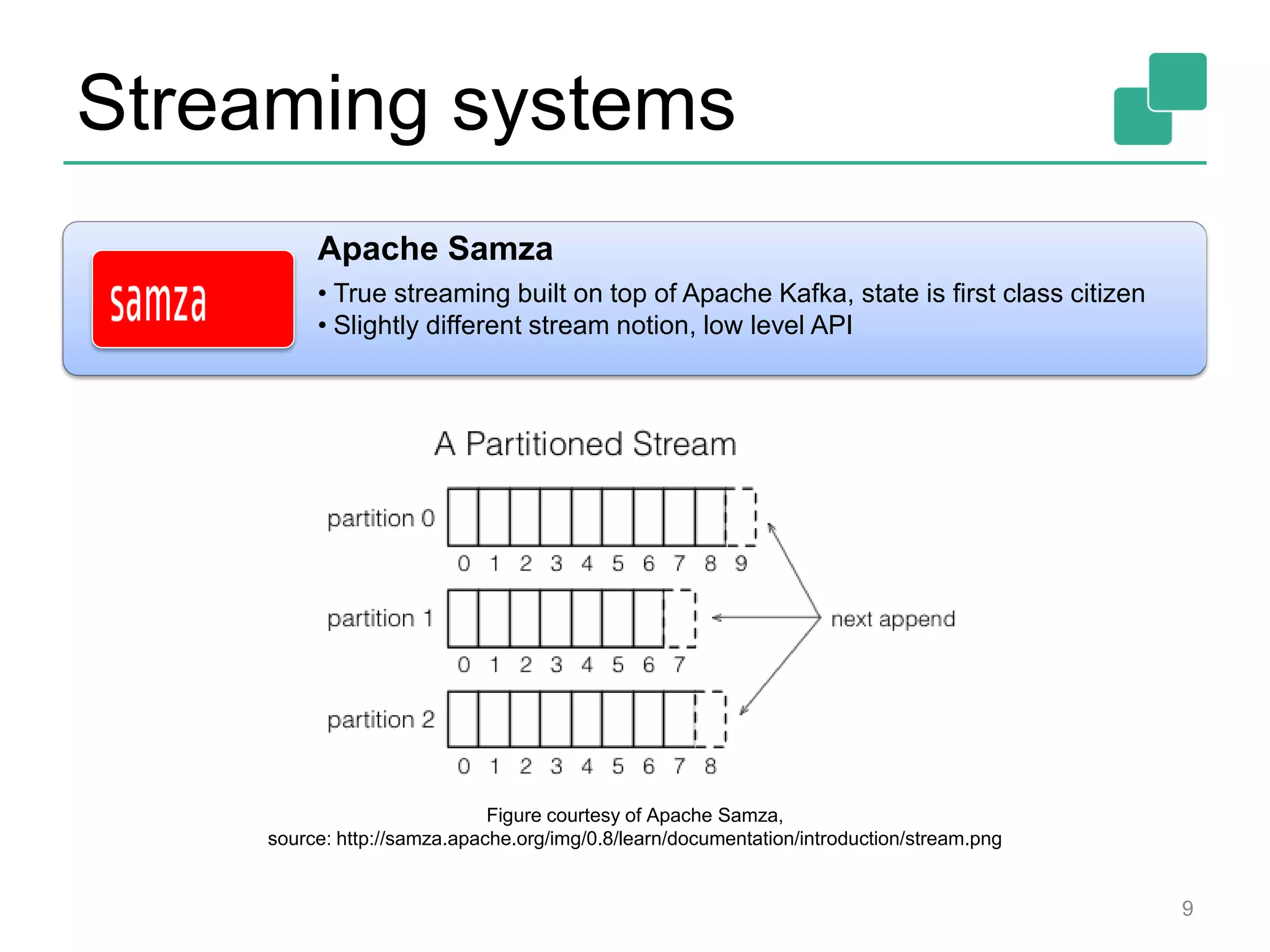
Apache Samza
• True streaming built on top of Apache Kafka, state is first class citizen
• Slightly different stream notion, low level API
Figure courtesy of Apache Samza,
source: http://samza.apache.org/img/0.8/learn/documentation/introduction/stream.png
Streaming systems
10
Apache Storm
• True streaming, low latency - lower throughput
• Low level API (Bolts, Spouts) + Trident
Spark Streaming
• Stream processing on top of batch system, high throughput - higher latency
• Functional API (DStreams), restricted by batch runtime
Apache Samza
• True streaming built on top of Apache Kafka, state is first class citizen
• Slightly different stream notion, low level API
Flink Streaming
• True streaming with adjustable latency-throughput trade-off
• Rich functional API exploiting streaming runtime; e.g. rich windowing semantics
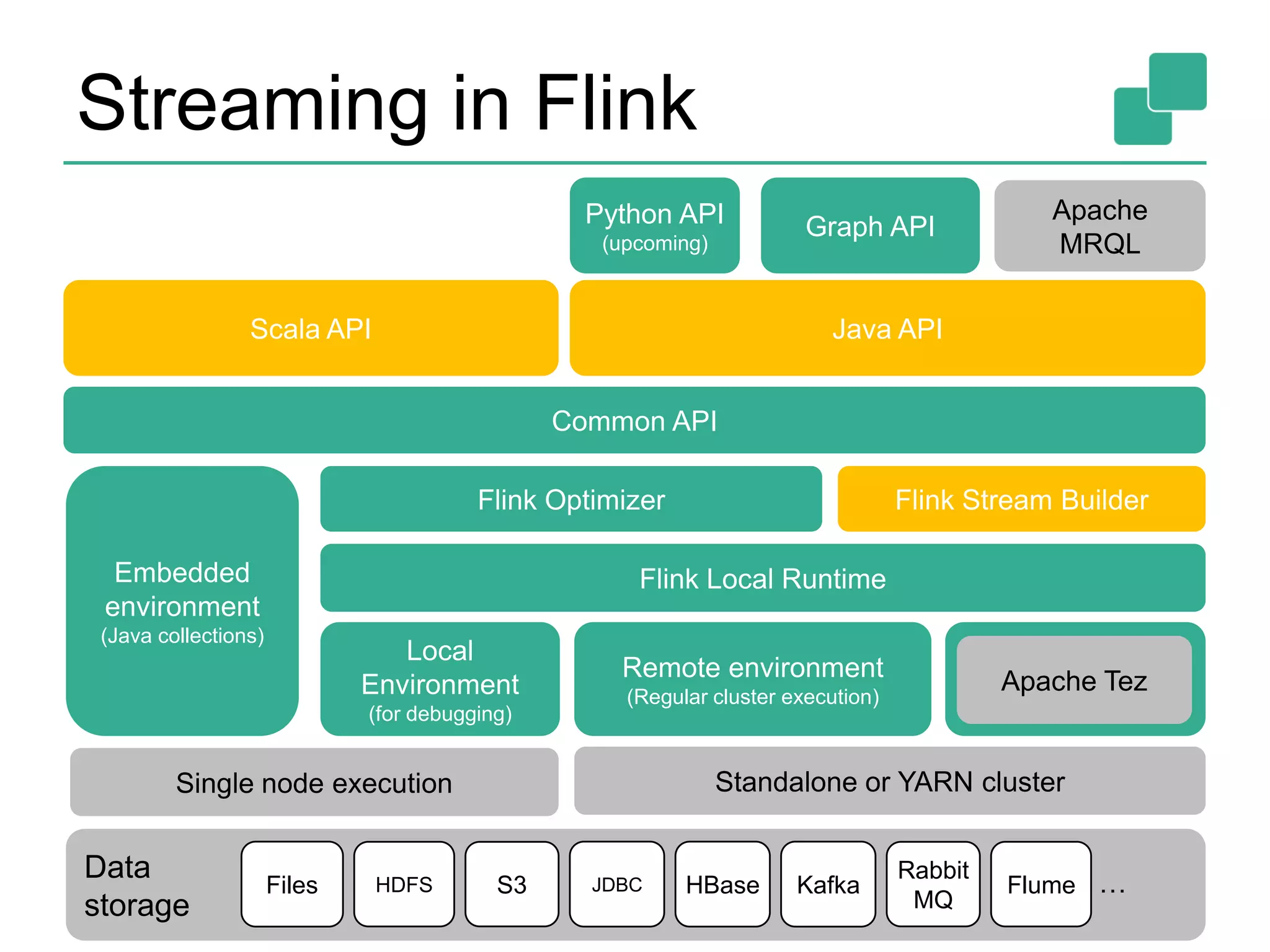
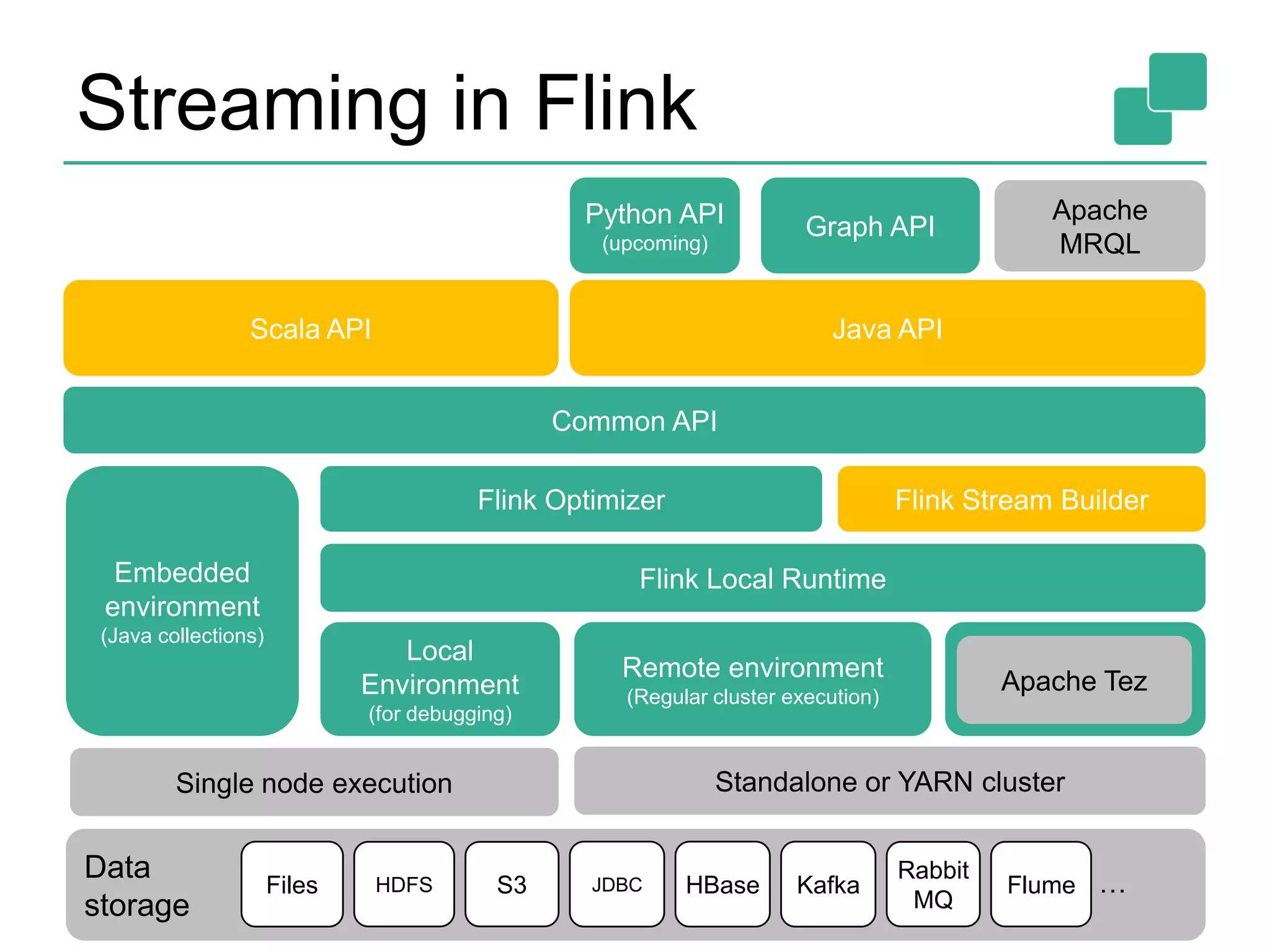
Streaming in Flink
11
Flink Optimizer Flink Stream Builder
Common API
Scala API Java API
Python API
(upcoming)
Graph API
Apache
MRQL
Flink Local RuntimeEmbedded
environment
(Java collections)
Local
Environment
(for debugging)
Remote environment
(Regular cluster execution)
Apache Tez
Data
storage
HDFSFiles S3 JDBC Flume
Rabbit
MQ
KafkaHBase …
Single node execution Standalone or YARN cluster
Using Flink
Streaming
12
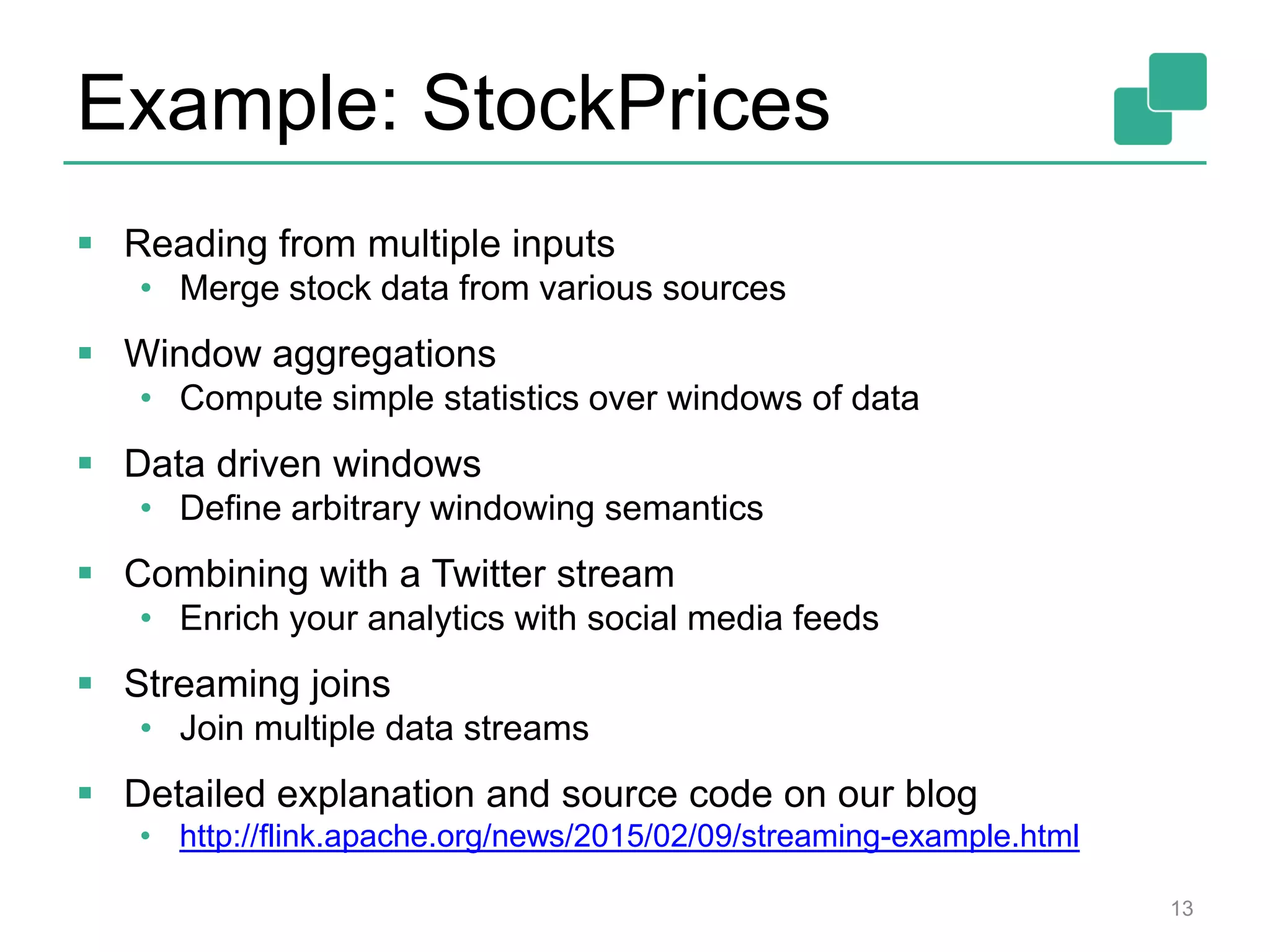
Example: StockPrices
13
 Reading from multiple inputs
• Merge stock data from various sources
 Window aggregations
• Compute simple statistics over windows of data
 Data driven windows
• Define arbitrary windowing semantics
 Combining with a Twitter stream
• Enrich your analytics with social media feeds
 Streaming joins
• Join multiple data streams
 Detailed explanation and source code on our blog
• http://flink.apache.org/news/2015/02/09/streaming-example.html
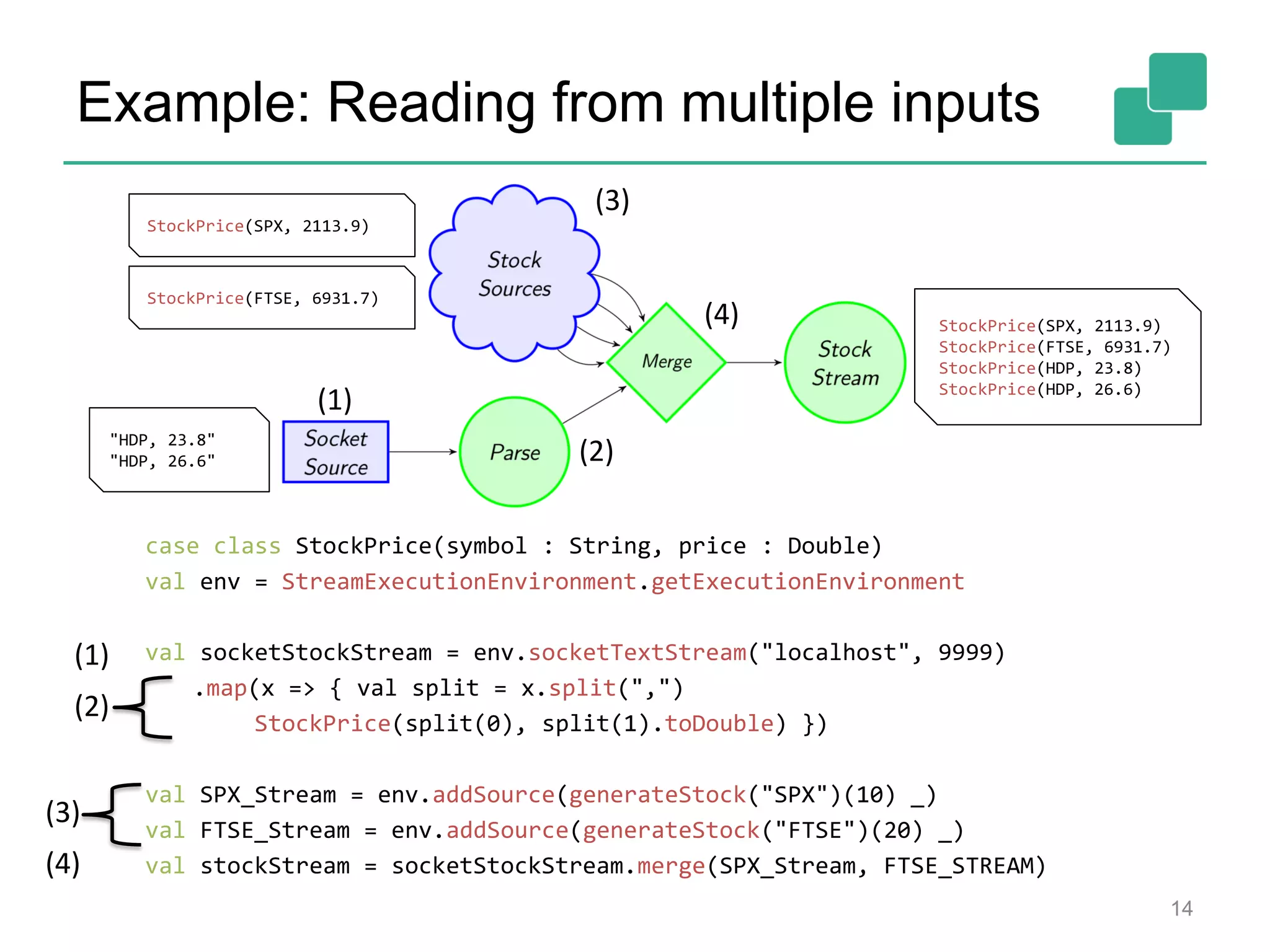
Example: Reading from multiple inputs
case class StockPrice(symbol : String, price : Double)
val env = StreamExecutionEnvironment.getExecutionEnvironment
val socketStockStream = env.socketTextStream("localhost", 9999)
.map(x => { val split = x.split(",")
StockPrice(split(0), split(1).toDouble) })
val SPX_Stream = env.addSource(generateStock("SPX")(10) _)
val FTSE_Stream = env.addSource(generateStock("FTSE")(20) _)
val stockStream = socketStockStream.merge(SPX_Stream, FTSE_STREAM)
14
(1)
(2)
(4)
(3)
(1)
(2)
(3)
(4)
"HDP, 23.8"
"HDP, 26.6"
StockPrice(SPX, 2113.9)
StockPrice(FTSE, 6931.7)
StockPrice(SPX, 2113.9)
StockPrice(FTSE, 6931.7)
StockPrice(HDP, 23.8)
StockPrice(HDP, 26.6)
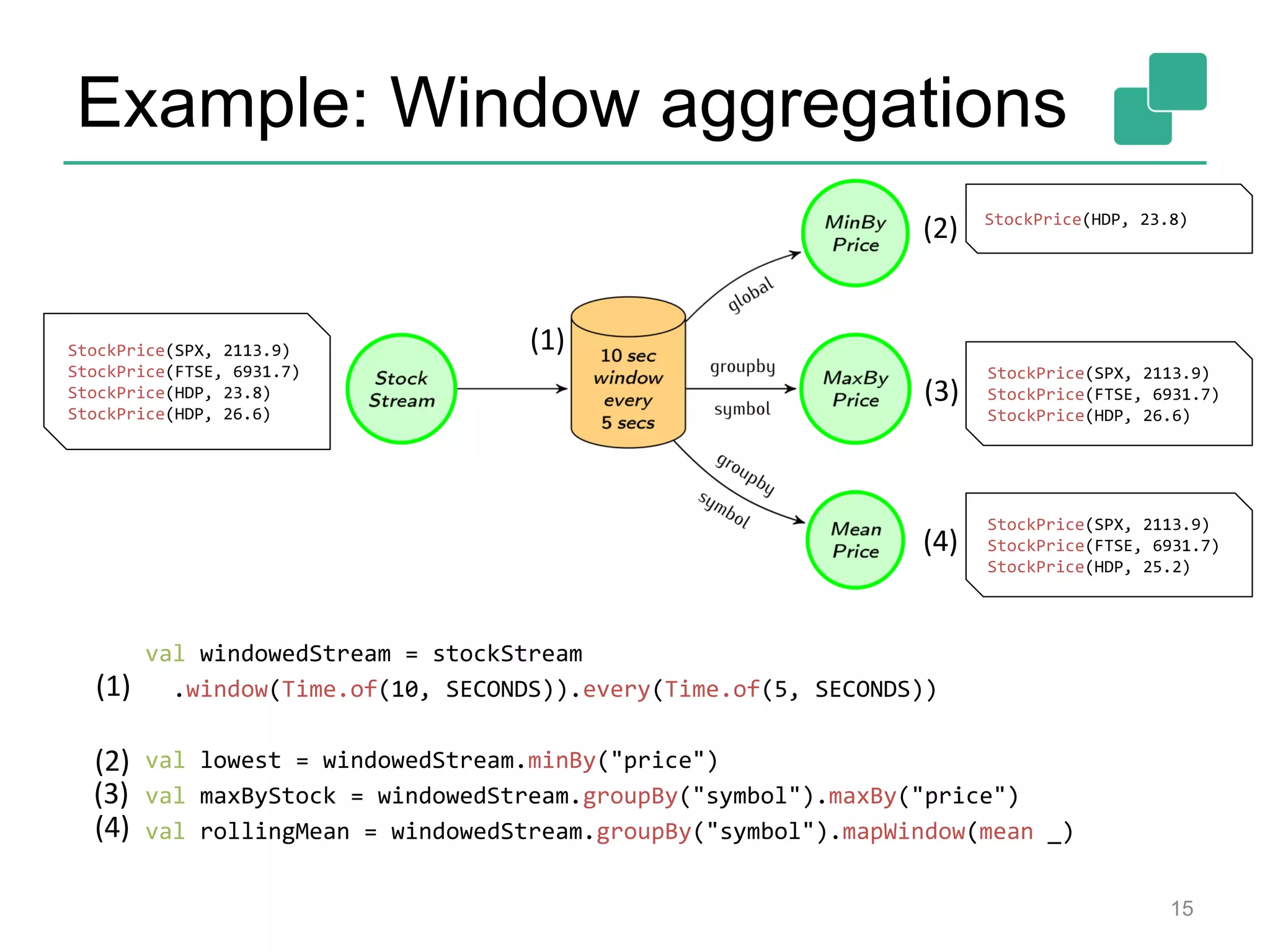
Example: Window aggregations
val windowedStream = stockStream
.window(Time.of(10, SECONDS)).every(Time.of(5, SECONDS))
val lowest = windowedStream.minBy("price")
val maxByStock = windowedStream.groupBy("symbol").maxBy("price")
val rollingMean = windowedStream.groupBy("symbol").mapWindow(mean _)
15
(1)
(2)
(4)
(3)
(1)
(2)
(4)
(3)
StockPrice(SPX, 2113.9)
StockPrice(FTSE, 6931.7)
StockPrice(HDP, 23.8)
StockPrice(HDP, 26.6)
StockPrice(HDP, 23.8)
StockPrice(SPX, 2113.9)
StockPrice(FTSE, 6931.7)
StockPrice(HDP, 26.6)
StockPrice(SPX, 2113.9)
StockPrice(FTSE, 6931.7)
StockPrice(HDP, 25.2)
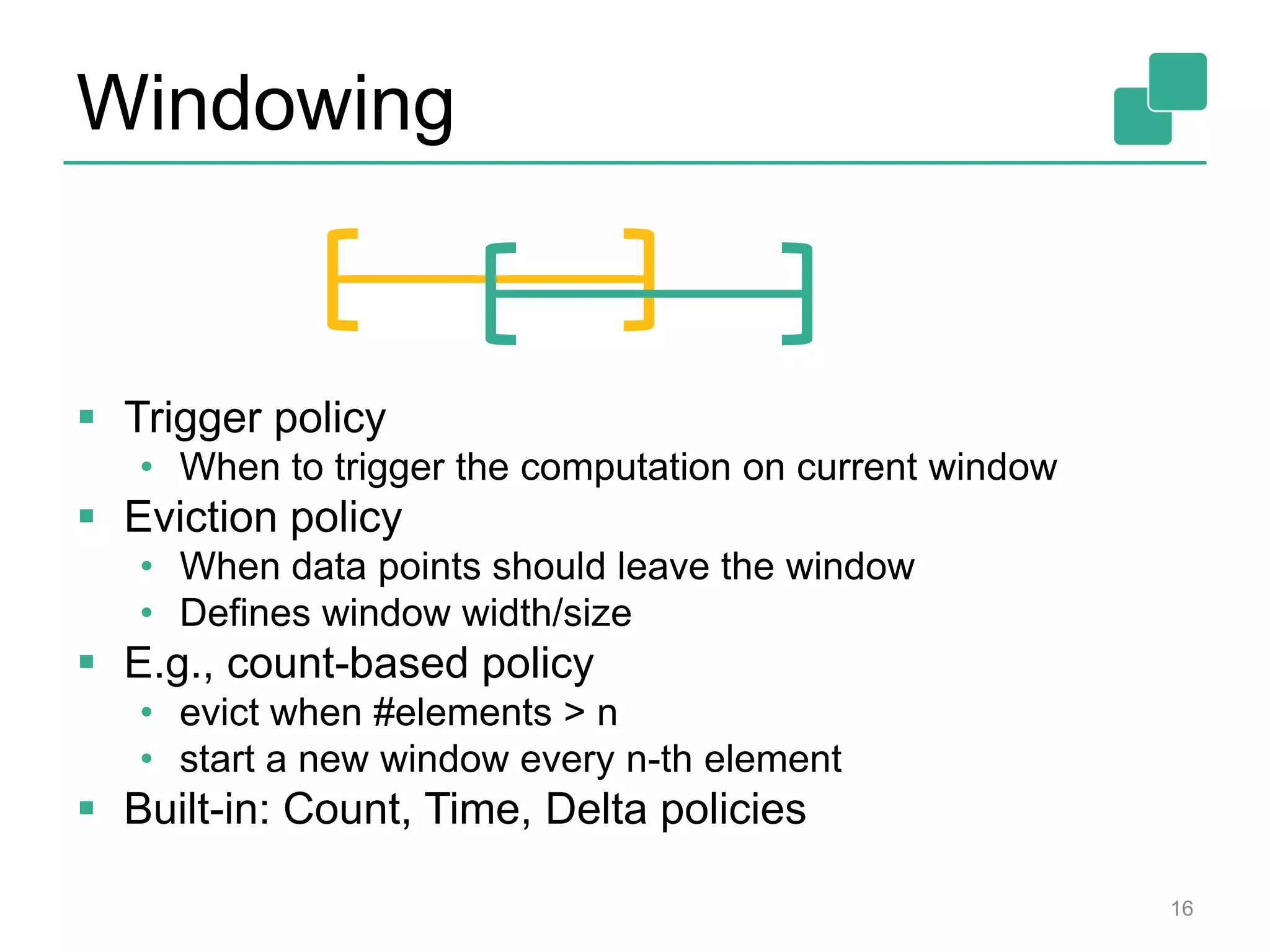
Windowing
 Trigger policy
• When to trigger the computation on current window
 Eviction policy
• When data points should leave the window
• Defines window width/size
 E.g., count-based policy
• evict when #elements > n
• start a new window every n-th element
 Built-in: Count, Time, Delta policies
16
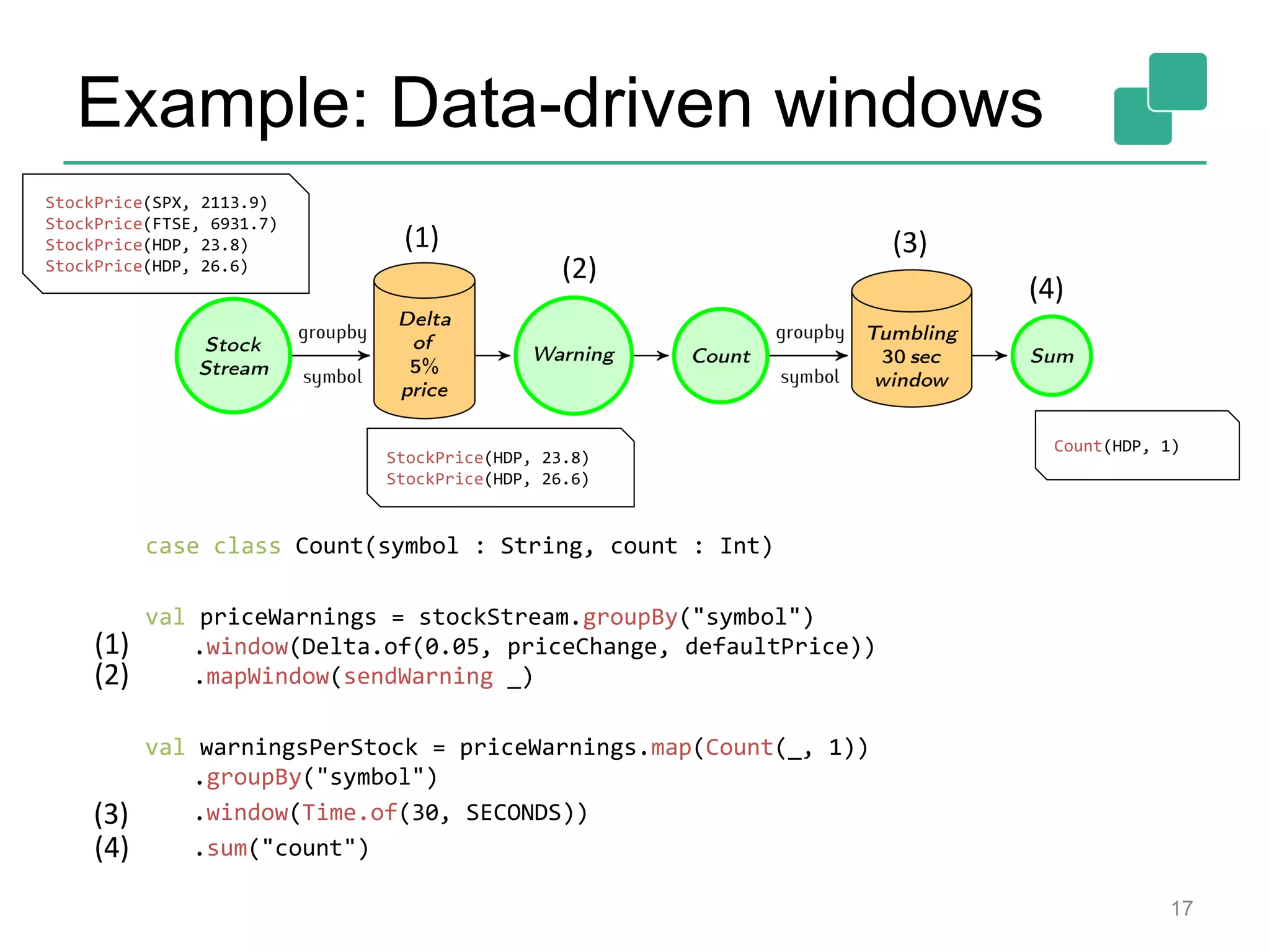
Example: Data-driven windows
case class Count(symbol : String, count : Int)
val priceWarnings = stockStream.groupBy("symbol")
.window(Delta.of(0.05, priceChange, defaultPrice))
.mapWindow(sendWarning _)
val warningsPerStock = priceWarnings.map(Count(_, 1))
.groupBy("symbol")
.window(Time.of(30, SECONDS))
.sum("count")
17
(1)
(2)
(4)
(3)
(1)
(2)
(4)
(3)
StockPrice(SPX, 2113.9)
StockPrice(FTSE, 6931.7)
StockPrice(HDP, 23.8)
StockPrice(HDP, 26.6)
Count(HDP, 1)
StockPrice(HDP, 23.8)
StockPrice(HDP, 26.6)
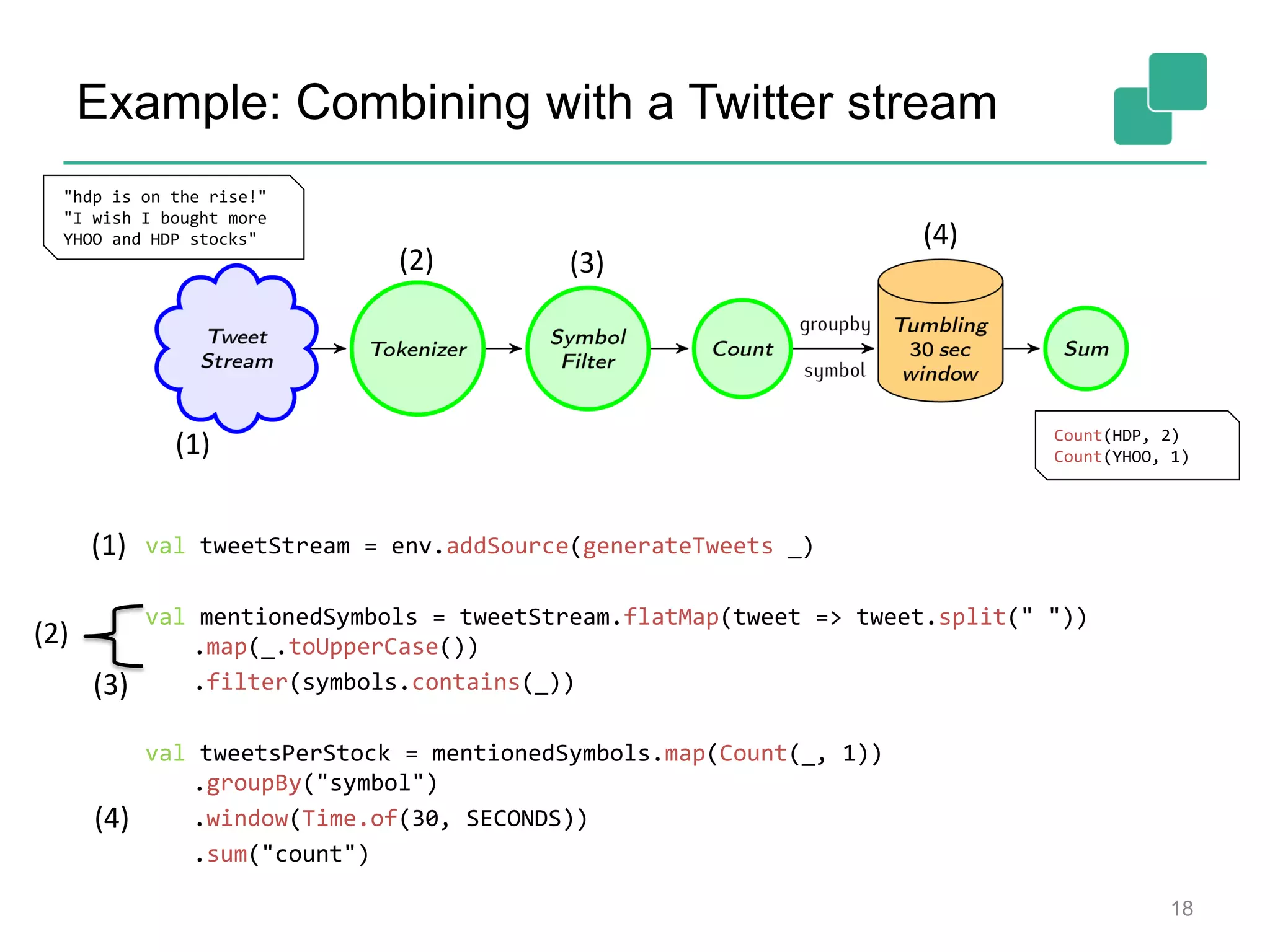
Example: Combining with a Twitter stream
val tweetStream = env.addSource(generateTweets _)
val mentionedSymbols = tweetStream.flatMap(tweet => tweet.split(" "))
.map(_.toUpperCase())
.filter(symbols.contains(_))
val tweetsPerStock = mentionedSymbols.map(Count(_, 1))
.groupBy("symbol")
.window(Time.of(30, SECONDS))
.sum("count")
18
"hdp is on the rise!"
"I wish I bought more
YHOO and HDP stocks"
Count(HDP, 2)
Count(YHOO, 1)(1)
(2)
(4)
(3)
(1)
(2)
(4)
(3)
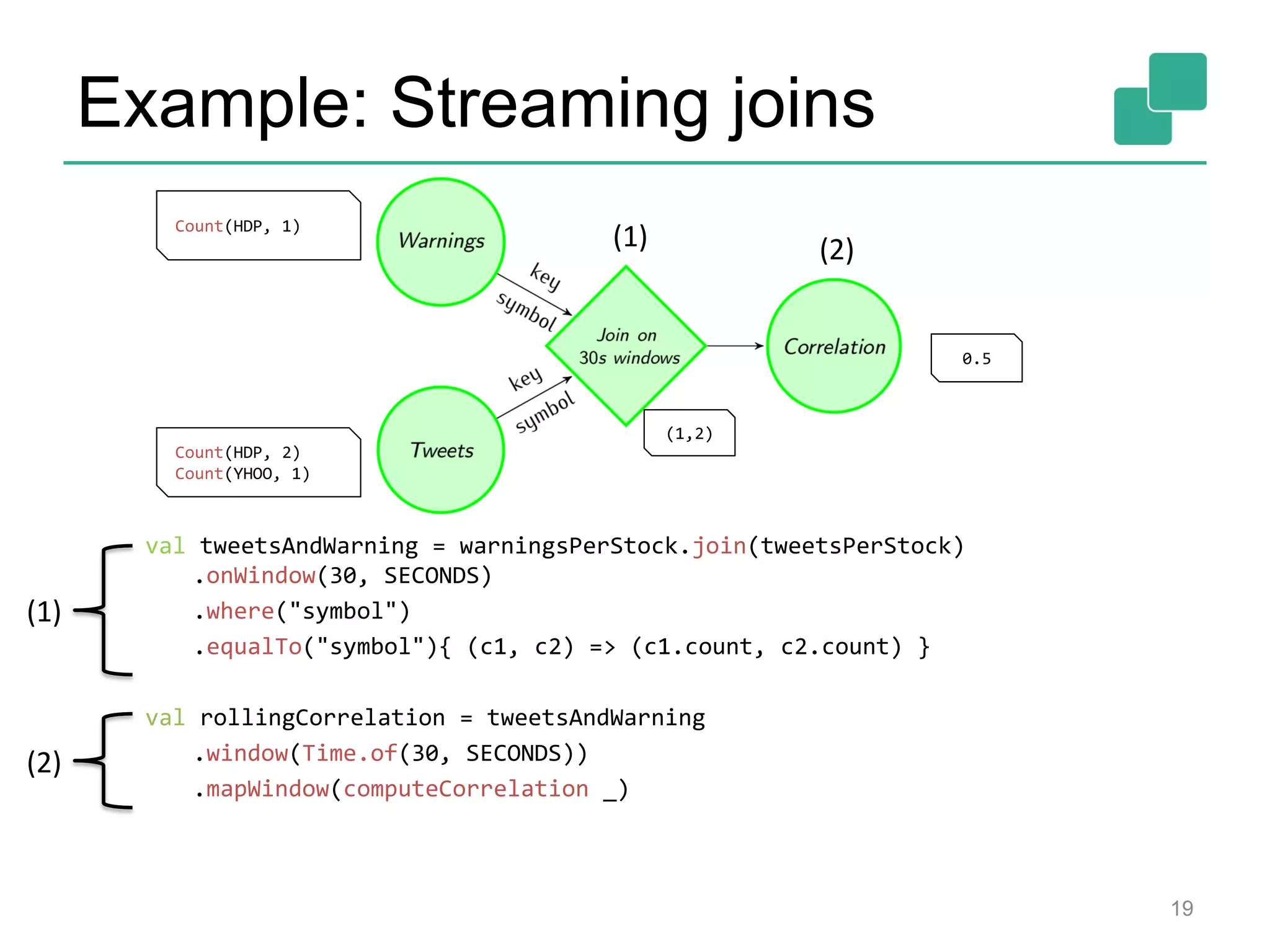
Example: Streaming joins
val tweetsAndWarning = warningsPerStock.join(tweetsPerStock)
.onWindow(30, SECONDS)
.where("symbol")
.equalTo("symbol"){ (c1, c2) => (c1.count, c2.count) }
val rollingCorrelation = tweetsAndWarning
.window(Time.of(30, SECONDS))
.mapWindow(computeCorrelation _)
19
Count(HDP, 2)
Count(YHOO, 1)
Count(HDP, 1)
(1,2)
(1) (2)
(1)
(2)
0.5
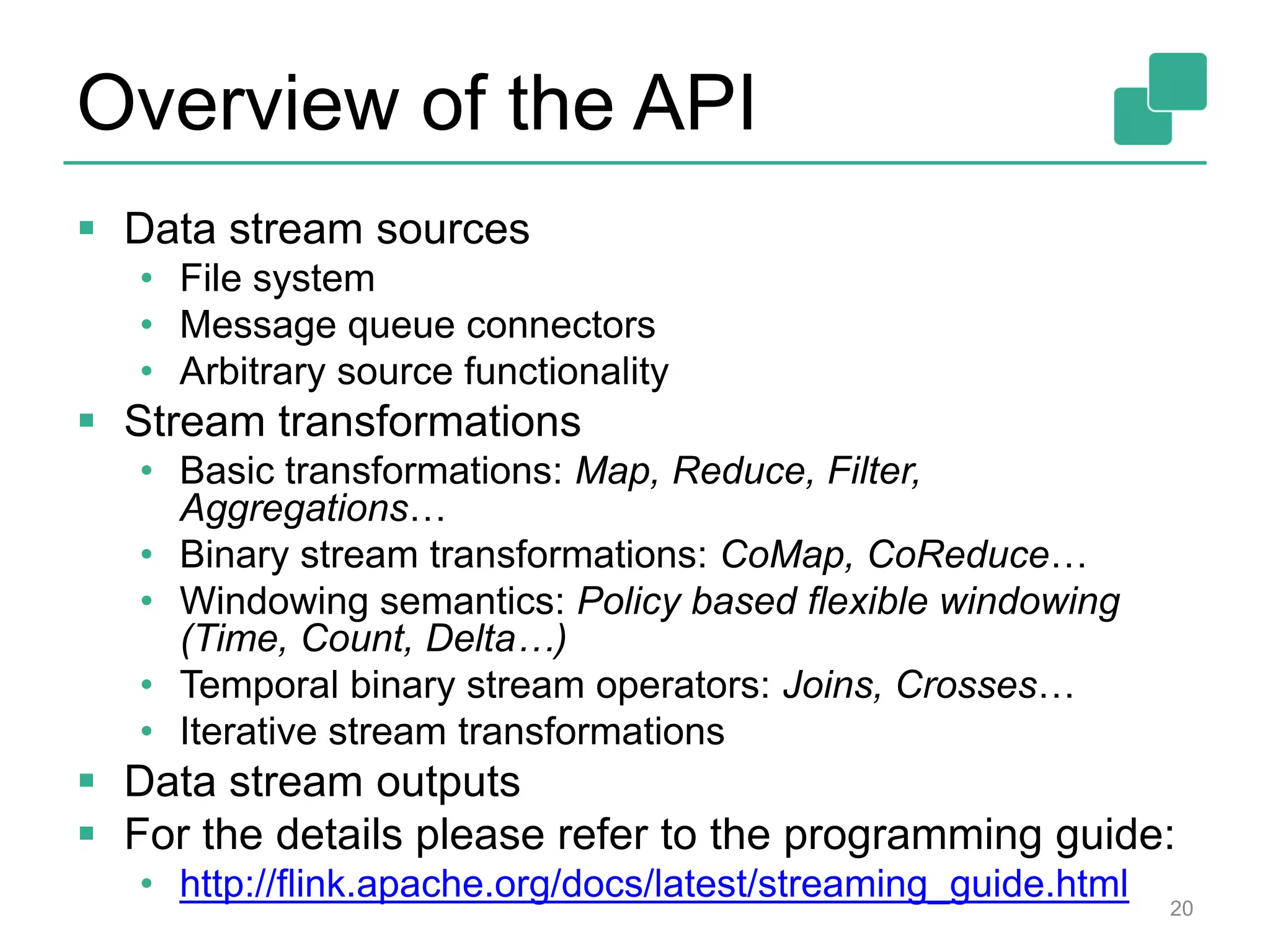
Overview of the API
 Data stream sources
• File system
• Message queue connectors
• Arbitrary source functionality
 Stream transformations
• Basic transformations: Map, Reduce, Filter,
Aggregations…
• Binary stream transformations: CoMap, CoReduce…
• Windowing semantics: Policy based flexible windowing
(Time, Count, Delta…)
• Temporal binary stream operators: Joins, Crosses…
• Iterative stream transformations
 Data stream outputs
 For the details please refer to the programming guide:
• http://flink.apache.org/docs/latest/streaming_guide.html 20
Internals
21
Streaming in Flink
22
Flink Optimizer Flink Stream Builder
Common API
Scala API Java API
Python API
(upcoming)
Graph API
Apache
MRQL
Flink Local RuntimeEmbedded
environment
(Java collections)
Local
Environment
(for debugging)
Remote environment
(Regular cluster execution)
Apache Tez
Data
storage
HDFSFiles S3 JDBC Flume
Rabbit
MQ
KafkaHBase …
Single node execution Standalone or YARN cluster
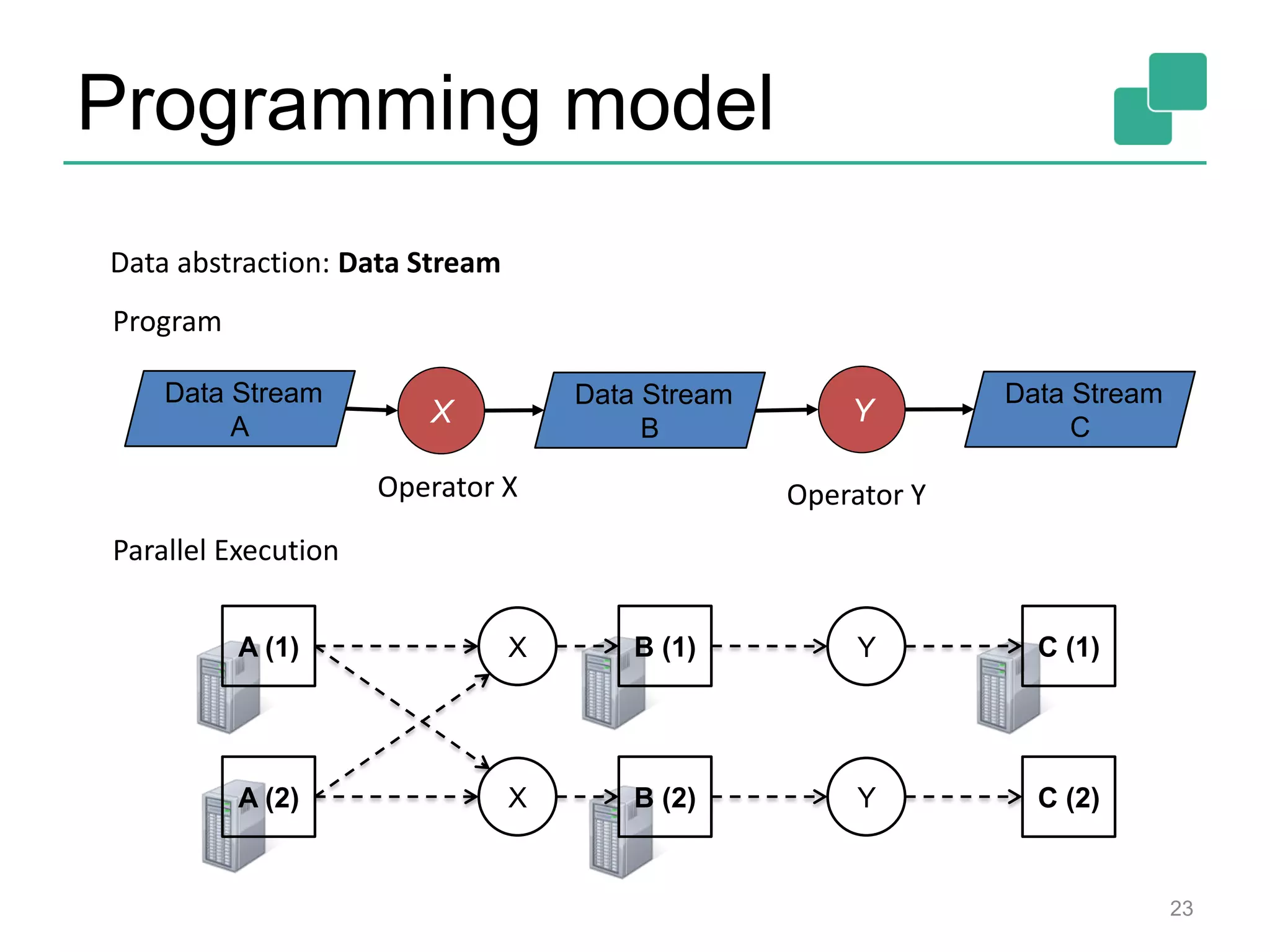
Programming model
Data Stream
A
A (1)
A (2)
B (1)
B (2)
C (1)
C (2)
X
X
Y
Y
Program
Parallel Execution
X Y
Operator X Operator Y
Data abstraction: Data Stream
Data Stream
B
Data Stream
C
23
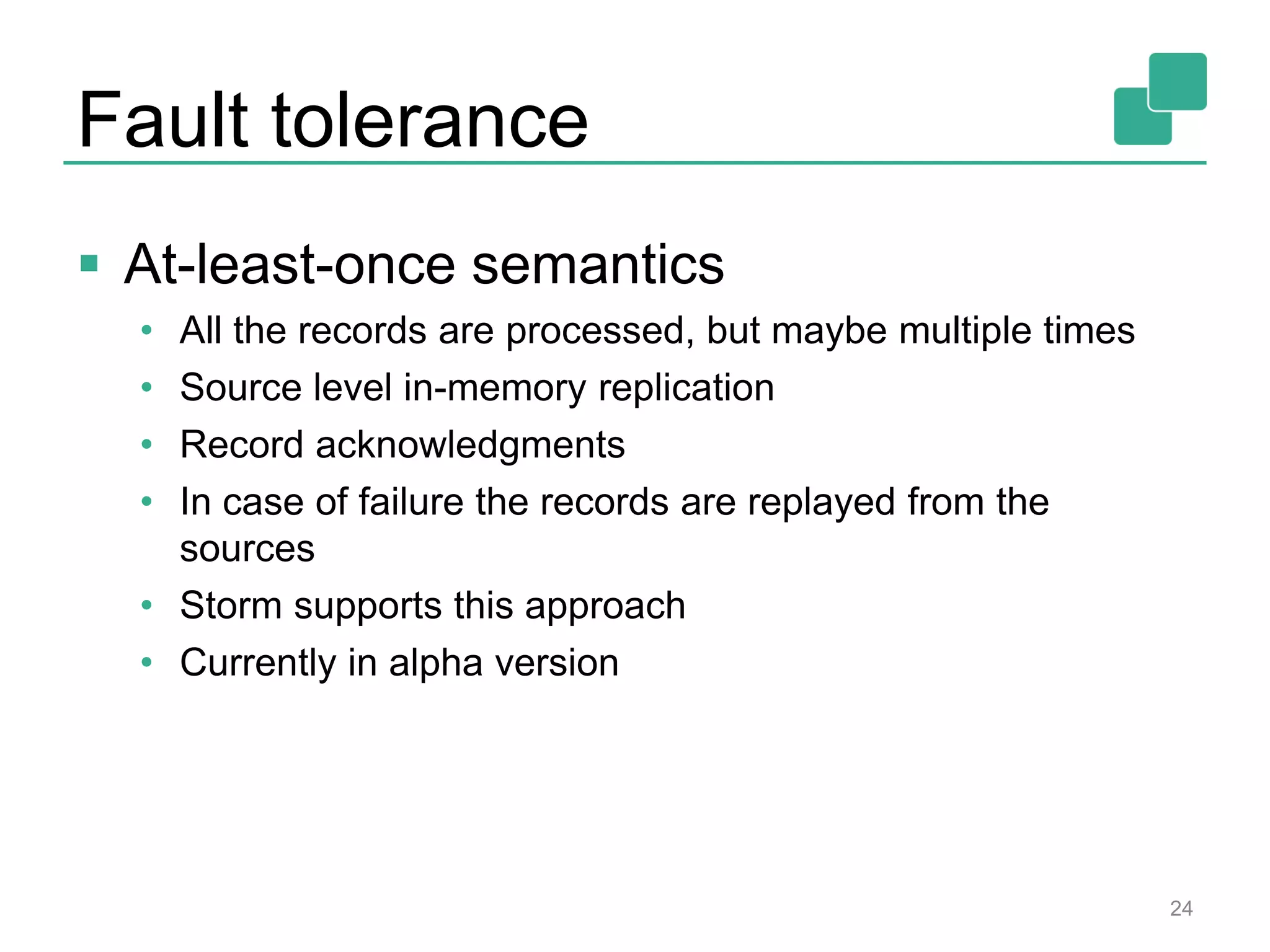
Fault tolerance
 At-least-once semantics
• All the records are processed, but maybe multiple times
• Source level in-memory replication
• Record acknowledgments
• In case of failure the records are replayed from the
sources
• Storm supports this approach
• Currently in alpha version
24
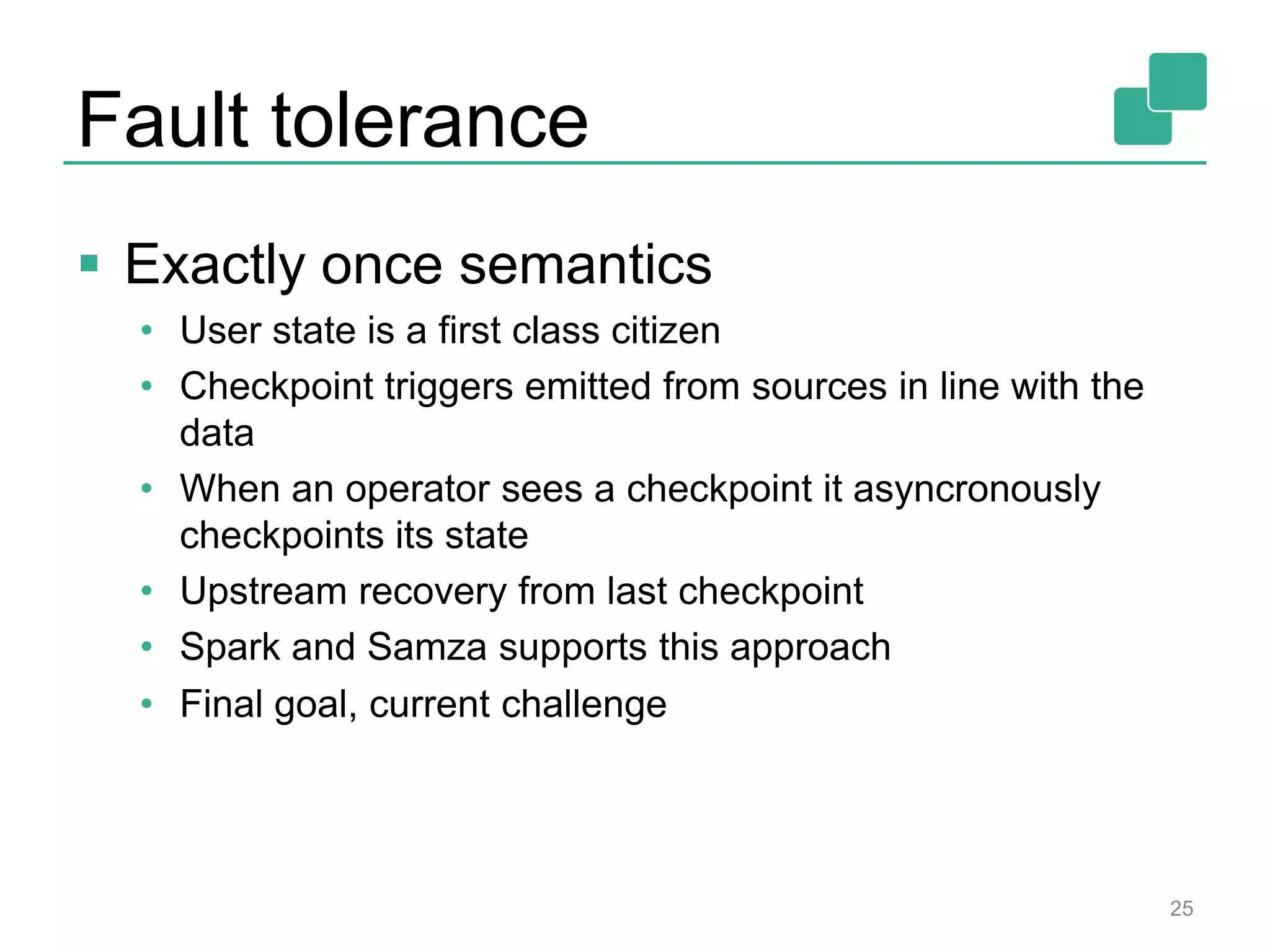
Fault tolerance
 Exactly once semantics
• User state is a first class citizen
• Checkpoint triggers emitted from sources in line with the
data
• When an operator sees a checkpoint it asyncronously
checkpoints its state
• Upstream recovery from last checkpoint
• Spark and Samza supports this approach
• Final goal, current challenge
25
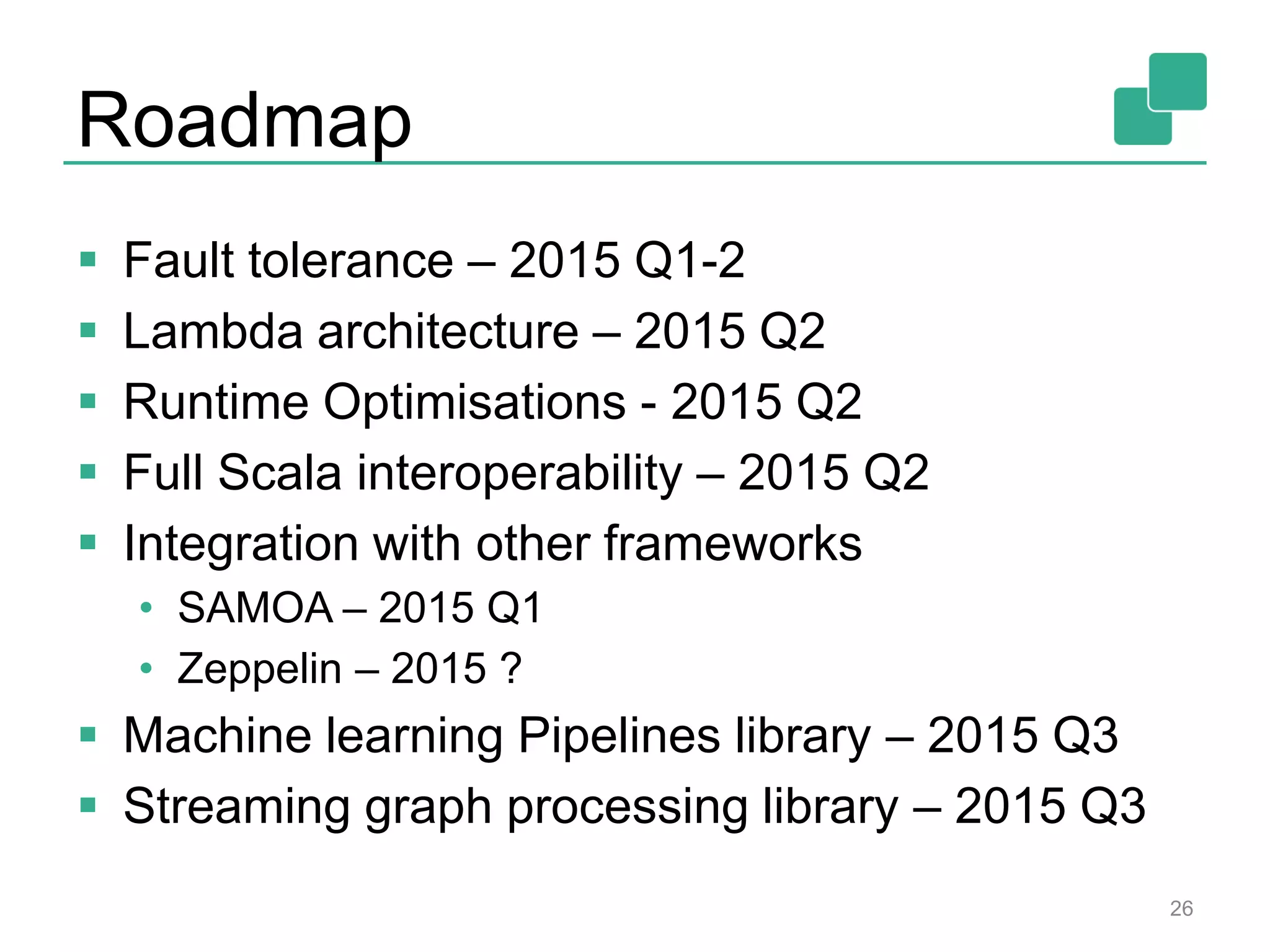
Roadmap
 Fault tolerance – 2015 Q1-2
 Lambda architecture – 2015 Q2
 Runtime Optimisations - 2015 Q2
 Full Scala interoperability – 2015 Q2
 Integration with other frameworks
• SAMOA – 2015 Q1
• Zeppelin – 2015 ?
 Machine learning Pipelines library – 2015 Q3
 Streaming graph processing library – 2015 Q3
26
Performance
27
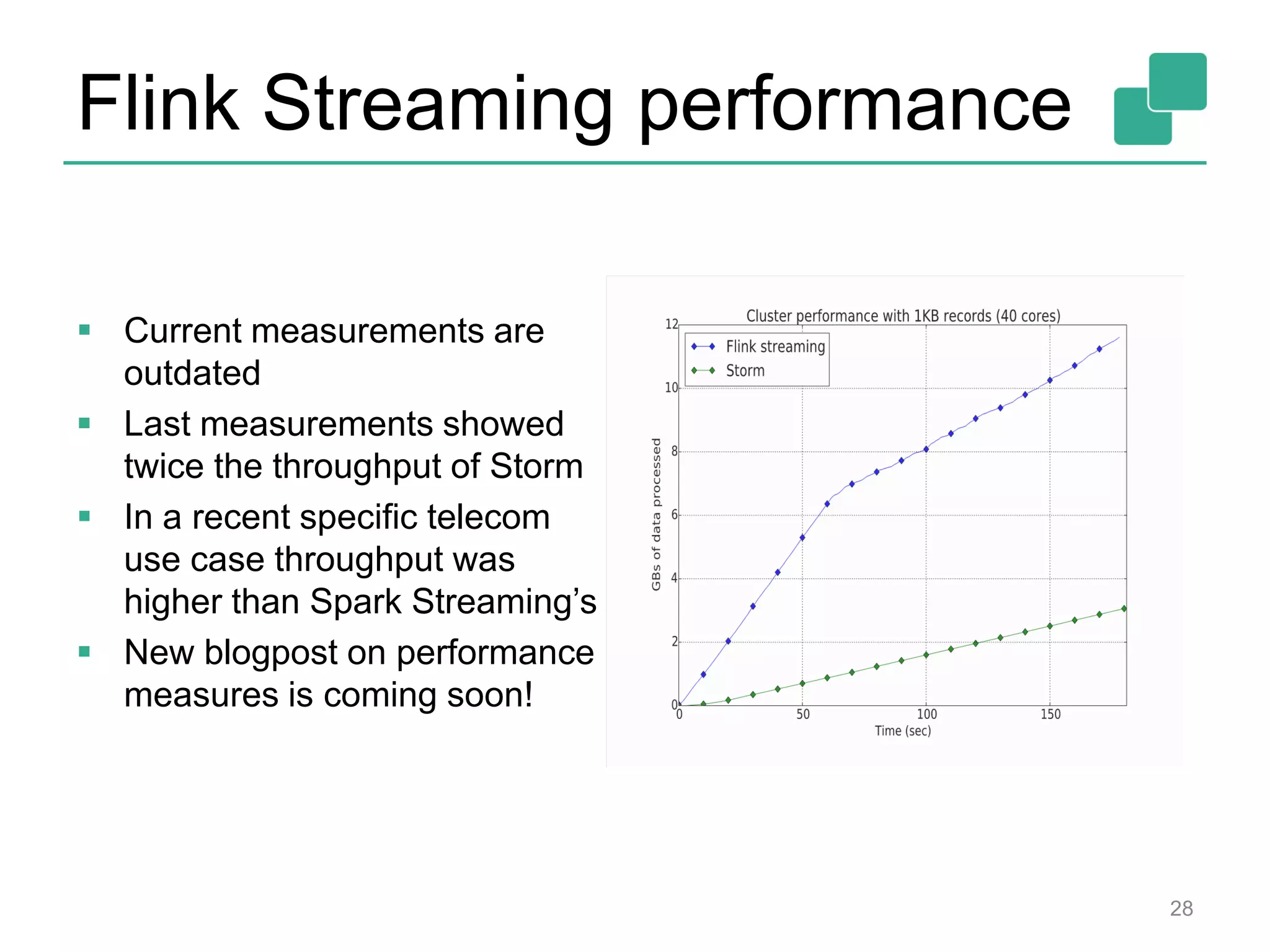
Flink Streaming performance
28
 Current measurements are
outdated
 Last measurements showed
twice the throughput of Storm
 In a recent specific telecom
use case throughput was
higher than Spark Streaming’s
 New blogpost on performance
measures is coming soon!
Closing
29
Summary
 Flink combines true streaming runtime
with expressive high-level APIs for a next-
gen stream processing solution
 Flexible windowing semantics
 Iterative processing support opens new
horizons in online machine learning
 Competitive performance
 We are just getting started!
30
flink.apache.org
@ApacheFlink
Appendix
32
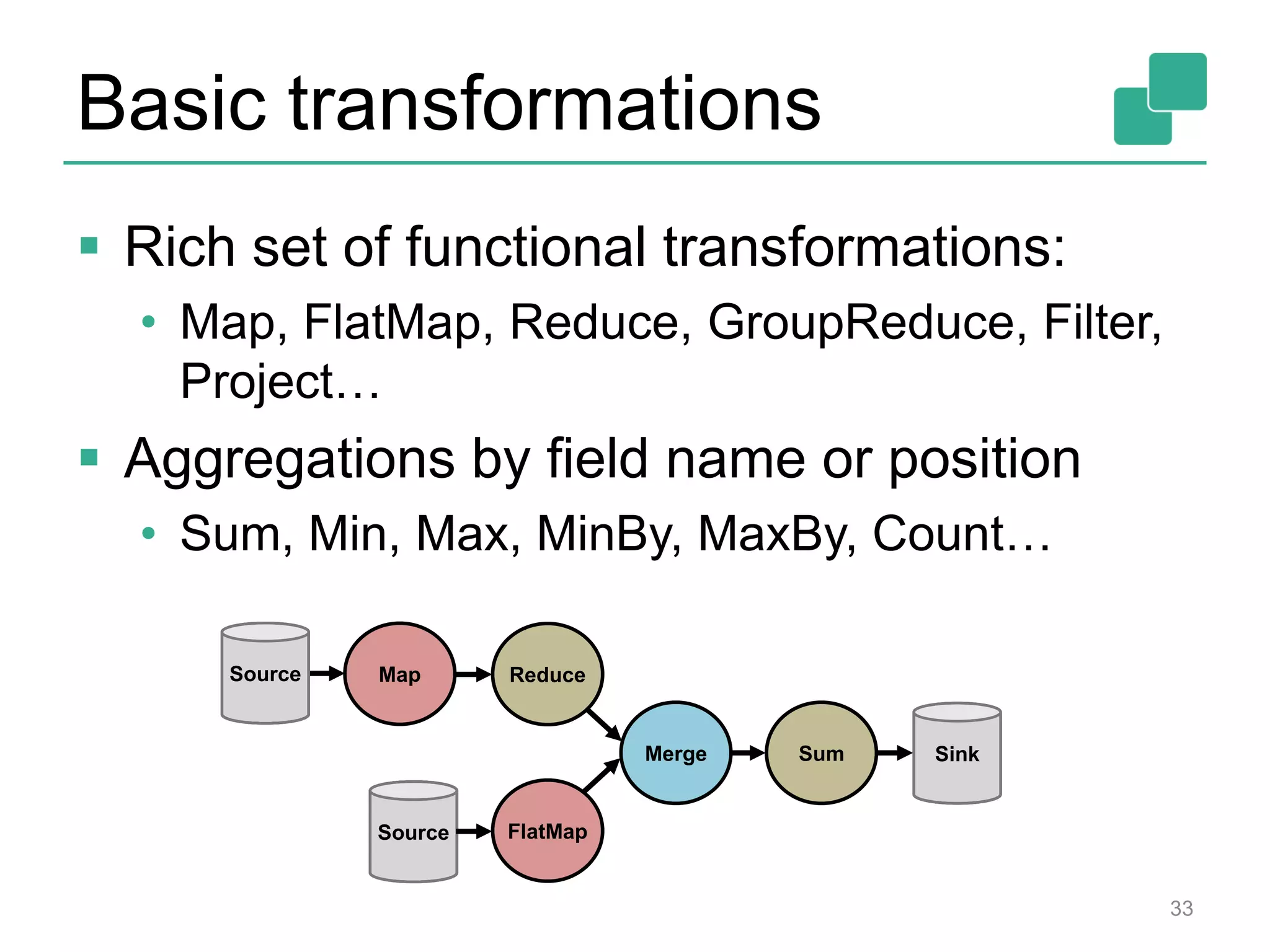
Basic transformations
 Rich set of functional transformations:
• Map, FlatMap, Reduce, GroupReduce, Filter,
Project…
 Aggregations by field name or position
• Sum, Min, Max, MinBy, MaxBy, Count…
Reduce
Merge
FlatMap
Sum
Map
Source
Sink
Source
33
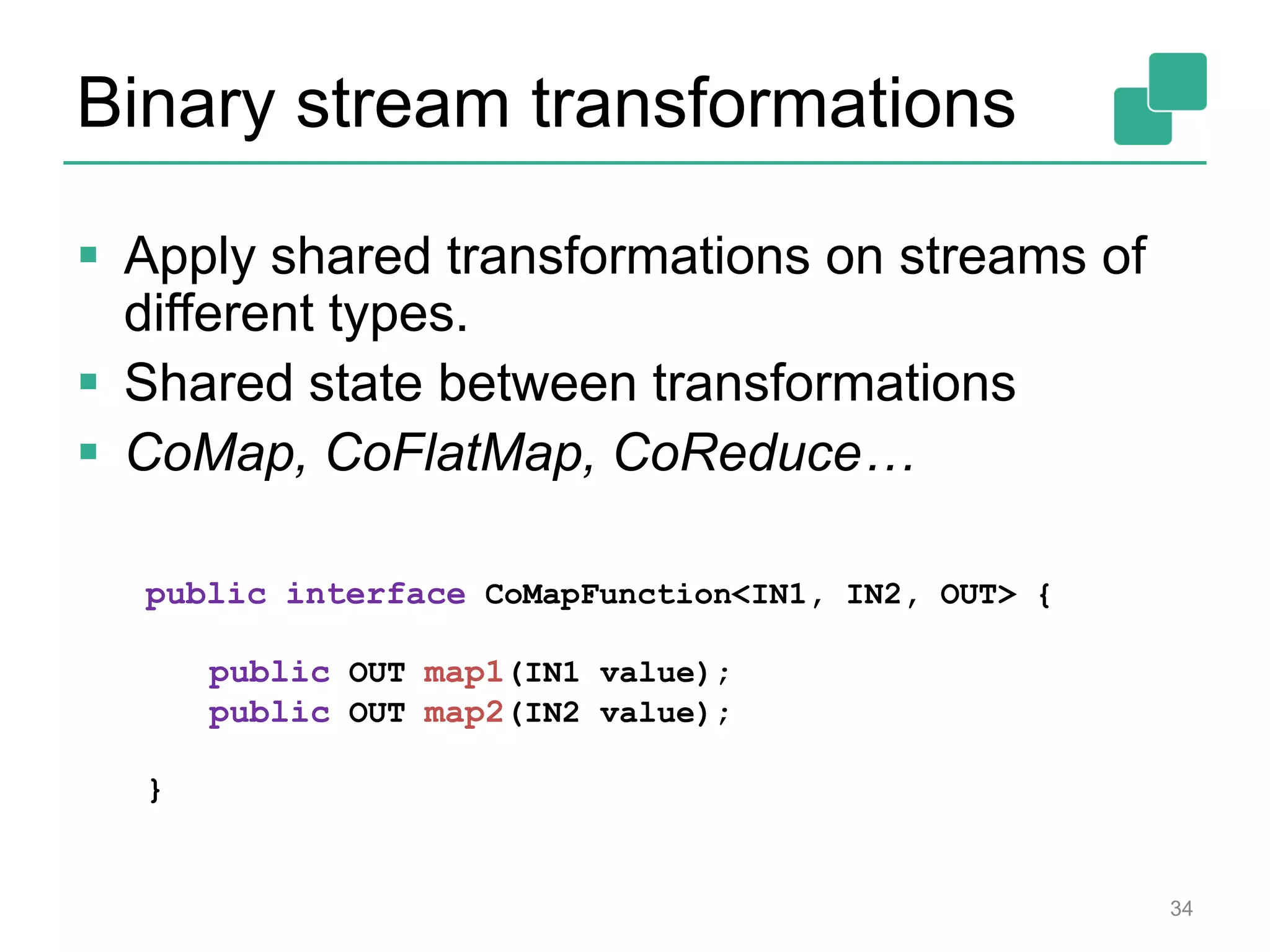
Binary stream transformations
 Apply shared transformations on streams of
different types.
 Shared state between transformations
 CoMap, CoFlatMap, CoReduce…
public interface CoMapFunction<IN1, IN2, OUT> {
public OUT map1(IN1 value);
public OUT map2(IN2 value);
}
34
Iterative stream processing
T R
Step function
Feedback stream
Output stream
def iterate[R](
stepFunction: DataStream[T] => (DataStream[T], DataStream[R]),
maxWaitTimeMillis: Long = 0 ): DataStream[R]
35
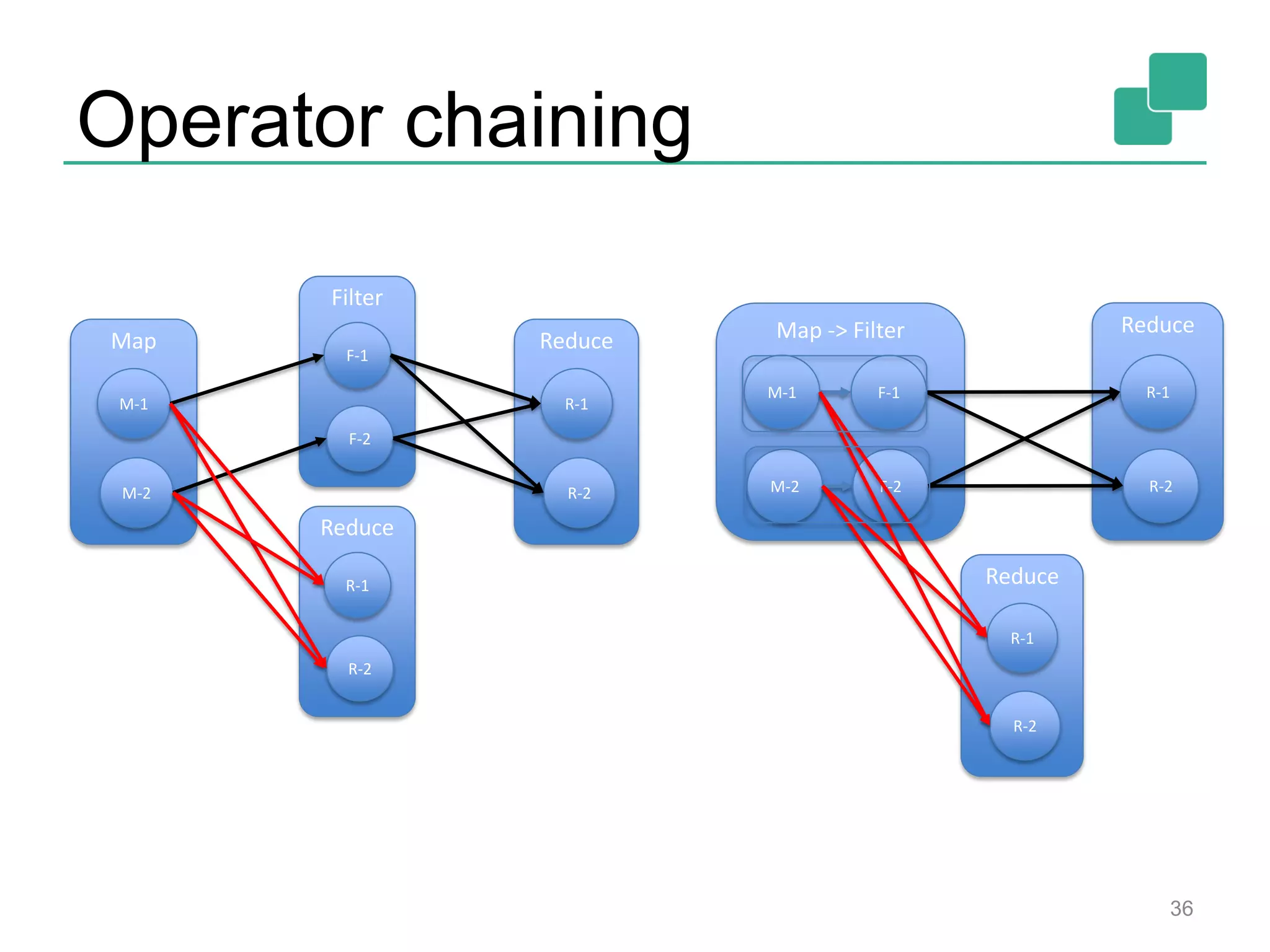
Operator chaining
Map
M-1
M-2
Filter
F-1
F-2
Reduce
R-1
R-2
Reduce
R-1
R-2
Reduce
R-1
R-2
Map -> Filter
M-1
M-2
F-1
F-2
Reduce
R-1
R-2
36
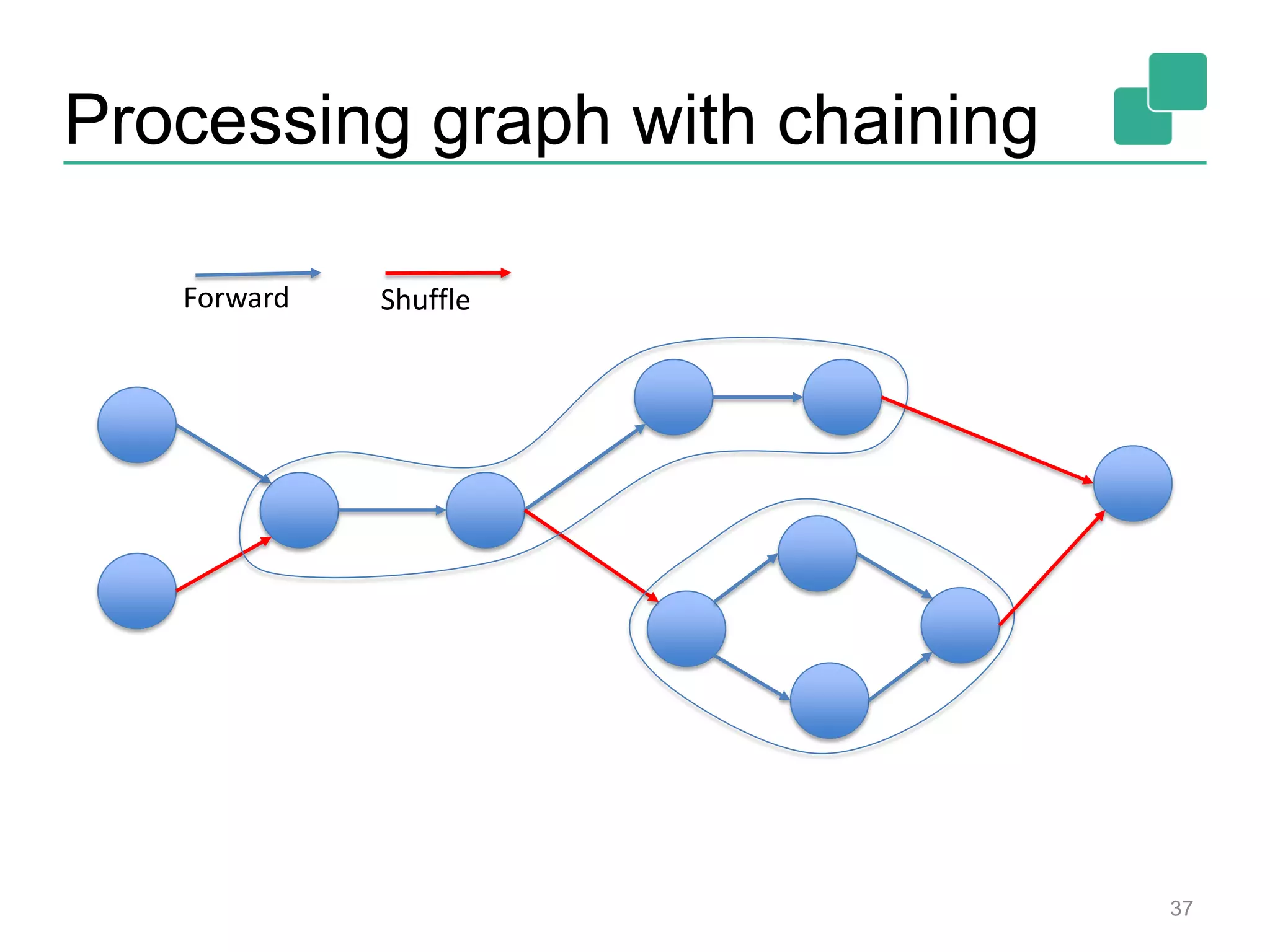
Processing graph with chaining
Forward Shuffle
37
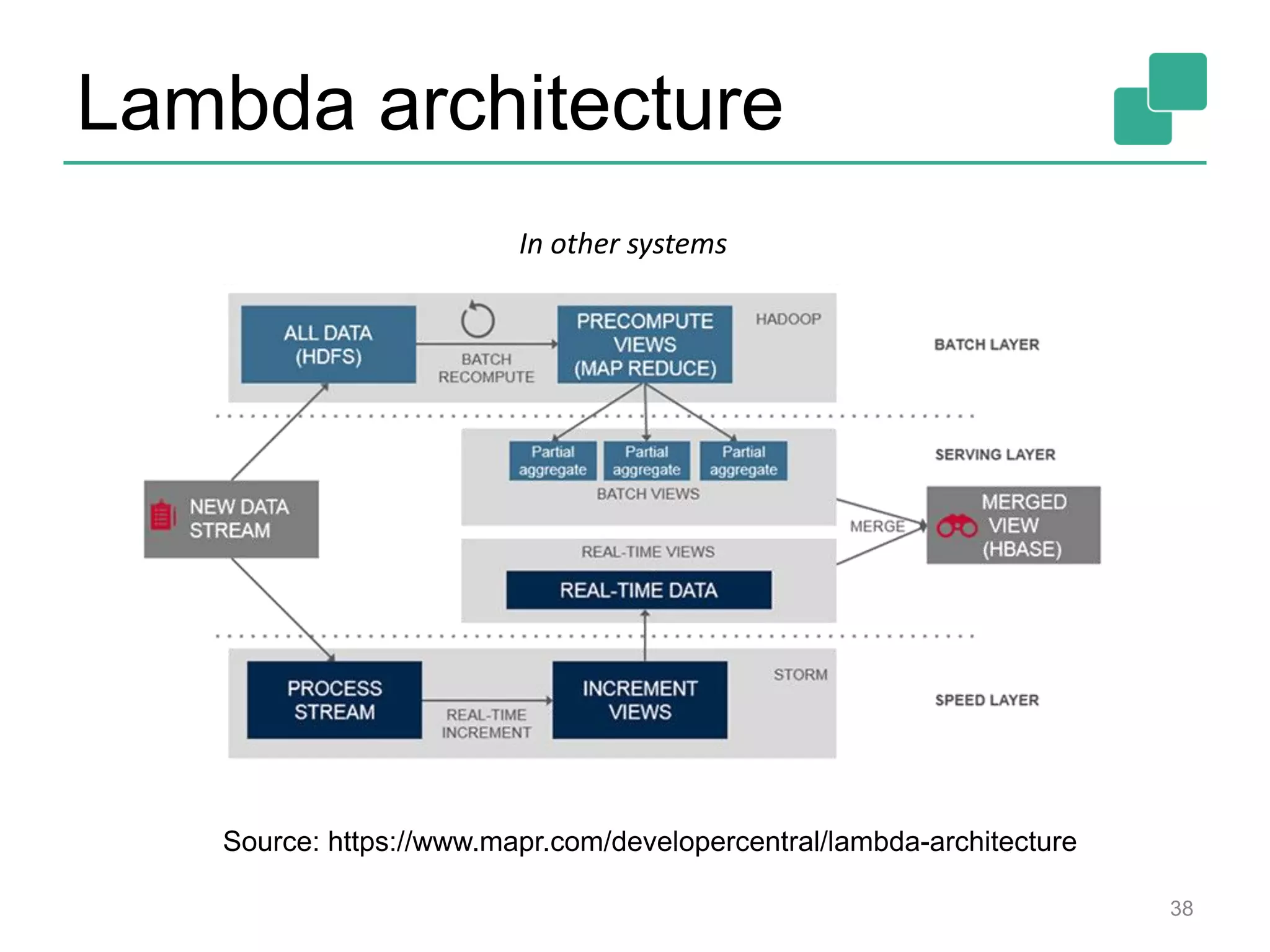
Lambda architecture
In other systems
Source: https://www.mapr.com/developercentral/lambda-architecture
38
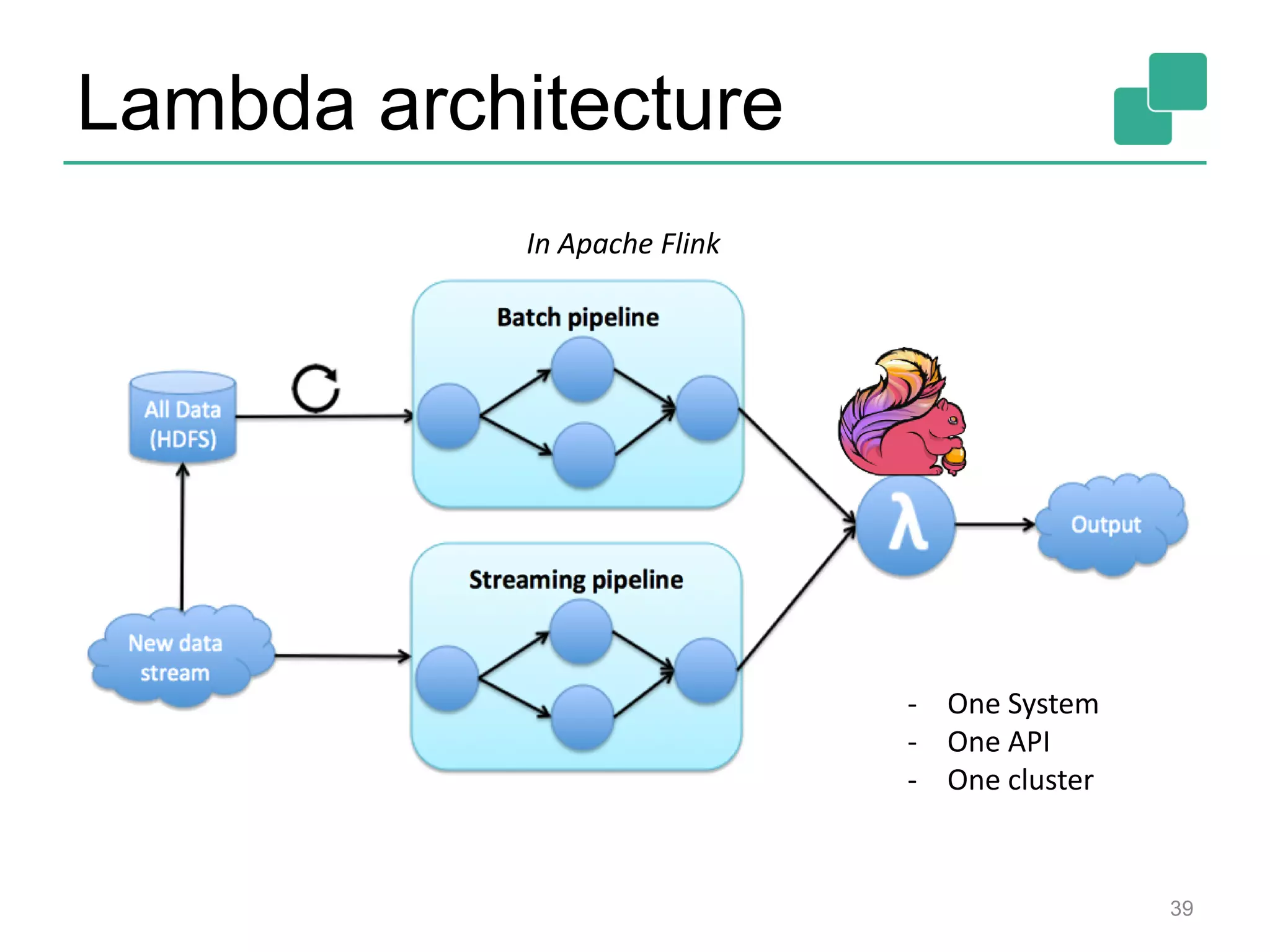
Lambda architecture
- One System
- One API
- One cluster
In Apache Flink
39
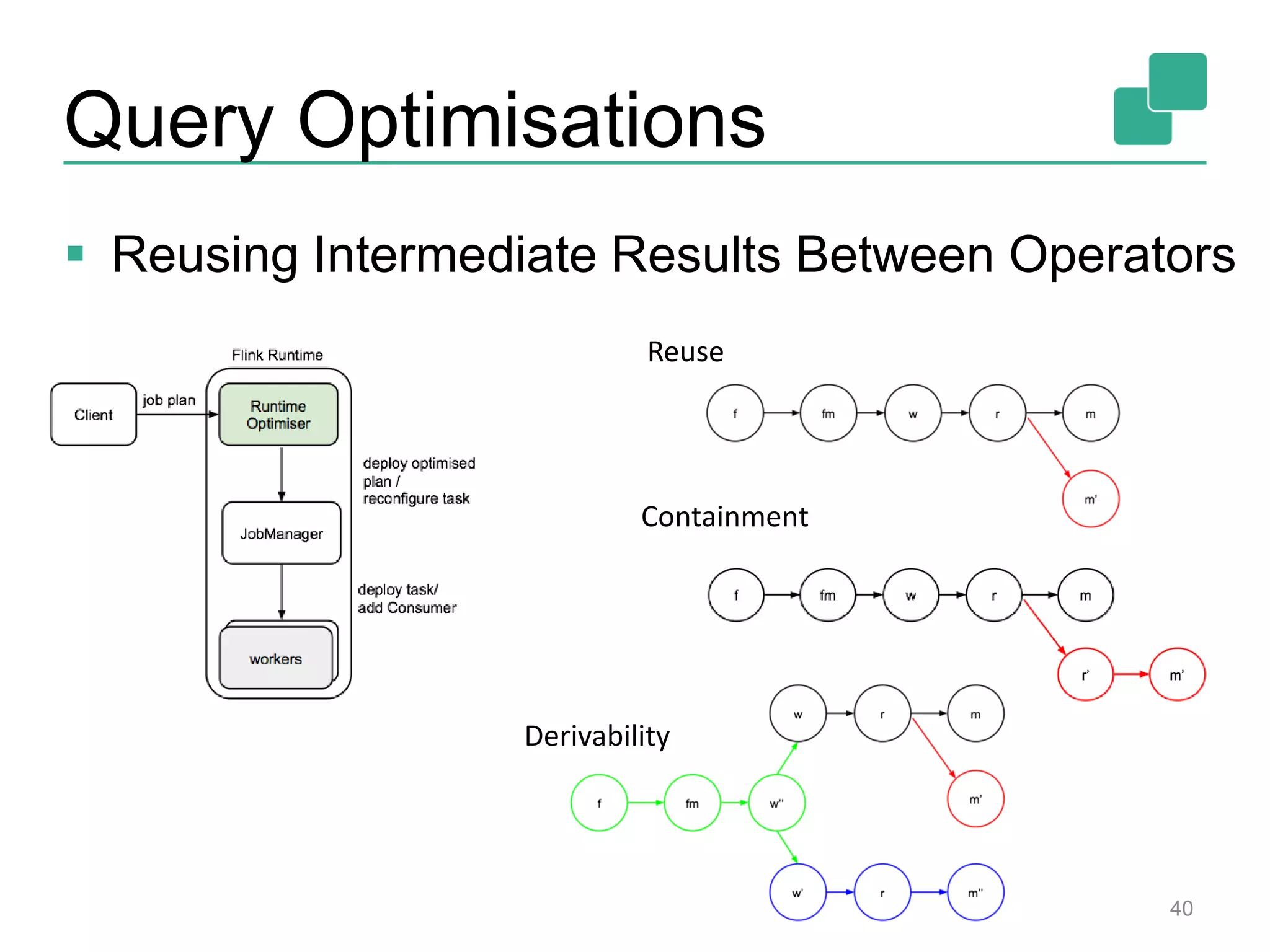
Query Optimisations
 Reusing Intermediate Results Between Operators
Reuse
Containment
Derivability
40
Scala Interoperability
 Seamlessly integrate Flink streaming programs
into scala pipelines
 Scala streams implicitly converted to
DataStreams
 In the future the output streams will be converted
back to Scala streams
fibs.window(Count of 4).reduce((x,y)=>x+y).print
def fibs():Stream[Int] = {0 #::
fibs.getExecutionEnvironment.scanLeft(1)(_ + _)}
41
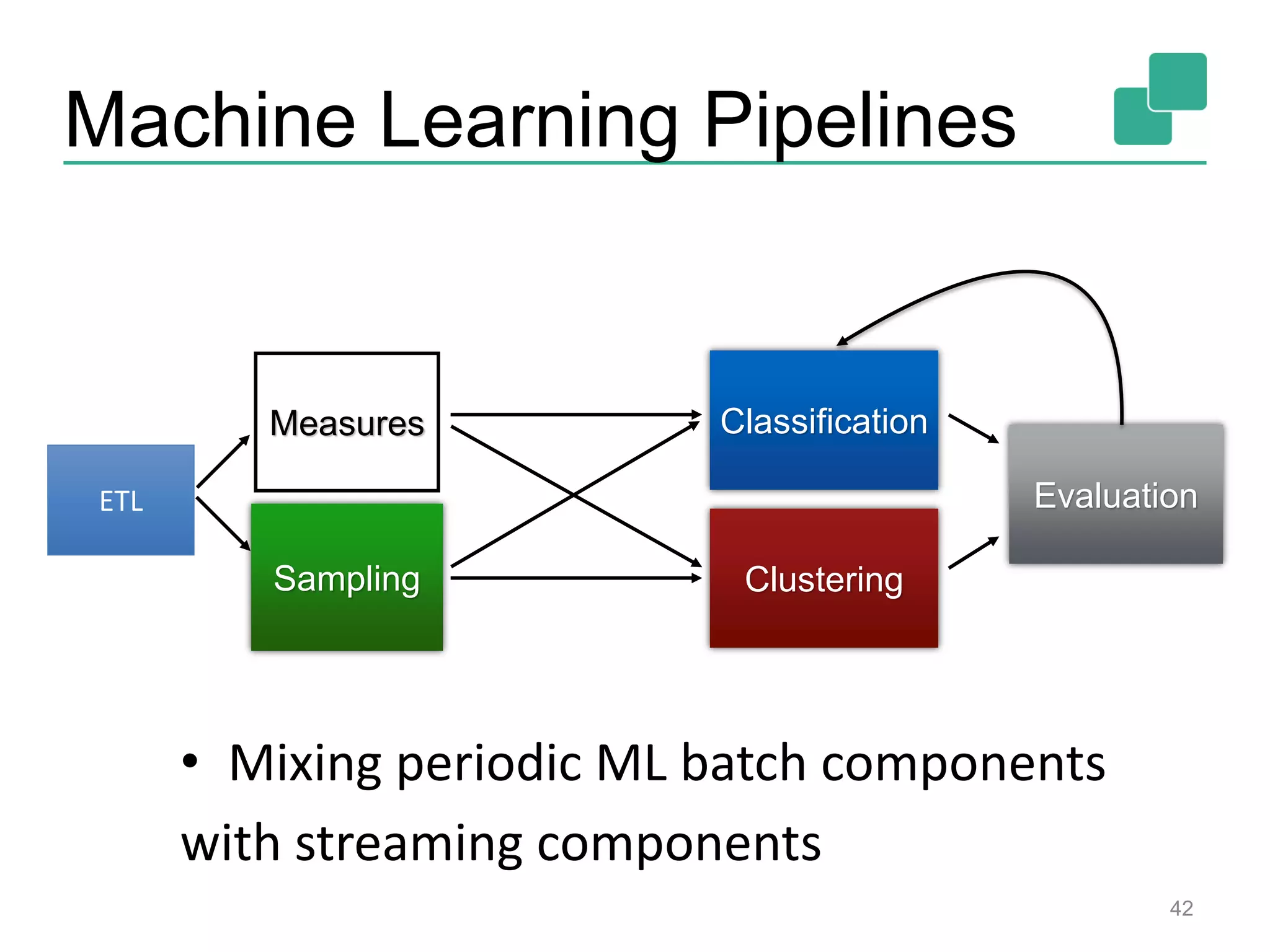
Machine Learning Pipelines
Sampling
ClassificationMeasures
Evaluation
Clustering
ETL
• Mixing periodic ML batch components
with streaming components
42
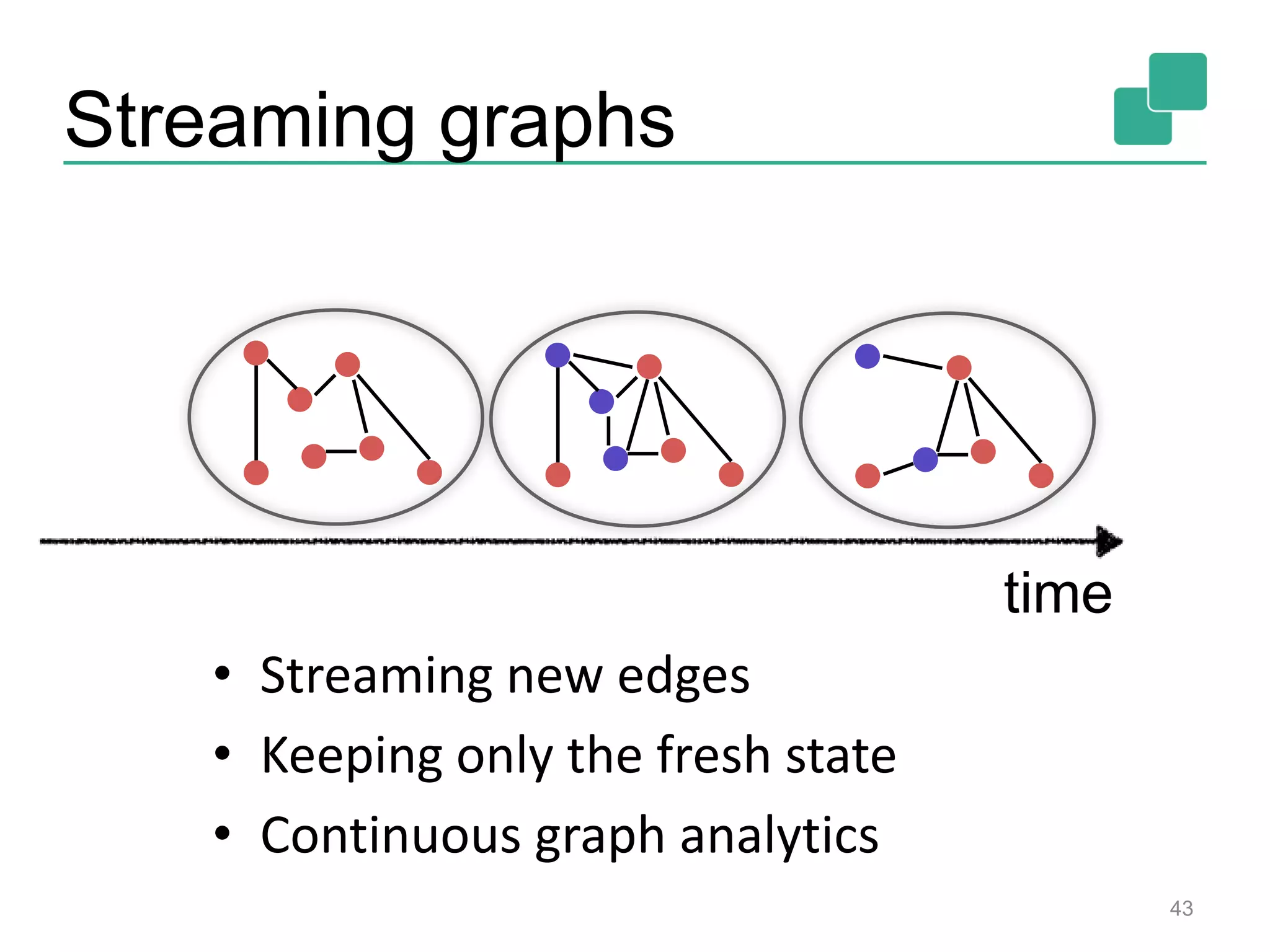
Streaming graphs
• Streaming new edges
• Keeping only the fresh state
• Continuous graph analytics
time
43

Flink Streaming Berlin Meetup

  • 1.
    Marton Balassi Flink committer dataArtisans @MartonBalassi Flink Streaming
  • 2.
  • 3.
    3 Stream Infinite sequence ofdata arriving in a continuous fashion.
  • 4.
    An example streaminguse case  Based on historic item ratings  And on the activity of the user  Provide recommendations  To tens of millions of users  From millions of items  With a 100 msec latency guarantee 4 Figure courtesy of Gravity R&D, used with permission. Recommender system
  • 5.
    Many buzzwords, similarconcepts 5 Figure courtesy of Martin Kleppmann, used with permission.
  • 6.
    Streaming systems 6 Apache Storm •True streaming, low latency - lower throughput • Low level API (Bolts, Spouts) + Trident Spark Streaming • Stream processing on top of batch system, high throughput - higher latency • Functional API (DStreams), restricted by batch runtime Apache Samza • True streaming built on top of Apache Kafka, state is first class citizen • Slightly different stream notion, low level API Flink Streaming • True streaming with adjustable latency-throughput trade-off • Rich functional API exploiting streaming runtime; e.g. rich windowing semantics
  • 7.
    Streaming systems 7 Apache Storm •True streaming, low latency - lower throughput • Low level API (Bolts, Spouts) + Trident Figure courtesy of Apache Storm, source: http://storm.apache.org/images/topology.png
  • 8.
    Streaming systems 8 Spark Streaming •Stream processing on top of batch system, high throughput - higher latency • Functional API (DStreams), restricted by batch runtime Figure courtesy of Matei Zaharia, source: http://cs.berkeley.edu/~matei/papers/2013/sosp_spark_streaming.pdf, page 6
  • 9.
    Streaming systems 9 Apache Samza •True streaming built on top of Apache Kafka, state is first class citizen • Slightly different stream notion, low level API Figure courtesy of Apache Samza, source: http://samza.apache.org/img/0.8/learn/documentation/introduction/stream.png
  • 10.
    Streaming systems 10 Apache Storm •True streaming, low latency - lower throughput • Low level API (Bolts, Spouts) + Trident Spark Streaming • Stream processing on top of batch system, high throughput - higher latency • Functional API (DStreams), restricted by batch runtime Apache Samza • True streaming built on top of Apache Kafka, state is first class citizen • Slightly different stream notion, low level API Flink Streaming • True streaming with adjustable latency-throughput trade-off • Rich functional API exploiting streaming runtime; e.g. rich windowing semantics
  • 11.
    Streaming in Flink 11 FlinkOptimizer Flink Stream Builder Common API Scala API Java API Python API (upcoming) Graph API Apache MRQL Flink Local RuntimeEmbedded environment (Java collections) Local Environment (for debugging) Remote environment (Regular cluster execution) Apache Tez Data storage HDFSFiles S3 JDBC Flume Rabbit MQ KafkaHBase … Single node execution Standalone or YARN cluster
  • 12.
  • 13.
    Example: StockPrices 13  Readingfrom multiple inputs • Merge stock data from various sources  Window aggregations • Compute simple statistics over windows of data  Data driven windows • Define arbitrary windowing semantics  Combining with a Twitter stream • Enrich your analytics with social media feeds  Streaming joins • Join multiple data streams  Detailed explanation and source code on our blog • http://flink.apache.org/news/2015/02/09/streaming-example.html
  • 14.
    Example: Reading frommultiple inputs case class StockPrice(symbol : String, price : Double) val env = StreamExecutionEnvironment.getExecutionEnvironment val socketStockStream = env.socketTextStream("localhost", 9999) .map(x => { val split = x.split(",") StockPrice(split(0), split(1).toDouble) }) val SPX_Stream = env.addSource(generateStock("SPX")(10) _) val FTSE_Stream = env.addSource(generateStock("FTSE")(20) _) val stockStream = socketStockStream.merge(SPX_Stream, FTSE_STREAM) 14 (1) (2) (4) (3) (1) (2) (3) (4) "HDP, 23.8" "HDP, 26.6" StockPrice(SPX, 2113.9) StockPrice(FTSE, 6931.7) StockPrice(SPX, 2113.9) StockPrice(FTSE, 6931.7) StockPrice(HDP, 23.8) StockPrice(HDP, 26.6)
  • 15.
    Example: Window aggregations valwindowedStream = stockStream .window(Time.of(10, SECONDS)).every(Time.of(5, SECONDS)) val lowest = windowedStream.minBy("price") val maxByStock = windowedStream.groupBy("symbol").maxBy("price") val rollingMean = windowedStream.groupBy("symbol").mapWindow(mean _) 15 (1) (2) (4) (3) (1) (2) (4) (3) StockPrice(SPX, 2113.9) StockPrice(FTSE, 6931.7) StockPrice(HDP, 23.8) StockPrice(HDP, 26.6) StockPrice(HDP, 23.8) StockPrice(SPX, 2113.9) StockPrice(FTSE, 6931.7) StockPrice(HDP, 26.6) StockPrice(SPX, 2113.9) StockPrice(FTSE, 6931.7) StockPrice(HDP, 25.2)
  • 16.
    Windowing  Trigger policy •When to trigger the computation on current window  Eviction policy • When data points should leave the window • Defines window width/size  E.g., count-based policy • evict when #elements > n • start a new window every n-th element  Built-in: Count, Time, Delta policies 16
  • 17.
    Example: Data-driven windows caseclass Count(symbol : String, count : Int) val priceWarnings = stockStream.groupBy("symbol") .window(Delta.of(0.05, priceChange, defaultPrice)) .mapWindow(sendWarning _) val warningsPerStock = priceWarnings.map(Count(_, 1)) .groupBy("symbol") .window(Time.of(30, SECONDS)) .sum("count") 17 (1) (2) (4) (3) (1) (2) (4) (3) StockPrice(SPX, 2113.9) StockPrice(FTSE, 6931.7) StockPrice(HDP, 23.8) StockPrice(HDP, 26.6) Count(HDP, 1) StockPrice(HDP, 23.8) StockPrice(HDP, 26.6)
  • 18.
    Example: Combining witha Twitter stream val tweetStream = env.addSource(generateTweets _) val mentionedSymbols = tweetStream.flatMap(tweet => tweet.split(" ")) .map(_.toUpperCase()) .filter(symbols.contains(_)) val tweetsPerStock = mentionedSymbols.map(Count(_, 1)) .groupBy("symbol") .window(Time.of(30, SECONDS)) .sum("count") 18 "hdp is on the rise!" "I wish I bought more YHOO and HDP stocks" Count(HDP, 2) Count(YHOO, 1)(1) (2) (4) (3) (1) (2) (4) (3)
  • 19.
    Example: Streaming joins valtweetsAndWarning = warningsPerStock.join(tweetsPerStock) .onWindow(30, SECONDS) .where("symbol") .equalTo("symbol"){ (c1, c2) => (c1.count, c2.count) } val rollingCorrelation = tweetsAndWarning .window(Time.of(30, SECONDS)) .mapWindow(computeCorrelation _) 19 Count(HDP, 2) Count(YHOO, 1) Count(HDP, 1) (1,2) (1) (2) (1) (2) 0.5
  • 20.
    Overview of theAPI  Data stream sources • File system • Message queue connectors • Arbitrary source functionality  Stream transformations • Basic transformations: Map, Reduce, Filter, Aggregations… • Binary stream transformations: CoMap, CoReduce… • Windowing semantics: Policy based flexible windowing (Time, Count, Delta…) • Temporal binary stream operators: Joins, Crosses… • Iterative stream transformations  Data stream outputs  For the details please refer to the programming guide: • http://flink.apache.org/docs/latest/streaming_guide.html 20
  • 21.
  • 22.
    Streaming in Flink 22 FlinkOptimizer Flink Stream Builder Common API Scala API Java API Python API (upcoming) Graph API Apache MRQL Flink Local RuntimeEmbedded environment (Java collections) Local Environment (for debugging) Remote environment (Regular cluster execution) Apache Tez Data storage HDFSFiles S3 JDBC Flume Rabbit MQ KafkaHBase … Single node execution Standalone or YARN cluster
  • 23.
    Programming model Data Stream A A(1) A (2) B (1) B (2) C (1) C (2) X X Y Y Program Parallel Execution X Y Operator X Operator Y Data abstraction: Data Stream Data Stream B Data Stream C 23
  • 24.
    Fault tolerance  At-least-oncesemantics • All the records are processed, but maybe multiple times • Source level in-memory replication • Record acknowledgments • In case of failure the records are replayed from the sources • Storm supports this approach • Currently in alpha version 24
  • 25.
    Fault tolerance  Exactlyonce semantics • User state is a first class citizen • Checkpoint triggers emitted from sources in line with the data • When an operator sees a checkpoint it asyncronously checkpoints its state • Upstream recovery from last checkpoint • Spark and Samza supports this approach • Final goal, current challenge 25
  • 26.
    Roadmap  Fault tolerance– 2015 Q1-2  Lambda architecture – 2015 Q2  Runtime Optimisations - 2015 Q2  Full Scala interoperability – 2015 Q2  Integration with other frameworks • SAMOA – 2015 Q1 • Zeppelin – 2015 ?  Machine learning Pipelines library – 2015 Q3  Streaming graph processing library – 2015 Q3 26
  • 27.
  • 28.
    Flink Streaming performance 28 Current measurements are outdated  Last measurements showed twice the throughput of Storm  In a recent specific telecom use case throughput was higher than Spark Streaming’s  New blogpost on performance measures is coming soon!
  • 29.
  • 30.
    Summary  Flink combinestrue streaming runtime with expressive high-level APIs for a next- gen stream processing solution  Flexible windowing semantics  Iterative processing support opens new horizons in online machine learning  Competitive performance  We are just getting started! 30
  • 31.
  • 32.
  • 33.
    Basic transformations  Richset of functional transformations: • Map, FlatMap, Reduce, GroupReduce, Filter, Project…  Aggregations by field name or position • Sum, Min, Max, MinBy, MaxBy, Count… Reduce Merge FlatMap Sum Map Source Sink Source 33
  • 34.
    Binary stream transformations Apply shared transformations on streams of different types.  Shared state between transformations  CoMap, CoFlatMap, CoReduce… public interface CoMapFunction<IN1, IN2, OUT> { public OUT map1(IN1 value); public OUT map2(IN2 value); } 34
  • 35.
    Iterative stream processing TR Step function Feedback stream Output stream def iterate[R]( stepFunction: DataStream[T] => (DataStream[T], DataStream[R]), maxWaitTimeMillis: Long = 0 ): DataStream[R] 35
  • 36.
  • 37.
    Processing graph withchaining Forward Shuffle 37
  • 38.
    Lambda architecture In othersystems Source: https://www.mapr.com/developercentral/lambda-architecture 38
  • 39.
    Lambda architecture - OneSystem - One API - One cluster In Apache Flink 39
  • 40.
    Query Optimisations  ReusingIntermediate Results Between Operators Reuse Containment Derivability 40
  • 41.
    Scala Interoperability  Seamlesslyintegrate Flink streaming programs into scala pipelines  Scala streams implicitly converted to DataStreams  In the future the output streams will be converted back to Scala streams fibs.window(Count of 4).reduce((x,y)=>x+y).print def fibs():Stream[Int] = {0 #:: fibs.getExecutionEnvironment.scanLeft(1)(_ + _)} 41
  • 42.
    Machine Learning Pipelines Sampling ClassificationMeasures Evaluation Clustering ETL •Mixing periodic ML batch components with streaming components 42
  • 43.
    Streaming graphs • Streamingnew edges • Keeping only the fresh state • Continuous graph analytics time 43