Development of Supply Chain for Fruit and Vegetable Industry Dr. D. N. Kulkarni President – Agri Food Jain Irrigation [email_address]
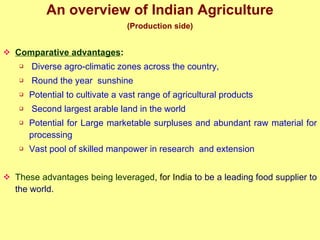
An overview of Indian Agriculture (Production side) Comparative advantages : Diverse agro-climatic zones across the country, Round the year  sunshine Potential to cultivate a vast range of agricultural products Second largest arable land in the world Potential for Large marketable surpluses and abundant raw material for processing  Vast pool of skilled manpower in research  and extension These advantages being leveraged , for India  to be a leading food supplier to the world.
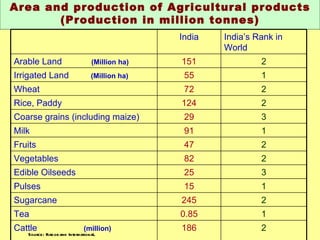
Area and production of Agricultural products (Production in million tonnes) Source: Rabobank Internationa l India India’s Rank in World  Arable Land  (Million ha) 151 2 Irrigated Land  (Million ha) 55 1 Wheat 72 2 Rice, Paddy 124 2 Coarse grains (including maize) 29 3 Milk 91 1 Fruits 47 2 Vegetables 82 2 Edible Oilseeds 25 3 Pulses 15 1 Sugarcane 245 2 Tea 0.85 1 Cattle  (million) 186 2
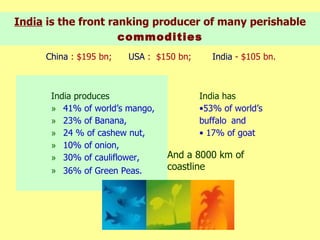
India  is the front ranking producer of many perishable  commodities India produces   41% of world’s mango, 23% of Banana,  24 % of cashew nut,  10% of onion,  30% of cauliflower, 36% of Green Peas.   China  : $195 bn;  USA  :  $150 bn;    India  - $105 bn. India has   53% of world’s buffalo  and 17% of goat And a 8000 km of coastline
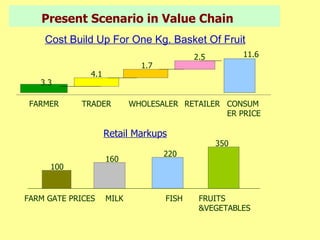
Present Scenario in Value Chain  Cost Build Up For One Kg. Basket Of Fruit   2.5 11.6 FARMER TRADER WHOLESALER RETAILER CONSUMER PRICE 3.3 4.1 1.7 Retail Markups FARM GATE PRICES MILK FISH FRUITS &VEGETABLES 350 220 160 100
Domestic Market Scenario…... Production may be insufficient if domestic markets all over the country targeted efficiently & effectively. Market prices are satisfactory Mango, Grapes, Apples, Pineapples, Pomegranates, Litchis can be sold out in the country itself because of the production in limited orchards & demand in whole country. Markets in the rural & semi urban(around 60-65%) should also be tapped along with Metros or big cities(around 12-15%)
International Markets : Trends Steady increase in global production of fresh produce. Balance of power shifting to retail chains from suppliers Food safety standards are higher & more complex requirements. Demanding regulations Increasing intensity of technology Consumption is convenience-driven. i.e. Value added products. Increasing health concerns reflected in food consummations.   - Organic, functional, herbal.
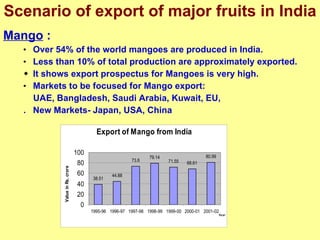
Scenario of export of major fruits in India Mango  : Over 54% of the world mangoes are produced in India. Less than 10% of total production are approximately exported.  It shows export prospectus for Mangoes is very high. Markets to be focused for Mango export: UAE, Bangladesh, Saudi Arabia, Kuwait, EU,  . New Markets- Japan, USA, China
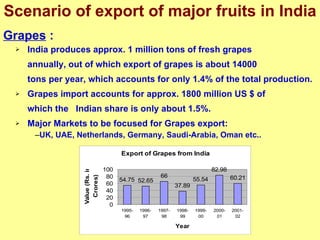
Scenario of export of major fruits in India Grapes  : India produces approx. 1 million tons of fresh grapes  annually, out of which export of grapes is about 14000  tons per year, which accounts for only 1.4% of the total production. Grapes import accounts for approx. 1800 million US $ of  which the  Indian share is only about 1.5%. Major Markets to be focused for Grapes export: UK, UAE, Netherlands, Germany, Saudi-Arabia, Oman etc..
Scenario of export of major fruits in India Banana  : First in production of Banana in the world. (Around 22% of world’s total output). However, the export from India is negligible. Reasons:  Non availability of on-farm packing house, precooling and cold storage facilities. Improper pre-harvest practices. Improper post harvest handling. Major Markets to be tapped for Banana export: UAE, Saudi-Arabia, Qatar, Oman, Kuwait, Bahrain etc.
Scenario of export of major fruits in India Pomegranate  :  Europe, UAE, Saudi-Arabia, Kuwait, Oman   Apples  :  Bangladesh, Belgium,Singapore, Srilanka, UK,  Malaysia etc.  Citrus Fruits:  (Oranges, Mandarins, Lemons, Limes etc.)   Bangladesh, UAE, Oman etc. Pineapples:  UAE,Saudi Arabia, UK etc . Other fruits for export: Papaya, Sapota, Strawberries,Litchis etc.
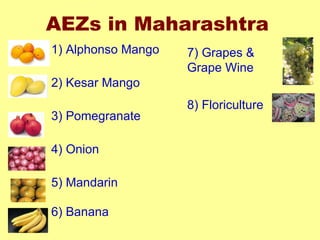
AEZs in Maharashtra 1) Alphonso Mango 2) Kesar Mango  3) Pomegranate 4) Onion 5) Mandarin 6) Banana 7) Grapes &  Grape Wine 8) Floriculture
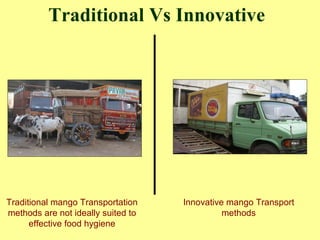
Traditional Vs Innovative Traditional mango Transportation methods are not ideally suited to effective food hygiene Innovative mango Transport methods
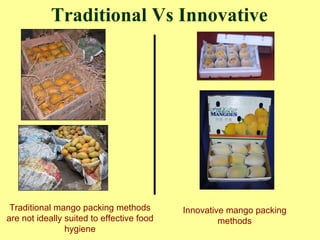
Traditional Vs Innovative Traditional mango packing methods are not ideally suited to effective food hygiene Innovative mango packing methods
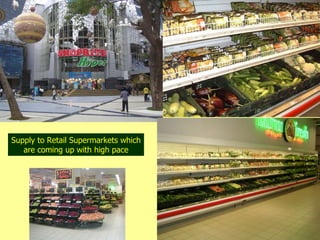
Supply to Retail Supermarkets which are coming up with high pace
Where are lacunae ?   Fragmented land holding Very poor backward and forward linkages Poor infrastructure Lack of post harvest Technology Poor logistics Supply Chain Management missing
Supply Chain Management End use based production Contract cultivation Captive cultivation Cluster approach in cultivation Supply just in time-production logistics Quality production Post harvest technology application Scientific storage
End use based production Local market for table purpose Long distance market within country As raw material for processing and for definite product manufacture Produce what market / consumer wants
Competitiveness Key issues in supply chain………. Global and local competitiveness Quality competitiveness Cost competitiveness
Quality Competitiveness Variety Controlling quality during growth Harvesting and Maturity standards Post harvest handling Post harvest treatments Packaging and storage Safety and Hygiene Traceability
Quality production Variety Season Horticultural practices Integrated water, nutrient, pest and disease, weed management Training/prunning Growth regulators Organic cultivation Harvesting methods/maturity standards
Cost competitiveness Cost of production Productivity By-product and waste utilization Off season production Marketing logistics Value addition Presentation in market
Supply Just in Time – logistics Determine what buyer wants?- Variety, Quality, Stage of maturity Determine when he wants?- Frequency Determine how much he wants?- Quantity, Lot size, Duration Determine how he wants?- Grading, Packaging, Transport mechanisms Determine where he wants?- at farm, Port
Service providers  Aggregators Logistic support Cold chain Warehousing Port handling Credit facilitators IT related services
THANK YOU

Fruit veg

  • 1.
    Development of SupplyChain for Fruit and Vegetable Industry Dr. D. N. Kulkarni President – Agri Food Jain Irrigation [email_address]
  • 2.
    An overview ofIndian Agriculture (Production side) Comparative advantages : Diverse agro-climatic zones across the country, Round the year sunshine Potential to cultivate a vast range of agricultural products Second largest arable land in the world Potential for Large marketable surpluses and abundant raw material for processing Vast pool of skilled manpower in research and extension These advantages being leveraged , for India to be a leading food supplier to the world.
  • 3.
    Area and productionof Agricultural products (Production in million tonnes) Source: Rabobank Internationa l India India’s Rank in World Arable Land (Million ha) 151 2 Irrigated Land (Million ha) 55 1 Wheat 72 2 Rice, Paddy 124 2 Coarse grains (including maize) 29 3 Milk 91 1 Fruits 47 2 Vegetables 82 2 Edible Oilseeds 25 3 Pulses 15 1 Sugarcane 245 2 Tea 0.85 1 Cattle (million) 186 2
  • 4.
    India isthe front ranking producer of many perishable commodities India produces 41% of world’s mango, 23% of Banana, 24 % of cashew nut, 10% of onion, 30% of cauliflower, 36% of Green Peas. China : $195 bn; USA : $150 bn; India - $105 bn. India has 53% of world’s buffalo and 17% of goat And a 8000 km of coastline
  • 5.
    Present Scenario inValue Chain Cost Build Up For One Kg. Basket Of Fruit 2.5 11.6 FARMER TRADER WHOLESALER RETAILER CONSUMER PRICE 3.3 4.1 1.7 Retail Markups FARM GATE PRICES MILK FISH FRUITS &VEGETABLES 350 220 160 100
  • 6.
    Domestic Market Scenario…...Production may be insufficient if domestic markets all over the country targeted efficiently & effectively. Market prices are satisfactory Mango, Grapes, Apples, Pineapples, Pomegranates, Litchis can be sold out in the country itself because of the production in limited orchards & demand in whole country. Markets in the rural & semi urban(around 60-65%) should also be tapped along with Metros or big cities(around 12-15%)
  • 7.
    International Markets :Trends Steady increase in global production of fresh produce. Balance of power shifting to retail chains from suppliers Food safety standards are higher & more complex requirements. Demanding regulations Increasing intensity of technology Consumption is convenience-driven. i.e. Value added products. Increasing health concerns reflected in food consummations. - Organic, functional, herbal.
  • 8.
    Scenario of exportof major fruits in India Mango : Over 54% of the world mangoes are produced in India. Less than 10% of total production are approximately exported. It shows export prospectus for Mangoes is very high. Markets to be focused for Mango export: UAE, Bangladesh, Saudi Arabia, Kuwait, EU, . New Markets- Japan, USA, China
  • 9.
    Scenario of exportof major fruits in India Grapes : India produces approx. 1 million tons of fresh grapes annually, out of which export of grapes is about 14000 tons per year, which accounts for only 1.4% of the total production. Grapes import accounts for approx. 1800 million US $ of which the Indian share is only about 1.5%. Major Markets to be focused for Grapes export: UK, UAE, Netherlands, Germany, Saudi-Arabia, Oman etc..
  • 10.
    Scenario of exportof major fruits in India Banana : First in production of Banana in the world. (Around 22% of world’s total output). However, the export from India is negligible. Reasons: Non availability of on-farm packing house, precooling and cold storage facilities. Improper pre-harvest practices. Improper post harvest handling. Major Markets to be tapped for Banana export: UAE, Saudi-Arabia, Qatar, Oman, Kuwait, Bahrain etc.
  • 11.
    Scenario of exportof major fruits in India Pomegranate : Europe, UAE, Saudi-Arabia, Kuwait, Oman Apples : Bangladesh, Belgium,Singapore, Srilanka, UK, Malaysia etc. Citrus Fruits: (Oranges, Mandarins, Lemons, Limes etc.) Bangladesh, UAE, Oman etc. Pineapples: UAE,Saudi Arabia, UK etc . Other fruits for export: Papaya, Sapota, Strawberries,Litchis etc.
  • 12.
    AEZs in Maharashtra1) Alphonso Mango 2) Kesar Mango 3) Pomegranate 4) Onion 5) Mandarin 6) Banana 7) Grapes & Grape Wine 8) Floriculture
  • 13.
    Traditional Vs InnovativeTraditional mango Transportation methods are not ideally suited to effective food hygiene Innovative mango Transport methods
  • 14.
    Traditional Vs InnovativeTraditional mango packing methods are not ideally suited to effective food hygiene Innovative mango packing methods
  • 15.
    Supply to RetailSupermarkets which are coming up with high pace
  • 16.
    Where are lacunae? Fragmented land holding Very poor backward and forward linkages Poor infrastructure Lack of post harvest Technology Poor logistics Supply Chain Management missing
  • 17.
    Supply Chain ManagementEnd use based production Contract cultivation Captive cultivation Cluster approach in cultivation Supply just in time-production logistics Quality production Post harvest technology application Scientific storage
  • 18.
    End use basedproduction Local market for table purpose Long distance market within country As raw material for processing and for definite product manufacture Produce what market / consumer wants
  • 19.
    Competitiveness Key issuesin supply chain………. Global and local competitiveness Quality competitiveness Cost competitiveness
  • 20.
    Quality Competitiveness VarietyControlling quality during growth Harvesting and Maturity standards Post harvest handling Post harvest treatments Packaging and storage Safety and Hygiene Traceability
  • 21.
    Quality production VarietySeason Horticultural practices Integrated water, nutrient, pest and disease, weed management Training/prunning Growth regulators Organic cultivation Harvesting methods/maturity standards
  • 22.
    Cost competitiveness Costof production Productivity By-product and waste utilization Off season production Marketing logistics Value addition Presentation in market
  • 23.
    Supply Just inTime – logistics Determine what buyer wants?- Variety, Quality, Stage of maturity Determine when he wants?- Frequency Determine how much he wants?- Quantity, Lot size, Duration Determine how he wants?- Grading, Packaging, Transport mechanisms Determine where he wants?- at farm, Port
  • 24.
    Service providers Aggregators Logistic support Cold chain Warehousing Port handling Credit facilitators IT related services
  • 25.