
Realizing sustainable agricultural mechanisation
African Conservation Tillage Network
By:
1 December 2017
Conservation Agriculture
Cover Crops
A PERMANENT YEAR-ROUND soil cover is central to conservation agriculture
NEVER WITHOUT COVER
Realizing sustainable agricultural mechanisation
Contents
1.Importance of cover crops in CA systems
2.Selecting the right cover crops
3.A simplified guide for screening of legume cover crop
4.Management/handling practices for legume cover crops
5.Potential cover crops for Namibia
6.Non-legume cover Crops
7.Multi-purpose fodder tress
8.Potential Legume Cover and Companion Crop Systems for Namibia
9.Challenges to the adoption of cover crops
Realizing sustainable agricultural mechanisation
Remember:
Soil cover is important for several reasons
1. It protects the soil from rain, sun, and wind.
2. It reduces soil erosion and protects the fertile topsoil, so preventing
the silting of rivers and lakes.
3. It stops the soil surface from sealing, and reduces the amount of
precious rainwater that runs off.
4. It suppresses weeds by smothering their growth and reducing the
number of weed seeds. This reduces the amount of work needed for
weeding.
Realizing sustainable agricultural mechanisation
1. It increases soil moisture by allowing more water to sink into the
ground and by reducing evaporation.
2. Decomposing vegetation and the roots of cover crops improve the
soil structure and make the clumps and lumps in the soil more stable –
making it harder for rain to break them up and wash them away.
3. Earthworms and other forms of life can prosper in the cover as well
as in the soil.
4. Soil cover stimulates the development of roots, which in turn improve
the soil structure, allow more water to soak into the soil, and reduce the
amount that runs off.
Realizing sustainable agricultural mechanisation
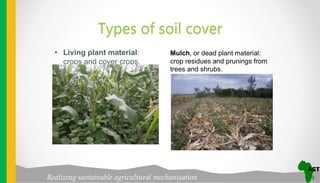
Types of soil cover
• Living plant material:
crops and cover crops.
Mulch, or dead plant material:
crop residues and prunings from
trees and shrubs.
Realizing sustainable agricultural mechanisation
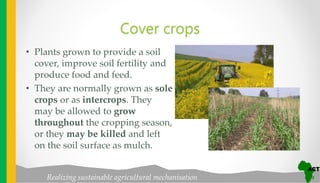
Cover crops
• Plants grown to provide a soil
cover, improve soil fertility and
produce food and feed.
• They are normally grown as sole
crops or as intercrops. They
may be allowed to grow
throughout the cropping season,
or they may be killed and left
on the soil surface as mulch.
Realizing sustainable agricultural mechanisation
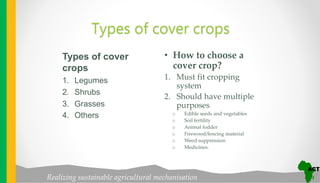
Types of cover crops
Types of cover
crops
1. Legumes
2. Shrubs
3. Grasses
4. Others
• How to choose a
cover crop?
1. Must fit cropping
system
2. Should have multiple
purposes
o Edible seeds and vegetables
o Soil fertility
o Animal fodder
o Firewood/fencing material
o Weed suppression
o Medicines.
Realizing sustainable agricultural mechanisation
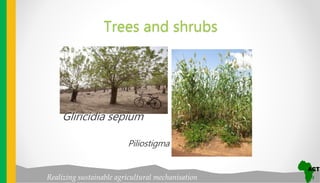
Trees and shrubs
Gliricidia sepium
Piliostigma
Realizing sustainable agricultural mechanisation
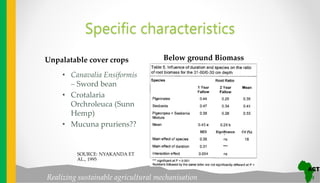
Specific characteristics
Unpalatable cover crops
• Canavalia Ensiformis
– Sword bean
• Crotalaria
Orchroleuca (Sunn
Hemp)
• Mucuna pruriens??
Below ground Biomass
SOURCE: NYAKANDA ET
AL., 1995
Realizing sustainable agricultural mechanisation
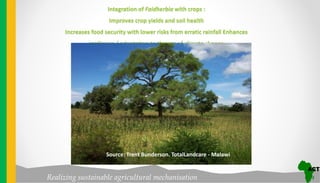
Integration of Faidherbia with crops :
Improves crop yields and soil health
Increases food security with lower risks from erratic rainfall Enhances
resilience / adaptation to threats of climate change
Source: Trent Bunderson. TotalLandcare - Malawi
Realizing sustainable agricultural mechanisation
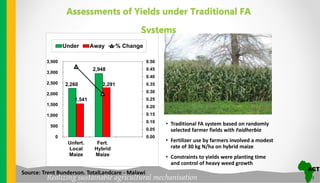
Assessments of Yields under Traditional FA
Systems
2,260
2,948
1,541
2,291
0.00
0.05
0.10
0.15
0.20
0.25
0.30
0.35
0.40
0.45
0.50
0
500
1,000
1,500
2,000
2,500
3,000
3,500
Unfert.
Local
Maize
Fert.
Hybrid
Maize
Under Away % Change
• Traditional FA system based on randomly
selected farmer fields with Faidherbia
• Fertilizer use by farmers involved a modest
rate of 30 kg N/ha on hybrid maize
• Constraints to yields were planting time
and control of heavy weed growth
Source: Trent Bunderson. TotalLandcare - Malawi
Realizing sustainable agricultural mechanisation
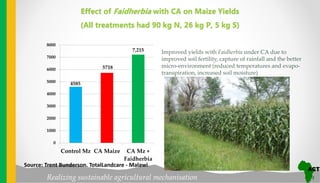
Effect of Faidherbia with CA on Maize Yields
(All treatments had 90 kg N, 26 kg P, 5 kg S)
Improved yields with Faidherbia under CA due to
improved soil fertility, capture of rainfall and the better
micro-environment (reduced temperatures and evapo-
transpiration, increased soil moisture)
4585
5718
7,215
0
1000
2000
3000
4000
5000
6000
7000
8000
Control Mz CA Maize CA Mz +
Faidherbia
Source: Trent Bunderson. TotalLandcare - Malawi
Realizing sustainable agricultural mechanisation
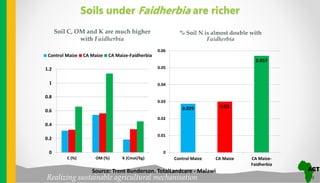
Soils under Faidherbia are richer
Soil C, OM and K are much higher
with Faidherbia
% Soil N is almost double with
Faidherbia
0
0.2
0.4
0.6
0.8
1
1.2
C (%) OM (%) K (Cmol/Kg)
Control Maize CA Maize CA Maize-Faidherbia
0.029 0.03
0.057
0
0.01
0.02
0.03
0.04
0.05
0.06
Control Maize CA Maize CA Maize-
Faidherbia
Source: Trent Bunderson. TotalLandcare - Malawi
Realizing sustainable agricultural mechanisation
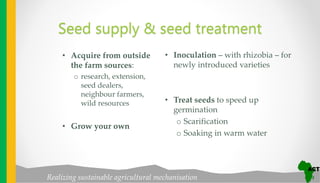
Seed supply & seed treatment
• Acquire from outside
the farm sources:
o research, extension,
seed dealers,
neighbour farmers,
wild resources
• Grow your own
• Inoculation – with rhizobia – for
newly introduced varieties
• Treat seeds to speed up
germination
o Scarification
o Soaking in warm water
Realizing sustainable agricultural mechanisation
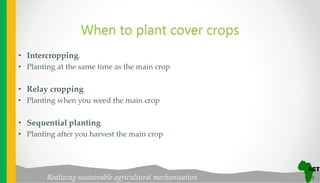
When to plant cover crops
• Intercropping.
• Planting at the same time as the main crop
• Relay cropping
• Planting when you weed the main crop
• Sequential planting
• Planting after you harvest the main crop
Realizing sustainable agricultural mechanisation
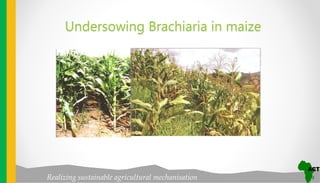
Undersowing Brachiaria in maize
Realizing sustainable agricultural mechanisation
How to plant cover crops?
1. As intercrop, relay crop or pure stand
2. For large seeds: plant with a hand hoe, jab planter or animal drawn direct
planter
3. For small seeds (such as finger millet): You can broadcast (provided the soil
cover is not too thick), or sow the seeds in lines by hand or use a seed drill.
4. Determine plant spacing and number of seeds per hole depend on several
factors:
o Use a narrower spacing in pure stands, and a wider spacing in mixed (intercropped) stands.
o Use a wider spacing in drier areas, so the plants don’t compete with each other for moisture.
o The number of seeds per hole depends on the amount of moisture available: fewer seeds per
hole in dry areas; more in wetter areas. In general, plant 2–4 seeds per hole.
Realizing sustainable agricultural mechanisation
Challenges of Cover Crops
1. Require a higher management level
2. Decomposition of cover crops can
lead to immobilization of nitrogen at
the beginning of the growing season
• Cover crops badly managed:
1. Interferes with seeding and fertilizing
activities
2. Hinders the emergence of seedlings
3. Allows weed species to emerge
Realizing sustainable agricultural mechanisation
Adequately managed:
• Adds organic matter
• Retains carbon in the soil and feeds carbon cycle in the soil
• Buffers pH and facilitates availability of nutrients
• Captures rainfall and protects the soil
• Reduces evaporation and increases soil moisture content
Realizing sustainable agricultural mechanisation
Review Questions
1. Which soil cover crops are known, used and eaten by farmers in
your community? How did they perform?
2. Which pastures or leguminous plants is there a good market
for?
Realizing sustainable agricultural mechanisation
Our Contacts
THANK YOU FOR LISTENING
Website: www.act-africa.org
Email: info@act-africa.org
Twitter: www.twitter.com/ACTillage

Conservation agriculture cover crops

  • 1.
    Realizing sustainable agriculturalmechanisation African Conservation Tillage Network By: 1 December 2017 Conservation Agriculture Cover Crops A PERMANENT YEAR-ROUND soil cover is central to conservation agriculture NEVER WITHOUT COVER
  • 2.
    Realizing sustainable agriculturalmechanisation Contents 1.Importance of cover crops in CA systems 2.Selecting the right cover crops 3.A simplified guide for screening of legume cover crop 4.Management/handling practices for legume cover crops 5.Potential cover crops for Namibia 6.Non-legume cover Crops 7.Multi-purpose fodder tress 8.Potential Legume Cover and Companion Crop Systems for Namibia 9.Challenges to the adoption of cover crops
  • 3.
    Realizing sustainable agriculturalmechanisation Remember: Soil cover is important for several reasons 1. It protects the soil from rain, sun, and wind. 2. It reduces soil erosion and protects the fertile topsoil, so preventing the silting of rivers and lakes. 3. It stops the soil surface from sealing, and reduces the amount of precious rainwater that runs off. 4. It suppresses weeds by smothering their growth and reducing the number of weed seeds. This reduces the amount of work needed for weeding.
  • 4.
    Realizing sustainable agriculturalmechanisation 1. It increases soil moisture by allowing more water to sink into the ground and by reducing evaporation. 2. Decomposing vegetation and the roots of cover crops improve the soil structure and make the clumps and lumps in the soil more stable – making it harder for rain to break them up and wash them away. 3. Earthworms and other forms of life can prosper in the cover as well as in the soil. 4. Soil cover stimulates the development of roots, which in turn improve the soil structure, allow more water to soak into the soil, and reduce the amount that runs off.
  • 5.
    Realizing sustainable agriculturalmechanisation Types of soil cover • Living plant material: crops and cover crops. Mulch, or dead plant material: crop residues and prunings from trees and shrubs.
  • 6.
    Realizing sustainable agriculturalmechanisation Cover crops • Plants grown to provide a soil cover, improve soil fertility and produce food and feed. • They are normally grown as sole crops or as intercrops. They may be allowed to grow throughout the cropping season, or they may be killed and left on the soil surface as mulch.
  • 7.
    Realizing sustainable agriculturalmechanisation Types of cover crops Types of cover crops 1. Legumes 2. Shrubs 3. Grasses 4. Others • How to choose a cover crop? 1. Must fit cropping system 2. Should have multiple purposes o Edible seeds and vegetables o Soil fertility o Animal fodder o Firewood/fencing material o Weed suppression o Medicines.
  • 8.
    Realizing sustainable agriculturalmechanisation Trees and shrubs Gliricidia sepium Piliostigma
  • 9.
    Realizing sustainable agriculturalmechanisation Specific characteristics Unpalatable cover crops • Canavalia Ensiformis – Sword bean • Crotalaria Orchroleuca (Sunn Hemp) • Mucuna pruriens?? Below ground Biomass SOURCE: NYAKANDA ET AL., 1995
  • 10.
    Realizing sustainable agriculturalmechanisation Integration of Faidherbia with crops : Improves crop yields and soil health Increases food security with lower risks from erratic rainfall Enhances resilience / adaptation to threats of climate change Source: Trent Bunderson. TotalLandcare - Malawi
  • 11.
    Realizing sustainable agriculturalmechanisation Assessments of Yields under Traditional FA Systems 2,260 2,948 1,541 2,291 0.00 0.05 0.10 0.15 0.20 0.25 0.30 0.35 0.40 0.45 0.50 0 500 1,000 1,500 2,000 2,500 3,000 3,500 Unfert. Local Maize Fert. Hybrid Maize Under Away % Change • Traditional FA system based on randomly selected farmer fields with Faidherbia • Fertilizer use by farmers involved a modest rate of 30 kg N/ha on hybrid maize • Constraints to yields were planting time and control of heavy weed growth Source: Trent Bunderson. TotalLandcare - Malawi
  • 12.
    Realizing sustainable agriculturalmechanisation Effect of Faidherbia with CA on Maize Yields (All treatments had 90 kg N, 26 kg P, 5 kg S) Improved yields with Faidherbia under CA due to improved soil fertility, capture of rainfall and the better micro-environment (reduced temperatures and evapo- transpiration, increased soil moisture) 4585 5718 7,215 0 1000 2000 3000 4000 5000 6000 7000 8000 Control Mz CA Maize CA Mz + Faidherbia Source: Trent Bunderson. TotalLandcare - Malawi
  • 13.
    Realizing sustainable agriculturalmechanisation Soils under Faidherbia are richer Soil C, OM and K are much higher with Faidherbia % Soil N is almost double with Faidherbia 0 0.2 0.4 0.6 0.8 1 1.2 C (%) OM (%) K (Cmol/Kg) Control Maize CA Maize CA Maize-Faidherbia 0.029 0.03 0.057 0 0.01 0.02 0.03 0.04 0.05 0.06 Control Maize CA Maize CA Maize- Faidherbia Source: Trent Bunderson. TotalLandcare - Malawi
  • 14.
    Realizing sustainable agriculturalmechanisation Seed supply & seed treatment • Acquire from outside the farm sources: o research, extension, seed dealers, neighbour farmers, wild resources • Grow your own • Inoculation – with rhizobia – for newly introduced varieties • Treat seeds to speed up germination o Scarification o Soaking in warm water
  • 15.
    Realizing sustainable agriculturalmechanisation When to plant cover crops • Intercropping. • Planting at the same time as the main crop • Relay cropping • Planting when you weed the main crop • Sequential planting • Planting after you harvest the main crop
  • 16.
    Realizing sustainable agriculturalmechanisation Undersowing Brachiaria in maize
  • 17.
    Realizing sustainable agriculturalmechanisation How to plant cover crops? 1. As intercrop, relay crop or pure stand 2. For large seeds: plant with a hand hoe, jab planter or animal drawn direct planter 3. For small seeds (such as finger millet): You can broadcast (provided the soil cover is not too thick), or sow the seeds in lines by hand or use a seed drill. 4. Determine plant spacing and number of seeds per hole depend on several factors: o Use a narrower spacing in pure stands, and a wider spacing in mixed (intercropped) stands. o Use a wider spacing in drier areas, so the plants don’t compete with each other for moisture. o The number of seeds per hole depends on the amount of moisture available: fewer seeds per hole in dry areas; more in wetter areas. In general, plant 2–4 seeds per hole.
  • 18.
    Realizing sustainable agriculturalmechanisation Challenges of Cover Crops 1. Require a higher management level 2. Decomposition of cover crops can lead to immobilization of nitrogen at the beginning of the growing season • Cover crops badly managed: 1. Interferes with seeding and fertilizing activities 2. Hinders the emergence of seedlings 3. Allows weed species to emerge
  • 19.
    Realizing sustainable agriculturalmechanisation Adequately managed: • Adds organic matter • Retains carbon in the soil and feeds carbon cycle in the soil • Buffers pH and facilitates availability of nutrients • Captures rainfall and protects the soil • Reduces evaporation and increases soil moisture content
  • 20.
    Realizing sustainable agriculturalmechanisation Review Questions 1. Which soil cover crops are known, used and eaten by farmers in your community? How did they perform? 2. Which pastures or leguminous plants is there a good market for?
  • 21.
    Realizing sustainable agriculturalmechanisation Our Contacts THANK YOU FOR LISTENING Website: www.act-africa.org Email: info@act-africa.org Twitter: www.twitter.com/ACTillage