PRESENTING TEAM
2/23/2017 2
B.Sc. (Hons.) AGRICULTURE BATCH-13 GROUP-04
SEED SECTOR
SEED A CRUCIAL AGRI-INPUT
• Seed is the basic and crucial input for successful crop production,
which holds the key to the farm productivity and profitability.
• The advent of modern plant breeding and technology advances in
seed industry has played a significant role in evolution of high
yielding varieties and hybrids.
• The principles of introduction, selection, heterosis, use of
Cytoplasmic male sterility, self incompatibility and genetic
engineering has been exploited in developing new varieties and
hybrids by the plant breeder and thus this sudden change have
brought and contributed to green revolution in early sixties in the
world.
• It is estimated that good quality seeds of improved varieties can
contribute about of 20-25 percent increase in production. Thus
good quality seeds are seeds of green revolution.
2/23/2017 3
B.Sc. (Hons.) AGRICULTURE BATCH-13 GROUP-04
SEED SECTOR
SEED DEFINATION
 Seed is defined as
• A ripened ovule or a fertilized matured ovule containing embryo
which has developed after fertilization.
• Any part (or) organ of plant which has the capability to regenerate
into a new plant
• A propagule responsible for maintaining the intrinsic (or) genetic
qualities of the variety / hybrid.
• An ‘embryo’, a living organism embedded in the supporting (or)
the food storage tissue and a protective coat.
• Any propagative material.
• Carrier of service material.
• However, the widely accepted definition for A seed is matured
ovule that consisting of an embryonic plant together with a store of
food, all surrounded by a protective coat.
2/23/2017 4
B.Sc. (Hons.) AGRICULTURE BATCH-13 GROUP-04
SEED SECTOR
2/23/2017
B.Sc. (Hons.) AGRICULTURE BATCH-13
GROUP-04 SEED
SECTOR
5
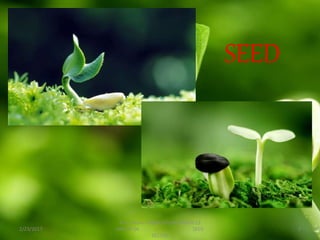
SEED
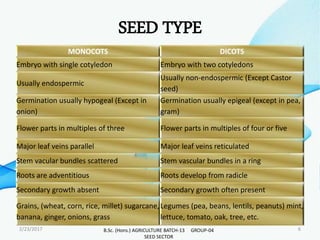
SEED TYPE
MONOCOTS DICOTS
Embryo with single cotyledon Embryo with two cotyledons
Usually endospermic
Usually non-endospermic (Except Castor
seed)
Germination usually hypogeal (Except in
onion)
Germination usually epigeal (except in pea,
gram)
Flower parts in multiples of three Flower parts in multiples of four or five
Major leaf veins parallel Major leaf veins reticulated
Stem vacular bundles scattered Stem vascular bundles in a ring
Roots are adventitious Roots develop from radicle
Secondary growth absent Secondary growth often present
Grains, (wheat, corn, rice, millet) sugarcane,
banana, ginger, onions, grass
Legumes (pea, beans, lentils, peanuts) mint,
lettuce, tomato, oak, tree, etc.
2/23/2017 6B.Sc. (Hons.) AGRICULTURE BATCH-13 GROUP-04
SEED SECTOR
SEED TYPE
1.Epigeal Germination
• The cotyledons come out above the soil
surface and generally turn green and act as
first foliage leaves. This type of germination
present in groundnut, bean, cotton, sunflower
and cotton seeds.
2/23/2017 7
B.Sc. (Hons.) AGRICULTURE BATCH-13 GROUP-04
SEED SECTOR
SEED TYPE
2.Hypogeal Germination
• The cotyledons do not come above the soil
surface. This type of germination is found in
wheat, barley, maize and pea.
2/23/2017 8
B.Sc. (Hons.) AGRICULTURE BATCH-13 GROUP-04
SEED SECTOR
SEED TYPE
On the basis of Viability
Orthodox Seeds
 Judean date, Palm seed
Recalcitrant seeds
 Mango, Cocoa and Rubber Seeds
2/23/2017 9
B.Sc. (Hons.) AGRICULTURE BATCH-13 GROUP-04
SEED SECTOR
2/23/2017
B.Sc. (Hons.) AGRICULTURE BATCH-13
GROUP-04 SEED
SECTOR
10
SEED
INDUSTRY
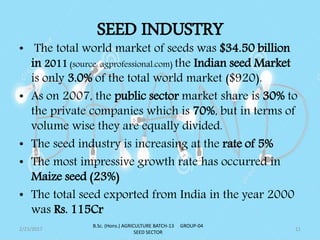
SEED INDUSTRY
• The total world market of seeds was $34.50 billion
in 2011 (source: agprofessional.com) the Indian seed Market
is only 3.0% of the total world market ($920).
• As on 2007, the public sector market share is 30% to
the private companies which is 70%, but in terms of
volume wise they are equally divided.
• The seed industry is increasing at the rate of 5%
• The most impressive growth rate has occurred in
Maize seed (23%)
• The total seed exported from India in the year 2000
was Rs. 115Cr
2/23/2017 11
B.Sc. (Hons.) AGRICULTURE BATCH-13 GROUP-04
SEED SECTOR
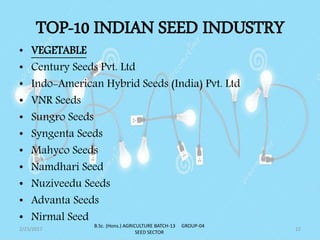
TOP-10 INDIAN SEED INDUSTRY
• VEGETABLE
• Century Seeds Pvt. Ltd
• Indo-American Hybrid Seeds (India) Pvt. Ltd
• VNR Seeds
• Sungro Seeds
• Syngenta Seeds
• Mahyco Seeds
• Namdhari Seed
• Nuziveedu Seeds
• Advanta Seeds
• Nirmal Seed
2/23/2017 12
B.Sc. (Hons.) AGRICULTURE BATCH-13 GROUP-04
SEED SECTOR
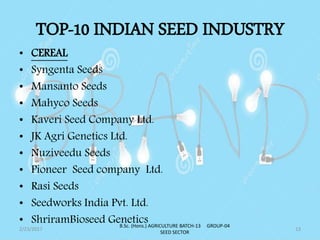
TOP-10 INDIAN SEED INDUSTRY
• CEREAL
• Syngenta Seeds
• Mansanto Seeds
• Mahyco Seeds
• Kaveri Seed Company Ltd.
• JK Agri Genetics Ltd.
• Nuziveedu Seeds
• Pioneer Seed company Ltd.
• Rasi Seeds
• Seedworks India Pvt. Ltd.
• ShriramBioseed Genetics
2/23/2017 13
B.Sc. (Hons.) AGRICULTURE BATCH-13 GROUP-04
SEED SECTOR
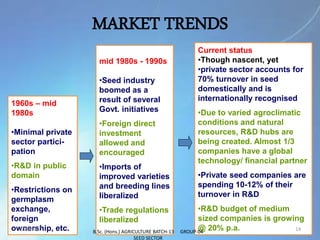
MARKET TRENDS
1960s – mid
1980s
•Minimal private
sector partici-
pation
•R&D in public
domain
•Restrictions on
germplasm
exchange,
foreign
ownership, etc.
mid 1980s - 1990s
•Seed industry
boomed as a
result of several
Govt. initiatives
•Foreign direct
investment
allowed and
encouraged
•Imports of
improved varieties
and breeding lines
liberalized
•Trade regulations
liberalized
Current status
•Though nascent, yet
•private sector accounts for
70% turnover in seed
domestically and is
internationally recognised
•Due to varied agroclimatic
conditions and natural
resources, R&D hubs are
being created. Almost 1/3
companies have a global
technology/ financial partner
•Private seed companies are
spending 10-12% of their
turnover in R&D
•R&D budget of medium
sized companies is growing
@ 20% p.a.2/23/2017 14B.Sc. (Hons.) AGRICULTURE BATCH-13 GROUP-04
SEED SECTOR
MARKET CHALLENGES
• Increase in the number of seed companies
• Highly competitive markets
• Long production lead-time
• Concentrated seasonal selling period
• Product line is perishable
• Strict regulatory production
• Quality assurance systems
• Vulnerable to environmental stresses
• Development and registration of new products is often a
long process
• Customers are diverse
• Have a wide range of product requirements
2/23/2017 15
B.Sc. (Hons.) AGRICULTURE BATCH-13 GROUP-04
SEED SECTOR
MARKET CHALLENGES
• Long-term cash flow
• Inventory management
• Seed production, Processing and quality assurance
• Market knowledge application
• Product evaluation and development
2/23/2017 16
B.Sc. (Hons.) AGRICULTURE BATCH-13 GROUP-04
SEED SECTOR
2/23/2017
B.Sc. (Hons.) AGRICULTURE BATCH-13
GROUP-04 SEED
SECTOR
17
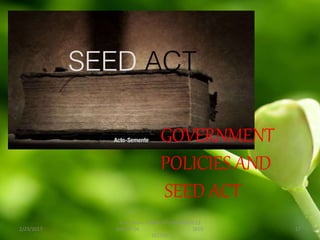
GOVERNMENT
POLICIES AND
SEED ACT
Government Policies in Seed
Industry
• National Seed Policy & Act
• Enactment of the Seeds Act, 1966
• The Act come into force throughout the country on 2
October 1969
• Seed Review Team-SRT (1968)
• National Commission on Agriculture’s Seed Group (1972)
• Launching of the World Bank aided National Seeds
Programme (1975-85) in three phases leading to the
creation of State Seeds Corporations, State Seed
Certification Agencies, State Seed Testing Laboratories,
Breeder Seed Programmes etc.
• Seed Control Order (1983)
2/23/2017 18
B.Sc. (Hons.) AGRICULTURE BATCH-13 GROUP-04
SEED SECTOR
Government Policies in Seed
Industry
• Creation of the Technology Mission on Oilseeds & Pulses
(TMOP) in 1986 now called The Integrated Scheme of
Oilseeds, Pulses, Oil Palm and Maize (ISOPOM).
• Seed Transport Subsidy Scheme (1987)
• New Policy on Seed Development (1988)
• Seed Bank Scheme (2000)
• National Seeds Policy (2002)
• The Seeds Bill (2004)
• Formulation of National Seed Plan (2005)
• National Food Security Mission (2007)
• RashtriyaKrishiVikasYojna (2007)
2/23/2017 19
B.Sc. (Hons.) AGRICULTURE BATCH-13 GROUP-04
SEED SECTOR
SEED (CONTROL) ORDER
• Seed (Control) order was issued in 1983.
• Its main features are :
• Seed Controller
• Issue of License to Dealers
• Renewal of License
• Appointment of Licensing Authority
• Time limit for analysis of samples by Seed Testing
Laboratory
• Suspension or Cancellation of License and
• Appeal
• The Plants, Fruits, and Seeds Order was issued in 1989
2/23/2017 20
B.Sc. (Hons.) AGRICULTURE BATCH-13 GROUP-04
SEED SECTOR
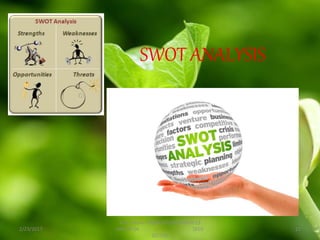
SWOT ANALYSIS
2/23/2017
B.Sc. (Hons.) AGRICULTURE BATCH-13
GROUP-04 SEED
SECTOR
21
SWOT Analysis
Strengths
• A well developed and knitted seed multiplication and
distribution systems linked with several ICAR institutes /
SAUs / NSC / SFCI etc.
• A network of 20 seed certification agencies and more than
96 notified seed testing laboratories to legally assure the
quality seeds moving in the seed market.
• A large number of varieties in different vegetable crops are
available suited to varied agro climatic conditions. This
makes the selection easier for taking up production in a
particular area.
2/23/2017 22
B.Sc. (Hons.) AGRICULTURE BATCH-13 GROUP-04
SEED SECTOR
SWOT Analysis
Strengths
• Our county is bestowed with varied agro climatic
conditions, which can be exploited for taking up seed
production of vegetables at any time of the year in one or
other past of the country.
• A very fast development of private seed companies which
are helpful in bridging. The gap between demand and
supply of vegetable seeds in the country.
2/23/2017 23
B.Sc. (Hons.) AGRICULTURE BATCH-13 GROUP-04
SEED SECTOR
SWOT Analysis
Weaknesses
• Vegetable seed production in the country has been
vulnerable to vagaries of weather resulting in production
of poor quality seeds.
• Availability of realistic data on actual area under vegetable
and requirements of vegetable seeds is inappropriate.
• Maintenance of isolation distance. Since in our system
there is no restriction for planting any particular vegetable
crops in any particular area, it becomes difficult many
times to maintain the recommended isolation distance.
2/23/2017 24
B.Sc. (Hons.) AGRICULTURE BATCH-13 GROUP-04
SEED SECTOR
SWOT Analysis
Weaknesses
• Very low or no indents for new improved varieties due to
ignorance about the performance of newly developed
improved varieties.
• Non-availability of adequate nucleus and breeder seeds in
the seed production chain.
• Problems in lifting produced seeds against indents.
2/23/2017 25
B.Sc. (Hons.) AGRICULTURE BATCH-13 GROUP-04
SEED SECTOR
SWOT Analysis
Opportunities
• Seed Replacement Rate is around 25% - huge gap in
quality seed requirement
• Quality seeds will be main drivers of crop production
• Need for development of improved technologies
• Integration with other inputs like crop nutrition and
protection
• Several business opportunities in each stage of the seed
value chain
• business R&D Production Marketing
2/23/2017 26
B.Sc. (Hons.) AGRICULTURE BATCH-13 GROUP-04
SEED SECTOR
SWOT Analysis
Opportunities
• Seed Production
• Breeding and Biotech Organizers
• Seed Processors
• Extension Service
• Transport Agencies Providers
• Warehouses Farmer Producer Companies, Seed
Cooperatives, Small Scale seed companies
2/23/2017 27
B.Sc. (Hons.) AGRICULTURE BATCH-13 GROUP-04
SEED SECTOR
SWOT Analysis
Thrust
• 1. Varietal Development and PVP
• 2. Seed Production
• 3. Quality Assurance
• 4. Seed Distribution and Marketing.
• 5. Infrastructure facilities
• 6. Transgenic Plant Varieties
• 7. Import of seeds and planting material
• 8. Export of seeds
• 9. Promotion of Domestic Seed
• 10. Strengthening of monitoring system
2/23/2017 28
B.Sc. (Hons.) AGRICULTURE BATCH-13 GROUP-04
SEED SECTOR
CONCLUSION
2/23/2017
B.Sc. (Hons.) AGRICULTURE BATCH-13
GROUP-04 SEED
SECTOR
29
CONCLUSION
• Indian seed industry has evolved to become 6th largest in the
world.
• Seed is the basic and most critical input for sustainable
agriculture. The response of all other inputs depends on
quality of seeds to a large extent.
• The Indian Seed Improvement Programme is backed up by
a strong crop improvement programme in both the public
and private sectors.
• Thus, the Indian Seed Programme is now occupying a
pivotal place in Indian agriculture and is well poised for
continued growth in the years to come.
2/23/2017 30
B.Sc. (Hons.) AGRICULTURE BATCH-13 GROUP-04
SEED SECTOR
CONCLUSION
• National Seeds Corporation, which is the largest single seed
organization in the country with such a wide product
range, pioneered the growth and development of a sound
industry in India.
• NSC, SFCI, States Seeds Corporations and other seed
producing agencies are continuously and gradually
expanding all its activities especially in terms of its product
range, volume and value of seed handled, level of seed
distribution to the un-reached areas, etc.
• Encouragement for investment in research and
infrastructure.
2/23/2017 31
B.Sc. (Hons.) AGRICULTURE BATCH-13 GROUP-04
SEED SECTOR
SOURCE
• http://www.slideshare.net/bhupen00000007/indian-seed-
industry?related=1
• http://www.slideshare.net/search/slideshow?searchfrom=header&
q=swot+in+seed+in+india
• BOOK- PLANT BREEDING B.D. SINGH
• http://www.slideshare.net/search/slideshow?searchfrom=header&
q=SWOT+in+seed+industry&ud=any&ft=all&lang=en&sort=
• http://www.slideshare.net/fababioasia/current-issues-and-trends-
in-seed-industry-bioasia-2010
• http://seednet.gov.in/material/IndianSeedSector.htm
• http://top10companiesinindia.co.in/2014/02/12/top-10-
agriculture-companies-in-india/
• http://agriquest.info/index.php/seed-companies
• http://www.fao.org/docrep/005/y2722e/y2722e0d.htm#TopOfPag
e
• https://en.wikipedia.org/wiki/Seed#Seed_types
2/23/2017
B.Sc. (Hons.) AGRICULTURE BATCH-13 GROUP-04
SEED SECTOR
32
2/23/2017
B.Sc. (Hons.) AGRICULTURE BATCH-13 GROUP-04
SEED SECTOR
33

Seed sector

  • 2.
    PRESENTING TEAM 2/23/2017 2 B.Sc.(Hons.) AGRICULTURE BATCH-13 GROUP-04 SEED SECTOR
  • 3.
    SEED A CRUCIALAGRI-INPUT • Seed is the basic and crucial input for successful crop production, which holds the key to the farm productivity and profitability. • The advent of modern plant breeding and technology advances in seed industry has played a significant role in evolution of high yielding varieties and hybrids. • The principles of introduction, selection, heterosis, use of Cytoplasmic male sterility, self incompatibility and genetic engineering has been exploited in developing new varieties and hybrids by the plant breeder and thus this sudden change have brought and contributed to green revolution in early sixties in the world. • It is estimated that good quality seeds of improved varieties can contribute about of 20-25 percent increase in production. Thus good quality seeds are seeds of green revolution. 2/23/2017 3 B.Sc. (Hons.) AGRICULTURE BATCH-13 GROUP-04 SEED SECTOR
  • 4.
    SEED DEFINATION  Seedis defined as • A ripened ovule or a fertilized matured ovule containing embryo which has developed after fertilization. • Any part (or) organ of plant which has the capability to regenerate into a new plant • A propagule responsible for maintaining the intrinsic (or) genetic qualities of the variety / hybrid. • An ‘embryo’, a living organism embedded in the supporting (or) the food storage tissue and a protective coat. • Any propagative material. • Carrier of service material. • However, the widely accepted definition for A seed is matured ovule that consisting of an embryonic plant together with a store of food, all surrounded by a protective coat. 2/23/2017 4 B.Sc. (Hons.) AGRICULTURE BATCH-13 GROUP-04 SEED SECTOR
  • 5.
    2/23/2017 B.Sc. (Hons.) AGRICULTUREBATCH-13 GROUP-04 SEED SECTOR 5 SEED
  • 6.
    SEED TYPE MONOCOTS DICOTS Embryowith single cotyledon Embryo with two cotyledons Usually endospermic Usually non-endospermic (Except Castor seed) Germination usually hypogeal (Except in onion) Germination usually epigeal (except in pea, gram) Flower parts in multiples of three Flower parts in multiples of four or five Major leaf veins parallel Major leaf veins reticulated Stem vacular bundles scattered Stem vascular bundles in a ring Roots are adventitious Roots develop from radicle Secondary growth absent Secondary growth often present Grains, (wheat, corn, rice, millet) sugarcane, banana, ginger, onions, grass Legumes (pea, beans, lentils, peanuts) mint, lettuce, tomato, oak, tree, etc. 2/23/2017 6B.Sc. (Hons.) AGRICULTURE BATCH-13 GROUP-04 SEED SECTOR
  • 7.
    SEED TYPE 1.Epigeal Germination •The cotyledons come out above the soil surface and generally turn green and act as first foliage leaves. This type of germination present in groundnut, bean, cotton, sunflower and cotton seeds. 2/23/2017 7 B.Sc. (Hons.) AGRICULTURE BATCH-13 GROUP-04 SEED SECTOR
  • 8.
    SEED TYPE 2.Hypogeal Germination •The cotyledons do not come above the soil surface. This type of germination is found in wheat, barley, maize and pea. 2/23/2017 8 B.Sc. (Hons.) AGRICULTURE BATCH-13 GROUP-04 SEED SECTOR
  • 9.
    SEED TYPE On thebasis of Viability Orthodox Seeds  Judean date, Palm seed Recalcitrant seeds  Mango, Cocoa and Rubber Seeds 2/23/2017 9 B.Sc. (Hons.) AGRICULTURE BATCH-13 GROUP-04 SEED SECTOR
  • 10.
    2/23/2017 B.Sc. (Hons.) AGRICULTUREBATCH-13 GROUP-04 SEED SECTOR 10 SEED INDUSTRY
  • 11.
    SEED INDUSTRY • Thetotal world market of seeds was $34.50 billion in 2011 (source: agprofessional.com) the Indian seed Market is only 3.0% of the total world market ($920). • As on 2007, the public sector market share is 30% to the private companies which is 70%, but in terms of volume wise they are equally divided. • The seed industry is increasing at the rate of 5% • The most impressive growth rate has occurred in Maize seed (23%) • The total seed exported from India in the year 2000 was Rs. 115Cr 2/23/2017 11 B.Sc. (Hons.) AGRICULTURE BATCH-13 GROUP-04 SEED SECTOR
  • 12.
    TOP-10 INDIAN SEEDINDUSTRY • VEGETABLE • Century Seeds Pvt. Ltd • Indo-American Hybrid Seeds (India) Pvt. Ltd • VNR Seeds • Sungro Seeds • Syngenta Seeds • Mahyco Seeds • Namdhari Seed • Nuziveedu Seeds • Advanta Seeds • Nirmal Seed 2/23/2017 12 B.Sc. (Hons.) AGRICULTURE BATCH-13 GROUP-04 SEED SECTOR
  • 13.
    TOP-10 INDIAN SEEDINDUSTRY • CEREAL • Syngenta Seeds • Mansanto Seeds • Mahyco Seeds • Kaveri Seed Company Ltd. • JK Agri Genetics Ltd. • Nuziveedu Seeds • Pioneer Seed company Ltd. • Rasi Seeds • Seedworks India Pvt. Ltd. • ShriramBioseed Genetics 2/23/2017 13 B.Sc. (Hons.) AGRICULTURE BATCH-13 GROUP-04 SEED SECTOR
  • 14.
    MARKET TRENDS 1960s –mid 1980s •Minimal private sector partici- pation •R&D in public domain •Restrictions on germplasm exchange, foreign ownership, etc. mid 1980s - 1990s •Seed industry boomed as a result of several Govt. initiatives •Foreign direct investment allowed and encouraged •Imports of improved varieties and breeding lines liberalized •Trade regulations liberalized Current status •Though nascent, yet •private sector accounts for 70% turnover in seed domestically and is internationally recognised •Due to varied agroclimatic conditions and natural resources, R&D hubs are being created. Almost 1/3 companies have a global technology/ financial partner •Private seed companies are spending 10-12% of their turnover in R&D •R&D budget of medium sized companies is growing @ 20% p.a.2/23/2017 14B.Sc. (Hons.) AGRICULTURE BATCH-13 GROUP-04 SEED SECTOR
  • 15.
    MARKET CHALLENGES • Increasein the number of seed companies • Highly competitive markets • Long production lead-time • Concentrated seasonal selling period • Product line is perishable • Strict regulatory production • Quality assurance systems • Vulnerable to environmental stresses • Development and registration of new products is often a long process • Customers are diverse • Have a wide range of product requirements 2/23/2017 15 B.Sc. (Hons.) AGRICULTURE BATCH-13 GROUP-04 SEED SECTOR
  • 16.
    MARKET CHALLENGES • Long-termcash flow • Inventory management • Seed production, Processing and quality assurance • Market knowledge application • Product evaluation and development 2/23/2017 16 B.Sc. (Hons.) AGRICULTURE BATCH-13 GROUP-04 SEED SECTOR
  • 17.
    2/23/2017 B.Sc. (Hons.) AGRICULTUREBATCH-13 GROUP-04 SEED SECTOR 17 GOVERNMENT POLICIES AND SEED ACT
  • 18.
    Government Policies inSeed Industry • National Seed Policy & Act • Enactment of the Seeds Act, 1966 • The Act come into force throughout the country on 2 October 1969 • Seed Review Team-SRT (1968) • National Commission on Agriculture’s Seed Group (1972) • Launching of the World Bank aided National Seeds Programme (1975-85) in three phases leading to the creation of State Seeds Corporations, State Seed Certification Agencies, State Seed Testing Laboratories, Breeder Seed Programmes etc. • Seed Control Order (1983) 2/23/2017 18 B.Sc. (Hons.) AGRICULTURE BATCH-13 GROUP-04 SEED SECTOR
  • 19.
    Government Policies inSeed Industry • Creation of the Technology Mission on Oilseeds & Pulses (TMOP) in 1986 now called The Integrated Scheme of Oilseeds, Pulses, Oil Palm and Maize (ISOPOM). • Seed Transport Subsidy Scheme (1987) • New Policy on Seed Development (1988) • Seed Bank Scheme (2000) • National Seeds Policy (2002) • The Seeds Bill (2004) • Formulation of National Seed Plan (2005) • National Food Security Mission (2007) • RashtriyaKrishiVikasYojna (2007) 2/23/2017 19 B.Sc. (Hons.) AGRICULTURE BATCH-13 GROUP-04 SEED SECTOR
  • 20.
    SEED (CONTROL) ORDER •Seed (Control) order was issued in 1983. • Its main features are : • Seed Controller • Issue of License to Dealers • Renewal of License • Appointment of Licensing Authority • Time limit for analysis of samples by Seed Testing Laboratory • Suspension or Cancellation of License and • Appeal • The Plants, Fruits, and Seeds Order was issued in 1989 2/23/2017 20 B.Sc. (Hons.) AGRICULTURE BATCH-13 GROUP-04 SEED SECTOR
  • 21.
    SWOT ANALYSIS 2/23/2017 B.Sc. (Hons.)AGRICULTURE BATCH-13 GROUP-04 SEED SECTOR 21
  • 22.
    SWOT Analysis Strengths • Awell developed and knitted seed multiplication and distribution systems linked with several ICAR institutes / SAUs / NSC / SFCI etc. • A network of 20 seed certification agencies and more than 96 notified seed testing laboratories to legally assure the quality seeds moving in the seed market. • A large number of varieties in different vegetable crops are available suited to varied agro climatic conditions. This makes the selection easier for taking up production in a particular area. 2/23/2017 22 B.Sc. (Hons.) AGRICULTURE BATCH-13 GROUP-04 SEED SECTOR
  • 23.
    SWOT Analysis Strengths • Ourcounty is bestowed with varied agro climatic conditions, which can be exploited for taking up seed production of vegetables at any time of the year in one or other past of the country. • A very fast development of private seed companies which are helpful in bridging. The gap between demand and supply of vegetable seeds in the country. 2/23/2017 23 B.Sc. (Hons.) AGRICULTURE BATCH-13 GROUP-04 SEED SECTOR
  • 24.
    SWOT Analysis Weaknesses • Vegetableseed production in the country has been vulnerable to vagaries of weather resulting in production of poor quality seeds. • Availability of realistic data on actual area under vegetable and requirements of vegetable seeds is inappropriate. • Maintenance of isolation distance. Since in our system there is no restriction for planting any particular vegetable crops in any particular area, it becomes difficult many times to maintain the recommended isolation distance. 2/23/2017 24 B.Sc. (Hons.) AGRICULTURE BATCH-13 GROUP-04 SEED SECTOR
  • 25.
    SWOT Analysis Weaknesses • Verylow or no indents for new improved varieties due to ignorance about the performance of newly developed improved varieties. • Non-availability of adequate nucleus and breeder seeds in the seed production chain. • Problems in lifting produced seeds against indents. 2/23/2017 25 B.Sc. (Hons.) AGRICULTURE BATCH-13 GROUP-04 SEED SECTOR
  • 26.
    SWOT Analysis Opportunities • SeedReplacement Rate is around 25% - huge gap in quality seed requirement • Quality seeds will be main drivers of crop production • Need for development of improved technologies • Integration with other inputs like crop nutrition and protection • Several business opportunities in each stage of the seed value chain • business R&D Production Marketing 2/23/2017 26 B.Sc. (Hons.) AGRICULTURE BATCH-13 GROUP-04 SEED SECTOR
  • 27.
    SWOT Analysis Opportunities • SeedProduction • Breeding and Biotech Organizers • Seed Processors • Extension Service • Transport Agencies Providers • Warehouses Farmer Producer Companies, Seed Cooperatives, Small Scale seed companies 2/23/2017 27 B.Sc. (Hons.) AGRICULTURE BATCH-13 GROUP-04 SEED SECTOR
  • 28.
    SWOT Analysis Thrust • 1.Varietal Development and PVP • 2. Seed Production • 3. Quality Assurance • 4. Seed Distribution and Marketing. • 5. Infrastructure facilities • 6. Transgenic Plant Varieties • 7. Import of seeds and planting material • 8. Export of seeds • 9. Promotion of Domestic Seed • 10. Strengthening of monitoring system 2/23/2017 28 B.Sc. (Hons.) AGRICULTURE BATCH-13 GROUP-04 SEED SECTOR
  • 29.
    CONCLUSION 2/23/2017 B.Sc. (Hons.) AGRICULTUREBATCH-13 GROUP-04 SEED SECTOR 29
  • 30.
    CONCLUSION • Indian seedindustry has evolved to become 6th largest in the world. • Seed is the basic and most critical input for sustainable agriculture. The response of all other inputs depends on quality of seeds to a large extent. • The Indian Seed Improvement Programme is backed up by a strong crop improvement programme in both the public and private sectors. • Thus, the Indian Seed Programme is now occupying a pivotal place in Indian agriculture and is well poised for continued growth in the years to come. 2/23/2017 30 B.Sc. (Hons.) AGRICULTURE BATCH-13 GROUP-04 SEED SECTOR
  • 31.
    CONCLUSION • National SeedsCorporation, which is the largest single seed organization in the country with such a wide product range, pioneered the growth and development of a sound industry in India. • NSC, SFCI, States Seeds Corporations and other seed producing agencies are continuously and gradually expanding all its activities especially in terms of its product range, volume and value of seed handled, level of seed distribution to the un-reached areas, etc. • Encouragement for investment in research and infrastructure. 2/23/2017 31 B.Sc. (Hons.) AGRICULTURE BATCH-13 GROUP-04 SEED SECTOR
  • 32.
    SOURCE • http://www.slideshare.net/bhupen00000007/indian-seed- industry?related=1 • http://www.slideshare.net/search/slideshow?searchfrom=header& q=swot+in+seed+in+india •BOOK- PLANT BREEDING B.D. SINGH • http://www.slideshare.net/search/slideshow?searchfrom=header& q=SWOT+in+seed+industry&ud=any&ft=all&lang=en&sort= • http://www.slideshare.net/fababioasia/current-issues-and-trends- in-seed-industry-bioasia-2010 • http://seednet.gov.in/material/IndianSeedSector.htm • http://top10companiesinindia.co.in/2014/02/12/top-10- agriculture-companies-in-india/ • http://agriquest.info/index.php/seed-companies • http://www.fao.org/docrep/005/y2722e/y2722e0d.htm#TopOfPag e • https://en.wikipedia.org/wiki/Seed#Seed_types 2/23/2017 B.Sc. (Hons.) AGRICULTURE BATCH-13 GROUP-04 SEED SECTOR 32
  • 33.
    2/23/2017 B.Sc. (Hons.) AGRICULTUREBATCH-13 GROUP-04 SEED SECTOR 33