welcome
Course Seminar
on
The Sustainable Development Goals & it’s Agenda 2030.
Under the Guidance
of.
Dr. O. P. Yadav
Presented by.
Virendra Pratap
CA-11886/21
C. S. Azad University of Agriculture & Technology , Kanpur
208002(UP)
content
• An overview.
• Types of sustainable development.
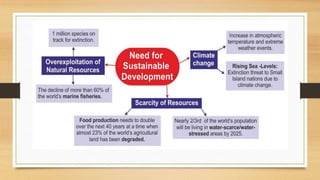
• Need of sustainable development.
• Sustainable development goals.
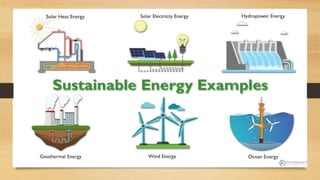
• Sustainable form of energy.
• Global issue related to sustainable development.
• Challenges.
• Conclusion.
• References.
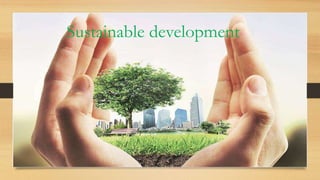
Sustainable development
• In recognition of the need for a more sustainable approach to development, a report was published
called: Our Common Future (also known as the Brundtland Report). The report was released in
1987 by the United Nations Commission on Environment and Development and set out the concept
of sustainable development for the first time along with its guiding principles.
• Sustainable development can be achieved through localised initiatives. In 1992 the Rio Earth
Summit resulted in Agenda 21, Think Globally, Act Locally. Local initiatives can support access to
clean water through sanitation programs, address hunger through community food banks and
community gardens, promote local recycling initiatives and ensure that all children have access to a
quality education through tailored support for girls, vulnerable children and those with disabilities.
An overview
• In 2015 the United Nations and its 193 member countries adopted the ambitious Sustainable
Development Goals (SDGs) – a 15-year plan that addresses 17 global and interconnected issues,
including the reduction in poverty and hunger, putting an end to discrimination and preventing
the long-term consequences of climate change. The Goals and targets to stimulate action to
achieve a better and more sustainable future for all are set out in Transforming our world: the
2030 Agenda for Sustainable Development.
• A more sustainable approach is to adopt energy efficient technologies and diversify our energy
supply. Renewable energy, such as wind, solar and biomass, is an alternative energy source,
which doesn’t pose harmful effects to our health and our environment
Sustainable development is development that meets the needs of the present without
compromising the ability of future generations to meet their own needs. It contains two
key concepts within it:
•The concept of 'needs', in particular, the essential needs of the world's poor, to which
overriding priority should be given; and
•The idea of limitations imposed by the state of technology and social organization on
the environment's ability to meet present and future needs.
What is sustainable development
•"Sustainability can be defined as the capacity to maintain or
improve the state and availability of desirable materials or
conditions over the long term.“
•"Sustainability is the long-term viability of a community, set
of social institutions, or societal practice. In general,
sustainability is understood as a form of intergenerational
ethics in which the environmental and economic actions taken
by present persons do not diminish the opportunities of future
persons to enjoy similar levels of wealth, utility, or welfare."
sustainability
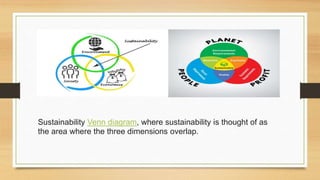
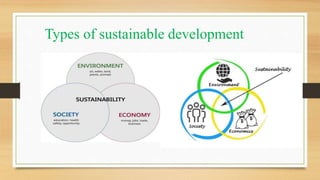
Sustainability Venn diagram, where sustainability is thought of as
the area where the three dimensions overlap.
Types of sustainable development
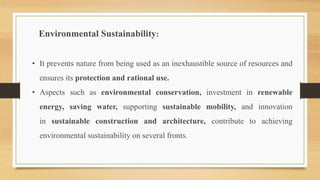
Environmental Sustainability:
• It prevents nature from being used as an inexhaustible source of resources and
ensures its protection and rational use.
• Aspects such as environmental conservation, investment in renewable
energy, saving water, supporting sustainable mobility, and innovation
in sustainable construction and architecture, contribute to achieving
environmental sustainability on several fronts.
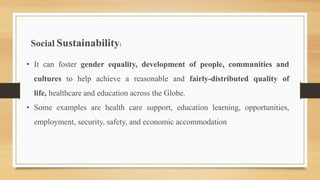
Social Sustainability:
• It can foster gender equality, development of people, communities and
cultures to help achieve a reasonable and fairly-distributed quality of
life, healthcare and education across the Globe.
• Some examples are health care support, education learning, opportunities,
employment, security, safety, and economic accommodation
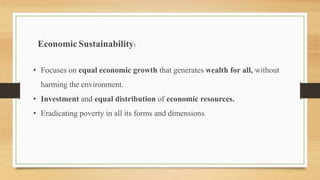
Economic Sustainability:
• Focuses on equal economic growth that generates wealth for all, without
harming the environment.
• Investment and equal distribution of economic resources.
• Eradicating poverty in all its forms and dimensions.
Sustainable Development Goals
FAO and the 2030 Agenda for Sustainable Development
•Food security and the right to food
•Nutrition
•Poverty eradication
•Resilience
•Social protection
•Climate change
•Ecosystems, biodiversity, gene
•
•Fisheries, aquaculture, oceans, seas
•Forestry and mountains
•Land and soils
•Sustainable agriculture
•Tenure rights
•Water
•Targets and Indicators
•Energy
Global issues Related to Sustainable Development
•Inequitable growth of national economies (North-South Divide)
•Loss of Biodiversity: Despite mounting efforts over the past 20 years, the loss of the world’s
biodiversity continues.
•Climate Change: As a global problem, climate change requires a global solution. Within climate
change, particular attention needs to be paid to the unique challenges facing developing countries.
•Tackling climate change and fostering sustainable development are two mutually reinforcing issues.
•Intellectual Property Rights (IPRs): There is a need for welfare for all rich and poor to have
affordable access to the results of innovation that can lead to sustainable development.
• Increasing inequality among and within countries requires urgent attention.
• 3 out of every 4 stunted children live in Southern Asia and sub-Saharan Africa.
• Young people are more likely to be unemployed than adults.
• Barriers in achieving gender equality.
• Global hunger has been on the rise after a prolonged decline.
• Extreme poverty declined from 36% in 1990 to 8.6% in 2018, but the pace of poverty
reduction is starting to decelerate as the world struggles to respond to entrenched deprivation,
violent conflicts and vulnerabilities to natural disasters.
• Extreme poverty is three times higher in rural areas than in urban areas.
• 2018 was the fourth warmest year on record. Levels of CO2 concentrations continued to
increase in 2018.
• Natural environment is deteriorating at an alarming rate.
• Sea levels are rising.
Challenges
As per the Sustainable Development Goals Report
Conclusion: To conclude, it can be said that sustainable development brings out
stability in the requirements of the environment. It makes the resources available
for use for the future generations. Sustainable development is an amazing way to
conserve the resources provided by nature. This can be achieved by using eco-
friendly resources and technologies that will have no serious impact on the
environment. The resources that are available to us shall be used in a sustainable
manner so that they do not become extinct for the usage of future generations.
https://www.fao.org/sustainable-development-goals/en/
https://www.drishtiias.com/to-the-points/paper3/sustainable-development-3
https://www.monash.edu/msdi/about/sustainable-development/what-is-it
References
thankyou

SDGs

  • 1.
  • 2.
    Course Seminar on The SustainableDevelopment Goals & it’s Agenda 2030. Under the Guidance of. Dr. O. P. Yadav Presented by. Virendra Pratap CA-11886/21 C. S. Azad University of Agriculture & Technology , Kanpur 208002(UP)
  • 3.
    content • An overview. •Types of sustainable development. • Need of sustainable development. • Sustainable development goals. • Sustainable form of energy. • Global issue related to sustainable development. • Challenges. • Conclusion. • References.
  • 4.
  • 5.
    • In recognitionof the need for a more sustainable approach to development, a report was published called: Our Common Future (also known as the Brundtland Report). The report was released in 1987 by the United Nations Commission on Environment and Development and set out the concept of sustainable development for the first time along with its guiding principles. • Sustainable development can be achieved through localised initiatives. In 1992 the Rio Earth Summit resulted in Agenda 21, Think Globally, Act Locally. Local initiatives can support access to clean water through sanitation programs, address hunger through community food banks and community gardens, promote local recycling initiatives and ensure that all children have access to a quality education through tailored support for girls, vulnerable children and those with disabilities. An overview
  • 6.
    • In 2015the United Nations and its 193 member countries adopted the ambitious Sustainable Development Goals (SDGs) – a 15-year plan that addresses 17 global and interconnected issues, including the reduction in poverty and hunger, putting an end to discrimination and preventing the long-term consequences of climate change. The Goals and targets to stimulate action to achieve a better and more sustainable future for all are set out in Transforming our world: the 2030 Agenda for Sustainable Development. • A more sustainable approach is to adopt energy efficient technologies and diversify our energy supply. Renewable energy, such as wind, solar and biomass, is an alternative energy source, which doesn’t pose harmful effects to our health and our environment
  • 7.
    Sustainable development isdevelopment that meets the needs of the present without compromising the ability of future generations to meet their own needs. It contains two key concepts within it: •The concept of 'needs', in particular, the essential needs of the world's poor, to which overriding priority should be given; and •The idea of limitations imposed by the state of technology and social organization on the environment's ability to meet present and future needs. What is sustainable development
  • 8.
    •"Sustainability can bedefined as the capacity to maintain or improve the state and availability of desirable materials or conditions over the long term.“ •"Sustainability is the long-term viability of a community, set of social institutions, or societal practice. In general, sustainability is understood as a form of intergenerational ethics in which the environmental and economic actions taken by present persons do not diminish the opportunities of future persons to enjoy similar levels of wealth, utility, or welfare." sustainability
  • 9.
    Sustainability Venn diagram,where sustainability is thought of as the area where the three dimensions overlap.
  • 10.
  • 11.
    Environmental Sustainability: • Itprevents nature from being used as an inexhaustible source of resources and ensures its protection and rational use. • Aspects such as environmental conservation, investment in renewable energy, saving water, supporting sustainable mobility, and innovation in sustainable construction and architecture, contribute to achieving environmental sustainability on several fronts.
  • 12.
    Social Sustainability: • Itcan foster gender equality, development of people, communities and cultures to help achieve a reasonable and fairly-distributed quality of life, healthcare and education across the Globe. • Some examples are health care support, education learning, opportunities, employment, security, safety, and economic accommodation
  • 13.
    Economic Sustainability: • Focuseson equal economic growth that generates wealth for all, without harming the environment. • Investment and equal distribution of economic resources. • Eradicating poverty in all its forms and dimensions.
  • 15.
    Sustainable Development Goals FAOand the 2030 Agenda for Sustainable Development •Food security and the right to food •Nutrition •Poverty eradication •Resilience •Social protection •Climate change •Ecosystems, biodiversity, gene •
  • 16.
    •Fisheries, aquaculture, oceans,seas •Forestry and mountains •Land and soils •Sustainable agriculture •Tenure rights •Water •Targets and Indicators •Energy
  • 18.
    Global issues Relatedto Sustainable Development •Inequitable growth of national economies (North-South Divide) •Loss of Biodiversity: Despite mounting efforts over the past 20 years, the loss of the world’s biodiversity continues. •Climate Change: As a global problem, climate change requires a global solution. Within climate change, particular attention needs to be paid to the unique challenges facing developing countries. •Tackling climate change and fostering sustainable development are two mutually reinforcing issues. •Intellectual Property Rights (IPRs): There is a need for welfare for all rich and poor to have affordable access to the results of innovation that can lead to sustainable development.
  • 19.
    • Increasing inequalityamong and within countries requires urgent attention. • 3 out of every 4 stunted children live in Southern Asia and sub-Saharan Africa. • Young people are more likely to be unemployed than adults. • Barriers in achieving gender equality. • Global hunger has been on the rise after a prolonged decline. • Extreme poverty declined from 36% in 1990 to 8.6% in 2018, but the pace of poverty reduction is starting to decelerate as the world struggles to respond to entrenched deprivation, violent conflicts and vulnerabilities to natural disasters. • Extreme poverty is three times higher in rural areas than in urban areas. • 2018 was the fourth warmest year on record. Levels of CO2 concentrations continued to increase in 2018. • Natural environment is deteriorating at an alarming rate. • Sea levels are rising. Challenges As per the Sustainable Development Goals Report
  • 20.
    Conclusion: To conclude,it can be said that sustainable development brings out stability in the requirements of the environment. It makes the resources available for use for the future generations. Sustainable development is an amazing way to conserve the resources provided by nature. This can be achieved by using eco- friendly resources and technologies that will have no serious impact on the environment. The resources that are available to us shall be used in a sustainable manner so that they do not become extinct for the usage of future generations.
  • 21.
  • 22.