Frogs
Lets learn about frogs!

By Gina Grant
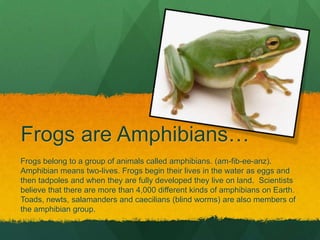
Frogs are Amphibians…
Frogs belong to a group of animals called amphibians. (am-fib-ee-anz).
Amphibian means two-lives. Frogs begin their lives in the water as eggs and
then tadpoles and when they are fully developed they live on land. Scientists
believe that there are more than 4,000 different kinds of amphibians on Earth.
Toads, newts, salamanders and caecilians (blind worms) are also members of
the amphibian group.
Frogs are cold-blooded…
Frogs are cold-blooded which means that their bodies are the
same temperature as the air or water around them. When they
are cold they will lay in the sun to warm up and when they get too
warm they will go into the water to cool their bodies off.
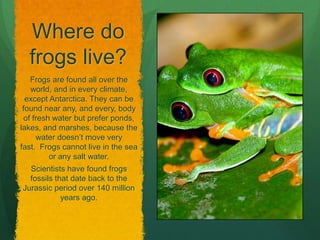
Where do
  frogs live?
    Frogs are found all over the
    world, and in every climate,
  except Antarctica. They can be
 found near any, and every, body
  of fresh water but prefer ponds,
lakes, and marshes, because the
      water doesn’t move very
fast. Frogs cannot live in the sea
          or any salt water.
  Scientists have found frogs
  fossils that date back to the
Jurassic period over 140 million
            years ago.
The Life-Cycle…
Jelly covered
   Eggs…
  Frogs begin their lives as
tadpoles that are hatched in
   the water from tiny jelly-
 covered eggs. The mother
  frog can lay thousands of
 eggs at one time. Imagine
having thousands of brothers
         and sisters!
                                 Tadpoles don't have eggs but frogs
                                 have eggs that turn into tadpoles then
 The jelly has an awful taste,   frogs.
which protects the eggs from     Frog eggs look look little jelly like
predators until they are ready   sacks with little black dots in the
           to hatch.             middle.
Tadpoles…
Tadpoles are born with gills, just like a fish, so that they can breathe
under water. They have a big head and a long tail. They definitely do
not look like frogs, yet! Tadpoles have a tough life. It’s a good thing
they are fast swimmers to escape the many other creatures that hunt
them in the ponds and lakes. They are a favorite food to fish and
water beetles.
Metamorphosi
     s
 Metamorphosis is the change
   of shape during an animal’s
    life. During metamorphosis
  the tadpole will develop back
      legs first, then front legs.
     Around 6 weeks of life the
        mouth starts to widen.
   Sometime around 10 weeks
       the froglet’s, as it is now
 called, eyes start to bulge out
   and the tail begins to shrink
     and eventually disappear.
        When the lungs finish
  developing the froglet makes
 it’s way onto the land and, Ta-
             da! It’s a frog!
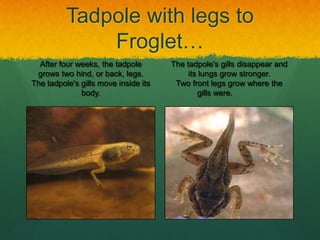
Tadpole with legs to
              Froglet…
  After four weeks, the tadpole       The tadpole's gills disappear and
 grows two hind, or back, legs.            its lungs grow stronger.
The tadpole's gills move inside its    Two front legs grow where the
              body.                           gills were.
What do
  they eat?
 Frogs are carnivores, which
means that they will eat meat.
Small to medium sized frogs
  eat insects such as flies,
  mosquitoes, moths and
dragonflies. Larger frogs will
   eat larger insects like
 grasshoppers and worms.
Some large frogs will even eat
  small snakes, mice, baby
   turtles, and even other
     smaller frogs!
What about that tongue..?
Frog’s tongues are attached to the front of their mouths rather than at the
back like humans. When a frog catches an insect it throws its sticky tongue
out of it’s mouth and wraps it around its prey. The frog’s tongue then snaps
back and throws the food down its throat.
Characteristic
     s
      Frogs have very good
  eyesight. They bulge out the
  sides of their heads in order
 for the frog to see in nearly all
            directions.
 Frogs also have an amazing
  sense of hearing. You can
    often tell the difference
 between a male and female
   frog by the size of their
 eardrum, which can be seen
   behind their eyes. If the
 eardrum is smaller than the
 eye, the frog is a female. On
  males their eardrum is the
    same size as the eye.
Characteristic
     s

   Frogs have very powerful
  back legs and webbed feet
   that help them jump great
 distances, as well as, swim.
 Frogs even use their legs to
 dig, or burrow, underground
 for hibernating (although not
      all frogs hibernate!)
 Every different species of frog
 has his or her own look. They
 come in many colors, patterns
      and sizes.
Frogs
(all different shapes, sizes and looks)
Frogs
(all different shapes, sizes and looks)
Frogs
(all different shapes, sizes and looks)
Predators
     …
Frogs have many predators.
 Animal predators include
   birds, fish and reptiles.
 Some frogs are very good at
 camouflaging themselves so
  that they blend in with their
environment, making it harder
    for their enemies to find
     them. Some frogs can
change the colour of their skin
        depending on its
          surroundings.
Human
 Danger…
   Humans have become a
major danger for amphibians
of all types. Water pollution is
 causing many deformities in
  frogs as well as poisoning
   them, and loss of habitat
through the building of roads
          and houses.
In some countries, frog’s legs
  are considered a delicacy,
which means that people love
      to eat them! Eew!


(Pictured is the native Maud
        Island Frog)
New Zealand Native
Frogs
New Zealand has 4 native frog species.
Frogs are declining everywhere in the world. More than most creatures,
frogs are sensitive to disease, pollution, chemical poisons and
environmental changes, as they absorb many things through their sensitive
skin.
New Zealand’s, Hamilton's frog (pictured) is the most critically endangered
species, with less than 300 individuals remaining.

Frogs.

  • 1.
    Frogs Lets learn aboutfrogs! By Gina Grant
  • 2.
    Frogs are Amphibians… Frogsbelong to a group of animals called amphibians. (am-fib-ee-anz). Amphibian means two-lives. Frogs begin their lives in the water as eggs and then tadpoles and when they are fully developed they live on land. Scientists believe that there are more than 4,000 different kinds of amphibians on Earth. Toads, newts, salamanders and caecilians (blind worms) are also members of the amphibian group.
  • 3.
    Frogs are cold-blooded… Frogsare cold-blooded which means that their bodies are the same temperature as the air or water around them. When they are cold they will lay in the sun to warm up and when they get too warm they will go into the water to cool their bodies off.
  • 4.
    Where do frogs live? Frogs are found all over the world, and in every climate, except Antarctica. They can be found near any, and every, body of fresh water but prefer ponds, lakes, and marshes, because the water doesn’t move very fast. Frogs cannot live in the sea or any salt water. Scientists have found frogs fossils that date back to the Jurassic period over 140 million years ago.
  • 5.
  • 6.
    Jelly covered Eggs… Frogs begin their lives as tadpoles that are hatched in the water from tiny jelly- covered eggs. The mother frog can lay thousands of eggs at one time. Imagine having thousands of brothers and sisters! Tadpoles don't have eggs but frogs have eggs that turn into tadpoles then The jelly has an awful taste, frogs. which protects the eggs from Frog eggs look look little jelly like predators until they are ready sacks with little black dots in the to hatch. middle.
  • 7.
    Tadpoles… Tadpoles are bornwith gills, just like a fish, so that they can breathe under water. They have a big head and a long tail. They definitely do not look like frogs, yet! Tadpoles have a tough life. It’s a good thing they are fast swimmers to escape the many other creatures that hunt them in the ponds and lakes. They are a favorite food to fish and water beetles.
  • 8.
    Metamorphosi s Metamorphosis is the change of shape during an animal’s life. During metamorphosis the tadpole will develop back legs first, then front legs. Around 6 weeks of life the mouth starts to widen. Sometime around 10 weeks the froglet’s, as it is now called, eyes start to bulge out and the tail begins to shrink and eventually disappear. When the lungs finish developing the froglet makes it’s way onto the land and, Ta- da! It’s a frog!
  • 9.
    Tadpole with legsto Froglet… After four weeks, the tadpole The tadpole's gills disappear and grows two hind, or back, legs. its lungs grow stronger. The tadpole's gills move inside its Two front legs grow where the body. gills were.
  • 10.
    What do they eat? Frogs are carnivores, which means that they will eat meat. Small to medium sized frogs eat insects such as flies, mosquitoes, moths and dragonflies. Larger frogs will eat larger insects like grasshoppers and worms. Some large frogs will even eat small snakes, mice, baby turtles, and even other smaller frogs!
  • 11.
    What about thattongue..? Frog’s tongues are attached to the front of their mouths rather than at the back like humans. When a frog catches an insect it throws its sticky tongue out of it’s mouth and wraps it around its prey. The frog’s tongue then snaps back and throws the food down its throat.
  • 12.
    Characteristic s Frogs have very good eyesight. They bulge out the sides of their heads in order for the frog to see in nearly all directions. Frogs also have an amazing sense of hearing. You can often tell the difference between a male and female frog by the size of their eardrum, which can be seen behind their eyes. If the eardrum is smaller than the eye, the frog is a female. On males their eardrum is the same size as the eye.
  • 13.
    Characteristic s Frogs have very powerful back legs and webbed feet that help them jump great distances, as well as, swim. Frogs even use their legs to dig, or burrow, underground for hibernating (although not all frogs hibernate!) Every different species of frog has his or her own look. They come in many colors, patterns and sizes.
  • 14.
  • 15.
  • 16.
  • 17.
    Predators … Frogs have many predators. Animal predators include birds, fish and reptiles. Some frogs are very good at camouflaging themselves so that they blend in with their environment, making it harder for their enemies to find them. Some frogs can change the colour of their skin depending on its surroundings.
  • 18.
    Human Danger… Humans have become a major danger for amphibians of all types. Water pollution is causing many deformities in frogs as well as poisoning them, and loss of habitat through the building of roads and houses. In some countries, frog’s legs are considered a delicacy, which means that people love to eat them! Eew! (Pictured is the native Maud Island Frog)
  • 19.
    New Zealand Native Frogs NewZealand has 4 native frog species. Frogs are declining everywhere in the world. More than most creatures, frogs are sensitive to disease, pollution, chemical poisons and environmental changes, as they absorb many things through their sensitive skin. New Zealand’s, Hamilton's frog (pictured) is the most critically endangered species, with less than 300 individuals remaining.