By: Darlinda Smith
General Information on Frogs
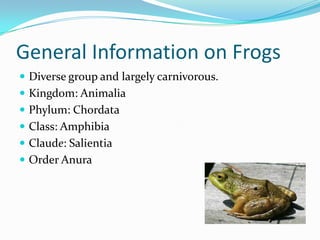
 Diverse group and largely carnivorous.
 Kingdom: Animalia
 Phylum: Chordata
 Class: Amphibia

 Claude: Salientia
 Order Anura
General Information on Frogs
 Suborders
 Archaeobatrachia, which contain four families of

primitive frogs.
 Mesobatrachia, contains five families of more
evolutionary intermediate frogs
 Neobatrachia divided into two superfamilies of
Hyploidea and Ranoidea
General Information
 Frogs are cold-blooded which means that their bodies

are the same temperature as the air or water around
them.
 When they are cold they will lay in the sun to warm up
and when they get too warm they will go into the water
to cool off their bodies.
 Frogs are found all over except in Antarctica. They can
be found near and every body of fresh water but prefer
ponds, lakes and marshes, since the water doesn’t
move very fast. Frogs cannot live in the sea or any salt
water.
The Starting Life of A Frog
 Frogs start their life off as tadpoles that are hatched in

the water from tiny jelly covered eggs. The female frog
will lay thousands of eggs at one time. The jelly has a
awful taste and protects eggs from predators until
they’re ready to hatch. Tadpoles are born with gills, so
that they can breathe under water. They have a big
head and long tail. It’s good that they are fast
swimmers to escape many predators that hunt them in
the pond. They’re favorite food to fish and water
beetles.
Metamorphosis
 During this period of a tadpole’s cycle it will develop

back legs first, then the front. Around 6 weeks of life
the mouth starts to widen. Around 10 weeks the
froglet’s eyes start to bulge out and the tail begins to
shrink and eventually disappear. When the lungs
finish developing the froglet will make it’s way onto
the land and here we have a frog! Yay!
Let’s learn about frogs!

Let’s learn about frogs!

  • 1.
  • 3.
    General Information onFrogs  Diverse group and largely carnivorous.  Kingdom: Animalia  Phylum: Chordata  Class: Amphibia  Claude: Salientia  Order Anura
  • 4.
    General Information onFrogs  Suborders  Archaeobatrachia, which contain four families of primitive frogs.  Mesobatrachia, contains five families of more evolutionary intermediate frogs  Neobatrachia divided into two superfamilies of Hyploidea and Ranoidea
  • 5.
    General Information  Frogsare cold-blooded which means that their bodies are the same temperature as the air or water around them.  When they are cold they will lay in the sun to warm up and when they get too warm they will go into the water to cool off their bodies.  Frogs are found all over except in Antarctica. They can be found near and every body of fresh water but prefer ponds, lakes and marshes, since the water doesn’t move very fast. Frogs cannot live in the sea or any salt water.
  • 6.
    The Starting Lifeof A Frog  Frogs start their life off as tadpoles that are hatched in the water from tiny jelly covered eggs. The female frog will lay thousands of eggs at one time. The jelly has a awful taste and protects eggs from predators until they’re ready to hatch. Tadpoles are born with gills, so that they can breathe under water. They have a big head and long tail. It’s good that they are fast swimmers to escape many predators that hunt them in the pond. They’re favorite food to fish and water beetles.
  • 7.
    Metamorphosis  During thisperiod of a tadpole’s cycle it will develop back legs first, then the front. Around 6 weeks of life the mouth starts to widen. Around 10 weeks the froglet’s eyes start to bulge out and the tail begins to shrink and eventually disappear. When the lungs finish developing the froglet will make it’s way onto the land and here we have a frog! Yay!