
Saltwater Crocodile Jonathan Davila Marine Biology, P.1 May 5, 2010
The Saltwater Crocodile
Classification Crocodylus Porosus   Kingdom: Animalia Phylum: Chordata Class: Reptilia Order: Crocodylia Family: Crocodylidae Subfamily: Crocodylinae Genus:  Crocodylus Species:  C. porosus
Habitat & Range Habitat:  Tropical wet season: freshwater swamps, rivers, and inland lakes; dry season: estuaries, coastal brackish water, sometimes travel out to sea Location:  Southeast Asia and northern Australia Range:  East Coast of India to Northern Australia to the Sea of Japan.
 
Feeding Habits Large adult saltwater crocodiles can potentially eat any animals within their range, including monkeys, kangaroos, wild boar, dingos, goannas, birds, domestic livestock, pets, water buffalo, bats, and even sharks. Domestic cattle, horses, water buffalo and gaur, all of which may weigh over a ton, are considered the largest prey taken by male crocodiles.
Reproductive Strategies Breeding territories are established in freshwater areas. Females reach sexual maturity at 10 to 12 years of age.  Males mature later at around 16 years of age. 40 to 60 eggs are usually laid in mound nests made from plant matter and mud during the months of November & March. If the nest is in danger of getting too dry, the female has been known to splash water onto it from a purpose-dug pool. Juveniles hatch after around 90 days.
General Characteristics The  Saltwater Crocodile  is the largest living reptile known & and is even larger then the  Komodo Dragon . Average lifespan in the wild:  Up to 70 years  The  Saltwater Crocodiles  are among the most aggressive of all marine animals & are known to attack & eat  people . They are more feared than  Sharks .
Body Type & Appearance Size:  Adult male grow 15.7 - 23 ft & Females grow 8 - 10 ft. Weight:  1,000 - 2,200 lbs  Some Saltwater Crocodiles have been known to grow up to 33ft, but they are rarely over 20ft.
Migration They have been reported to migrate considerable distances over land in search of more suitable habitat.  They inhabit rivers, lakes and other larger bodies of water in the plains and up to 600 m in the hills, throughout the Indian Subcontinent.
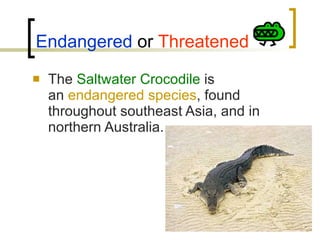
Endangered  or  Threatened The  Saltwater Crocodile  is an  endangered species , found throughout southeast Asia, and in northern Australia.
Diseases Some  "Chlamydia-infected"  tissue was put into a crocodile cell line, it was discovered to be associated with a virus.  Many more crocodiles die every year from unidentified causes which could also be viral-related.
Natural Predators Saltwater Crocodiles  have no predators known to mankind.
Sensitivity to Pollution or Temperature Changes Saltwater Crocodiles are known to be sensitive to  weather changes . They live in hot areas so cold areas would affect them.
The End Hope you enjoyed my presentation!

Saltwater crocodile

  • 1.
    Saltwater Crocodile JonathanDavila Marine Biology, P.1 May 5, 2010
  • 2.
  • 3.
    Classification Crocodylus Porosus Kingdom: Animalia Phylum: Chordata Class: Reptilia Order: Crocodylia Family: Crocodylidae Subfamily: Crocodylinae Genus: Crocodylus Species: C. porosus
  • 4.
    Habitat & RangeHabitat:  Tropical wet season: freshwater swamps, rivers, and inland lakes; dry season: estuaries, coastal brackish water, sometimes travel out to sea Location:  Southeast Asia and northern Australia Range: East Coast of India to Northern Australia to the Sea of Japan.
  • 5.
  • 6.
    Feeding Habits Largeadult saltwater crocodiles can potentially eat any animals within their range, including monkeys, kangaroos, wild boar, dingos, goannas, birds, domestic livestock, pets, water buffalo, bats, and even sharks. Domestic cattle, horses, water buffalo and gaur, all of which may weigh over a ton, are considered the largest prey taken by male crocodiles.
  • 7.
    Reproductive Strategies Breedingterritories are established in freshwater areas. Females reach sexual maturity at 10 to 12 years of age. Males mature later at around 16 years of age. 40 to 60 eggs are usually laid in mound nests made from plant matter and mud during the months of November & March. If the nest is in danger of getting too dry, the female has been known to splash water onto it from a purpose-dug pool. Juveniles hatch after around 90 days.
  • 8.
    General Characteristics The Saltwater Crocodile is the largest living reptile known & and is even larger then the Komodo Dragon . Average lifespan in the wild:  Up to 70 years The Saltwater Crocodiles are among the most aggressive of all marine animals & are known to attack & eat people . They are more feared than Sharks .
  • 9.
    Body Type &Appearance Size:  Adult male grow 15.7 - 23 ft & Females grow 8 - 10 ft. Weight:  1,000 - 2,200 lbs Some Saltwater Crocodiles have been known to grow up to 33ft, but they are rarely over 20ft.
  • 10.
    Migration They havebeen reported to migrate considerable distances over land in search of more suitable habitat. They inhabit rivers, lakes and other larger bodies of water in the plains and up to 600 m in the hills, throughout the Indian Subcontinent.
  • 11.
    Endangered or Threatened The Saltwater Crocodile is an  endangered species , found throughout southeast Asia, and in northern Australia.
  • 12.
    Diseases Some "Chlamydia-infected" tissue was put into a crocodile cell line, it was discovered to be associated with a virus. Many more crocodiles die every year from unidentified causes which could also be viral-related.
  • 13.
    Natural Predators SaltwaterCrocodiles have no predators known to mankind.
  • 14.
    Sensitivity to Pollutionor Temperature Changes Saltwater Crocodiles are known to be sensitive to weather changes . They live in hot areas so cold areas would affect them.
  • 15.
    The End Hopeyou enjoyed my presentation!