Frequency
Modulation
Course No.: EEE 3218
Course Title: Communication Engineering
II Sessional
Content
What is Modulation?
 Need of Frequency Modulation.
 What is Frequency Modulation?
 Classification of Modulation
 Frequency Modulation Theory
 Generation of FM in Laboratory
 Experimental Input & Output
 List of Equipments
 Advantages & Disadvantages
 Applications
What is Modulation?
 Modulation is the process by which the characteristics
of carrier signal is varied according to the message
signal.
Why is Modulation Needed?
 Message signal is incompatible for direct transmission. So it
strength has to be increased by modulating with a high frequ
carrier signal which doesn’t affect the parameters of the mess
signal.
What is Frequency Modulation?
 Frequency modulation is a technique by which the amplitude o
signal is kept constant, while its frequency is varied by the mod
signal.
Classification of Modulation
 Amplitude Modulation
 Frequency Modulation
 Phase Modulation
Frequency Modulation Theory
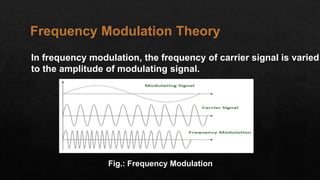
In frequency modulation, the frequency of carrier signal is varied
to the amplitude of modulating signal.
Fig.: Frequency Modulation
Initially, when the amplitude of the modulating signal starts to increase in its
positive half cycle, the frequency of the carrier signal also increases. When the
modulating signal is at its peak, the modulated signal’s frequency becomes
maximum.
After that, when the amplitude of the modulating signal starts decreasing, a corresp
decrement in the frequency of modulated signal is noticed. At the negative peak of
modulating signal, the frequency of the modulated signal becomes minimum.
Frequency Modulation Theory
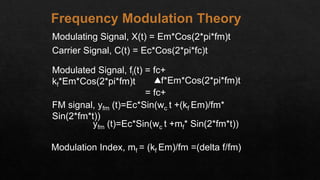
Modulating Signal, X(t) = Em*Cos(2*pi*fm)t
Carrier Signal, C(t) = Ec*Cos(2*pi*fc)t
Modulated Signal, fi(t) = fc+
kf*Em*Cos(2*pi*fm)t
= fc+
f*Em*Cos(2*pi*fm)t
FM signal, yfm (t)=Ec*Sin(wc t +(kf Em)/fm*
Sin(2*fm*t))
yfm (t)=Ec*Sin(wc t +mf* Sin(2*fm*t))
Modulation Index, mf = (kf Em)/fm =(delta f/fm)
Frequency Modulation Theory
Generation of FM in Laboratory
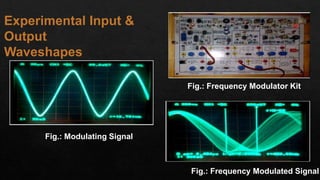
FM modulator kit was used to get frequency modulated signal. Using a function gener
message signal was generated . Inside the FM modulator block, there was an option o
of carrier signal’s frequency between 500KHz to 1500KHz.
From the output of FM modulator block, we got a frequency modulated
signal. The output waveshape was seen on the oscillator.
Fig.: Frequency Modulator Kit
Fig.: Modulating Signal
Fig.: Frequency Modulated Signal
Experimental Input &
Output
Waveshapes
List of
Components Function Generator
 FM Modulator Kit
 Power Supply (12v)
 Wires
 Oscilloscope
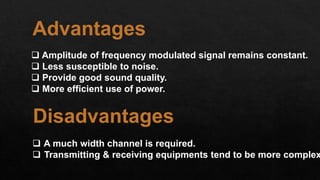
Advantages
 Amplitude of frequency modulated signal remains constant.
 Less susceptible to noise.
 Provide good sound quality.
 More efficient use of power.
Disadvantages
 A much width channel is required.
 Transmitting & receiving equipments tend to be more complex
Application of FM
 Broadcasting of FM Radio.
 Telemetry , Radar & Seismic Prospecting.
 EEG-Monitoring of Newborns.
 In Music Synthesis.
Thank You

Frequency modulation

  • 1.
    Frequency Modulation Course No.: EEE3218 Course Title: Communication Engineering II Sessional
  • 2.
    Content What is Modulation? Need of Frequency Modulation.  What is Frequency Modulation?  Classification of Modulation  Frequency Modulation Theory  Generation of FM in Laboratory  Experimental Input & Output  List of Equipments  Advantages & Disadvantages  Applications
  • 3.
    What is Modulation? Modulation is the process by which the characteristics of carrier signal is varied according to the message signal. Why is Modulation Needed?  Message signal is incompatible for direct transmission. So it strength has to be increased by modulating with a high frequ carrier signal which doesn’t affect the parameters of the mess signal.
  • 4.
    What is FrequencyModulation?  Frequency modulation is a technique by which the amplitude o signal is kept constant, while its frequency is varied by the mod signal. Classification of Modulation  Amplitude Modulation  Frequency Modulation  Phase Modulation
  • 5.
    Frequency Modulation Theory Infrequency modulation, the frequency of carrier signal is varied to the amplitude of modulating signal. Fig.: Frequency Modulation
  • 6.
    Initially, when theamplitude of the modulating signal starts to increase in its positive half cycle, the frequency of the carrier signal also increases. When the modulating signal is at its peak, the modulated signal’s frequency becomes maximum. After that, when the amplitude of the modulating signal starts decreasing, a corresp decrement in the frequency of modulated signal is noticed. At the negative peak of modulating signal, the frequency of the modulated signal becomes minimum. Frequency Modulation Theory
  • 7.
    Modulating Signal, X(t)= Em*Cos(2*pi*fm)t Carrier Signal, C(t) = Ec*Cos(2*pi*fc)t Modulated Signal, fi(t) = fc+ kf*Em*Cos(2*pi*fm)t = fc+ f*Em*Cos(2*pi*fm)t FM signal, yfm (t)=Ec*Sin(wc t +(kf Em)/fm* Sin(2*fm*t)) yfm (t)=Ec*Sin(wc t +mf* Sin(2*fm*t)) Modulation Index, mf = (kf Em)/fm =(delta f/fm) Frequency Modulation Theory
  • 8.
    Generation of FMin Laboratory FM modulator kit was used to get frequency modulated signal. Using a function gener message signal was generated . Inside the FM modulator block, there was an option o of carrier signal’s frequency between 500KHz to 1500KHz. From the output of FM modulator block, we got a frequency modulated signal. The output waveshape was seen on the oscillator.
  • 9.
    Fig.: Frequency ModulatorKit Fig.: Modulating Signal Fig.: Frequency Modulated Signal Experimental Input & Output Waveshapes
  • 10.
    List of Components FunctionGenerator  FM Modulator Kit  Power Supply (12v)  Wires  Oscilloscope
  • 11.
    Advantages  Amplitude offrequency modulated signal remains constant.  Less susceptible to noise.  Provide good sound quality.  More efficient use of power. Disadvantages  A much width channel is required.  Transmitting & receiving equipments tend to be more complex
  • 12.
    Application of FM Broadcasting of FM Radio.  Telemetry , Radar & Seismic Prospecting.  EEG-Monitoring of Newborns.  In Music Synthesis.
  • 13.