By
Ms.Atcharaporn Khoomtong
Content
   Introduction
   Fish muscle
   Fundamentals of Freezing and
    Thawing of fishes and seafood
   Quality-related changes in
    frozen fish muscle
   The length of storage time for
    fish


                                     2
Know about fish
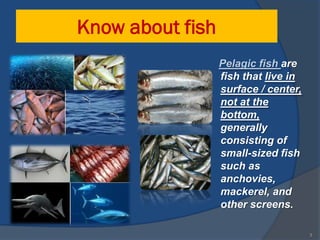
                  Pelagic fish are
                  fish that live in
                  surface / center,
                  not at the
                  bottom,
                  generally
                  consisting of
                  small-sized fish
                  such as
                  anchovies,
                  mackerel, and
                  other screens.

                                      3
Know about fish (Cont’)
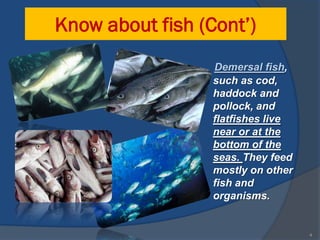
                  Demersal fish,
                  such as cod,
                  haddock and
                  pollock, and
                  flatfishes live
                  near or at the
                  bottom of the
                  seas. They feed
                  mostly on other
                  fish and
                  organisms.


                                    4
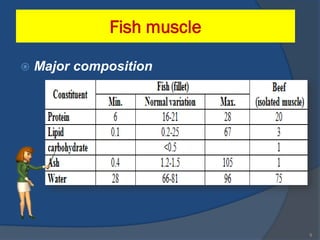
Fish muscle

   Major composition


                            5
Let you know about TMAO
 TMAO is formed by biosynthesis in
  certain zooplankton species.
 These organisms possess an enzyme
  (TMA mono-oxygenase) which oxidizes
  TMA to TMAO.
 TMA is commonly found in marine plants
  as are many other methylated amines
  (monomethylamine and dimethylamine).


                                           6
Structure of fish muscle
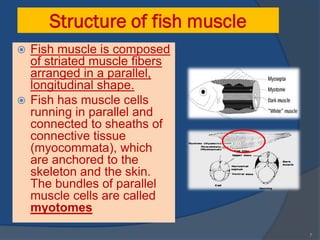
 Fish muscle is composed
  of striated muscle fibers
  arranged in a parallel,
  longitudinal shape.
 Fish has muscle cells
  running in parallel and
  connected to sheaths of
  connective tissue
  (myocommata), which
  are anchored to the
  skeleton and the skin.
  The bundles of parallel
  muscle cells are called
  myotomes

                                7
Post mortem changes in fish muscle

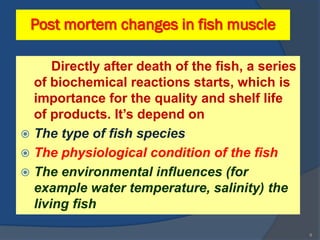
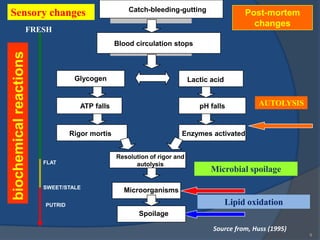
      Directly after death of the fish, a series
  of biochemical reactions starts, which is
  importance for the quality and shelf life
  of products. It’s depend on
 The type of fish species,
 The physiological condition of the fish,
 The environmental influences (for
  example water temperature, salinity) the
  living fish

                                                   8
Catch-bleeding-gutting
Sensory changes                                                                              Post-mortem
                                                                                               changes
                    FRESH
                                                Blood circulation stops
biochemical reactions


                                  Glycogen                                Lactic acid


                                    ATP falls                                pH falls           AUTOLYSIS


                                 Rigor mortis                         Enzymes activated


                                                Resolution of rigor and
                        FLAT                          autolysis
                                                                                 Microbial spoilage
                        SWEET/STALE
                                                  Microorganisms

                        PUTRID                                                          Lipid oxidation
                                                       Spoilage

                                                                                 Source from, Huss (1995)
                                                                                                            9
Freezing and Thawing of fishes


                                 10
Fundamentals of Freezing of fishes


General Freezing temperature
   Use temperature < 32 F (0 C)
   Change in water from liquid to solid.


  General Freezing theory
   lower temperature. Will reduce spoilage.
   Water is unavailable for microorganisms
    and chemical reactions.
                                               11
FREEZING/SUPERFREEZING OF FISH

 Freezing is the process by which
  temperatures of fish or seafood are
  reduced to -20oC
 Super freezing is the process by which
  temperatures of fish are mechanically
  reduced to -40oC


                                           12
Freezing point depression
   In fish muscle the freezing point is
    depressed below that of pure water
    because of small solutes present in the
    muscle water.

   The freezing point is often referred to as
    ‘the equilibrium freezing point’


                                                 13
Ice crystal formation
     in pre- and post-rigor muscle
 In pre-rigor muscle, the cell fluids are
  associated to intra-cellular proteins and the
  diffusivity from inside to outside the cell is
  therefore limited resulting in the formation of
  the intracellular ice crystals independent of
  freezing rate.
 If very slow freezing rates are used the
  muscle can go into rigor mortis during the
  freezing process, and ice crystal formation
  will then be extra-cellular
                                       (Love, 1970).
                                                       14
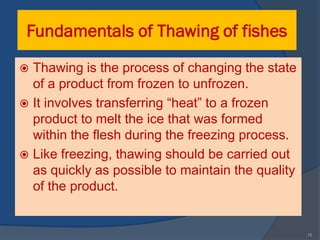
Fundamentals of Thawing of fishes
 Thawing is the process of changing the state
  of a product from frozen to unfrozen.
 It involves transferring “heat” to a frozen
  product to melt the ice that was formed
  within the flesh during the freezing process.
 Like freezing, thawing should be carried out
  as quickly as possible to maintain the quality
  of the product.


                                                   15
Fundamentals of Thawing of fishes
 If the thawing process is carried out
  correctly there should be little effect on the
  quality of the product.
 The final quality of thawed seafood will
  depend not only on the thawing process but
  also on factors such as frozen storage
  conditions and the length of time that it has
  been frozen, packaging, product form and
  product type.

                                                   16
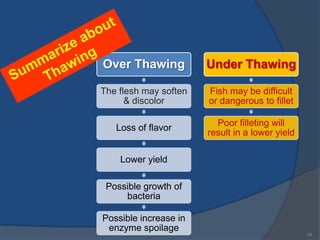
Over Thawing           Under Thawing

The flesh may soften   Fish may be difficult
      & discolor       or dangerous to fillet

                         Poor filleting will
   Loss of flavor
                       result in a lower yield

    Lower yield

 Possible growth of
     bacteria

Possible increase in
 enzyme spoilage
                                                 17
Quality-related changes
 in frozen fish muscle


                          18
A mistake that many
             people make

   when freezing fish and other seafood
products is to assume that, once it has
been frozen, it will not change.


                                          19
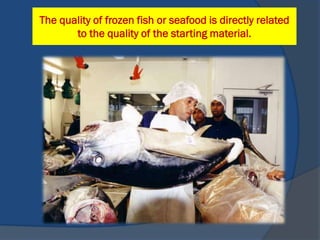
The quality of frozen fish or seafood is directly related
       to the quality of the starting material.
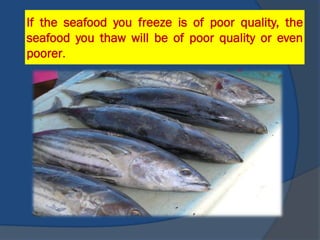
If the seafood you freeze is of poor quality, the
seafood you thaw will be of poor quality or even
poorer.
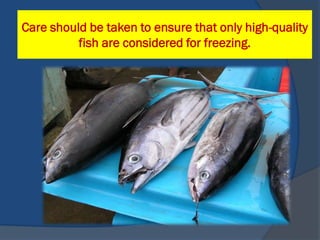
Care should be taken to ensure that only high-quality
          fish are considered for freezing.
Factors that effected on Quality-related
            changes in frozen fish muscle

   Fish species
   Temperature and Handling before slaughter
   Slaughter stress
   Temperature of the pre-rigor storage
   Freezing rate
   Frozen storage temperature and time
   Thawing procedure
   Prevention against oxidation (light,oxygen)

                                   (Sørensen et al., 1995)
                                                             23
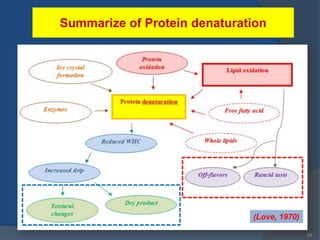
Affecting protein changes
            in fish muscle


Dehydration and the effect of inorganic salts


  Changes in lipids and fatty acids


     Enzymatic breakdown of TMAO
          (Autolytic changes)


                                           24
Summarize of Protein denaturation


                              (Love, 1970)

                                             25
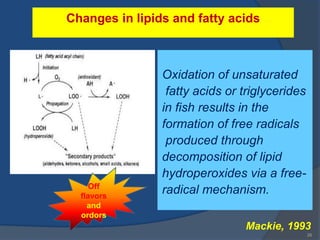
Changes in lipids and fatty acids


                Oxidation of unsaturated
                 fatty acids or triglycerides
                in fish results in the
                formation of free radicals
                 produced through
                decomposition of lipid
                hydroperoxides via a free-
     Off
  flavors
                radical mechanism.
    and
  ordors
                                Mackie, 1993
                                                26
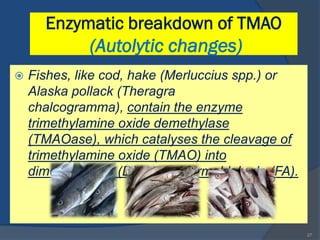
Enzymatic breakdown of TMAO
           (Autolytic changes)
   Fishes, like cod, hake (Merluccius spp.) or
    Alaska pollack (Theragra
    chalcogramma), contain the enzyme
    trimethylamine oxide demethylase
    (TMAOase), which catalyses the cleavage of
    trimethylamine oxide (TMAO) into
    dimethylamine (DMA) and formaldehyde (FA).


                                                  27
Changes in functional properties
      caused by protein changes
 The main changes are reported to occur in
  myosin light-chain, but actin and actinin also
  degrade during frozen storage.
 Some of the changes reported are increases
  in ß-sheet at the expense of -helix structure.
  As the main part of muscle water is located
  within the myofibrillar structure, changes in
  this typically result in reduced WHC.


                                                   28
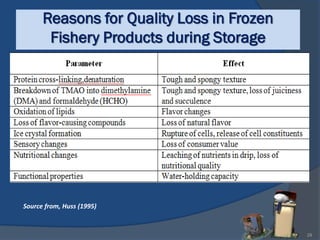
Reasons for Quality Loss in Frozen
       Fishery Products during Storage


Source from, Huss (1995)


                                           29
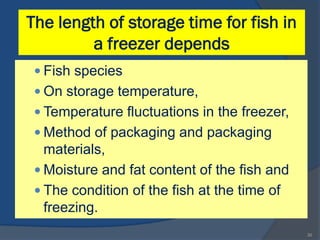
The length of storage time for fish in
         a freezer depends
  Fish species
  On storage temperature,
  Temperature fluctuations in the freezer,
  Method of packaging and packaging
   materials,
  Moisture and fat content of the fish and
  The condition of the fish at the time of
   freezing.
                                              30
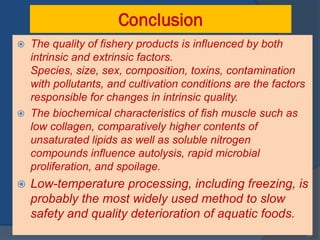
Conclusion
 The quality of fishery products is influenced by both
  intrinsic and extrinsic factors.
  Species, size, sex, composition, toxins, contamination
  with pollutants, and cultivation conditions are the factors
  responsible for changes in intrinsic quality.
 The biochemical characteristics of fish muscle such as
  low collagen, comparatively higher contents of
  unsaturated lipids as well as soluble nitrogen
  compounds influence autolysis, rapid microbial
  proliferation, and spoilage.
   Low-temperature processing, including freezing, is
    probably the most widely used method to slow
    safety and quality deterioration of aquatic foods.
                                                                31
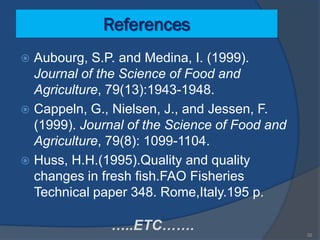
References
 Aubourg, S.P. and Medina, I. (1999).
  Journal of the Science of Food and
  Agriculture, 79(13):1943-1948.
 Cappeln, G., Nielsen, J., and Jessen, F.
  (1999). Journal of the Science of Food and
  Agriculture, 79(8): 1099-1104.
 Huss, H.H.(1995).Quality and quality
  changes in fresh fish.FAO Fisheries
  Technical paper 348. Rome,Italy.195 p.

              …..ETC…….                        32
THANK YOU FOR YOUR ATTENTION


                               33

Freezing and thawing process (atcharaporn khoomtong)

  • 1.
  • 2.
    Content  Introduction  Fish muscle  Fundamentals of Freezing and Thawing of fishes and seafood  Quality-related changes in frozen fish muscle  The length of storage time for fish 2
  • 3.
    Know about fish Pelagic fish are fish that live in surface / center, not at the bottom, generally consisting of small-sized fish such as anchovies, mackerel, and other screens. 3
  • 4.
    Know about fish(Cont’) Demersal fish, such as cod, haddock and pollock, and flatfishes live near or at the bottom of the seas. They feed mostly on other fish and organisms. 4
  • 5.
    Fish muscle  Major composition 5
  • 6.
    Let you knowabout TMAO  TMAO is formed by biosynthesis in certain zooplankton species.  These organisms possess an enzyme (TMA mono-oxygenase) which oxidizes TMA to TMAO.  TMA is commonly found in marine plants as are many other methylated amines (monomethylamine and dimethylamine). 6
  • 7.
    Structure of fishmuscle  Fish muscle is composed of striated muscle fibers arranged in a parallel, longitudinal shape.  Fish has muscle cells running in parallel and connected to sheaths of connective tissue (myocommata), which are anchored to the skeleton and the skin. The bundles of parallel muscle cells are called myotomes 7
  • 8.
    Post mortem changesin fish muscle Directly after death of the fish, a series of biochemical reactions starts, which is importance for the quality and shelf life of products. It’s depend on  The type of fish species,  The physiological condition of the fish,  The environmental influences (for example water temperature, salinity) the living fish 8
  • 9.
    Catch-bleeding-gutting Sensory changes Post-mortem changes FRESH Blood circulation stops biochemical reactions Glycogen Lactic acid ATP falls pH falls AUTOLYSIS Rigor mortis Enzymes activated Resolution of rigor and FLAT autolysis Microbial spoilage SWEET/STALE Microorganisms PUTRID Lipid oxidation Spoilage Source from, Huss (1995) 9
  • 10.
  • 11.
    Fundamentals of Freezingof fishes General Freezing temperature  Use temperature < 32 F (0 C)  Change in water from liquid to solid. General Freezing theory  lower temperature. Will reduce spoilage.  Water is unavailable for microorganisms and chemical reactions. 11
  • 12.
    FREEZING/SUPERFREEZING OF FISH Freezing is the process by which temperatures of fish or seafood are reduced to -20oC  Super freezing is the process by which temperatures of fish are mechanically reduced to -40oC 12
  • 13.
    Freezing point depression  In fish muscle the freezing point is depressed below that of pure water because of small solutes present in the muscle water.  The freezing point is often referred to as ‘the equilibrium freezing point’ 13
  • 14.
    Ice crystal formation in pre- and post-rigor muscle  In pre-rigor muscle, the cell fluids are associated to intra-cellular proteins and the diffusivity from inside to outside the cell is therefore limited resulting in the formation of the intracellular ice crystals independent of freezing rate.  If very slow freezing rates are used the muscle can go into rigor mortis during the freezing process, and ice crystal formation will then be extra-cellular (Love, 1970). 14
  • 15.
    Fundamentals of Thawingof fishes  Thawing is the process of changing the state of a product from frozen to unfrozen.  It involves transferring “heat” to a frozen product to melt the ice that was formed within the flesh during the freezing process.  Like freezing, thawing should be carried out as quickly as possible to maintain the quality of the product. 15
  • 16.
    Fundamentals of Thawingof fishes  If the thawing process is carried out correctly there should be little effect on the quality of the product.  The final quality of thawed seafood will depend not only on the thawing process but also on factors such as frozen storage conditions and the length of time that it has been frozen, packaging, product form and product type. 16
  • 17.
    Over Thawing Under Thawing The flesh may soften Fish may be difficult & discolor or dangerous to fillet Poor filleting will Loss of flavor result in a lower yield Lower yield Possible growth of bacteria Possible increase in enzyme spoilage 17
  • 18.
    Quality-related changes infrozen fish muscle 18
  • 19.
    A mistake thatmany people make when freezing fish and other seafood products is to assume that, once it has been frozen, it will not change. 19
  • 20.
    The quality offrozen fish or seafood is directly related to the quality of the starting material.
  • 21.
    If the seafoodyou freeze is of poor quality, the seafood you thaw will be of poor quality or even poorer.
  • 22.
    Care should betaken to ensure that only high-quality fish are considered for freezing.
  • 23.
    Factors that effectedon Quality-related changes in frozen fish muscle  Fish species  Temperature and Handling before slaughter  Slaughter stress  Temperature of the pre-rigor storage  Freezing rate  Frozen storage temperature and time  Thawing procedure  Prevention against oxidation (light,oxygen) (Sørensen et al., 1995) 23
  • 24.
    Affecting protein changes in fish muscle Dehydration and the effect of inorganic salts Changes in lipids and fatty acids Enzymatic breakdown of TMAO (Autolytic changes) 24
  • 25.
    Summarize of Proteindenaturation (Love, 1970) 25
  • 26.
    Changes in lipidsand fatty acids Oxidation of unsaturated fatty acids or triglycerides in fish results in the formation of free radicals produced through decomposition of lipid hydroperoxides via a free- Off flavors radical mechanism. and ordors Mackie, 1993 26
  • 27.
    Enzymatic breakdown ofTMAO (Autolytic changes)  Fishes, like cod, hake (Merluccius spp.) or Alaska pollack (Theragra chalcogramma), contain the enzyme trimethylamine oxide demethylase (TMAOase), which catalyses the cleavage of trimethylamine oxide (TMAO) into dimethylamine (DMA) and formaldehyde (FA). 27
  • 28.
    Changes in functionalproperties caused by protein changes  The main changes are reported to occur in myosin light-chain, but actin and actinin also degrade during frozen storage.  Some of the changes reported are increases in ß-sheet at the expense of -helix structure. As the main part of muscle water is located within the myofibrillar structure, changes in this typically result in reduced WHC. 28
  • 29.
    Reasons for QualityLoss in Frozen Fishery Products during Storage Source from, Huss (1995) 29
  • 30.
    The length ofstorage time for fish in a freezer depends  Fish species  On storage temperature,  Temperature fluctuations in the freezer,  Method of packaging and packaging materials,  Moisture and fat content of the fish and  The condition of the fish at the time of freezing. 30
  • 31.
    Conclusion  The qualityof fishery products is influenced by both intrinsic and extrinsic factors. Species, size, sex, composition, toxins, contamination with pollutants, and cultivation conditions are the factors responsible for changes in intrinsic quality.  The biochemical characteristics of fish muscle such as low collagen, comparatively higher contents of unsaturated lipids as well as soluble nitrogen compounds influence autolysis, rapid microbial proliferation, and spoilage.  Low-temperature processing, including freezing, is probably the most widely used method to slow safety and quality deterioration of aquatic foods. 31
  • 32.
    References  Aubourg, S.P.and Medina, I. (1999). Journal of the Science of Food and Agriculture, 79(13):1943-1948.  Cappeln, G., Nielsen, J., and Jessen, F. (1999). Journal of the Science of Food and Agriculture, 79(8): 1099-1104.  Huss, H.H.(1995).Quality and quality changes in fresh fish.FAO Fisheries Technical paper 348. Rome,Italy.195 p. …..ETC……. 32
  • 33.
    THANK YOU FORYOUR ATTENTION 33