Fish Quality
Venny Agustin, M.Sc
Quality
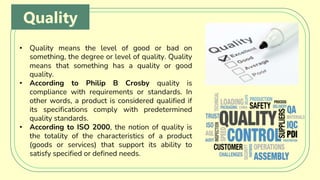
• Quality means the level of good or bad on
something, the degree or level of quality. Quality
means that something has a quality or good
quality.
• According to Philip B Crosby quality is
compliance with requirements or standards. In
other words, a product is considered qualified if
its specifications comply with predetermined
quality standards.
• According to ISO 2000, the notion of quality is
the totality of the characteristics of a product
(goods or services) that support its ability to
satisfy specified or defined needs.
● Source: Oehlenschlager, J and Hartmut ,Rehbei. 2009. Fishery Products: Quality,
Safety and Authenticity
Categories of
fish species
Source: Oehlenschlager, J and Hartmut,
Rehbei. 2009. Fishery Products:
Quality, Safety and Authenticity
Fish muscle
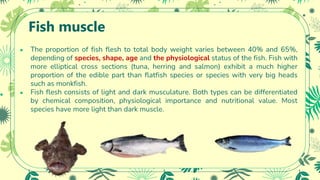
● The proportion of fish flesh to total body weight varies between 40% and 65%,
depending of species, shape, age and the physiological status of the fish. Fish with
more elliptical cross sections (tuna, herring and salmon) exhibit a much higher
proportion of the edible part than flatfish species or species with very big heads
such as monkfish.
● Fish flesh consists of light and dark musculature. Both types can be differentiated
by chemical composition, physiological importance and nutritional value. Most
species have more light than dark muscle.
Continue…
• The light musculature is used for rapid, sudden
movements and obtains energy mainly from anaerobic
glycolysis. For continuous swimming, fish use their
dark musculature.
• This type of muscle is therefore well developed in
pelagic species (herring, mackerel, tuna), well supplied
with blood and rich in myoglobin. The metabolism of
dark muscle is aerobic; energy is provided by lipids
and carbohydrates.
Nutritional composition
• The fat content of fish varies greatly in quantity and fatty acid composition. The
protein content is almost constant. The fat content is mainly dependent on
biological state of maturity, but also on nutritional status, age, catching ground
and season.
• The fat is not homogeneously distributed in the body. In lean fish species, it is
located in the liver as an energy reservoir; in fatty species, it is deposited in the
muscle tissue, as a subcutaneous layer under the skin or in the intestines.
• Lean fish species have a higher proportion of polar lipids (phosphatidylcholine
and phos-phatidylethanolamine).
• The highly unsaturated character of these fatty acids is the reason why they are
susceptible to lipid oxidation and oxidative degradation. Fatty fish species
therefore have a tendency to exhibit rancid tastes and odours after limited
storage time.
Vitamins
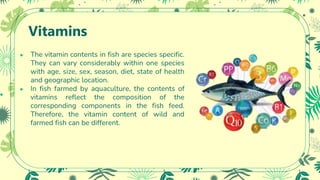
● The vitamin contents in fish are species specific.
They can vary considerably within one species
with age, size, sex, season, diet, state of health
and geographic location.
● In fish farmed by aquaculture, the contents of
vitamins reflect the composition of the
corresponding components in the fish feed.
Therefore, the vitamin content of wild and
farmed fish can be different.
• The liver of fish is a rich source of fat-soluble vitamins (A, D, E and K). In
fish flesh, dark muscle contains more fat-soluble vitamins than white
muscle because of its higher fat content.
• The flesh of fatty fish still contains moderate amounts of vitamin A, but
lean fish contain only trace amounts. Fish and fish products are
commonly regarded as the most important natural food sources of
vitamin D.
• Vitamin E functions as a natural antioxidant to prevent lipids from
becoming rancid. Fish flesh is only a low to modest source of vitamin E.
• Relatively few values for the vitamin K content of fish are available. The
highest concentrations are found in muscle of marine and freshwater
fish with high fat content, and in the liver.
Fat-soluble vitamins
Water-soluble vitamins
● Most fish species cannot synthesise vitamin C (ascorbic acid). The average
vitamin C content of fish ranges from 1 to 5 mg per 100 g.
● The natural thiamin (vitamin B1) content of most fish and fishery products is
relatively low. A special problem with some fresh- and seawater fish species is
the occurrence of thiaminases. These enzymes cleave the thiamin molecule.
They ooccur especially in the viscera of fish.
● For example, carp, mackerel and mussels have high thiaminase activity. The
enzymes can act during food storage, but they are inactivated by heat, so
cooking and smoking destroy them.
Quality parameters of fishery products
• Good quality → Fresh fish
• Fresh fish → looks,
smells, tastes, as well as
the texture
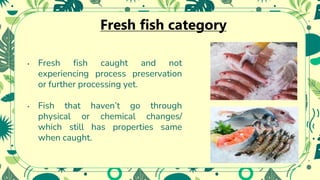
Fresh fish category
• Fresh fish caught and not
experiencing process preservation
or further processing yet.
• Fish that haven’t go through
physical or chemical changes/
which still has properties same
when caught.
Factors determining the quality of fresh
fish
1. How to catch fish
2. Fishing port
3. Various other factors, starting from
the public sale, packing,
transportation and processing
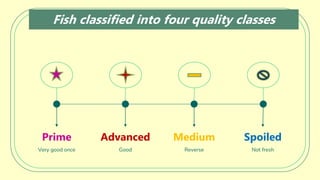
Fish classified into four quality classes
Prime
Very good once
Advanced
Good
Medium
Reverse
Spoiled
Not fresh
Spoilage of Fresh Aquatic Products
• Fish and other aquatic products are among the world’s
most perishable commodities. Spoilage in aquatic
products begins soon after death. Following the death of
fish, blood circulation stops resulting in a series of
changes within the muscle.
• The spoilage of fresh fish is complicated process for
which no single factor is responsible, but, rather it is a
combination of several interrelated processes.
What makes the
fish spoil?
Bacteria
Enzymes
Chemical
Bacteria
● The flesh of the fish is sterile (free from bacteria) when they are
alive, but large numbers of bacteria are normally present in the
surface slime, on the gills, and in the guts.
● Freshwater fishes bacteria: mesophilic-gram positive. – 3 layers of
cell wall and purple in color. Example: Micrococcus, Bacillus,
Cornyformes
● Marinewater fishes bacteria: Psychrotrophic gram-negative- 2
layers of cell wall and pink in color. Example: Pseudomonas,
alteromonas, acinetobacter, flavobacterium, cytophaga and vibrio.
● Bacterial spoilage does not start until the passage of rigor mortis.
Enzymes
● Enzymes are protein substances present in the muscle and in the
gut of fish that initiate or speed up chemical reactions.
● At the death of fish, the normal regulation system stops to
function and the supply of oxygen and energy production ceases.
● The cells begin a new sequence of processes characterized by the
breakdown of glycogen (this process known as Glycolysis) – the
degradation of energy-rich compounds.
● After death, the enzymes naturally act on the food in the gut
tissue.
● Autolysis – the self-breakdown or selfdigestion that results the
weakening, softening and discoloration of fish tissues.
Chemical spoilage
Spoilage of fish due to chemical changes mainly occurs during
storage in ice or in frozen condition.
3 factors in chemical changes or rancidity of lipids:
1. Lipid autolysis – enzymatic hydrolysis with fatty acids, and glycerol as
main product.
2. Auto-oxidation – the reaction of unsaturated lipid with oxygen.
● Oxidative rancidity in fish can result to serious quality problems such
as rancid flavors and odors as well as discoloration.
3. Denaturation of proteins during frozen storage resulting to tough, dry
and fibrous texture.
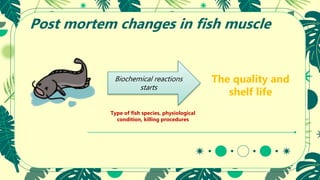
Post mortem changes in fish muscle
The quality and
shelf life
Type of fish species, physiological
condition, killing procedures
Biochemical reactions
starts
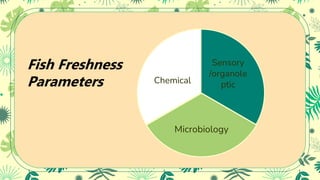
Fish Freshness
Parameters
Sensory
/organole
ptic
Microbiology
Chemical
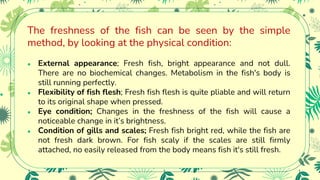
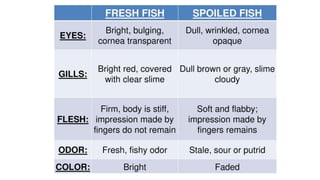
The freshness of the fish can be seen by the simple
method, by looking at the physical condition:
● External appearance; Fresh fish, bright appearance and not dull.
There are no biochemical changes. Metabolism in the fish's body is
still running perfectly.
● Flexibility of fish flesh; Fresh fish flesh is quite pliable and will return
to its original shape when pressed.
● Eye condition; Changes in the freshness of the fish will cause a
noticeable change in it’s brightness.
● Condition of gills and scales; Fresh fish bright red, while the fish are
not fresh dark brown. For fish scaly if the scales are still firmly
attached, no easily released from the body means fish it's still fresh.
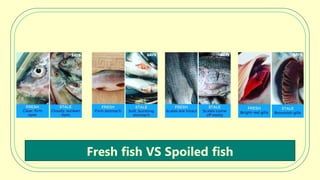
Fresh fish VS Spoiled fish
Chemical
analysis
pH Analysis
Hypoxathine content
analysis
Analysis of dimethylamine,
trimethylamine/ammonia
levels
IMP (Inosine
Monophosphate
Dephosphorylation)
Fat breakdown
analysis (ex:TBA)
Chemical freshness determination of fish
Fish meat pH analysis
• Fish that is not fresh has a high pH (alkaline) compared to fresh
fish. Due to the presence of alkaline compounds ex: ammonia,
trimethylamine, and compounds other volatiles.
Analysis of hypoxanthine content
• Hypoxanthine comes from ATP breakdown, the higher the
content hypoxanthine then the degree of freshness low fish
Continue…
Analysis of dimethylamine, trimethylamine/ammonia levels.
• Protein decomposition produces the above compounds, if the
freshness of the fish has decreased then volatile nitrogen content
enhancement. Patterns of protein breakdown in fresh water fish
produce ammonia, while sea fish produce dimethylamine and
trimethylamine.
Dephosphorylation of Inosine Monophosphate (IMP)
• IMP is related to changes in the taste of meat fish and fish
freshness, so it can be used to determine the freshness of the fish.
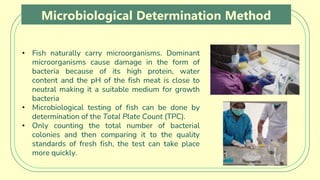
Microbiological Determination Method
• Fish naturally carry microorganisms. Dominant
microorganisms cause damage in the form of
bacteria because of its high protein, water
content and the pH of the fish meat is close to
neutral making it a suitable medium for growth
bacteria
• Microbiological testing of fish can be done by
determination of the Total Plate Count (TPC).
• Only counting the total number of bacterial
colonies and then comparing it to the quality
standards of fresh fish, the test can take place
more quickly.
Sensory Fish Determination Method
• This method is easier and faster (using sensory tools)
• Sensory testing is more towards observation visually
• Sensory testing in the form of color appearance, mind taste
and texture
• The fresher the fish analyzed the score will be the higher it
is.
• Its nature is very subjective just rely on panelist senses (e.g.
discriminating between foul odor with ammonia or indole
odor)
• The panelists will give a score on observed samples
Organoleptic Test
Thankyou

Fish Quality.pptx

  • 1.
  • 2.
    Quality • Quality meansthe level of good or bad on something, the degree or level of quality. Quality means that something has a quality or good quality. • According to Philip B Crosby quality is compliance with requirements or standards. In other words, a product is considered qualified if its specifications comply with predetermined quality standards. • According to ISO 2000, the notion of quality is the totality of the characteristics of a product (goods or services) that support its ability to satisfy specified or defined needs.
  • 3.
    ● Source: Oehlenschlager,J and Hartmut ,Rehbei. 2009. Fishery Products: Quality, Safety and Authenticity
  • 4.
    Categories of fish species Source:Oehlenschlager, J and Hartmut, Rehbei. 2009. Fishery Products: Quality, Safety and Authenticity
  • 5.
    Fish muscle ● Theproportion of fish flesh to total body weight varies between 40% and 65%, depending of species, shape, age and the physiological status of the fish. Fish with more elliptical cross sections (tuna, herring and salmon) exhibit a much higher proportion of the edible part than flatfish species or species with very big heads such as monkfish. ● Fish flesh consists of light and dark musculature. Both types can be differentiated by chemical composition, physiological importance and nutritional value. Most species have more light than dark muscle.
  • 6.
    Continue… • The lightmusculature is used for rapid, sudden movements and obtains energy mainly from anaerobic glycolysis. For continuous swimming, fish use their dark musculature. • This type of muscle is therefore well developed in pelagic species (herring, mackerel, tuna), well supplied with blood and rich in myoglobin. The metabolism of dark muscle is aerobic; energy is provided by lipids and carbohydrates.
  • 8.
    Nutritional composition • Thefat content of fish varies greatly in quantity and fatty acid composition. The protein content is almost constant. The fat content is mainly dependent on biological state of maturity, but also on nutritional status, age, catching ground and season. • The fat is not homogeneously distributed in the body. In lean fish species, it is located in the liver as an energy reservoir; in fatty species, it is deposited in the muscle tissue, as a subcutaneous layer under the skin or in the intestines. • Lean fish species have a higher proportion of polar lipids (phosphatidylcholine and phos-phatidylethanolamine). • The highly unsaturated character of these fatty acids is the reason why they are susceptible to lipid oxidation and oxidative degradation. Fatty fish species therefore have a tendency to exhibit rancid tastes and odours after limited storage time.
  • 9.
    Vitamins ● The vitamincontents in fish are species specific. They can vary considerably within one species with age, size, sex, season, diet, state of health and geographic location. ● In fish farmed by aquaculture, the contents of vitamins reflect the composition of the corresponding components in the fish feed. Therefore, the vitamin content of wild and farmed fish can be different.
  • 10.
    • The liverof fish is a rich source of fat-soluble vitamins (A, D, E and K). In fish flesh, dark muscle contains more fat-soluble vitamins than white muscle because of its higher fat content. • The flesh of fatty fish still contains moderate amounts of vitamin A, but lean fish contain only trace amounts. Fish and fish products are commonly regarded as the most important natural food sources of vitamin D. • Vitamin E functions as a natural antioxidant to prevent lipids from becoming rancid. Fish flesh is only a low to modest source of vitamin E. • Relatively few values for the vitamin K content of fish are available. The highest concentrations are found in muscle of marine and freshwater fish with high fat content, and in the liver. Fat-soluble vitamins
  • 11.
    Water-soluble vitamins ● Mostfish species cannot synthesise vitamin C (ascorbic acid). The average vitamin C content of fish ranges from 1 to 5 mg per 100 g. ● The natural thiamin (vitamin B1) content of most fish and fishery products is relatively low. A special problem with some fresh- and seawater fish species is the occurrence of thiaminases. These enzymes cleave the thiamin molecule. They ooccur especially in the viscera of fish. ● For example, carp, mackerel and mussels have high thiaminase activity. The enzymes can act during food storage, but they are inactivated by heat, so cooking and smoking destroy them.
  • 12.
    Quality parameters offishery products • Good quality → Fresh fish • Fresh fish → looks, smells, tastes, as well as the texture
  • 13.
    Fresh fish category •Fresh fish caught and not experiencing process preservation or further processing yet. • Fish that haven’t go through physical or chemical changes/ which still has properties same when caught.
  • 14.
    Factors determining thequality of fresh fish 1. How to catch fish 2. Fishing port 3. Various other factors, starting from the public sale, packing, transportation and processing
  • 15.
    Fish classified intofour quality classes Prime Very good once Advanced Good Medium Reverse Spoiled Not fresh
  • 16.
    Spoilage of FreshAquatic Products • Fish and other aquatic products are among the world’s most perishable commodities. Spoilage in aquatic products begins soon after death. Following the death of fish, blood circulation stops resulting in a series of changes within the muscle. • The spoilage of fresh fish is complicated process for which no single factor is responsible, but, rather it is a combination of several interrelated processes.
  • 17.
    What makes the fishspoil? Bacteria Enzymes Chemical
  • 18.
    Bacteria ● The fleshof the fish is sterile (free from bacteria) when they are alive, but large numbers of bacteria are normally present in the surface slime, on the gills, and in the guts. ● Freshwater fishes bacteria: mesophilic-gram positive. – 3 layers of cell wall and purple in color. Example: Micrococcus, Bacillus, Cornyformes ● Marinewater fishes bacteria: Psychrotrophic gram-negative- 2 layers of cell wall and pink in color. Example: Pseudomonas, alteromonas, acinetobacter, flavobacterium, cytophaga and vibrio. ● Bacterial spoilage does not start until the passage of rigor mortis.
  • 19.
    Enzymes ● Enzymes areprotein substances present in the muscle and in the gut of fish that initiate or speed up chemical reactions. ● At the death of fish, the normal regulation system stops to function and the supply of oxygen and energy production ceases. ● The cells begin a new sequence of processes characterized by the breakdown of glycogen (this process known as Glycolysis) – the degradation of energy-rich compounds. ● After death, the enzymes naturally act on the food in the gut tissue. ● Autolysis – the self-breakdown or selfdigestion that results the weakening, softening and discoloration of fish tissues.
  • 20.
    Chemical spoilage Spoilage offish due to chemical changes mainly occurs during storage in ice or in frozen condition. 3 factors in chemical changes or rancidity of lipids: 1. Lipid autolysis – enzymatic hydrolysis with fatty acids, and glycerol as main product. 2. Auto-oxidation – the reaction of unsaturated lipid with oxygen. ● Oxidative rancidity in fish can result to serious quality problems such as rancid flavors and odors as well as discoloration. 3. Denaturation of proteins during frozen storage resulting to tough, dry and fibrous texture.
  • 21.
    Post mortem changesin fish muscle The quality and shelf life Type of fish species, physiological condition, killing procedures Biochemical reactions starts
  • 23.
  • 24.
    The freshness ofthe fish can be seen by the simple method, by looking at the physical condition: ● External appearance; Fresh fish, bright appearance and not dull. There are no biochemical changes. Metabolism in the fish's body is still running perfectly. ● Flexibility of fish flesh; Fresh fish flesh is quite pliable and will return to its original shape when pressed. ● Eye condition; Changes in the freshness of the fish will cause a noticeable change in it’s brightness. ● Condition of gills and scales; Fresh fish bright red, while the fish are not fresh dark brown. For fish scaly if the scales are still firmly attached, no easily released from the body means fish it's still fresh.
  • 26.
    Fresh fish VSSpoiled fish
  • 27.
    Chemical analysis pH Analysis Hypoxathine content analysis Analysisof dimethylamine, trimethylamine/ammonia levels IMP (Inosine Monophosphate Dephosphorylation) Fat breakdown analysis (ex:TBA)
  • 28.
    Chemical freshness determinationof fish Fish meat pH analysis • Fish that is not fresh has a high pH (alkaline) compared to fresh fish. Due to the presence of alkaline compounds ex: ammonia, trimethylamine, and compounds other volatiles. Analysis of hypoxanthine content • Hypoxanthine comes from ATP breakdown, the higher the content hypoxanthine then the degree of freshness low fish
  • 29.
    Continue… Analysis of dimethylamine,trimethylamine/ammonia levels. • Protein decomposition produces the above compounds, if the freshness of the fish has decreased then volatile nitrogen content enhancement. Patterns of protein breakdown in fresh water fish produce ammonia, while sea fish produce dimethylamine and trimethylamine. Dephosphorylation of Inosine Monophosphate (IMP) • IMP is related to changes in the taste of meat fish and fish freshness, so it can be used to determine the freshness of the fish.
  • 30.
    Microbiological Determination Method •Fish naturally carry microorganisms. Dominant microorganisms cause damage in the form of bacteria because of its high protein, water content and the pH of the fish meat is close to neutral making it a suitable medium for growth bacteria • Microbiological testing of fish can be done by determination of the Total Plate Count (TPC). • Only counting the total number of bacterial colonies and then comparing it to the quality standards of fresh fish, the test can take place more quickly.
  • 31.
    Sensory Fish DeterminationMethod • This method is easier and faster (using sensory tools) • Sensory testing is more towards observation visually • Sensory testing in the form of color appearance, mind taste and texture • The fresher the fish analyzed the score will be the higher it is. • Its nature is very subjective just rely on panelist senses (e.g. discriminating between foul odor with ammonia or indole odor) • The panelists will give a score on observed samples
  • 32.
  • 35.

Editor's Notes

  • #28 Oksidasi lemak merupakan fenomena yang umum dan sering memberikan perubahan kimia yang berdampak pada penurunan kualitas nutrisi, flavor dan perubahan tekstur produk. Perubahan kimia tersebut bertanggung jawab terhadap terjadinya ketengikan flavor dan aroma