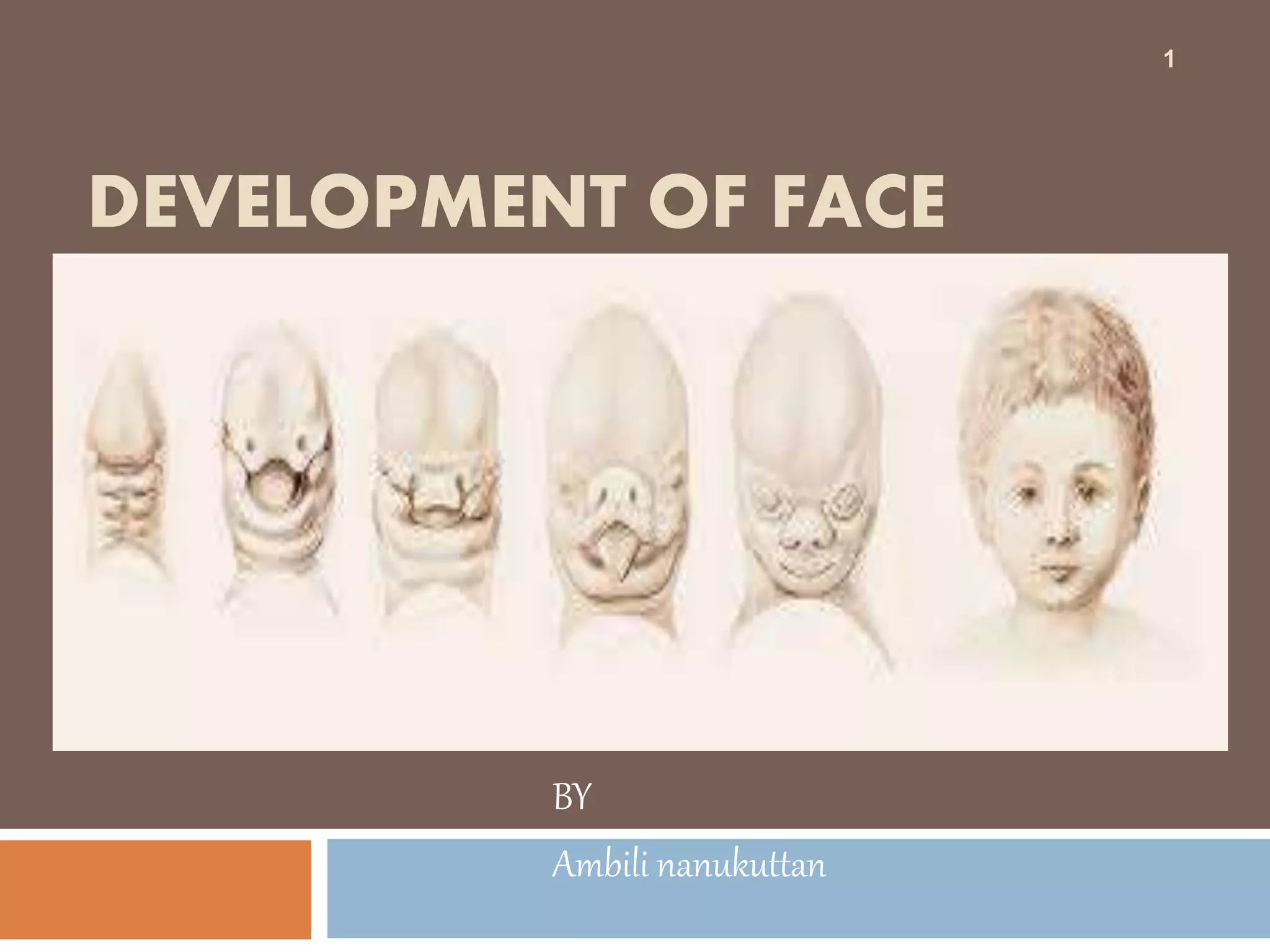

DEVELOPMENT OF FACE
BY
Ambili nanukuttan
1
Contents
• Introduction
• Embryology
• Stomatodeum
• Face formation
• Formation of
Upper lip formation
Lower lip
Nose
Cheeks
External ear
Eye
2
Palate
Tongue
Mouth
Teeth
• Developmental anomalies
• Conclusion
• References
3
.
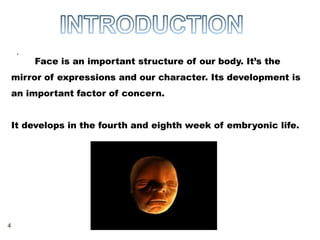
Face is an important structure of our body. It’s the
mirror of expressions and our character. Its development is
an important factor of concern.
It develops in the fourth and eighth week of embryonic life.
4
EMBRYOLOGY
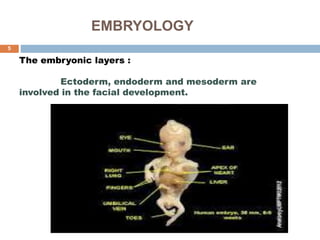
The embryonic layers :
Ectoderm, endoderm and mesoderm are
involved in the facial development.
5
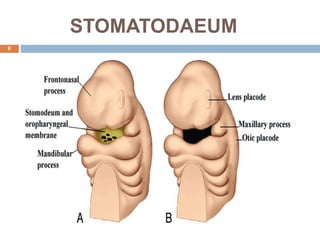
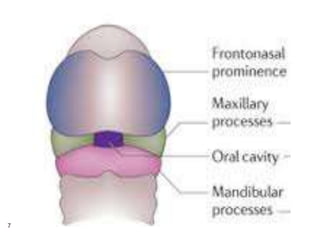
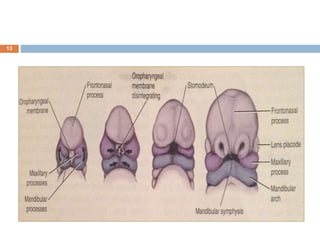
STOMATODAEUM
6
7
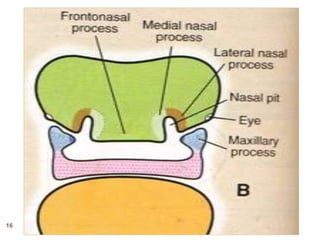
Frontonasal process in future :
- forehead
- bridge of the nose
- primary palate
- nasal septum and
all structures related to medial nasal process.
8
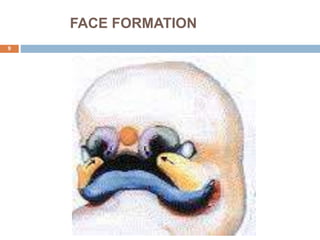
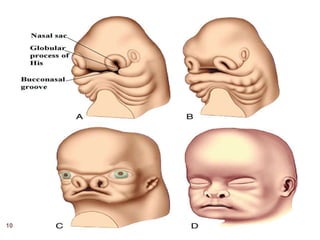
FACE FORMATION
9
10
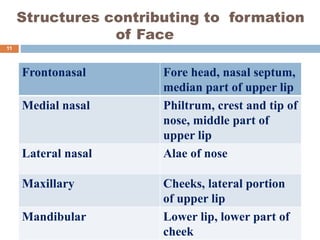
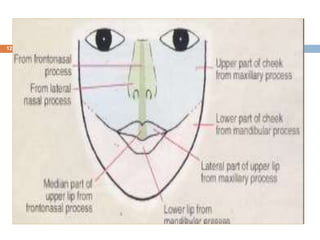
Structures contributing to formation
of Face
Frontonasal Fore head, nasal septum,
median part of upper lip
Medial nasal Philtrum, crest and tip of
nose, middle part of
upper lip
Lateral nasal Alae of nose
Maxillary Cheeks, lateral portion
of upper lip
Mandibular Lower lip, lower part of
cheek
11
12
13
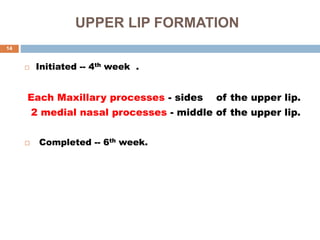
UPPER LIP FORMATION
 Initiated -- 4th week .
Each Maxillary processes - sides of the upper lip.
2 medial nasal processes - middle of the upper lip.
 Completed -- 6th week.
14
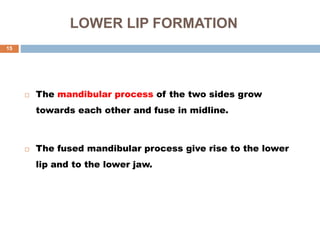
LOWER LIP FORMATION
 The mandibular process of the two sides grow
towards each other and fuse in midline.
 The fused mandibular process give rise to the lower
lip and to the lower jaw.
15
16
NOSE
17
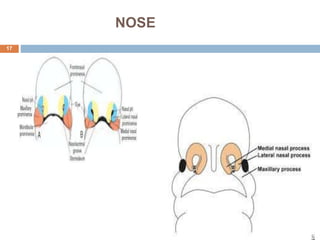
 External nares - when the nasal pits are cut off from
stomatodaeum.
 Fronto nasal process narrows - nasal septum.
 Medial nasal process fuses together -- middle portion
of nose from root to apex ,centre portion of lip and
philtrum .
 Lateral nasal process forms alae or sides of nose.
18
DEVELOPMENT OF CHEECK
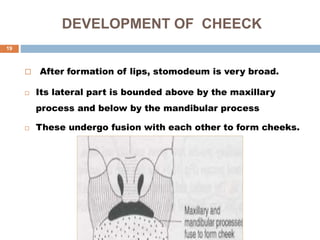
 After formation of lips, stomodeum is very broad.
 Its lateral part is bounded above by the maxillary
process and below by the mandibular process
 These undergo fusion with each other to form cheeks.
19
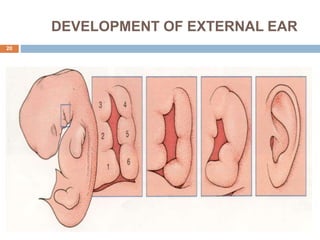
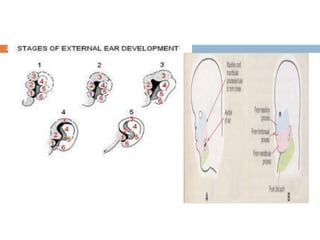
DEVELOPMENT OF EXTERNAL EAR
20
21
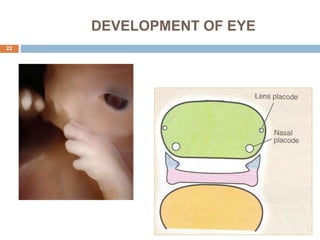
DEVELOPMENT OF EYE
22
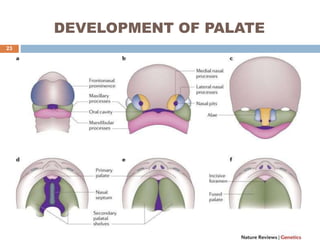
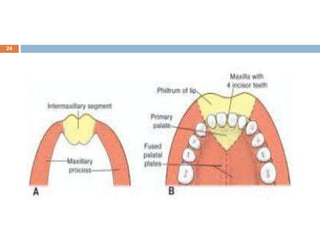
DEVELOPMENT OF PALATE
23
24
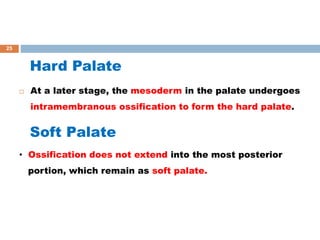
Hard Palate
 At a later stage, the mesoderm in the palate undergoes
intramembranous ossification to form the hard palate.
Soft Palate
• Ossification does not extend into the most posterior
portion, which remain as soft palate.
25
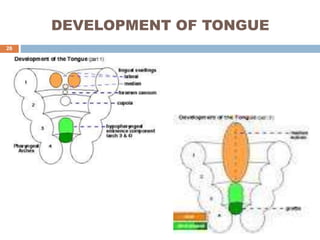
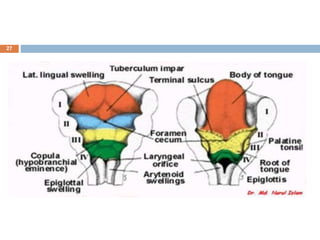
DEVELOPMENT OF TONGUE
26
27
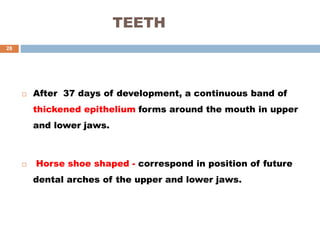
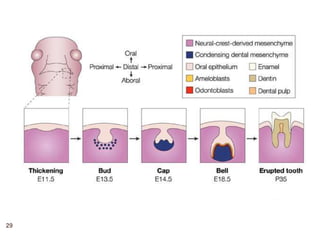
TEETH
 After 37 days of development, a continuous band of
thickened epithelium forms around the mouth in upper
and lower jaws.
 Horse shoe shaped - correspond in position of future
dental arches of the upper and lower jaws.
28
29
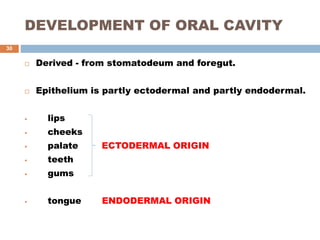
DEVELOPMENT OF ORAL CAVITY
 Derived - from stomatodeum and foregut.
 Epithelium is partly ectodermal and partly endodermal.
 lips
 cheeks
 palate ECTODERMAL ORIGIN
 teeth
 gums
 tongue ENDODERMAL ORIGIN
30
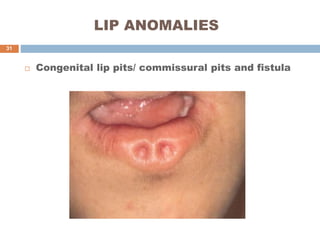
LIP ANOMALIES
 Congenital lip pits/ commissural pits and fistula
31
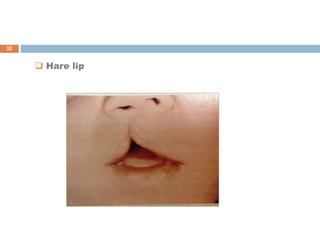
 Hare lip
32
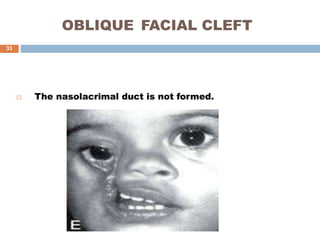
OBLIQUE FACIAL CLEFT
 The nasolacrimal duct is not formed.
33
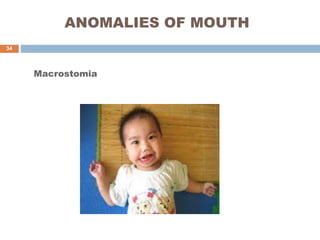
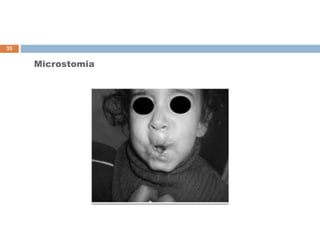
ANOMALIES OF MOUTH
Macrostomia
34
Microstomia
35
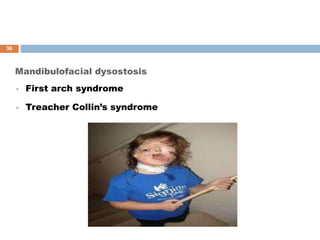
Mandibulofacial dysostosis
 First arch syndrome
 Treacher Collin’s syndrome
36
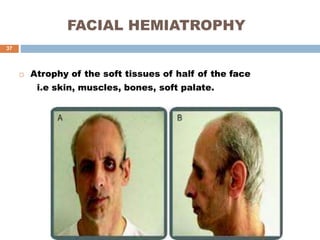
FACIAL HEMIATROPHY
 Atrophy of the soft tissues of half of the face
i.e skin, muscles, bones, soft palate.
37
ANOMALIES OF JAW
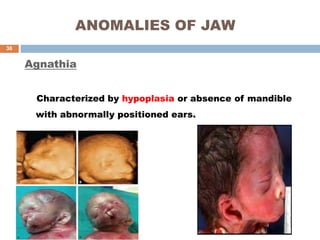
Agnathia
Characterized by hypoplasia or absence of mandible
with abnormally positioned ears.
38
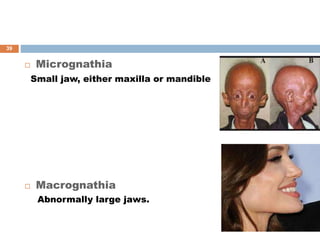
 Micrognathia
Small jaw, either maxilla or mandible
 Macrognathia
Abnormally large jaws.
39
ANOMALIES OF NOSE
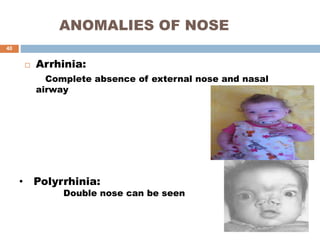
 Arrhinia:
Complete absence of external nose and nasal
airway
• Polyrrhinia:
Double nose can be seen
40
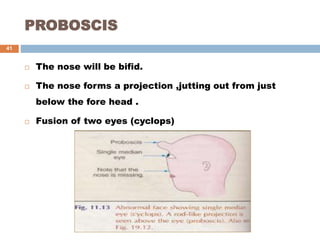
PROBOSCIS
 The nose will be bifid.
 The nose forms a projection ,jutting out from just
below the fore head .
 Fusion of two eyes (cyclops)
41
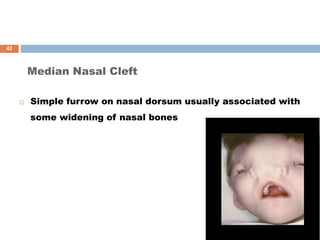
 Simple furrow on nasal dorsum usually associated with
some widening of nasal bones
Median Nasal Cleft
42
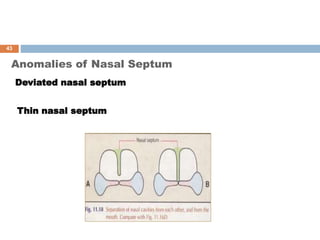
Anomalies of Nasal Septum
Deviated nasal septum
Thin nasal septum
43
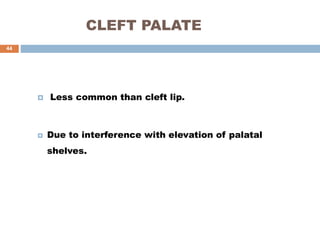
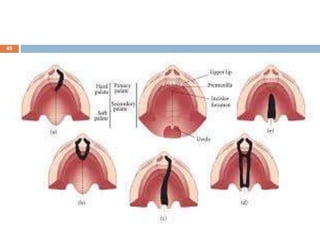
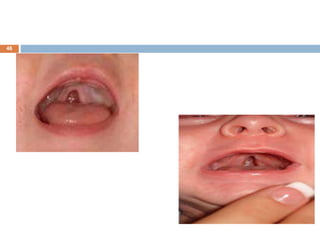
CLEFT PALATE
 Less common than cleft lip.
 Due to interference with elevation of palatal
shelves.
44
45
46
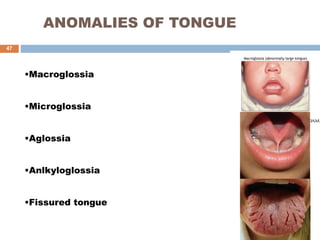
ANOMALIES OF TONGUE
•Macroglossia
•Microglossia
•Aglossia
•Anlkyloglossia
•Fissured tongue
47
CONCLUSION
Human face is the area, which is most likely to
develop malformations. Knowledge of normal development
will aid in the understanding the potential reasons for
preventing or treating of anomalies.
48
REFERENCES
• B.D. Chaurasia : Human Anatomy- volume three -4th edition
• I.Singh : Human Embryology- 7th edition
• Shafer’s oral pathology-5th edition
• Tencate’s Oral histology- development, structure and function;
Antonio Nanci; 7th edition
49
11111111111111111111111111111111
1111111111111111111111111111111150

Ambili face development