FRAGMENTATION
- An Internetworking concept
Shashwat Shriparv
dwivedishashwat@gmail.com
InfinitySoft
What is fragmentation?
Splitting up things into smaller more
manageable entities for incorporating
ease in use and flexibility in transport.
Where could it possibly come in
Networks ?
Each n/w imposes some maximum
size on its packets, the reason being;
 Hardware (frame size)
 Operating System (buffers size 512 bytes)
 Protocols (no. of bits in packet length field)
 Compliance with some standard
 To reduce error-induced retransmission to
some level
 Prevent packet from choking channel
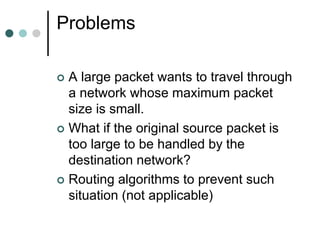
Problems
 A large packet wants to travel through
a network whose maximum packet
size is small.
 What if the original source packet is
too large to be handled by the
destination network?
 Routing algorithms to prevent such
situation (not applicable)
Fragmentation in networks
 Allow gateways to break up packets
into fragments, sending each packet
as a separate internet packet
 Breaking up a thing is easy, but fixing
it back is not that easy
Types of fragmentation
 Transparent
 Non transparent
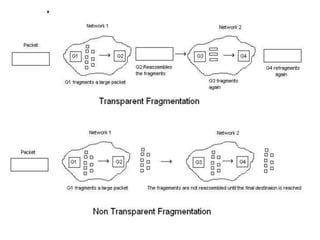
Transparent Fragmentation
 Caused by a “small packet” network
transparent to any subsequent networks
through which the packet may pass on its
way to the destination
 Gateways fragment oversized packets,
each addressed to the same exit gateway,
where they are recombined
 The process carries on until destination is
reached
Problems
 Exit gateway should know that it has
received all fragments to start
combination sequence
 All packets must exit via the same
gateway, else data loss occurs
 Overhead required to fragment and
reassemble at each gateway
Non transparent Fragmentation
 Refrain from recombining fragments
at intermediate gateways
 Fragments are considered as packets
and are passed through the gateways
 Recombination occurs only at the
destination host
 IP follows this methodology
Problems
 Requires all hosts to do Reassembly
 Increases overhead, larger the
packet, more the headers
 An advantage being multiple exit
gateways can be employed increasing
the efficiency of the transmission
Schemes
 Fragments should be numbered in a way
that aids recombination
 Trees can be used
 0 can be split as 0.1, 0.2, 0.3 …..
 These can be again fragmented as 0.0.0,
0.0.1, 0.0.2, …….., 0.1.0, 0.1.1 etc.
 Only if enough space is reserved in header
such terminology can be employed
 Sufficient to reorder fragments
THANK YOU
Shashwat Shriparv
dwivedishashwat@gmail.com
InfinitySoft

Fragmentation

  • 1.
    FRAGMENTATION - An Internetworkingconcept Shashwat Shriparv dwivedishashwat@gmail.com InfinitySoft
  • 2.
    What is fragmentation? Splittingup things into smaller more manageable entities for incorporating ease in use and flexibility in transport. Where could it possibly come in Networks ?
  • 3.
    Each n/w imposessome maximum size on its packets, the reason being;  Hardware (frame size)  Operating System (buffers size 512 bytes)  Protocols (no. of bits in packet length field)  Compliance with some standard  To reduce error-induced retransmission to some level  Prevent packet from choking channel
  • 4.
    Problems  A largepacket wants to travel through a network whose maximum packet size is small.  What if the original source packet is too large to be handled by the destination network?  Routing algorithms to prevent such situation (not applicable)
  • 5.
    Fragmentation in networks Allow gateways to break up packets into fragments, sending each packet as a separate internet packet  Breaking up a thing is easy, but fixing it back is not that easy
  • 6.
    Types of fragmentation Transparent  Non transparent
  • 8.
    Transparent Fragmentation  Causedby a “small packet” network transparent to any subsequent networks through which the packet may pass on its way to the destination  Gateways fragment oversized packets, each addressed to the same exit gateway, where they are recombined  The process carries on until destination is reached
  • 9.
    Problems  Exit gatewayshould know that it has received all fragments to start combination sequence  All packets must exit via the same gateway, else data loss occurs  Overhead required to fragment and reassemble at each gateway
  • 10.
    Non transparent Fragmentation Refrain from recombining fragments at intermediate gateways  Fragments are considered as packets and are passed through the gateways  Recombination occurs only at the destination host  IP follows this methodology
  • 11.
    Problems  Requires allhosts to do Reassembly  Increases overhead, larger the packet, more the headers  An advantage being multiple exit gateways can be employed increasing the efficiency of the transmission
  • 12.
    Schemes  Fragments shouldbe numbered in a way that aids recombination  Trees can be used  0 can be split as 0.1, 0.2, 0.3 …..  These can be again fragmented as 0.0.0, 0.0.1, 0.0.2, …….., 0.1.0, 0.1.1 etc.  Only if enough space is reserved in header such terminology can be employed  Sufficient to reorder fragments
  • 13.