



FRACTURE
VIBHUTI NAUTIYAL
MPT (MUSCULOSKELETAL)
INTRODUCTION
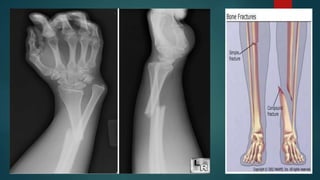
 A fracture is a break in the structural continuity of bone.
 It may be no more than a crack, a crumpling or a splintering of the cortex; more
often the break is complete and the bone fragments are displaced
 It can be classified on the basis of aetiology, the relationship of the fracture with
the external environment, the displacement of the fracture, and the pattern of the
fracture
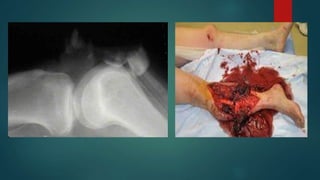
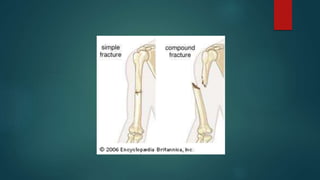
 If the overlying skin remains intact it is a closed (simple) fracture; if the skin or
one of the body cavities is breached it is open (or compound) fracture
ON THE BASIS OF AETIOLOGY
1. Traumatic:
a. Direct force:
 The bone breaks at the point of impact
 Subjected to excessive force
 Soft tissues are also damaged
 Usually splits the bone into transversely or bends it over a fulcrum so as to create a
break with a ‘butterfly fragment’
 Damage to the overlying skin is common
 Example: fall, RTA etc
b. Indirect force:
 Bone breaks at a distance from where the force is applied
 Soft tissue damage at the site of fracture is not inevitable
 Applies mainly to long bone
 Mechanism:
 Twisting causes a spiral fracture
 Compression causes short oblique fracture
 Bending results in fracture with a triangular ‘butterfly’ fragment
 Tension tends to break the bone transversely
2. Fatigue or stress fracture:
 Occur in normal bone
 Which is subjected to repeated heavy loading
 These high loads create minute deformations that initiate the normal process of remodelling
 When exposure to stress and deformation is repeated and prolonged, resorption occurs faster than
replacement and leaves the area liable to fracture
 Example: athletes, dancers, military and patients with chronic inflammatory disorders who are on
treatment with steroids
3. Pathologic fractures:
 A fracture which has been made weak by some underlying disease
 A trivial or no force may be required to cause such a fracture
 Example: osteoporosis, osteogenesis imperfect, cyst, metastasis
ON THE BASIS OF DISPLACEMENT
1. Undisplaced fracture: absence of significant displacement
2. Displaced fracture:
 A fracture may be displaced
 The displacement can be in the form of shift, angulation or rotation
 Factors responsible for displacement:
 Fracturing force
 Muscle pull on the fracture fragment
 gravity
ON THE BASIS OF RELATIONSHIP
WITH EXTENRAL ENVIRONMENT
1. Simple fracture:
 Fracture not communicating with the external environment
 Overlying skin and the other soft tissues are intact
 Also known as closed fracture
2. Compound fracture:
 Also known as open fracture
 Break in the overlying skin and soft tissues
 Communicating with the external environment
a. Internal compounding:
 Compounding from within
 Sharp fracture end pierces the skin from within
b. External compounding:
 Compounding from without
 Object causing the fracture lacerates the skin and soft tissues over the bone
ON THE BASIS OF PATTERN
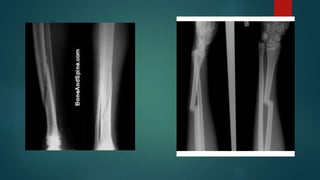
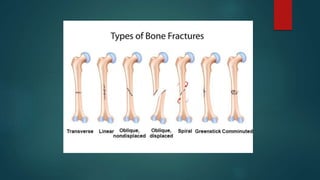
1. Complete fracture:
 Bone is split into two or more fragments
a. Transverse fracture:
 Fracture line is perpendicular to the long axis of the bone
 Caused by a tapping or bending force
 X- ray: fragments usually remains in place after reduction
b. Oblique fracture:
 Fracture line is oblique
 Caused by a bending force
 Has a component along the long axis of the bone
 X- ray: tend to shorten and re- displace even if the bone is splinted
c. Spiral fracture:
 Fracture line runs spirally in more than one plane
 Caused by a primarily twisting force
 X- ray: same as oblique fracture
d. Comminuted fracture:
 Fracture with multiple fragments
 Caused by a compression or crushing force along the long axis of the bone
 X- ray: more than two fragments; unstable
e. Segmental fracture:
 Two fractures in one bone
 But at different level
2. Incomplete fracture:
 Bone is incompletely divided
 Periosteum remains in continuity
 Example: greenstick fracture:
 Bone is buckled or bent
 Seen in children
 Bone is more springy than adults
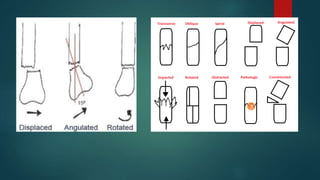
FRACTURE DISPLACEMENT
1. Translation (shift):
 Fragments may be shifted forwards, backwards or sideways in relation to each
other
 Fracture will usually unite as long as sufficient contact between surfaces is
achieved
2. Angulation (tilt):
 May be tilted or angulated in relation to other
 Malalignment if in corrected
 May lead to deformity of the limb
3. Rotation (twist):
 One of the fragments may be twisted on its longitudinal axis
 The bone looks straight
 But the limb ends up with a rotational deformity
4. Length:
 The fragments may be separated and distracted
 Or they may overlap, due to muscle spasm
 Causing shortening
THANK YOU

Fracture

  • 1.
  • 2.
    INTRODUCTION  A fractureis a break in the structural continuity of bone.  It may be no more than a crack, a crumpling or a splintering of the cortex; more often the break is complete and the bone fragments are displaced  It can be classified on the basis of aetiology, the relationship of the fracture with the external environment, the displacement of the fracture, and the pattern of the fracture  If the overlying skin remains intact it is a closed (simple) fracture; if the skin or one of the body cavities is breached it is open (or compound) fracture
  • 4.
    ON THE BASISOF AETIOLOGY 1. Traumatic: a. Direct force:  The bone breaks at the point of impact  Subjected to excessive force  Soft tissues are also damaged  Usually splits the bone into transversely or bends it over a fulcrum so as to create a break with a ‘butterfly fragment’  Damage to the overlying skin is common  Example: fall, RTA etc
  • 5.
    b. Indirect force: Bone breaks at a distance from where the force is applied  Soft tissue damage at the site of fracture is not inevitable  Applies mainly to long bone  Mechanism:  Twisting causes a spiral fracture  Compression causes short oblique fracture  Bending results in fracture with a triangular ‘butterfly’ fragment  Tension tends to break the bone transversely
  • 7.
    2. Fatigue orstress fracture:  Occur in normal bone  Which is subjected to repeated heavy loading  These high loads create minute deformations that initiate the normal process of remodelling  When exposure to stress and deformation is repeated and prolonged, resorption occurs faster than replacement and leaves the area liable to fracture  Example: athletes, dancers, military and patients with chronic inflammatory disorders who are on treatment with steroids 3. Pathologic fractures:  A fracture which has been made weak by some underlying disease  A trivial or no force may be required to cause such a fracture  Example: osteoporosis, osteogenesis imperfect, cyst, metastasis
  • 9.
    ON THE BASISOF DISPLACEMENT 1. Undisplaced fracture: absence of significant displacement 2. Displaced fracture:  A fracture may be displaced  The displacement can be in the form of shift, angulation or rotation  Factors responsible for displacement:  Fracturing force  Muscle pull on the fracture fragment  gravity
  • 11.
    ON THE BASISOF RELATIONSHIP WITH EXTENRAL ENVIRONMENT 1. Simple fracture:  Fracture not communicating with the external environment  Overlying skin and the other soft tissues are intact  Also known as closed fracture 2. Compound fracture:  Also known as open fracture  Break in the overlying skin and soft tissues  Communicating with the external environment
  • 13.
    a. Internal compounding: Compounding from within  Sharp fracture end pierces the skin from within b. External compounding:  Compounding from without  Object causing the fracture lacerates the skin and soft tissues over the bone
  • 14.
    ON THE BASISOF PATTERN 1. Complete fracture:  Bone is split into two or more fragments a. Transverse fracture:  Fracture line is perpendicular to the long axis of the bone  Caused by a tapping or bending force  X- ray: fragments usually remains in place after reduction b. Oblique fracture:  Fracture line is oblique  Caused by a bending force
  • 15.
     Has acomponent along the long axis of the bone  X- ray: tend to shorten and re- displace even if the bone is splinted c. Spiral fracture:  Fracture line runs spirally in more than one plane  Caused by a primarily twisting force  X- ray: same as oblique fracture d. Comminuted fracture:  Fracture with multiple fragments  Caused by a compression or crushing force along the long axis of the bone  X- ray: more than two fragments; unstable
  • 16.
    e. Segmental fracture: Two fractures in one bone  But at different level 2. Incomplete fracture:  Bone is incompletely divided  Periosteum remains in continuity  Example: greenstick fracture:  Bone is buckled or bent  Seen in children  Bone is more springy than adults
  • 18.
    FRACTURE DISPLACEMENT 1. Translation(shift):  Fragments may be shifted forwards, backwards or sideways in relation to each other  Fracture will usually unite as long as sufficient contact between surfaces is achieved 2. Angulation (tilt):  May be tilted or angulated in relation to other  Malalignment if in corrected  May lead to deformity of the limb
  • 19.
    3. Rotation (twist): One of the fragments may be twisted on its longitudinal axis  The bone looks straight  But the limb ends up with a rotational deformity 4. Length:  The fragments may be separated and distracted  Or they may overlap, due to muscle spasm  Causing shortening
  • 21.